The Power Report: Mind the gap — ASA liquidation leaves vacuum

by Megan Power (@Power_Report) I didn’t cheer the demise of the embattled Advertising Standards Authority this month. For all its faults — and it seems there were many — the independent industry regulator offered a voice, certainly to weary consumers fed up with blatant untruths or misleading claims.

So, unlike some marketers, who have over the years accused the authority of bully-boy tactics, I don’t celebrate its liquidation. Flawed as it may have been, it provided a welcome platform for aggrieved, and oft ignored, consumers to state their case.

New, reinvigorated

A new, reinvigorated authority — run, funded and managed by an apparently enthusiastic and committed industry — will, we’re told, soon replace the ASA and get down to the business of regulating commercial speech. That’s to be welcomed, and fast-tracked. An oversight vacuum serves nobody’s interests. In the interim, it will largely be up to consumers to keep the industry in check. And I have no doubt they’ll do just that, using social media to amplify their disdain to hundreds, if not tens of thousands.

But they won’t be alone in their battle. The Consumer Protection Act, that remarkable blueprint for how businesses should behave, will have their back. The act places great store on honest and responsible marketing; a main focus is how goods and services should be advertised and marketed. It bans false, misleading and deceptive representations; unfair, unreasonable or unjust price or marketing; negative option marketing; pretending someone has won a competition; and overselling.

It also talks of unconscionable conduct — a warning to all that you can’t use undue influence or unfair tactics in marketing goods. Taking advantage of disability, ignorance, illiteracy or inability to understand the language is also prohibited. Then there’s the really tricky one for marketers: they can’t use exaggeration, innuendo or ambiguity in relation to a material fact. So, if it can’t be substantiated or is likely to mislead, marketers could be on thin ice.

Consumers aren’t fools

Legislation and regulators aside, consumers aren’t fools; most know when they’re being had and when brands promises aren’t lived up to. All indications, too, are that younger consumers are becoming increasingly more cynical. Where they don’t complain publicly, they’ll punish brands for it by voting with their wallets. And rightly so. Consumers across the board today have wide choice; they don’t need to stay loyal to brands and organisations that betray their trust.

In a new study, Experience Gap, from Clear, a global marketing strategy consultancy, more than half the almost 10 000 US consumers surveyed said they didn’t accept a brand promise at face value, and 32% said the gap between what a brand promised and what it did was widening. Respondents were surveyed on their experiences with 225 brands across eight categories including alcohol, automotive, media and retail.

Said Rhonda Hiatt, Clear chief strategy officer, “You don’t have to win at every moment but you have to win on what you promise. Consumers are being very tough, expectations are high.”

Ignore at peril

Local consumers aren’t any less demanding. With rampant corruption and deceit at every turn, too, battle-scarred South Africans are becoming increasingly disillusioned — and less inclined to forgive. It’s a reality marketers ignore at their peril.


Megan PowerMegan Power (@Power_Report) has nearly 30 years’ experience working in South African media, including investigative journalism and news editing; she now runs Power LAB, a strategic communications and customer experience agency focusing on customer journey audits, crisis readiness and brand reputation. Megan’s consumer column, The Power Report, ran weekly in the Sunday Times for six years and has now found a new home on MarkLives.

— One subscription form, three newsletters: sign up now for the MarkLives newsletter, including Ramify headlines; The Interlocker, our new monthly comms-focused mailer; and Brands & Branding, launching soon!

Media Design: EDGAR, Fukt, TIME, Cosmo India, Wall Sheet Journal

Shane de Lange (@shanenilfunct)’s weekly analysis of media design from South Africa and around the world:

  • Online: EDGAR defines the ‘new’ man in the Middle East
  • Independent print: Fukt makes an important point about words in relation to consciousness, in a world dictated by anti-intellectualism and the overconsumption of culture
  • Commercial print: TIME and Cosmopolitan India, albeit overlooked, make important statements about the current metanarrative of our zeitgeist
  • Iconic: Wall Sheet Journal was perhaps one of the earliest lucky-packet-like avant-garde magazines, showcasing surprisingly important exponents of the late 20th century

Find a cover we should know about? Tweet us at @Marklives and @shanenilfunct.
Pinterest icon Want to view all the covers at a glance? See our Pinterest board!


Print

Heart-Love-Polygon-Geometric-Flat-Design-Icon-Illustration by lekkyjustdoit courtesy of FreeDigitalPhotos   TIME (US), 2017–2018, and Cosmopolitan (India), March 2018

As the year nears an end, a few covers have clearly slipped through the cracks. On this occasion, two magazines, TIME and Cosmopolitan, need a special mention.

TIME, 2017-2018: Donald Trump - StormyThe first is TIME’s ‘stormy’ Trump cover(s), which this week won Adweek’s Cover of the Year award. This series of three covers portrays US president Donald Trump in a hurricane-like scenario. The first cover was published in February 2017, wryly stating, “nothing to see here”, with a storm in full-swing happening inside the Oval Office. The second was released in February 2018, depicting Trump in the same pose and space but finding himself in the midst of a storm surge, complemented by one word, “Stormy”. The ambiguity of these first two covers are timely, because both Trump’s supporters and dissenters could draw different interpretations from them.

Cosmopolitan India, March 2018 - Sophia the RobotThe latest cover, however, has only negative connotations linked to this current North American president. Published in September 2018, the cover presents Trump neck-deep, barely keeping his head above water, with the Oval Office completely flooded. No matter which angle one sees it from, these covers represent the perceived chaos stemming from the White House at present. The reference to Stormy Daniels here is a clever footnote. These covers were also animated for Facebook, Instagram and Twitter, presenting the storm progressing, the water gradually rising and Trump progressively drowning. A subtle example of a good concept iterated across different channels, where print and digital marry happily.

The second cover, from Cosmopolitan India and published in March 2018, builds upon, more so evolves upon, the other Cosmopolitan cover featured this year, which showcases the infamous humanoid robot, Sophia. One must admit: it’s out there to feature the world’s most-advanced humanoid robot on a cover to Cosmopolitan magazine, no matter how poor the cover design may be or which Cosmopolitan it is.


Independent

Heart-Love-Polygon-Geometric-Flat-Design-Icon-Illustration by lekkyjustdoit courtesy of FreeDigitalPhotos   Fukt (Germany), issue 17, October 2018

Fukt, print with AR and online, issue 17, 2018Issue #17 of Fukt Magazine is themed “The Words Issue”, comprising various ‘written drawings’ reminiscent of local conceptual artist, Willem Boshoff, and his language-based art, which arguably riffs off the work of American conceptual artist, John Baldessari. This cover overshadows some others that seem to be overly dependent on gimmicky uses for QR codes which attempt to take advantage of shallow strategic insights, supposedly implementing ‘innovation’ and ‘disruption’, alongside superficial experiential and interactive elements. In fact, these cheap tricks do nothing more than simply obscure magazine covers, and miss the point entirely.

A proper cover, this issue of Fukt is Designed (with a capital “D”) by Ariane Spanier, and hails back to the concrete poetry of Stéphane Mallarmé and Guillaume Apolinaire. The entire magazine is a festival of words and the cover literally comes alive, thanks to augmented reality (AR) technology. The point here? Words can be a drawing platform. This is an extremely relevant approach, given that words are increasingly losing meaning, or rather meaningfulness, in a world deprived of a consciousness, lacking any real movement, brought about by increased anti-intellectualism and the blind overconsumption of culture.

Now, more than ever, the appreciation of well-written, meaning-filled words is needed. This issue certainly supports this message with some heavy-hitters, including Ed Ruscha’s word drawings, and Sol LeWitt’s notorious instructions on how to properly execute his drawings. Other important contributors include designer Paula Scher, artist Roni Horn, and poet Henri Chopin, among many, many others.


Online

Heart-Love-Polygon-Geometric-Flat-Design-Icon-Illustration by lekkyjustdoit courtesy of FreeDigitalPhotos   EDGAR (Dubai, UAE), issue 69, October 2018

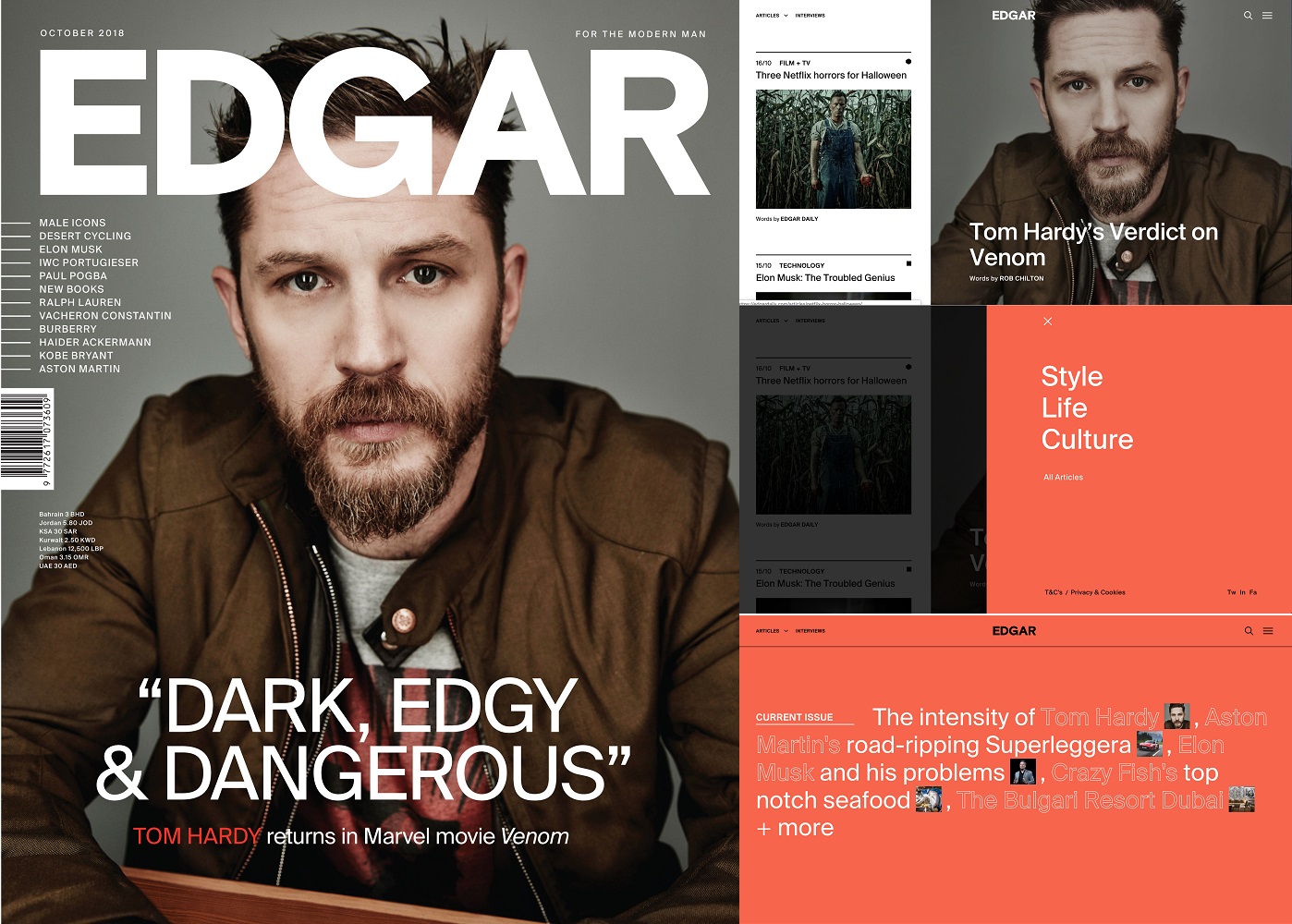
Edgar, issue 69, online and print, October 2018 - Tom HardyIn a feminine zeitgeist, what are the traits of a ‘modern man’? Especially a cosmopolitan, affluent, urban man from the Middle East? EDGAR is an online and print magazine that focuses on luxury men’s lifestyle in the Middle East. It makes a concerted effort to portray this ‘new’ kind of man, one who seeks sophisticated content that doesn’t fall into stereotypical traps that other men’s magazines often fall into.

Published monthly, EDGAR tells modern stories about fashion, cars, devices, food and travel. The synergy between the print and online versions is very strong. The website is particularly well-designed, with a tasteful and considered understanding of typography, layout and design across the board. Great art direction, functional yet dynamic grid usage, and accessible content are all incredibly pleasing and noteworthy elements to this site.


Iconic

Heart-Love-Polygon-Geometric-Flat-Design-Icon-Illustration by lekkyjustdoit courtesy of FreeDigitalPhotos   The Wall Sheet Journal (UK), issue 4, 1969

The Wall Sheet Journal, issue 4, 1969While covering McSweeney’s magazine and looking further back in time to South Africa’s own MK Bruce Lee during last week’s column, a point was made about peculiar print formats, particularly lucky-packet-like packaging for publications. Looking even further back in history, this week we focus on The Wallsheet Journal, which was essentially an assortment of posters placed in a transparent plastic bag and stapled closed, with a folded piece of cardboard that held the masthead.

This limited-edition publication was a final student project edited, designed, and published by Pearce Marchbank while he was studying at the Central School of Art and Design (it’s worth noting here that other alumni of this school include John Berger, Eric Gill, and Bill Moggridge, to name a few).

Marchbank started his career designing covers for iconic magazines such as Friends, Oz and Time Out, and he was an important exponent of the British underground press, thanks in part to the notoriety achieved by The Wallsheet Journal. A closet modernist, he would become co-editor and art director of Oz for three issues because the magazine’s founders — Richard Neville, Richard Walsh, and Martin Sharp — were placed in jail due to their historic obscenity trial. Marchbank referred to The Wall Sheet Journal as a “magazine of multiples”, and the publication had surprisingly important contributions from various designers, musicians, artists and writers, including Pink Floyd’s Nick Mason, Monty Python’s Terry Jones, designer Richard Hollis, and typographer Alan Kitching, among others.

References


Shane de LangeShane de Lange (@shanenilfunct) is a designer, writer, and educator currently based in Cape Town, South Africa, working in the fields of communication design and digital media. He works from Gilgamesh, a small design studio, and is a senior lecturer in graphic design at Vega School in Cape Town. Connect on Pinterest and Instagram.

Media Design, formerly Cover Stories and MagLove, is a regular slot deconstructing media cover design, both past and present.

— One subscription form, three newsletters: sign up now for the MarkLives newsletter, including Ramify headlines; The Interlocker, our new monthly comms-focused mailer; and Brands & Branding, launching soon!

Dear Radio: Turbo-charge your Christmas radio campaigns

by Paulo Dias (@therealptp) Here are some simple tips, all based on good programming practices, to apply to your radio advertising to improve your chances of cutting through this time of year.

Traditionally, Christmas-time advertising fills up radio spot logs to breaking point. It’s make-or-break season for every retailer, car dealership, ISP, cellphone network, gym chain, fast-food outlet and so on. From January to mid-October, most radio shows run three 3-minute spot breaks. In the weeks leading up to Christmas, these stretch to around five minutes each — meaning your 30” generic ad is now competing for attention with up to nine other spots, fighting for a listener who barely pays attention at the best of times.

What’s in it for the listener?

Ask yourself this before you turn on the mic. As appealing/clever/interesting you think your message is, why should listeners care? How do they benefit from what you’re saying? Then lead with this.

Keep it simple

I saw some Nielsen research which found, on average, that listeners are aware of less than 1 second of 30 seconds of airtime — and that doesn’t even mean they’ve taken in what you’re saying. This insight strengthens the argument for frequency of spots but also makes you aware of how concise your ad should be.

Frequency

Not just in how often you play the spot, but how often you enforce your simple message.

What is your one instruction and how do you say it simply, over and over in the same on-air moment? I often get clients sending me feedback that the copy we’ve supplied them is too repetitive and that we’re saying the same thing in different ways. That’s very intentional — it’s frequency of a simple message packed into one on-air moment.

Speak like people speak

My major bugbear with spots I hear is that people just don’t talk like that. A standard spot break is going to be preceded by natural conversation between presenters with great chemistry, who make the audience feel like part of the team. To then follow with over-scripted, hard-selling, over-dramatic voices in the ad breaks that connection instantly.

I know there is a lot of to-ing and fro-ing when writing scripts and recording sessions sometimes need a court stenographer, but, you know what, it hurts no one if you just let the voice artist be real and “unscripted”.

Avoid audio overload

When I was at the stations, this time of year we tended to under-produce our promos and recorded spots. Fewer whizzes and bangs, lighter music (if any music at all), toned-down sound and voice effects etc. It’s December, there’s a lot going on, people are tired and don’t need to be bombarded because you think you’re being creative.

I’ve found that this time of year standing out might simply mean standing down.


Paulo DiasPaulo Dias (@therealptp) is the head of creative integration at Ultimate Media. He works closely with the programming teams at leading radio stations to help implement commercial messaging into their existing formats. He contributes the regular column, “Dear Radio”, looking at the changing radio landscape in South Africa, to MarkLives.com

— One subscription form, three newsletters: sign up now for the MarkLives newsletter, including Ramify headlines; The Interlocker, our new monthly comms-focused mailer; and Brands & Branding, launching soon!

Market Research Wrap: Youth fear for their financial future

Cheryl Hunter (research at marklives.com)’s weekly wrap of the latest market and consumer research:

  • SA youth worries
  • Online grocery sales surge
  • Media allocation benchmarks

SA youth’s financial concerns

BrandMapp logoAfter last week’s introduction, here’s the first in a selection of interesting insights from the 2018/19 BrandMapp survey that we will be sharing over the next few weeks from Brandon de Kock, WhyFive Insights director.

by Brandon de Kock. If you think our youth are only worried about their twitter profiles, think again; they’re playing Survivor SA like the rest of us and it’s keeping them awake at night.

According to the latest official stats, there are approx 9.7m young adults between 16 and 24 in South Africa. That’s about 17% of the total population and only a million less than the population of Greater London. In BrandMapp 2018, we asked younger respondents: “Which of the following thing make you anxious?” and the answer from a total sample of 1 275 young adults under the age of 25 is sobering.

Given a list of the kind of things that parents worry about on behalf of their children, the overwhelming majority (72%) ticked a box to say they’re nervous about how they’ll make their own money in future. In a distant second, (43%) is ‘studying and exams’ — although there’s a significant gender skew showing that young women (59%) are far more likely to worry about their marks than young men (24%).

After that, things such as ‘being left out’, diet and looks are almost insignificant — around the 20% mark at best — and once again showing that young women are more likely to be worried about such things. As for social media paranoia and the evils of alcohol, they’re just not on the radar.

So, our future leaders’ hopes and dreams and bright ideas are tempered by a single, overwhelming concern: how to survive in an economic environment defined by institutionalised theft, corruption and a currency that’s as stable as a plane without wings. The single most-important thing the rest of us can do is remind them that we live in times of extraordinary potential, characterised by disruptive technology, a loss of faith in outdated social norms and a planet in dire need of quality thinking. Imagine what we could achieve if our brightest young minds spent their days embracing our formidable challenges as a country instead of angsting over cash.

• For more, go to WhyFive Insights.


Consumers choose online shopping

Packaged Facts super internet ecommerce marketOnline sales of groceries more than tripled between 2013 and 2018 in the US and are expected to quadruple to 2023, according to market research firm, Packaged Facts, in its report, Online Grocery Shopping in the US, 2nd edition.

Packaged Facts forecasts an immense increase in online grocery sales as online options become more available and consumers become more open to trying online shopping or using online options more frequently to purchase their groceries. Most of the market’s growth has occurred since 2016 as ecommerce platforms and conventional grocery stores have increased both their participation and their geographic footprint with expanded service areas.

Amazon and Walmart are currently the key participants in the US market, together accounting for nearly 28% of online grocery sales.

Says David Sprinkle, Packaged Facts research director, “Three key factors have created a perfect environment for growth of the online grocery market over the last five years — there’s been increased use of mobile phones and smartphones, interfaces for websites and mobile apps have improved, and there’s been a notable expansion of business models to shopping and delivery.”

• Buy the report at Packaged Facts.


Splitting the spend

WARC media allocation report sampleThe typical budget split of the world’s most highly successful campaigns is a 69% spend on television and digital combined, according to the latest edition of WARC’s Media Allocation Benchmark.

Using its database of effective advertising campaigns, WARC analysed almost 840 case studies between 2009 and 2017 that contain budget and media allocation information for TV, digital, print, out of home/experiential and other media. The key findings included:

  • Successful brands have spent an average of 69% of their budgets on TV and digital channels combined over the 2013–2017 period.
  • The biggest determinant of media allocation remains the size of the budget. Successful, prize-winning low-budget campaigns are highly digital-focused. At high-budget levels, TV takes up more than 60% of a prize-winning brand’s advertising investment.
  • Media allocation varies by sector. Categories with low budgets, such as government and not-for-profit, are highly digital-led, as are transport and tourism, a category where consumers increasingly purchase online.
  • The food category has the most-concentrated media investment profile. Prize-winning food campaigns allocated 81% of their budgets to TV and digital combined.
• Register to download a report sample or buy the full report at WARC.

Updated at 12.13pm on 18 October 2018.


Cheryl Hunter

Cheryl Hunter (@cherylhunter) has written for the South African media, marketing and advertising industries for more than 15 years. A former editor of M&M in Independent Newspapers and contributor to Bizcommunity, AdFocus, AdReview and the Ad Annual, she has also produced for various television networks and currently consults on communication strategy and media liaison. She now does the new weekly “Market Research Wrap” column for MarkLives.com.

— One subscription form, three newsletters: sign up now for the MarkLives newsletter, including Ramify headlines; The Interlocker, our new monthly comms-focused mailer; and Brands & Branding, launching

#Campaigns: Beaded love letters, cars & a giant billboard

by MarkLives (@marklives) This week we feature insight into the brief, creative idea, production challenges and results of the “Toyota Corolla Love Letter” campaign for Toyota South Africa from FCB Joburg.


Pinterest icon View all the #Campaigns at a glance on our #Campaigns Pinterest board!
YouTube icon Watch our #Campaigns and #CampaignRadar playlists on YouTube!


Client: Toyota South Africa
Ad agency: FCB Joburg
Title: Toyota Corolla Love Letter

Toyota Corolla beaded love letter collage

Information supplied by FCB Joburg.

Brief

The Toyota Corolla Special Edition was launched this year and FCB Joburg was tasked to create a social campaign for it, as well as highlight the full Corolla range, for continued awareness. It did that… and then some.

Creative summary

The topic of love is a dominant theme in the social life of people the world over and, since time immemorial, people have sent their beloveds letters expressing their interest. Whether that letter takes the form of a handwritten sonnet, a typed essay, an SMS, or even a beaded brooch, the intention remains the same. Zulu people are famous for their beadwork and, with the exception of items used by ritual specialists, it all relates in some way to love. The Ibheqe — or love letter — is a small, postage stamp-sized plaque of beads (often suspended from a safety pin so that the love letter may be worn like a brooch) that conveys an emotion to recipient, usually a favourable or unfavourable inclination towards the advances. The combination of the pattern and colours of the beads convey a subtle message, without the need to speak.

To celebrate the launch of the Special Edition Corolla, FCB Joburg decided that the use of Zulu love letters as an art directional device would be a fitting way of celebrating South Africa’s most-loved car, the Corolla. This quickly grew from an art directional device to one of its most-ambitious billboards yet. The biggest beaded love letter ever, to be exact. But then the agency asked itself, what if it created a billboard that not only spoke about love but also spread the love? To this end, it partnered with Woza Moya, the economic empowerment project of the Hillcrest AIDS Centre Trust, in KwaZulu-Natal (KZN) to help it execute this audacious creation and KZN, being the home of Corolla, made this partnership the perfect match.

Woza Moya’s mission is to promote creativity that creates economic empowerment through traditional, quality local crafts. By selling to Woza Moya, crafters are empowered to become self-empowered and self-employed.

Paula Thompson, Woza Moya founder, says that “it’s been an amazing project just in terms of scale… we have taken on big projects but nothing like this” and “for me, the real heart-warming part about it is that it is creating mass employment.” She adds that “the pay-out from the billboard and the love-letter pins gave all of our crafters triple their income for the last three months.”

Production

From origination to execution, this was a collaborative project between Toyota, FCB Joburg and the crafters at Woza Moya. Tian van den Heever, project creative director, says “it was amazing to mobilise such an enthusiastic, amazing, vibrant force to create something so beautiful… that’s really real, that’s really crafty and really South African.”

Resources

  • The process of creation was documented and shared on Toyota SA’s social pages
  • It was erected just in time for Heritage Day in September 2018
  • Mini-beaded love letters were handed out to dealerships for Corolla owners during Heritage Month
  • When the billboard is taken down, the intention is for it to live out its life in the Toyota plant in KZN where Corollas are manufactured
  • Social media was chosen as the main form of engagement since Toyota has a very active and engaged community

Mark Ewing from Red Dot, the company responsible for erecting the love letter, initially noted that this beaded love letter was a “tremendous challenge [and] some said that it could not be done”.

The scale of the project wasn’t the only obstacle the group faced. Since the women at Woza Moya hadn’t worked with wooden beads before, they had to be trained for a week before the stitching could begin. Once trained, each of the 350 dedicated beaders working on the billboard received a metre-by-metre panel to be beaded. Each of the 108 panels was then meticulously stitched together. Finally, the assembled love letter, consisting of 138 000 hand-stitched beads, weighing in at almost a ton, was crane-lifted onto a truck bed and transported to Joburg.

Since FCB Joburg wanted as many South Africans as possible to see this one-of-a-kind billboard, it opted for a site on the M1 De Villiers Graaff Highway after the Crown Mines interchange. This location offers a diverse audience and approximately 214 422 cars drive past there daily.

While the billboard was being created, an additional 600 ladies from as far afield as Pongola and Jozini were stitching 7500 mini beaded love letters. These letters were distributed to dealerships nationwide and handed out to Toyota fans during Heritage Month.

Because of the positive feedback being received, a second site where the love letter may be installed is currently being investigated. The intention for the final home of this work of art will be the Toyota plant in KZN.

Measurement

  • The beaded billboard featured as the top international best ad of the week on AdForum on 24 September 2018
  • It received an Orchid from the Citizen newspaper on 22 September 2018
  • In total, it earned over R1.9m in PR exposure

Social stats (17 August–2 October 2018)

  • The campaign generated 284 204 video views
  • 100 631 video completions equating to an average of 60% completion rate
  • 1 070 308 unique users reached on Facebook, Instagram and YouTube channels

Campaign duration

17 August–31 October 2018

Credits

Brand

Toyota SA
Brand: Corolla
VP marketing: Glenn Crompton
Senior manager, advertising & digital marketing: Tasneem Lorgat

Agency

FCB Joburg
Executive business director: Reagen Kok
CEO & chief creative officer: Brett Morris
Account lead: Taryn Marais
Account manager: Narissa Rajagopal
Project manager: Christine Lubbe
Creative director: Tian van den Heever
Creative director (design): Janine Kleinschmidt
Art directors: Julie Thorogood, Thato Moatlhodi, MotlagoleNthite
Copywriters: Esté de Beer, Marina Andreoli
Strategy: Stuart Sims, Jason Doyle
Print producer: Monica Maloka

Production

Billboard production: Red Dot
Content production: Creative Motion
Content director: Dewan Meyer
Media strategists: Gwen Bezuidenhout, Thulani Nombewu, Langa Sithole
Campaign manager: Thato Moganedi


MarkLives logo#Campaigns is the new weekly MarkLives column featuring insight into the brief, creative idea, production challenges and results of South African communication campaigns, both ongoing and recent. Have a campaign worthy of being featured in #Campaigns? Submit a short motivation to 2mark and we may well be in touch. Please include links to campaign material, when it ran/is running and why you believe it should be featured.

— One subscription form, three newsletters: sign up now for the MarkLives newsletter, including Ramify headlines; The Interlocker, our new monthly comms-focused mailer; and Brands & Branding, launching soon!

B2B Customer Centricity: Measuring centric-approach performance

by Mark Eardley (@mdeardley) In the four previous Q&As with Laura Ramos, we’ve looked at how a customer-centric approach underpins marketing’s ability to attract and retain profitable business. Far from being a touchy-feely cliché, we’ve shown that full-on centricity creates sales, protects margins and reinforces loyalty. This final Q&A looks at measuring — and proving — its contribution to producing those paramount results.

Ramos is Forrester’s VP and principal analyst serving B2B marketing professionals.

Given that attracting and retaining profitable customers is marketing’s sole goal, knowing what to measure is straightforward: sales, margins and loyalty. By using those three crystal-clear criteria as benchmarks, how to measure should be guided by one principle: there must be a demonstrable link between activity and achievement.

When considering the execution of any tactic within a customer-centric strategy, marketers first have to define how they will evaluate its performance in relation to the benchmarks. Measurement can’t be an after-thought; it has to be a starting point:

“Measurement is the first step that leads to control and eventually to improvement. If you can’t measure something, you can’t understand it. If you can’t understand it, you can’t control it. If you can’t control it, you can’t improve it.” —Dr H James Harrington, CEO, Harrington Group International

Back2Basics: How may marketers simplify the way they implement and verify their measurements? In other words, how may we build direct links that connect activity to achievement?
Laura Ramos:
Business marketers struggle seriously to connect activity to achievement — 77% of global B2B said that their inability to measure results is one of their top concerns, up from 58% the prior year.

When B2B marketing execs can’t definitively quantify what their company gets in exchange for the money it spends on in-person events, sponsorships, advertising, and sales support, CFOs see marketing as a cost centre; sales execs see it as a resource diversion; and CEOs don’t consider it a strategic part of the management team. To gain this needed respect, marketing must measure its impact across the entire customer lifecycle and show how marketing produces the customer-centric engagement that is vital to increasing loyalty, advocacy and customer-lifetime value.

Engagement is the key word here. To simplify the way marketing measures its impact on the business, and its return on investment, marketers must focus their results-reporting on how their activity changes or improves the way customers interact, influence, and get involved with their communications, products and services. To measure engagement, marketers must understand what the business is trying to achieve as specific goals, not vague platitudes like “drive growth” and “increase market share”, but as measurable change in objectives that can be quantified — again, across the entire customer lifecycle. Customer lifecycle performance measures give marketers the data they need to quantify the contribution that marketing makes to building awareness, the pipeline, generating revenue, and growing accounts. For many marketers, this process will require them to challenge business leaders in functions like sales, support, and account management to be more specific about “how” they expect to achieve their business goals.

You can’t measure anything unless you know where you are now and where you need to get to by when. With this understanding, marketers can then turn to the question of how to demonstrate that what marketing does creates customer engagement that moves the needle on achieving those agreed, specific, measurable goals.

If you measure everything in relationship to how it ultimately affects the customer, the CFO, CEO and sales team will stop questioning why marketing does what is does and spends what it spends.

B2B: The ability to measure is the ultimate litmus-test for framing the scope and scale of marketing’s activities. Why should customer-centric marketers adopt a mindset that says if we can’t evaluate, we won’t initiate?
LR:
Evaluating progress is a core principle of business, not just marketing. You won’t stay in business long if you can’t evaluate what you initiate and know if you are making money the right way. This applies to the entire business, not just marketing. (And marketers would be wise to remind their sales and customer success management counterparts of this axiom as well.)

Marketing’s measurement mindset should always start with customers and how marketing activity impacts their awareness, interest, understanding, desire, use, success, and engagement. This mindset should also focus on how marketing impacts this progression — as change over time against specific metrics — not just on factors like traffic, registrations, views, downloads, etc. For example, many marketers struggle to measure the impact of brand-building activity on market awareness. If you focus that activity on building awareness with specific accounts or market segments, by taking an account-based marketing or industry approach, then this goal becomes easier to evaluate. Moving from measuring impact on “the whole market” to specific segments or accounts also makes the measurement process more customer-centric.

To focus marketing measurement on the “how” of customer engagement, marketers must apply three key metrics to everything they choose to initiate:

  • Impact: This is the direction metric. Are things moving in a positive trajectory? One of the most-important areas for marketing to quantify and communicate the trajectory is the percentage and value of the pipeline, revenue, and account-specific growth that marketing helps to generate.
  • Predictability: This is the forecast metric. Will things continue to move in a positive direction? B2B marketers need to understand not only how well their programs perform at each stage of the customer lifecycle, but also how performance in any one stage drives activity in the next. Marketing measures here must focus on ways to track pipeline health and account penetration to confidently forecast both current and future quarters.
  • Return on investment: This is the result metric. Which things have the most impact on or the best performance against goals? Optimising spend and resource use must address two key stages of the customer’s journey: presale and post-sale.

Marketing needs to measure the sales opportunities generated and use this data to continuously optimise the ROI achieved across a well-considered marketing mix. Marketing must also measure how post-sale communications help shorten implementation times; increase use; and improve opportunities to upgrade, add additional capabilities or services and increase wallet share.

~•~•~

That wraps my series of Q&As with Ramos on customer centricity. Many thanks indeed to her for being such a willing participant and taking the time to share her wise and actionable insights.

See also


Mark EardleyMark Eardley (@mdeardley) advises B2B companies on how to govern their marketing to attract and retain profitable customers; several of his clients have grown to become market leaders. He and Charlie Stewart have written Business-to-Business Marketing: A Step-by-Step Guide (Penguin Random House), which offers practical, actionable advice on how to make marketing make money. His monthly “Back2Basics” column covers how B2B companies and their agencies should manage their marketing.

— One subscription form, three newsletters: sign up now for the MarkLives newsletter, including Ramify headlines; The Interlocker, our new monthly comms-focused mailer; and Brands & Branding, launching soon!

Adnalysis: Strategy no longer about positioning statements, platforms

by Bogosi Motshegwa (@Thinkerneur) Gone are the days when a strategist’s role was to meander through hundreds of slides, only to land on ‘positioning’ or ‘the strategic platform’ and to be criticised over a typo in the positioning statement or, worst-case scenario, to be told that what’s been presented isn’t a strategy. (The audacity — but that’s a story for another day.)

Not about the last slide

There’s more to strategy than just holding your breath until the last slide is presented. It’s disheartening that all that creatives care about is that three-to-four-word phrase that’s meant to encapsulate and capture the essence of the other 20-30 slides.

This approach used to work for a long time — and it still does — but, in today’s world, positioning statements and strategic platforms alone no longer cut it. I view this as a shortcut and a somewhat lazy approach to what strategy should be.

I use “lazy” and “shortcut” cautiously as a lot of work goes into strategic thinking or planning. We probe, we test, we put together, we pull apart, and we flip inside out in order to get to a rich, and hopefully uncharted, territory that may be the catalyst for compelling great work which pushes brand-building forward.

Defining & designing

Strategy today is about defining future business and designing future human behaviour. For businesses to thrive today, they need to plan for the future, as strategy isn’t and shouldn’t be about reacting to market conditions but instead shaping them. That’s what being a true market leader is: not having the bigger share of the market but rather a bigger share of the future.

While strategic platforms or positioning statements do have a role to play, that has shrunk and therefore a need for thinking and planning for future impact has become paramount.

I believe that any strategy presentation that truly has the business’s best interest at heart should at least initiate a conversation towards designing a brand narrative based on the future; the best way to do that is to ask: “What does the future brand ‘x’ look like?”

And the future is not 2–3 years from now; it’s 10–30 years from now. Gone are the days when we planned for the former. We need to think deeper and establish conversations that aren’t predicated on what’s happening but rather what could, and what should, happen.

Strategists’ role

Strategists are meant to shape and drive the future. As a strategist, you need to have conversations beyond ‘messaging’, and start engaging clients and internal people around possibilities and what lies ahead.

Strategists are underused in ad agencies. It isn’t surprising to see consultancy firms entering our territory with more authority and credibility, and that’s because they’re having completely different conversations with our clients. While agencies are obsessed with awards, consultancies are toiling with the concept of rewards for business.

Perhaps instead of doing competitor reviews, we should be doing ‘future reviews’. This would be a fundamental shift in mindset because what it means is that, instead of concentrating on what our competitors have done in the past, we now focus our energy and zone in on what we should be doing in the future.

We’ll never arrive where we never planned to go. Even if we arrive there, we won’t know that we are there because it was never conceived in our minds.


Bogosi MotshegwaBogosi Motshegwa (@Thinkerneur) truly believes that advertising can really change the world. He believes that brands, marketers and ad agencies can do even better branding building and advertising. He shares his thoughts on the industry and sometimes has unconventional views. A former committee member of AMASA, an Advisory Council member, a guest speaker and lecturer at Vega, Rosebank College and Red & Yellow, he also does speaker management at TEDxJohannesburg. He is currently a freelance strategist and has founded Thinkerneur, a brand consultancy firm, and is also the co-founder of Melanoid Éclat (for finding black entrepreneurs). He contributes the monthly column, “Adnalysis”, which analyses adland from a strategist’s point of view, to MarkLives.com.

— One subscription form, three newsletters: sign up now for the MarkLives newsletter, including Ramify headlines; The Interlocker, our new monthly comms-focused mailer; and Brands & Branding, launching soon!
SA TV Ratings: SABC 3 — primetime top 20 for Sep, Aug 2018

by MarkLives (@marklives) The hottest primetime shows on SABC 3 in South Africa revealed: TV ratings for September and August 2018.

SABC 3 logoSABC 3, September 2018

Top 20 Programmes All Adults 15+
September 2018 Prime Time 5.30pm—10pm
Adults 15+ years U:34978 S:8319

 Day

Date

From

To

Station

Programme title

Genre

AR

Viewers

Share

Fri 07/09/2018 1900 1928 S3 Isidingo:the Need Soap 3.2 1128721 9.5
Sat 01/09/2018 1905 2051 S3 Paradise Stop Movi 2.2 773621 7.6
Wed 12/09/2018 1730 1757 S3 The Bold and the Beautiful Soap 1.9 665150 8.5
Sun 09/09/2018 1829 1929 S3 Blue Planet II Docu 1.9 662783 6.2
Sat 29/09/2018 1803 1905 S3 Top Billing Maga 1.8 615712 7.1
Sat 22/09/2018 1600 1758 S3 English Premier League Liverpool vs Sout Spor 1.6 561337 7.7
Sat 29/09/2018 1600 1800 S3 English Premier League Manchester City V Spor 1.6 545707 8
Sat 22/09/2018 1759 1801 S3 News Headlines News 1.5 536273 7.8
Sat 01/09/2018 2127 2342 S3 John Carter Movi 1.5 525188 10
Sat 15/09/2018 2100 2127 S3 News News 1.5 521501 5.8
Sat 15/09/2018 1902 2047 S3 High Noon Movi 1.5 517627 4.9
Mon 17/09/2018 1930 2026 S3 Survivor:Cambodia Real 1.5 510749 3.9
Sun 09/09/2018 1500 1754 S3 Raja Rani Movi 1.4 503445 6.7
Sat 15/09/2018 2129 2328 S3 Derailed Movi 1.4 495613 9.6
Sat 08/09/2018 1904 2047 S3 Nothing for Mahala Movi 1.4 493230 5
Sat 01/09/2018 1559 1758 S3 English Premier League Chelsea vs Afc Bo Spor 1.4 485981 7.3
Sun 16/09/2018 1803 1828 S3 Brooklyn Nine-Nine Dram 1.4 478106 5
Sat 15/09/2018 2052 2057 S3 Music Musi 1.4 474022 5.1
Sun 16/09/2018 1500 1733 S3 Alaipayuthey Movi 1.3 468951 5.9
Sun 02/09/2018 1459 1732 S3 Raanjhanaa Movi 1.3 439772 6

Source: BRCSA September 2018


SABC 3 logoSABC 3, August 2018

Top 20 Programmes All Adults 15+
August 2018 Prime Time 5.30pm—10pm
Adults 15+ years U:34978 S:8202

Day

Date

From

To

Station

Programme title

Genre

AR

Viewers

Share

Mon 06/08/2018 1900 1929 S3 Isidingo:the Need Soap 3.2 1111336 8.9
Sat 25/08/2018 1903 2045 S3 Gifted Hands Dram 2.2 784371 7.1
Mon 06/08/2018 1729 1757 S3 The Bold and the Beautiful Soap 2 702455 8.9
Sun 05/08/2018 1830 1929 S3 The Blue Planet Docu 1.9 676244 6
Sat 25/08/2018 1802 1903 S3 Top Billing Maga 1.9 650725 6.6
Sun 26/08/2018 1829 1933 S3 Blue Planet II Docu 1.8 634860 5.5
Sat 25/08/2018 2131 2320 S3 Race to Witch Mountain Movi 1.7 611860 10.7
Sat 25/08/2018 1800 1802 S3 News Headlines News 1.6 566654 7.1
Sat 25/08/2018 2100 2128 S3 News News 1.6 563473 6
Mon 06/08/2018 1930 2025 S3 The Amazing Race Real 1.6 548397 4.2
Sat 25/08/2018 2045 2100 S3 Hollywood News Feed-R Vari 1.5 535316 5.3
Sun 12/08/2018 1830 1930 S3 Blood Lions Docu 1.4 503041 4.4
Sat 18/08/2018 1900 2100 S3 Stranger Than Fiction Movi 1.4 498426 4.7
Sun 05/08/2018 1730 1757 S3 Behind the Scenes:Becoming Bold & Beauti Docu 1.4 497508 5.5
Mon 20/08/2018 1930 2024 S3 Survivor:Cambodia Real 1.4 489882 3.7
Sun 26/08/2018 1756 1759 S3 Carving Day Vari 1.4 472296 4.3
Tue 07/08/2018 1930 2026 S3 Top Chef Junior Real 1.3 464569 3.6
Sat 18/08/2018 2130 2351 S3 The Guardian (Mov) Movi 1.3 443323 9.7
Sat 04/08/2018 1856 2100 S3 Pride & Prejudice Movi 1.2 419226 4.1
Sun 26/08/2018 1500 1746 S3 Zindagi Na Milegi Dobara Movi 1.2 413803 4.8

Source: BRCSA August 2018

In 2016, the Broadcast Research Council of South Africa (BRCSA) changed its policy about giving away TAMS and now only monthly reports, highlighting the top 20 or 30 primetime shows on several popular channels, are available.


Broadcast Research Council of South AfricaThe Broadcast Research Council of South Africa (the BRC) is a non-profit, industry body that was incorporated in 2015 to cater to the audience research needs of the radio and television industry in South Africa.

— One subscription form, three newsletters: sign up now for the MarkLives newsletter, including Ramify headlines; The Interlocker, our new monthly comms-focused mailer; and Brands & Branding, launching soon!

#AgencyFocus: Joe Public United — purpose parallel with profit

by Sabrina Forbes. In a landscape where the way we connect changes daily, the need to engage with each other has ignited the reinvention of one of South Africa’s largest 100% independently owned agencies. Enter Joe Public 2.0, which has evolved from a traditional ATL agency to one with digital at its core and is equipped to deliver cross-platform campaigns to all clients, through all the lines.

Growth

The term “growth” is meant to be synonymous with Joe Public United. Everything it does feeds back to the purpose of growth, which in turns underpins its understanding of the need to embrace diversity, and the leaders at Joe Public United stand steadfast in their aim to provide a rich, supportive foundation for all races and genders. By providing this guidance and impartial mentorship, the leadership team is able to watch its crop grow and weather the industry’s storms. Without pushing the metaphor too far, anyone who’s tried to grow something from seed to seedling will understand how much nurturing this takes.

The premise of growth lies in its ripple effect. As you grow your people, they help your clients to grow, which helps the country, which gives more opportunity for growth to the people, which allows them to help your clients grow, which helps grow the country… you get the point.

In January 2018, Joe Public United launched the School of Growth, taking the purpose of growth internally with a separate entity created to facilitate the personal and professional developments of the group’s staff. This SETA-accredited academy is starting small with internal upskilling of staff but aims to extend its services externally to graduates, clients, and other selected industry learners. The plan to create a school that educates the industry with coaches who’ve learned from real-life experiences of the environment and culture they operate in fulfils the founding purpose of the agency.

Growing greatness

Pepe Marais, group chief creative officer and co-founder, says that it’s his “deepest belief that human growth surpasses the development of only the intelligent quotient, and that the development of the emotional and spiritual quotients are critical to growing effective, creative beings.” He adds, “Growth is in itself a creative process [and] the School of Growth is a big idea that will ripple across our business from the inside out.


Growing Greatness book coverBook Extract 1: Growing Greatness — Pepe Marais tells us his story
Book Extract 2: Growing Greatness — Pepe Marais cuts his teeth on booze
Book Extract 3: Growing Greatness — Pepe Marais on meeting Gareth Leck
Book Extract 4: Growing Greatness — Pepe Marais on the worst is the best
Book Extract 5: Growing Greatness — Pepe Marais on business = being, too

Founded 20 years ago by Marais and Gareth Leck, Joe Public has gone from selling traditional advertising services by way of a takeaway-inspired menu to an agency group offering full services in advertising and communication through a number of specialist companies. The above-the-line agency, Joe Public, is supported by four separate but complementary agencies:

  • Joe Public Connect — digital innovation
  • Joe Public Engage — public relations
  • Joe Public Ignite — below-the-line
  • Joe Public Shift — strategic brand

Industry shift

The last couple of years, and perhaps leading up to the last decade, has seen a shift in the way this industry works. Clients are looking for increasingly creative ways to push their decreasing budgets further, while strategies have moved from traditional paid advertising media to digitally focused earned media. Many traditional agencies have acquired digital expertise and slotted them into their offering. Instead, the Joe Public United leadership team has chosen to evolve the offerings of Joe Public to include more digital-minded thinking while expanding and strengthening the existing digital expertise of Joe Public Connect. This way, who the company is and what it stands for don’t have to change.

What has changed, though, is the group’s full-service offering, which now includes an expanded repertoire with data, technology, and innovation as part of its core, along with a heavily digital mindset.

Xolisa Dyeshana and Khuthala Gala-Holten

The evolution of Joe Public United has brought with it a new set of leaders. Each company, although supported by the group, is run by a separate team and this has given growth opportunities to some key staff members. It was announced in September this year that Joe Public deputy MD Khuthala Gala-Holten had been promoted to MD and, together with Xolisa Dyeshana, the ATL CCO, has taken full leadership of the ‘newly digitised’ Joe Public. Marais, Leck and Laurent Marty (group strategic director) have moved laterally across into group roles.

Expertise & collaboration

Each arm in the group works independently of each other, with some client-overlap, looking at each brand holistically. This allows a focus on expertise but also opens things up for collaboration, with every team having the best interests of the group in mind.

The work speaks for itself, and the awards this independent agency has racked up just this year alone only add to it — a total of 30 Loeries plus being crowned Loeries Agency of the Year 2018 is one way of showing Joe Public’s ability to consistently deliver creative excellence while pursuing a constant and uncompromising growth journey.

In September 2018, Joe Public Connect was announced as the Digital Agency of the Year at the New Generation Digital and Social Media Awards, following its success of being 2017’s most-awarded agency. It’s not only the agency which has been noticed and awarded. Industry stalwarts Marais and Leck were recently awarded the Medium Business Entrepreneur of the Year Award in the 2018 Entrepreneur of the Year competition sponsored by Sanlam and Business/Partners. The duo were also runners-up in the 2018 Business Category of Conscious Companies 2018, an award that identifies organisations which align people, planet, and profit in service of all stakeholders and seeks to celebrate leaders who’re committed to business as a force for good.

Real change

Growth can be a powerful tool to effect real change and, for Joe Public 2.0, creating a ‘fertile soil that grows its people, clients, and country.’

MarkLives YouTube playlist

Joe Public United logo 2018
joepublicunited.co.zaRamify Premium


Sabrina ForbesSabrina Forbes (IG) is an experienced and published writer covering the food, health, lifestyle, beverage, marketing and media industries. She runs her own full-stack web/app development and digital-first content creation company. For more, go to moonwrench.com. She is a contributing writer to MarkLives.com.

“#AgencyFocus” is an ongoing weekly series updating the market on ad agency performance, including business performance, innovation, initiatives, the work, awards and people.

— One subscription form, three newsletters: sign up now for the MarkLives newsletter, including Ramify headlines; The Interlocker, our new monthly comms-focused mailer; and Brands & Branding, launching soon!

Clicks ’n Tricks: CATwalk changes & the advent of the IT girl

by Charlie Stewart (@CStewart_ZA) Still struggling to come to terms with the impact of martech, marketers in the fashion industry have a new challenge on their hands. Computer-aided technology (CAT) is hitting the ramp. And it presents brand managers with an interesting dilemma.

Last month, French luxury brand house Balmain unveiled the three new faces of its autumn campaign — Shudu, Margot and Zhi. They quickly racked up hundreds of thousands of Instagram followers, even attracting comments from the likes of Naomi Campbell, Tyra Banks and Alicia Keys.

https://www.instagram.com/p/BnGj9H8gzKd/?utm_source=ig_embed

The quirk with this campaign is that all three are computer-generated models. Shudu, the more famous of the trio, is already being touted as the world’s first digi-supermodel. Which probably also qualifies her the first true IT girl.

Makes sense

On the face of it, CGI in the fashion industry makes sense. For all the virtues of working with human models, photographing them is a challenge. Aside from the politics of whether a model is too fat or too thin, shoots come at a price. Who can forget Linda Evangelista’s famous comment that she wouldn’t get out of bed for less than US$10 000 a day? Traditional fashion advertising also takes time — a commodity that few marketers have. CGI allows advertisers to adhere to today’s maxim that content should be produced at the speed of culture. In other words, knock it out quick and cheap.

While it’s not new in advertising — the CGI ad flighted back in 1984 when the Canned Food Information Council released a Super Bowl spot with a robot espousing the virtues of tinned beans and it’s subsequently been used to great effect in the auto sector — creating a fake human is something of a departure.

While many in the rag trade laud the development, others have got their knickers in a knot over ethics of it all. But, while they may rail over concerns about job losses, my worry is about influence.

Influencers

It’s the fashion and media industry, after all, that gave us influencers. And for all Kim Kardashian’s lack of authenticity, there’s an element of harmlessness to her actions — most of us know that most of the time she’s faking her admiration for the latest brand she’s plugging. But if the influencer now becomes an anonymous (and non-disclosed) computer-generated bot, how are we to tell what’s real and what’s not? And that’s precisely what happened when the Balmain Three were ascribed real human-like identities.

The prospect will become even more frightening when the inevitable happens and Shudu or others of her ilk are given artificial intelligence (AI) and the power to mine our social media and search history to pitch us products in real time.

Is Cameron-James Wilson, Shudu’s creator, a modern-day Victor Frankenstein? While the creature he’s manufactured may be far from grotesque, I fear that it may just become all the fashion.

Deepfaking it

Finally, a rather more-shocking and -insidious use of the transformative powers of tech is making headlines, thanks to the crusading power of 24-year-old, Noelle Martin, the victim of something called the deepfake.

Deepfakes entered the news earlier in the year, when the internet became flooded with porn movies featuring high-profile female celebs. Sadly, these weren’t any common or garden Paris Hilton-esque tapes, which silly celebs were careless enough to have had stolen from their hacked iCloud accounts. They were movies in which famous faces were engineered onto more-regular adult performers. And so good is the tech that it’s almost impossible to spot that it’s not real.

While the affected celebs probably didn’t like the videos, they at least had the credibility and profile to deny their involvement and the legal means to have them pulled down. But Martin is a regular person, like you and I, and the internet is flooded with compromising movies of pornstars wearing her face. Her harrowing TED Talk, in which she describes the impact deepfakes have had on her life, is well worth a watch.

It’s a sobering reminder of just how dangerous tech can be.

See also

Updated at 3.37pm on 12 November 2018 and 9.24am on 15 October 2018.


Charlie StewartCharlie Stewart (@CStewart_ZA) is CEO of Rogerwilco, a multi-award-winning independent digital agency best known for its expertise with Drupal, SEO and content marketing. A Scot by birth, he moved to South Africa in the early 2000s in his quest to support a winning rugby team — a search he’s reluctantly forsaken. Together with Mark Eardley, he co-authored Business to Business Marketing: A Step by Step Guide, (Penguin Random House, 2016) and may be found on LinkedIn. Charlie contributes the monthly “Clicks ‘n Tricks” column, which looks at how brands are using digital channels to engage their customers, to MarkLives.

— One subscription form, three newsletters: sign up now for the MarkLives newsletter, including Ramify headlines; The Interlocker, our new monthly comms-focused mailer; and Brands & Branding, launching soon!

Online CPD Courses Psychology Online CPD Courses Marketing analytics software Marketing analytics software for small business Business management software Business accounting software Gearbox repair company Makeup artist