Is marketing beset with enemies of progress?

by Taazima Kala-Essack (@taazimakala) There are times when trying to get even the simplest of tasks done feels impossible. I’m not talking about overhauling an entire corporate strategy, ousting someone from their seat or anything even remotely worth more than three grey hairs and a double espresso — but simple, progressive and small tasks or steps.

For no reason

And yet. Ah yes, and yet. And yet some things remain more out of reach than they ought to be, more difficult than necessary and downright frustrating for no reason, because people almost get a kick out of being enemies of progress. We see it every day and in almost every context: security guards being difficult for no reason, customer-care centre agents unwilling to go off script to actually address an issue at hand, or bureaucracy just doing its best to get in the way of moving forward.

Saddest of all is that I’m beginning to suspect this horrid behavioural trend is starting to rear its ugly head a little too close to home. Is this why getting something done in the world of PR (and marketing as a whole) is so hard? Is marketing beset with enemies of progress? Are we killing what could be great quick wins because of… processes, hierarchies and closed minds?

The proverbial playing field is in many ways tougher than ever, with budget cuts across the board (with the marketing budget being the first to get the chop), increasing involvement from procurement teams and, a lot of red tape designed to ensure more efficiencies and optimisation, and yet doing the very opposite in most cases. We have become so bogged down by process, rules and red tape (and sometimes egos) that boring and dull have become the theme du jour. If we want to see big things, amazing work, and real impact, we need to rally together and make the most of every opportunity, no? This would, of course, be what logic dictates.

Whopper vs Big Mac

In December 2019, Burger King UK revealed its Whopper news: that every single Whopper advert, billboard, promo and pretty much any and visual depiction of the famous burger had a Big Mac hiding behind it. The mechanics were simple: every photoshoot of a Whopper has the Whopper placed in front of a Big Mac, ensuring the Mac was not visible — literally hidden by the more impressive Whopper or in its proverbial shadow. (Take a look if you have a minute; it’s really quite clever!)

https://youtu.be/BfEEY1nmW8o

Every single Whopper, for an entire year — the brand showcasing that nothing beats a Whopper, and it’ll always take centre stage. Adverts appeared in this way in every print, social media artwork and billboard ad. It was a campaign that was over a year (literally) in the making, and which dictated needing to wait an entire year just to see the impact.

Commenting on Burger King’s big stunt, Ian Heartfield, BBH London chief creative officer, said: “Placing our competitor’s product in our own ads throughout 2019 without anyone knowing has been one of the most-fun ideas we have ever executed. It is, of course, just a good old-fashioned product comparison idea, but it’s been brought bang up to date by some lateral thinking and rebellious media behaviour. We’re loving it.”

It was easily one of the most-memorable efforts of the year, and it’s not hard to see why. It didn’t stop there, either, for the flow of ‘cool’ continued into the new decade. For Valentine’s Day 2020, the Burger King offered a free Whopper for anyone who brings in a photograph of their ex.

On the opposite side of this, and entirely unrelated, a recent McDonald’s UK outdoor campaign didn’t even feature its logo, its tagline or any product imagining: just a list of burger ingredients, and you would have to be a hermit not to recognise the brand behind it all (pardon the pun).

“Are you insane?”

Imagine being a part of the communications team that pitched these ideas to client… “Are you insane?” “Don’t be stupid” and “We would like to see real value from you, please” are just some of the responses I imagine would likely have come from the brand office. Imagine the energy in that team, and the sheer passion and purpose that went into cultivating the idea into life! Ah, to have been there!

To be fair, I’m not suggesting communication managers are solely at fault; the culture of putting the bottom-line first and immediate monetary returns continues to reign strong, no matter how hard we deny it, and the pressure on communications teams is now greater than ever — do more with less, no artsy stuff, no frilly ideas, and convert to sales without any fuss in between.

Like the NFL players groomed to be ‘blocking machines’, great ideas seldom have a chance to make it out the shoot before being shot down because we’re feeding a culture that inhibits creativity or chooses to dictate its bounds to a tee. Yes, even when we claim we’re doing the very opposite.

Procurement offices are dictating briefs, finance decides with a sharp pencil who gets work based purely on budgets, and people who don’t see nearly as strongly the inherent opportunities in their brands make final decisions on ‘creative’. The more pressure they feel from the top to deliver, the more they inhibit and hamstring the very ideas that would otherwise make them shine.

Domino-like effect

The effect is domino-like in every way: the creatives lose their mojo, their passion and their nerve to think outside the ‘box’ and the standard of work becomes a cyclical feed of mediocre. It devolves into a culture of needless blocking, unnecessary difficultness and passive-aggression, and ennui, as the French would say. Rest in peace, dear creativity. You were a dear friend.

So, what’s the cure, then, if there’s even one? I neither profess to know one, nor suggest a single silver-bullet solution. Yet it can’t be too hard, can it? To wake up each day, vowing to think progressively, creatively, and with true long-term foresight and open-mindedness. To be clear in our objectives, direct in our briefs and yet, equally so, open to new perspectives, new interpretations and a healthy amount of rule-breaking and unconventional action. No longer will negative energy enter the pitch or presentation room before you; you go in ready to be amazed and leave with firm refusal for anything short of that. Be curious, be passionate, and allow the intellectual and creative bandwidth of others to flourish.

Whether you’re on the client-side or the agency- or consultancy-side, don’t be the problem or the cause of any more than three grey hairs and a double espresso. Be the Whopper who refuses to bow the status quo, and defies, by all odds, any chance of becoming an enemy of progress. There are far too many already, I’d say.

See also


Taazima Kala-EssackTaazima Kala-Essack (@taazimakala) is a PR and public affairs specialist consultant based in Gaborone, Botswana, with an academic background in language and literature. She has led and collaborated on a number of strategic and communications projects in Botswana and Namibia, and is currently the only CIPR-accredited PR consultant in Botswana. She is the lead consultant at Hotwire PRC, Botswana’s oldest and largest PR consulting business which is aligned to FCB Wired.

“Motive” is a by-invitation-only column on MarkLives.com. Contributors are picked by the editors but generally don’t form part of our regular columnist lineup, unless the topic is off-column.

Sign up now for the MarkLives newsletter, including Ramify.biz headlines, emailed every Monday, Wednesday and Friday!

Brands & Branding: Brand, and purpose

by Andy Rice (@ricecommaandy) Not since Rolls met Royce have two words been so intimately joined at the hip. The concept of brand purpose has become so ingrained in the marketing vernacular that nowadays my phone’s spellcheck offers it as an option long before I’ve finished typing the phrase. I’m almost tempted to find an alternative expression just to get the satisfaction of proving to those smarty-pants at Google that they know nothing about the world of brand strategy and the language that’s used to convey it.

Definition

But inevitably, as ubiquity grows, so does imprecision. Like brands themselves, the more widespread the use of the concept of brand purpose, the less easily we seem to be able to define it. It’s become the catch-all bucket into which we put everything about a brand’s behaviour that isn’t ruthlessly rational or conclusively justified by a mountain of carefully collected data. It’s a slippery beast, this idea of purposeful branding and, as a result, it’s hard to get our hands and heads around it. It slithers away and out of the spotlight far too easily.

Let’s try to bring it back to centre stage by starting with a definition of brand purpose. All brand consultants have their pet definition, so there’s no shortage of choice, but my preference is for the one coined by the World Advertising Research Centre (WARC):

“Purpose is a reason for a brand to exist beyond making profit. When it’s done well, a brand identifies a purpose that relates to its core product or service that not only puts it at an advantage commercially but it also benefits a broader community who may — or may not — be consumers of the brand.”

This definition is neither verbose nor intimidating, which makes it more likely that marketers will be tempted to explore the concept further, which in turn is to be welcomed because, when the hubbub and the dust die down, brand custodians will quickly see that properly managed purpose can build a brand’s equity and differentiation more rapidly than almost anything else they’ll find in those well-thumbed textbooks of their student days.

Simon Sinek

So, who’s to blame for this sudden explosion of interest in what brands can offer beyond their traditional commercial roles? Who is the godfather of brand purpose? If you ask me, I would point to everybody’s favourite guru, Simon Sinek. This astute British-American business consultant, armed with little more than a flipchart, a couple of koki pens and an invitation to speak at TEDx, changed the vocabulary of brand strategy, almost overnight. Elegantly simple, but none the worse for that, Sinek’s thinking has been hailed as the most-convincing articulation of the future of branding since Procter & Gamble coined the concept of brand management itself, 50 and more years ago. Such was Sinek’s persuasiveness that ‘brand purpose’ quickly condemned related concepts such as brand ideals and brand citizenship to the sidelines of marketing theory.

So, if ‘brand purpose’ has become part of the brand landscape, reflecting as it does the contemporary marketing zeitgeist, how much life is there left in the concept? Is it another of those generational ideas that sheds its skin every couple of decades or so? There’s a clue in our friend Sinek’s core business specialisation. His website describes him as being first and foremost an organisational consultant, which suggests something rather more fundamental than simply enhancing brand equity. Organisational consultants shake businesses up to the very core; brand managers are all too often several steps removed from where the real action is (which, incidentally, is why marketers grumble so long and loud about being excluded from the C-suite and a seat on the board).

Marketers can do one of two things in this situation. Either they can keep quiet and accept their status quo as a non-essential discipline, or they can plot a clear path to Sinek territory with the unambiguous objective of putting the brand at the heart of the organisation’s stated purpose. Instead of being driven by financial imperatives, or distribution, or manufacturing, or whatever, the business should put the brand itself at its epicentre in order to become truly brand-centric. The brand purpose has thus become the organisational purpose, and every significant strategic option should be evaluated in terms of its ability to strengthen the brand through living up to its purpose. The ambition should no longer be confined to building a brand-centric marketing department; what is needed goes beyond that, to the idea of creating a brand-centric business strategy.

Successful examples

Successful examples of a brand-centric purposeful organisation are thin on the ground, but that’s most likely due to the fact that it’s difficult, if not downright dangerous, to try to retrofit a purpose into a business that has long held baser beliefs. So, the case studies are most-easily found where the hand of an inspired (and inspirational) leader-founder is evident in all that the brand says and does. Sinek himself uses Apple as his reference point, and it is hard to quarrel with that choice — the biggest company in the world, and one that got to that high point by putting the brand and all its prospective customers right at the centre of its overall strategy. Virgin would be another great example from the world stage, and locally Nando’s is a brand that considers social commentary to be every bit as important as selling spicy chicken. Kulula.com is another local brand that built its success around the demystification of a category that was viewed by many as elitist and unaffordable. By promising that ‘now anyone can fly’, and by adding irreverent humour to the experience, Kulula introduced a whole new market segment previously ignored by its competitors. In the often-cynical world of financial services, too, brands such as Nedbank and Discovery are working hard to rehabilitate the category’s image through adding purpose to their brands.

Some closing cautionaries. We’ve already pointed out that brand purpose is difficult to introduce into long-established, purpose-free zones. The old adage about the time it takes to turn a super tanker around is relevant here; if you haven’t got the stamina for the long haul, don’t try it at all. Don’t confine your message to external audiences, either. Purposeful branding may be a useful tool for effective differentiation out there where your customers play, but its greatest value is in providing a sense of direction and unity for your internal stakeholders. Nothing aligns staff behind a company’s strategy faster than a purpose that they believe in and which they feel they can contribute to.

There’s also a view in some quarters that brands with purpose are only of interest to the younger demographics — millennials, Generation Z and others of their age groups. Quite apart from the ludicrous belief that attitudes and behaviour are somehow driven by birthdate (which makes this kind of segmentation as rigorous as astrology, and about as much use), there’s no evidence that I’ve seen that suggests that our appetite for a sense of purpose diminishes with advancing age. Brands that choose to align themselves with a purpose that resonates with its customers and prospects will always reap the commercial benefits, regardless of the age profile of its audiences.

Elegant

Amazon founder, Jeff Bezos (another purpose-driven pioneer), recently coined an elegant new definition of a brand. He said that “[y]our brand is what people say about you when you’re not in the room.” If you would prefer that unheard conversation to be one that casts you in a positive light, you can do a lot worse than start by adding a dose of purpose to your brand strategy.


Brands & Branding 2019 now available!

Johannesburg-based Andy Rice (@ricecommaandy) is probably South Africa’s best-known brand strategist, public speaker, and advertising commentator. He is regularly asked to comment on marketing issues of the day and recently received a Lifetime Achievement Award from his peers in the brand communications industry.

The article first appeared in the 2019 edition of Brands & Branding in South Africa, an annual review from Affinity Publishing of all aspects of brand marketing. Find case-studies, profiles and brand news at Co.RetailingAfrica.com. Order your copy of the 25th annual edition now!

Sign up now for the MarkLives newsletter, including Ramify.biz headlines, emailed every Monday, Wednesday and Friday!

Zeitgeist of Now: Natural me & implications for brands

by Jason Stewart (@HaveYouHeard_SA) Let’s explore what I call Natural Me, the cultural response to working and playing too hard for too long, as well as the extreme health fanaticism of the past decade. Not only does Natural Me eschew 14-hour work days and six- or seven-day work weeks, it positively baulks at crossfit injuries, only eating tuna for a month, celery juice binges…

In a previous column (October 2019), I wrote about the anti-perfection movement, the backlash against the Instagram ideal and the celebration of flaws and asymmetry. I also discussed SuperPower Me (December 2019), the cultural shift that is an obsession with becoming the most-extreme, high-performance version of oneself, aided by technology and science.

Driving belief

With Natural Me, the driving belief is that it’s healthier to cheat a little and give yourself some slack, rather than aim for extreme perfection and living in constant guilt, unhappiness, damaging yourself physically, emotionally and mentally. Balance has bounced back and, influenced by post-modern values and a call back to mother nature, the intention is to achieve the most-real, -natural, -healthy and -enlightened version of oneself.

The movement embraces anything that brings the consumer closer to the perceived most-natural state: from hemp, yoga, meditation, psychedelics, vegans and superfoods to bulletproof coffee, the paleo diet, how to sleep better, run barefoot, freeze yourself to faster exercise recovery, or breath yourself to a stronger immune system.

Natural Me, naturally, has a 100% unshakeable belief in mother nature; sometimes this belief is well-founded but other times… well, the jury is out but Natural Me has closed his heart and shuttered her mind. Fuelling Natural Me’s stance is the backlash to toxins of the industrial revolution that permeate our world, and the consequent distrust of science and scientists. These consumers use Instagram and other social media channels to ‘badge’ and connect with liked-minded friends, portraying a lifestyle that is of the healthiest, happiest, sexiest (without stating it), accepting and open-minded, living for life itself (not for work or stress).

Paramount importance

At the same time, mother nature and the environment are of paramount importance to this movement, particularly limiting — and possibly reversing — the impact of climate change. While most believe that individuals can’t do this alone, and that its predominantly up to governments and corporations, these consumers are adamant about living positively and making choices based on how it will impact nature. Of course, their beliefs are driving consumption patterns and building new markets, just as the supplement and vitamin craze sees people seeking out niche, hard-to-find ingredients from far-away places that promise results they desperately need or want.

This community is often a gullible or blinkered one, such is its members’ desire for more-natural and -utopian solutions. It’s often targeted by products offering miracle solutions, using conspiracy theories and pseudoscience to press all of Natural Me’s buttons.

The cultural shift or trend is also manifesting itself in ‘nature’ or ‘natural’ being brought back into all aspects of our lives. From greening our environment to using natural substances in production (shoes made from algae that don’t negatively impact the environment) and being inspired in our design by nature (Airbus last year revealed a concept plane inspired by the shape and movement of birds of prey in flight that reduces pollution and is more economical and higher in performance).

Humans are biophilic: we instinctively love nature and have an innate drive to connect with nature in form, feel and aesthetic. Research often states the powerful and positive emotional and mental impact of bringing nature back into our homes and our work environments. It makes us happier, calmer and boosts performance for a reason. Nature will continue to grow in its importance to us the more we realise how much we need it, and this will be a major driver for brand choice in the future.

Lessons for brands

  1. Consumers are driving the demand for more-responsible impact on nature. They’re seeing past the lip-service of the past, and looking into the organisations themselves. Brands now need to not only preach it but live it.
  2. Look for ways to make easy and positive impact on nature, to be inspired by nature in design and through how we touch consumers’ five senses.


Jason StewartJason Stewart is co-founder of HaveYouHeard (@HaveYouHeard_SA), a full-service agency. Zeitgeist of Now, his new column on MarkLives, is inspired by the agency’s proprietary tool developed to understand the invisible but powerful forces that influence people, products, culture and societies. If we appreciate these, he argues, we become more-effective marketers.

Sign up now for the MarkLives newsletter, including Ramify.biz headlines, emailed every Monday, Wednesday and Friday!

Louise Johnston on creativity, career paths & people

by Jessica Evans (@JessRobinEvans) “Creativity is what we do — it’s our currency — but creativity needs to drive business success,” says Louise Johnston, recently appointed managing director at Grey Advertising Africa. “Grey’s collective ambition around this is very clear: ‘To be the world’s leader in applying creativity to solve business problems.’”

Creativity

Johnston was inspired to move after being DDB South Africa MD for several reasons, one being “the quality of the creative product”, a reiterated theme at Grey. Their creative ideals also complement each other, making 2020 a year of promise for the agency.

“Our ambition is to be the most-progressive, -pioneering, -creative company in the world. To achieve that ambition, we must continue to attract the very best talent,” says Paul Jackson, Grey Africa CEO, adding that her experience and award-winning campaigns add value to Grey’s people and clients.

The feeling is mutual. “The idea of working alongside the experienced Grey leadership really excites me. I find their ambition for the agency both energising and challenging,” says Johnston, adding that the creative drive at Grey resonates with her. “Grey is on a mission to create the most-admired agency network on the African continent, with creativity at the core, and that’s a mission I want to be part of.”

Career path

Johnston has been in advertising for 26 years, beginning her career as an account manager before eventually switching to agency management —a natural next step. “I was given the opportunity at DDB to increasingly become more involved in the running of the agency, rather than just a portfolio of clients. When the previous deputy MD left, it was quite a natural progression then [to take] on an agency management role, first as deputy MD and then as MD,” she explains.

She attributes her current success to luck and persistence, saying that she was fortunate to receive “proper career-path advice” early on in her career. ‘Pestering’ others to mentor her also played its part. “With hard work and a lot of lucky breaks over the years, I am exactly where I envisaged myself to be today,” she says, a claim many are unable to make.

The advice she would give her younger self is this: “Surround yourself with people who are smarter than you. The more intimidating you find it, the richer the experience will be.”

Challenge is a recurring theme for her and another reason for her move from DDB to Grey. “I thoroughly enjoyed my tenure at DDB but had been there for over eight years and needed a new challenge,” she explains.

People

“I don’t talk about ‘resources’; I talk about ‘people’,” she insists. Creativity and people are the two pillars of her outlook, and she emphasises her desire to mentor people as she’s been mentored, offering them a future like her present: “I invest a lot of my time in mentorship and training because some of the proudest moments in my career have been watching young people [whom] I have nurtured over the years go on to do great things.”

Johnston’s time at Grey promises to be fulfilling in that regard. “In the short time I have been at Grey, we have already celebrated so much: our people being acknowledged; [the] winning of new business; cementing relationships with new clients; some fabulous new hires,” she says. “My hopes are that we look back on 2020 as our best year yet in every sense.”

See also


Jessica EvansJessica Evans (@JessRobinEvans) is a young writer interested in branding, marketing, health, lifestyle, environmental journalism and science communication. After completing her BJourn at Rhodes University, she turned her attention to copywriting and now works for HKLM Group as a content producer while also building a career as a freelance writer. In her spare time, she runs bite-sizedsci.com, where she aims to make everyday science more accessible. She is a contributing writer to MarkLives.com.


Sign up now for the MarkLives newsletter, including Ramify.biz headlines, emailed every Monday, Wednesday and Friday!

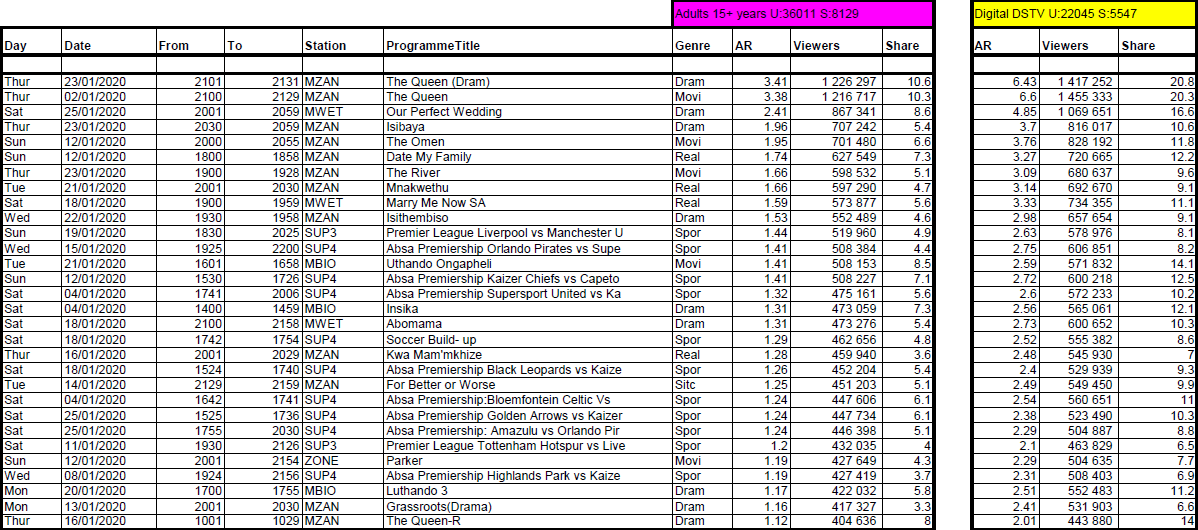
SA TV Ratings: DStv — primetime top 30 for Jan 2020

by MarkLives (@marklives) The hottest primetime shows on DStv in South Africa revealed: TV ratings for January 2020. Please take heed of this loadshedding note (pdf) from the Broadcast Research Council of South Africa (BRCSA).

DStv logoDStv, January 2020

Top 30 Programmes All Adults 15+ & DStv Adults
January 2020 Prime Time 5.30pm—10pm

Source: BRCSA January 2020

BRCSA TV Ratings January 2020 primetime DStv
Click to enlarge.

See also


Broadcast Research Council of South AfricaThe Broadcast Research Council of South Africa (BRCSA) is a non-profit, industry body that was incorporated in 2015 to cater to the audience research needs of the radio and television industry in South Africa. In 2016, it changed its policy about giving away TAMS and now only monthly reports, highlighting the top 20 or 30 primetime shows on several popular channels, are available.

Sign up now for the MarkLives newsletter, including Ramify.biz headlines, emailed every Monday, Wednesday and Friday!

The Suit: How about “less with less”?

by Jason Harrison. Everyone keeps saying “do more with less” but are we in adland prepared for the consequences?

I recently watched Chicken Little with my daughter and there’s a scene where this little rooster runs around hysterically shouting to the townsfolk, “The sky is falling! The sky is falling!” My daughter then asked me, “Dad, what does that mean?”

I told her that it was a saying that had been around for hundreds of years and it meant that the person saying it believed the world was coming to an end.

To which she responded, “But it’s not, Dad; it’s just a movie.” #kidssaythesmartestthings

Rallying mantra

It reminded me of the inevitable Predict-the-Future-of-our-Industry-January-Edition that contained another potent remix of “we are all doomed”, a smattering of Daft Punk’s “Harder. Better. Faster” added to a deep base track of “data, data, data”, and the seemingly viral rallying mantra of everyone: “Do more, with less.”

Of all the predictions, “do more with less” is the most-damaging narrative to buy into, in my view. I’m ashamed to say I even used it in a management meeting recently. I say ashamed because, when you think about it, it makes absolutely no sense as a statement whatsoever. It’s the equivalent of logistics company saying, “We need to drive double the distance, with half the petrol,” or a civil engineering company saying, “We need to build a skyscraper three times higher, with half the bricks,” or the government saying, “We need to double the electricity output, with just three pieces of wet coal.” (Too soon?)

In no realms of reality would that statement make sense or be accepted, except in our industry, where we’ve consistently demeaned and devalued the thing we all make as marketers and advertisers. It’s tantamount to everyone admitting to the CEO, “We don’t really know what it does anyway so, yes, we can certainly do much, much more of it… with less money, less time, less people and less critical thinking.”

In a world gone mad, where the amount of complexity, clutter and confusion has reached an unbearable high, does the world really need MORE communication? And are we prepared for the consequences of more on our people — more mental illness, more anti-anxiety medication, more therapy, more burnout, more talent leaving for other industries?

Here’s a radical suggestion for this year: “Less with less.”

The following is attributed to Steve Jobs, “The hardest thing we do at Apple is constantly figuring out what not to do”.

So how do we do less this year?

If it’s good enough for Disney, it’s good enough for us

I’m reading a book by Bob Iger, The Walt Disney Company executive chairperson, called the Ride of a Lifetime. In it he writes about being interviewed as the COO to take over from the then current CEO, Michael Eisner. He goes through numerous interviews over a six-month period and his single-minded plan to reinvigorate the global phenomenon that is Disney comes down to three simple things:

  1. Devote disproportionate time and capital to the creation of high-quality branded content
  2. Embrace technology to its fullest extent to produce better content and reach more people
  3. Become a truly global company

Three things! Fifteen years later, he had the EXACT same strategy and it had enabled him to buy Pixar, Marvel, LucasFilm, 21st Century Fox and build the biggest-ever DisneyWorld experience in China, transforming it into a multi-billion-dollar company.

What would happen if you sat with your client and just picked three things that you were both going to back to make a massive difference to the fortunes of the brand this year, and the next, and the next? I bet the social media calendar would fall by the wayside pretty quickly…

“Less things. More focus. Bigger results…” I can hear the new Daft Punk remix already.

Chief simplicity officers

As a suit, your title is not “account executive” or “business director”; it’s “chief simplicity officer”. Your job is to cut away anything superfluous and provide absolute clarity and direction to everyone around you (including the client).

The clearer you can get, the less time is wasted on the wrong conversations, wrong briefs and wrong solutions. Move from one-page briefs, to one-paragraph briefs, to one-sentence briefs. This clarity of thought alone will create enormous amounts of time to consider things more deeply and meaningfully in the pursuit of the perfect solution.

What gets measured, gets done

One of my founding partners and our chief distiller loves to say, “What gets measured, gets done.” Think about how much of what you’re doing actually has any kind of tangible and understandable result attached to it. Surely, if you don’t understand what success looks like, then you’ll never know if what you’re doing is actually working?

The suit’ job is to push the client to define that single audacious end point we’re all aiming for and then get everyone in the room to take the tiger line to hit it. Having that audacious end point liberates the right conversation to decide what not to do, as the proverbial ‘scope octopus’ tries to escape the netted drawstring bag.

So, the next time someone says, “We need to do more with less”, you can respond, “Perhaps less with less is a smarter way to change the brand’s fortunes this year.”

Here’s to a radical year.

See also


Jason HarrisonJason Harrison started as a 23-year-old account executive at Ogilvy & Mather before moving to London five years later to run three agency teams in three different European countries. He joined his old mates again in 2011 as one of the founding partners of the M&C Saatchi Group at 33. He believes that creating beautifully simple solutions for an increasingly complex world will, in fact, save the world. His MarkLives column, “The Suit” is about inspiring and helping up-and-coming suits to be better at their craft. He is no longer on Twitter.

Sign up now for the MarkLives newsletter, including Ramify.biz headlines, emailed every Monday, Wednesday and Friday!

Social media and the customer experience

by Craig Hannabus (@crayg) Flash back to 13 years ago and Mark Zuckerberg is announcing to the world that our favourite social media platform was going to start serving us ads. Brands would be able to build pages and communities, and it was all very exciting. I mean, for the brands, it was exciting. The rest of us weren’t terribly thrilled.

Come & go

Have we gotten the social media marketing thing right? In my 12-year career in social media, I’ve seen so, so many strategies, approaches, and methods come and go.

  • The brand sledgehammer is still a favourite, flooding feeds with marketing messaging focused on product. The result? It depends on who you ask. I’ve seen several FMCG brands that were locked down in agency negotiations while their marketing efforts were put on hold. Nothing happened. Sales were just as strong as ever.
  • There’s also the “lifestyle-content” strategy. Basically, it’s creating lifestyle content to appeal to the audience on a more-personal level. The result? Engagement sometimes goes through the roof and that’s about it.
  • More recently, I’ve seen the “test-and-learn” campaign become a part of marketers’ vocabulary. It’s a step in the right direction. Trying different messaging, platform and audience combinations to see what works seems like a good place to start. But that approach on its own probably won’t yield comprehensive results.

Why are we still sitting here, 13 years later, with only a handful of examples of social media shooting the lights out. Why are we still struggling to move the needle on sales/conversions?

Simple answer

The answer is simpler than you think. Facebook, Twitter, and Instagram are only a part of the overall customer experience. The strange thing is that they’re often treated as isolated platforms. How often have you seen the “social media strategist” job description? Why does that exist? Because we’re still building separate strategies for platforms and content that should be a part of a bigger digital-strategy picture.

Hypothetically speaking, your social strategy should be tightly integrated with your search engine optimisation (SEO), paid and mailer efforts. Most marketers (especially in multi-agency environments) will stop at creating a consistent message. It’s great to have at least one hook to hang your marketing strategy on but you need more. You need to have a consistent user journey in place. What will the consumer see at point A; how will they be remarketed to at point B; what will they get if they Google at point C?

A user journey starts with the consumer. The problem with many social media strategies is that they’re based on whatever analytics the platform in question spits out. Top-level demographics and a hint at what might interest the audience is hardly a place to start looking for insights. Having a few real, face-to-face conversations with members of the target audience is a far better approach. Maybe they’re craving the lifestyle content you’ve always eschewed. Maybe they want more competitions with product giveaways so they can trial. How are you going to know these things without actually talking to them?

Journey, not destination

So, 13 years on and we’ve basically decided that social media is just a space for brand awareness. Social media is an always-on inconvenience, a money sink that needs to be done because everyone else is doing it. Except there are a handful of SMEs and consultants pulling in revenue and turning a profit based on their Facebook campaigns alone. So how does that work? What do they know that big brands don’t?

It’s easy: What they know is their audience. What they know is that audience relationship is a journey, not a destination.

No social media strategists were harmed during the writing of this post.


Craig HannabusCurrently the strategic director at Rogerwilco, Craig Hannabus (@crayg) has spent his adult life in the tech and marketing industry, exploring both the development and the content creation aspects. He began as a developer, writing software to integrate cell phones with GPS systems, thus building one of South Africa’s first vehicle tracking systems. Through the years, he’s developed a strong interest in exploring the world of customer experience and has worked on brands including Standard Bank, Nedbank, General Motors, Nestle, and Caxton.

“Motive” is a by-invitation-only column on MarkLives.com. Contributors are picked by the editors but generally don’t form part of our regular columnist lineup, unless the topic is off-column.

Sign up now for the MarkLives newsletter, including Ramify.biz headlines, emailed every Monday, Wednesday and Friday!

Press Pass: Newzroom Afrika, from brand-new to go-to

by Carey Finn (@carey_finn) “News doesn’t break on television anymore,” says Thokozani Nkosi (@ThokozaniNkosi), co-founder of 24-hour news channel, Newzroom Afrika (@Newzroom405). “News breaks on your phone. Our function isn’t to tell you the news; by the time you come to our channel, you’ve already heard it. Our job is to give you the ultimate in terms of analysis — to give you the human story behind the story.”

Building viewership

As Newzroom Afrika, which broadcasts live on DStv channel 405, approaches its first anniversary, the two co-founders and co-CEOs, Nkosi and Thabile Ngwato (@ThabileNgwato), are focused on building their viewership. “We are working on entrenching our position,” says Ngwato. “2020 is a big year for us, in the sense that we’re turning one, and we will no longer be the so-called new kids on the block.”

When the channel launched on 2 May 2019, replacing the controversial Afro Worldview (formerly known as ANN7), it came onto the air without a press briefing or much information. Though it might have raised some eyebrows, the silent start was deliberate, says Nkosi: “We wanted to focus first on getting the product right. It’s something that MultiChoice was happy for us to do, too.”

However, as part of an effort to reintroduce the channel, better define it and grow audience share, Newzroom Afrika will be launching an above-the-line campaign around its anniversary.

Target

With viewership figures from inception to mid-February 2020 sitting at 2 727 823, Newzroom Afrika reaches approximately 12.37%  of the South African news-watching audience, says Nkosi. “Our target is to have the lion’s share of that audience,” he says.

“Something that we’re really excited about is the demographic we’ve managed to attract,” adds Ngwato. “Going into the bid for this channel, we were clear that we wanted to attract a younger news-watching audience because we know that news-watching people are predominantly 50+, and we’ve been able to achieve our desired epicentre, which is 35.”

According to her, it’s the channel’s emphasis on analysis that has helped to differentiate it from other news channels. “I think what we definitely need and what we strive to be is an alternative voice: you need more voices — the more voices the better,” she says. “Part of us telling the human story is bringing in the voice of the viewer; we’re not only telling you what’s in the news and what’s currently happening around you; we also want to know how it’s affecting you as a viewer. And, when it comes to the analysis, we’ve made sure that editorially, behind the scenes and also on air, we’ve got really credible journalists [who] are putting together factual news and can also unpack it with the relevant experts.”

“Verification portal”

Newzroom Afrika calls itself a “verification portal” for news, says Nkosi. “We go by the motto, ‘It’s better to be right than to be first.’” Helping to uphold this since December 2019 are Sbu Ngalwa (@sbungalwa), the former Daily Dispatch editor-in-chief who’s joined the channel as politics editor; Stephen Grootes (@StephenGrootes), the seasoned radio journalist brought onboard as senior news anchor; and Katy Katopodis (@KatyKatopodis), the former EWN editor-in-chief who’s been news director since the beginning of 2020.

The three form part of a team of over 320, which Ngwato and Nkosi are not looking to grow rapidly; news is expensive, says Ngwato, so the focus is on optimising available resources and ensuring sustainability while providing opportunities for staff development.

Revenue-wise, the channel is funded by commercials, as well as branded content, which largely takes the form of programmes produced in-house. Nkosi and Ngwato report growth in both areas without disclosing details. The pair seem positive about the months ahead, and report high levels of motivation to ensure the channel succeeds. “For me, it’s [about] love of country,” says Nkosi. “When we said we were going into news, people said, “Are you crazy? There isn’t money in news.” But, for us, it’s always been about what we can do; how we can use our skill sets to impact the country and world. What fulfils and motivates me in particular is the ability to know that we are contributing towards the vibrant democracy we have in this country.”

“Change the lives of young South Africans”

For Ngwato, “news is all I know,” she says. “I always considered myself a person who was born to be an entrepreneur. It made sense for me to have a business in news. This speaks to me wanting to create opportunities for young people like myself, to change the lives of young South Africans — particularly young black South Africans.”

For more


Carey FinnCarey Finn (@carey_finn) is a writer and editor with a decade and a half of industry experience, having covered everything from ethical sushi in Japan to the technicalities of roofing, agriculture, medical stuff and more. She’s also taught English and journalism, and dabbled in various other communications ventures along the way, including risk reporting. As a contributing writer to MarkLives.com, her column, “Press Pass”, is a monthly feature spotlighting media leaders and their responses to the trends and tribulations in the industry.

Sign up now for the MarkLives newsletter, including Ramify.biz headlines, emailed every Monday, Wednesday and Friday!
Q5: The state of coding in SA, with Stephen van der Heijden [interview]

by Carey Finn (@carey_finn) Stephen van der Heijden, the vice president of growth at South African tech talent marketplace, OfferZen, shares insights into the local software development scene — and what it means for adland.

OfferZen logoQ5: What is the no. 1 thing adland ought to know about software developers in South Africa?
Stephen van der Heijden: Demand for software developers is high, which makes finding a developer, especially a great one, extremely hard. We also know that it’s hard to recognise quality skills because developers don’t need accreditation to be excellent at what they do, as we’ve seen in OfferZen’s latest survey with one in four developers being self-taught with similar earning potential. South African developers have the skills to help your business thrive and should be treated as more than a “resource” or code-monkey if you want to keep them in your team. So, making your company stand out as a great place to work is especially important when competing against so many local, and global, opportunities.

Q5: Could you give us any insights into the number of developers currently working in the local advertising and marketing industry, and how those figures might change in the next few years?
SVDH: Those numbers aren’t really out there but, according to our State of SA’s Developer Nation survey, around 3% of SA developers work in the media and advertising industry, and 4% in digital agency or services. As people continue to spend more and more time in front of screens, however, it becomes difficult to imagine a world in which each industry is not almost completely overhauled into the digital space, and the need for development and digital design skills only increases.

Q5: What lessons could adland learn from the developer community?
SVDH: The biggest thing others can learn from the developer community is the constant hunger to learn new things in order to stay relevant. In fact, according to our survey, the no. 1 reason that developers turn down a job offer is because of a lack of growth opportunities. Tech moves so quickly that the best developers have to continuously spend a huge portion of their time learning new things or risk becoming irrelevant. Good developers know this and have built a culture around moving jobs often, working on side projects, and taking online courses. The reality is that industries are evolving faster and faster and, if we don’t all become a little more focused on keeping up, we’re going to be left behind.

The second thing we can all learn from developers is how they focus on fostering a community. Because they need to learn a lot, and fast, they need to band together to learn from each other, share experiences, and collaborate to develop impactful solutions. We’ve seen this happen in the real world, at events and meet-ups like MERGE, as well as in online communities like ZATech on Slack.

Q5: For agencies looking to ‘onboard’ developers, what would you suggest they keep in mind during the hiring process?
SVDH: Remember that you’re competing with other companies offering awesome opportunities for developers, both locally and internationally, so you need to invest in your hiring process. Ensure that you have a slick and fast way of finding and interviewing candidates, so that you can move quickly and hire the right person to help your tech team thrive.

Q5: For anyone considering dabbling in coding, either as a full-time career or side-hustle, where would you recommend they start?
SVDH: There are various ways to get involved in various real-world and online communities — either full or part-time. The biggest suggestions would be to look into:


Carey FinnCarey Finn (@carey_finn) is a writer and editor with over decade and a half of industry experience, having covered everything from ethical sushi in Japan to the technicalities of roofing, agriculture, medical stuff and more. She’s also taught English and journalism, and dabbled in various other communications ventures along the way, including risk reporting. As a contributing writer to MarkLives.com, her regular column “Q5” hones in on strategic insights, analysis and data through punchy interviews with inspiring professionals in diversive fields.

Sign up now for the MarkLives newsletter, including Ramify.biz headlines, emailed every Monday, Wednesday and Friday!

Online CPD Courses Psychology Online CPD Courses Marketing analytics software Marketing analytics software for small business Business management software Business accounting software Gearbox repair company Makeup artist