Last week CNN fired one of its senior editors, Octavia Nasr, after she paid her respects in a tweet following the death of a controversial Lebanese Shia cleric.
 The cleric in question, Grand Ayatollah Sayyed Mohammad Hussein Fadlallah, has been associated with Hezbollah, which is deemed a terrorist organisation by most Western governments.
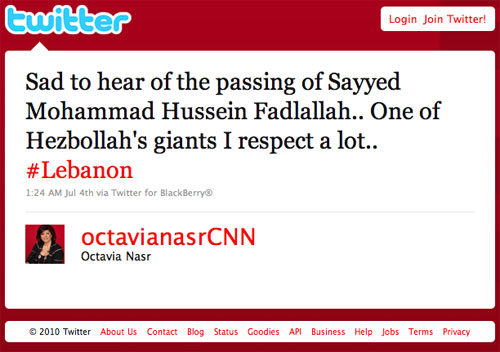
The tweet that cost Nasr her job read “Sad to hear of the passing of Sayyed Mohammad Hussein Fadlallah.. One of Hezbollah’s giants I respect a lot.. #Lebanon.”
She would later attempt to clarify and contextualise her tweet in a blog post, but Atlanta would have none of it.
The debate sparked by CNN’s firing of Nasr can be found all over the web with some big-name journalists venturing an opinion. Lucky for them, they don’t work for CNN. Many journalism schools still don’t encourage students to form or express opinions. It’s because journalists need to be objective, not takes sides, thus offering the complete story to readers so they can form their own opinion rather than have yours crammed down their throat.
Of course that is still how many view journalism, readers especially, and journalists have not done enough to update these views on our profession. Journalists often establish a personal voice in their writing. It breaks the monotony of blandness in news reporting that the information age is rendering pointless.
See the full story on Memeburn.com
 The guys behind it, MD Ben Wren and operations director Michael van den Heerik, both left senior positions at The Jupiter Drawing Room to launch an agency they hope will help turn traditional agency structures on their heads. Wren and van der Heerik are financing the agency themselves, which officially launched in March 2010, and which forms part of the 60 Layers of Cake network headquartered in Amsterdam. The international office will own a minority shareholding in the new agency.
 tell a story in a way that is accessible to readers. Visual journalists like Charles Apple play an increasingly important role as the news industry attempts to increase engagement, with consumers used to sound bites and quick synopses of news as it happens. Their work and strategic importance is already apparent locally in the recent redesigns of South African newspapers Rapport and City Press.
 other mobile devices, computing is becoming increasingly intimate and integrated into daily life. In his latest book, “Mobile Mania”, Simon Silvester (EVP Head of Planning at Young and Rubicam and Executive Planning Director, Wunderman Europe Middle East and Africa), argues that computings’ new intimacy, driving as it does aspects of our social, shopping, travel and personal communication, offers amazing opportunities for mobile app developers and entrepreneurs.
 This weekend, Twitter was abuzz with the news that South Africa’s former national police commissioner, Jackie Selebi, was found guilty of both charges he was facing. But the initial buzz on Twitter was wrong, or at least not 100% accurate.