A very civilised CityMob

A series of Facebook pages, started several years ago, has been so successful that its creator has teamed up with two friends to start a group-buying business called CityMob off the back of it. Daniel Solomon started the I Like Cape Town fan page on Facebook on a whim and has seen it grow to a group with over 30 000 members.

Solomon and his partners also run I Like Durban (with over 40 000 fans), I Like Johannesburg (more than 5000 fans), I like PE (over 8000 fans) and I Like South Africa (over 36 000 fans).

Solomon, together with Luke Jedeikin and Claude Hanan, believe they can marry the success of these Facebook fan pages with group buying. Made famous by US-based Groupon, group buying offers consumers a daily discounted deal via email. The deal is usually available for a limited time (typically one day) and requires a minimum number of consumers to buy in on the deal before it expires.

The trio started looking at how to monetise their Facebook success when group buying was starting to make waves outside the US. There were few local offerings at the time – the primary two being Wicount and Twangoo (now Groupon MyCityDeal South Africa).

They come from three diverse but ultimately complimentary fields. Jedeikin was a brand strategist at Ogilvy, Hanan had a financial background at Allan Gray and Solomon worked in IT infrastructure. Today, Jedeikin manages day-to-day operations at the company.

Having scoped out Wicount and Twangoo, they decided there was space for another player. As, says Jedeikin laughing, did everyone else apparently. He counts as many as 25 group buying players in SA at the moment. In any case, Jedeikin and his partners felt they had a ready-made community on Facebook, and after a six-month due diligence process, stuck their own money into getting the project off the ground.

Jedeikin says the Facebook communities involved have been generally supportive of CityMob and the direction it has taken the fan pages involved. According to Jedeikin, the pages were being spammed with commercial messages and that growth was stalling and interaction declining.

CityMob, he says, brings a structured and much more sensitive commercial element to these community pages. Growth has started up again, as has page activity, which Jedeikin says points to them doing something right. Jedeikin says that, while CityMob has taken ‘custodianship’ of the pages in question, it supports active community forums and user interactivity.

The SA launch of Groupon came as a bit of a shock, Jedeikin admits, and he sees consolidation in the local group-buying industry going forward. CityMob, with its ready-made user base, believes it will succeed as long as it focuses on the best local deals for consumers while capturing the philosophy of the merchant they are doing business with. And in any case, Groupons’ local entry has sped up the maturing of the market from both a consumer and merchant perspective – which is good for all the players in the field.

For city businesses, group-buying sites offers ‘risk free marketing’ with no upfront costs and performance-based remuneration. Commission is dependent on the price point but Jedeikin says CityMob’s commission is lower than that of its main rivals.

The business is evolving as things change on the ground, says Jedeikin, and the original vision and projections keep on changing as the market develops. CityMob currently employs a team of eight and works closely with its two partner agencies, Hello Computer and World Wide Creative. CityMob is also not a business being “built to sell” – its objective is to create legitimate relationships with its community, and Jedeikin is more than happy with organic growth levels.

Jedeikin admits that, in SA, many group-buying sites are falling short. Offers up for a week or more takes the urgency out of the purchase decision and allows consumers to shop around (‘that is a good price, but maybe Groupon offers something better tomorrow’).

They also don’t take advantage of the group element (where consumers email friends saying there is a great deal out there but you also need to buy in if it’s going to be realised) by setting low tipping points. At CityMob, the aim is to do group buying in its classical sense only.

CityMob hopes to reach Johannesburg and Durban before the end of the year. This expansion will allow it to hedge it bets across several markets, which will mitigate a bad day here or there in another.

Read the full story on BizCommunity

The ultimate social media strategy is not having one

by Dave Duarte. On Sunday 1st May 2011, Barack Obama announced that Osama Bin-Laden had been killed. The strike against his compound in Pakistan was not televised, but it was tweeted. The thing is, Al-Qaida was already looking irrelevant after the “Arab Spring” – the social-media enabled revolutions that occurred throughout the Middle-East in early 2011.
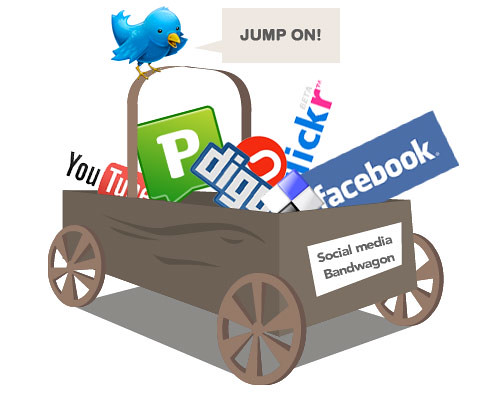
social media bandwagon With a heartfelt video posted online earlier this year, 26 year old Asmaa Mahfouz effectively managed to spark a series of public protests in Egypt that would unseat the country’s corrupt and brutal presidency.

Tools like Facebook, Twitter and Youtube don’t topple governments, but they certainly can help convince, connect and organize the people who do.

The phenomenon of Social Media is revolutionary in the truest sense. Citizens, Consumers and Communities can now organize without “organizations”. It is an issue, then, that Organizations need to take very seriously.

Trifles, Truths and Trends

While Social Media may seem to some to be a bunch of online websites and mobile applications, it is in fact a cultural phenomenon that is coming to define our times.

These websites have all emerged as a result of the convergence between people’s fundamental social needs and a host of enabling technologies – the founders didn’t invent online social media, they responded to an emerging trend with well-designed database-backed websites that made it easier for people to do what they already wanted to do.

It’s useful to distinguish between the tools that we use, and the trends that enable their use. Making this distinction will ensure that we invest our effort in ways that are meaningful as opposed to simply ‘cool’. To make this clear, try consider Social Media in terms of Trifles, Trends and Truths:

Trifles are fashionable at a particular time, but aren’t likely to represent a major societal shift by themselves. In the product world this could be something like skinny jeans – it might seem like a great idea right now, but in time that feeling will pass. The technical world is filled with trifles – thousands of websites and applications that are launched every month, each one promising to be the next big thing. Trifles are here today gone tomorrow. Even giant companies like Facebook and Twitter could be seen as Trifles, because there are no guarantees that they’ll be around in a couple of years – we’ve certainly seen many other large companies come and go in recent years.

Trends are more sustainable shifts in commerce and culture than any particular company or product can represent. Whereas YouTube.com may be a Trifle, Social Media and people’s capability and desire to share their perspectives online is a Trend. The trend is large, millions of people and thousands of companies are behind it, and it’s likely to shape the way we all do things over the coming years.

Truths underpin and enable any trend. The closer a Trifle or Trend is aligned with a human Truth, the more likely it is to be sustainable. The human truth of Social Media is that people are fundamentally social. People’s need to connect with each other is almost as high up as the survival instinct. Combine this powerful natural driver with web-based tools to enable social connection with mobile devices that connect seamlessly to the web, and you have the makings of a major behavioral shift. People are responding compulsively to the opportunity to do social grooming whenever and wherever.

The idea is to align why you use technologies to the truths (and this is the most important work you can do), what you do to the trends, and how you do it to the trifles.

Digital Nomads

The use of mobile phones is a particularly interesting trend to pay attention to. Smart phones – that enable web browsing and applications – grant us the wherever, whenever access to our social networks that we so compulsively desire.

The first mobile social-network was your phone’s contact list, and it was every bit as revolutionary as Facebook’s social graph – if not more so. The contact list in the phone in your pocket accompanies you to work, and the work-places of your “friends” (I use inverted commas because we all know how far the definition of “friend” is stretched in social media). The effect of which is to blur the boundaries between our social-lives and our work-lives. No need to deny you use your phone, however occasionally, for personal communication while at work – the research shows that we all do it.

The thing is that your work life is probably creeping into your social life too. Email is no-longer confined to your desktop. Thanks to mobile devices it now follows you around to dates, lines at the supermarket, and even holidays.

In this way we are digital nomads: mobility allows us to roam with our economic and social structure carried with us in tiny digital caravans. We’re seeing the enterprisation of our social lives, and the socialisation of our enterprises.

Companies around the world have blocked Social Media access at work, because it’s seen as an unproductive waste of time. However, as we all know – with the rise of smart-phones, people are accessing Social Media media at the office anyway.

The good news, though, is that research conducted at the University of Melbourne has shown that a certain amount of free web browsing is actually conducive to productivity, as long as it doesn’t take up more than 20% of our day.

Busyness

This blurring of boundaries can have a host of unforeseen consequences. For one thing, there’s a general sense that we are all more busy and distracted than ever before. There’s always something demanding our attention.

Multitasking has gone to another level. Tabbed browsing online, multiple applications running on your computer, and people contacting you on various devices and channels – everything urgent, everything “real-time”. While media multi-tasking may have seemed like a good idea some-time in the 90’s, it was clearly a trifle, because subsequent research has shown that it may have adverse affects on memory and brain function.

Do you ever get anxious when looking at your email? You could be suffering from “Email Apnea” – the tendency to hold your breath when dealing with an over-full inbox. This nasty little unconscious habit activates your sympathetic nervous system to kick-in the fight-or-flight response – so your poor body thinks it’s being chased by a mammoth animal while you’re just sitting at your desk. This is generally experienced as “stress”, which by the way can make you fat.

A simple way to deal with this overload is to just force yourself to single-task. Commit uninterrupted time to complete work tasks, enjoy short guilt-free social-media breaks between, and take regular “tech-free” sabbaticals on holidays and weekends.

Social Media and Reputation

Time-wasting is perhaps the least of company worries when it comes to social-media. With entire organizations connecting to the outside world publicly, the potential for PR blunders, Wikileak-type scandals, and general impropriety is greatly enhanced.

Qantas Airlines discovered this earlier this year when their share price was significantly affected by a false rumour that emerged on Twitter. The hard-earned lesson, in words of their CEO, Alan Joyce: “In this modern day and age with social media, you have to be responsive immediately. You have to be out there with the facts very fast, so it’s changing the whole dynamic and speed to market that organisations like Qantas have to respond to.”

It’s not just companies that need to be mindful of social media. It has become standard hiring practice to do a Google search on someone before hiring them. Have you Googled yourself? What comes up there is colloquially called your “Google CV” – the contemporary alternative to the paper version. If you want to take control of the impression you make online, the best advice I can give you is to ask yourself if you’d be happy for your boss or clients to see what you’re uploading. If not, don’t post it.

Clearly it’s not possible to stop people from using social media, so the most viable response seems to be simply to educate people on responsible online activity. Forward-thinking companies have drafted official Social Media guidelines for staff, along with ongoing training to help people use these powerful tools responsibly, professionally, and sustainably.

Radical Authenticity

One of the fears that people have with all this online use is that Big Brother is watching us, but with all our millions of tiny cell-phone cameras, tweets and wikis, the bigger story is that we are now watching Big Brother.

With the explosion of information available online – much of it unreliable – we have become far more skeptical consumers.The true currency of the web today is Trust. And Trust is built over time by aligning what is said with what is done.

Ultimately, social media is not just a communications channel that can be managed and controlled. It is a not a set of technologies to be mastered, it is a cultural reality to be engaged with. It promises to expose the corrupt and reveal the extraordinary, and if nothing else it is to guaranteed to keep us on our toes. It is chaotic, unpredictable, and uncontrollable. So the best social media strategy, then, is not a strategy at all, it is to be purposeful, ethical, and transparent and let our communications and behaviours flow from that.

First published on DaveDuarte.co.za under a Creative Commons License.

S’HOT 2011 review: Smart Thinking

FIREMAN

FENCER

BOXER

The Client: Webber Wentzel
The Agency: Net#work BBDO
The Brief: Webber Wentzel Attorneys needed a brand campaign to communicate their smart thinking.
Creative Solution: Net#work BBDO created two opponents using of mind maps to demonstrate how the smart thinker will always prevail.
The ads ran in the business press (FM and Business Day).
Creative Team: Donovan Goliath (Art Director), Jeff Tyser (Copywriter), Jenny Glover, Brent Singer (Creative Directors)

This ad was also featured in the ‘Create’ pages I compile for AdVantage magazine. It was run in the April 2011 edition of the magazine.

S’HOT 2011 review: Alfa Romeo Centenary Poster

Alfa Romeo Centenary Poster

The Client: Alfa Romeo
The Agency: Leo Burnett
The Brief: Create in-store material in support of Alfa Romeo’s centenary celebration.
Creative Solution: An info-graphic poster that displays Alfa Romeo’s 100-year manufacturing history. The poster illustrates every make, model and year of production from Alfa’s birth in 1910 to 2010.
Creative Team: Matthew Barnes (Creative Director), Ryan Liedeman (Art Director)

The people want to overthrow the ad tracker

You have every reason to be paranoid about your privacy in a digital world, says Dominic White, a security consultant at SensePost and self-proclaimed ‘argumentative Catholic hacker geek’, known under the pseudonym ‘Singe‘ online. White was a speaker at ITWeb’s Security Summit recently held in Sandton, where he discussed the politics and technology around online privacy.

The consequences of data-tracking online, by governments, media owners, advertisers and social media services, are greater than many trackers would allow, White told me in a phone interview, in that you never know what kind of picture trackers are building off your browsing habits or where and to whom they will be selling that data.

That picture they built can land you in a ton of trouble, especially as reams and reams of new legislation get passed in what results, according to White, in the overcriminalisation of the economic and personal lives of citizens. In short, if you tweak Big Brother’s interest, you are bound to get nailed for something somewhere.

In addition, data tracking can result in organisations such as life or health insurers buying up behavioural data and, next time you request an online quote, it might well result in an increased premium or other penalising features being quoted back at you.

White asks what access employees have to all the data being gathered by ad trackers, and points out that even the best online security gets hacked, as banks and other financial inductions have discovered to their cost.

In short, data-based profiles have consequences for real life, while we have neither access nor control on and over the profiles third parties are building on us. We cannot modify them, set the record straight nor delete these profiles.

There are three classes of thought in trying to find a solution to the question of online privacy, says White. First, there is a legislative effort to shape what data can be gathered and how it can be used. In the US, so-called ‘Do Not Track’ legislation is being considered, aimed at protecting consumer information from being used without consent.

Then there is the John-McCain- and John- Kerry-backed Commercial Privacy Bill of Rights Act, which aims to lay down “down fair information practices”, as well as acknowledge the right of individuals, to control how information on them is collected, used, stored or transferred. Enforcement and jurisdiction remain a concern.

Then you have actual enforcement through available technology such as Adblock Plus and GoogleSharing – both Firefox add-ons that counter trackers. GoogleSharing mixes the requests of many different users together so that Google is not capable of telling what requests are coming from whom. Adblock Plus removes online advertising from websites you visit and blocks known malware domains.

A third way, and one which White favours, is active subversion, where consumers find ways both of blocking data tracking and of increasing the cost of data tracking (GoogleSharing is one example of achieving both counts). White became interested in digital security during his school years and became part of the local hacking community. At Rhodes University, he belonged to a group of hackers who targeted one another with each other’s permission and later he created a tool stripping out Google’s ability to track link clickthroughs from search engine results. White sees his interest in privacy as a natural by-product of his interest in security.

Many South Africans still need to wake up to the fact that international firms are building profiles of them and these have a transactional value, says White – SA companies are increasingly willing and able to purchase these profiles from international suppliers to supplement their own data.

Something many of us have been hearing a lot about is how public the lives of modern teens have become and how this generation is comfortable with sharing their digital data. The next generation of consumers are OK with ad tracking, we are told, at the same time as being made to feel old and odd for having privacy concerns.

White argues that while teens certainly post more content – especially on social networks – they closely control who gets to see what. For example, many a teen have frantically untagged themselves where they feature in photo galleries of friends at parties they should not have been. They effectively use tools such as friend groups on Facebook to specify who has access to what personal data. More information does not equate to living your life in public, as White points out.

A number of security and privacy scares, such as the recent PlayStation Network breach and revelations that the iPhone stores unsecured location for up to one year, has given online privacy advocates a boost. Rebellion in the Middle East and North Africa and the government security sweeps that followed have reminded people that autocrats like micro-managing their subjects and have themselves the ability to sniff out online dissidents offline.

White firmly believes that, ultimately, users should have control of the data gathered on them. They should be able to remove that which they don’t want known and be empowered to decide how the data gathered on them can be used.

Read the full story on BizCommunity

S’HOT 2011 review: Worth waiting for

19450_Braces_3x12small

19446_Dog_3x12small

The Client: Allan Grey
The Agency: King James
The Brief: Remind consumers that Allan Gray is a South African investment company that has always focused on long-term investing.
Creative Solution:  The longer you give something, the more you nurture it, and the more patience you have, the more it will grow.
Creative Team: Alistair King (Creative director), Karin Barry-McCormack (Art director), Paige Nick (Copywriter)

This ad was also featured in the ‘Create’ pages I compile for AdVantage magazine. It was run in the March 2011 edition of the magazine.

S’HOT 2011 review: End of the Big 5

 End of the Big 5

Big 4 safaris

 End of the Big 5

 End of the Big 5

 End of the Big 5

The Client: Save the Rhino
The Agency: Stick
The Brief: Highlight the seriousness of the current carnage and show what the eventual outcome of the continued slaughter might turn out to be.
Creative Solution: Create intriguing visuals that suggest that when the rhinos have all gone nothing that we can ever do will bring them back. The Big 5 might soon be something of the past. The work was done pro-bono and is running in supportive media including the inflight magazine of Mango.
Creative Team: Jono Wolberg (Art Director), Mike Ellman-Brown (Copywriter & CD ) and Darryl Cowling (Creative Director)

This campaign was also featured in the ‘Create’ pages I compile for AdVantage magazine. It was run in the April 2011 edition of the magazine.

S’HOT 2011 review: Basejumper

BASEJUMPER

jumper poster

The Client: Land Rover
The Agency: Y&R
The Brief: Target the lifestyle and leisure segment of the Defender consumer by playing off its class leading off-road capabilities.
Creative Solution: Put on your gear, drive up the Matroosberg mountains, park your car and jump out the door. The defender is a vital piece of equipment for the more adventurous at heart. The ad was originated out of the Cape Town office and is running in press and outdoor across Europe as well as locally in SA 4X4 magazine, Getaway and Property Magazine.
Creative Team: Clinton Bridgeford, Liam Wielopolski, Graham Lang (Y&R London) (Executive Creative directors), Ntobeko Ximba (Art director), Deanne Longmore (Creative director), Bryan Traylor @locker14 (Photographer), Lee Aldridge, Stuart Frost (Y&R London), Dillon @still (Retouching)

This ad was also featured in the ‘Create’ pages I compile for AdVantage magazine. It was run in the March 2011 edition of the magazine.

S’HOT 2011 review: Pop culture town

lobster logoside-2

toffie2011_poster

The Client: Toffie Pop Culture festival
The Agency: The President
The Brief: Create a CI for the annual Toffie Pop Culture festival.
Creative Solution: Create a CI that embodies the creative, yet accessible spirit of the festival and conference, based in Cape Town.
Creative Team: Peet Pienaar (creative director)

This design was also featured in the ‘Create’ pages I compile for AdVantage magazine. It was run in the March 2011 edition of the magazine.

S’HOT 2011 review: A brand magazine

Skip (Unilever) The Agency: The Jupiter Drawing Room

Skip (Unilever) The Agency: The Jupiter Drawing Room

The Client: Skip (Unilever)
The Agency: The Jupiter Drawing Room
The Brief: Position the Skip Intelligent range as the choice for well-dressed women who want to look after their wardrobe. It was important to introduce them to new laundry habits (different powder for each washing load) while placing enough emphasis on the new black and white variants.
Creative Solution: Position the brand in the world of fashion by partnering with Marie Claire magazine to develop a “Black and White Issue” specifically for the Skip campaign that would be given away in malls as part of a Skip Black and White promotion. All you had to do to receive a free copy of Marie Claire was to purchase 1kg of Skip Black or Skip White and hand your till slip to one of the promotional ladies.
Creative Team: Ross Chowles (Executive Creative Director), Yumna Sadan (Art Director), Shameema Davids (Copywriter), Samantha Milne (Account Director) and Nico du Toit (Non-Traditional Creative Expert)

This ad was also featured in the ‘Create’ pages I compile for AdVantage magazine. It was run in the February 2011 edition of the magazine.

Online CPD Courses Psychology Online CPD Courses Marketing analytics software Marketing analytics software for small business Business management software Business accounting software Gearbox repair company Makeup artist