Tony Koenderman earned the mantle “legend”

Tribute by Matthew Bull

I read today that Tony Koenderman had passed away.

If ever there was a man who earned the mantle “legend”, it was Koenders.

I recall the first time I spoke to him as a wiseass creative director at Tholet Sievers, telling him how great we were. He calmly told me he would reserve judgement. Which, in a sense, epitomised the man. He had values, principles. He was not one for the flamboyant, off-the-cuff, flavour of the month. He was studied, meticulous, professional. But he knew what he liked. And what he liked were companies, people, work that tried to do things of exceptional value, things of substance.

I learned a great deal from him. I had a propensity to shoot my mouth off in those early days and a man of lesser integrity could have burned me on the page, had he so chosen to. Instead, he would advise me against certain statements, certain provocations — even though there is little doubt he could have taken advantage of them.

He was an incredible and unstinting supporter of our industry — the very best part of our industry. He believed fervently in the power of creativity to positively transform companies, brands, lives. Thanks to him, in the ’90s and 2000s, he gave us a collective identity as an industry through AdFocus and AdReview. As an agency owner and leader, I can tell you that I had no prouder a moment than when our agency won Agency of The Year. And no more disappointing a moment when we didn’t. Because I knew that Tony would have been ethical and exceptionally diligent in ensuring his fellow judges took in all the information, all the facts, before deciding.

Much like he would do when he wrote an article.

I have missed Tony immensely as a business associate for the last decade; I have yet to meet a journalist globally that could hold a torch to his journalistic and human abilities.

I know I speak for an entire industry when I say he will be, and has been, sorely missed. A great champion has left us. But may his legacy inspire others forever.

My condolences to all his loved ones, of which I know there were many.

Matthew.
Matthew Bull | New York chief creative officer | mcgarrybowen


Industry reaction on Twitter


Announcement by family

The family of veteran industry journalist, editor and commentator, Tony Koenderman, has announced that he passed away on Sunday evening, 9 April 2017, from complications that arose after an operation for a broken leg and an extended stay in ICU.

“Tony loved the advertising and marketing industry and nothing gave him greater joy or pride than to have played a role in it for over 30 years,” writes his daughter, Samantha Koenderman. “He founded AdFocus, then AdReview, and over the years had a weekly column at Financial Mail and FinWeek. He was a perfectionist and always pushed himself to compete, not against others, but against himself.

“As much as he loved journalism, his greatest pleasure was the friends he made in the industry and the people he met. His face lit up when he spoke about conversations he’d had with Graham Warsop, Andy Rice, the ever-generous Ken Varejes and other advertising heavyweights. And he always had a glint in his eye when he heard about the antics of advertising’s more-rebellious creatives. He was a loved husband, father, friend and member of the advertising industry. He will be sorely missed.”

Koenderman is survived by his wife Christine and his children Tonya, Samantha and Gregory. Information about his funeral will follow.

Condolences to Tony’s friends and family from the team at MarkLives.

— Sign up now for the MarkLives email newsletter every Monday and Thursday, now including headlines from the Ramify.biz company newsroom service!

Adnalysis: SA ad strategies too weak and average

by Bogosi Motshegwa (@Thinkerneur) In South Africa, I’m convinced that the strategies on which creative ideas are expressed are too weak or average or both, in general. Either that, or the creative executions fail to embrace the strategic platforms that are meant to differentiate brands. Whichever way you look at it, it all goes back to the backbone of the communication: strategy.

Effective and distinct communication doesn’t require the need to see the thinking behind it. Keep in mind that consumers are only exposed to ads on TV, radio, newspapers, digital and any other marketing activities; they aren’t privy to the backend of insights and strategy.

Strategies that aren’t average

Let’s look at a couple of brands with strong strategies that enable differentiation and distinction (levels of which will, of course, vary)

Doom

What do the other players say about their brands or products in this category? Insecticides aren’t saturated, yet the brands in this category all speak about how fast their products kill insects or how long they last in the atmosphere to continue to kill. All product-focused.

Doom takes a different route and aims to be distinct by talking rational and emotional benefits; its key message is that Doom kills insects so that you get a good night’s sleep, and are therefore refreshed for the next day. That’s totally different from “kills faster” or “lasts longer”, which is good because ‘killing insects faster’, no matter how fast, is an expected product attribute; therefore, why invest so much money, effort and time in rehashing a point of parity?

Jameson

https://youtu.be/cCUyESi3z0E

Jameson’s ‘character’ brand ad is one of my favourite, not because of the ad itself but for the strategy behind it.

How do the players in this category communicate their brands? They seem to be defined or positioned around one platform: success. If you look at the majority of whisky brands, they are talking about success, albeit different variations and iterations of it. Jameson differentiates itself by taking success and making it a non-factor by expressing it as artificial. The individual is presented as the factor that’s authentic: ‘When all the fake life, women, money and awards are taken away, what’s left is character, which is inside’.

Jameson has since released a new brand ad in complete contradiction to what I’ve written above. It’s average and totally blends in — replace the logo with a Ballentine’s logo and it’s a perfect fit.

Grand-Pa

One notable brand worth mentioning that has differentiated itself from the category norm is Grand-Pa. While every other category brand shows how a headache tablet works, Grand-Pa has positioned itself in the emotional space and used the community-hero platform to illustrate the importance of not letting a headache interfere with normal life.

We need more strategies like these that help push brands outside of what is expected, especially within their respective categories.

Strategies that are weak and average

It would seem that most brands are obsessed with being safe and expected (although I hope that that’s not a real objective that they’re trying to achieve). But, when looking at communication in certain categories, the messaging may as well have come from the same strategists, creative teams and ad agencies.

As a strategist, it’s particularly frustrating to see communication all look, sound and feel the same:

  • Omo, MAQ, Surf and Ariel — are you able to distinguish between any of the brands? They make clothes brighter and they all clean better than their nearest competitor. Even the executions are similar: they all demonstrate how well their products work. This is absurd.
  • The formula for throat lozenges/flu products? You get a sore throat or flu symptoms, you take a lozenge or cough syrup and you get back to your normal self.

I’d love to see the positioning maps just to see exactly which space or gap these brands are trying to occupy. Based on we see, it’s as if these brands are neither trying to occupy any gap nor have identified an opportunity to disrupt their respective categories.

Why brands fail to differentiate and distinguish themselves

The purpose of any brand building effort is, or should be, to position a client’s brands in a favourable manner that sets it apart from the rest, thereby giving customers or people compelling enough reasons to choose them over everyone else. There are many reasons that certain brands in certain categories continue to do the same thing, being obvious, expected and vanilla (vanilla is very nice, though, especially vanilla ice cream), but it’s still no excuse for competing brands to all be premised on the same thinking. Here’s why some categories look as if they’re run by a single agency:

  • Clients are too rigid to the stretch their imaginations
  • Strategists and creative people obsessed with keeping clients happy
  • Agencies believing they have no power and therefore cave in to give client “what client wants”
  • It’s what has always worked
  • Wrong or not strong-enough insights
  • Lack of target market knowledge — no in-depth probing
  • No guts to challenge the status quo
  • No real intention to challenge the category norms
  • No real effort to position brands uniquely
  • No purpose behind the brand

Most importantly, strategists are confined and stifled by category conventions and therefore let these conventions dictate the way forward. For example, it seems that most strategists are tempted to portray the power of the (new) washing powder or the strength of the headache tablet or solution in the headache/pain relief category, because it’s what makes the brand ‘different’. Yet, if you’re going to be product- or feature-focused in messaging, you don’t really have a USP; these days, attributes are easy to copy and replicate.


Bogosi MotshegwaBogosi Motshegwa (@Thinkerneur) truly believes that advertising can really change the world. Every single day he tries to prove this. He shares his thoughts on the industry and sometimes has unconventional views. Bogosi is a committee member of AMASA, an Advisory Council member at Vega, and also does speaker management at TEDxJohannesburg. He is currently a strategic planner at McCann WorldGroup Johannesburg. He contributes the new monthly column, “Adnalysis”, which analyses adland from a strategist’s viewpoint, to MarkLives.com.

— Sign up now for the MarkLives email newsletter every Monday and Thursday, now including headlines from the Ramify.biz company newsroom service!

Shelf Life: From LSMs to SEMs — a practical solution

Cheryl Hunter (shelflife at marklives.com)’s weekly pick of all things new — product, packaging, design, insight, food, décor and more!

  • Understanding South Africa with SEMs
  • Tribalfish gives Tullamore the fingers
  • Hill’s continues to transform pet lives

LSMs to SEMs

There has been a lot of talk in the industry regarding the Living Standard Measure or LSMs, its misrepresentation of the South African landscape, racial bias and other inaccuracies, and new systems always meet with some resistance; here’s why swapping to the new Socio-Economic Measure (SEM) is a good idea.

LSM vs SEM profile of South African households
Source ES: 6 months Jul-Dec 2016

The SEM household continuum, developed by Neil Higgs at Kantar TNS and funded by the Publisher Research Council (PRC) and the Broadcast Research Council (BRC), is simply a more-accurate reflection of South African society in terms of how people live. Says Peter Storrar, Kantar TNS lead on the ES Survey, “SEMs speak to how South Africans live and not what they have. This household continuum is a statistically beautiful and technically elegant solution.”

The international measure of income distribution is the Gini coefficient and SA has one of the highest in the world, translating into very-unequal income distribution between haves and have-nots. The LSM, which hasn’t been changed since 2011, continues to misrepresent the SA household landscape: “If the LSM distribution tables below were true, we would have a massive middle class and an income distribution like Canada or Australia,” says Peter Langschmidt, consultant to the PRC. “However, we don’t as we are still suffering the after effects of 350 years of colonialism, 50 years of apartheid and 10 years of corruption, so our Gini coefficient is still incredibly high.”

While LSM shows that only 6% or one in 17 houses is in the bottom LSM 1–3 group, SEM shows that 44% or one in 2.3 households are struggling. In terms of the all-important LSM 8-10 group, which receives more than 70% of advertising spend, SEM also outperforms LSM, with 19% of households vs 14% for LSM.

According to the Publisher Research Council, SEM also has numerous practical advantages over LSM: With 14 variables vs the 29 on LSM, questionnaires are shorter and easier to administer. SEMs are also more stable due to less reliance on durables and more reliance on household structures and community infrastructure that change more gradually. The only four durables included in the final variables are deep freezer, microwave oven, floor polisher or vacuum cleaner, and washing machine. The others include post office nearby, police station nearby, built-in kitchen sink, home security service, motor car, floor material, water source, type of toilet, roof material and number of sleeping rooms.

As promised, LSM will be run in parallel with SEM for a period of two years until 2018.

prc.za.com

Updated 2017/04/12. Quote attribution amended after being incorrectly supplied.


#3xBetter

With Irish whiskey exports predicted to double to 12m cases by 2020 and the African market a primary source of growth, the new continent-wide campaign for Tullamore DEW Irish Whiskey had only one option — to be three times better.

Explains Peter Schmitt, MD of Tribalfish, “At the heart of Tullamore DEW is true Irish spirit; a spirit built in the company of true characters and the conversation they share; bold opinions that challenge preconceptions, poetic expression that bares the soul, and playful sparring that sharpens the wit. But true spirit also refers to the whiskey itself, as it is the only whiskey that is triple-distilled, triple-blended and triple-cask-matured for flavour.”

The story? A whiskey that’s #3xBetter.

Shakera Kaloo, creative director of Tribalfish Johannesburg, says: “This singleminded message [is] visually represented by the distinctive three-finger hand gesture or ‘salute’ that [brings] the #3xBetter message to life across all media, giving the product a unique narrative and strong visual that [is]  ownable, aspirational, educational and [fets] people curious about why it’s #3xBetter than any other Irish whiskey.”

The campaign, a three-way collaboration between the Really Great Brand Company, Tribalfish and William Grant, includes out-of-home media plus activations inviting consumers to get ‘3xLuckier”. Consumers roll three branded Tully dice: those rolling two threes receive a glass of Tully, and those rolling three threes take home a whole bottle. The activation is fun and speaks to the social aspect of the brand.

Shaun Stemmett, brand manager for Tullamore DEW at the Really Great Brand Company, says Irish whiskey continues it staggering growth internationally, predicted to double from 12m cases in 2020 to 24m cases by 2030: “The African market remains one of the primary growth markets for the category, but consumers are becoming far more selective in the choice of their whiskey, opting for whiskeys that are better — #3XBetter to be exact.”

tullamoredew.com • Facebook • Twitter
rgbc.co.za • Facebook
tribalfish.net • Facebook • Twitter • Ramify


No more TEARS

Just as many brands are now using ‘real people’ rather than models and keeping to the ‘doing good’ theme, Hill’s Pet Nutrition South Africa has chosen to use shelter pets for its most-recent campaign, resulting in Digby, Imogen, TJ and Honey the cat (aka Digby and the Gang) going from shelter to stardom and loving homes.

Digby and the Gang from TEARS Animal Rescue in Cape Town are the heroes of the campaign, with each pet the face of one of the foods in Hill’s Prescription Diet i/d gastrointestinal range.

Carla Bath, marketing manager for Hill’s Pet Nutrition SA, says: “As a tribute to all pets waiting for their forever homes, we chose to feature local shelter pets rather than use professionals or stock pix for this campaign and some of the animals were ideal for the products — Imogen, for example, had severe anxiety and Hill’s i/d Stress resulted in a calm and completely unfazed, playful dog.”

Within days of the campaign going live, enquiries started flooding in. It didn’t take long for all four pets to be adopted.

“The innovative idea to use shelter dogs means families have been exposed to the idea of adopting shelter dogs and may consider this when choosing a family pet. We made a promise to leverage the campaign to help these awesome dogs and cat find the wonderful homes they deserve. It was the right thing to do and it demonstrated how the right diet can have positive, long-lasting results on pets’ health and behaviour.”

HillsTransformingLives.co.za/HeroPets • Facebook • Twitter
tears.org.za • Facebook • Twitter


Cheryl HunterShelf Life is MarkLives.com’s weekly column covering all things new. Notify us of yours at shelflife at marklives dot com. Want to sponsor Shelf Life? Contact us here.

Cheryl Hunter (@cherylhunter) has written for the South African media, marketing and advertising industries for more than 15 years. A former editor of M&M in Independent Newspapers and contributor to Bizcommunity, AdFocus, AdReview and the Ad Annual, she has also produced for various television networks and currently consults on communication strategy and media liaison.

— Sign up now for the MarkLives email newsletter every Monday and Thursday, now including headlines from the Ramify.biz company newsroom service!

On My Mind: Data is gold — get analysing!

by Jerry Mpufane (@JerryMpufane) Corporations no longer ‘own’ the brand. It lives in the consumer’s mind, in their social media feeds, and on their mobile devices. It lives on the stage of popular opinion. As such, data is gold and brands must position themselves so as to constantly gauge consumer sentiment.

In 2013, global brands such as Bud Light and TV show True Blood demonstrated their support of gay marriage by using the equal sign in their creative content. Over the past few years, brands such as Starbucks, Microsoft and Target have also shown their support for this. These brands resonate; managing to be ‘at one’ with their consumer segments: a tough thing to achieve in a constantly evolving marketplace. Add to this the new consumer, who is permanently connected to their own world via technology in all forms, and the millennial lifestyle that continues to change longstanding cultural norms.

South Africa is also experiencing a significant cultural revival, with the younger generation showing commitment to embrace disruption while honouring their intrinsic cultural roots.

Gauging consumer sentiment

When it comes to gauging consumer sentiment, brands should consider:

  • the option to rate a product/service at the end of a telephone call
  • examining social media likes and retweets using formal analysis
  • the use of built-in platforms within Google, Twitter and Facebook to track geographic location, profile user segments, and yield qualitative feedback
  • in-depth yet easy-to-complete qualitative digital surveys; and
  • the use of data-driven digital research as part of a deliberate strategy

Clearly, it’s my opinion that authentically resonant brands must maintain permanent research mechanisms. Brand-health trackers should be permanently ‘in field’, as it were, collecting data much more frequently than they did in the past. The technologies to do this are so much more affordable that it’s possible to survey core consumer focus groups on a consistent basis.

What about memes, trends and fads?

When it comes to passing fads, how may marketers tell what has ‘legs’ and what doesn’t? Fads are, by nature, short-lived. Although they may draw a lot of consumer attention and engagement at a particular period in time, we can never tell how long a trend, meme or viral burst will last. (They seldom do.)

For this reason, if you are going to try to leverage a fad or tap into the cultural zeitgeist, speed is essential — though it may be tricky to choose the right moments to keep focused and not be influenced by extremely short-term behaviours. (And it’s equally smart to know when to get out.)

Take Paleo and Atkins diets, for example, which went mainstream in 2014. Many brands developed new recipes and adapted product lines to slot into the Paleo or Atkins obsessions. But there’s now abundant evidence of food fad fatigue, with vegan-lifestyle searches increasing three-fold (+221%), gluten-free searches increasing by 69% and dairy-free gaining in search popularity (91%). These are all longer-term lifestyle choices (source: Huffpost).

Beneficial

It’s beneficial, therefore, to weed out the long-term trends that will prove to be valuable and will deliver business success now and in the future.

I regularly think about Trevor Noah, who — despite being an immigrant to the US — seems able to tap into his audience’s milieu. Indeed, his outsider perspective appears to be an asset to the execs who hired him. “He is a long-term student of our culture. But he looks at it from a different perspective.” said Michele Ganeless, former Comedy Central President, to GQ.

In short, marketing success lies in the ability to distinguish between real trends that may shape a brand’s vision, values, offer, and marketing plan, as opposed to superficial fads. And data is, literally, everything.

See also


Jerry MpufaneJerry Mpufane has executive experience in both ad agency and client organisations, and has only one goal in life, which is to be an inspiring leader. He is currently chairperson of the M&C Saatchi Abel JHB Group of Companies; vice-chair of the Association for Communication and Advertising (ACA); a Loerie Awards board member; and a judge for Bookmarks, Loeries and PRISMs. His monthly column on MarkLives, “On My Mind”, focuses upon what it takes to run a great AND sustainable ad agency.

— Sign up now for the MarkLives email newsletter every Monday and Thursday, now including headlines from the Ramify.biz company newsroom service!

Brand Culture: Pepsi riots

by DK Badenhorst (@BrandCultureSA) The recent Pepsi commercial featuring Kendall Jenner took a massive nosedive soon after release, so much so that, at the time of writing this, I couldn’t find it on the Pepsi YouTube page and the original article featuring the commercial simply said “this video is no longer available”.

https://youtu.be/dA5Yq1DLSmQ

The commercial is a strange combination between montage and storyline. It briefly follows a musician and then a photographer — both of whom display some sort of discontent with a status quo of sorts. They then join a march that passes Jenner’s photoshoot. This, combined with Pepsi, inspires her to join the protest which ends in peace as she hands a police officer a Pepsi.

Ad anatomy

But what is the anatomy of this ad? It surely didn’t come from nowhere. Protest has been everywhere from music videos to commercials for a good while now. In 2012, the music video No Church in the Wild featured heavy protesting and what seemed to be real violence. In the same year, United Colours of Benetton released Unemployee of the Year — once again a piece that captured some real struggle. For those who recall, this was all short on the heels of the London Riots and the Arabs Spring which, in turn, was the first time that we saw social media be used as a political tool with repercussions. Gary Vaynerchuck sarcastically states that we are free to forget about this thing that overthrows dictators after decades of tyranny.

But why did the Pepsi commercial not do so well? Why did the music video and Unemployee fly while Pepsi had to pull its ad after a short while? To execute properly is a tedious process but the answer lies simply in good cultural insight and strong brand character.

First, the music video was a piece of pop art before it was anything else. With that, I mean that it spoke on behalf of culture before it spoke on behalf of a brand. That makes the world’s difference. It’s the difference between a beer brand saying something and AKA saying something. The one sells a product and is, in all likelihood, little less than a commercial entity. while the other often works hard to become a commercial entity that stands beyond the cultural world.

Think here of people such as Shaun Combs launching a vodka brand (leverages cultural relevance into a commercial space) and comparing that to a company such as adidas (which leverages a commercial entity into a cultural space). The music video was a visual expression of a lyrical expression of a cultural truth by a cultural icon. It could go wrong but it was highly unlikely and, if it did, there was enough cultural weight behind the two artists to allow them to recover.

United Colours of Benetton has a rich heritage of stirring up uncomfortable images, ranging from inherent racist perceptions, violent conflict and damage to the environment. What is important to note here is that these images ran in a pre-Google era, which meant uncensored images were hard to come by. And here we were, looking at them off the back of a clothing brand. The truth, however, is that it was being honest. The brand followed through. There was no ivory tower, no armchair activism that didn’t result in anything. It ran risky images that hammered home uncomfortable realities.

United Colours of BenettonWhile its focus made a radical shift, the Unemployee of the Year commercial did the same thing. But, instead of shock, it leverages sympathy. The stable element: cultural understanding and fighting for what is right in the eyes of your audience. Being a moral consumer-champion. Unemployee of the Year didn’t lay into bankers or the system; consumers were doing that already. It would be silly and patronising to do that. If you wanted to be in the battle with your consumers, if you really cared, you’d tip a hat and support. You’d recognise that young people who struggle were not failures; instead, they were victims of economic predators who weren’t taking this laying down. They were unemployed but great —they were Unemployees of the Year.

Simply cashed out

At this point, it should become clear why Pepsi fell flat. In many ways, it simply cashed out on the signifiers of protest. It simply looked like a protest while, in reality, contributing nothing. Not even a patronising donation. It simply treated protest and rebellion as a trend. You could almost hear the brand chalking it up to ‘crazy kids’. It dumbed protest down to the most-generic, residual symbolism of them all: the peace sign. And protesters were turned into artists — the now residual icon of rebellion.

If the commercial didn’t reference Black Lives Matter, it would simply have been vacuous and empty. Generic artists rebelling for generic peace. Why generic? Because the symbolism on each side is gleaned from the ’70’s: the cello player, the film photographer and the peace sign. But then, in a modernize-by-numbers exercise, it went with a Jenner in order to drag all these symbols into the 21st century.

From a semiotic point of view, it failed simply because those symbols are outdated. Without exaggerating, this might have been retro in the ’90s, when tie-dyed shirts made a short comeback. But what really offended was the comparison to real modern sociopolitical issues. The world is currently experiencing a shift that Clay Shirky predicted as the response to the modern printing press and that Slavoj Zizek might “jokingly” see as a move towards a communist utopia.

Absence of real understanding

Identity politics are front and center and, in the absence of a real understanding of a collective consciousness or a Lacanian Other, we are holding modern individuals liable for historical ideological crimes. The result is new nationalism where modern individuals are standing up to defend historical ideological crimes. The truth is that, as this unstoppable force is heading to the immovable object, real people stand to lose out.

Pepsi’s attempt at championing the rebellious spirit today is an embarrassment, not only to its understanding of the world but to our industry. I’ve written this before and will most probably write it again but we hold the levers of influential concepts and there is an onus on us to take morally correct actions that are culturally accurate and not offensive. We are, in the first place, working with someone else’s favourite brand but, in the second place, we stand to influence slightly the way in which they see the world. We are neither politicians nor world leaders but we owe it to the people who support our brands to understand their lives and their causes.

I’m certain that Pepsi didn’t set out to create an offensive commercial. But I wouldn’t be surprised if it prioritised internal policies and procedures above consumers to create a commercial that is right by the numbers but offensive in reality. Yes, rioters standing face to face with rioters have the potential to be iconic. Martin Luther King was photographed in his altercations with police, linking this back to African American struggles of the past. More recently, however, Leisha Evans was captured on film, creating the contrasting image of a solitary woman against an armed police force. While some might argue the active force involved, it is difficult to deny the symbolism.Leisha Evans montage

The horror of the Pepsi ad then becomes conflating the now-dated symbolism of ’70s activism (peace signs and artists) with a somewhat irrelevant icon of pop culture (Kendall Jenner), giving it a purpose by looking at the most-real and -pressing issues in local culture (social and economic inclusion of citizens) and then holding an implausible product up as the solution. Stripping away the looted symbols, we really end up with a commercial that says “cheer up, protesters, and have a Pepsi”.

We can do better

I can’t think of an era where this sort of advertising worked. But I do know that, in a modern age, with the current understanding of what brands can really do and with the existing social problems we face, a heavy-hitter such as Pepsi can do better than just offering us a drink.


DK BadenhorstDK Badenhorst (@BrandCultureSA) is head of strategy at Cape Town ad agency, 140BBDO, and brings cultural context and long-term trend insights to brand communication through cultural insight and semiotics. He contributes the monthly “Brand Culture” column, exploring the value and meaning interaction between brands and society, to MarkLives.com.

— Sign up now for the MarkLives email newsletter every Monday and Thursday, now including headlines from the Ramify.biz company newsroom service!

Big Q: Transformation — the proverbial workhorses have bolted

by MarkLives (@marklives) The marketing and advertising industries are transforming. So why are so many black professionals disgruntled with the rate of progress? And is the quality of most of the work specifically directed at a black audiences still sub-par? We emailed a panel of key industry executives for their take. This week it’s the turn of Grant Sithole of Bakone Media & Advertising.

Grant Sithole

Grant SitholeGrant Sithole (@blaxem) spent 12 years at FCB Africa, rising from intern to creative director, and a year at Ogilvy & Mather South Africa before taking on the creative partner role at Bakone Media & Advertising. He has worked on some of South Africa’s iconic brands, including Coca-Cola, Vodacom, Toyota, Old Mutual, FNB, Tiger Brands, DStv and Standard Bank.

I spent an entire weekend writing and deleting and repeating the process, trying to find the most diplomatic way to put these words together. But then I thought, “But that’s exactly the problem, isn’t it?”

Isn’t it strange that we’re asking this question when the proverbial workhorses have bolted? That we have had to wait to the point where senior black creatives are “disgruntled” to the point of leaving the big shops?

Let’s be honest

Because, let’s be honest, black creative are not necessarily leaving the advertising industry completely. Save for the few who have had irreparable damage visited upon them by the frustration (and I do happen to know a few), experienced black creative talent has simply just gone onto the world of freelance or ‘started their own thing’.

I’ve decided not to spend too much time on “why” black creatives are disgruntled with the pace of transformation or the way black people are still being represented in TV ads. Frankly, I think that, if we still have to delve into that, then our problems are bigger than we think. If I have to still talk about taking our insights/ideas/scripts through a panel of people who are too scared to say “you probably know more about this than I do” and instead put their prints all over the work just ’cause they are the CD/ECD? Then our problems are waaaaaaay bigger than what we think. Oh, and someone knowing what “7 Colours” means is not a pass of any kind.

So I’m happy to report that we have stopped being disgruntled. The word “disgruntled” is covered in connotations of whiny, spoilt brats who are not getting their way and should just wait until the parent says it’s ok. So we stopped being disgruntled a while back. Around about the time when we realised that our plight is also somehow exactly like living in someone’s house and asking them to change the asbestos roof as it’s killing you and your kids, when you could either move out and find a less-hazardous place to raise your family or build your own house. This putrid metaphor is even more ironic when you realise that this person doesn’t realise that the asbestos is not doing him/her any favours either, but they are happy to sit in it because that’s just how houses were built back then.

Not disgruntled anymore

So, no, we are not disgruntled anymore. We are out creating the kind of work and working environments that we have been asking the industry to do for some time now. And I’m very pleased to see that some historically rigid players are slowly seeing the… uhm.. .light. I smile to myself about the parts of the industry that had the opportunity to ‘unKodak’ themselves and realise that the world around them has been changing (because every black creative and even the beloved institutions of research have been telling them so) because now they are having to collaborate with the creatives they thought were being unreasonable or crazy. These people were in-house but the failure to realise the importance of their vision for you and your agency to actually see beyond us dancing for everything from debit cards to margarine and funeral plans has led us to this place.

But let’s also not be shortsighted enough to think that people freelancing and starting small shops is only being done by black creative. This is a global trend that should have all types of agencies worried because no one wants to do things the way you have been anymore. It’s just that, in our case, it is because the change has become urgent on a few fronts and transforming the voice of the industry is chief amongst them.

Turning point

Ya, so we are not disgruntled. We are excited for what we hope is a turning point in a conversation that I think we have to fix now so we can get onto other things. Like paying creatives more.

Because we’re not going to be able to raise any more children in those asbestos houses.

PS. “We” is used in the African sign of respect. Because you are always surrounded by the spirits of those who came before you.

See also


MarkLives logoLaunched in 2016, “The Big Q” is a regular column on MarkLives in which we ask key industry execs for their thoughts on relevant issues facing the ad industry. If you’d like to be part of our pool of potential panellists, please contact editor Herman Manson via email (2mark at marklives dot com) or Twitter (@marklives). Suggestions for questions are also welcomed.

— Sign up now for the MarkLives email newsletter every Monday and Thursday, now including headlines from the Ramify.biz company newsroom service!

MagLove: The best magazine covers this week (7 April 2017)

MediaSlut (@MediaSlut)’s choice of the best international and South African magazine covers this week:

  • British Airways High Life (UK)
  • Financial Mail
  • The Economist
  • VISI

Find a cover we should know about? Tweet us at @Marklives and @MediaSlut.
Pinterest icon Want to view all the covers at a glance? See our MagLove Pinterest board!


British Airways High Life (UK), April 2017

British Airways (UK), April 2017: Little Freddie King

Last week, we featured the South African edition’s cover as the strangeness really caught my attention. This week it’s the turn of the UK version as it features the “master of electricity, king of the gut-bucket blues”, Little Freddie King (a blues artist from New Orleans). I may never have heard of him but the cover makes him seem, and sound, so amazing, that I now want to know who this cool “chicken pickin’, string pulling, showstoppin’” guy is! Great contender for Cover Line of the Year, if there ever were one…


Financial Mail, 6 April 2017

Financial Mail, 6 April 2017: Jacob Zuma

“Skollie” was the first thing that jumped to mind when I saw the latest cover of Financial Mail, and it’s definitely a term that’s been thrown around a few times in the media not just by South African citizens but also by politicians. It’s a scary cover. It makes you think. It makes you mad. A definite contender for Cover of the Year! Hopefully, in a couple of weeks’ time, it won’t be “Junk President” on the cover, but “Impeached President”… [a lovely dream – ed]


Financial Mail, 30 March 2017

Financial Mail, 30 March 2017: Pravin Gordhan

I thought the previous FinancialMail cover was also strong and relevant enough to be included; it stands on its own merits. It shows the eminent explosion that Bomb-Zuma was going to cause… and, boy, did it cause massive destruction!


The Economist, 1 April 2017

The Economist, 1 April 2017: Donald Trump

This cover gives new meaning to ‘digging your own grave’; at least Trump is doing it in style on the golf course, where he seems to be spending too much time… Another must-read article.


VISI 89

VISI 89, April 2017

The brand-new Bosjes is one of those locations that not only magazines are clamouring to get their hands on but so too are future wedding couples! It’s one of the most awe-inspiring locations I’ve seen in a long time, and VISI has captured its essence perfectly! On my next trip towards Ceres, Bosjes is definitely on my list, plus a visit to its Bosjeskombuis.


MediaSlutMagLove by @MediaSlut is a regular slot featuring the best local and international magazine covers every week, recognising well thought-out, powerful and interesting (and hopefully all three-in-one) covers and celebrating the mix of pragmatism, creativity and personal taste that created each of them. The anonymous (for now) blogger behind MediaSlut knows way too much for his own good about media in South Africa, magazines in particular. His mission is to show when SA magazines fail but, most importantly, also when they succeed. If you’re looking for a library about SA magazines and news, this is your one-stop pitstop.

— Sign up now for the MarkLives email newsletter every Monday and Thursday, now including headlines from the Ramify.biz company newsroom service!

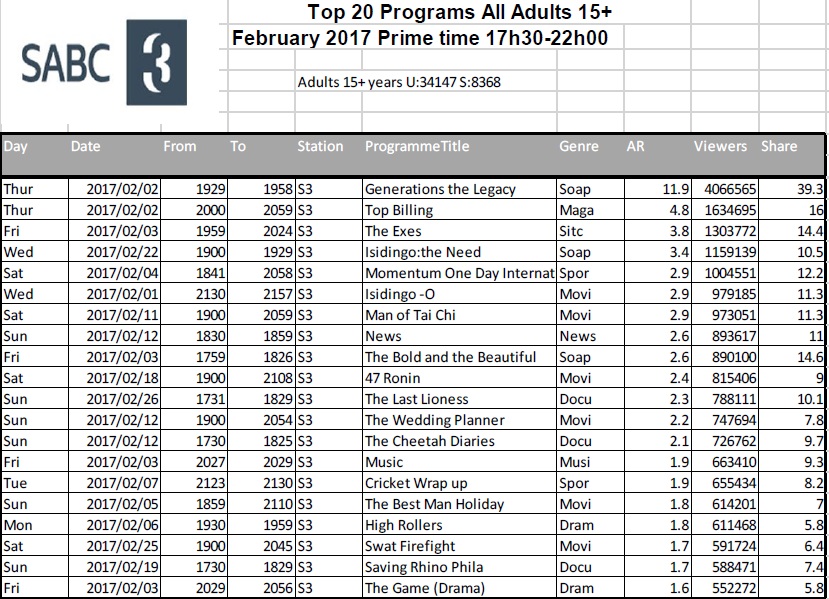
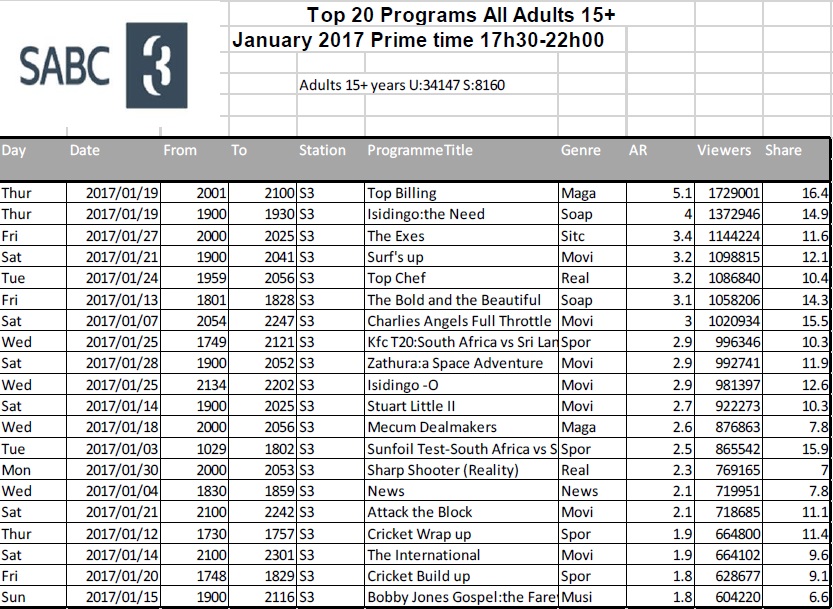
SA TV Ratings: SABC 3 — primetime top 20 for Jan, Feb 2017

by MarkLives (@marklives) The hottest primetime television shows on SABC 3 in South Africa revealed: TV ratings for January and February 2017.

In 2016, the Broadcast Research Council of South Africa (BRCSA) changed its policy about giving away TAMS and now only monthly reports, highlighting the top 20 or 30 primetime shows on several popular channels, are available.

SABC 3 February 2017

BRCSA TV Ratings February 2017 primetime SABC 3

Source: BRCSA February 2017


SABC 3 January 2017

BRCSA TV Ratings January 2017 primetime SABC 3

Source: BRCSA January 2017

Broadcast Research Council of South Africa


The Broadcast Research Council of South Africa (the BRC) is a non-profit, industry body that was incorporated in 2015 to cater to the audience research needs of the radio and television industry in South Africa.

— Sign up now for the MarkLives email newsletter every Monday and Thursday, now including headlines from the Ramify.biz company newsroom service!

Headspace: Going beyond the millennial stereotype

by Tenielle Maris. As the most-researched and analysed target audience in history, millennials are considered one of the most-influential audiences of all times. This group of 18-35 year olds is described as more optimistic, tech-savvy, experience-centric, socially driven, collaborative, ambitious and creative than their Gen X predecessors and — something that brands simply can’t seem get enough of — they believe in making a difference.

Jumping on the bandwagon

These are just some of the leading need-states that are associated with millennials all over world, and brands are jumping on the bandwagon to connect with these people in smarter and more-creative ways than the next.

The problem with this line of thinking is that we are making the assumption that this enormous and diverse group of people, spanning the globe, all have the same behavioural traits in common: whether we are talking to a 21-year-old student or a 34-year-old single mother, they both want the same thing, right?

For marketers and advertisers, this very notion goes against everything we have learned about connecting with people: that placing people in predefined, generational boxes is a recipe for cookie-cutter messaging that fails to connect with audiences on a deeper level. Not only are we disregarding life-stages and sub-cultures but it also means that we’re presuming that the 18-year-old millennial’s need-states will not evolve in any way within a 20-year timeframe. Sounds crazy, no?

“Millennial Trap”

This is something that has been described as the “Millennial Trap” (Ipsos Marketing, U.S, 2016) which essentially calls out that marketing to the ‘millennial’ is downright lazy. Why lazy, you may ask? For starters, it fails to recognise the type of millennial individuals you want to target, and then it ultimately means shoehorning a variety of things to make your brand ‘relevant’ to a gigantic base of people. People with not a lot in common.

What you end up with is a campaign that ticks a few of the generic millennial boxes but lacks the sense of purpose needed to differentiate your brand from the next. This sense of purpose — not the cool, collaborative things your brand did on Snapchat — is what engenders a long-term connection with a brand.

SME South Africa has pinpointed that the growth of the millennial customer segment, as well technological developments, will be among the biggest contributors to the changing consumer market in the country. As such a strong influence in consumer spending power, the millennial segment of consumers is hard for brands to ignore.

Getting it right

In an effort to connect with female millennials last year, Nike produced an eight-episode series that was featured on YouTube to inspire female fans to exercise. It wasn’t just the funny, branded content that connected with Nike’s audience; rather it was an authentic representation of a deep consumer insight: that each woman experiences their own personal and emotional fitness journey.

Marketers and advertisers need to remember that millennials are individuals and not just a demographic. In order to truly connect with them, beyond the obvious things we have come to associate with the stereotype, we need to dig deep to uncover the types of insights that make a brand unequivocally relevant in these individual’s lives.


Tenielle MarisTenielle Maris is strategic director at TTL agency, 34°, in Johannesburg. Beginning her career in branding and communications, she has spent the last decade in the marketing industry where she has worked upon big brands spanning the African continent. Having found her passion in understanding what drives human beings to connect with particular brands, her time is spent getting up close and personal with the people whom brands are trying to connect with. Tenielle contributes the monthly “Headspace” column, which unpacks anything and everything that helps marketers and advertisers understand why people connect with brands, to MarkLives.com.

— Sign up now for the MarkLives email newsletter every Monday and Thursday, now including headlines from the Ramify.biz company newsroom service!

2020 vision — the agency of the future

by Adrian Hewlett (@adrianhewlett) It’s time to stop talking about the death of traditional communications, and focus instead on the evolution of client’s needs.

Yes, it has been a tough year for advertising, and advertising agencies. A tougher decade. Possibly the toughest in recent history as we’ve struggled to adapt to a world that is evolving and changing at an ever-faster pace. Budgets are down, margins are tight, the industry is heavily overtraded and the bubble created by the digital world — which for a couple of years, at least, has propped up many a traditional agency — is about to burst. Okay, maybe it won’t burst, but those who have benefitted from first-mover advantage will find that the competition has now caught up.

You’d be surprised

Yet, if you stop for just a second and look over your shoulder (or perhaps, rather, under that all-pervasive line), you might be surprised to find a whole sector of the communications industry that isn’t only surviving amid all this tumult but thriving.

Specialist agencies, operating in fields as diverse as content provision, live activations, shopper marketing, trade marketing, loyalty, CRM and data management, are definitely on the up and up; and so-called traditional agencies would do well to take note.

In a world in which consumers are exposed to upwards of 5 000 commercial messages EVERY DAY, so-called ‘traditional advertising’ simply isn’t cutting it. Which is not to say that it should be cut out —rather, that marketers need to incorporate other, less-traditional means of attracting consumer attention.

The way forward

It is my belief that herein lies the way forward for the advertising world. The agency of the future must possess the ability to offer clients not only world-class branding solutions, communicated via ground-breaking creative flair, but also the means to support each and every campaign with a variety of specialist marketing solutions. The aim must be to provide a solve that goes beyond simple communications and messaging by creatively delving into the mechanics and specialisation niches that sell more of the brand, for less investment.

There are some — very large — agencies that have managed to get this right by incorporating a variety of these specialist services under one roof. Yet it is fair to say that the vast majority of these specialists are currently housed within specialist business units or consultancies, operating entirely independently of traditional agencies. This means that marketing departments across the client spectrum are dealing with a multitude of different ‘service providers’ — not only costing clients more in terms of financial commitment but time commitment, too.

It’s time to bring it all together. Because it makes sense for agencies — and clients — to benefit from streamlined costs, and even more sense for marketers to work with one trusted partner who can orchestrate a broad spectrum of work that drives KPIs across a variety of pillars.

Less about advertising, more about marketing solutions

I believe that agencies of the future should be less about advertising, and more about marketing solutions; not specialising in the provision of creative campaigns but rather orchestrating brand messaging across any and all imaginable channels to the ultimate benefit of the client.

If agencies get this right, they will continue to command the respect of their clients and will grow as any innovative and progressive business should. If they don’t, they will lose relevance and with that, contracts.


Adrian HewlettAdrian Hewlett (@adrianhewlett) is CEO of Publicis Machine, which is represented in both Johannesburg and Cape Town and features additional talent across five specialist pillars: Narrative (content marketing), Incentiv (loyalty and rewards), Answered (research), Moon Walk (public relations), and Nurun (technology specialist).

“Motive” is a by-invitation-only column on MarkLives.com. Contributors are picked by the editors but generally don’t form part of our regular columnist lineup, unless the topic is off-column.

— Sign up now for the MarkLives email newsletter every Monday and Thursday, now including headlines from the Ramify.biz company newsroom service!

Online CPD Courses Psychology Online CPD Courses Marketing analytics software Marketing analytics software for small business Business management software Business accounting software Gearbox repair company Makeup artist