SA TV Ratings: SABC 2 — primetime top 20 for Oct 2017

by MarkLives (@marklives) The hottest primetime television shows on SABC 2 in South Africa revealed: TV ratings for October 2017.

In 2016, the Broadcast Research Council of South Africa (BRCSA) changed its policy about giving away TAMS and now only monthly reports, highlighting the top 20 or 30 primetime shows on several popular channels, are available.

SABC 2 October 2017

BRCSA TV Ratings October 2017 primetime SABC 2Source: BRCSA October 2017

Broadcast Research Council of South Africa


The Broadcast Research Council of South Africa (the BRC) is a non-profit, industry body that was incorporated in 2015 to cater to the audience research needs of the radio and television industry in South Africa.

Sign up now for the MarkLives email newsletter every Monday and Thursday, now including headlines from the Ramify.biz company newsroom service!

Cover Stories: Top 5 South African mag covers for 2017 — commercial

by Shane de Lange (@shanenilfunctThere are many aspects of South African society that require more patronage and support, none more so than our county’s rich artistic heritage and culture. If many of the print magazine covers published locally this year are anything to go by, art seems to be a key theme. It goes without saying that art is a pivotal cultural pillar in the creation of any thriving society, and so my choice of the Top Five Local Commercial Covers for 2017 follows this trend in support of South African art and the various cultural efforts — often unnoticed — of South African artists.


Find a cover we should know about? Tweet us at @Marklives and @shanenilfunct.
Pinterest icon Want to view all the covers at a glance? See our Pinterest board!


#5. VISI, September 2017

VISI, 8 September 2017 — Zeitz MOCAAA recent and iconic feature has been added to the cultural landscape of African art, with the launch of the much-anticipated Zeitz Museum of Contemporary Art Africa (Zeitz MOCAA) situated within the old silo district at the V&A Waterfront in Cape Town and designed by internationally renowned architect, Thomas Heatherwick. The building is a testament to the dual notions of heritage and metamorphosis. This VISI cover depicts Githan Coopoo, assistant curator of costume, appreciating a work by South African artist, Penny Siopis, titled “Tranfigure III”, which is still on display in the museum. A succinct introduction to arguably one of the most-important institutions for contemporary African art and art from the African diaspora today, opening Africa to the world.


#4. The Mission, March/April 2017

The Mission, The Cult of Fly Fishing, issue 2, March/April 2017The Mission is an eccentric South African magazine, about the “cult of fly fishing”, that has somehow found a way to connect a niche sport with an appreciation of craft, art and design. Issue #2, published during March/April this year, started the magazine’s somewhat obscure cultural journey in which it began to showcase the work of established South African artist, Conrad Botes, known for his expressive and painterly style of illustration. Botes first emerged into the broader public sphere during the early ’90s with his contributions to the subversive publication, Bitterkommix, alongside his regular collaborator, Anton Kannemeyer. A fresh take on a seemingly conservative sport, we need more efforts like this where various facets of society — from sport, to science, to art — begin to creatively intermingle and hybridise into interesting conversations from various angles and approaches.


#3. Art Africa, Issue 9, September 2017

Art Africa, Issue 9, September 2017Invariably in favor of art that critically confronts issues on the cultural periphery of the continent, for its September issue, Art Africa showcased the work of subversive South African conceptual artist, Robin Rhode. A detail taken from Rhode’s series titled “David”, this image focuses on aspects of colour theory and geometry, following the work of Sol Lewitt (an important late-modernist and minimalist artist). Importantly, as opposed to Rhode’s earlier work, this series rejects representative forms that deliberately appropriate from political, economic, and social discourses surrounding post-colonialism, favoring the construction of a fictional, quasi Afro-modernist, world. In a warped manner, Rhode uses western establishment, in the form of high modernism, against itself, fighting fire with fire. In the end, it exposes that, despite the culmination of the struggle 23 years ago and that independence has been achieved, “liberation is not deliverance”.


#2. Friday, 1-7 September 2017

Friday Mail & Guardian, 1-7 September, 2017Zimbabwean artist, Kudzanai Chiurai, featured prominently on the cover of Mail & Guardian’s Friday magazine, with his work titled “We Live in Silence XVIII”. This image formed part of his solo exhibition at the Goodman Gallery in Johannesburg earlier this year, 31 August– 14 October. The scene is appropriated from the 1967 film, “Soleil Ô”, by Mauritanian filmmaker, Med Hondo; it’s a story about a black immigrant who travels to Paris in search of his Gaul ancestors. Kudzanai unpacks the post-colony, contesting dominant colonial narratives, and questioning expectations forced upon the African migrant to adopt the identity, language, and forms of representation of the coloniser. Inspired by Hondo, Kudzanai recasts the main character as a female in this story of black liberation, contesting gender discrimination embedded within the narrative of the post-colony, which tends to favor the black male as the savior, or martyr. An apt statement is made here, given the archaic and bigoted social, historical and political perspectives still imposed upon women locally and globally today.


#1. DESTINY, Heritage Issue, September 2017

Destiny, Heritage Issue, August-September 2017 - Esther MahlanguLiving her art, breathing her heritage, DESTINY magazine could not have chosen a better cover model than prolific South African, Esther Mahlangu. Themed the Heritage Issue, this cover sets a precedent for pluralism and multiplicity in South Africa. As a portrait of Mahlangu, it’s a picture of grace rooted within Ndebele culture, all in celebration of Women’s Month (August) earlier this year. An effective ode to cultural diversity, representation and identity in South Africa — an approach we need much more of in our country, filled as it is with so much potential.


Shane de LangeShane de Lange (@shanenilfunct) is a designer, writer, and educator currently based in Cape Town, South Africa, working in the fields of communication design and digital media. He works from Gilgamesh, a small design studio, and is a senior lecturer in graphic design at Vega School in Cape Town. Connect on Pinterest and Instagram.

Cover Stories, formerly MagLove, is a regular slot deconstructing media cover design, both past and present.

Sign up now for the MarkLives email newsletter every Monday and Thursday, now including headlines from the Ramify.biz company newsroom service!

Taking customer experience to the next level

by Leeya Hendricks (@LeeyaHendricks) As the final frontier in Star Trek, customer experience (CX) remains the ultimate lead to transformation that will propel us into the galaxy.

Corporate leaders expect chief marketing officers to have primary responsibility for growth strategies and revenue generation. CMOs need to find new routes to drive revenue. With various trends and outlined predictions for growth, one common thread is data. Data is now at the heart of customer experience, and companies are embracing advanced technology that helps them use data better.

Last year’s expert predictions of where customer experience would be headed in 2017 are already seeing traction with an ongoing stream of modern technologies that are challenging enterprise businesses to adopt smarter capabilities. Technology is impacting customer-experience development and delivery, and influencing rising customer expectations. Leading companies are integrating technologies into their existing processes to create innovatively connected experiences that increase long-term customer loyalty.

Data leading the frontier

With a growing adoption of these technologies, it is creating a higher level of customer-experience maturity, connecting systems and removing silos to create a common data source that drives more effective ways to engage customers and propel business growth. Data collection, analysis, and application allow for a richer understanding of the customer across your entire organisation.

There is a clear mandate among senior management teams and board members for marketing to be the growth driver and business value creator in their organisations.

Many CMOs highlight challenges in embracing integrated data-driven analytics to embark on the drive for revenue generation, and enduring customer relationships; with their being less involved in the development of new products, markets, customer experiences and business conversions, this should not be the case. Here lies the opportunity: data-driven platforms may help CMOs get the boost they are seeking.

Business has gone digital and there is no turning back

New-age digital consumers demand more, and expects something special each time they deal with a brand. Customers have a wide array of choices when it comes to choosing the right business to invest in, and often go with the best the market must offer that fits their budget.

What’s the first thing people do when they have a negative experience? They share it with other people. According to a research paper by American Express, 95% consumers share bad experiences with each other. If businesses don’t transform themselves digitally, they might lose their potential future customers to their competition.

Delivering an awe-inspiring customer experience remains imperative for a business to survive these times of digital transformation and delivering a consistent CX is the imperative.

Delivering a consistent customer experience

At the most-basic level, collaboration is key. If you have individual teams responsible for each area of marketing and they’re not working together, you’re going to have a disjointed customer experience.

Integrating all the departments — technology, HR, marketing etc — within the business is key. Achieving the optimum mix on how all the different departments work together is the biggest area of focus and opportunity.

In terms of managing data, consolidating it into one organisation helps, and having one platform of analytics is key. When you’re overloaded with data and everyone has a piece of it, this then adds to the problem.

The more insights we gain from data and the smarter we get with the data, the more we can prioritise and become more targeted and remove items off the list. Over time, we learn what to focus on and what not to focus on.

Marketing, technology, and management were silos of the past. Marketing technology management — MarTech — is the fabric of the future, as so eloquently put by Scott Brinker. And the best person qualified to handle all of these is the CMO, the propellant of transformation within the new frontier.


Leeya HendricksLeeya Hendricks (@LeeyaHendricks) is a chartered marketer, global marketing strategist, a digital driver and a Women in Tech leader. She joined Oracle South Africa in 2016 as marketing director SADC, responsible for leading integrated modern marketing strategies for the business across the Southern African region, and is currently marketing director for the ECEMEA region, based at Oracle UK, responsible for driving digital strategy, demand generation and transforms portfolios to develop sustainable revenue growth.

“Motive” is a by-invitation-only column on MarkLives.com. Contributors are picked by the editors but generally don’t form part of our regular columnist lineup, unless the topic is off-column.

Sign up now for the MarkLives email newsletter every Monday and Thursday, now including headlines from the Ramify.biz company newsroom service!

Brands & Branding: Brand use transcending generations

by Snethemba Phakathi & Adrie le Roux. This case study seeks to explore how Sunlight Liquid has established and maintained brand loyalty among lower LSM groups in South Africa, with particular reference to the use of advertising.

There exists limited literature (from recent years) that focuses specifically on black female South African consumers who fall into lower LSM groups. This article presents findings from a research study conducted in 2016, in which qualitative data was gathered from 20 black females residing in the Msawawa township and Diepsloot, with an income of less than R2 500 a month. Data was gathered using eight semi-structured interviews and one single focus group. Although the sample is not representative of the population and findings cannot be generalised, the data revealed factors that contributed to brand loyalty among the selected participants.

LiveMoya (2016), a SA behaviour change consultancy, notes that, although townships comprise predominantly low-income consumers, the number of consumers living in these segments mean that they represent buying power. Brands should not only market to this segment in their preferred language but also through the use of narratives that resonate with them. A number of SA brands have already elevated themselves to what Ask Afrika and the Target Group Index (TGI) (2016) refer to as ‘icon brands’ through the use of narratives that resonate with intended target markets. Alistair Mackay (2014: 22) writes that: “South Africa’s history and context has profoundly influenced the kind of themes and stories that we tell one another, and the themes that inspire and motivate us. Brands that can authentically leverage these archetypal stories will connect with South African consumers in a way that really makes an impression. But as with all brand-building today, it requires marketers to do things that demonstrate these narratives rather than just talking about them in an ad.”

Consumers who fall into lower LSM group categories have limited disposable income, and as such need value for money from the products they purchase.

Thematic analysis was used to analyse the data, and patterns and themes identified are discussed below:

Brand use transcending generations

All participants said that their first encounter with Sunlight Liquid took place at home. Their mothers, grandmothers, aunts and other women in the home have used this dishwashing liquid. Based primarily on this experience, they have come to trust and value the brand. They noted that it is hard to break away from products that they grew up with. One participant stated, “Even though there is a cheaper soap, I will still buy Sunlight. Ma, my aunts and neighbour used it when I was young. I still buy it because I saw that it is a nice washer [dishwashing liquid]… so it works for me and I know that my girls will use it [too].”

Participants have maintained their relationship with the brand, even though they are no longer living ‘at home’. One participant stated that “uGogo [grandmother] used it a lot… it would be in a small box… from the stokvel. And took long to finish. I use it still because I can save imali [money]”.

‘A little goes a long way’ — perceived quality and a reminder of ‘home’

When asked how often they purchase Sunlight Liquid, the focus group immediately recalled the phrase, “a little goes a long way”, the tagline of a popular Sunlight Liquid TV ad that they had seen on television. This was the phrase that they have come to associate the most with Sunlight Liquid.

Participants reported that the ad reminded them of their childhood homes and the poverty they grew up in. They assert that there is great truth in the advertisement and expressed sentimentality about it. It was clear that the advertisement evoked emotion among the participants.

Value for money was a product benefit that was mentioned numerous times by participants. One participant stated that she thinks many people think Sunlight Liquid is “too expensive and they don’t want to buy it… so they choose a cheap one that finishes quickly.” She explained that people are unaware that Sunlight Liquid actually helps one save money, because it lasts longer. Many respondents from the focus group agreed, saying that the liquid is also multipurpose.

When asked whether or not they would consider using another dishwashing liquid, one participant noted: “I think that I will want to try it but Sunlight is nice…I know ukuthi iyasebenza [I know that it works], futhi anginamali yokudlala [and I do not have money to waste]. So, I will continue to use Sunlight…”

Several interviewees shared a similar sentiment. They would want to try out a new dishwashing liquid, but they have used Sunlight for years, making a brand switch very difficult.

Sunlight Liquid ads and brand loyalty

In an attempt to derive whether or not a relationship between brand loyalty and advertising existed among participants, several questions about the media that they consume and ads they encounter were asked. Participant media-consumption was predominantly in the form of magazines, newspapers, posters and television. They mentioned that they had seen Sunlight Liquid print ads in local publications such as Drum and Move magazines, and on posters at their local shops. Participants said that they believed that advertising played a role in their purchasing decisions. One noted that: “There is [are] many other soaps at the stores… I think that I would buy them. I see something in a magazine, paper, TV or poster… I want to find out about it. Like if I see shoes or anything in a Jet advert on the TV, I will want to see them live [in real life]… and see if I want to buy them. I think kubanjalo with yonkinto [*it is like that with everything].”

Many stated that they think it is important to see a product and be reminded of its benefits. Product involvement and brand loyalty are positively related so, the more consumers are involved (and exposed) to a particular brand, the more-committed and -loyal they are to that brand (Karunaratma, Lim and Quester, 2003).

Many participants state that the cost of living in the Gauteng province is too high, and they have had to substitute many of their favourite brands with cheaper ones, but they have been careful to keep the Sunlight brand in their homes because they are constantly reminded, through personal use and ads, that the liquid lasts longer than others and is value for money.

Drawing on nostalgia and relevant narrative

Participants indicated that they felt the role of advertising is just as important as that of encountering a particular product in the home space. Although they stated that their first encounters with Sunlight Liquid took place at home, advertisements about the brand have acted as a reminder of the product benefits, with some participants saying that, the more they are exposed to an advertisement, the more likely they are to purchase a product. However, the importance of the perceived benefits of Sunlight among participants was continuously reinforced during interviews. All participants had come to value the Sunlight brand because their mothers, grandmothers, aunts and other females in their childhood homes did.

The study focused particularly on historically disadvantaged black women who occupy informal and formal housing, a division of people who may still be somewhat excluded from SA studies on advertising. Although these people lack financial resources (income), they still have buying power. This study sheds light on one particular group, extracting nuanced views and opinions on Sunlight Liquid.

References

See also


Brands & Branding 2017Snethemba Phakathi is a dedicated, dynamic and results-driven individual with a penchant for research who hopes to make waves in the marketing industry. She attained her BA (Hons) in strategic brand communications from Vega School. Adrie le Roux recently completed her PhD in visual arts at Stellenbosch University, with a focus on the feasibility of the use of wordless picture books in developing a culture and love of reading within the South African context, approached from her viewpoint as an illustrator. Research for this article was conducted in the authors’ capacity as honours in brand leadership students at Vega School, a brand of The Independent Institute of Education.

The article first appeared in the 2017 edition of Brands & Branding in South Africa, an annual review from Affinity Publishing of all aspects of brand marketing — consisting of case-studies, profiles, articles and research — which may also be accessed at the brand-new Brands.MarkLives.com. Order your copy of the 2017 edition now!

Sign up now for the MarkLives email newsletter every Monday and Thursday, now including headlines from the Ramify.biz company newsroom service!

The Martini Shot: A look at the status of SA’s film services industry

by Bobby Amm. The past year has been one of flux in the South African film services industry, seen across multiple platforms and fields. But, although many areas have been turbulent, we’ve got a lot to look forward to. So, to close off the year, here are the six top topics of 2017:

1. Budgets vs expenses

A current challenge in South Africa is budgets and production costs. With SA’s trying economic times, there’s a strong push by suppliers to raise fees but budgets aren’t increasing with them. This has a negative impact on an industry that’s already under constant scrutiny by cost-controllers and clients.

The Commercial Producers Association of South Africa (CPA) and its members are consequently in dialogue with suppliers about why putting rates up is counterproductive to the sustainability of the service industry. Instead, we recommend that service companies be smarter about their quotes and make a concerted effort to negotiate wherever possible.

2. SA, the film location

The 2016/17 film season was a challenging one for SA’s service sector, as it seemed to end prematurely, and it was down compared to the busy one we’d had before. Frustrations have also remained around bureaucratic red tape regarding visas and location restrictions, particularly over the holiday season.

Another concern is that clients seem less inclined to travel. This could be due to Brexit, current international instability, and the threats posed by terrorism. With SA expenses going up, SA’s also threatening to price itself out of the competition, meaning clients are also looking for cheaper production centres such as Portugal, Thailand, and South America.

The CPA has communicated with suppliers regarding its concerns about the sustainability of the industry but, with everyone battling financially, this isn’t always well-received. Their tendency is to increase rates to try offset losses, which we believe is the exact opposite of what’s needed to attract more international work.

3. A change in mindset

It’s becoming clear that production companies in the service sector need to negotiate harder than ever before. Many smaller and less-experienced companies are cutting corners to win jobs but leaving clients in the lurch when they can’t deliver on their promises. This is not good for SA’s reputation as a service destination.

Formal agreements between the CPA and supplier associations have also become problematic in that they are too rigid and often don’t allow for flexibility or negotiation. The International Performers Agreement (IPA), for example, which is used by clients to contract actors and models in SA, was verbose and confusing, so the CPA took a decision to have the contract rewritten in plain language.

Some of the old usage tables and recommended talent rates had also become outdated and lengthy, so they have also been rewritten to assist producers and agents to budget and negotiate effectively. We anticipate that this new talent documentation will be in use by the end of the year.

4. Location challenges

Location availability, and the regulations governing their use, continues to present challenges to the service sector in Cape Town. Regular meetings between industry association representatives, the City of Cape Town, and provincial government are held to find ways to accommodate everyone. This, however, is tricky, considering it’s a city where space and resources are in short supply.

One of the biggest challenges regarding the Capetonian location restrictions is when the holiday season kicks in and when other events such as Cape Town Cycle Tour or the opening of parliament take place. Events like these effectively shut down the industry.

As the issue is ongoing and requires constant management, the CPA has partnered with the South African Association of Stills Producers (SAASP) to contract a full-time location consultant, Rudi Riek. He will assist with all location-related issues that negatively impact the industry’s access to locations.

5. The film industry fund

Because of negative public perceptions about the film industry, the CPA and SAASP started The Film Industry Fund NPC in 2013. This was to address the impact that the film industry sometimes has on the public, and to give back to the communities in which filming often takes place.

The Film Industry Fund consequently puts money and resources into projects that have a tangible benefit to the people affected by filming at Cape Town’s most-popular locations. This goes a long way in uplifting the city and its people.

Since inception, the fund has undertaken the following projects:

Apr 2014 Computers donated to Baphumelele Waldorf Foundation R37 000
Aug 2014 Dancing lessons at the Samaritan Fun School of Dance in District Six R6 375
Sept 2014 Construction of a jungle gym in the Bo-Kaap R35 000
Sept 2014 Donation to Learn to Read R30 000
Sept 2014 263 books donated to the Astra School for the Disabled R10 000
Feb 2015 Television, DVDs, and educational videos donated to Hout Bay Educare R15 767
Sept 2015 Chess sets donated to Ummangaliso Primary School in Khayelitsha R3 300
Oct 2015 Construction of jungle gyms in parks in Rugby and District Six R70 000
Oct 2015 Donation to Friends of Wynberg Park for plant ID tags R5 720
Nov 2015 Construction of jungle gym in Leeuwenhof R35 000
Apr 2017 Donation of a container library to Kleinberg Primary School, Ocean View R270 000
Jul 2017 Donation to the fire relief fund in Knysna, following the devastating fires that ravaged the area R50 000
Oct 2017 Donation of a life-saving jet ski to the National Sea Rescue Institute (NSRI) R250 000

For more info on the fund and pictures of the various projects, go to www.filmindustryfund.co.za.

6. The industry evolution

The evolution of SA production is complex. This is because, instead of following a straight trajectory, it’s meeting challenges as they come up and adapting accordingly. With many companies closing and restructuring, the industry is having to diversify.

There are also a lot of newcomers challenging the more-experienced companies. This is both good and bad as, with increased competition, comes the need to work harder to win jobs and attract clients, which pushes limits and drives innovation. So, while this may be rocky terrain for most, it opens up vast new areas of opportunity.

~~~

This year’s been one of great highs and lows. We’re confident that, with a strategic and organised approach, 2018 will be more-consistently positive for the greater industry.


Bobby AmmBobby Amm is chief executive of the Commercial Producers Association of South Africa (CPA), the trade association of production companies that produce television, cinema and internet commercials for the local and international market. After a brief stint in journalism, she began her career in the industry at the Consultative Committee for the Entertainment Industry in the early 1990s. She first joined the CPA in 1997 but left three years later to join a production company. After finding that she missed the big-picture perspective of the CPA and the interesting issues which continuously perplex the production industry, Bobby returned to the CPA in 2003. She contributes “The Martini Shot” column monthly, covering developments, trends and insights into the commercial production and film services industries in South Africa, to MarkLives.

Sign up now for the MarkLives email newsletter every Monday and Thursday, now including headlines from the Ramify.biz company newsroom service!

The innovation fallacy

by Gau Narayanan. Let me start with an admission. Not quite in Steve-Balmer style but I do love our industry. And we have reasons to be positive. What we do for the brands and businesses that we serve is remarkable. Which is why this piece may appear to be a swipe at the industry yet it isn’t. It’s a request to take a long hard, honest look at ourselves in the mirror. As an industry that prides itself on being one step ahead when advising our clients, how well and how often do we apply this to our own business?

I hear and see a lot about how ad agencies have changed. Globally, and especially in the media locally, over the past couple of months or so. Instead, let’s look at some companies around the world we all admire that may help me make my point around innovation. For me, there are three fundamentals that allow these companies to be genuinely different.

1. The operating system — how they navigate the world

In April 2017, Tesla’s market cap exceeded Ford and GM’s, despite having a fraction of their revenues and that it is making a loss. The market is clearly betting on the future and Tesla’s ability to understand people and its ability to pivot. A large part of its success is due Elon Musk, a software engineer, having set up a car company. He doesn’t approach the automotive industry by the same rules; he doesn’t think the same as the C-suite of his rivals do. As a software engineer, he has set up a company with a completely different mindset and paradigm.

In our world, there are some phenomenal advertising agencies but I’m not aware of one that wasn’t started by an ad exec. I see potential paradigm-shifting thinking through the rise of Deloitte Digital and Accenture Digital, and the many media owners, from the Wall Street Journal and BuzzFeed to Quartz to HuffPo and our own 24.com, that are investing in content capabilities — who will come at it differently. These are all examples of horizontal integration, rather than coming from a radically different paradigm.

The closest example I see is the duopoly that are Facebook and YouTube. These two software companies understand their audiences; they want to monetise these audiences for themselves and on behalf of the brands. They are able to disrupt the advertising agency model using data, technology and an unrivalled understanding of consumer behaviour. That’s a different operating system.

This doesn’t mean Droga 5, Adam and Eve DDB, RGA, Colenzo BBDO, aren’t great companies run by great people who are unable to innovate — it just means their ability to look at the business differently is hindered by what they’ve already learned.

2. The algorithm — their ability to learn

We pretend, or think, we’re data driven. Many of us are, to an extent, but it’s relative. If any of us were seriously exposed to the way data drives decisions at NetFlix, AirBnb, Amazon, Alibaba, fivethirtyeight.com (the company whose US election predictions have been astonishingly accurate), Google and Facebook etc… we may develop a different view. Again, this isn’t really a criticism because the money invested by these companies in computational power, training, analytical tools, IT infrastructure, talent and AI is beyond the market cap of agencies, networks and maybe even holding companies.

But, if you start out as an advertising company, your primary view on investing ahead of the curve will not be through a data warehouse, or AI; it’ll be in people and partners to help you master a new technology or a new platform. Again, the world of software engineering teaches you to think about data differently, to think about research differently, to think about A-B testing differently. We embrace some of these principles we see in Silicon Valley some of the time but we don’t come close to using data the way these leading companies do.

3. The source code — the operational instructions

To look at how operations can truly be disrupted, look inside an Alibaba warehouse and judge our ability to organise the way we work against it. Or look at the rate of change in a car assembly plant since the 1950s.

And for us?
The way we work has been the way we’ve worked.
The copywriter plus art director pairing.
How the client briefs the agency and receives the work.
The time taken and the process of campaign development.
We claim we have revolutionised this but has it changed from Don Draper’s day?
Maybe I’m being harsh, but the reality of change doesn’t really reflect the rhetoric.
When a brief comes in, we should be surrounding that problem with the right people — ethnographers; researchers; anthropologists; category experts (aka clients); planners; media planners; analytics teams; economists — and. Importantly, the people we want to sell to (aka consumers or humans). We should look at how they currently buy or don’t buy. We should expose them to our strategic logic to see if it’s true and compelling. We should understand their journeys online and in the real world. We should understand them better as people and where they are in the buying cycle and their user journeys.

Again, the best agencies do this. Often in times of crisis (account in trouble) or opportunity (pitch), we subvert the process, but it is for a limited period. And after we put out the fire, or win the business, we tend to go back to a business-as-usual mentality.

Why?

Because it’s the tried-and-tested way.
We are creatures of habit.
It’s the way we’re paid.
It’s what we and our clients know.

But that isn’t good enough, is it? This is the kind of thinking that will get us to faster horses.
As in my introduction, this isn’t a swipe at what we do. Innovation isn’t easy; many industries are struggling with this. But, unless we admit that we are only enacting incremental innovation, we are kidding ourselves.

I don’t have the answers of how to disrupt ourselves before we become irrelevant but maybe asking yourself the following questions may give you a sense of the viability of the company you work at:

  1. Do you see or work with people who are outside advertising?
  2. Has the process and speed of developing work changed at all?
  3. Do you involve different thinkers to help you solve problems and do you test your work in interesting ways with people/potential consumers?
  4. How important is data in your company?
  5. Is technology a fundamental part of your company’s strategy?

The good news is that we have time to change: we are a simple business that has relied on powerful ideas, ideologies and people. Helpfully, too, no one has really worked this out yet but people are starting to experiment. And maybe there’s an Elon reading this article may can help this industry look at innovation through a different lens.


Gau NarayananGautham “Gau” Narayanan is regional director at BBDO Africa and managing director of Net#work BBDO. He joined Net#work BBDO at the end of 2014 after 13 years at AMV BBDO London, and has helped the BBDO agencies across Africa land several new business wins, focuses on talent development across the four BBDO offices and runs BBDO’s regional accounts.

“Motive” is a by-invitation-only column on MarkLives.com. Contributors are picked by the editors but generally don’t form part of our regular columnist lineup, unless the topic is off-column.

Sign up now for the MarkLives email newsletter every Monday and Thursday, now including headlines from the Ramify.biz company newsroom service!

Shelf Life: Grey creates Uber’s first local campaign

Cheryl Hunter (shelflife at marklives.com)’s weekly pick of all things new — product, packaging, design, insight, food, décor and more!

  • Uber South Africa ads launch with laughter
  • Ella instant cappuccino on shelf
  • Firestone’s summer karaoke in a kombi

Grey humour

The first locally production ATL campaign for global ride-hailing service, Uber, focuses on freedom, bringing to life the occasions when we just don’t want to be troubled by the hassle of driving ourselves.

Conceptualised by Grey Advertising South Africa, the TVCs and radio spot ads capture the comedically irrational relationship between South Africans and their cars. Says Fran Luckin, chief creative officer of Grey Advertising, “This campaign is not a global one that was localised; it was uniquely conceptualised and executed here in South Africa by Grey Africa.”

The ads portray the various anxieties that come with being a car owner, ranging from traffic and a lack of parking to wanting to responsibly enjoy a couple of drinks with your friends. “For these moments, Uber offers you freedom at a tap. The adverts depict the moment where people break the news to their cars: that this time, they unfortunately cannot not come with them, followed by buckets of reassurance of a reunion.”

uber.comFacebookTwitter
grey.comFacebookTwitterRamify


Quick caffeine

An off-the-shelf ‘shake, pour and drink’ cappuccino mix, called Ella, launches in Thrupps stores in Jozi this month after first being available in Spar in Hout Bay, Western Cape. It allows consumers to carry barista-quality coffee in their back pockets.

According to Neil Hellmann, entrepreneur and inventor of Ella, his team has formulated and patented a unique foaming ring which generates the perfect foam from liquid coffee and milk encapsulated in the container; this is a significant leap from the traditional powdered alternatives.

The pack design, conceptualised and designed by marketing and brand strategy consultancy Yellowwood, represents the deep aroma associated with full roast barista coffee in rich, dark colours. The logo is an ambigram taking centre stage on the pack, whether displayed on shelf or turned over to shake and pour; art was the inspiration for pack differentiation, with different moods meant to be conveyed through the tones and palette revealed through the logo.

The product itself is a combination of pure espresso and low-fat milk, is preservative free and may be kept on shelf for up to six months, thanks to a unique oxygen barrier.

ella.coffeeFacebook
ywood.co.zaFacebookTwitterRamify


Setting the summer scene

Firestone has launched its global Firestone Kombi Karaoke campaign (#FirestoneKK) in South Africa, which is hitting the road visiting several music, food and experiential festivals across the country during the busy summer season.

https://youtu.be/zcKppkooI5I

#FirestoneKK consists of two kombis: one old-school, fully restored, 1972 Volkswagen Brasília Kombi, loaded with speakers, microphones, a TV prompter and thousands of ‘old school’ songs; the other, a brand-new 2017 VW Kombi, hosting a large catalogue of new school songs.

Patrick Leslie, brand and channel manager at Bridgestone South Africa (which also manufactures and markets Firestone), says: “Music has been an integral part of the brand’s marketing DNA ever since Firestone founder, Harvey Firestone, hosted new acts on his radio show, Voice of Firestone in the 1920s. We decided to channel a bit of that legacy by creating ‘Karaoke Kombis’ to give visitors a platform of their own. At our stand, they can sing their hearts out, win great prizes and share their moment in the limelight with other festival-goers and their friends.”

After each act, participants receive an SMS with a link to their performance, channeled through the website.

firestonejourneys.comFacebookTwitter


Cheryl HunterShelf Life is MarkLives.com’s weekly column covering all things new. Notify us of yours at shelflife at marklives dot com. Want to sponsor Shelf Life? Contact us here.

Cheryl Hunter (@cherylhunter) has written for the South African media, marketing and advertising industries for more than 15 years. A former editor of M&M in Independent Newspapers and contributor to Bizcommunity, AdFocus, AdReview and the Ad Annual, she has also produced for various television networks and currently consults on communication strategy and media liaison.

Sign up now for the MarkLives email newsletter every Monday and Thursday, now including headlines from the Ramify.biz company newsroom service!

Young, Gifted & Killing It! 2017 in review

by Veli Ngubane (@TheNduna) We struck gold this year, and we didn’t have to dig too deep to find the shining nuggets in our industry. Just scratch the surface, and there they are: young and gifted creatives who’re killing it! as copy- and scriptwriters, creative, art and film directors, executive producers and more. As we discovered when we interviewed them during the year, they’re adding lustre and rich diversity to our industry. We look back on their stories.

January: Nganga Dlanga
Now copywriter at Avatar

Nganga DlangaInspired by his talented older brother, Khaya, Nganga Dlanga (@babydlanga) is clearly gifted and killing it! in the creative industry as a copywriter. An ad he crafted in the second month of his internship went on to win a Loeries Grand Prix, and then he masterminded the remake of the 16 June 1976 iconic image of Hector Pieterson.


February: Nkanyezi Masango
Creative director, King James

Nkanyezi MasangoNkanyezi Masango (@MisterMasango) has come a long way since he started out as a “shameless stalker” who identified the best creative directors and cold-called them for job interviews. We found out more about this young and gifted creative director, including the astonishing discovery along the way that the most important tool of his trade is.… pen and paper.


March: Melusi Mhlungu
Now copywriter at David The Agency (Miami, US)

Melusi MhlunguIt’s not just writing abilities or ideas that have won Melusi Mhlungu (@Adverttown) a proud place in adland, with the Loeries 2015 Young Creative of the Year already among his accolades. It’s his love for the industry that has got him this far, he explains. “Loving what you do is everything because that’s what’s going to get you through the bad days, like when your creative director says, ‘That’s a brilliant idea but it’s been done before.’”


April: Makosha Maja-Rasethaba
Head of insight at M&C Saatchi Abel

Makosha Maja-RasethabaWith single-minded determination, Makosha Maja-Rasethaba (@luminousmk) has taken every opportunity to work her way into the job she wanted from the day she graduated from brand communications school. Young and gifted, she’s now killing it in her role driving cultural and consumer insight across the M&C Saatchi Abel Group. What she would particularly like to see is more local brands embracing campaigns that break down stereotyping of women and she gives us some stunning examples in this interview.


May: Nobantu Sibeko
Art director at FCB Global

Nobantu SibekoNobantu Sibeko wanted to be an actress but, as she says, “I stumbled into advertising.” Backed by her fearless determination, this gifted young woman is now killing it! as one of the few black female art directors in South Africa. “As women, we need to start unapologetically taking up space and demanding our worth,” she tells us. “The time to be scared of asking for things we know we deserve has come to an end.”


June: Musaba Kangulu
Now senior consultant at Deloitte

Musaba KanguluAdvertising wasn’t exactly on Musaba Kangulu’s ‘Top 100 things to do’ list but the industry welcomed the wide-eyed young woman with open arms. Not afraid to speak her mind, she (@ThatTypeOfMoose)) believes in using her digital expertise to empower and nurture young black talent to challenge the status quo.


July: Amr Singh
Film director & creative partner at Fort

Amr SinghFrom working with Hollywood funnyman, Kevin Hart, and shooting music videos for rapper AKA to an award-winning short film about Nepal, 32-year-old Amr Singh (@amrsingh) has already crammed into a lot into his filmmaking career. And he is only just beginning. The co-founder of Fort — a creative agency of “storytellers for a connected world”, based in Johannesburg with offices in Cape Town, Nairobi and Lagos — Singh talks about his favourite films, the cinematic potential of virtual reality, and why more diversity is needed in the industry.


August: Jabu Nadia Newman
Film director at Ground Glass

Jabu Nadia NewmanThis writer, filmmaker and photographer is staking out her place at the forefront of the new generation of creatives in our country. Inspired by women she met during the #FeesMustFall protests at the University of Cape Town, this young and gifted creative started killing it! by putting her studies on hold to write The Foxy Five film web series, which tells the story of five friends grappling with different issues of feminism.


September: Zwelethu Radebe
Film & commercial director at Egg Films

Zwelethu Radebe. Pic: Hloniphizwe Coleman.When it comes to being young, gifted and killing it! you don’t need to look much further than Zwelethu Radebe (@ZwelethuRadebe). For the past three years, he’s been directing commercials for local and international agencies and clients in nine countries across Africa and Europe. His accolades include best short film awards at international festivals in Zanzibar and Durban for The Hangman, which he wrote and directed.


October: Simoné Bosman
Executive producer & founder at Molo Sana

Simoné Bosman“Hello Baby” has taken on a new meaning. In isiXhosa, it’s “Molo Sana”, and now it’s become Molo Sana Films. This new production house has assembled a pool of black creative talent, ranging from established film directors to photographers, content producers and writers. Molo Sana, says Simoné Bosman, “is on a mission to create work that truly speaks to the hearts of black South Africans and the rest of Africa”. This young and gifted creative tells us how she and her colleagues are working on killing it!


November: Zandi Tisani
Film director at Arcade Content

Zandi TisaniZandi Tisani (@ZandiTee) deserves an extra round of applause. “The show I wrote, directed and starred in has been selected to play at the New York Television Festival in the Independent Pilot Competition. Clap for me,” she tweeted after hearing the great news. Not only was she also the only African filmmaker to have her production screened at the festival’s flagship competition this year, she won, too, in the category OneX Pitch Deal.

Young, Gifted & Killing It! will resume in 2018.


Veli NgubaneVeli Ngubane (@TheNduna) entered the world of advertising with a passion after completing his BSocSci (law, politics and economics) at the University of Cape Town and a post-graduate marketing diploma at Red & Yellow, where he also currently serves as advisory board chairman. He is the chief creative officer and founding partner of one of the fastest-growing agencies in the country, AVATAR. A full-service marketing agency with digital at the core, its clients include Brand South Africa, FOX Africa, National Geographic, SAA and Chevron. Veli hails from Kosi Bay in the rural KwaMhlaba Uyalingana area of KZN. In his monthly column “Young, Gifted & Killing It”, he profiles award-winning, kick-ass black creative talent in South Africa.

Sign up now for the MarkLives email newsletter every Monday and Thursday, now including headlines from the Ramify.biz company newsroom service!

Media Redefined: Programmatic & the curse of the long tail

by Martin MacGregor (@MartMacG) To badly misquote Winston Churchill: ‘Never in the history of advertising has so much been spoken about one thing, yet so little understood.’ I have spent much time recently trying to really understand the phenomenon that is programmatic buying, why it came about and why it has been so successful (well, financially, for digital media agencies anyway).

This started by asking a lot of questions, first of myself and then of anyone in the industry that I have come in contact with. I soon realised that not only did I not really understand it but even the most-highly rated digital strategists were unable to explain it in simple terms.

Procurement

The murmurs around transparency in digital advertising have now erupted into a very loud shout, especially by clients as they try and understand what is going on. I am not often on the side of procurement, yet I can see that this is coming from it and rightly so. Marketing teams shouldn’t be spending a cent of their budgets where they don’t fully understand why it’s being spent and where its messaging is actually going.

I am a big believer in understanding history as a way of getting to grips with the present and, usually in history, there is one moment on which everything pivots and a new direction is taken. This moment for programmatic, according to a brilliant article in Business Insider by Mike Shields called “The Advertising Industry has been living a lie”, was when someone called Chris Anderson wrote an article in Wired in 2004 called “The Long Tail”. It captured the real potential of the web being the ability to target every possible niche-target-market audience through the use of many, many websites. This has lead to the long tail of millions of niche sites that have proliferated everywhere.

If you think about it, it’s a no-brainer: targeting the most-relevant message to the most relevant audience at a rock bottom price. The internet was going to finally deliver the holy grail of media planning — almost perfect optimisation.

Reflection of reality?

Buying audiences instead of overpriced environments made so much sense on so many levels. Rather buy an audience with intent for the category within which the brand sits, and then follow them wherever they went — to every last niche (and cheap) site. But is this long tail really a reflection of reality?

Just like on DStv, where I have access to more than 100 channels, in reality I only really watch around five. I might dip into a few others but good luck to the advertiser trying to catch me there. How many apps and sites do you really use often? It’s probably a much-smaller number than programmatic buyers are banking on, and the wastage all along the long tail everyone admits is immense.

The more I understand programmatic, the more cynical I become. Marketers globally are already questioning the tail and it’s likely to be chopped off soon. Time for a new digital media model? I think so.


Martin MacGregorMartin MacGregor (@MartMacG) is managing director of Connect, an M&C Saatchi Company, with offices in Johannesburg and Cape Town. Martin has spent 18 years in the industry, and has previously worked at Ogilvy and was MD of MEC Nota Bene in Cape Town. He contributes the monthly “Media Redefined” column, in which he challenges norms in the media space, to MarkLives.com.

Sign up now for the MarkLives email newsletter every Monday and Thursday, now including headlines from the Ramify.biz company newsroom service!

Cover Stories: Thoughtfulness in design (1 Dec 2017)

by Shane de Lange (@shanenilfunct) Let’s delve into great media design from South Africa and around the world:

  • Local/print: BitterKomix defined a vernacular in the South African creative industry
  • Local/print: Financial Mail pieces together 36 frames detailing the rise and fall of Africa’s most-infamous dictator
  • Online: Hopes&Fears continues the cause, creating evermore relevant discourse around various forms of art and design
  • International/print: Icon proves how modernism and 20th century avant-garde tendencies remain influential today
  • Iconic: RAW revived the notion of comics made for adult readers, and reformed a dwindling underground scene
  • International/print: Wired and The New Yorker portray the forth industrial revolution as burgeoning and immediate.

Find a cover we should know about? Tweet us at @Marklives and @shanenilfunct.
Pinterest icon Want to view all the covers at a glance? See our Pinterest board!


Print

Financial Mail (South Africa), 23–29 November 2017

Financial Mail, 23-29 November 2017 - Robert Mugabe

So, it is set in stone, Robert Mugabe’s autocratic reign in Zimbabwe is over. With the inauguration of Zimbabwe’s new interim president, Emmerson Mnangagwa, Mugabe’s legacy has come to an abrupt, albeit belated, end. And he has undoubtedly left a legacy, one that the Financial Mail effectively portrays on the cover of this issue. The work of Zimbabwean artist, Michael Mathison, adorns it, using 36 images of Mugabe, one from every year that he was president. The opening image is a 2Z$ from 1980 and the closing one is a 2Z$ bond from 2017, illustrating on one page how one man may uplift and bankrupt a country. Despite this, the future looks bright for Zimbabwe, with increased openness to the outside world.


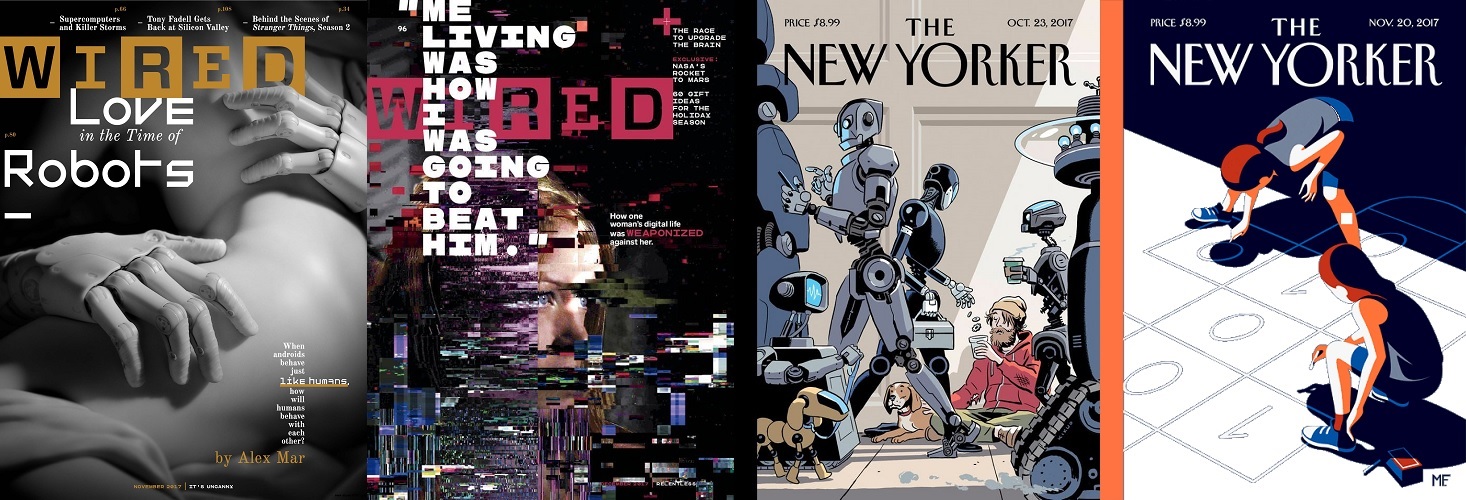
Wired (US), November & December 2017
The New Yorker (US), 23 October & 20 November 2017

Wired, November & December 2017 and The New Yorker, 23 October & 20 November 2017

The fourth industrial revolution has been upon us for a while now, with an array of new technologies that are terminally altering the way we, as human beings, function and continue to evolve. It seems inevitable:,the fusion of the physical, digital and biological, affecting all facets of human existence — economic, social, political, environmental, biological, et al. The effects of existing and emerging technologies, such as the internet of things, autonomous transportation, 3D printing, quantum computing, nanotechnology, robotics and artificial intelligence, support the growth of a new revolution; one that could pave the way for the various narratives brought forward in the various covers issued by Wired and The New Yorker alike over the past few weeks.

Aside from Wired’s “love in a time of robots” and glitch identity covers, of particular interest is Malika Favre’s illustration for the 30 November 2017 edition of The New Yorker (the tech issue), titled “Coding 101”, which observes the future in a positive light, speaking about women who find themselves in a tech-centered profession, mostly dominated by men. The message here is that a solution may be found in education from a young age for both girls and boys, using games that children play in order to do away with the stereotype that only men can be in the technology industry.

Kikuo Johnson’s “Tech Support” illustration for the 23 October 2017 cover of The New Yorker (the money issue), is also pretty insightful, depicting a world dominated by robots. A human being sits begging, with his pet dog by his side, suggesting that the artist is not too phased by the prospect of machines replacing him. After all, one does not get into a creative field such as illustration for job security.


Bitterkomix (SA), annual #17, 2016

Bitterkomix, issue 17, 2016

The most-recent incarnation of the legendary Bitterkomix canon is its 17th annual. Co-edited by established South African artists, Conrad Botes and Anton Kannemeyer, this annual is a tribute to renowned anarchist publisher, writer, artist and graphic designer, Tienie du Plessis (1949–2015). Du Plessis published the Bitterkomix duo’s first comic, called “Case no. 308”, in STET magazine. Aside from it being an ode to an historic SA publisher, this issue features the work of other key artistic talents from SA, including Gerhard Human, Joe Daly (The Red Monkey), Karlien de Villiers, and Kannemeyer’s own alter-ego, Joe Dog, to name a few. The cover, illustrated by Kannemeyer, is noteworthy as it illustrates the still-pressing topic of education in SA, related to the events that occurred during the #feesmustfall protests. It portrays student protesters celebrating while burning artworks taken from the hallowed halls of their university campus. All the while, Bitterkomix provides a satirical, almost macabre, critique of a predominantly conservative Afrikaner mainstream culture.


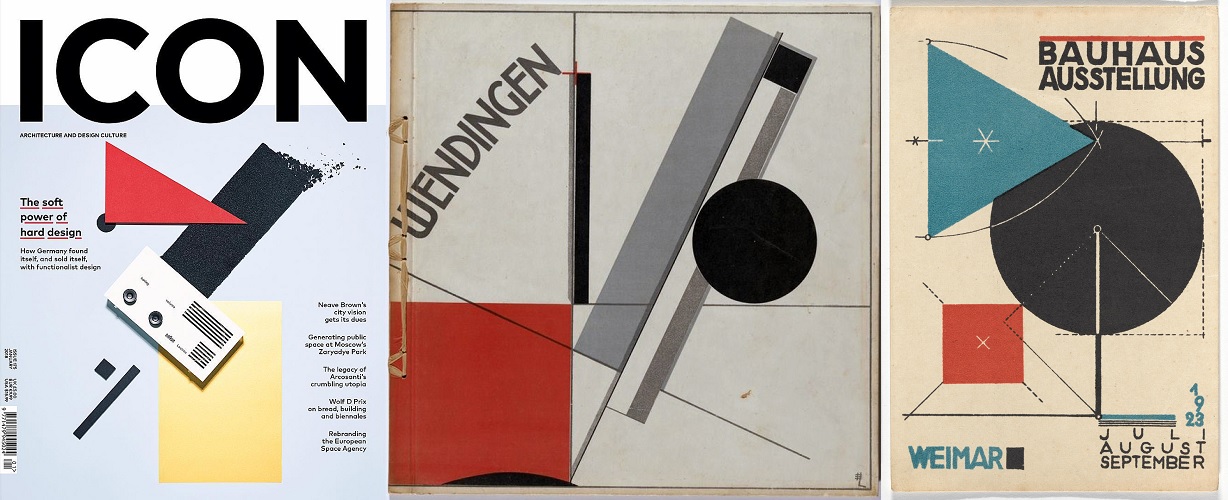
Icon (UK), #175, January 2018

Icon, January 2018 and Wendingen by El Lissitzky, 1921 and Bauhaus Exhibition by Herbert Bayer, 1923

The forthcoming issue, #175, of Icon magazine continues to hint at the renewed interest within the global creative community in modernism, particularly the early-to-mid 20th century avant-garde designers. Themed, “The soft power of German design”, one is immediately drawn to post-World War II names such as Dieter Rams and his iconic designs for Braun (displayed on the cover), but not forgetting the pre-war legacy of the Bauhaus; all of this is neatly illustrated on this cover — an ode to formalism, abstraction and, to a certain extent, minimalism.

The cover is the result of a collaboration between Carlo Apostoli (art direction), Felicity McCabe (photography, and Morewnna Smith (graphic design). In keeping with the German design theme, the cover has a slight resemblance to the work of Herbert Bayer, who was at one time a student of the Bauhaus but later became the director of the printing and advertising workshop at the school’s Dessau campus, 1925–1928. Despite the clear connections to German design, the cover is more reminiscent of Dutch and Russian avant-garde tendencies, specifically the work of El Lissitsky, illustrated here with his cover design for the Dutch magazine, Wendingen, meaning upheaval (which was the first of eight Frank Lloyd Wright issues). Appropriation, intertextuality, and iteration at their best.


Online

Hopes&Fears (US), November/December 2017

Hopes&Fears, front page, November/December 2017

Two important mechanisms in the creation of discourse are arguably relevant critique and critical thinking. And, if certain values could be attached to the process of being critical, hope and fear would be under the proverbial microscope. So, it seems apt that an online critical thinking magazine has called itself Hopes&Fears. As an online publication, it offers commentary on various cultural elements while remaining visually oriented and always keeping design in mind. The site is really well-structured and provides an unobtrusive experience, supported by functioning typeface combinations and well-curated visuals, especially when it comes to illustration. With some layered discourse to boot.


Iconic

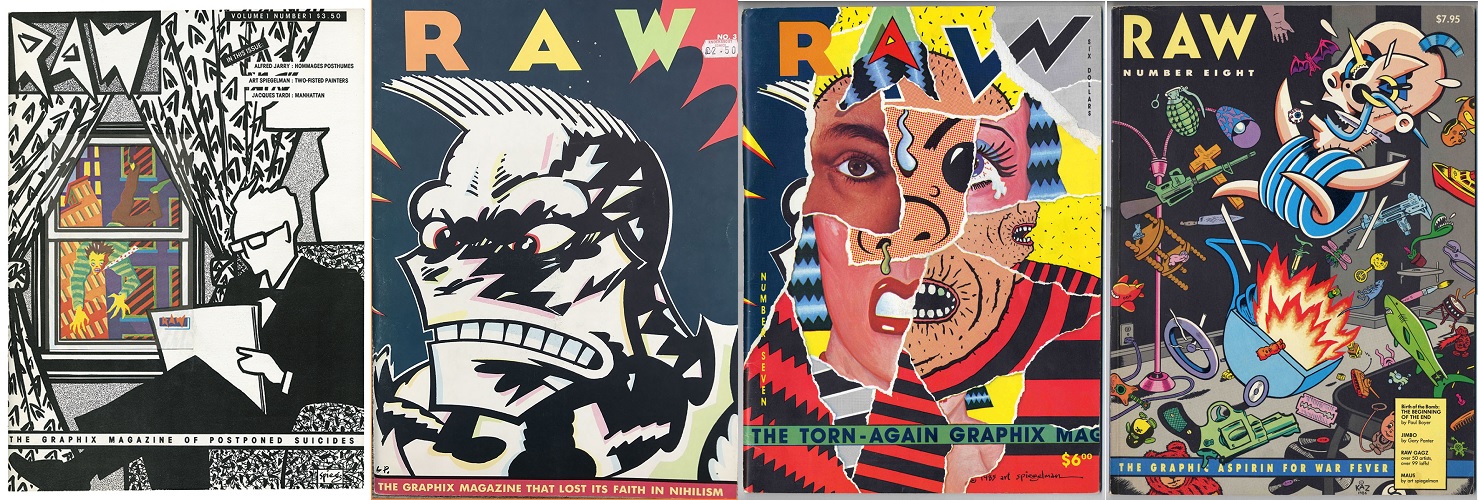
RAW (US), various (#1, #3, #6 and #8 featured), 1980–1991
RAW 1, 3, 6 and 8, 1980–1991

RAW was an influential collection of comics edited by Art Spiegelman and his wife, Françoise Mouly (currently the art editor of The New Yorker). Published between 1980 and 1991 and spanning two volumes, RAW was more-intellectually poised, as opposed to most other comics anthologies of the time.Hence it was an important entry point for European comics into the US, placing the publication at the forefront of alternative comic-book production during the ’80s.

Fearing that comics for adults could disappear, alongside the gradual decline of the underground scene, RAW took inspiration from independent punk and new wave publications, which tended to be very subversive and expressive. Veering slightly from their underground influences, Mouly and Spiegelman decided upon a large-scale, more-sophisticated format with the tagline “graphix magazine”, hoping to attract more adult readers into the comics fray.

Perhaps the most-notable comic to be showcased in RAW was Spiegelman’s “Maus”, which won a Pulitzer Prize in 1992 — the first graphic novel to do so. Recurring as individual chapters, Maus originally featured as a mini-comic placed inside each issue of RAW. Eventually, RAW shrank to mirror Maus’ size and format, culminating in the last three issues published as digests. After 11 issues, spanning two volumes, RAW ended production in 1991.


Shane de LangeShane de Lange (@shanenilfunct) is a designer, writer, and educator currently based in Cape Town, South Africa, working in the fields of communication design and digital media. He works from Gilgamesh, a small design studio, and is a senior lecturer in graphic design at Vega School in Cape Town. Connect on Pinterest and Instagram.

Cover Stories, formerly MagLove, is a regular slot deconstructing media cover design, both past and present.

Sign up now for the MarkLives email newsletter every Monday and Thursday, now including headlines from the Ramify.biz company newsroom service!

Online CPD Courses Psychology Online CPD Courses Marketing analytics software Marketing analytics software for small business Business management software Business accounting software Gearbox repair company Makeup artist