Masterclass Notes: POPI, social media & influencers

by Johanna McDowell (@jomcdowell) There were two parts to this session: the latest on the Protection of Personal Information Act (POPI), which is now starting to roll out, plus regulations that will be tabled by the Advertising Regulatory Broad (ARB) regarding the management of influencers in advertising and social media.

1. POPI

Although the POPI Act has been signed into law, it’s not yet in force. Preparations are underway, however, and it’s advisable for marketers and agencies alike to be aware of the final regulations which were published at the end of 2018. There are already five staff members employed by the Information Regulator (South Africa) to manage this — so it’s just a matter of time. It therefore makes sense for us to start implementing the provisions in readiness.

Key points

Here are some key points that were mentioned by Danie Strachan, partner at Adams & Adams Attorneys:

  • One of the most-famous cases that led to a lot of the modern-day thinking about privacy was the case in the 1960s of a Mrs O’Keefe who was photographed shooting a gun. Because of the unusual occurrence of a lady shooting a gun — in those days, at least — the photograph found its way into a newspaper. Mrs O’Keefe successfully sued The Argus for publishing without her permission and the judge said that the publication hadn’t observed her rights to privacy.
  • The POPI Act was signed into law in 2014 and final regulations were published at the end of 2018
  • We need the legislation so that unscrupulous people may not access or sell our information.
  • Some of the information is sold onto what is known as the “dark web”, where very unpleasant things are sold eg porn, drugs, guns etc
  • POPI covers:
    • Processing of personal information
    • Information entered into a record by or for a responsible party
    • Information obtained through automated or non-automated means — which must then be in a filing system
  • What is personal information — how do we define it? Apart from the obvious things such as addresses, birthdays, identity numbers etc, it also covers facial recognition and biometric information. How does this affect CCTV footage, for example? How do the owners of any CCTV security footage prove consent? Or are they protected by a disclaimer?
  • A lot still needs to be defined as we go along and as legislation is put in place and enforced
  • The big change for marketers will be the “opting in” aspect which means that they will have to ask consumers if they want to share information as opposed to the current situation where consumers have to ask to “opt out”

2. Self-regulation for influencers

Gail Schimmel, CEO of the newly constituted ARB, has been tabling a number of items to add to the advertising code of practice — the self-regulatory code for agencies and marketers alike — which will assist in the management of the communication around influencers.

She highlighted a number of examples in the area of social media in particular but, as she pointed out, the same rules apply to influencers and social media as in traditional advertising.

So, we know that consumers will feel differently if they know that an influencer is being paid. In that case, what needs to happen so that we know that a piece of communication by an influencer has been paid for?

Consumers deserve to know

  • That an influencer on social media is being paid
  • That there also has to be some sort of self-regulation to ensure that the content is true
  • And that, if something looks like editorial, is that really the case or is it “advertorial”, which is made obvious in print media for example
  • That influencers might have been paid via a barter arrangement ie use of product with some sort of testimonial in return

As a result

  • Ethical influencers will need to add an #AD or #Advertisement or #sponsored hashtag to their tweets
  • Bloggers will have to declare their gifts from brands (ethical blogging)
  • Parody accounts must be clearly declared
  • The brand is responsible ultimately for any misleading content, and it’s the agency’s job to ensure that all content is signed off as approved by client
  • Agencies and marketers must take everything they know about self-regulation in advertising and apply it to social media and influencer marketing — the same rules apply.

If in doubt, contact ARB: www.arb.org.za.


Johanna McDowellJohanna McDowell (@jomcdowell) is MD of the Independent Agency Search and Selection Company (IAS), which is partnered with the AAR Group in the UK. Johanna is one of the few experts driving this mediation and advisory service in SA and globally. She also runs the IAS Marketers Masterclass, a programme consisting of masterclasses held in Cape Town and in Johannesburg. Twice a year she attends AdForum Worldwide Summits.

— Sign up now for the MarkLives newsletter, including Ramify.biz headlines, emailed every Monday, Wednesday and Friday!

Driving retail ecommerce growth in SA a matter of trust

by ORiSA. Transparency, setting industry standards for excellence, education, and a trust mark that’s an indicator of a safe place to shop online — that’s what Edcon’s Paris Philippou believes will help drive local online retail.

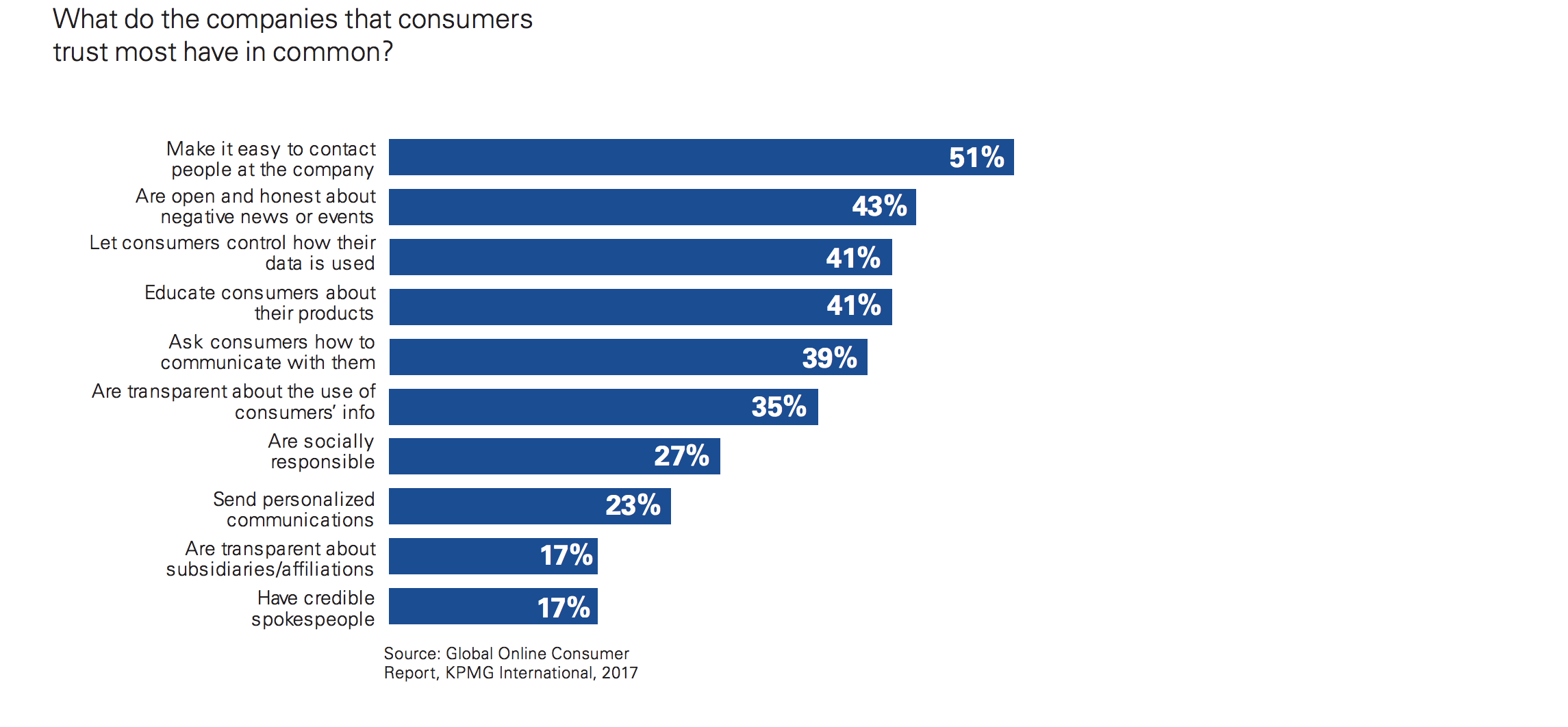
What motivates a person to buy something online? Is it because the shopper trusts one online retail brand more than another? This, in part, is what KPMG sought to understand when it did a global research study of some 18 430 consumers in 50 countries across the globe. All those surveyed had bought at least one item online in the previous year and were between the ages of 15 and 70.

Biggest impediments

Trust is one of the biggest impediments to shopping online, but what builds trust? The 2017 KPMG Research, called “The Truth About Online Consumers”, reveals that transparency, access, putting consumers in control, education, and personalisation build online confidence in ecommerce retailers.

Global Online Consumer Report, KPMG International, 2017Trust is something that Philippou thinks about a lot. The Edcon group’s divisional executive for ecommerce and digital says that branding plays a big part in building trust, as does the sophistication of South Africa’s banking system.

“South Africa has a fairly mature banking environment in comparison to the rest of Africa, which helps,” he adds. “This helps build trust because there has been a big educational push to make online shoppers aware that if there is a problem with fraud on their bank account, when it comes to online stores, the liability sits with the retail partner or the bank — whether this is an Edgars, a Takealot, or any one of the banks, which safeguards the consumer,” he explains.

Knowledge

“This means, from a transactional perspective, a lot of trust has already been gained,” Philippou says, going on to explain that trust, in part, is about knowledge and about how much the market is doing to explain the risks associated with retail, and what customers should do if their transactional cards are used fraudulently. “A big part of what trust means to the consumer is the degree to which they are comfortable enough with a brand to shop online with them.”

Despite this, he says, “there is still a lagging element of trust. For too long now, the total percentage of online retail spend year-on-year has hovered just above 1% in SA. We speak about this as the psychological 1%, a barrier that needs to be broken and which has so much to do with trust.

“But what we see in emerging markets is that if you break this barrier and start moving beyond the 1% to 2, and 3%, you get a snowballing effect. After that, retail ecommerce grows more aggressively.”

Emerging markets

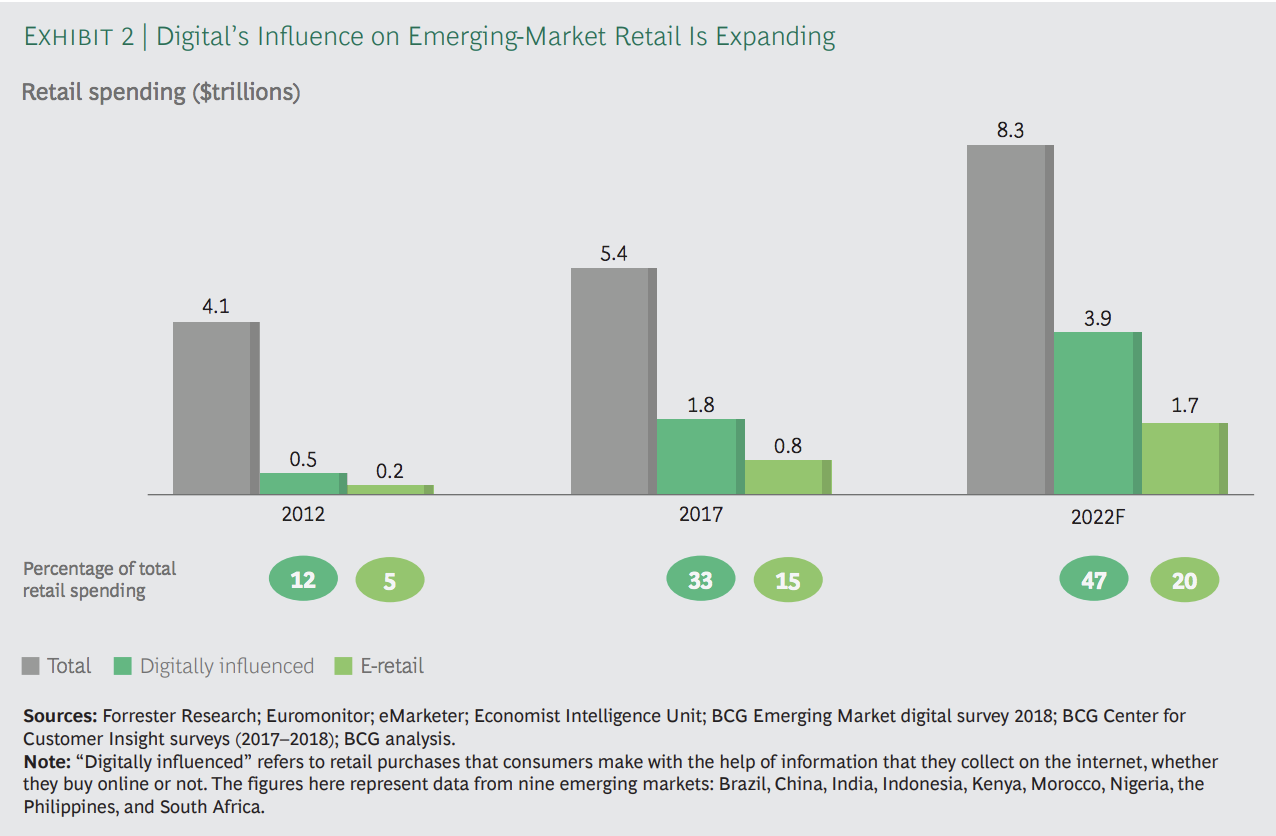
The World Bank reports that GDP in emerging markets grew rapidly, surging from 11% to 28% after the millennium to 2016. During the same period, the cost of smartphones dropped by as much as 40%, according to Boston Consulting Group, enabling “spectacular advances” in internet access. “Internet users in emerging markets now outnumber internet users in developed markets by more than two to one, and the difference is widening,” Boston Consulting Group writes in its report: “Digital Consumers, Emerging Markets, and the $4 Trillion Future”.

Boston Consulting Group digital influence on emerging market retail expanding
Source: BCG.com

“E-retail revenues in the biggest emerging markets rose to $800 billion in 2017, a figure that represents 15% of all retail revenues in those markets. And that number is dwarfed by the volume of digitally influenced purchases, which amounted to about $1.8 trillion last year and should grow to a staggering $3.9 trillion by 2022,” Boston Consulting Group writes.

A cornerstone to trust, Philippou believes, is knowledge. “By this I mean, how much is the market doing to manage the narrative and to actively educate online shoppers, and this is where a body like the Ecommerce Forum of Africa can step in,” he says. A forum board member and chair of the Trust Committee, Philippou is part of the body’s drive to grow local retail ecommerce by working with the industry to enhance trust through education, sector knowledge, research, legislation, and consumer protection. In tandem, the forum has launched “Safe.Shop”, a trust mark first set up in Amsterdam but which is now used universally to build trust among consumers worldwide and to foster global digital trade.

Industry standards

“We’re bringing in agreed industry standards, and engaging with online retailers to ensure that they meet these minimum criteria so that the industry works together to grow the sector as a whole,” he says. “We’re hopeful that this will make people more comfortable to do that first online shop, or to start shopping online regularly.”

Innovation, Edcon’s ecommerce head says, will also drive growth: “South Africa should be growing a lot faster, but there are so many gaps and opportunities for local solutions. This is where the real retail disruptors are going to emerge from. Younger generations are going to be the ones that come up with the ideas that we can’t dream of right now, and which will catapult retail ecommerce to new levels.”

More ORiSA stories


Online Retail in South Africa 2019 (ORiSA) is a study conducted by World Wide Worx and Platinum Seed with the support of Visa, and is endorsed by the Ecommerce Forum of Africa. Marklives.com is the media partner, and Heavy Chef is the learning partner for this initiative, which seeks to actively promote online shopping and the growth of online retail in South Africa. For more info, go to onlineretail.co.za, or download the executive summary.

MarkLives logo— One subscription form, three newsletters: sign up now for the MarkLives newsletter, including Ramify headlines; The Interlocker, our new monthly comms-focused mailer; and Brands & Branding, launching soon!

SA TV Ratings: DStv — primetime top 30 for Feb 2019

by MarkLives (@marklives) The hottest primetime shows on DStv in South Africa revealed: TV ratings for February 2019.

DStv logoDStv, February 2019

Top 30 Programmes All Adults 15+ & DSTV Adults
February 2019 Prime Time 5.30pm—10pm

Source: BRCSA February 2019

 Adults 15+ years

U:35679 S:8315

Digital DSTV U:19816 S:5222

Day

Date

From

To

Station

Programme title

Genre

AR

Viewers

Share

AR

Viewers

Share

Tue 26/02/2019 2100 2129 MZAN The Queen Movi 3.42 1 219 117 10.7 7.51 1 487 675 22.7
Sun 24/02/2019 1902 1955 MZAN Our Perfect Wedding Dram 2.79 996 235 9.6 5.85 1 158 561 17.9
Sun 17/02/2019 2000 2055 MZAN Ehostela Dram 2.62 936 097 8.1 5.69 1 127 787 16.6
Mon 25/02/2019 2030 2059 MZAN Isibaya Dram 2.34 833 429 6.5 5.06 1 001 905 13.7
Sat 16/02/2019 1932 2001 MWET Sengkhathele Maga 2.21 789 680 7.5 4.79 949 431 14.9
Thur 14/02/2019 2058 2101 MZAN Epk:Gh Mumm Sunmet Docu 1.99 708 439 8 4.28 848 167 16.8
Sun 17/02/2019 1801 1859 MZAN Date My Family Real 1.94 691 770 7.5 4.01 794 334 13.8
Wed 27/02/2019 1900 1929 MZAN The Throne (Drama) Dram 1.67 596 698 5.3 3.52 697 060 10.8
Sat 16/02/2019 2102 2159 MWET Igazi Dram 1.59 566 763 6.4 3.68 729 467 13
Mon 04/02/2019 1930 1959 MZAN Isithembiso Dram 1.45 515 999 4.5 3.15 624 364 9.6
Sun 24/02/2019 2100 2129 MZAN Ikhaya Dram 1.43 510 485 5.6 2.99 591 720 10.2
Wed 06/02/2019 2000 2029 MZAN Unmarried Dram 1.39 495 216 3.9 3.01 596 954 8.7
Sat 09/02/2019 1537 1801 SUP4 Absa Premiership Kaizer Chiefs vs Orland Spor 1.32 469 328 5.7 2.74 541 970 10.9
Sun 24/02/2019 1800 1853 MBIO Ntombinkulu Dram 1.25 446 100 5.1 2.96 587 244 10.2
Sun 03/02/2019 1430 1924 SSEL Wwe Specials: Royal Rumble Spor 1.23 437 131 5.5 2.61 518 017 10.3
Thur 21/02/2019 1000 1029 MZAN The Queen-R Dram 1.2 427 536 8.2 2.31 458 434 16
Mon 18/02/2019 1603 1655 MBIO Four Four Masihlalisane Dram 1.18 421 275 7.3 2.53 500 472 12.7
Sun 24/02/2019 2002 2135 ZONE Anacondas:the Hunt for the Blood Orchid Movi 1.17 418 062 4 2.85 564 915 8.8
Sun 17/02/2019 1730 1759 MWET Isibaya – R Dram 1.17 416 219 5 2.94 582 782 10.7
Thur 21/02/2019 1030 1100 MZAN Isithembiso -R Dram 1.15 411 009 8 2.25 445 698 15.3
Sat 23/02/2019 1806 1929 MWET Idols SA Real 1.15 409 680 5 2.65 525 906 10.1
Tue 05/02/2019 1600 1656 MBIO Ungeno Movi 1.12 400 615 6.9 2.41 477 296 12.7
Mon 04/02/2019 1900 1929 KYKN E-Nuus News 1.1 393 685 3.6 2.08 411 310 6.7
Sat 23/02/2019 1709 1912 SUP1 Super Rugby:Stormers vs Lions Spor 1.09 387 900 5.1 2.11 418 364 8.5
Mon 04/02/2019 1601 1655 MBIO Nkosathana Dram 1.05 372 807 6.7 2.26 447 710 11.7
Tue 26/02/2019 2003 2031 MZAN Yobe Real 1.04 372 142 3 2.18 432 133 6.2
Thur 28/02/2019 1500 1552 MBIO Isibonakaliso Dram 1.03 367 236 6.6 2.11 418 634 11.5
Fri 08/02/2019 1601 1656 MBIO Isitha Dram 1.03 366 940 6.4 2.23 441 065 11.6
Thur 28/02/2019 1600 1656 MBIO Ingoduso Dram 1.03 366 520 6.4 2.16 428 505 10.7
Mon 18/02/2019 1504 1559 MBIO Umgcagco Wezinyembezi Dram 1 358 454 6.5 2.06 407 983 11.3

In 2016, the Broadcast Research Council of South Africa (BRCSA) changed its policy about giving away TAMS and now only monthly reports, highlighting the top 20 or 30 primetime shows on several popular channels, are available.


Broadcast Research Council of South AfricaThe Broadcast Research Council of South Africa (the BRC) is a non-profit, industry body that was incorporated in 2015 to cater to the audience research needs of the radio and television industry in South Africa.

— One subscription form, three newsletters: sign up now for the MarkLives newsletter, including Ramify headlines; The Interlocker, our new monthly comms-focused mailer; and Brands & Branding, launching soon!

#AgencyFocus: The business impact of Retroviral

by Sabrina Forbes. Retroviral’s manifesto speaks about “brave business, brave brand, and brave heart” and explain how it “vow[s] to throw rocks at the stagnant pool of digital comms, punch brands in the gut of their crippling conservatism, and throttle the breath out of mundane and mediocre marketing”. The digital communications agency believes that “disruption can only ever be derived from differentiation” and that “talk is cheap [but] so, too, is unimaginative social media”.

Almost nine years ago, one of the first influencer marketing agencies in the country was born. What started out as a niche, social amplification play has evolved into an award-winning digital creative agency whose work has not only gone ‘viral’ myriad times but created solid commercial success for its respective clients. Led by its founder, Mike Sharman, Retroviral was already generating hundreds of thousands to millions of social views in 2010 by creating what he calls a “sticky factor” for content. Today, Retroviral makes word of mouth spread online for brands using bespoke strategy, online video creation, content seeding, social media, and influencer marketing.

“Virality for us isn’t just a buzzword. It’s about an impact that [leads] to a sale. It actually [has] a business impact,” he says.

Watershed moment

It was from its fifth year in business that Retroviral stopped having one-night stands with clients, successfully converted project clients to retainer. From 2015 to 2018, the agency experienced 1000% increase in retainer income. Then, in 2016, it had its watershed moment when it was awarded lead creative agency for both RocoMamas and Russell Hobbs.

Sharman credits the long journey he and his team took to really figure out who they were as an agency to the success his business is experiencing today. The team consistently works to understand its four core pillars: strategy and content creation take first and second place; marrying the king (content) and queen (audience) with clever dissemination is third; and reporting closes off the loop as fourth.

“We’re obsessed about the dissemination of our content,” he says, explaining his belief that reporting in our industry is broken and that agencies tend to be scared to look at what they’ve achieved. For him, setting metrics with honest clients is most important. “Calls to action are our objectives as agencies,” he shares.

Counter-culture

Retroviral is the alternative agency
Click to enlarge

Sharman believes his personality works best with clients willing to look at counter-culture and take risks. “People know very quickly if my personality is going to work for them or not,” he says.

He wastes no time in explaining that what his business is good at is working with the #3 and #4 brands in their respective industries; he doesn’t covet working with leading brands. For him, Retroviral is a disrupter agency suited to disrupter brands —the alternative agency.

Sharman’s top trend for 2019 is the creation of behavioural change. In June 2018, Retroviral launched “Liberty Lives”, an internal system for Liberty staff members that gives them login-controlled access to podcasts, videos, information, training programmes etc. It’s been well-adopted — 3000 people currently log in , even though there are a number of security hoops to do so — and shows that, by providing relevant content and giving employees an entertaining incentive platform, the knock-on effects may be huge.

Russell Hobbs

Retroviral’s work for Russell Hobbs, which made it onto Top 10 ads of the week on AdsoftheWorld, cleverly uses only the sounds made by using the range of appliances to create the TVC soundtrack. The strategy was to show the breadth of the brand and educate consumers that it does a lot more than just toasters and kettles.

RocoMamas

Since Retroviral took over as lead agency for RocoMamas, its first campaign for the brand, #ElectionBurger, showed the virality of using current affairs in a creative way to generate consumer engagement, which in turns generates sales. The campaign reached 14m people online alone and increased RocoMamas’ year-on-year sales by 20%.


Unofficial ambassador

As the head of Retroviral and unofficial ambassador for his clients’ brands, Sharman has experienced the influx of communication on all fronts. “As a leader, there are more channels to be contacted on, especially with the technologically advanced clients we have,” he says. His team runs internal and external communications through traditional channels such as email and the like but finds that WhatsApp is the quickest route to dump thoughts, share ideas, send references, and find inspiration 24/7 — in the age of social, having a WhatsApp group with the founder of RocoMamas to get feedback in real time is an important strategy, especially for a brand that monitors Twitter live 20 hours a day.

The potential for burnout is massive, and growing. “We live with more clutter than ever before and, as humans, we haven’t kept up with the pace we’re creating the technology,” says Sharman. To survive in a world drowning in content, he believes his super powers to be the ability to remember names and faces, and to make sense of a lot of information very quickly: “I can retain and distill information easily and can take as much information as I need from all platforms and then create the most-valuable output for my clients. I love that we get to make money by being creative. It’s the ultimate drug. It keeps me ticking.”

When asked how he first priced Retroviral in the industry, Sharman admits that, even though it was a young small business, it launched and pitched as a medium-sized one. This way, as it grew, it didn’t need to raise its prices to keep up. While he will admit he’s not good with details, he chose a strong finance partner to take care of that part of the business. The tight financial processes mean it’s a smarter business today, and potentially into the future.

BBBEE

In June 2018, a 51% stake in Retroviral was bought by Shaka Sisulu, entrepreneur, businessman and founder of Plum, another digital and social media agency. This has raised Retroviral’s empowerment status to BBBEE Level and the two agencies work in tandem.

All 16 Retroviral employees are seen as partners, too, with Sharman taking his experience working at Black River FC in 2010 as a springboard for creating his own agency culture. People are inherently very different and he wants everyone to have the freedom to share what they feel and believe. His culture is that of autonomy with accountability. “Different people bring the best of the strengths of their own shit to the mix,” he says.

As an entrepreneur, Sharman has experienced the highs and the very lows — and written a book about it, too. It’s a lonely journey where you’re always expected to be on your A-game, even though your friends, family, and colleagues might not understand how difficult creating this perception can be. In saying this, he’s kept ticking and inspired by his journey and isn’t about to stop now. “We’re all a little bit f*cked up; that’s why we’re in this industry,” he says.

Retroviral logo square
www.retroviral.co.za

  • Office locations: Sandton, Joburg
  • Revenue band: R20–30m
  • Staff count: 16
  • Key clients: Russell Hobbs, RocoMamas, Epson, Martin and Martin, Blue Ribbon, BB Bread, M-Net
  • Services: Strategy, online video creation, content seeding, influencer marketing & social media

See also

Updated at 9.21am on 25 March 2019.


Sabrina Forbes“#Agency/BrandFocus” is an ongoing weekly series updating the market on ad agency performance, including business performance, innovation, initiatives, the work, awards and people.

Sabrina Forbes (IG) is an experienced writer covering the food, health, lifestyle, beverage, marketing and media industries. She runs her own full-stack web/app development and digital-first content creation company. For more, go to moonwrench.com. She is a contributing writer to MarkLives.com.

— One subscription form, three newsletters: sign up now for the MarkLives newsletter, including Ramify headlines; The Interlocker, our new monthly comms-focused mailer; and Brands & Branding, launching soon!

2018 Creative Circle annual award winners, overall rankings

by MarkLives (@marklives) South Africa’s Creative Circle has announced its Annual Award 2018 winners and Overall Rankings. Nando’s, Sanlam and Carling Black Label were the big winners of Wednesday night, 20 March 2019, with each brand winning in multiple categories. Ogilvy Cape Town was the top performer followed by M&C Saatchi Abel Cape Town and then King James Group.

TBWA\Hunt Lascaris Johannesburg came first in the Creative Circle Overall Rankings Agency of the Year 2018. Second was Ogilvy Joburg, followed by Joe Public United in third. TBWA SA and Ogilvy SA tied for Group of the Year 2018, followed by Joe Public United in third place.

Annual Awards 2018

Category

Prize

Campaign title

Brand

Product

Entry agency

Communication Design: Jan–Dec 2017 1st Beautiful Pathogens Goodbye Malaria Goodbye Malaria TBWA\Hunt Lascaris Johannesburg
Communication Design: Mar 2018 2nd #rightmyname Nando’s PERi-PERi Chicken M&C Saatchi Abel Cape Town
Communication Design: Jan–Dec 2017 3rd Know Your Strength Zazi Zazi Shift Joe Public
Digital & Interactive: Jan–Feb 2018 1st The World’s First Baby Marathon Kimberly-Clark Huggies Ogilvy Johannesburg
Digital & Interactive: Apr 2018 2nd Breaking Ballet Joburg Ballet Bite-Size Ballet TBWA\Hunt Lascaris Johannesburg
Digital & Interactive: Mar 2018 3rd #rightmyname Nando’s PERi-PERi Chicken M&C Saatchi Abel Cape Town
Live Communications: Mar 2018 1st Soccer Song for Change Ab: InBev Africa Carling Black Label: Anti Women Abuse Initiative Ogilvy Cape Town
Live Communications: Mar 2018 2nd Bill of Rights ZA The Apartheid Museum The Apartheid Museum Joe Public United
Live Communications: Mar 2018 3rd Halloween Sleepover MultiChoice DStv Ogilvy  Johannesburg
Out of Home: Nov 2018 1st #NoExcuse Body Count ABInBev Carling Black Label Ogilvy Cape Town
Out of Home: Sep 2018 2nd Corolla Beaded Billboard Toyota South Africa Motors (Pty) Ltd Corolla FCB Joburg
Out of Home: Jun 2018 3rd The Anthology of Great(stock) Poetry GreatStock GreatStock Joe Public United
PR & Media: Sep 2018 1st Make A Meal of It KFC Streetwise 2 Ogilvy Cape Town
PR & Media: Mar 2018 2nd NotThatNewlands Newlands Spring Brewing Co. Newlands Spring Brewing Co. King James Group
PR & Media: Jan–Feb 2018 3rd 2 Minute Shower Songs Sanlam 2 Minute Shower Songs King James Group
Print: Mar 2018 1st #rightmyname Nando’s PERi-PERi Chicken M&C Saatchi Abel Cape Town
Print: May 2018 2nd Life beyond the logo, Red Bull, Puma, Angry Birds National Geographic Kids Magazine magazine FoxP2 Advertising
Print: Jun 2018 3rd Afrikaans Independent Media Isolezwe FCB Durban
Radio: Apr 2018 1st Toyota Hilux Hill Assist “Just Another Road”, Anniversary, Lobola, Boss Man Toyota South Africa Motors (Pty) Ltd Hillux Hill Assist FCB Joburg
Radio: Jun 2018 2nd Far Fetched, Catch It, Kiss, Spike Lee Chicken Licken Brand Joe Public United
Radio: Jan 2018 3rd Masekela Tribute Universal Music South Africa South African Jazz Music Havas Worldwide Johannesburg
Film- May 2018 1st Return–Chapman’s Peak Mercedes-Benz S-Class Net#work BBDO
Film- Nov 2018 2nd Vuka SAB 18+ Joe Public United
Film: Jun 2018 3rd Father’s Share Allan Gray Allan Gray King James II
Integrated: Jan–Feb 2018 1st 2 Minute Shower Songs Sanlam 2 Minute Shower Songs King James Group
Intergrated: Mar 2018 2nd #rightmyname Nando’s PERi-PERi Chicken M&C Saatchi Abel Cape Town
Integrated: Oct 2018 3rd Sanlam 100 Years | Integrated Campaign Sanlam Sanlam Financial Products King James Group

Overall Rankings 2018

Agency of the Year

Rank

Agency

1 TBWA\ Hunt Lascaris Johannesburg
2 Ogilvy Johannesburg
3 Joe Public United
4 King James Group
5 Ogilvy Cape Town
6 VML
7 M&C Saatchi Abel Cape Town
8 Grid Worldwide
8 Grey
10 FCB Johannesburg
10 DDB SA
10 1886 Advertising (Hello Computer)
13 FCB Cape Town
14 FoxP2 Cape Town
14 Bain & Bunkell
16 Net#work BBDO
17 King James II
17 Havas Johannesburg
19 FCB Durban
19 Shift Joe Public

Group of the Year

Rank

Group

1 TBWA\SA
1 Ogilvy SA
3 Joe Public Group
4 King James Group
5 VML
6 FCB Africa
7 M&C Saatchi Abel
8 Grey
9 DDB
10 Bain & Bunkell
10 FoxP2
12 BBDO
13 Havas

Creative Circle Annual Awards

Rank

Agency

1 Ogilvy Cape Town
2 M&C Saatchi Abel Cape Town
3 King James
4 Joe Public United
5 TBWA\Hunt Lascaris Johannesburg
5 FCB Johannesburg
7 Ogilvy Johannesburg
8 Net#work BBDO
9 FoxP2 Cape Town
10 King James II
10 Havas Johannesburg
10 FCB Durban
10 Shift Joe Public

The Creative Circle Overall Rankings are the cumulative results from all the Creative Circle-endorsed global and local award shows throughout 2018, including The One Show, D&AD, Cannes International Festival of Creativity, Loeries and  its own Annual Awards, at which judges look at all the Creative Circle Monthly Award winners throughout the year and award the best work from each category. Only Creative Circle SA members are included.

Sponsors are SAB, AB InBev, Liberty and Primedia, which sponsored the Radio & Audio category with free airtime to the value of R100 000, R60 000 and R40 000 respectively for this year’s first, second and third place Radio & Audio winners.

Judges

Name

Position

Agency

Peter Khoury CCO & Creative Circle chairperson TBWA\Hunt Lascaris Joburg
Brad Reilly ECD  Net#WorkBBDO
Bridget Johnson ECD  Riverbed
Grant Sithole CCO  Avatar
Jonathan Deeb CCO FCB Africa
Justin Gomes Founding partner FoxP2
Neo Mashigo CCO M&C Saatchi Abel
Nkgabiseng Motau Co-founder Think Creative Africa
Molefi Thulo Creative partner Ogilvy Joburg
Nathan Reddy CCO Grid Worldwide
Roanna Williams ECD  Joe Public United
Rob McLennan Creative leader SoloUnion
Safaraaz Sindhi Associate CD Ogilvy Cape Town
Suhana Gordhan CD FCB Africa
Xolisa Dyeshana CCO Joe Public United

See also


MarkLives logo— One subscription form, three newsletters: sign up now for the MarkLives newsletter, including Ramify headlines; The Interlocker, our new monthly comms-focused mailer; and Brands & Branding, launching soon!

Media Design: Brein, Bloomberg Businessweek, Eye On Design, NYLON

Shane de Lange (@shanenilfunct)’s weekly analysis of media design from South Africa and around the world:

  • Independent print: AIGA Eye On Design continues to asks pertinent questions about the value of design in socioeconomic terms, power relations, and the human factor
  • Commercial print: Bloomberg Businessweek reflects on the state of society today through the lens of mediocrity exhibited by governments and corporations around the world
  • Iconic: Brein is a testament to how the underground feeds the mainstream, only in a South African context
  • Online: NYLON is also a testament to how the underground feeds the mainstream, and vice versa, in a continually evolving lifecycle between the new and old, and the commercial and sub-cultural
  • Special mention: The Guardian — Journal reflects upon the horrific events that unfolded in New Zealand last weekend.

Find a cover we should know about? Tweet us at @Marklives and @shanenilfunct.
Pinterest icon Want to view all the covers at a glance? See our Pinterest board!


Print

Heart-Love-Polygon-Geometric-Flat-Design-Icon-Illustration by lekkyjustdoit courtesy of FreeDigitalPhotos   Bloomberg Businessweek (US) 11 & 18 March 2019

Bloomberg Businessweek, 11 & 18 March 2019 - Game of Thrones and Mark ZuckerbergThe last two issues of Bloomberg Businessweek are too clever not to mention together.

The first, from 11 March 2019, paints a portrait of bureaucracy today, implying a plague — a destructive meme in businesses, brands, corporations, governments, and the like — that continually call upon their original values but actually don’t have any values at all. Who, lacking empathy or foresight, fall upon age-old strategies that are void of any insightful approach to leadership, using branding jargon such as “promise”, “essence”, “vision”, “mission”, etc but, in the same breath, don’t see people as human beings, viewing us only as consumers. And, rather than seeing employees as human beings, they see numbers depicted in various colour-coded Venn diagrams, bell curves and strategic models, using overused empty terms like “innovation” and “disruption” as alibis for the destruction of culture. This is why these institutions are prone to be blinded by their own mediocrity and red tape. Globally, these entities no longer have it in their DNA to be ‘disruptive’ or ‘innovative’, even though they continually use this rhetoric, because bureaucracy is entrenched, aiming only to please shareholders, ignorant towards stakeholders, focused only profit.

Brexit is an obvious example of this plague in terms of global politics and socioeconomic concerns. When compared to Netflix, the archaic strategy of AT&T regarding HBO’s streaming service is another. This overall problem of ‘Strategy Out of the Dark Ages’ is visualised here like a conceptual art installation, with an archetypal office chair lit with ‘cool’ florescent light, superimposed with the Iron Throne from Game of Thrones (implying fantasy and spectacle), surrounded by stereotypical office props such as a fake plastic indoor plant, the ubiquitous water dispenser, and a dated air conditioner. A pure image of leadership, or the lack thereof, today.

The second, from 18 March, relates to the first in many ways, specifically when it comes to values, leadership, empathy and the human factor. It presents a creepy machine-like portrait of Facebook co-founder and CEO, Mark Zuckerberg, looking like the corporate version of the Night King (another Game of Thrones reference), groomed to sit in the office iron chair pictured in the previous issue. With the headline, “The apology machine”, the robot-like Zuckerberg — also reminiscent of the Data character from Star Trek — is superimposed with code suggesting his inner monologue, and resultant lack of ability to perceive compassion and empathy. What a portrait of business and leadership today.


Heart-Love-Polygon-Geometric-Flat-Design-Icon-Illustration by lekkyjustdoit courtesy of FreeDigitalPhotos    AIGA Eye on Design (US), issue #3, November 2018 & issue #4, March 2019

AIGA Eye On Design, issue 3, November 2018 & issue 4, March 2019The last two issues of AIGA’s Eye on Design magazine are also worth mentioning together, and oddly relate to the issues of Bloomberg Businessweek mentioned above. Released near the end of 2018, issue #3 was themed “Gossip” and designed by Tala Safié. Suggested by the manipulated eye on the cover — made to look like a talking mouth spreading various converging and diverging lines of communication — this issue delivers reportage on the role that design has in various forms of communication today, whether fake or truthful, manipulating and influencing.

Themed “Worth”, perhaps #4 is more closely related to the subject matter of the Bloomberg Businessweek issues above. The cover sports a glossy, iridescent eye that has been covered with a giant metallic barcode, with Orwellian implications. Guest-designed by Berlin-based graphic designer, David Benski, #4 asks pertinent questions about the value of design in socioeconomic terms, power relations, and the human factor.


Online

Heart-Love-Polygon-Geometric-Flat-Design-Icon-Illustration by lekkyjustdoit courtesy of FreeDigitalPhotos   NYLON (US), March 2019

NYLON, online, March 2019A testament to how the underground feeds the mainstream, and vice versa, in a continually evolving lifecycle between the new and old, and the commercial and subcultural, New York-based NYLON is a leading lifestyle magazine for young women and is focused on emerging culture through youthful reportage about the dark matter that exists between fashion and entertainment.

Previously, NYLON had Marvin Scott Jarrett as editor-in-chief, as he was a founder of the publication alongside Jaclyn Jarrett, his wife. Interestingly, Marvin Scott Jarret was the owner, founder and publisher of Ray Gun magazine, which produced over 70 issues between 1992 and 2000. His magazines have always been noteworthy for their iconic use of graphic design, calling upon the talents of a number of historically influential creatives, most famously David Carson [who was recently interviewed by Media Design] and Chris Ashworth.

After much controversy, wherein it appears that Jarret had NYLON pried away from him in a joint-investment move from a number of influential corporate entities, NYLON has evolved into a multiplatform media company, with the original magazine turning into an afterthought. The focus still remains fashion but is geared more aggressively towards youth and pop culture. Marc Luzzatto is now the chairperson and owner of NYLON, and he made the call to close off the original print edition of magazine, with Evan Luzzato as the president, alongside Gabrielle Korn as editor-in-chief.

Despite all the tectonic shifts at NYLON, the online presence of this media company is impressive. The latest edition showcases American screenwriter, producer, and actress, Lena Waithe. The site is really well put together, with all musts for a well-oiled user experience supported by great design.


Iconic

Heart-Love-Polygon-Geometric-Flat-Design-Icon-Illustration by lekkyjustdoit courtesy of FreeDigitalPhotos   Brein (South Africa), 1998–2000

Brein, issue 1 1998, issue 2 March 1999 and issue 3 March 2000Brein was a Bitterkomix-inspired zine, first published in early 1998. The brainchild of South African designer and illustrator, Rikus Ferreira , the first issue was co-edited with his university classmate, Matt Ross (who is today co-founder and chief creative officer at King James Digital), while completing their final year at the visual arts department of Stellenbosch University.

Brein was launched in Stellenbosch, and was also showcased at the KKNK in Oudtshoorn (accompanied by an exhibition) and the National Arts Festival in Grahamstown that year.

Only three issues were published. While completing his masters in fine art at Stellenbosch University, Ferreira went on to edit the remaining two issues of Brein alone, as Ross left for England in late 1998. The creative duo were particularly inspired by Anton Kannemeyer and Conrad Botes, who were busy with the then still-underground Bitterkomix. Brein was meant to be another voice adding to the underground and independent publishing scene in SA at the time, particularly within the comic book genre. Ferreira and Ross did most of the stories and comic strips for #1 themselves, with the help of a few contributors to give more depth to the issue. This trend continued for each of the following two issues. Some notable contributors include Brandt Botes, Wil Kruger and Joe Dog (Kannemeyer’s pseudonym). And, once again, the pendulum flows from the underground to the mainstream and back again.


Special mention

The Guardian — Journal, 16 March 2019

The Guardian - Journal, 16 March 2019 - ChristchurchIn light of the dark events that unfolded in Christchurch, New Zealand last weekend, the cover to The Guardian — Journal quietly chants a powerful and moving message. Designed by Dutch illustrator, Dennis Vernooij, the cover illustration plays with gestalt elements, depicting a set of hands (with a hint of doves with open wings) almost in a prayer gesture, gently nestling a mosque minaret in the negative space in between. There are no words.

Sources


Shane de LangeShane de Lange (@shanenilfunct) is a designer, writer, and educator currently based in Cape Town, South Africa, working in the fields of communication design and digital media. He works from Gilgamesh, a small design studio. Connect with him on Pinterest and Instagram.

Media Design is a regular slot deconstructing media design, both past and present.

— One subscription form, three newsletters: sign up now for the MarkLives newsletter, including Ramify headlines; The Interlocker, our new monthly comms-focused mailer; and Brands & Branding, launching soon!

Market Research Wrap: Best across creativity, effectiveness, media

by MarkLives (@marklives) Our weekly wrap of the latest market and consumer research:

  • Global best of the best
  • SA in 2030

Best of all across WARC Rankings

The world’s top companies measured across creativity, effectiveness and media were released this week by WARC in its first-ever “Best of the Best” global index of excellence, and South Africa has clocked in at no.9 in the countries list. The WARC Rankings, successor to the Gunn Report and WARC 100, are annual rankings providing a global benchmark for campaign, agency, network, holding company, brand and advertisers’ success. [Cheryl Hunter]

The results are an aggregation of three recently released WARC rankings — Creative 100, Effective 100 and Media 100 — and place BBDO New York as #1 agency, BBDO Worldwide #1 agency network. Omnicom Group as #1 holding company, Burger King as the world’s top brand and Procter & Gamble the world’s top advertiser.

Says David Tiltman, WARC head of content, “BBDO New York performed strongly in both creativity and effectiveness and its parent network, BBDO Worldwide, had a total of 59 offices contribute to its winning network total.”

Burger King tops the Best of the Best brands, with 23 award-winning campaigns across all three rankings.

“Procter & Gamble topped the advertiser ranking by less than a point, as the two leading FMCG players continue to produce highly successful work, particularly in effectiveness and media. However, neither had a brand in the top 10. Instead, both had multiple successful brands throughout the depth of the rankings.”

Top 10 countries

Rank

Country

Points

1 US 2988.6
2 UK 1241.8
3 Australia 971.7
4 Brazil 698.4
5 Spain 687.6
6 Germany 633.5
7 India 405.3
8 France 380.8
9 South Africa 336.9
10 Japan 320.1

Top 10 agencies

Rank

Agency

Location

Points

1 BBDO New York, USA 489.8
2 adam&eveDDB London, UK 466.7
3 McCann New York, USA 413.1
4 AMV BBDO London, UK 410.8
5 MediaCom London, UK 390.8
6 Colenso BBDO Auckland, New Zealand 351.8
7 LOLA MullenLowe Madrid, Spain 343.1
8 McCann London, UK 316.6
9 Host/Havas Sydney, Australia 288.3
10 AlmapBBDO São Paulo, Brazil 281.0

Top 10 agency networks

Rank

Network

Points

1 BBDO Worldwide 3207.1
2 McCann Worldgroup 2912.0
3 Ogilvy 2006.7
4 DDB Worldwide 1746.7
5 MediaCom 1511.2
6 IPG Mediabrands 1430.9
7 PHD Worldwide 1395.2
8 TBWA Worldwide 1315.0
9 Dentsu Aegis Network 1298.2
10 Mindshare Worldwide 1174.2

Top 10 agency holding companies

Rank

Network

Points

1 Omnicom Group 8926.6
2 WPP 8556.4
3 Interpublic Group 5772.1
4 Publicis Groupe 2714.6
5 Dentsu 1398.5
6 Havas Group 1151.5
7 Accenture 260.3
8 Hakuhodo DY Group 259.3
9 MDC Partners 189.8
10 BlueFocus 152.7

Top 10 brands

Rank

Network

Points

1 Burger King 593.2
2 McDonald’s 465.0
3 IKEA 339.0
4 Coca-Cola 327.9
5 Pedigree 321.0
6 KFC 299.6
7 Greenpeace 260.4
8 Skittles 260.3
9 Palau Legacy Project 258.0
10 Nike 257.8

Top 10 advertisers

Rank

Network

Points

1 Procter & Gamble 969.8
2 Unilever 969.1
3 Mars 963.3
4 Restaurant Brands International 593.2
5 Anheuser-Busch InBev 567.6
6 Volkswagen Group 553.8
7 McDonald’s 573.5
8 The Coca-Cola Company 469.5
9 Heineken 382.3
10 PepsiCo 347.3
  • Download the full report by registering at WARC.

*Updated on 22 March 2019.


SA in ten years

Euromonitor logoA new report just released by Euromonitor, “South Africa in 2030: The Future Demographic”, provides a snapshot of SA in ten years, analyses our changing population structures and places SA among global population trends. [Cheryl Hunter]

Despite rapid rises in older age groups and falling birth rates, SA will remain an overwhelmingly young country, with children still accounting for over a quarter of the population by 2030. Urban population will continue to swell, with Johannesburg expanding at the strongest rate out of the major cities; however, smaller urban areas should see even faster growth, taking into account moderate net migration.


This weekly “Market Research Wrap” column offers an overview and critique of the latest market and industry research.

Cheryl HunterCheryl Hunter (@cherylhunter) has written for the South African media, marketing and advertising industries for more than 15 years. A former editor of M&M in Independent Newspapers and contributor to Bizcommunity, AdFocus, AdReview and the Ad Annual, she has also produced for various television networks and currently consults on communication strategy and media liaison.

— One subscription form, three newsletters: sign up now for the MarkLives newsletter, including Ramify headlines; The Interlocker, our new monthly comms-focused mailer; and Brands & Branding, launching soon!

#DesignIndaba2019: UX, designers & the rest of us

by Herman Manson (@marklives) Cape Town smells like piss. From Sea Point all the way to the MyCiti station at the Civic Centre, it permeates the air, nudged alive by a little bit of light rain the evening before. It’s human, desperate for release and waiving a fat one at passers-by.

UX for design conferences

Inside Artscape, bits of plastic get zipped onto your arm — no taking them off; you have to wear them for all three days of the conference (I convince the media registration team to keep mine loose enough for me to remove in the evenings; experience has taught me it itches like mad). Then you get your fingerprints taken but the machines won’t pick up my prints, a common problem I’m told.

I get bounced at the first door I try to enter. No print, no entry. “But your machines don’t work.” Somebody has a list somewhere and I need to go confirm that I am on it for them to give me access.

Design Indaba 2019 campaign theme at Artscape TheatreI trot down the stairs to find it but the guy is swamped with people. The Webtickets team manning all doors, waiting for delegates to stamp their fingers for entry, physically blocks anybody whose print isn’t processing. Little old ladies, first-timers, old-timers, we all get bounced. I’ve haven’t felt less welcome anywhere in the longest time. I doubt that I am the only one.

Tech is great until it isn’t. Then it becomes a yellow puddle that just can’t wait for you to step in it.

Everybody’s next design challenge: UX at a design conference.

Bad design

Design Indaba 2019 MBOISA Interdependence II by HoutlanderIt’s impolite to say negative things about Design Indaba speakers. Except maybe if your talk is about glitter pork or bespoke chairs. We haven’t had either for several years, although a chair did win the Most Beautiful Object in South Africa design competition announced on stage this year.

This is mostly good, because nobody likes grouches, and it doesn’t go down well with the “designers as heroes” narrative that feels like it has become a central, if uncritical, pillar of Design Indaba’s own mythology.

British design critic, Alice Rawsthorn, offers an anecdote in her talk on bad design and how to avoid it, highlighting a number of categories of bad design. The useless (damn all digital printers), the pointless (Google Glasses), the lazy (failure to recycle electronic waste, or to design it to be recyclable in the first place), the thoughtless (software design that leads to racial profiling), ominous (the Uber business model leading to labour exploitation, congestion and increased pollution), untrustworthy (think most tech firms, but especially Apple, after a software update drained battery usage of existing clients, encouraging upgrades), offensive (Frieda Carlo Barbie, Gucci blackface etc.), strategically bad design (cigarette packaging designed to discourage use) and bad design with good intentions (ballot papers in Florida gifting the world with George Bush). Design can tackle problems only if it is deployed responsibly, ethically and with empathy.

Big business and a sea of sameness

Olof Schybergson, CEO of Fjord, talks about the three lenses of design, namely human, tech and organisations. He notes the plummeting cost of tech and how talent is fast becoming a decisive competitive factor for organisations. Big business has embraced design, which is great for the careers of designers, but has also resulted in a sea of corporate- and product-sameness, from websites to processed chicken nuggets to corporate identities. As clutter increases and designers need to cater for different segments such as B2C, B2B, B2E (employee) and B2S (society), design becomes more complex. He calls on designers to simplify without dumbing down, to design systems not just artefacts. Design with ethics and with value user privacy. Be comfortable with discomfort, says Schybergson, in unhappiness and frustration lies an opportunity to design and improve.

Design as analysis

Ellie Frymire’s talk, in which she analyses tweets around the #MeToo movement using cluster analysis, is an interesting example of using design to analyse communication in an age of information- and data-overload. Frymire wanted to know what the millions of tweeps are really saying about #metoo , and analysed 1.4m tweets, following the original call to action by actress Alyssa Milano.

Her analysis highlighted a number of themes, or clusters, the first focused on politics with keywords including: vote, please, moore, democrat, president, american, donald, end, country, trump [for context, see this New York Times story].

The workplace clusters focused on people sharing their stories on harassment in the workplace but also the changing dynamics brought on by the #metoo movement. Keywords included: work, workplace, changing, thanks, discuss, issue, power, abuse, conversation.

The angry clusters came from both supporters and critics of the movement, and keywords included: disgusting, fucked, twitter, abuse, guy, shit, behaviour and violence. The conversation clusters shared inspiring stories and encouraging change; keywords included: discuss, conversation, gender, survivors, equally, fight, supporting, story, help. Finally, a grouping called the Uplifting clusters voiced support for those sharing their stories — keywords: truth, strong, inspired, brave, courage, together, let, stand, love, amazing, voices.

Design Indaba 2019 Day 2 after lunch2019’s most-inspiring talk

Yes, it’s arbitrary, but I think Kenya’s Wanuri Kahiu makes for an inspiring and powerful spokesperson for creative freedom and hope of positive change in Africa. Rafiki, a love story she filmed in her home country, was banned by a crassly homophobic Kenya Film Classification Board (KFCB).

In spite of the challenges she faced, Kahiu’s message focuses on how joy and hope are an integral part of African culture. Pain and suffering should not be the defining images of Africa and its people. How different this is to the popular Western perception of the continent and its people. Her call for Africans to start seeing themselves as a people of joy is one she wants depicted in our films and stories.

The end

Of course, the big news of Design Indaba 2019 was the launch, after two years of hard work, of the first African collection to be curated and produced for retail giant IKEA. Called ÖVERALLT, the collection features 10 African designers, all Design Indaba alumni, and includes furniture, tableware and textiles. The range is set to be rolled out globally — and apparently even middle-of-the-range products average 2m units for IKEA. The opportunity for the designers involved are surely life-changing.

It’s a practical manifestation of Design Indaba’s intent to foster African creativity and design, and is to be applauded wholeheartedly.

None of the designs will, however, be manufactured on the continent. Even the designers seem deflated by this news. It feels, for a moment, like finally getting to stand in front of a door to something big and inspiring, knowing you are about to be let in, before getting asked for a thumb print by millennial in a Webtickets golf shirt.

On the hopeful and optimistic side, at some other door, somewhere, someone has a guest list with your name on it. I guess I’ll take it.


Herman Manson 2017Herman Manson (@marklives) is the founder and editor of MarkLives.com.

— One subscription form, three newsletters: sign up now for the MarkLives newsletter, including Ramify headlines; The Interlocker, our new monthly comms-focused mailer; and Brands & Branding, launching soon!

We should be paid for our thinking, not our time

by Pepe Marais (@pepemarais) I’d like to tell you a tale of two strategists.

Strategist A

In this short story, Strategist A is a strategist at one of the best advertising agencies in our country, having received a MBA degree cum laude long before everyone else. Two decades later, A’s top talents, according to Gallup’s StrengthsFinder are “Strategic”, “Ideation” and “Learner” and A’s critical thinking ability is off the charts.

Strategist A will ask “Why?” more than your average child, to the frustration of those who surround A. A is the bloodhound of the strategic pack, can sniff out a profound insight ten miles away, find the correct ‘room for growth’ and conceive of a brilliant marketing strategy while another big dog might still be scratching the fleas behind her ear. A’s thinking may intimidate people; at times, even drive them up the walls. But clients keep coming back for more. Because A pushes them. A adds true value to their brands and businesses.

A, in my book, is great. Exceptionally so.

Strategist B

On the other side of the spectrum is Strategist B. B is your average, everyday strategist. Same-age dog up to a different set of old tricks. B, too, has over two decades of experience. B is overly polite, says what clients want to hear and tries to keep everyone happy.

B regurgitates old thinking and repackages it into what B believes clients will think is something new. B is overly obsessed with research and data and likes to put 187 wordy slides together to argue the point in detail, yet hardly ever disagrees when that point is finally shot down. B doesn’t like to use too many visuals — hey, presentations with pictures are for those creative folk! And, yes, most clients are happy working with B, because B baffles them with bullsh!t. B loves the ticking of boxes as much as B loves the sound of B’s own voice.

B, in my book, is ordinary. Unexceptional. B gets the job done but, if you really listen closely at the end of B’s presentations, you may just hear a soft sigh of relief in utter boredom.

Hourly rate

But here’s the interesting part: If you had to pitch B against A, given the identical brief and business challenge, you will find that B will deliver on the task at hand in 48 hours, while A will give you something astounding in a third of the time. And since both A and B earn the same salaries, based on their experience, their hourly rate — when calculated by our archaic costing formula of salary times overhead ratio — results in the same round figure: two and three round zeros of ZAR to the cent.

But here’s where the whole calculation fails to add up. While we can charge R96 000 for B’s half-baked, over-processed and boringly good thinking, we can only charge R32 000 for a slice of greatness from the genius of A’s mind.

Because we are paid for our time and not for our thinking.

Root of the problem

And there, in short, you have the root of the problem that we face as an advertising business model today. Because I can make exactly the same case for a great copywriter vs an average copywriter, an exceptional art director vs a mediocre one, a critical-thinking business unit director vs a paper pusher, or any other billable person within our business.

We are incentivised to create by means of laborious process. Because the more arduous our process, the more exhausting the pipeline from brief to market, the more we can charge. Irrespective of the calibre of thinking that is finally consumed by our market. We are paid to be slow, and not to be sharp.

American architect, systems theorist, author, designer, inventor and futurist, Buckminster Fuller, said: “You never change things by fighting against the existing reality. To change something, you build a new model that makes the old model obsolete.”

Critical issues

Change, in this industry, will start when we become candid about critical issues. When we become conscious about our incompetence. When we start to create a product based on critical thinking that will produce maximum impact for our clients. Because only by fixing the calibre of our creative thinking can we begin to have the conversation around being paid for it.

Rather than for our time.

Updated on 20 March 2019.


Pepe Marais August 2018Pepe Marais (@pepemarais), founding partner and group chief creative officer of Joe Public United,  launched his first book, “Growing Greatness — A Journey Towards Personal and Business Mastery” in 2018.

“Motive” is a by-invitation-only column on MarkLives.com. Contributors are picked by the editors but generally don’t form part of our regular columnist lineup, unless the topic is off-column.

— One subscription form, three newsletters: sign up now for the MarkLives newsletter, including Ramify headlines; The Interlocker, our new monthly comms-focused mailer; and Brands & Branding, launching soon!

Fair Exchange: Who owns which idea?

by Erna George (@edgeo23) In the age of democratisation of ideas, partnership with multiple agencies and open-plan offices, how do we protect ideas and ensure distinct ideas across brands?

Everyone has a CV or a reel or portfolio showcasing their work and their ideas, and it becomes interesting when those projects appear in multiple portfolios. It’s even more interesting when we see what we believed to be a breakthrough idea brought to market by another brand at almost the same time as our activity breaks — now how did that happen?!

I don’t want to get into a moral or subjective debate on this as I suspect emotions will run high. All I want to do is see if there are ways to diminish the confusion and I will try for no judgement. If I don’t succeed in not taking sides, please know the intent is not to judge but provoke a level of appreciation for how important addressing this subject is

Few big ideas, distinct executions

At a previous job, one of my mentors told me there are very few real and distinct insights; I believe a similar line of thought may apply to ideas. Given the idea is the big overarching theme or principle, it may be brought to life in various executions or expressions. Think family reunion as an idea: soldier comes home safe after war — ‘the tear jerker’; family comes together from across the world for a reunion celebration — ‘laughter and good times’; or ‘the epic, moving tale’ of twins adopted by different families finding each other years later. Same idea, different stories and emotions.

If indeed there’re only a few ideas, we need to work so that that our executions of these are distinct, relevant to category and consumers and, above all, true to the brand. It’s key to develop memory structure that can be woven within to protect the brand ownership of the idea’s execution. This ensures that, even if the idea or execution is used by another, a unique aspect is recognised or remembered as your brand. Don’t forget to push the boundaries so the idea expression is remarkable and remembered.

Be disciplined about protecting ideas

So, whether there’re few or many ideas, protecting your ideas and executions is crucial and a challenge. At my first job after graduating, we were required to complete numerous (what I then thought were crazy) courses and mystery checkers on data protection, risk management, confidentiality checks. What I realised later was the discipline that was entrenched with clear actions and signs of ‘confidentiality-health’ — simple things like a clear/clean desk policy, no visitors beyond reception unless accompanied and, even then, only to communal areas or meeting rooms. I have joined businesses where this has not been formalised and visitors walked freely to R&D or marketing seating areas, which are the hub of many ideas, new launches or innovative twists. New pack formats or designs sit on desktops, new campaigns are discussed across the room or taste sessions for breakthrough new products are shared around.

It’s not about not trusting your agency with your ideas but you often work in close proximity to other category brand teams. If the agency works on these categories (with other teams in their businesses), don’t take the chance. Chinese walls are tough to maintain. I doubt it would be intentional but it’s difficult to un-see an idea or design; it often pops uncalled into your mind and, while the connection may not be made to your company, a good idea could be shared unwittingly. Find a room or space where you can share your idea with your agency partner openly but care enough to shelter it from unsought temptation.

Power of language used around idea

So, on one of my brands, I came up with the idea of rejuvenating an existing product to be used or made three ways — yielding three outputs. The marketing manager on my team took the idea and ran with it, refining, building and then executing with R&D and agency partners. So, while I spouted this crazy idea from my lips in a creative spurt, how it looked when it was executed was well-rounded, distilled and shifted into the realm of completeness. Is this my idea or may the marketing manager lay claim to it? What of the other parties? Do we discuss the idea generator vs the idea refinement and execution of the strategy?

I’ve seen the same happen in my exposure across the globe on multiple brands, ie when I see an idea an agency was part of in its pitch/portfolio but I know that it wasn’t the lead-idea generator. Some stay true to their role; others allow the lines to be blurred. The trick is, you never know who’s in the room, whether it’s a pitch or an interview; speak to your role in the process and how instrumental you were to your aspect of the project, as everyone adds value in the chain of custody from idea to execution. This will protect relationships and levels of trust.

Doesn’t have to be war

We work in a small industry where the rules of engagement around ideas are unclear but this doesn’t have to be war. However, ego is involved and this makes it more sensitive. Ideas and effective execution of these are a strong currency and may be priceless for a brand, agency or individual when leveraged well.

  1. Don’t be too democratic with these ideas, especially before they are crafted into distinct and ownable executions
  2. Protect ideas and executions like they’re your children — build the discipline across your business
  3. If you didn’t ‘give birth’ to the idea, acknowledge and craft the story on your role in the execution so your expertise and skill are clear and integrity maintained.


Erna GeorgeAfter starting at Unilever in a classical marketing role, Erna George (@edgeo23) explored the agency side of life, first as a partner at Fountainhead Design, followed by the manic and inspiring world of consultancy at Added Value. She has returned to client-side, leading the marketing team in the Cereals, Accompaniments & Baking Division at Pioneer Foods. Her monthly “Fair Exchange” column on MarkLives concerns business relationships and partnerships in marketing and brandland.

— One subscription form, three newsletters: sign up now for the MarkLives newsletter, including Ramify headlines; The Interlocker, our new monthly comms-focused mailer; and Brands & Branding, launching soon!

Online CPD Courses Psychology Online CPD Courses Marketing analytics software Marketing analytics software for small business Business management software Business accounting software Gearbox repair company Makeup artist