The Business of Business: Getting paid well — the holy grail

by Jerry Mpufane (@JerryMpufane) Let me start this month’s column by sharing the good news: The optics have shifted to Brand.

More and more, company executives are asking questions about the opportunity to leverage Brand in order to create stakeholder value. Since the last major economic collapse, companies are approaching close to 10 years of creating profits from cost-cutting exercises.

Paid Stamp courtesy of Stuart Miles at FreeDigitalPhotos.net
Image courtesy of Stuart Miles at FreeDigitalPhotos.net

Cutting back was necessary when we consider the excesses that came with the good times leading up to 2008. High operating costs, however, do not represent the whole story if we want to establish long-term viability for any business.

Entire value chain

Leveraging Brand means that companies must consider the entire value chain, beginning with a deeper understanding of the ‘custumer’ (to coin a new word), to delivering best-in-class product/service, all the way to creating excellent customer experiences. Of course, brand communication remains the constant throughout the value chain, whether it be with helping to drive an internal company ethos or inviting customers to do business with them.

From an advertising-agency point of view, when client organisations start demanding a more robust performance from Brand, the stakes are raised significantly in our industry’s favour.

We are entering an era in which there is a real opportunity for increased revenues, the chance to create better work and to keep our employees engaged on more challenging briefs, as well as making the CMO famous in the C-Suite.

Mutual benefit

We can leverage this opportunity for the mutual benefit of client and agency.

The big assumption here is that agency bosses will remain very conscious about establishing a balanced client portfolio. A good portfolio has a good mix of clients who offer an agency the chance to shine creatively; they are a good match when it comes to values and ethos; they deliver when it comes to briefs that inspire our enthusiastic talent; contribute to scale; and, of course, pay us well.

The opportunity that comes with many companies focusing on Brand means that the traditional agency model is no longer a banker. Infamously built on the one aspect of the customer journey — this being the creation of brand awareness — the agency model must now incorporate skills sets that can deliver along the journey all the way to customer experience, conversion and retention.

Right response

The agency’s ability to provide brand communications that impact the customer journey along the key touch points is not only the right response to a client brief, but it also creates the chance for an agency to demonstrate real value as we help our clients meet their business goals.

Helping our clients achieve their business goals is what we do.

If we help our clients to meet their business goals, we may well be on our way to opening up a real conversation about value-based compensation. Charging by the hour is the beginning, but it misses the point. Our clients have the expectation that we feel their pain, and thus we equally have the obligation to discuss value with clients when it comes to our services. And not just price.

Shifting the fee conversation

Because Brand can help drive stakeholder value, it is time we shifted the fee conversation.

In the same way that higher fees do not have a direct link to value-creation for the client, the same applies to lower fees. Moreover, for a very long time we have quantified price, and not value, when we entered fee negotiations with our clients.

Of course, there is no science to determining price based upon value. As they say, value, just like beauty, is in the eye of the beholder! (Or was it the beerholder? Let’s ask the person who took the client to lunch).

Belief in delivering value

In addition, if agency bosses do not believe that they are truly delivering value to their clients, the clients will not believe it either. Also, we must avoid the temptation to set prices based upon clients’ willingness or ability to pay.

On the flipside, we need to choose our clients wisely, and be wary of the cynic. Oscar Wilde is famously quoted as having said “a cynic is one who knows the price of everything and the value of nothing.”

What we do know, however, is that the perception of good value, in the eyes of the good client, is determined by measuring the outcomes, and not the deliverables.

Pointers for fee negotiation

Here are some pointers in preparation for the fee negotiation. More importantly, this is what I suggest agencies consistently need to focus upon in order to drive the compensation discussion towards value:

  1. Establish a very clear process that defines the picture of success for every important client brief. Led by the agency and signed off by the client, this process must be worked back to fit the business goal. You can establish a value discussion this way vs focusing on a list of deliverables.
  2. Ensure that the picture of success represents a shared view in the C-Suite, and not just with the CMO alone. We are, after all, working towards meeting the business goal, and not just a communications objective. This way, our compensation can be linked to delivery for the business, and not only for the marketing department.
  3. In partnership with the CMO, focus on the bigger objective, eg gaining market share, as the campaign goal. The C-Suite is less interested in fluff.
  4. Ensure that the senior agency talent works directly on the client brief. You will get to the real client business problem quicker, and get to the creative solution even faster. And that’s going to make the CMO very happy. Senior involvement also ensures that the agency can elevate the day-to-day conversation with the client.
  5. Gear up to fix the niggles quickly, so you reserve valuable CMO time for the real business issues. Executive time must be committed to the war, and not the small battles.
  6. Always ask your clients about what keeps them awake at night. Agencies often fall into the trap of sharing the most brilliant ideas that will not fix clients’ most pressing issues.

Don’t be scared

Agencies must not be scared to have a conversation with the client about money. Many clients will listen when we present alternative methods of remuneration, considering the difficult trading conditions.

Lastly, we must not be scared to walk away from a bad deal. Someone once said that fees are commensurate with the consultant’s low esteem.

Jerry Mpufane, July 2014Jerry Mpufane has executive experience in both ad agency and client organisations. He’s only got one goal in life, which is to be an inspiring leader. Jerry is currently group MD, Gauteng of M&C Saatchi Abel. His monthly column on MarkLives, “The Business of Business”, focuses on what it takes to run a great AND sustainable ad agency.

— MarkLives’ round-up of top ad and media industry news and opinion in your mailbox every Monday and Thursday. Sign up here!

The Sell: Are consumers killing advertising?

by Mimi Nicklin (@MimiNicklin) There are an infinite number of articles written that profess the end of advertising as we know it. Whether its print, or TV, or digital banners, they have all been claimed to be “dead” or dying at some point in the last few years, and indeed the debate continues as to whether there is truth somewhere in these statements.

It would seem to me that, on the whole, we advertising folk are great exaggerators.

Mimi NicklinOur inability to see

None of the above is really ‘dead’ or dying or defunct, but simply changing, morphing and constantly moving. As with our own lifestyles and consumption habits, our industry needs to be an ever-changing cycle of opinions, tastes, and fads. It is our inability to see these nuances that creates the real problem.

If only we could stand back and make the effort to truly understand why things are changing and why it is that the aforementioned advertising may appear less effective or engaging than it previously was.

In an industry run by the under 35s, are we all too ‘Gen Y’ in our impatience for change — and our obsession for fast-moving innovation — to take note of that which is really changing?

Culture. It is surely culture, society and human beings that are really changing. Perhaps when we are really honest, our problem as an industry is our inability (or impatience) to keep up with the ‘speed of culture’ versus the ‘speed of our need’ to continually innovate and rebuild and relook the models? Is it ‘advertising’ that’s changing, or is it simply the people whom we are talking to?

Acutely similar

I recently spent some time reviewing work from the 1960s and ’70s, with the intent of noting the critical “evolution” in advertising to further understand if my industry is a lost cause. What struck me was that, when you review the work from days gone by with the work out there today, they are acutely similar. The media change, certainly, and the delivery and production values have certainly become more sophisticated and diverse but, when you look beyond the ‘gloss’, the work is remarkably close.

Both then and now we are selling stories, creating personalities that consumers will follow and delivering functional benefits hidden within a higher order need.

“Storytelling” is the buzz word of the day today but is this truly new? I don’t think so.

“Big data” comes in second place but, again, I would debate that the theory here is anything but new.

Not new news

Indeed, we have more access to more data within central systems, but the use of data to create insights and to tell stories that sell product? This is not new news. It doesn’t mean TV or print advertising is dead, just because it doesn’t have a data collection mechanic or a real-time personalised message attached to it.

So is it really the consumers who are killing advertising? Is it their fragmented attention spans and fickle loyalty that is killing the specialism as we know it? Can we blame these pencil-portrait segmentation models that disguise normal people as distant ‘consumers’ for responding less to our work?

My answer would be no.

We can’t blame them and we can’t blame the industry. We can only blame ourselves.

What is actually changing?

If we don’t put the energy and time into truly understanding ‘consumers’ and their cultures, we will spend the next decade panicking further that ‘advertising is dead’ — when it is our energy to constantly reinvent the role of creativity and strategy that is being depleted.

Advertising is changing — absolutely. The advertising of the future looks very different. Our brands need higher utility to reflect what “consumers” really do (versus what we want them to do); brands will need to deliver on experience and service beyond unbeatable brilliance of function; and they will need to be guided by a purpose and not a “positioning statement” — but it’s not the industry they live in that is dying a slow or contorted death.

Advertising has the potential to mean more to people today than it ever has before. If we don’t embrace the need for cultural relevance and insightful reflection of society in South Africa, we too will suffer from the statistics that prove that ‘most’ Americans state total indifference to the theoretical disappearance of 80% of the brands they know.

Let’s be truly honest

So, if we are truly honest with ourselves, is it the consumers/millenials/the times/technology (the list goes on!) that are killing advertising as we know it?

Or is it us?

Mimi Nicklin (@MimiNicklin) followed her passion and experience in the consumer, retail and shopper space from regional roles in Europe and Asia, to South African shores in 2010. Having led global brands through the line for Procter & Gamble, and two of London and Hong Kong’s top agencies, her background gives her an international perspective to add to her depth of SA understanding. She serves as strategic director and a partner at 34 Group. Mimi contributes the monthly “The Sell” column concerning shopper marketing to MarkLives.

— MarkLives’ round-up of top ad and media industry news and opinion in your mailbox every Monday and Thursday. Sign up here!

Media Report: Independence Day

a The Media Report 2014 feature “The media shines a light on abuses of power. They expose those who abuse public power but they also shed light when big business misbehaves.” — South African Public Protector Thuli Madonsela

by Oresti Patricios (@orestaki) The theme of this issue of The Media Report 2014 is independence… and independence is the issue. An independent judiciary, independent law enforcement and an independent media, all balanced by a constitutional system that provides checks and balances — this is what makes for a healthy democracy and, naturally, a healthy economy.

the media report: independence graphicAn independent media has several roles to play. Firstly, as a watchdog, the press can inform the populace of abuses of power, if and when they take place. Secondly, as educator, it serves to inform people of their rights; how they can combat corruption and what to do if they witness abuses. An independent media is something to be protected by all free-thinking individuals.

This is the main reason that in South Africa, civil society and members of the media have been up in arms over two pieces of proposed legislation: the Protection of State Information Bill and the Media Appeals Tribunal – both of which could be used to curtail freedom of speech and the press in the country.

But South Africa is not alone. Throughout Africa, 2014 has seen good and bad developments on this front. In Namibia, information leaked to the press led to civil society protesting against a proposed amendment to the country’s constitution. Thanks to press participation, the process has been stalled. Mozambique’s parliament is currently debating an Access To Information bill, that would make it the fifteenth African country to pass a law specifically guaranteeing the public’s right to access to information.

Jailing journalists

Zimbabwe and Somalia, meanwhile, have less than spectacular records when it comes to the press: in Zimbabwe several journalists were allegedly assaulted by the police. In Somalia 19 journalists were arrested and detained by the government, while a media law has been drafted that would force journalists to reveal their sources. In Zambia, three journalists were sentenced to three years’ hard labour for “publishing false news with intent to cause fear or alarm.” There are other examples – too many to go into here, save to say that the continent has a long way to go.

Repression isn’t always violent. According to the Media Institute of Southern Africa: “Throughout the SADC, the use of outmoded laws to target journalists and stifle freedom of expression is a major cause of concern. From Tanzania down to Lesotho and South Africa, these laws have been used to ban newspapers, target individual journalists and criminalise free speech. Criminal defamation laws appear to be a popular choice for many governments for the exercise for these purposes.” Not a violent option, but an effective one nonetheless.

Another worrying development has been then growth of media as manipulator. African Media Initiative’s chief executive Eric Chinje says that hate speech in the media “is happening all around us. All of a sudden, Africa again is becoming the land of strife. And in different ways – it’s not always like Rwanda in 1994 but there is a growing sense of exclusion on the continent, and the media appears to be a part of it.” Clearly, for media to retain credibility, it must have both editorial independence and subscribe to a code of ethics.

Hold leaders accountable

Independence in Media creates transparency in government and business. A corrupt leader — be they a businessperson or a politician — cannot assume a ‘divine right of kings’, as despots did in the past. In a democracy, leaders are accountable to the voters.

By educating the public, an independent media informs the public, to help them make better choices when it comes to electing officials. Sadly, in Africa we see people making the wrong decisions for the wrong reasons – people who vote for a dominant party because that’s what they’ve always done, or because they fear upsetting the powers that be. We observe too much of this type of flawed thinking in the rural communities where service delivery is poor – and yet the long-suffering community continues to vote for the same bad leadership. Only education and information can empower the poor to make better choices for themselves, and use the ballot-box as a lever for change.

By stimulating debate and discourse, independent media has a role to play in encouraging leaders to make better decisions across the board. The media can provide a two-way channel that filters out the noise and allows constructive communication to happen between politicians and the electorate, between business leaders and workers. It also allows for diversity by giving voice to minority views.

A healthy, independent media will also encourage investment — especially direct foreign investment. Developed nations want to invest in growth economies, but only if they are stable and have long-term prospects. A sure sign of this is a media that is free and open. An absence of corruption, along with a market that is independently owned, implies that a fair tender process can take place, which in turn would mean that the country as a whole is getting the best deal.

Independence aids growth

Opening up markets and promoting fair trade practices, both on the micro and macro levels, will promote growth and ultimately be better for all stakeholders.

Independent media is everything to Africa as we stand poised for huge growth. Enjoy this edition of The Media Report, that focuses on independence — not only independence in journalism, but independence in media research as well.

I look forward to hearing what you enjoyed in this issue, and what you’d like to see more of in our next issue.

Salute!


the media report: independence graphicOresti Patricios (@orestaki), the CEO of Ornico, a Brand Intelligence® firm that focuses on media, reputation and brand research.

This feature first ran in The Media Report 2014, which is published by Ornico with MarkLives.com as its official media partner. Read or download the full magazine via Issuu.

Visuals used are licensed through Creative Commons. Attribution and gratitude go to: Reporters Without Borders and the Give Dictators The Finger campaign; r2hox, who documents urban and street art; Rebel Mouse Digital artist, Surian Soosay; Khalid Albaih, founder of Freestock.ca; Nicolas Raymond, print buyer, and photographer, Karen Roe; photographer SandisterTei; and author, scientist and occasional photographer, Duncan Hull.

— MarkLives’ round-up of top ad and media industry news and opinion in your mailbox every Monday and Thursday . Sign up here!

The Real McCoy: Making strategy happen

by Sean McCoy (@TheRealMcCoyTRM) In a guest lecture to a strategic marketing honours group recently, I was preceded by a speaker who discussed the role of reputation and corporate communication. She made a clear distinction between brand and reputation.

The former, she suggested, belongs to the organisation and is essentially a promise made to the market — this is a simplistic brand definition I have always enjoyed. The latter, she purported, belongs to the stakeholders you engage with and is their assessment of the extent to which the organisation delivers on its promise — a superb nuance that is clearly stated and extremely critical.

Sean McCoyLies at the heart

You see, this is what lies at the heart of internal branding and the process of brand alignment. It is a key part of organisational strategy and architecture, and needs to sit centrally in the business, rather than as something ‘down the corridors of the building’ that someone in marketing occasionally does.

And it most certainly transcends the idea that we can put a few posters up, issue caps and t-shirts, and hold a company braai as a solution to building the internal brand. This is not intended to be flippant, but to seriously jolt us out of this thinking which, you will be surprised to hear, still prevails in many businesses.

True brand alignment means putting the internal brand at the core of business strategy, ensuring that it is driven by leadership and has a direct impact on shaping the values, culture and, ultimately, behaviours of the business.

Culture trumps strategy

While strategy is key, it has often been said that culture trumps strategy on any given day, so the link or, better still, the synthesis between strategic direction and culture of the business is vital — internal brand provides the glue that binds this.

Brand alignment goes beyond this, however, and it supersedes the world of the perceived ‘warm and fuzzy’. Ensuring an integrated and cohesive approach to brand alignment means that all of the ‘harder facets’ of the business are also aligned to this thinking.

Structures and systems are built to support this; knowledge, skills and abilities are driven towards achieving this; and technology serves as an enabler to further enhance and deliver this.

The nett effect

This means that internal brand mimics organisational architecture. The nett effect is that it lands internal brand as a key business capability, the resultant impact being that connections to external stakeholders are arrived at through the internal stakeholder — more succinctly put as our people —better equipping us to deliver on what my fellow guest speaker eluded to — consistent delivery of our promise — against which all external stakeholder will assess us and define our business reputation; on their terms, as opposed to what our latest marketing speak may suggest.

Capability is an acknowledged strategic tool and is regarded as a highly effective aspect of the resource-based view, if staying with an academic stream, and a key component of deriving competitive advantage. In simplified and pragmatic terms, brand alignment or internal branding is therefore a key opportunity for competitive advantage within companies, rather than a sadly neglected function, often relegated to the ‘caps and braaivleis’ thinking referred to earlier.

Whose responsibility is it?

Argument for a chief brand officer

In an ideal world, it is the chief executives who drive this, albeit that they do have busy day jobs. While we can hardly argue for more C-level roles in the current economic context, there is an argument for a chief brand officer to integrate the efforts of marketing, corporate communication, human resources and the line management functions.

This role can be adopted by an existing executive — and I again stress the seniority of involvement to make it effective and ensure resource allocation — whose primary role is to ensure that the respective disciplines drive this holistically, rather than in the often siloed and fragmented efforts of the business.

In the absence of formalised internal brand leadership responsibility, at the very least these teams need to work together seamlessly in order to achieve effective internal branding.

Dr Sean McCoy, MD and founding member of HKLM, is a prominent figure in the branding arena, with his expertise centered on client service, brand strategy and business development. Sean has been chairperson for the Brand Council of South Africa since 2012. He contributes the regular “The Real McCoy” column focusing on internal branding to MarkLives.

— MarkLives’ round-up of top ad and media industry news and opinion in your mailbox every Monday and Thursday. Sign up here!

The Word: Influence — the double-edged sword

by Mongezi Mtati (@Mongezi) A little influence goes a long way in building traction for campaigns, and it’s that, and the possibility of going viral, that can be beneficial for charity initiatives. Influence, however, may be a double-edged sword, not always eliciting the response you desire.

Social media timelines were recently abuzz with cancer-support awareness and pledges, some of which received great traction, others which drew criticism and some of which rose quietly through the ranks, making their way through the noisy social web.

YOU BacklashIf you have used any social media platform for long, you have likely seen your fair share of ‘share this, and someone in the story gets that’ posts, but how many times have you seen a tangible result from sharing or liking these posts?

The need to reach more people with a lasting message of awareness sometimes gets lost in the journey of making more noise and gathering shares.

To understand the challenges inherent in creating campaigns, particularly when raising awareness for a particular social cause, I’ve taken a look at some of the more recent campaigns that have graced the various social media platforms.

Influence vs novelty conundrum

One of the most successful charity campaigns that was adopted globally in 2014 and hit South Africa by storm, with video after social media post being published, was the Amyotrophic Lateral Sclerosis (ALS) Ice Bucket Challenge.

According to Wikipedia “The most commonly accepted origin credits Pete Frates, a Bostonian who was diagnosed with ALS in March 2012”. It was later adopted by celebrities in the US, and SA soon followed suit, with many people dumping a bucket of ice water over their heads.

It was fun; even the late-to-the-party TV news channels showed some of their teams splashing themselves for a cause, some in winter in SA, and awareness spread like the proverbial wild fire.

This challenge — with the hashtag #ALSIceBucketChallenge — was also criticised on some noteworthy platforms as being problematic and promoting the trend, more than driving awareness for ALS, which is known as Motor Neurone Disease (MND) in SA.

Jacob Davidson wrote that most of the videos that went viral did not make reference to the cause itself and, although funds were raised, the challenge also became more about dousing oneself with water simply to hop on the bandwagon. Davidson’s article on the TIME magazine website challenges causes to rethink how they move past the novelty aspect of tapping into influence to drive change.

SA embraced the challenge, with local celebrities dousing water over their heads and challenging their peers to either do the same or donate towards MND, which gives it a localised context.

SA People shared how South Africans can get involved in donating towards MND research or taking the challenge themselves. Part of the criticism was that whoever gets challenged and takes it on did not necessarily have to make a donation and that part of the message got lost in the video sharing.

This challenge raised both awareness and over US$100 million in donations, according to Dan Diamond’s findings on Forbes.

The dark side

When YOU Magazine recently used pictures of celebrities in which their heads had been photoshopped bald, a fair share of influencer backlash from various publications and individuals on the social web — both online and in the real world — was received.

In an apology published on its website, YOU Magazine states that its 23 October issue caused great debate but not in the way it was intended. The campaign led to positive social media responses for the Cancer Association of South Africa (CANSA), but the dark cloud remained because it seems that more news platforms picked up on the negative coverage than spread the intended message from the campaign.

Influence in action

In the midst of people pouring water over their heads and YOU Magazine putting out fires, Don Packett — a comedian, MC and professional speaker — has quietly conceptualised Kaalkop For Cancer, where he’s cut his hair and intends to raise funds for CANSA or another similar organisation. Packett plans to drive action because while awareness and clicks alone may drive awareness but the key is to take action, make donations or do something that assists a charity organisation.

Kaalkop For Cancer extends an invitation to viewers to watch the video, so they will understand why Packett has taken this course of action and chosen to share it on social media. Unlike other initiatives that go viral on social media, every time someone watches the video, Packett will donate R1 per view towards an organisation such as CANSA after all the views have been collated on 31 December 2014.

One of the influencers who has shared the Kaalkop For Cancer initiative is tech journalist and “human behind Women in Tech”, Samantha Perry. In Perry’s opinion, most initiatives fall short in getting people to take the action necessary to help to keep the doors open of these worthy organisations. “It’s an issue that gets a lot of coverage already, but things like cleavage pictures as your Twitter avatar for breast cancer awareness are pointless if people don’t DO something,” she says, referring to other cancer initiatives.

If you would like to get involved with Kaalkop For Cancer, watch the video below and make a pledge.

It’s easy to get lost in the excitement of the millions of YouTube views, which I shamelessly hope Kaalkop Packett gets, instead of connecting it to why people should take an action in support of a cause.

Connect the dots

Here are some things to think about prior to planning your campaign:

  1. Clarify the action and the intended outcome.
  2. Communicate the progress with your community.
  3. Set a clear timeline for the duration of the campaign.
  4. If you adopt an international initiative, contextualise it for the local audience.

Mongezi Mtati


Mongezi Mtati (@Mongezi) is the founding MD of WordStart (www.wordstart.co.za). Apart from being a kiteboarding and sandboarding adventurer, Mongezi connects companies and brands with measurable word-of-mouth. He contributes the monthly “The Word” column on word-of-mouth marketing and social media strategy to MarkLives.


— MarkLives’ round-up of top ad and media industry news and opinion in your mailbox every Monday and Thursday. Sign up here!

Brand Culture: Ray Bans on the promenade

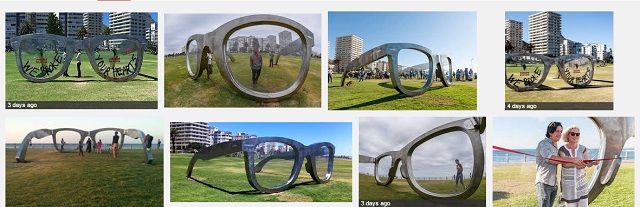
by DK Badenhorst. By now, most people would have heard about the oversized and recently vandalised pair of Ray Ban Wayfarer sunglasses on the promenade.

Google Search results for Ray Ban sculpture Cape Town promenadeThe initial public reaction, prior to the vandals, was a sort of puzzled look. People felt compelled to write and remark in an ‘if you say so’ tone — that ignorance (parading as a savvy eye) that you so often see at an open art exhibition. For the record, I have to state that I’m not a regular at art galleries and, when I do go, I often end up staring at a canvas, wondering what I’m not seeing.

Take a step back

But let’s take a step back. When we look at symbols, we find language on the one end of the spectrum — symbols that carry their meaning by pure convention.

The word ‘car’ in no way resembles an automobile. It doesn’t look, sound, smell or feel like a car. It is simply by convention that we all know it means the box with four wheels and an engine. If you are going to start using car to refer to water, you’ll break the convention of language and your application of it will be confusing and irrelevant.

Brands play somewhere in the middle of this spectrum, and art is on the other end. While convention is leveraged, it is really open to interpretation and we have to explore the meaning and the context in order to get what it really means. It’s often a new symbol that carries mixed meanings from different spheres of life in order to achieve a variety of goals.

Incubation chamber and beta versions

I have a friend who is an artist and we’ve had the discussion about why we have art. And it would seem it can (among other things) serve as a sort of incubation chamber for expression and meaning — it creates the beta versions of ways in which we can bridge gaps in culture. But, as with all beta versions, you get the excitement of a new thing at the cost of potential frustration.

Such is the case with the pair of Ray Bans on the promenade.

The language is powerful — first because it is loud — it’s a larger-than-life pair of sunglasses propped up looking over towards Robben Island. The political link is then because this icon of carefree living is meant to commemorate Nelson Mandela. But what is interesting is that it is a symbol of wealth before it is a symbol of freedom or anything else.

High-school experiment

This is almost a lab test of what goes on in South Africa. I remember the high-school experiment where you cool a super-saturated solution. After a short while, whatever saturated the solution will start crystalising upon the walls of the container. It’s an experiment that comes back to me whenever something weird happens in society. Circumstances changes and whatever is out there crystalises in the real world.

But what has crystalised upon the pair of Ray Bans? We are super-saturated with frustration.

Tokolos Stencils is not a political activist group; it’s a group of frustrated and ignored individuals who leverages the language of society in order to give a platform to how they feel. Neither Marikana nor the art installation is theirs but it will have to do — much like the bridge over Nelson Mandela Boulevard is not theirs but still got the ‘remember Marikana’ treatment.

It’s not coherent messaging

But the point of groups such as Tokolos Stencils is not coherent messaging; it’s a massive red flare from a life raft adrift at sea. Much like the flare uses complex chemicals to make the simple red streak, so, too, Tokolos uses complicated language (Marikana, non-descript threats and art installations) to call attention to itself.

And this isn’t bad; it’s not narcissism — it’s a legitimate demand for political representation, executed in a somewhat tasteless fashion, leaving an innocent artist as collateral damage.

Why do I not think it is about the messaging?

Can do better

If your mission statement is ‘to scare the powers’, you can do better than reminding Ray Ban Wayfarer-wearing, art-appreciating Cape Town of the Marikana Massacre. Plastering ‘remember Nkandla’ on government buildings would be closer to your mission statement (you’ll also have to deal with the repercussions of such an act).

But, then, you have to ask, “Are we at that point where criminal behavior is the only solution? Is the society so irrelevant that I don’t consider its norms to be consistent with my own?”

But where does this leave a brand such as Ray Ban and others (such as Woolworths), which get pulled into every other political argument out there?

Brand vs brand relationship

First, I think it’s worth nothing the distinction between an attack on the brand and an attack on the brand relationship. It’s the difference between an attack on Angelina Jolie or Brangelina — the celebrity superstar or the celebrity supercouple.

No-one has a problem with the brand or its values; it’s only when you mix it with the target audience that it becomes a legitimate target. It’s a somewhat macabre litmus test for whom your target audience is perceived to be.

The vandalising of the installation might have been avoided if the artist opted for the iconic Gandhi spectacles, but that would mean something completely different, and its connection to pop culture cannot even be compared. It’s the relationship to the world that is under fire — not the brand itself.

Standing for middle-class affluence

The brands have become part of establishment; not only do they resonate with their target audience, the world happens to know that they do. Woolworths has come to stand for middle-class affluence and the doors of Woolworths have become portals into that sphere of society.

In this instance, Ray Ban Wayfarers (especially on the promenade) have become a proxy for middle/upper-income Cape Town. And, instead of the installation being seen for the bridge it’s trying to be, it’s been crucified for the gap that currently exists.

To me, this highlights the point to which our society is saturated with economic, social and political frustration, and — while our government is sinking yet more resources into keeping our president out of trouble — the evidence of social unrest is crystalising upon the walls of our society.

DK Badenhorst


DK Badenhorst is a cultural insight and semiotics consultant who brings cultural context and long-term trend insights to brand communication. He contributes the monthly “Brand Culture” column, exploring the value and meaning interaction between brands and society, to MarkLives.com.


— MarkLives’ round-up of top ad and media industry news and opinion in your mailbox every Monday and Thursday. Sign up here!

Naspers’ new play to grow SA’s ecommerce market

by Herman Manson (@marklives) Efinity is a new South African ecommerce fulfilment service, built by Media24 ecommerce on the back of experience gained through its consumer-ecommerce plays, Spree.co.za and ShopGuru.

According to Nic Robertson, head of new business development at Media24 ecommerce, the offering is similar to Amazon’s ecommerce fulfilment solution, but obviously geared towards SA retailers.

The product is focused on cost-effective and efficient fulfilment through a partnership with sister company, On The Dot, the Media24-owned logistics-services provider which provides warehousing space, and handles dispatches and returns through various courier partners.

efinity logoPay as you use

Efinity has a pay-as-you-use model, says Robertson, allowing entrepreneurs to try their hand at ecommerce. Stock can be scaled up and down.

The Efinity model addresses various bottlenecks in ecommerce fulfilment, including ensuring that technology is properly engineered; trusted payment methods are on offer (and offering payment not just through credit cards, but also through chipped debit cards); and, finally, logistics and fulfilment. Efinity also offers reverse logistics (returns). Inventory can be tracked, as can deliveries.

Efinity came about through experience built up with fashion site Spree.co.za. Initially, outside products were looked at but these were either too expensive or performed only some of the tasks that were expected. Media24 ecommerce decided to build a platform and then to enter the business-to-business (B2B) space.

Scope for expansion

While it is happy with the trajectory of both Spree and ShopGuru, the company is loathe to enter into niches already serviced by another Naspers-owned ecommerce play — kalahari.com (which recently announced it would merge with takealot.com, subject to Competition Commission approval). It limits its scope for expansion in the business-to-consumer (B2C) space.

Robertson says it’s also in the best interests of Media24 to open up the ecommerce market — the more people get used to online shopping, the bigger the local ecommerce pie will grow. With Efinity, the company hopes to help grow both the markets and its slice of the pie.

Nic Robertson
Nic Robertson.

Cost bases

There are three cost bases with Efinity:

  1. There is the inbound cost — where it charges for receiving the product, doing a quality check, checking that the product is in line with the invoice, tagging it with a barcode and inserting it into the Efinity system. At this point, the product will display in your EC store. The cost is not fixed and depends upon the client and product.
  2. Then there is a storage cost, charged pro-rata — the quicker your stock moves, the more cost-efficient this gets.
  3. Finally, there is an outbound cost — for the product being packed and shipped. It’s charged on delivery. The system breaks down the cost and clients are able to factor it into their margins.

Efinity will have access to a new warehouse facility in Johannesburg soon, says Robertson, which should have a positive impact on costs; at the moment, it only ships from Cape Town. Clients will be able to split stock between Cape Town and Joburg.

A fraction of the size

Ecommerce is still only a fraction of the size it could and should be, says Robertson, who estimates the value of the SA ecommerce environment was around US$500m in 2013. But growth is standing at around 40% year-on-year and Robertson expects the market to grow to US$1bn in pure ecommerce sales within the next three years.

The expanding reach of Wi-Fi is growing SA’s online customer base, as is leaps in payment systems and education in online commerce by well-known brands such as Woolworths, Mr Price and Edgars.

According to Robertson, the role of mobile in ecommerce growth cannot be underestimated; as much as 70-80% of a sites traffic can come via mobile devices.

Consumer expectations

Managing consumer expectations are a major factor in all ecommerce plays, says Robertson, who urges retailers to focus on building user-friendly sites that offer a number of payment methods and don’t promise delivery times which are unlikely to be achieved.

Robertson says Efinity will work with clients ranging for bloggers to established business — no business is too small or too big.

The company is already exploring partnerships with other Naspers companies to grow the ecommerce system further, hints Robertson, who adds that Efinity is also in advanced talks with a number of clients.

— MarkLives’ round-up of top ad and media industry news and opinion in your mailbox every three work days. Sign up here!

MagLove: Robert Downey Jr is waiting, talking emoji

MediaSlut (@MediaSlut)’s choice of the best international and local magazine covers this week:

  • Esquire Singapore [(Fe)Male Issue]
  • FT Weekend Magazine
  • New York
  • Stylist
  • WIRED
  • VISI
  • SARIE Woon

INTERNATIONAL

Esquire Singapore, November 2014

Esquire Singapore, November 2014Robert Downey Jr + B&W photograph + great location + (Fe)Male Issue = great November 2014 cover!

FT Weekend Magazine, November 2014

FT Weekend Magazine, November 2014We had “Video Killed the Radio Star” and now FT Weekend Magazine is looking at how YouTube is “Taking a bite out of TV”, in a creatively illustrated cover story!

New York, 17 November 2014

New York, 17 November 2014I’m already starting to think in Emoji while I’m talking, so I’m definitely guilty of “Speaking Emoji”. Not only is this cover brilliant in capturing the cover story, but the story itself is brilliant, too ;-). Read it here.

Stylist, November 2014

Stylist, November 2014It’s not every day that a main cover story is about ‘books’, but Stylist has gotten it right, not only in making people take note, but also in wanting to read it!

The list of “25 Classics Every Woman Should Read” was compiled by ‘Lisa Simpson’ as she is “one of the wisest minds in existence”, and is “often seen clutching a copy of The Bell Jar and quoting lines of her favourite prose”.

A fabulous editorial concept, and extremely well-executed! Read the full list, as chosen by ‘Lisa Simpson’, right here.

WIRED, December 2014

WIRED, December 2014Continuing with brilliant editorial concepts is WIRED! Not only is the cover haunting and mysterious, but the issue was ‘directed’ by Christopher Nolan, who is on everyone’s lips for directing the movie “Interstellar”.

But, wait, it’s doesn’t end there… According to New York Daily News, Nolan “couldn’t fit all his great sci-fi ideas in his film’s 2-hour, 50-minute running time” so, as an exclusive with WIRED, he published a ‘lost chapter’ as a comic called “Absolute Zero”, which is a prequel to Interstellar! Fantastic!

And, to make fans even more excited, WIRED and Christopher Nolan released probably the best ‘trailer’ for a magazine issue I have ever seen!

LOCAL

VISI 75

VISI, Issue 75Wow! Just look at this cover for a few seconds! The colours, the angle, the dress, the reflections! To me, it’s all bright and beautiful” and oh so striking!

The picture is from the shoot that took place at the KLûK CGDT boutique store in Bree Street, Cape Town.

Something else worth mentioning is that this is a strong issue as a total! I just got lost in the pictures and beautiful venues and locations… So worth a buy, especially if you haven’t bought it in a while.

SARIE Woon, 2014/2015

SARIE Woon, 2014/2015Fitting in perfectly with my VISI cover selection is SARIE Woon, also with a similar palette of bright and cheerful colours, and definitely standing out from the crowd!


Find a cover we should know about? Tweet us at @Marklives and @MediaSlut.
Want to view all the covers at a glance?
See our MagLove Pinboard!


MediaSlutMagLove by @MediaSlut is a regular slot featuring the best local and international magazine covers every week, recognising well thought-out, powerful and interesting (and hopefully all three-in-one) covers and celebrating the mix of pragmatism, creativity and personal taste that created each of them. The (for now anonymous) blogger behind MediaSlut knows way too much for his own good about media in South Africa, magazines in particular. His mission is to show when SA magazines fail but, most importantly, also when they succeed. If you’re looking for a library about SA magazines and news, this is your one-stop pitstop.

— MarkLives’ round-up of top ad and media industry news and opinion in your mailbox every Monday and Thursday. Sign up here!

Heroes & Zeros: Mazda & City of Joburg — best & worst brands of the week

Every week, The Ad Feature team on 702 takes you through the highs and lows of advertising in South Africa. This week, Andy Rice (@ricecommaandy) and Jenny Crwys-Williams (@jcwLIFE) commend Mazda for its risky, yet brave, new campaign, while the City of Joburg is slammed for the shambles regarding the regulations for the outdoor advertising industry.

Find out why these feature in this week’s Heroes & Zeros by watching the webisode below:


For a fresh look at the world of advertising, Jenny Crwys-Williams of talk radio station 702 (@Radio702) chats to advertising critic Andy Rice on The Ad Feature, every Wednesday 2.30pm — 3pm. The filmed Heroes & Zeroes will appear on MarkLives every Friday as a webisode.

— MarkLives’ round-up of top ad and media industry news and opinion in your mailbox every Monday and Thursday. Sign up here!

Africa Style: No-one needs your brand

by Masingita Mazibuko. Wake up and smell the coffee, marketers; no-one really, truly, honestly, genuinely, absolutely needs your brand. That’s why the brand’s relationship with the intended consumer, as well as its product intrinsics, is such a crucial element of the marketing mix.

Earlier this year, at a gathering of some 650 retailers, Thierry Stern, the 44-year-old president of celebrated watchmaker Patek Philippe, delivered a rather odd speech. In it, he informed his audience that “Nobody needs a Patek.”

Masingita MazibukoSo why do people want a Patek?

It is an extraordinary product that has taken extraordinary lengths to remain relevant, including funding an experimental laboratory (Nouvelle Technologie) with the mandate to find 21st-century solutions to improve 15th-century spring technology.

It also expands time and money protecting its customers’ investment in the product by, for example, committing to work on any Patek dating back to 1839 (a promise that requires maintaining an archive of five million components and a collection of tools that were used 175 years ago) and carefully managing levels of supply, no matter how intense the demand, so that Patek retains its rarity and cachet.

I think the secret for its sustained success is that Patek exists where product and desire overlap. In this place, price becomes irrelevant.

But which comes first, the ephemeral element of the equation (desire) or the physical (product)? I believe it’s the former because you will only know what to deliver if you understand what is desired.

And the value proposition exists at the nexus — or meeting point — of what the product constitutes and what it means to the consumer… regardless of the price.

Can we grow brands such as Patek on the African continent? Could these be Afro-centric brands?

If by Afro-centricity we mean tapping into the African world and understanding the role the brand plays in this world, yes. If we mean going beyond simply filming in an African environment and including a few vernacular terms in the dialogue, yes.

If we don’t. Well, Africa doesn’t need a Patek and Africa doesn’t need your brand either.

Masingita Mazibuko is a marketing director at Unilever. The views expressed within this monthly “Africa Style” column are, however, entirely her own.

— MarkLives’ round-up of top ad and media industry news and opinion in your mailbox every Monday and Thursday. Sign up here!

Online CPD Courses Psychology Online CPD Courses Marketing analytics software Marketing analytics software for small business Business management software Business accounting software Gearbox repair company Makeup artist