#Top40TVratings: 10–16 November 2014

by SAARF & MarkLives (@marklives) See who made it to the top of our National and DStv charts for the week of 10–16 November 2014! A collaboration between the South African Audience Research Foundation (SAARF) and MarkLives, this #Top40TVratings column is a weekly roundup of SA’s TV audience viewership.

Satellite dishWe reveal the best-watched shows of the week before (in this case, 10–16 November 2014), where they ran and how many South Africans tuned in to watch.

We offer two tables:

  • The first covers all households — free-to-air viewing (the various SABC channels and e.tv), as well as the DStv platform.
  • The second charts the best-watched shows on the DStv network of channels only.

SAARF/MarkLives #Top40TVratings Charts: 10–16 November 2014

National

Market Target Activity
National Total Indv (incl guests) Live + VOSDAL
Counter Description (grouped) Channel Level 1 Level 2\variable (r) AMR % AMR SHR %
1 SKEEM SAAM SABC 1 Drama Drama 19.5 8 353 659 62.79%
2 MUVHANGO SABC 2 Drama Drama 15.2 6 509 539 53.61%
3 KOWETHU SABC 1 Drama Drama 14.6 6 270 586 49.96%
4 SOUL CITY SABC 1 Drama Drama 13.5 5 790 878 46.31%
5 SHREDS AND DREAMS SABC 1 Drama Drama 12.6 5 395 958 41.94%
6 MUTUAL FRIENDS SABC 1 Drama Drama 12.1 5 189 812 40.68%
7 MY PERFECT FAMILY SABC 1 Sitcom Sitcom 10.9 4 662 401 35.41%
8 POWERBALL SABC 2 Variety Variety 10.5 4 508 264 41.87%
9 SELIMATHUNZI SABC 1 Variety Variety 9.3 3 982 001 31.09%
10 WHEN WE WERE BLACK 2 SABC 1 Drama Drama 9.2 3 951 371 31.00%
11 XHOSA NEWS SABC 1 News News 9.1 3 914 566 32.78%
12 SCANDAL e.tv Drama Drama 8.7 3 736 983 29.28%
13 ZULU NEWS SABC 1 News News 8.6 3 676 850 30.63%
14 THE X FACTOR SOUTH AFRICA SABC 1 Reality Reality 8.4 3 604 204 32.52%
15 SPEAK OUT SABC 2 Actuality Actuality 7.6 3 266 728 35.60%
16 1’S AND 2’S SHOW SABC 1 Music Music 7.6 3 247 706 26.80%
17 ORANGE AFRICA CUP OF NATIONS QUALIFIER:SOUTH AFRICA VS SUDAN SABC 1 Sport Football (soccer) 7.0 2 981 611 31.96%
18 ROOTS SABC 1 Music Music 6.9 2 973 777 29.47%
19 SKWIZAS SABC 2 Sitcom Sitcom 6.6 2 848 158 23.42%
20 THE WORLD IS NOT ENOUGH e.tv Movies Drama 6.5 2 787 234 30.31%
21 SKEEM SAAM -R SABC 1 Drama Drama 6.4 2 761 253 53.95%
22 RHYTHM CITY e.tv Drama Drama 6.4 2 750 000 25.93%
23 WWE WRESTLING RAW e.tv Sport Wrestling 6.4 2 729 354 28.96%
24 MOHLOLOHADI 2 SABC 2 Drama Drama 6.3 2 705 872 27.97%
25 SKWIZAS -R SABC 2 Sitcom Sitcom 6.2 2 674 066 30.77%
26 EMZINI WEZINSIZWA -R SABC 1 Sitcom Sitcom 6.0 2 562 139 47.99%
27 MUVHANGO -R SABC 1 Drama Drama 5.9 2 534 869 49.86%
28 SUNDAY LIVE SABC 1 Actuality Actuality 5.9 2 529 774 20.35%
29 MUVHANGO -O SABC 2 Drama Drama 5.8 2 507 225 31.05%
30 VELAPHI -R SABC 1 Sitcom Sitcom 5.7 2 466 347 48.65%
31 SHREK THE THIRD e.tv Movies Animation 5.5 2 355 178 19.93%
32 ISIDINGO:THE NEED SABC 3 Soap opera Local 5.5 2 346 868 19.48%
33 AMERICA’S GOT TALENT e.tv Reality Reality 5.3 2 292 242 31.74%
34 7DE LAAN SABC 2 Soap opera Local 5.3 2 291 298 21.60%
35 MUVHANGO -R SABC 2 Drama Drama 5.3 2 258 142 33.60%
36 ZAZIWA SABC 1 Variety Variety 5.2 2 243 199 24.22%
37 HOLA MPINJI SABC 1 Educational Program Educational program 5.1 2 183 763 20.45%
38 100% YOUTH SABC 1 Variety Variety 5.0 2 133 063 25.17%
39 THE LINK (MAGA) SABC 1 Magazine Magazine 4.9 2 087 240 21.87%
40 WHERE THE WILD THINGS ARE SABC 2 Movies Drama 4.7 2 027 525 20.69%

DStv

Market Target Activity
DStv Total Indv (incl guests) Live + VOSDAL
Counter Description (grouped) Channel Level 1 Level 2\variable (r) AMR % AMR SHR %
1 SKEEM SAAM SABC 1 Drama Drama 12.4 1 681 381 39.02%
2 MUVHANGO SABC 2 Drama Drama 11.0 1 483 031 38.01%
3 POWERBALL SABC 2 Variety Variety 6.8 918 084 26.07%
4 ISIBAYA Mzansi Magic Variety Variety 6.7 911 476 21.82%
5 SELIMATHUNZI SABC 1 Variety Variety 5.9 791 433 17.79%
6 SPEAK OUT SABC 2 Actuality Actuality 5.7 771 611 24.39%
7 SCANDAL e.tv Drama Drama 5.7 768 615 18.09%
8 MY PERFECT FAMILY SABC 1 Sitcom Sitcom 5.5 738 107 16.84%
9 SOUL CITY SABC 1 Drama Drama 5.2 696 229 16.28%
10 KOWETHU SABC 1 Drama Drama 5.1 693 952 16.90%
11 OUR PERFECT WEDDING (MAG) Mzansi Magic Magazine Magazine 4.8 644 194 14.73%
12 RHYTHM CITY e.tv Drama Drama 4.7 636 340 16.85%
13 XHOSA NEWS SABC 1 News News 4.7 632 711 15.35%
14 ZULU NEWS SABC 1 News News 4.4 598 064 14.45%
15 7DE LAAN SABC 2 Soap opera Local 4.4 593 968 15.71%
16 ENGLAND INTERNATIONAL RUGBY:ENGLAND VS SOUTH AFRICA SuperSport 1 Sport Rugby (all) 4.2 566 679 15.29%
17 MUTUAL FRIENDS SABC 1 Drama Drama 4.1 555 125 12.97%
18 SHREDS AND DREAMS SABC 1 Drama Drama 4.0 544 997 13.42%
19 SKWIZAS -R SABC 2 Sitcom Sitcom 3.8 507 934 18.08%
20 WWE WRESTLING RAW e.tv Sport Wrestling 3.4 464 792 12.99%
21 ISIDINGO:THE NEED SABC 3 Soap opera Local 3.4 458 843 11.13%
22 MOHLOLOHADI 2 SABC 2 Drama Drama 3.3 443 741 13.94%
23 1’S AND 2’S SHOW SABC 1 Music Music 3.2 433 935 11.07%
24 THE X FACTOR SOUTH AFRICA SABC 1 Reality Reality 3.2 428 695 10.97%
25 SKEEM SAAM -R SABC 1 Drama Drama 3.1 418 165 24.46%
26 ORANGE AFRICA CUP OF NATIONS QUALIFIER:SOUTH AFRICA VS SUDAN SABC 1 Sport Football (soccer) 3.1 413 714 12.44%
27 MUVHANGO -R SABC 1 Drama Drama 2.9 389 286 22.83%
28 ORANGE AFRICA CUP OF NATIONS QUALIFIER:SOUTH AFRICA VS SUDAN SuperSport 4 Sport Football (soccer) 2.8 378 318 11.33%
29 NEWS e.tv News News 2.8 378 302 9.85%
30 IT’S GOSPEL TIME -R SABC 2 Music Music 2.6 356 301 14.15%
31 IDOLS YR 10 Mzansi Magic Reality Reality 2.6 349 539 8.84%
32 THE BOLD AND THE BEAUTIFUL SABC 3 Soap opera International 2.6 348 149 10.31%
33 WHEN WE WERE BLACK 2 SABC 1 Drama Drama 2.6 345 342 8.44%
34 DIE NATANIEL TAFEL kykNET Drama Drama 2.5 344 115 7.71%
35 ROOTS SABC 1 Music Music 2.5 342 713 9.32%
36 CARTE BLANCHE M-Net Actuality Actuality 2.5 334 209 7.67%
37 NUUS SABC 2 News News 2.4 328 827 7.96%
38 KHUMBUL’ EKHAYA SABC 1 Magazine Magazine 2.4 327 969 9.78%
39 SKWIZAS SABC 2 Sitcom Sitcom 2.4 321 660 7.48%
40 ZAZIWA SABC 1 Variety Variety 2.4 319 942 10.31%

How to read the tables

AMR% refers to the number of people in a target market who were watching an event ie programme, expressed as a percentage of the population for that demographic: “On average, 16.3% of adults aged 15+ who watched TV from 28 Jan-3 Feb 2014 watched Society on SABC 1”.

AMR is the number of people in a target market watching a specific event ie programme per minute, expressed in absolute figures: “On average, 1, 541, 066 adults aged 15+ who watched TV from from28 Jan-3 Feb 2014 watched Society on SABC 1”.

Share % (SHR %) is the share or proportion of the available audience (people watching TV at that time) that a specific channel/programme has achieved at that time: “Society achieved a share % of 52.59% from 28 Jan- 3 Feb 2014 on SABC 1″.

saarf 150SAARF is the name by which the South African Audience Research Foundation is familiarly known. SAARF’s main objective is to direct and publish media audience and product/brand research for the benefit of its stake-holders, thereby providing data for target marketing and a common currency for the buying and selling of media space and time. SAARF has thus the responsibility to measure the audiences of all traditional media such as newspapers, magazines, radio, television, cinema and out of home media.

— MarkLives’ round-up of top ad and media industry news and opinion in your mailbox every Monday and Thursday. Sign up here!

Shelf Life: Luxury cinema comes to Cavendish

Louise Marsland (@Louise_Marsland)’s weekly pick of recent product, packaging and design launches:

  • Enticing movie goers back to the cinema
  • Southern Comfort and Nic Harry partner
  • Sir Juice launches a berry summer, and
  • Bliss brands kids TV.

Luxury movies

Ster Kinekor Cine Prestige Cavendish Square interiorToday, Thursday, 20 November 2014, Ster-Kinekor Cavendish Square launches a new cinema experience in Cape Town with the opening of two Cine Prestige theatres at the premier Southern Suburbs mall. Reclining leather chairs, snack trays, refrigerated cup-holders and gourmet platters on offer in the private waiting area are all part of the experience.

“The designer chairs are what make Cine Prestige our premium offering,” explains Doug Place, marketing executive of Ster-Kinekor Theatres. “The installation of the seats in our new Cavendish cinemas, similar to those in the recently opened cinema at Sandton, include the automated reclining facility and a refrigerated cup-holder to ensure a smooth, sleek and ultra-comfortable cinema experience.

“Cine Prestige is the perfect date-night venue. Adding to the experience is the exclusive VIP lounge area where queuing is a thing of the past. Here, platters of food can be ordered and enjoyed, or the cinema staff can bring your order to you where you are seated comfortably inside the theatre!”

This is the company’s sixth investment in the luxury Cine Prestige format, following the success of installations at The Zone @ Rosebank, Johannesburg; Cradlestone Mall, Johannesburg West; The Grove Mall, Pretoria East; Gateway, Durban; and, most recently, Sandton City, Johannesburg.

Comfort socks

Southern Comfort Nic Socks limited edition promoYou know you’re on the road to making it in fashion when you can add your name or a derivative thereof to your brand — and other brands start partnering with you, too!

Mobile and digital consultant and aspirant fashion mogul, Nic Haralambous, has been taking the simple sock to a whole new level of cool for several years now, since he sat out a trade restraint after selling his mobile company, Motribe, by trying to see it he could launch a little start-up with only a R5 000 investment. He chose to source and design socks locally, selling them online and by subscription — and so NicSocks was born.

It has just been relaunched as Nic Harry clothing, a premium men’s accessories company.

A month before the rebranding, Southern Comfort included NicSocks in its annual festive-season gift-box sets with a limited-edition designer range for the alcohol brand for Spar Tops stores,

There are plans to expand into other fashion areas. As founder Haralambous says: “Nic Harry is about style, not fashion. We’re about creating trends, not following them. We’re about choice, quality and accessories.”

Fruity treat

Sir Juice The Berries Fruit Nectar BlendSir Fruit has launched a berry variant to the popular juice range often seen at industry events. The summer launch of The Berries follows upon the launch of the Harrismith Apple flavour earlier this year.

The new addition has whole blended blackcurrants, strawberries, raspberries and pressed apple juice, and is packed with pips and bits that make this new berry nectar unique.

“Our dream was to create a thick, dark and great-tasting berry juice. A berry juice that is not from concentrate, but made with proper berries. The end result is The Berries,” says Roanne Goldsmith, Sir Fruit marketing manager.

Sir Fruit juices is described as having a thick consistency due to their pulp-based production process and being filled with bits because it is unfiltered and made with all natural ingredients!

Branded kids content

Bliss Brands Kids Securex superheroesBliss Brands has created a television series for children to promote personal hygiene and its brand Securex. The fully animated Kid Securex features four superhero kids who go on missions to stop germs invading the human world.

The consumer-driven content is part of Bliss Brands’ strategy to implement marketing campaigns that are unique. The series was created with the aim of not only entertaining but demonstrating the importance of hygiene and using Securex soap to keep skin protected against germs.

The series runs on e.tv at 2.30pm, Monday to Thursdays.

I’m surprised we don’t have more brand-driven children’s programmes with educational messages in South Africa, as branded entertainment and content marketing is such a trend — plus intelligent brands need to find ways around all the advertising restrictions coming into play with all sorts of products, including advertising to children.

Children are little sponges; socially-responsible programming will work as they remember songs and rhymes and identify with characters at an early age. Just ask the little ‘Princess Sofia’ in my household!

There are amazing brand-driven programmes in many of our schools already, especially in areas of need, so the next step to brand-driven local TV programming makes sense.


Shelf Life is a weekly column by Louise Marsland. Tweet new product, packaging and design launches to @louise_marsland Louise Marslandor email her at louise.marsland at gmail.com. Want to sponsor Shelf Life? Contact us here.

Louise has written about the FMCG, media, marketing and advertising industry for 20 years as a former editor of magazines AdVantage, Marketing Mix and Progressive Retailing, as well as websites Bizcommunity.com and FMCGFiles. She also edited the weekly Wednesday Media & Marketing Page for The New Age newspaper. She is currently the publishing editor of industry trendwatching portal, TRENDAFRiCA, for consumer insight, research and trends in Africa; a regular industry columnist and speaker; a consultant on content strategy; and contributing editor to Fast Company South Africa magazine, which has just launched in South Africa.

— MarkLives’ round-up of top ad and media industry news and opinion in your mailbox every Monday and Thursday. Sign up here!

Green Sky Thinking: Start with what’s there

by Colwyn Elder (@colwynelder) Walking past a typical red London telephone box recently, my five-year-old stopped to ask me what it was. In his world, phones belong in bags or pockets, not boxes, and he found the idea of a phone tied to a box and being fed coins highly amusing.

So we stood in the phone box discussing how many people could fit inside (14, incidentally, is the new world record set in Belfast in 2003) and how Superman used it as his change room. The phone itself was out of order.

I’m a big fan of architect Sir Giles Gilbert Scott’s phone box. It’s been around since the 1920s and, thanks to Her Majesty’s crown sitting squarely and prominently above the door, has become an iconic British symbol. But I walked away wondering exactly how many unused red pillar box phone booths line the streets of London and (Superman aside) what’s to become of them as we increasingly centre our lives upon mobile devices.

solarbox courtesy of solarboxlondon.org
Pic courtesy of solarboxlondon.org

Repurposing

My question was answered just a few weeks later, when I discovered that two students from the London School of Economics have found a way to make them relevant again. The renamed solarbox is being painted (ahem) green and transformed into a walk-in, solar-powered phone charger, with a150-watt solar panel on top and a mini/micro-USB and iPhone charger inside. There is also a screen that runs advertising while people charge their phones, making it free to the public.

Brainchild of Kirsty Kenner and Harold Craston, the solarbox is a response to thinking about public space and existing public infrastructure could be better used — essentially “upgrading it as opposed building something new”.

In addition to providing a battery-charging solution for busy Londoners on the move, the duo also hopes to make solar power more accessible, thereby increasing awareness of solar energy as well as developing London’s green agenda.

The idea won them second place in the 2014 Mayor of London’s Low Carbon Entrepreneur of the Year Award as well as the 2014 LSE Emerging Entrepreneur of the Year award, but consumer uptake remains to be seen. The first of six charging kiosks opened in Tottenham Court Road in October and another five are scheduled to open elsewhere in the city in April 2015.

Too quick to assume

There’s a lot to be said for working with existing systems and structures in new ways. We’re often all too quick to assume that new games and new rules need a new playing field. And, while there is merit in starting with a blank sheet of paper, this may result in rendering something obsolete unnecessarily.

The solarbox is a wonderful example of how an existing object can be repurposed according to new needs, thereby maintaining relevance and extending its lifespan. As our smartphone usage continues to increase, so will our demand for a conveniently positioned power boost, and that it supplies clean energy only makes it that much more appealing.

Colwyn Elder


Strategic consultant Colwyn Elder (@colwynelder) brings a global perspective to the issue of sustainability, having lived and worked in London, Tokyo, Amsterdam and Cape Town. She contributes the monthly “Green Sky Thinking” column on sustainability issues to MarkLives.


— MarkLives’ round-up of top ad and media industry news and opinion in your mailbox every Monday and Thursday. Sign up here!

Ad of the Week: Eyes in the back of your head

by Oresti Patricios (@orestaki) We’ve seen the articles about self-drive cars, most notably those created by Google. Indeed, it looks as if the era of hands-off driving is no longer science fiction. It may still be a little while before being able to let your car do the driving becomes an everyday thing but, in the meantime, a lot of that ‘intelligent engineering’ technology is filtering down to today’s motor vehicles.

These are technological innovations that boost our driving with added elements of safety and convenience. A while ago I featured an ad for Merc’s system that detected driver drowsiness — now it’s VW’s turn, with the brand’s ‘Side Assist’.


VW Side AssistWithout technical jargon

Ogilvy & Mather Cape Town devised a campaign for this innovation that gets the message across without any technical jargon or simulations. It’s an interesting campaign in that it uses a common message and a technique that is adapted to different media. But why are we featuring a campaign that originally flighted last year, and won a bronze at the Loeries this year?

The really strange thing is that this campaign is not even scheduled for publication or flighting right now, but it’s being talked about in social media and featured on advertising websites. When we spoke to executive creative director at O&M Cape Town, Chris Gotz, he said he wasn’t sure why this had happened.

The answer, I think, is that it’s a truly good campaign that has managed to ‘go viral’ in a sense, because it’s smart and simple.

The dreaded ‘blind spot’

The idea behind the Side Assist technology is that it warns the driver when vehicles are approaching from behind, on either side. Sensors pick up the vehicles in adjoining lanes from up to 50m back — as these vehicles pass through the dreaded ‘blind spot’ — as we all know, blind spots in the side mirrors are the cause of many accidents.

The system draws the driver’s attention to the presence of a car approaching from behind by flashing a light under the mirror. If the driver signals before making a lane change that is dangerous, the same LED flashes more brightly to draw attention to the danger.

In effect, the system ‘knows what’s coming’. And (you guessed it), this is the message that O&M has hooked the campaign onto.

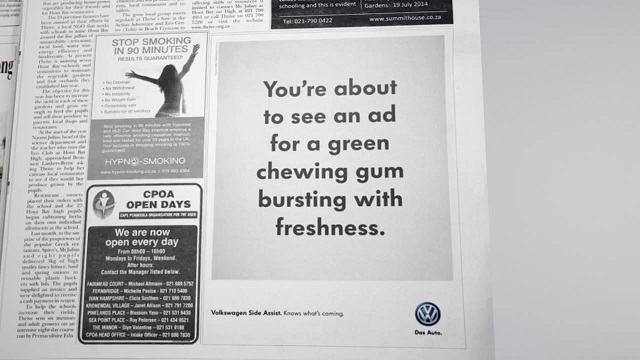
In print, this was done through carefully placed ads, that ‘foretold’ what was over the next page. So, for example, an ad placed on the bottom right-hand page would say: “You’re about to see an ad for a green chewing gum bursting with freshness.” In smaller type, the VW payoff line: “Volkswagen Side Assist. Knows what’s coming.”

VW Side Assist street pole campaign photo VW Side Assist street pole campaign photo 2In the same position

On the next page, in the same position as the VW ad, is another ad. But this time it’s an ad for Clorets SupaFresh.

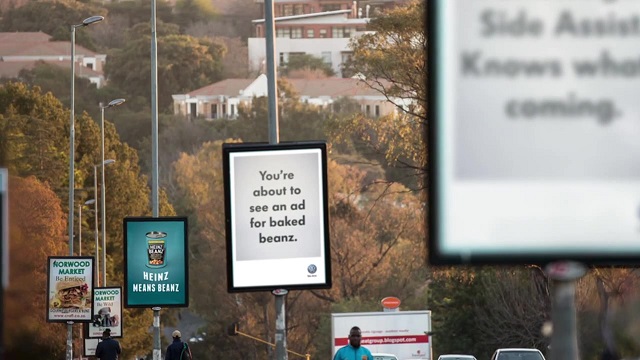
For street-pole posters, the execution was a one-two-three punch. The first ad would carry the main message: “Volkswagen Side Assist. Knows what’s coming.” The next ad would be “You’re about to see an ad for baked beanz.” The next pole would be “Heinz Means Beanz”.

The radio ad worked along similar lines, sometimes with a quirky take on the content, such as “You’re about to hear an ad featuring the sound of the ocean during a storm… followed by the sound of the ocean during a storm.” And, of course, that would be what one would hear.

Similarly, the TV ad predicts: “You’re about to watch a TV ad featuring a very unusual office. You’ll see a woman who loves her job. Kind of. And her colleagues who love dolphins. A lot. Volkswagen Side Assist. Knows what’s coming.” The following ad is then the one for Careers24, featuring the dolphin-crazy office.

VW Side Assist print adAlways have had fun

VW Side Assist print ad 2The “people’s car” people have always had fun with the VW brand and, in this case, the campaign has cleverly conspired to draw attention to itself by drawing attention to other advertising, and the medium of advertising itself. (How meta!)

The design of all the ads is simplistic to the extreme: the radio and TV ads have no music. Visually, they are all black print (the familiar VW Futura-Bold) on light grey, with a simple VW logo at the bottom. Even the TV ad is just a simple light grey screen, with just the final slogan and logo appearing at the end. This is extremely smart, because it has the effect of making the ads stand out amid the ‘clutter’ and noise of most ads, using white space and simplicity to its best advantage.

Hats off to O&M Cape Town, for a fantastically self-referential, versatile and well-executed campaign. But mostly for a campaign that communicates a really important and clever innovation from the agency’s clients — VW.

Credits
Advertising agency: Ogilvy & Mather, Cape Town, South Africa
ECD: Chris Gotz
Creative director: Prabashan Gopalakrishnan Pather
Art director: Reijer van der Vlugt
Copywriter: Justin Osburn
Account director: Gemma Thompson
Sound studio: We Love Jam, We Love Jam
Agency producer: Iris Vinnicombe
Editor: Robert Martin
Photographer: Theo Klompje
Account manager: Sina Berrada


Oresti PatriciosAd of the Week, published on MarkLives every Wednesday, is penned by Oresti Patricios (@orestaki), the CEO of Ornico, a Brand Intelligence® firm that focuses on media, reputation and brand research.


If you are involved in making advertising that is smart, funny and/or engaging,
please let Oresti know about it at info@ornicogroup.co.za.


— MarkLives’ round-up of top ad and media industry news and opinion in your mailbox every Monday and Thursday. Sign up here!

Motive: Hello — we’re the Millennials

by Gareth Pearson (@gareth_pearson) The Millennials are an important generation and are influencing brands, social media, politics, religion and trends in a new and powerful way.

Significant in size, forceful in their change potential, tech-savvy in how they engage with the world — they think globally, are eco-friendly and weigh heavily on causes which they see as having strong values.

Gareth PearsonMillennial culture is different, more liberal, more challenging, more opinionated and less shocked. They’re trying to make a difference and they get frustrated at how long the world is taking to understand the importance of the digital world.

Millennials are marketing-savvy and socially empowered — and, as consumers, can be ruthless with products and brands which they see as irrelevant, self-seeking, non-tech, shy and non-engaging.

They demand more from brands and they want more value, greater personalisation and better rewards. And if they get this, they become the greatest brand advocates. They’re also very aware of world developments and trends, and personal recommendations carry huge weight with brand and product adoption.

Millennials are expressive and want to share their ideas, thoughts and opinions — and when combined with their unprecedented interest in mobile apps, it makes for a hugely influential consumer group.

Digital media is a cornerstone in the millennial shopper’s journey and the group is not only looking to peers for assistance in making smart purchase decisions but also makes use of the digital world to influence and justify their purchases.

Showrooming

Smartphones are everything to millennials and the level of texting, calling, shopping and their general way of life is really a state of cellphone addiction.

What with mobility being a key pillar in millennial behaviour, retailers and brand owners are responding with more apps, m-commerce and engagement facilities available on mobile devices. And as we come to realise that the millennials are all about mobility, showrooming is becoming a more evident trend

Packaging changes

Millennials seek natural content in what they eat and drink — and recyclability and ability to keep food fresh are two key aspects of their packaging choices. Food trends include fresh, healthy, farmer markets and sushi with beverage trends, including craft beer and wine.

Product offerings are having to change fast in order to respond to their demands, changing tastes and attitudes.

For example, there’s been a major shift in the packaging of beer and ready-to-drink beverages from aluminium to glass, and ironically, on the food shelves, millennials are seeking shelf-stable cartons and powders which in turn are displacing canned goods.

So — millennials are driving shelf changes in supermarkets and, to meet their demands, packaging companies, CPG companies and retailers are having to be innovative and factor in these millennial changes in how they do business.

One-to-one marketing

Personalising the pack is an absolute delight to millennials. Having their name printed on the label of their favourite product pack is extremely powerful and hits the millennial sweet spot. More and more brands are doing this across the globe, and involving Facebook, families and products in a powerful, personalised way.

Aspirational

Millennials will spend more on a brand if they believe it will meet their brand aspirations.

Where brands are perceived to be able to offer millennials the type of life and image they require, it becomes tough and demanding on those brands that they select and associate with.

Brand-buying motives run deeper than the mere product and millennials expect brands to support larger causes than the brands themselves. Therefore, brand owners need to respond by creating more millennial attraction by carefully selecting causes that can be associated with their brands.

Value

Seeking value is a fundamental driver for millennials. They will pay a higher premium if there’s a perception of value — usually in the form of content and return.

Another interesting trait of millennials is that they’re frugal and price-conscious. Knowing that the net provides resources for price and cost comparisons means that, as a habit, millennials will research deals before making purchases.

Through the great recession, other generations have also become more frugal. This, together with the pre-existing millennials’ trends, has exacerbated the weight and gravity of this frugality trend on global purchasing habits as consumers focus on debt reduction.

Multi-channel marketing to millennials

Never before has omni-channel marketing been as important as a critical factor of success. Millennials need to be able to engage with brands and retailers using any channel they wish. In fact, they need the freedom to engage with a brand in one channel and move across different channels throughout the engagement.

Private labelling

Private-label adoption is another key trend for millennials. They have a higher propensity to buy and use private-label goods than other generations, and their key driver is that they’re seeking value for money.

Millennials are constantly seeking innovation in their lives, and brands which understand and bring something new and fresh to this generation will be liked and rewarded.

The ‘F’ word

Finally, millennials are all about F-words. Frugality, fast, fresh and fun.

Gareth Pearson (@gareth_pearson) is CEO and shareholder of BMi Research. As a market research specialist with particular focus in the industrial and fast-moving consumer goods (FMCG) markets in various sectors, including the retail market, Gareth has great insight into many workings of the retail world and has plenty information that is valuable to share.

“Motive” is the new by-invitation-only column on MarkLives.com. Contributors are picked by the editors but generally don’t form part of our regular columnist lineup, unless the topic is off-column.

— MarkLives’ round-up of top ad and media industry news and opinion in your mailbox every Monday and Thursday. Sign up here!

Fair Exchange: Convenience revisited

by Erna George. As a Committed Shopper who has long worshiped at the Altar of Brands, I thought these would give me some stability, some sense of accomplishment, some convenience when my world was turned upside-down by the arrival of the cutest alarm clock in the world, my son. No such luck.

Women Shopping Shows Commercial Activity and Adult by Stuart Miles at FreeDigitalPhotos.net
Image courtesy of Stuart Miles at FreeDigitalPhotos.net

Just one foray to the mall tore away the veneer and showed that making life easier for a busy mom is not high on brands’ priority lists. It’s time for brand custodians and marketers to rectify this.

For today’s consumers, convenience is a key differentiator. Brands that promise and deliver convenience will easily earn, in exchange, customer loyalty. But therein lies the rub; what do brands deliver?

Let’s explore

Sticking to my motherhood theme, let’s explore … disposable nappies.

As I’d received a few packs as gifts, I did not shop for these before his birth. When he arrived a little on the lean side (a problem his mother has never had), he needed a snugger fit, and I duly dispatched my brother-in-law to the nearest store. His instructions? Buy the smallest nappy and the smallest pack. And, because I’m a smart shopper, compare the price between Pampers, Huggies and the house brand. I had no allegiances at that stage but figured it wouldn’t hurt to begin my research.

A completely flummoxed male called 15 minutes later begging me to simply say a brand name, any brand name, so he could get out of the shop. I wondered what had scrambled his thought processes until I stood in front of the shelf myself.

There is no standard size for a pack!

The pack size for a 4-9kg baby can be 72 nappies for Brand A, 94 for Brand B, 87 for Brand C and one of the Click’s packs contained just 9. There is no uniformity, no way of making a quick value-comparison.

Assumes two types of shoppers

To me, this assumes two types of shoppers — The Blindly Brand Loyal Sucker and The Lowest Price Per Pack Seeker. What about the First-Time Shopper or Value Shopper?

I suppose mothers are a hostage audience, so the critical thought in the brand manager’s mind is to maximise profitability. I simply cannot think of another reason for the packs to come in odd numbers, other than to make calculations just tiresome.

Differences like this in product categories are unnecessary. It reminds me of the early days of cellphones when each upgrade needed a new charger, creating clutter and frustration for consumers. Today, even though connection points may differ, most have a USB-to-plug connection with an interchangeable plug point so you can charge using your laptop or your car. Not perfect, but at least more flexible and convenient.

Finding Nemo

Not at all like my recent experience with said smartphone. Even though there were enough cellphone stores in the mall to stop a truck, finding one to repair the failing device was like finding Nemo.

The best Cell Store 1 could do was to send my phone off to Johannesburg for three weeks. Cell Store 2 could direct me to Cell Store 3 in a mall 20 minutes’ drive away. I did ask Cell Store 2 to contact Cell Store 3, but it didn’t ask the right questions so, when I got there, Cell Store 3 didn’t have the parts in stock and could help me in a week’s time. Convenient?

And then there’s my recent ATM experience. The very definition of an ATM is ‘convenient cash box’. Except that when I made a withdrawal after banking hours, the ATM gave me a little less cash than reflected on the withdrawal slip. Going into the branch the next day to point this out and ask that it be corrected, I was told that I should, in future, use the ATM linked to the branch in that mall so that the reconciliation would be easier. Alternatively, I should withdraw from a retailer.

Excuse me? The ATM linked to the bank is in a low-traffic — and therefore less-safe — part of the mall after hours. And, guess what, Pick n Pay is not a 24/7retailer. Convenient?

It’s about the full experience

I would like brand managers to return to their brand-positioning tools and properly evaluate how benefits such as convenience are expressed in their offers and brands. They have to remember it is no longer just about the product inside. It is about consumers being able to find the product easily online or on-shelf, being able to understand the value in a blink, about the pack opening easily, and the product delivering.

It is about the full experience, not just about it cooking in two minutes.

Today, the brand must deliver both functional and emotional benefits; this creates a deeper connection with consumers. If each of the benefits a brand wants to be famous for are delivered on a 360-degree basis, can you imagine the power of the brand’s ability to connect?

Ask yourself:

  1. Which are most critical or differentiating benefits, such as convenience?
  2. How can you ensure the journey from shelf to use delivers on each of those benefits?
  3. Can they also be delivered consistently at each touch-point right through to your call centres?

Erna George


Erna George is the business director heading up quality research at brand development and marketing insight consultancy, Added Value. She works with diverse brands and categories — from FMCG, alcohol and agriculture to financial services and entertainment — in countries across many geographies, including South Africa, Mozambique, Nigeria, Kenya, India, Philippines and Brazil. She contributes the monthly “Fair Exchange” column about business relationships and partnerships in adland to MarkLives.


— MarkLives’ round-up of top ad and media industry news and opinion in your mailbox every Monday and Thursday. Sign up here!

The Switch: Get the reference right

by Alistair Mokoena (@AlistairMokoena) One of the great things about living, working and doing business in South Africa is the diversity that one encounters on a daily basis. The various nationalities, races, languages, class groups, cultures and the subcultures all make for a very interesting landscape — the kind of landscape that should be an artist’s paradise.

I use the words “should be” instead of “is” because I don’t believe our industry does enough to take full advantage of this diversity. We speak about it a lot and claim it as a competitive advantage on the world stage but, in my experience, more could be done by all of us.

Important distinctions

At a simplistic level, diversity can be explained by focusing on racial differences; however, at a deeper level, it is about the various social classes that make up our society. The two levels of distinction are both important; nevertheless, as our society evolves, class starts to play a larger role in explaining the differences between sections of society.

People who belong to the same class, regardless of race, generally tend to develop similar interests and tastes; yet cultural differences among them might still lead to different frames of reference.

The biggest myth among us is that western culture is understood and embraced by all.

This erroneous perception is fuelled by the media’s portrayal of western culture as the definition of popular culture. It gets lots of publicity and therefore enjoys wide distribution; however, this does not mean that everyone who is exposed to it assimilates it.

Armed with this myth, many agencies treat western culture as a proxy or as a default for all depictions of the consumer world.

Get the references right

Human beings are visual animals. This is why clients fall in love with manifesto videos and audiovisual references. It is very important to get these right. Using the wrong references may have a fatal effect on a good idea. Most of the references we use when selling work to clients are from Hollywood, when SA has a thriving film industry that can assist us with locally relevant content.

But we can’t achieve this level of relevance and understanding unless we familiarise ourselves with local content. You can try and rescue the situation by explaining “Alice in Wonderland” or “Charlie and the Chocolate Factory” in two minutes to someone who’s never heard of these stories, but that won’t get you far.

My suggestion is two-fold:

  1. We need to study our clients so we can get a good understanding of their frames of reference, and
  2. invest time in familiarising them with references we are likely to use in the future.

That way we avoid making them feel stupid or uncool in meetings.

Do your own research

As a black middle-class marketer, there are many western references that go over my head, simply because they are not relevant or familiar to my frame of reference. What I often do is turn to my white colleagues for assistance but what I should be doing is my own research so I can get a deeper understanding of the target market I’m serving.

Growing up in the townships, my favourite past time was playing soccer — not watching Star Wars. So characters such as Darth Vader and Yoda, even though known to me by name, do not mean as much to me as one would expect, given my newly acquired middle-class status.

By the same token, the name Khethiwe from Generations won’t mean much to many of my white colleagues, even though Generations (currently in hiatus) has been the biggest TV programme in SA and it has English subtitles.

Experience, don’t ask

The trick is to experience these things and not just ask someone to explain them to us.

Embracing diversity means investing time and effort in understanding other races. It is not the responsibility of the non-white members of the team to unpack black, coloured or Indian consumers. It is also not the responsibility of my white colleagues to explain white consumers to me. White consumers or black consumers are not a homogenous group. There are language differences, cultural difference and class differences amongst consumers of the same race group.

In the same vein, it is wrong to expect one black colleague to be the authority on how black people consume advertising. Your black colleagues will give you a view but the responsibility to get under the skin of your target market, irrespective of race, lies with you.

Immerse ourselves fully

To take advantage of this diversity, we have to master it. We have to immerse ourselves fully in this tapestry of creed and colour before we can draw inspiration from it.

It’s time we got under each other’s skin.

Alistair MokoenaAlistair Mokoena (@AlistairMokoena) is a Unilever-trained Chartered Marketer with lots of blue-chip marketing experience who is currently MD of FCB Joburg. One of his favourite pastimes is driving around in the bush, photographing wild animals. Alistair, who switched from client- to agency side at the end of 2012, contributes the monthly “The Switch” column, covering relationships inside agencies and between agencies and clients, to MarkLives.com.


— MarkLives’ round-up of top ad and media industry news and opinion in your mailbox every Monday and Thursday. Sign up here!

Media Future: Jim Goodnight’s big data glimpse of the future

by Arthur Goldstuck (@art2gee) He might not appreciate being called the Steve Jobs of analytics, but SAS Institute founder and CEO Jim Goodnight has a few things in common with the Apple founder.

In computer history, 1976 is remembered as the year Steve Jobs and company produced the first commercially available personal computer, the Apple-I, which has evolved into the market trendsetter 38 years later.

But 1976 was also a seminal year in the world of big data and analytics. Another company that started 38 years ago, today leads the world in a rarefied version of business intelligence called predictive analytics.

The main differences are that the SAS Institute is unknown among consumers; and that it has enjoyed revenue growth for every one of those 38 years.

Jim GoodnightThere are great similarities, though, aside from date of birth: both companies were built on a driving vision that remains undiminished decades later; each holds the accolade of being market leader in specific niches – Apple in several hardware categories, SAS in advanced analytics. In parallel with the way Apple put the personal into personal computer, SAS pinned down big data long before it got big.

Today, according to the New York Times, SAS is the world’s biggest privately held software company. And the leadership style of its co-founder and CEO, Dr Jim Goodnight, is the topic of business school case studies.

So, while Dr Goodnight probably wouldn’t appreciate being called the Steve Jobs of analytics, he should take it as a compliment. From the gleaming company headquarters in the unlikely backwoods of Cary, North Carolina, he oversees an operation that continues to set the pace in its field.

Now 71, Goodnight is a man of few words and even less small talk. During an interview at the SAS-hosted Premier Business Leadership Series in Las Vegas last week, he resisted all efforts to be draw into making visionary statements.

For example, asked about forecasts that emerging markets would overtake the USA as the world’s biggest producer of data in the next few years, he warned: “We’re still not sure if we’ll make use of all that data, but we’ll try. I remember the big RFID thing; this was going to change the world, and all it did was replace barcodes.”

He was referring to Radio Frequency Identification, which allows tiny radio transmitters to be inserted into all packaging, potentially allowing a trolley-load of shopping to be scanned automatically and instantaneously as it is pushed past a pay-point.

Today, it’s become just a subset of the Internet of Things, which revolves around sensors being built into anything that can conceivably be linked to the Internet. Goodnight is on top of this trend.

“Pretty soon, everything will have an IP address and you’ll be able to access it from the Internet or generate data from it. Today you can turn on your thermostat or burglar alarm via the Internet. Cars especially will be using telematics to broadcast all sorts of sensor data every few seconds or minutes.”

It’s not theory, either.

“Right now we’re working with a fleet of 45 000 trucks that will broadcast 60 sensor readings every 15 minutes and then try to make sense of all that data. When you have all the sensor data being thrown out, someone has to figure out what use has to be made of it. We’re in a great position to do that.”

In the developing world, he believes, the pace of data generation will be faster because of the rapid growth in use of cars and appliances, among other.

“In the USA, it will take 10 years to replace current car fleets with cars that have IP addresses. In emerging markets, it’s possible to put in sensors from the start, so we’ll see tremendous growth in the Internet of Things.”

However, he pours cold water on the idea that this will allow for a leapfrog effect, where skipping legacy systems allows emerging markets to move ahead of developed countries.

“Take smart meters in houses that broadcast every 15 minutes what your energy consumption has been. Now we’ve got it, no one can figure what to do with it, except maybe energy forecasting. In future, that meter can send all that data back and inform you to shut down things in the house and tell the air conditioner to cut off or raise the temperature.”

He dismisses suggestions that big data will eventually need some form of built-in self-destruction, due to a rising tide of privacy protests.

“There’s been a movement in the European parliament to have a right of privacy, where no one can keep personal information after two years. That never passed. If you’ve got a 30-year mortgage, what impact would such a law have?”

However, he does not regard himself as a big data crusader against privacy laws.

“Whatever the law requires for destruction of personal information, we’ll certainly comply.”

Surprisingly, he does not reject the kind of possibility raised in the movie Minority Report, in which psychics in a “PreCrime” police unit apprehend criminals who intend to commit a crime. Except that the real thing will be based on predictive analytics rather than precognitive powers.

He is asked: “Do you foresee a time when people are taken into protective custody based on the likelihood they will commit a crime?”

He answers without hesitation: “Yes, I do. We will certainly be able to forecast at a high probability level. There is a constabulary in UK that already did that; they were able to forecast that a certain person would be doing a robbery within a certain period after being released from prison, so they followed him and caught him in the act.

“In Iraq and Afghanistan, SAS was at the centre of a programme to forecast the location of IEDs (improvised explosive devices), and was close to 30% accurate. That saved a lot of people’s lives.”

Despite his own ability to see the future , however, Dr Goodnight refuses to be drawn on the possibility of arrest or search warrants being based on predictive analytics.

“It will be up to the courts and legislative system to come up with the rules. I’m not a lawyer; I’m just a developer.”

Arthur Goldstuck

Arthur Goldstuck heads up World Wide Worx (www.worldwideworx.com) and is editor-in-chief of Gadget. He is a consulting editor to MarkLives and our media tech columnist. Follow him on Twitter on @art2gee. This article has been republished from Gadget.

— MarkLives’ round-up of top ad and media industry news and opinion in your mailbox every Monday and Thursday days. Sign up here!

Brand Culture: Brands need personality

by DK Badenhorst. Brand characters are not developed by committee; they aren’t even developed by one person — they are people. This idea came to life again two weekends ago when I saw the Amazon Echo commercial.

In his book “I know you got soul”, Jeremy Clarkson writes about how the Ferrari product captures the racing spirit of Enzo Ferrari — a man who was willing to sell cars to the general public in order to finance his love for motor racing. He was also quoted as saying, “The client is not always right.”

This really came into its own when tractor manufacturer Ferrucio Lamborghini, after buying his own Ferrari, made some gearbox recommendations to Enzo. Enzo returned the favour by recommending that Ferrucio stick to tractors. Ferrucio, insulted by the suggestion that he knew nothing about racing cars, went home and set out on a mission to show Enzo that he too could build a racing car.

Or so the legend goes.

Myth

This story, I’m sure, is — to a great extent — myth. But now that you’ve heard it, you can’t really look at the two brands and say “Rubbish”. If you’ve ever been close to Viglietti Motors in Cape Town when it takes a client (or fan) on a test drive, you’ll be excused for tucking your ears into your shoulders as they head up towards De Waal Drive. The actual car might not be a racing car but it’s definitely related to one.

Later on in the same book, Clarkson then notes how Lamborghinis are not supercars but rather hyper cars. In his own lascivious way, he notes how supercars play with g-force and hyper cars with G-strings. Hyper cars are made to impress andd it doesn’t take much to link Clarkson’s two stories together to show how right he really is.

I’m not a huge Clarkson fan but I’ll give him this insight — if a car is going to have soul, it’s going to get it from its founding father.

It’s about brand

Clarkson chalks it up to cars having soul but I’ll go further to say it’s about brand. The guiding principles of Ferrari, Lamborghini, Honda, Mercedes-Benz and all the other fantastic automotive brands are plausible and relevant because they are real. The brand characters were not developed by committee; they weren’t even developed by one person — they were people. Enzo Ferrari was a stubborn racing fanatic; Soichiro Honda was a dreamer.

But let’s get back to the Amazon Echo ad. It hasn’t been a well-received production…

The video takes us through the day-to-day actions of an ordinary (an eerily too ordinary) family’s life together with Echo, a digital personal assistant housed in a speaker-cylinder. It’s an oddly cheesy movie and I can’t help but see the brand character of Jeff Bezos in action.

A peculiar businessman

I’m a fan of Amazon’s founder; he’s a peculiar businessman and I like the personal brand he brings to the battle between the tech brands.

On the one hand, Apple had its founder, Steve Jobs — another man who didn’t believe the customer was always right. Jobs championed design, and brought beautiful and life-enhancing products to the world. It’s easy to join the dots from the brand through the product to a man who followed his love above all (and dropped in on calligraphy classes because he wanted to). This makes for a brand with real soul.

Bezos, on the other hand, brings curiosity and a sheer love for the future to the tech world. He hasn’t set out to make the world’s best tablet; he’s set out to make the world’s best e-reader.

Drive today into the future

The best tablet will fade into obscurity as soon as the next one is out but the best e-reader will sit on top of existing habits and drive who we are today into the future.

It not about building an alpha product; rather, it’s about upgrading our habits — the device is sort of a gadget tacked onto the back.

Whereas Jobs’ products ask, “How can you resist?”, Bezos asks, “Why would you not want one?” The one lures in and seduces — the other just makes good practical sense.

Dots aren’t connected

In the same way, the Echo commercial is not a seductive piece of communication that leaves us with an Amazon-shaped void in our soul. Instead, it’s a relatively truthful product commercial presented in a ‘serving suggestion’ style. It’s an honest sales-orientated ad that comes from the first online retail giant.

In the context of Bezos and the company he’s built, this commercial is somewhat endearing. The failure is probably that the dots aren’t connected — Bezos simply isn’t to Amazon what Jobs was to Apple or Branson is to Virgin.

No matter what a brand gets up to, at some point it has to answer to a character and a personality of sorts. Companies with single leaders can leverage that single personality in order to drive the brand, especially if the company is rooted in the passion of the founder.

Not the only personalities

But founders are not the only personalities in the game. Look around your boardroom table (I’ve always been interested in the people who run a company today). Who are they? What do they believe in? Can they believe in the brand values being suggested?

Equally, you should look at who you are talking to. Today, more than ever, your customers have the potential to own your brand. What do they believe in? What are their values? What do they expect from you?

This non-linear interaction is important. As Brendan Eich learned the hard way, your own values have to line up with your product, your brand and your consumer’s values. It’ not a top-down affair; it’s more like a social circle.

Difficult and easy

These questions are, at the same time, very difficult and very easy to answer. Difficult because we’re trying to formalise the social software our brains developed over millions of years in order to leverage and organise our social groups. Easy because we all run the latest version of that software in our own brains.

The depth to which we can unpack this and apply it to our brands will, to a great degree, determine our brand’s success.

DK Badenhorst


DK Badenhorst is a cultural insight and semiotics consultant who brings cultural context and long-term trend insights to brand communication. He contributes the monthly “Brand Culture” column, exploring the value and meaning interaction between brands and society, to MarkLives.com.


— MarkLives’ round-up of top ad and media industry news and opinion in your mailbox every Monday and Thursday. Sign up here!

Hero steps up as Jozi office prepares to scale

by Herman Manson (@marklives) As many of the better-known independent agency brands continue to join global agency networks, a new generation of challenger agencies are aiming to take their places — agencies you have probably never heard of. But will.

James Burton
James Burton

Built over decades, these owner-managed business are generating revenues of between R40 and R70 million, and have strong below-the-line and digital abilities.

Hero is one such agency.

James Burton and a business and creative partner, Doug Lockhart, took over a small agency called Hero in 1996. The two had previously worked together at D’Arcy Masius Benton & Bowles (later Sonnenberg Murphy Leo Burnett in Cape Town).

Promised to work together again

Their paths had split but they promised one another that one day they would work together at their own agency – Hero would be it.

They got into the digital space quite early, launching Hyperactive (later Fuse Net Solutions) in 1997;  the digital agency was later folded back into Hero about three years ago. The agency pitched and won BTL business from Eskom, which put it on the radar.

The agency later won business from satellite communications firm, Iridium. The Iridium client later left for Old Mutual — and took the agency along with it

Burton met Andrew Hall through friends and they soon started cycling together. Hall had started his career as the marketing and events executive for Western Province Rugby Union before joining Protea Hotels as marketing co-ordinator.

Hero logoCatalyst for growth

After finding that its relationship with Old Mutual was going through a rough patch, Burton asked Hall to come on board and stabilise the relationship. Hall stepped up and the renewed relationship proved a catalyst for growth at Hero.

Hero has been built on project fees — R40 million of them per annum, in fact. Hall, who was recently promoted to the position of co-MD, is changing that and recently signed the agency’s first retainer. He is also chasing new business.

Burton, now CEO but ever the entrepreneur, is incubating new businesses inside the agency environment, such as Hero Plugins and MediaLoop (which offers screen space inside media-buying agencies). Burton says the agency believes in its people and is — providing it makes business sense, of course — willing to back them up with resources.

Generally the agency takes a 60% stake, with the remaining 40% held by the entrepreneur/s it supports.

Andrew Hall
Andrew Hall

It was their first job

Burton says the agency enjoys a low staff- and client churn. Nearly all the directors started as juniors at the agency; for many, it was their first job.

Hero achieved 38% growth in turnover last year and employs 58 people in Cape Town and Johannesburg. It has rarely pitched over the past few years because of quick organic growth, but is now of a size where it wants to start competing with established agency brands, says Burton.

For Hall, Joburg is a key growth area. The agency struggled there for its first three years of operation but has since been turned around after Hero acquired a successful two-man agency and brought the partners (Duncan Palmer and Brett Toerien) on board to run the office.

Hall and Burton both want to see the Jozi office sizing up to numbers similar to the Cape Town agency. Its core BTL and digital skills are in significant demand and Hall says Johannesburg will soon have its own traffic and production teams in place, on top of the current nine-person team.

Hall says the agency is on on track to see 20% growth in revenue from last year. “Our projections are to achieve a constant growth rate of 20%+ in the next 5 year period,” says Hall.

Independence a key advantage

According to Burton, its independence remains a key advantage: “It presents a great opportunity to position ourselves as wholly South African and therefore proudly 100% part of and supportive of our country’s economy — in retaining and/or gaining business versus those who are internationally owned, it makes a compelling proposition to certain potential clients/markets.

“It also allows us to be far more nimble in our tactical approach, decision-making process and pricing than, say, a company that is constrained by group oversight, protocols and pricing models,” he adds.

— MarkLives’ round-up of top ad and media industry news and opinion in your mailbox every three work days. Sign up here!

Online CPD Courses Psychology Online CPD Courses Marketing analytics software Marketing analytics software for small business Business management software Business accounting software Gearbox repair company Makeup artist