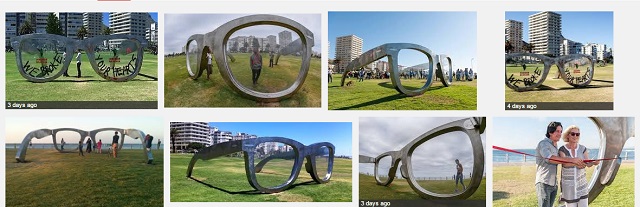

by DK Badenhorst. By now, most people would have heard about the oversized and recently vandalised pair of Ray Ban Wayfarer sunglasses on the promenade.
 The initial public reaction, prior to the vandals, was a sort of puzzled look. People felt compelled to write and remark in an ‘if you say so’ tone — that ignorance (parading as a savvy eye) that you so often see at an open art exhibition. For the record, I have to state that I’m not a regular at art galleries and, when I do go, I often end up staring at a canvas, wondering what I’m not seeing.
Take a step back
But let’s take a step back. When we look at symbols, we find language on the one end of the spectrum — symbols that carry their meaning by pure convention.
The word ‘car’ in no way resembles an automobile. It doesn’t look, sound, smell or feel like a car. It is simply by convention that we all know it means the box with four wheels and an engine. If you are going to start using car to refer to water, you’ll break the convention of language and your application of it will be confusing and irrelevant.
Brands play somewhere in the middle of this spectrum, and art is on the other end. While convention is leveraged, it is really open to interpretation and we have to explore the meaning and the context in order to get what it really means. It’s often a new symbol that carries mixed meanings from different spheres of life in order to achieve a variety of goals.
Incubation chamber and beta versions
I have a friend who is an artist and we’ve had the discussion about why we have art. And it would seem it can (among other things) serve as a sort of incubation chamber for expression and meaning — it creates the beta versions of ways in which we can bridge gaps in culture. But, as with all beta versions, you get the excitement of a new thing at the cost of potential frustration.
Such is the case with the pair of Ray Bans on the promenade.
The language is powerful — first because it is loud — it’s a larger-than-life pair of sunglasses propped up looking over towards Robben Island. The political link is then because this icon of carefree living is meant to commemorate Nelson Mandela. But what is interesting is that it is a symbol of wealth before it is a symbol of freedom or anything else.
High-school experiment
This is almost a lab test of what goes on in South Africa. I remember the high-school experiment where you cool a super-saturated solution. After a short while, whatever saturated the solution will start crystalising upon the walls of the container. It’s an experiment that comes back to me whenever something weird happens in society. Circumstances changes and whatever is out there crystalises in the real world.
But what has crystalised upon the pair of Ray Bans? We are super-saturated with frustration.
Tokolos Stencils is not a political activist group; it’s a group of frustrated and ignored individuals who leverages the language of society in order to give a platform to how they feel. Neither Marikana nor the art installation is theirs but it will have to do — much like the bridge over Nelson Mandela Boulevard is not theirs but still got the ‘remember Marikana’ treatment.
It’s not coherent messaging
But the point of groups such as Tokolos Stencils is not coherent messaging; it’s a massive red flare from a life raft adrift at sea. Much like the flare uses complex chemicals to make the simple red streak, so, too, Tokolos uses complicated language (Marikana, non-descript threats and art installations) to call attention to itself.
And this isn’t bad; it’s not narcissism — it’s a legitimate demand for political representation, executed in a somewhat tasteless fashion, leaving an innocent artist as collateral damage.
Why do I not think it is about the messaging?
Can do better
If your mission statement is ‘to scare the powers’, you can do better than reminding Ray Ban Wayfarer-wearing, art-appreciating Cape Town of the Marikana Massacre. Plastering ‘remember Nkandla’ on government buildings would be closer to your mission statement (you’ll also have to deal with the repercussions of such an act).
But, then, you have to ask, “Are we at that point where criminal behavior is the only solution? Is the society so irrelevant that I don’t consider its norms to be consistent with my own?”
But where does this leave a brand such as Ray Ban and others (such as Woolworths), which get pulled into every other political argument out there?
Brand vs brand relationship
First, I think it’s worth nothing the distinction between an attack on the brand and an attack on the brand relationship. It’s the difference between an attack on Angelina Jolie or Brangelina — the celebrity superstar or the celebrity supercouple.
No-one has a problem with the brand or its values; it’s only when you mix it with the target audience that it becomes a legitimate target. It’s a somewhat macabre litmus test for whom your target audience is perceived to be.
The vandalising of the installation might have been avoided if the artist opted for the iconic Gandhi spectacles, but that would mean something completely different, and its connection to pop culture cannot even be compared. It’s the relationship to the world that is under fire — not the brand itself.
Standing for middle-class affluence
The brands have become part of establishment; not only do they resonate with their target audience, the world happens to know that they do. Woolworths has come to stand for middle-class affluence and the doors of Woolworths have become portals into that sphere of society.
In this instance, Ray Ban Wayfarers (especially on the promenade) have become a proxy for middle/upper-income Cape Town. And, instead of the installation being seen for the bridge it’s trying to be, it’s been crucified for the gap that currently exists.
To me, this highlights the point to which our society is saturated with economic, social and political frustration, and — while our government is sinking yet more resources into keeping our president out of trouble — the evidence of social unrest is crystalising upon the walls of our society.

DK Badenhorst is a cultural insight and semiotics consultant who brings cultural context and long-term trend insights to brand communication. He contributes the monthly “Brand Culture” column, exploring the value and meaning interaction between brands and society, to MarkLives.com.
— MarkLives’ round-up of top ad and media industry news and opinion in your mailbox every Monday and Thursday. Sign up here!