Ad of the Week: Banking that breaks the fourth wall

by Oresti Patricios (@orestaki) Capitec, that innovative banking brand, has come up with a campaign for the social age. These YouTube ads talk directly to viewers with a quick hit that gets the message across in five seconds. For the curious — those who don’t click the ‘skip’ button and keep watching — hilarity ensues.

“Five-second ads — annoying, right?” That’s what one of the cleverly cast characters in Capitec’s three-part web ad series says in the bank’s new campaign. He’s right; we’ve become so used to hitting the YouTube “skip” button that it’s as much of a reflex as saying “Bless you” when somebody sneezes.

Capitec launched in 2001 and, in just over a decade and a half, has grown from a small bank to one of South Africa’s ‘Big Five’. The bank’s message to market has always been based on the KISS (keep it simple, stupid) principle. Never shy to challenge other banks on their high fees, Capitec has provided simple, low-cost banking for individuals. In response, most clients you come across will declare a loyalty one normally only sees in Apple Mac fans. This approach has appealed to a lot of first-time banking clients, for whom charges are a major issue, as well as ‘switchers’ who are not satisfied with their current bank’s service levels.


Pinterest icon View all the Ads of the Week at a glance on our #AdoftheWeek Pinterest board!
YouTube icon Watch our 2017 #AdoftheWeek playlist on YouTube


Fast forward, and Capitec still realises how to connect. In this latest series of web ads, developed and produced inhouse, Capitec plugs right into the zeitgeist of its consumer base. Youthful, ‘ordinary’ people are filmed against a white background. The first five seconds presents the ‘sell’: Ain’t nobody got time for queues, any more than for ads. Use the Capitec app instead. Five seconds: boom, done.

In each ad, the presenter points to the bottom-right corner and tells the viewer to skip after delivering the message. But what happens if you don’t? The camera continues to roll, and the presenter carries on doing their banking on the cellphone app. After a few seconds, there is a ‘glitch’ edit, the presenter looks up, and looks blankly at the camera. “Don’t watch me,” the actor in one of the ads says.

If you persist in watching, things get a little silly [in the best possible way]. The actor says, to the screen: “I’ve got banking to do. Come on, here we go, can you please skip?” In another ad, an actor gives the camera a really blank look and says: “Really, the ad is done. You can skip now. There’s nothing to see.” After that the actor returns to doing her banking on the app.

There is inherent humour in breaking the fourth wall — addressing the viewer directly without any of the artifice of an authoritarian voice. The personable presenters provide a sense of one-on-one engagement, but in a fun and humorous way.

Each of the ads has a different ending. In the first one, the man finishes with his banking app, says: “I’m done,” and disappears. In the second, the woman — clearly improvising — bursts into laughter, saying, “OK, I’m done,” and disappears. In the third ad, the man has his app banking interrupted by the makeup artist, as the background disappears to reveal a green screen. Then the crew start switching off the lights. “No, no, no!” he exclaims. Then, when the screen is black, he quips: “OK, take it and go.”

Each character has a distinct personality that is easily identifiable without being overly typecast. These are the kinds of people you might easily meet in a bank queue. But, of course, you won’t, because they will be at home using the app.

Capitec has shown itself to be an innovator, using electronic systems such as fingerprint readers to try and make sure clients move through the physical banking as quickly as possible. But, for most banks, it makes sense to get people to use an app for their day-to-day transactions. It cuts down on people needed to staff the bricks-and-mortar establishments, and it is convenient for clients to do what they need to do in their own time, and not waste time standing in queues.

It’s this forward-thinking that has won Capitec accolades from its users, and forced other banks to re-examine the way they deal with their customers. Moreso, Capitec has earned major brand loyalty and the kind of admiration from its clients that other brands would kill for.

Smart people, Capitec. No wonder people love the brand.

Credits

Agency: Capitec (communications and internal production teams)
Creative concept & script: Matthew Smith
Producer & director: AJ van der Merwe
Filming & post production: Edwin Lloyd, Aaron Scheiner, AJ van der Merwe
Makeup and wardrobe: Este Ueckermann

Credits added at 9.42am on 8 March 2017.


Oresti PatriciosAd of the Week, published on MarkLives every Wednesday, is penned by Oresti Patricios (@orestaki), the CEO of Ornico, a Brand Intelligence® firm that focuses on media, reputation and brand research. If you are involved in making advertising that is smart, funny and/or engaging, please let Oresti know about it at info@ornicogroup.co.za.

— Sign up now for the MarkLives email newsletter every Monday and Thursday, now including headlines from the Ramify.biz company newsroom service!

[CARTOON] The Marketing Mice on that new Etios Sprint ad

by Charlie Mathews (@CharlesLeeZA) The Marketing Mice have just watched the latest ad by FCB Africa for the Toyota Etios Sprint.


Charlie MathewsCharles Lee Mathews (@CharlesLeeZA) is a writer who likes to draw, such as this regular editorial cartoon — exclusive to MarkLives — in which The Marketing Mice offer their take on the world of marketing, media and advertising.

— Sign up now for the MarkLives email newsletter every Monday and Thursday, now including headlines from the Ramify.biz company newsroom service!

Multisensorial marketing — the aromatic aspect

by Marguerite de Villiers. Do you remember — when you were a child — the scent of new clothes in the New Year, wrapping paper and cake candles on your birthday, freshly baked bread in a local bakery and newly cut grass on weekends? Do these scents remind you of moments, memories or emotions even now?

When I was a child, South Africa smelled like bushfires, laundry detergent, Zam-buk and KFC. Now, when I drive past a burning field, hang up the laundry, get sunburnt or order takeaways, I am transported back to my childhood here.

Scentscapes

Aromas tend to conjure up childhood memories because we encounter most new scents in our youth. When we first come across these aromas, we forge a link between scent, memory and emotion, and these links form part of our episodic memory.

Episodic memory refers to the events in people’s lives that are subjective, personal and relative to the individual. Scent marketing draws on episodic memory to enhance or establish particular associations consumers might make with certain products or brands.

The challenge for marketers is to create memorable moments and emotional links between the consumer and a brand or product. Because particular scents are lodged in our memories with deep-rooted associations, scent marketing is an effective way to draw and build on these existing connections.

Two big brands, New Balance and Mercedes Benz, appear to have gotten it right — but in different ways — by tapping into the two categories of scent marketing: ambient scenting and scent branding.

1. Ambient scenting

Ambient scenting fills the air with a particular scent in order to influence the consumer experience within that space. In other words, it adds to the experience of walking into a place — whether it is estate agents brewing coffee before an open house to create a feeling of home and warmth, or barbershops spraying cologne to create a refreshing and sophisticated atmosphere.

When the New Balance shoe store opened in Beijing in 2009, it understood that “it’s no longer simply enough to present or provide your products or services in a strongly branded visual context; the brand needs to connect and engage with all five senses of the customer in order to create resonance and establish long-term loyalty.”

The New Balance store brought in notes of wood and leather to convey ‘heritage and craftsmanship’ by imitating the aroma of a mid-20th century shoe store. Results reflected the success of doing so, as customers seemed to spend more time in the store.

2. Scent branding

Scent branding is about creating a signature scent that is associated with a brand and evokes certain emotions. It draws on “social developments, cultural movements and sociological changes” — something futurologists at Mercedes Benz are very familiar with.

By looking at past and present patterns, it was able to pinpoint what is and will continue to be important for its core target group and then, together with a team of olfactory experts, created a signature scent that reflected that.


Marguerite de VilliersMarguerite de Villiers is an anthropologist at strategic marketing consultancy, Added Value.

“Motive” is a by-invitation-only column on MarkLives.com. Contributors are picked by the editors but generally don’t form part of our regular columnist lineup, unless the topic is off-column.

— Sign up now for the MarkLives email newsletter every Monday and Thursday, now including headlines from the Ramify.biz company newsroom service!

Shelf Life: Dove takes a Real Beauty Pledge to celebrate 60 years

Cheryl Hunter (shelflife at marklives.com)’s weekly pick of all things new — product, packaging, design, insight, food, décor and more!

  • Dove recommits to Real Beauty
  • Shazam launches augmented reality for brands
  • Techsys uses facial recognition for rewards

Beauty at its best

Dove has taken another step in its mission to help women realise their personal beauty potential with the announcement of the Dove Real Beauty Pledge. This is a further commitment to create a world where beauty is a source of confidence, not anxiety.

To mark the launch of the Dove Real Beauty Pledge, Dove partnered with renowned photographer and creative director Mario Testino, famous for taking candid shots of women. Testino and his London-based creative agency, MARIOTESTINO+, photographed 30 portraits showcasing the beauty of women from around the world. All the images were shot according to the Dove Real Beauty Pledge and feature 32 real women and girls, aged 11 — 71, from over 15 countries, including South Africa. The portraits make up part of the Dove Real Beauty Showcase, celebrating 60 years of Dove.

Testino says: “The way Dove empowers women to celebrate their own unique beauty has long resonated with me. I have always taken the same approach with my pictures. A photographer has a choice — they can take a picture and make it about themselves by using avant-garde techniques, sometimes capturing the weakness in women, or they can choose to give their picture over to the woman in front of the lens by making her look herself and feel her most powerful.”

Says Dove global vice president, Sophie Galvani: “In 2017, the beauty landscape is wildly different to what it was in 2004 when we launched the Dove Campaign for Real Beauty; however, our commitment to redefining beauty hasn’t changed.”

The women featured in the Dove Real Beauty Showcase include Vicki, a retired medal-winning Paralympian from the UK who had to change her definition of beauty after losing her leg to cancer; Paola, a football lover who started her own club for girls in her hometown of Mexico City after she noticed many young girls drop out of sports as they entered their teenage years; and Luyanda, a chartered accountant from SA who always struggled with her appearance, despite her successful career.

The full Dove Real Beauty Pledge and the Dove Real Beauty may be viewed here.

dove.co.za • Facebook • Twitter
mariotestino.com • Facebook • Twitter


Get Shazammed

Popular app Shazam has announced the launch of a massively scaled augmented reality (AR) platform for its brand partners, artists and hundreds of millions of global users today, Tuesday, 6 March 2017.

Since launching visual-recognition functionality in 2015, Shazam has partnered with brands and artists to connect its users to custom content, and AR marks the next step forward in this offering. Shazam is reportedly used by hundreds of millions of people each month to connect to the world around them. Building on its pioneering leadership in music identification, the app has been downloaded over 1bn times and in over 190 countries, and users Shazam over 20 million times each day.

According to Shazam CEO, Rich Riley, the new platform can bring marketing materials to life: “Products, packaging, POS, advertising, events, can utilise the app to scan unique ‘Shazam Codes’ capable of delivering AR experiences, including 3D animations, product visualisations, mini-games and 360-degree videos.

“One of the things missing from augmented reality for advertisers has been a frictionless way to deliver these experiences at scale. Because Shazam has such a massive install base and consumers are already accustomed to using the app for discovery, we have now solved that problem. The possibilities for a brand to bring their products to life or make their advertising more engaging are quite literally only limited by the imagination.”

Shazam AR works with all iOS (Shazam v10.5) or Android (Shazam v7.5) devices.

shazam.com • Facebook • Twitter


Making work beerable

Motivating staff to complete their timesheets on Fridays is every agency’s headache, so Techsys Digital decided to find a solution and came up with a fun, highly effective incentive.

Using facial recognition technology in the door of a bar fridge, the fridge identifies who is in front of it and then connects wirelessly to the agency’s timesheet system to verify that the person’s timesheets are up to date. If they’ve been completed, the platform unlocks the fridge and, voila, the fridge dispenses an ice-cold Windhoek beer.

A win-win solution indeed.

techsys.co.za • Facebook • Twitter • Ramify


Cheryl HunterShelf Life is MarkLives.com’s weekly column covering all things new. Notify us of yours at shelflife at marklives dot com. Want to sponsor Shelf Life? Contact us here.

Cheryl Hunter (@cherylhunter) has written for the South African media, marketing and advertising industries for more than 15 years. A former editor of M&M in Independent Newspapers and contributor to Bizcommunity, AdFocus, AdReview and the Ad Annual, she has also produced for various television networks and currently consults on communication strategy and media liaison.

— Sign up now for the MarkLives email newsletter every Monday and Thursday, now including headlines from the Ramify.biz company newsroom service!

A journey of ideas — a timeline of innovation

by Terena le Roux (@TerenaleRoux) Social media had hardly calmed down after the announcement of the closure of creative craft favourite Ideas/Idees when Media24 announced that the team would be continuing with publishing the magazine. This is the journey of a 37-year-old brand, now starting again as a small, independent magazine with a whole new lease of life.

September 1980

Woman's Value, March 1997

Naspers bought Checkers Value, a free magazine for Checkers customers. Initially just called Value, the name changed to Woman’s Value with the fourth issue.

September 2001

Woman's Value, September 2001
The first step in the rebranding.

On the 21st birthday of Woman’s Value, the first issue of dit was launched — an acronym for ‘die idees tydskrif’. Ironically, the name Idees was the first choice, but at the time the board did not like it. This was also when I, the current editor and now owner, took over the reins as editor.

April 2003

Woman’s Value/dit became the first South African magazine to publish internationally when it launched in Hungary, initially as Woman’s Value, and later, when the Hungarians battled with the pronunciation, as Noi Ertek — a direct translation. The language issue made quality control difficult and the contract was not renewed.

2003–June 2004

A ‘win this home’ home makeover competition led to the launch of Tuis by the same team and editor. After the first issue, it was handed over to a new team.

April 2005–June 2007

A very gradual strategy was implemented to rebrand the magazines to Ideas/Idees, the name that is now associated with its creative offering.

August 2008

The team published Entertainment Ideas, the first of the myriad special editions we see now from numerous titles.

2009

February 2010–2016

The first Party Ideas for Kids was published in 2010. By the second edition, it was so popular that it was sold as a whole to publishers in Germany, England, China, Australia and Latvia.

July 2013

The magazine used its global appeal to collaborate with one of Holland’s most-popular magazines, Flow. The two magazines produced an article on the Rijksmuseum together and then sold the two titles as a pack. This started a long relationship of exchanging content.

November 2016

Media24 announced the closure of Ideas/Idees, together with four other magazines in the stable.

December 2016

The penultimate edition… not.

January 2017

Ideas, January 2017

While the final issue was on shelf, Media24 announced the transfer of the brand to me. The team continues to publish the magazine — now as a bi-monthly with a higher cover price (R80) and small print order (15 000).

6 March 2017

Expect to see the first issue of the new, now independent Ideas/Idees on shelf and in your digital magazine shops! As the world is still riding the wave of all things artisanal, handmade and entrepreneurial, this team is continuing their journey as creative South Africans’ favourite source of inspiration.

See also


Terena le RouxTerena le Roux (@TerenaleRoux) is current editor, and now owner, of Ideas/Idees. She started her career as a newspaper journalist at Beeld before becoming the first full-time researcher for M-Net’s Carte Blanche. She then moved to magazines as fashion editor at Rooirose and, after a short stint as freelance stylist, joined Woman’s Value as fashion and beauty editor and then editor from 2000. After she launched décor magazines Tuis and Home, she was appointed editorial head for Creative Living Magazines (WV, dit, Tuis and Home) and then became publisher on these titles for three years, during which she rebranded Woman’s Value and dit to Ideas and Idees. Editorial was her passion, though, and in 2009 she returned to the ed’s chair at Ideas/Idees. When Media24 decided to close the title at the end of 2016, she took over the trademark and has become owner-editor of the magazines.

“Motive” is a by-invitation-only column on MarkLives.com. Contributors are picked by the editors but generally don’t form part of our regular columnist lineup, unless the topic is off-column.

— Sign up now for the MarkLives email newsletter every Monday and Thursday, now including headlines from the Ramify.biz company newsroom service!

Big Q: Transformation apartheid plagues SA ad agencies

by MarkLives (@marklives) The marketing and advertising industries are transforming. So why are so many black professionals disgruntled with the rate of progress? And is the quality of most of the work specifically directed at a black audiences still sub-par? We emailed a panel of key industry executives for their take. First up is Ivan Moroke of Co-Currency.

Ivan Moroke

Ivan MorokeThe career of Ivan Moroke (@ivanmoroke) has shaped and has been shaped by brands, from running his family shebeen in Atteridgeville (many, many years ago) to starting a marketing consultancy, Co-Currency, 18 months ago. Consciously and unconsciously, his passion for what he does is rooted in the the power of authentic collaboration to create new possibilities. Daily, he is inspired by the three truisms: 1. You can never know the full story… 2. but everything is connected… 3. including the two statements.

On the face of it, South African advertising is transforming itself. Inside today’s ad agencies, you see lots of black faces and brown faces, as well as white. Often, however, transformation is only skin-deep. Go deeper and you encounter subtle forms of transformation apartheid.

Let me explain…

When the old white government became embarrassed by the term “apartheid”, it called the system “separate development” instead — one set of stellar opportunities for whites and a third-rate set of hand-me-down opportunities for blacks. Our ad agencies are not so crass. Many make sincere attempts to provide better opportunities. But, on closer examination, you see the “separate development” ethos in black and white.

The big idea

To understand what’s happening, you have to consider the philosophy and the traditional holy grail of the big idea. All ad agencies tell you the big idea is core competence. This is their preferred creative currency. But what is a big idea?

My definition is an organising creative concept that speaks to the human condition or experience based on a human truth or insight. Here we enter the realm of human truths, and human truths are universal. The setting might be African, American or European, but the core idea is so big it resonates everywhere.

Big ideas — properly executed — do great things for brands (and ad agencies and their creatives). National and international recognition follows. Global celebrations of creativity such as the Cannes Festival salute you. This is the fast track to career success and I applaud every brand, agency and creative team that achieves the big breakthrough.

Now check the pigmentation of the creatives who delivered the big idea. You will see that white executive creative directors, creative directors, copywriters and art directors predominate. Why is this? A key reason is that big campaigns with international relevance are entrusted to white creatives, not blacks. Whites are assumed to be more attuned to international norms.

Separate track

What happens on the wrong side of the international fast track? Solid success may be achieved here, too, but without glamour and global acclaim. This separate track is dedicated to campaigns that have local relevance but don’t pretend to speak to consumers everywhere. These campaigns are often targeted at the township market. If the market is black, then black insights are needed. Therefore, the work goes to black teams.

In practice, we see separate development. Think international scope and global accolades and you use the white pigeonhole. Think black consumers and the township market, and you use the black pigeonhole. To put it crudely, the whites get the French Riviera; the blacks get low-income communities you reach by taxi.

Similar dynamics may also apply in the strategic area.

Apart-ness like this need not be deliberately racist. Separation may also exist at agencies where black executives hold senior positions.

Entrenches a de facto system

However, the use of local and global pigeonholes entrenches a de facto system of separate development. These divisive trends have to be urgently addressed. The starting point is to acknowledge these dangers and admit transformation should be better than this.

Lots of factors are in play, including the complicity between whites driven by self-interest and blacks who are content to ‘sell out’. This is just one aspect of a complex story and the subject for another day…

See also


MarkLives logoLaunched in 2016, “The Big Q” is a regular column on MarkLives in which we ask key industry execs for their thoughts on relevant issues facing the ad industry. If you’d like to be part of our pool of potential panellists, please contact editor Herman Manson via email (2mark at marklives dot com) or Twitter (@marklives). Suggestions for questions are also welcomed.

— Sign up now for the MarkLives email newsletter every Monday and Thursday, now including headlines from the Ramify.biz company newsroom service!

What your favourite search engine will look like soon

by Daniel Schmidt (@DanielSchmidtJr) There’s no doubt that search engines are one of the best ways to connect brands to their consumers and we’ve compiled a few developments that will continue to gain importance during the rest of 2017.

The constantly evolving nature of search engines means there are new and exciting opportunities around every corner. They depend on technology and, therefore, tend to advance at a similar rate. Algorithms are updated and rules are changed — often unannounced — so, to stay on top of the game, those in the field of search engines can never lose focus.

When the goal posts are shifted, search engine rankings are affected and this influences the way agencies and media owners carry out their search marketing operations. Even the most tech-savvy characters may be taken by surprise and predicting what the future holds can be a guessing game.

The developments

Google shopping

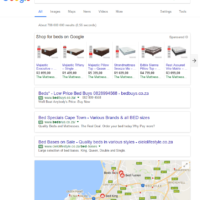
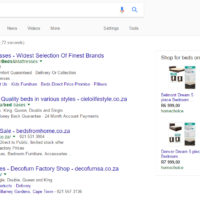
This is probably the biggest update for search engines in southern Africa and you’ll start seeing shopping ads when you enter a commercial query into the search engine. There is extensive testing happening to see which area of real estate is most effective for these ad units.

Shopping ads allow advertisers to promote merchandise on the search engine results pages (SERPs) with an image, a price and a description that will show up when a relevant query is entered. Priced as standard paid search ads with cost per click (CPC) bids, these are a highly effective way to advertise your e-commerce products on the search network and, if the price is right, expect to see good returns from shopping ads.

Featured snippet

life insurance featured snippet
Click to enlarge

If the search engine is asked a question, Google programmatically detects pages that can answer the user’s question, and serves an answer in a “featured snippet”. A cousin of the knowledge graph, the featured snippet will carry on developing and changing the way marketers set up their on-page content.

Expect to see companies setting up content to answer consumer questions directly, with the aim of driving users to their landing pages. For example, imagine a question such as: “At what age should you get life insurance?” Insurance companies could set up pages with content aimed at answering this question. If the featured snippet outranks the top organic results, this is the most-effective option of driving quality traffic to their commercial pages.

Images in SERPs

beef stroganoff schema mark up
Click to enlarge

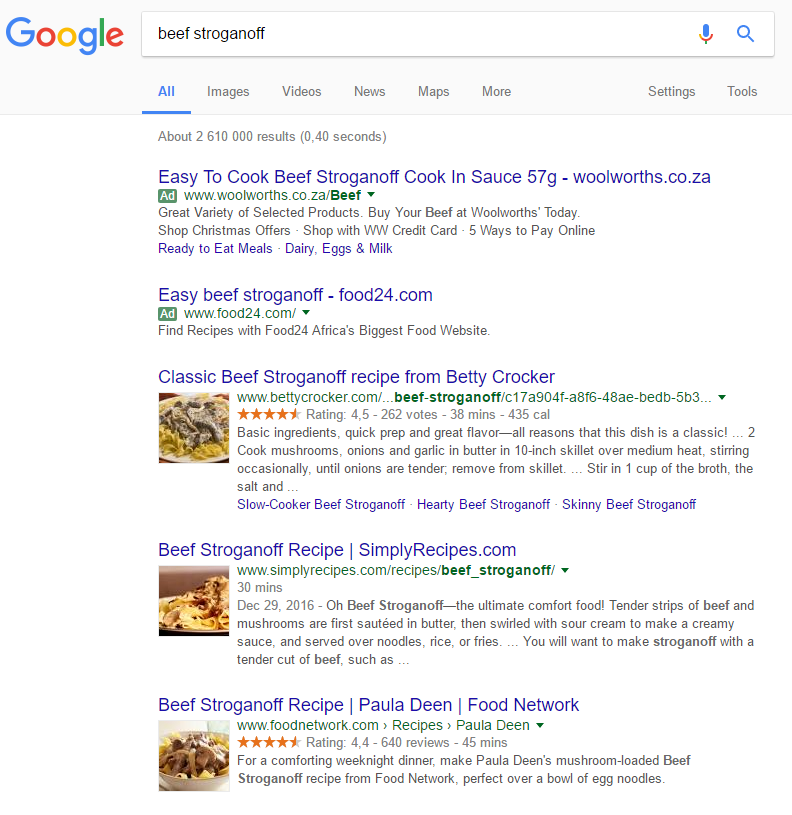
Try a search for “beef stroganoff” and you’ll notice images which display on SERPs, next to their respective organic listings. Expect more marketers to take advantage of the “recipe” schema markup to enable these (recipe-rich snippet) pictures.

Web users have a lot of variety to choose from, and therefore extremely high standards! Ranking second and having a delicious-looking stroganoff could be more important than being at #1!

Click through rate still a massive ranking factor

Senegal in the news
Click to enlarge

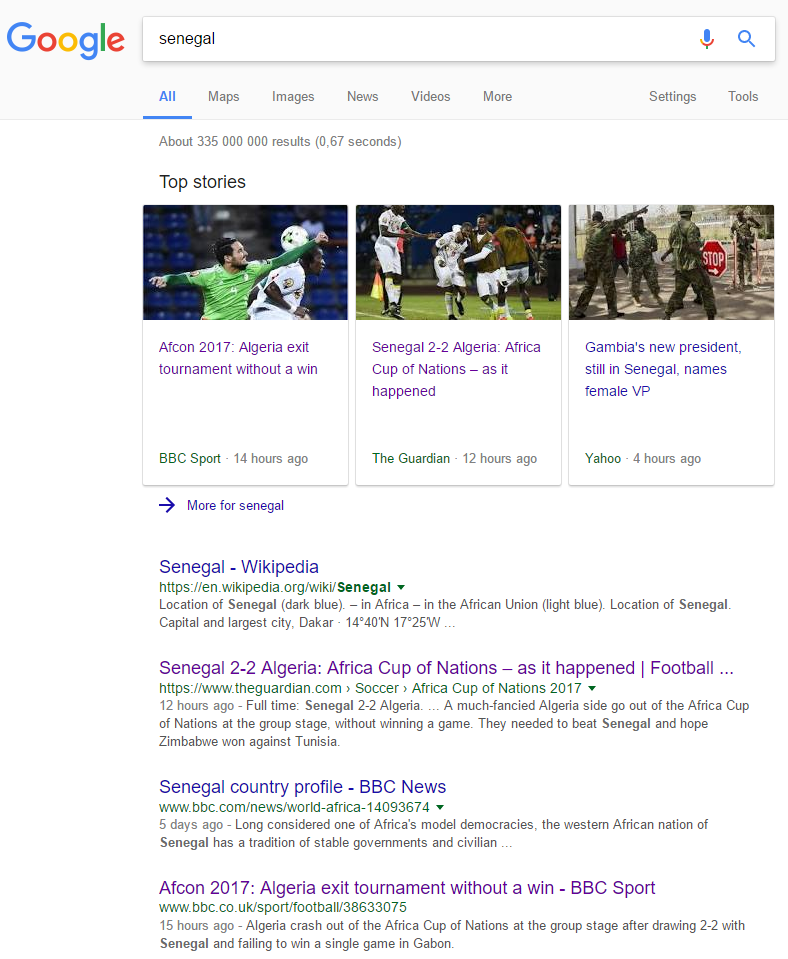
Engagement continues to be a massive ranking factor on Google. In the screengrab, a query for “Senegal” triggers results that contain “Top Stories”. At the time of the query (late January 2017), this country was competing in the African Cup of Nations and there was political turmoil in neighbouring Gambia.

Notes:

  • A BBC Sport link outranks The Guardians link in “Top Stories”, for the query “Senegal”. This is strange when you consider that The Guardian’s article outranks the BBC Sport article with its organic listing (#2 and #4).
  • The Guardian’s article is also fresher and contains the crucial keyword (Senegal) in the description.
  • Both links are AFCON-related and outrank the political article on the Yahoo news network.

The rational way to analyse these results is to assume that the BBC Sport article was deemed the most relevant to the query, by virtue of Google users voting with their clicks. This seems to echo Rand Fishkin’s 2014 experiment, where along, with his audience, he tests the relevance of user engagement on organic rankings.

We may expect continued battles between the large publishers for those top three places, especially for newsworthy content on high-volume keyword queries.

Other interesting updates

Voice search

According to Google, 55% of teens use voice search more than once a day. Another recent survey found that about 40% of smartphone users agreed that voice commands made using their smartphone easier, but the younger demographic were a lot more likely to use voice search in public.

As AI becomes more intelligent, expect voice search to have a significant impact on the way we find the things we’re looking for.

Mobile indexing

There are now more mobile searches than desktop on Google Search, but the algorithms still look at the desktop version of a page’s content to evaluate search rankings. Sometime this year, Google will roll out its debut mobile-first index.

Local SEO

These searches are on the rise and this year we expect users to be even more demanding — if someone searches Google for “toasted sandwiches”, they want the top result to be close by, to be open for business and have high ratings (Google reviews). This is before they’ve even walked in the door.

First impressions are so important for your brand, so make sure that your local SEO reflects who you are as a business, and increase your foot traffic.

Paid search

Ads in position 1-4 on the search networks accrue 86% of the demanded impressions, leaving only 14% for positions 5 and lower. The bigger brands with more spending power will dominate the more-commercial query auctions but, with the right guidance and some clever tactics, new brands may push their way into those markets.

Advice and insights

  • Your consumers have done most of the work — they are actively searching for the service you offer and you just need to give it to them. Search listings work best when site navigation is straightforward and the interface is user-friendly, so make sure you allow the consumer a simple process.
  • Know your platforms and the applicable technologies. The more you offer brands and consumes, the better. Incorporate the latest tools into your search and know how to use them.
  • Know your best practices (whether these come from industry specialist support or campaign experience).
  • Use data! Experimentation is vital in areas such as search marketing that change so frequently. Data will continue to grow in importance, as it sheds light on the grey areas of digital media. When your experience gives you the ability to offer clients solutions, data empowers you to make sure that the results follow.


Daniel SchmidtDaniel Schmidt (@DanielSchmidtJr) is head of search at Mark1 Media and is driven by the fact that search engine marketing requires constant focus. Search engines may seem simple on the front end, but he’s made it his mission to understand what goes on behind the scenes. He is passionate about consumer psychology and tries to learn something new every day.”

“Motive” is a by-invitation-only column on MarkLives.com. Contributors are picked by the editors but generally don’t form part of our regular columnist lineup, unless the topic is off-column.

— Sign up now for the MarkLives email newsletter every Monday and Thursday, now including headlines from the Ramify.biz company newsroom service!

SA TV Ratings: SABC 3 — primetime top 20 for Nov, Dec 2016

by MarkLives (@marklives) The hottest primetime television shows on SABC 3 in South Africa revealed: TV ratings for November and December 2016.

Last year, the Broadcast Research Council of South Africa (BRCSA) has changed its policy about giving away TAMS and now only monthly reports, highlighting the top 20 or 30 primetime shows on several popular channels, are available.

SABC 3 December 2016

BRCSA TV Ratings December 2016 primetime SABC 3

Source: BRCSA December 2016


SABC 3 November 2016

BRCSA TV Ratings November 2016 primetime SABC 3

Source: BRCSA November 2016

Broadcast Research Council of South Africa


The Broadcast Research Council of South Africa (the BRC) is a non-profit, industry body that was incorporated in 2015 to cater to the audience research needs of the radio and television industry in South Africa.

— Sign up now for the MarkLives email newsletter every Monday and Thursday, now including headlines from the Ramify.biz company newsroom service!

MagLove: The best magazine covers this week (3 March 2017)

MediaSlut (@MediaSlut)’s choice of the best international and South African magazine covers this week:

  • FORTUNE
  • Golf Digest (Hot List issue)
  • Popular Science
  • San Antonio
  • The New Yorker
  • WineLand

Find a cover we should know about? Tweet us at @Marklives and @MediaSlut.
Pinterest icon Want to view all the covers at a glance? See our MagLove Pinterest board!


FORTUNE, 1 March 2017

The promise vs the peril. A very cool flip cover telling two very different stories, captured perfectly through photography, a simple graphic and strong colours.


Golf Digest, March/April 2017

Golf Digest, March/April 2017: Hot List issue

Every year, Golf Digest rolls out its Hot List over all its international issues, so it always has to pull out all the stops to make its cover as creative as possible while always using the most important equipment to play golf… the golf club. This year, it didn’t disappoint once again. If you’re into golf and want to know what are the best putters, irons and drivers out there, click here.


Popular Science, March/April 2017

Popular Science, March/April 2017

Popular Science is looking at “the state of water in our world”, but it could just as well have talked about the Western Cape specifically, as this seems to be our future (roughly 121 days of water left, currently). For that reason, this cover definitely grabbed my attention; the photoshop and colour usage are also really done very well.


San Antonio, March 2017

San Antonio, March 2017

San Antonio is in south-central Texas, North America, and its local magazine is featuring its “Best of the City” issue with clever embroidery that catches the eye.


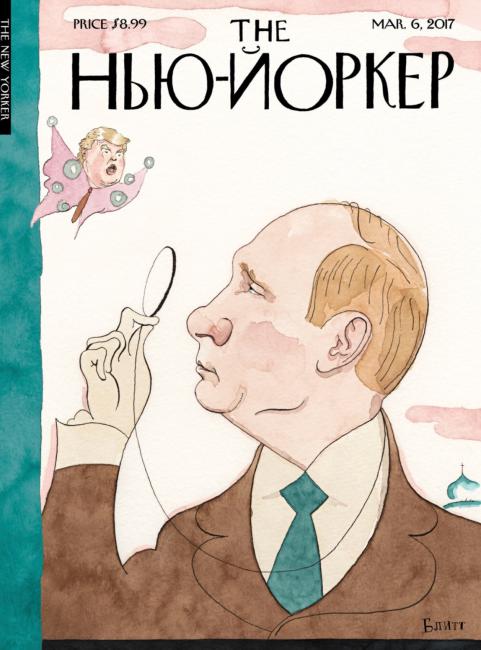
The New Yorker, 6 March 2017

The New Yorker, 6 March 2017: Vladimir Putin and Donald Trump

No, this is neither fake news nor a fake cover. This is The New Yorker taking a massive stance on politics in the US (and, more specifically, the relationship between Putin and Trump) by going as far as even changing its logo to Russian! What makes this cover even more amazing — and worth talking about — is that it’s based on its very, very first cover in 1925 (by Rea Irvin) but this time “our dandy mascot has become Eustace ‘Vladimirovich’ Tilley and the lepidopteran under scrutiny is none other than a stunned Donald Trump.”

Still doesn’t make sense what all the fuss is about, and why it’s so great? Then read this great interview with the art editor, Françoise Mouly, who puts its all perfectly into perspective. Also click here to read about “Trump, Putin, and the new Cold War”. Scary stuff!


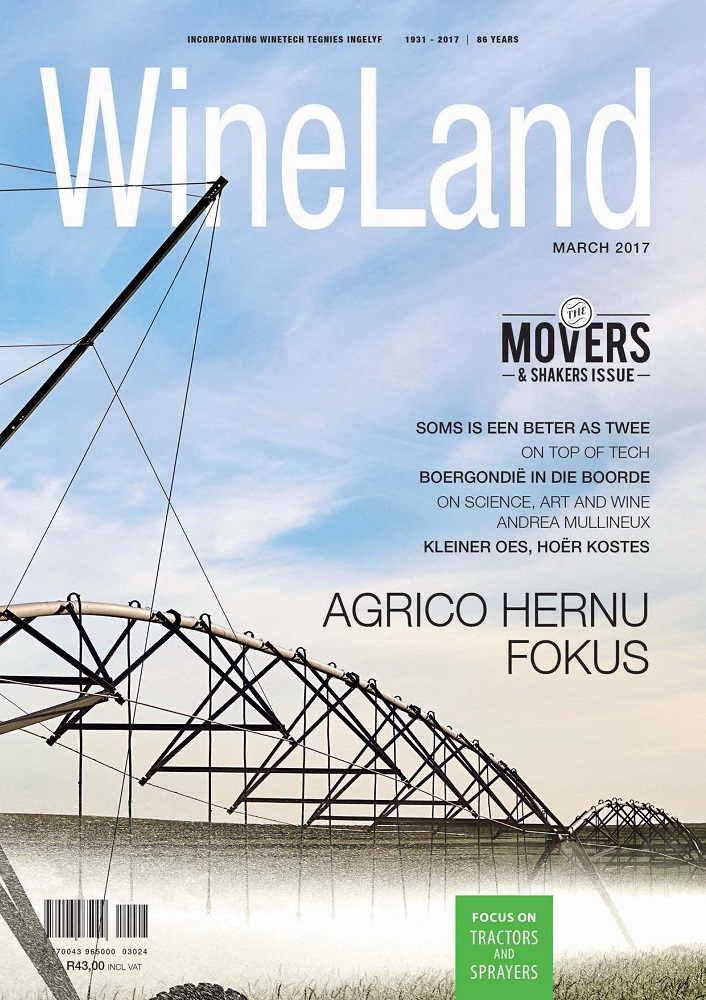
WineLand, March 2017

WineLand, March 2017

Beautiful cover! As the son of a farmer, I grew up with Wineland magazine always being in our house, so it’s great to see how it’s transformed over the years while staying as relevant as possible. Strong photography, clever photoshop over the logo, and simple typography.


MediaSlutMagLove by @MediaSlut is a regular slot featuring the best local and international magazine covers every week, recognising well thought-out, powerful and interesting (and hopefully all three-in-one) covers and celebrating the mix of pragmatism, creativity and personal taste that created each of them. The anonymous (for now) blogger behind MediaSlut knows way too much for his own good about media in South Africa, magazines in particular. His mission is to show when SA magazines fail but, most importantly, also when they succeed. If you’re looking for a library about SA magazines and news, this is your one-stop pitstop.

— Sign up now for the MarkLives email newsletter every Monday and Thursday, now including headlines from the Ramify.biz company newsroom service!

Nielsen AdEx Top 50 SA advertisers 2015 vs 2016

by MarkLives (@marklives) Nielsen Sub-Saharan Africa has released its list of the top 50 advertisers in South Africa for 2016, covering cinema, direct mail, out of home, print, radio and TV, and excluding self-promotion and internet. We compare it to the 2015 figures.

Please note rate card value is reflected and discounts are excluded. According to Gustav Goosen, head of research for the IAB SA, the 2016 data collection for internet adspend is currently underway.

Spend per category

Media

2016 (ZAR)

2015 (ZAR)

Change

Cinema  328 823 665 359 442 942 -8.5%
Direct mail  82 244 984 91 321 170 -9.9%
Out of home 791 597 291 691 356 618 14.5%
Print 2 949 002 598 3 012 620 711 -2.1%
Radio 2 819 101 969 2 541 173 420 10.9%
TV 14 247 288 906 13 088 612 891 8.9%
Total 21 218 059 413 19 784 527 752 7.2%


Rank

2016 advertisers

2016 total spend (ZAR)

2015 advertisers

2015 total spend (ZAR)

1 SHOPRITE HOLDINGS 1 512 522 344 UNILEVER SA 1 541 239 228
2 UNILEVER SA 1 441 427 759 SHOPRITE HOLDINGS 1 394 433 710
3 CLIENTELE LIFE 1 132 493 943 CLIENTELE 898 165 142
4 SAB MILLER 796 725 420 SAB MILLER 791 530 374
5 ABSA 713 561 656 PICK N PAY 708 461 216
6 PICK N PAY 693 836 703 DISTELL 627 198 413
7 MASSMART 617 944 345 ABSA 609 696 778
8 OUTSURANCE 613 002 739 OUTSURANCE 580 519 451
9 VODACOM 604 850 443 NEDBANK 507 413 158
10 COCA COLA 518 039 150 SPAR 507 022 707
11 DISTELL 511 769 310 STANDARD BANK 498 861 874
12 SPAR 498 191 927 CELL C 481 437 086
13 TELKOM 479 536 387 VODACOM 461 270 097
14 NEDBANK 477 426 914 MASSMART 455 798 734
15 FIRST RAND BANK LTD 476 475 551 FIRST RAND BANK LTD 433 909 361
16 RECKITT & BENCKISER 473 251 034 BEIERSDORF 428 684 083
17 BEIERSDORF 458 899 368 TELKOM 416 378 299
18 MULTICHOICE 432 161 678 TIGER BRANDS 413 179 063
19 CELL C 399 584 516 MULTICHOICE 410 272 016
20 TIGER BRANDS 395 146 836 YUM SOUTH AFRICA 373 905 383
21 MTN 379 594 727 GOVERNMENT NATIONAL 360 186 818
22 ALL LIFE 376 013 310 PROCTER & GAMBLE 358 533 307
23 FAMOUS BRANDS 369 787 573 MONDELEZ 356 689 349
24 GOVERNMENT NATIONAL 353 314 114 OLD MUTUAL 334 769 543
25 STANDARD BANK 333 397 385 FAMOUS BRANDS 305 537 531
26 PROCTER & GAMBLE 326 793 757 EDCON 295 691 286
27 DISCOVERY HOLDINGS 318 915 579 PEPKOR 285 387 413
28 YUM SOUTH AFRICA 314 351 168 FORD 280 240 021
29 GLAXOSMITHKLINE 313 293 806 COCA COLA 267 993 454
30 PEPKOR 303 655 193 DISCOVERY HOLDINGS 250 444 501
31 VOLKSWAGEN 298 050 914 TOYOTA 245 077 016
32 MONDELEZ 275 967 958 PIONEER FOODS 244 480 914
33 EDCON 274 657 270 RECKITT & BENCKISER 244 116 997
34 NEW CLICKS 269 071 234 VOLKSWAGEN 240 522 907
35 NESTLE 265 828 398 MTN 231 061 932
36 SHOW MAX.COM 248 094 788 NESTLE 219 510 002
37 SAMSUNG 246 581 563 JOHNSON & JOHNSON 218 890 906
38 MCDONALDS 242 103 436 NEW CLICKS SA 216 827 737
39 TOYOTA 223 322 049 GLAXOSMITHKLINE 210 139 997
40 OLD MUTUAL 221 778 542 GENERAL MOTORS SA 209 380 579
41 PIONEER FOODS 218 499 049 DIAGEO 208 483 369
42 GOVERNMENT GAUTENG 218 317 199 JD GROUP 207 922 406
43 BUDGET INSURANCE 211 571 483 MCDONALDS 197 809 579
44 HEINEKEN 208 594 762 AVI 195 245 501
45 JOHNSON & JOHNSON 205 897 549 HEINEKEN 187 846 400
46 FORD 205 173 703 DIS-CHEM 175 828 688
47 DIS-CHEM 190 154 705 LOREAL 175 773 986
48 1ST FOR WOMEN 189 938 537 1LIFEDIRECT INSURANCE 175 208 867
49 1LIFEDIRECT INSURANCE 188 626 066 BUDGET INSURANCE 173 600 975
50 AMKA 179 865 573 1ST FOR WOMEN 171 929 598
TOTAL TOP 50 ADVERTISERS 21 218 059 413 TOTAL TOP 50 ADVERTISERS 19 784 507 752
(Others) 22 438 924 656 (Others) 21 146 149 574
Grand Total 43 656 984 069 Grand Total 40 930 657 326


Updated at 9.20am on 2 March 2017.

— Sign up now for the MarkLives email newsletter every Monday and Thursday, now including headlines from the Ramify.biz company newsroom service!

Online CPD Courses Psychology Online CPD Courses Marketing analytics software Marketing analytics software for small business Business management software Business accounting software Gearbox repair company Makeup artist