The second wave of digital is breaking

by Luke Mckend (@lmckend) Too often, we in the digital media industry have reduced the conversation about digital transformation to one about shifting budgets from one flavour of digital media to another, rather than a deeper understanding of what this digital transformation really means for a business.

The digital media space has exploded, providing brands and publishers with exponentially more real estate in which to advertise and get their messaging across. The use of cellular telephony has also exploded — 50% of South African adults today are online and own a smartphone. Online retail, or ecommerce, has grown by over 20% year-on-year for the past 16 years, according to research by World Wide Worx, and annual sales have now hit around R9bn. And then there’s the internet of things (IoT) — an expanding number of connected devices that gather and transmit data — from smart appliances, to watches and fitness trackers.

Rapidly evolving landscape

What does this all add up to? A rapidly evolving landscape for advertising execs to navigate and understand.

We interact digitally hundreds of times every day, and some of those provide an opportunity for brands to engage us with relevant and useful information. Each of these engagements with a consumer allows a brand to start building a profile of that person. As a brand gathers more and more data on a given consumer, it may leverage the insights the data provides to more accurately engage them — or so the theory goes.

The lack of interrogating what digital transformation really means for business has resulted in a growing sense of frustration from clients and content creators alike, who both sense that they are being short-changed in the process. The recent suggestion from the world’s biggest advertiser, Proctor & Gamble, that digital media needs to grow up is a clear example of the pressure that’s going to come digital media’s way.

Too little focus on impact

Digital is great for generating activity — and, for clients interested in big numbers, it’s hard to argue with the hundreds of millions of impressions and tens of thousands of clicks, views and likes that are available to buy. Unfortunately, for all the measurable activity, there is far too little focus on impact in the form of value created for customers — whether it be in the form of actual sales, or any other measurable attribute.

And, when metrics are reported, there is often confusion, especially when comparing different media sources: Does an impression mean the ad was actually seen? Are all video views equal? Was my ad seen by someone I care about (or who cares about my product or service?). Many of these questions are simply ignored or answered by columns in Excel spreadsheets masquerading as analysis with no actionable insight.

One of the reasons for this is that the first wave of digitisation has been driven by consumer technology and consumption of information. The second wave is now being led by businesses which are leveraging the deluge of information that’s been created by connected people interacting with friends, colleagues, businesses etc, as well as by increasingly connected systems (think supply chains), as well as more and more connected devices.

Technology has provided new means to engage consumers; it now needs to be used to show how value is created for brands by using those platforms. The second wave of digital is breaking.


Luke MckendLuke Mckend (@lmckend) is country director of Google South Africa. 

“Motive” is a by-invitation-only column on MarkLives.com. Contributors are picked by the editors but generally don’t form part of our regular columnist lineup, unless the topic is off-column.

— Sign up now for the MarkLives email newsletter every Monday and Thursday, now including headlines from the Ramify.biz company newsroom service!

#DesignIndaba 2017: Design Indaba made Grid do it

by MarkLives (@marklives) Every year, Design Indaba’s advertising and marketing campaign is conceptually refreshed and, after many years of sterling work by The Jupiter Drawing Room (Cape Town), the baton has now been handed over to Grid Worldwide. Heléne Lindsay, Grid general manager Cape Town, gives us an overview of the latest evolution of the iconic design festival’s visual identity.

…and ACTION

The Grid/Design Indaba partnership is a creative inception of like-mindedness, passion and belief that creativity has the power to change the world, aligned to the Grid philosophy of #MakeItMeanSomething.

Design Indaba is great. It inspires, informs and connects people, but inspiration is nothing without action. This became the insight that informs this year’s Design Indaba. The campaign aims to push the public at every level to take what inspires them and turn it into results. In doing so, delegates and viewers will be able to say “Design Indaba made them do it”.

MAKE Design Indaba’s purpose visible

Ravi Naidoo, the founder and MD, has been determined to make the purpose behind the Design Indaba Festival more overt and visible — both in messaging and campaign treatment. We need to dispel the notion that it’s only about three days; it’s about the conference inspiring delegates to go out and do incredible things for all 365 days of the year. It’s a call-to-action to be a part of a movement that promotes design thinking and creativity as a means to solve real-world challenges.

Design Indaba has expanded its impact with a set of initiatives that fit together under the Design Indaba ‘motherbrand’. The Grid team consolidated these initiatives into a holistic, consistent system. These consist of the:

  • festival conference
  • simulcast (in six venues in sub-Saharan Africa)
  • film festival
  • Most Beautiful Object in South Africa (MBOISA) exhibition
  • Emerging Creatives exhibition, and
  • first-ever Nightscape — which sees a collection of music, art, design, films, food, installations and other weird and wonderful things coming together.

GRID Design Indaba 2017 brand architecture


GO GO GO

A collection of collateral has been brought to life across social media, print, promotional material and venue branding, and across the various initiatives.

The communication employs stark, bold, minimalist black typography on a white background. The messages employ action-oriented copy that should give viewers a not-so-subtle kick up the backside. This no-nonsense aesthetic reinforces the idea that we should all be doing more with our inspiration. The visual and tonal language is an intentional counterpoint to the whimsical, dreamlike, colourful fantasy world that creative director, Selly Raby Kane, has created on the Artscape Piazza.


Design Indaba MADE me DO it

As part of the campaign, we’re featuring various luminaries who, as a result of connecting with Design Indaba, have done amazing things. The tagline “Design Indaba Made Me Do It” is used to bring the amazing feats to light. We intend for this to be an ongoing project that pays tribute to Design Indaba’s neverending quest to inspire people to do great things. Our hope is that, next year, a lot more people will be able to say that “Design Indaba made me do it”.

Credits

Agency: Grid Worldwide Branding & Design
Chief creative officer: Nathan Reddy
Executive creative director: Paul Hinch
Creative directors: Jan-Hendrik Labuschagne, Greg Trombetta
Designers: Wade Moonsamy, Tarryn Chimes
Finished art: Ian Dally, Lloyd Carey
Writer: Johannie van As
Account director: Heléne Lindsay
Account management: Nic Symmonds, Kyle Jewill
Animators: Jeremy Collins

See also


—MarkLives.com is a proud media supporter of Design Indaba 2017. Sign up now for the MarkLives email newsletter every Monday and Thursday, now including headlines from the Ramify.biz company newsroom service!

Ad of the Week: The human connection

by Oresti Patricios (@orestaki) Investec, Aqua and Greg Gray of Velocity Films reach out to the ‘me’ generation with a cyber-essay that celebrates individualism, and astutely positions the private bank as the brand with the human touch.

In an age of internationalism, when some of the world’s biggest banking brands compete for top end clients, how may financial brands differentiate themselves? In an age when artificial intelligence is recreating banking products, and big data is moving marketing campaigns, surely discerning customers long for that human connection?

We’ve all had the experience of being treated like a number — when an organisation grows so big it ceases to see us as individuals, but instead we’re a data set. As the owner of a company that deals in data collection and analysis, this is something that I’ve become acutely aware of. Yes, data and statistics are critical in market to evaluate trends or to determine the efficacy of advertising campaigns. Data is useful to try and understand consumer behaviour but, when it comes to customer service in private banking, individual and highly personalised connections are everything. The human touch that makes us feel seen and visible is what sets the top brands apart from the ‘also rans’.


Pinterest icon View all the Ads of the Week at a glance on our #AdoftheWeek Pinterest board!
YouTube icon Watch our 2017 #AdoftheWeek playlist on YouTube


Investec plugs into this zeitgeist — this craving for visibility in a data-driven world — with its latest TV commercial, part of the integrated #MoreThanData campaign across print, cinema, digital and social media channels. The beautifully crafted black-and-white narrative begins with the question, “When did you become just a number?” The 60s-television commercial ends with the statement, “Where others see you as the sum of data, we see you.” This is a story told by an artificial intelligence — a being made up of data, about what it means to make a human connection.

The ad starts with a close-up of a face on a grey-black background, speaking directly to camera. This character, a man in his 20s with a stubbly beard, asks the question, “When did you become just a number?” The camera cuts in to a much-tighter shot, and now we see that the man’s skin is made of digital points, and connections that map his face in 3D. He asks, “When were you classified as only ones and zeros?”

In the middle of the next shot, the male face ‘glitches’ halfway through the sentence, morphing into a female face and voice, who asks: “When did statistics start speaking for you?” The visual effects are disturbingly brilliant and have the effect of making one want to look even more closely at this ad.

When the faces morph from one actor to the next, the visual effect is a cross between a digital glitch and a quick transition. In a world where so many commercials become wall paper, this is attention-grabbing. The faces are perfectly aligned, so the eyes and mouth match up, creating an eerie effect. This is an ad that demands to be seen.

There is also a subtle but audible glitch on the soundtrack, as the transition happens. It’s not over-the-top; just enough to make the effect work convincingly. The continuation of the commentary — a series of strong voices — uses several different faces, in rapid succession, and the voices overlapping with precision.

Suddenly, the camera zooms into an eye, and then travels through a digital landscape, settling on two strands of DNA that divide and recombine. The animation is consistent with the digital feel of the faces. This then represents the symbolism of individuality in the building blocks of life. It works on several levels: a person’s eye is often thought of as “the window to the soul”, while DNA is all about the genetic code that provides each individual with their unique traits. The animation is carried by the copy: “When you’re more than algorithms, when data capture doesn’t capture who you really are.” The sequence returns to the varying faces, with the copy, “When a human voice is all you’re looking for — with empathy that’s real, not electronic.”

Highly contested market

The ultimate message of this campaign? ‘Data can never define you.’ The faces morph at an increasing tempo towards the end of the film, while the copy reads: “And where I’m just an average of data, you won’t ever be.” The sequence ends with the same face that leads the commercial but the face disintegrates in a cloud of particles to reveal the slogan, “Where others see you as the sum of data, we see you.”

Private banking is a highly contested market. Local and international brands compete at the highest level for a sought-after prize — a moneyed market that is discerning and wants the best. There is only so much financial brands can do to differentiate product; beyond that, everything is about the human connection and which brand manages this best.

Investec first made a name for itself in this market because of its unparalleled private banking service. It was a breakthrough brand that distinguished itself with a superior product offering. In an era when banks will increasingly use big data and artificial intelligence to reach customers, Investec is cleverly setting itself apart by treating humans as humans.

Credits

Ad agency: Aqua
Executive creative director: Theo Ferreira
Creative director: Andrew Shaw
Art director: Ernst van der Merwe, Martjie Louw
Copywriters: James Armstrong, Cameron Dalton
Strategist: Amy Ford
Client service director: Tanya Fialkov
Project manager: Pascale Oswald
TV producer: Lee-Ann Booysen
Production company: Velocity Films
Director: Greg Gray
Executive producers: Helena Woodfine, Karen Kloppers
Producers: Helena Woodfine, Helmke Möller
DoP: Paul Gilpin
Post production online: Deliverance Post Productions
Editor: Ricky Boyd
Visual effects & post production offline: Glassworks, London
VFX supervisor: Duncan Malcolm
2D artists: Mark Holman-Harris, Leanne Pletersky, Caroline Pires
3D artists: Alastair Hearsum, Matt Fletcher, Julian Johnson, Gil Weiss
Colourist: Daniel de Vue
Producer: Duncan Cook
Music/composer/sound: Mad Planet

Credits last updated at 10.10am on 6 March 2017.


Oresti PatriciosAd of the Week, published on MarkLives every Wednesday, is penned by Oresti Patricios (@orestaki), the CEO of Ornico, a Brand Intelligence® firm that focuses on media, reputation and brand research. If you are involved in making advertising that is smart, funny and/or engaging, please let Oresti know about it at info@ornicogroup.co.za.

— Sign up now for the MarkLives email newsletter every Monday and Thursday, now including headlines from the Ramify.biz company newsroom service!

Getting data right & understanding how it should be used

by Craig Hannabus (@crayg) With the omnipresent nature of data and creative people being who they are, there are some new ideas floating around. This has led to some confusion as to how data should be used.

The importance of data in the ad industry around the globe has gained popularity. With better tools coming onto the market, agencies which are devoted to sourcing qualitative data and clients savvier with regards to current trends, data has become an industry all on its own.

Where is and isn’t it applicable?

My first port of call was Maarten Vanhoof, a data scientist at the Open Lab at Newcastle University. To say that he knows data is an understatement — he’s devoted a large amount of time to analysing and interpreting data from a multitude of sources. Vanhoof is currently working on a project to determine more-effective placements of urban infrastructure, such as shopping malls or help centres. Looking at foot traffic, location-based cellular usage, public-transport use and other data points, Vanhoof can roughly determine where to place stuff to maximise their effectiveness. All of this based, mostly, on quantitative data. In other words, it’s a reflection of what people are doing.

I asked him if he believed that we could use quantitative data to determine what our creative ideas should look like. The example he used was simple. If your quantitative data tells you that your target market likes the colour blue, how does that determine your creative? Easy. Just make sure that your creative is blue. It’s an easy creative brief because it gives a very clear instruction.

The downside is that your chances of building something new and innovative drop to zero. Your creative team may put together a campaign that may be fairly successful, but you’re not going to make any real impact on a consumer’s life. The road to innovation doesn’t really start until you begin the process of interrogating and gleaning qualitative data.

So what is the correct approach?

Going back to our previous example ,where we used quantitative data to establish a behaviour, we then have to examine that data further by asking what drives that behaviour. Why does the target market like the colour blue? In order to find out why, we may have to step out of the office and pose that question to actual people. A scary thought, indeed. What we may find (for the sake of our example) is that people like the colour blue because it is calming. Suddenly, our creative brief has far more scope. We are still working within the constraints of what we know is true, but we have more options as to how to execute. Sure, we can take the easy route and make our creative blue, but maybe there are some other ways to make our campaign more calming.

Data leads to insight; insight is what leads to great creative. This might seem obvious to most strategists and creatives, and I am probably preaching to the converted, but I think it is relatively important to remind ourselves of this. As we move into a time of deeper uncertainty, politically, socially and economically, it becomes more and more important for us to connect with people in a more meaningful and consistent fashion. The word “authenticity” has always been bandied around in advertising circles but, at what appears to be the dawn of a new era, authenticity has taken on a new layer of importance.

So, how do we elevate authenticity and create room for innovation?

1. Make sure you have an insight

Very often, data is dressed up as an insight. Our insight? According to our findings, the target market likes the colour blue. That isn’t an insight; that’s just a bit of data.

Let me use a deeper example. In some recent research, we found that our target market was aspirational. In the South African context, that’s hardly something to get excited about and, very often, that sort of thing is presented as an insight. “We need to be more aspirational,” says the slide. But that doesn’t answer the “why” question. Why are people aspirational? If you can answer that using qualitative research, you’re close to finding an insight.

2. Quantitative and qualitative

These two go hand-in-hand. Be very wary of any insights you’ve gleaned where both qualitative and quantitative data aren’t involved.

I recently witnessed an example where a presentation clearly demonstrated that the sales of a certain brand had fallen; however, the consumer’s perception was that the brand was extremely successful and well-liked. There is a dissonance there. One of those pieces of information is either flawed or untrue.

Always make sure that your qualitative and quantitative data are working together. If they aren’t, make sure you know why.

3. Maintain objectivity

It may be very hard to put your preconceived notions, your assumptions and, in some cases, your prejudices aside. You’ll need to, because when you’re chewing on data to find an insight, you can’t afford to have anything coloured by preconceived notions. Maintain an open mind, and it is very likely that you will be surprised.

Wherever you can, attempt to apply the Socratic method. Prove your assumptions wrong and you’ll come one step closer to the truth.

~~~

Data in advertising is a new toy; we’re still learning how to play with it. We may either cheat and mould it to say what we want it to, or we may be patient and use it to build better products and a better world.


Craig HannabusCraig Hannabus (@crayg), a creative strategist at Havas Boondoggle, has spent his entire adult life in the technology and marketing industry, exploring both the development and the content creation aspects of it. Through the years, he has developed a strong interest in the psychology and sociology around social media, as well as exploring the depths of user experience and web development.

“Motive” is a by-invitation-only column on MarkLives.com. Contributors are picked by the editors but generally don’t form part of our regular columnist lineup, unless the topic is off-column.

— Sign up now for the MarkLives email newsletter every Monday and Thursday, now including headlines from the Ramify.biz company newsroom service!

Shelf Life: Kidswear market booming, thanks to social media

Cheryl Hunter (shelflife at marklives.com)’s weekly pick of all things new — product, packaging, design, insight, food, décor and more!

  • Kidswear is trending
  • Ornico banks on Joburg CBD
  • “Read to Remember” says Publisher Research Council

Growing up smart

A trend for 2017 that doesn’t appear to have received much attention is the steep upward growth curve in the kidswear category, with international market research company Technavio forecasting the sector’s growth to be more than 6% by 2020 — far surpassing the anticipated growth in the women and men’s wear sectors for the same period.

This boom appears to be in stark contrast with the performance of the overall clothing sector, particularly locally.

Charl Cronje, managing director of value retailer Ackermans, attributes the slowdown to macro-environmental factors: “The drop in the rand’s value, climate change, political uncertainty and the rising cost of inflation [have] impacted consumers across the board.”

This does not mean they’re not spending: “Gone are the days of children wearing ‘hand-me-downs’ or ill-fitting clothing. Even in a tough economy, our own research reveals that South Africans consistently put their children first, wanting them to look and feel their best.”

Boosted by the infiltration of fashion into children’s clothing, this category is consistently outperforming other lines: “The advent of technology and rise of social media have also been huge contributors to this growth, specifically in the pre-teen category.”

And, thanks to social platforms such as Instagram and technology such as smartphones, satellite TV and tablets, children now have immediate access to international trends, leading to an increasingly discerning and style-conscious young customer, with the usual enormous ‘pester power’.

To take advantage of the category growth, Cronje believes that retailers need to be customer-centric and adaptable: “If a line of kids’ jackets sold well last year, don’t assume a similar style will do well this year. Don’t repeat a formula simply because it was successful in the past. It is integral to pay attention to and constantly reassess customers’ needs, innovate and adapt accordingly, and then deliver well — and consistently — on your brand proposition.”

technavio.com
ackermans.co.za • Facebook


Historic new home for Ornico

Brand and media intelligence company, Ornico, has moved its operations from Sandton into an historic building at 90 Albertina Sisulu Street in Johannesburg’s CBD, now called Ornico City, marking a new phase in the organisation’s journey.

Oresti Patricios, CEO of Ornico, acquired the old Natal Bank Building in January 2016 and has been working for the past year to restore the building to its former glory. Provisionally declared a national heritage site in 1990, it is the oldest standing bank building in Joburg.

Patricios acquired the premises after the media- and brand-research company had outgrown its old premises in Grayston Drive: “I was looking for a new location for Ornico’s head office, and was set on moving back to Johannesburg from Sandton. Urban spaces are our future, and Johannesburg’s inner city is very much the heart and soul of what it means to be South African. One loses a sense of that pulse out in Sandton. There’s an energy, an enthusiasm, and opportunity for massive innovation in the city that’s contagious.”

The neoclassical Natal Bank Building was constructed immediately after the Anglo Boer War and, when Patricios first saw it, it had started to fall into a state of disrepair. Ornico has spent the last six months working with Sakhive Construction, a Jozi-based construction and restoration company, to repair and renovate the site. The building’s interior refurbishment is being done by international boutique interior architecture firm StudioA, which was founded by 28-year-old Tristan du Plessis, a young SA designer.

Du Plessis says owners of heritage sites are tasked with maintaining the building’s historical integrity: “We accepted the task of restoring the property to its former glory, which meant furnishing it to Ornico’s needs and giving it a contemporary edge, while still respecting the beautiful historic building.”

According to Patricios, the building is remarkable: “The mastery of the construction, the absolute detail in the counters, lights and pressed ceilings. The height from ceiling to floor, the typical curves so common to architecture of its time, and the balconies that lead out and overlook Johannesburg.”

The move marks a new phase for Ornico, which has expanded into Nigeria and Kenya and is looking at entering other African territories. “We’ve grown so much during the past few years, it makes sense that our next strong push into Africa will be driven from the very centre of Johannesburg’s central business district.”

ornico.co.za • Facebook • Twitter
studioa.co.za • Facebook • Twitter


Reading = ROI

After 40 years of a single source AMPS, the industry is moving to the global model of a hub Establishment Survey (ES), with the newly formed Publisher Research Council (PRC) of South Afric as an integral spoke.

Publisher Research Council of South Africa logoThe PRC has been created to meet the needs of fast-changing reading behaviour across both traditional and digital reading platforms, and to provide a “Gold Standard” Reader Audience Measurement founded on global and local best practice, expertise and resources.

Peter Langschmidt, PRC GM, says: “We will ensure the most-complete measurement of reader audiences, across all platforms, to inform effective advertising investment, unlike in the past, when reader research provided advertisers with only the numbers.”

“Read to Remember”, the PRC slogan, stresses its commitment to researching and better understanding both the quality and quantity of the audiences.

In keeping with the PRC ethos, projects, studies and upcoming research this year includes Media Synergy, which combines Nielsen Adex data with the GFK consumer scanner panel sales of 3000 representative South African shoppers. This is meant to shows that, when including print and online in a schedule, the actual sales ROI per rand spent is better than TV or radio.

Based along the lines of similar panels such as PAMCO in the UK and EMMA in Australia, the PRC will begin development of its own panel in 2017.

prc.za.com


Cheryl HunterShelf Life is MarkLives.com’s weekly column covering all things new. Notify us of yours at shelflife at marklives dot com. Want to sponsor Shelf Life? Contact us here.

Cheryl Hunter (@cherylhunter) has written for the South African media, marketing and advertising industries for more than 15 years. A former editor of M&M in Independent Newspapers and contributor to Bizcommunity, AdFocus, AdReview and the Ad Annual, she has also produced for various television networks and currently consults on communication strategy and media liaison.

— Sign up now for the MarkLives email newsletter every Monday and Thursday, now including headlines from the Ramify.biz company newsroom service!

Rocking the burger business

by Kim Penstone. How do you grow a new brand, in a depressed and downtrodden consumer environment, in an overtraded market, with a client who — by his own admission — is a “firm believer in the death of mainstream marketing and advertising” and thinks that “TV is dead in the water” and “hates radio”? Let your customers do the talking, says Mike Sharman of Retroviral.

Crucial role

The specialist online agency was tasked by RocoMamas to help it connect with the millennial market, and has played a crucial role in growing the franchise from just three stores across South Africa a short 18 months ago to 52 across SA, Namibia and as far afield as Saudi Arabia.

Brian Altriche, the man who developed this zero-to-hero brand from scratch in an attempt to create ‘wholesome’ fast food for kids such as his own daughter, acts nonchalant about the exponential growth and the subsequent sale of a majority share to franchise giant, Spur Corporation. But behind this seemingly relaxed facade is a man completely obsessed with creating a brand that truly connects with consumers.

“I’d been grappling with how to connect with the millennial market for a while because I believe that, if you get the millennials, the rest will come. But they’re a tough crowd. So I spent a lot of time sitting in the stores, just watching them interact with the brand,” says Altriche.

He knew from the outset, through his daughter, that social media was his way in, but it wasn’t until he saw his customers photographing the food that he realised the full extent of the opportunity. And as a newcomer to the social media space himself, he realised he needed a helping hand.

Donald-Trump huge

Enter Retroviral, and the birth of what seems like a truly collaborative relationship.

The team’s first stab at the social scene, the six-week long #ElectionBurger campaign that played out at the same time as the American elections in 2016, was huge. Donald-Trump huge.

The 2016 #ElectionBurger campaign invited RocoMamas fans to vote for their favorite of three specially-created burgers, #TheDonald (super cheesy, double the bill, no guacamole or anything sounding Mexican) #TheHillBill (liberally garnished beef, chicken and bacon burger), and #TheJoker (the minority option with a bold flavour).


Within two hours of the official launch, #ElectionBurger trended nationally and, to date, RocoMamas holds the record as the most instagrammed burger in SA. Over the six-week period, the campaign yielded 14m ‘opportunities to see’ on Twitter, while the RocoMamas Facebook page grew by 20 000 fans, reaching a high of 57 000 unique visitors — a 70% year-on-year increase. Importantly, the campaign resulted in a 20% year-on-year increase in sales, making it the most-successful campaign in RocoMamas’ three-year history.

Both client and agency are quick to point out that this success is a direct result of both parties truly listening, not only to each other but also — and most crucially — to their customers. “From sitting in the stores, just watching, Brian saw that his customers wanted to share their experiences at RocoMamas, so he created the best possible environment for that,” Sharman explains.

Entire interior custom-designed

In fact, the entire interior of the RocoMamas brand — from the open-plan kitchens and unique mosaics on the walls to the lighting in-store and the boards on which the food is served — has been custom-designed to enhance and encourage food photography. Altriche even outlawed lettuce on the burgers, because it is prone to wilt, often spoiling an otherwise good shot. (As an aside, it comes as no small surprise to learn that Altriche studied the art of franchise at the right hand of Spur founder, Allen Ambor, who was also intimately involved in every aspect of the Spur brand, right down to designing the iconic in-store lights himself.)

To enhance the RocoMamas experience, Altriche also handpicks the store music playlists, from a selection of ’60s and ’70s rock — what he terms “multigenerational music” from the time when “rock was cool”. And, in order to actively encourage customers to share their RocoMamas experience more freely, he is determined that each store will ultimately provide unlimited free wifi. (Although, obviously, this is reliant upon infrastructure which doesn’t always play ball.)

But, in a world choked with food experiences, building the perfect brand no longer guarantees that your customers will come.

RocoMamas and Retroviral released the brand’s second social-media campaign in February 2017. Entitled #HomeoftheBrave, it aims to reinforce RocoMamas brand stand as somewhat extra-ordinary. So, if you’re not scared of eating ribs on a first date, or smashing a burger in your face when you’re ‘hangry’, you know where to go! Shot by Huw Morris.


“There is a science to social media. You need the right content to create talkability, but you also need to seed it to the right people, at the right time. Making something go viral to the extent that the #ElectionBurger campaign did requires a team that truly understands this new environment, and how the new generation interacts within it,” says Sharman.

Altriche adds that, these days, it’s all about “sharing your brand”: “We never told our customers what to think about RocoMamas; we’ve let them experience the brand and tell their own stories about it. In this way, they have been allowed to share in the brand story, and its development. Our customers have grown brand.”

https://youtu.be/ybABiYpR0eU


Kim PenstoneKim Penstone is a freelance journalist, specialising in marketing, media and advertising. Over the past 15 years, she has worked for a variety of leading marketing industry publications, including Marketing Mix, Marketingweb and Brand Magazine, and in her freelance capacity contributes regularly to specialist titles, such as Brands & Branding, AdFocus and MarkLives. She has recently started a blog, www.runlikeamom.co.za, which is completely unrelated to the marketing industry.

— Sign up now for the MarkLives email newsletter every Monday and Thursday, now including headlines from the Ramify.biz company newsroom service!

On My Mind: Interplay of politics, brand values & performance

by Jerry Mpufane (@JerryMpufane) On Monday, 30 January 2017, Lyft surpassed Uber in daily downloads on the App Store for the first time ever. This was according to Mobile Action, which studies the app market. Such a powerful and immediate turnaround should come as a warning call for brands everywhere.

Last month, after US President Donald Trump signed an executive order that banned immigrants from seven Muslim-majority countries, protests swept across the nation. On the Saturday following the executive order, the Taxi Workers’ Alliance — a nonprofit union that claims to represent more than 50 000 drivers in New York City — supported those voicing their opposition to Trump’s policies at New York’s John F Kennedy International Airport by asking its members to halt work at the airport between 6pm and 7pm.

Shortly after the TWA said the stoppage would end, Uber tweeted that it had turned off surge pricing at JFK. Almost immediately, accusations that Uber was attempting to profit off protesting cab drivers by making it cheaper for consumers to hail a ride began flying on Twitter. Soon there were calls to #deleteUber — and indeed, many users began posting screenshots of themselves deleting the Uber app or registering for competitor Lyft. Notably, many people listed a number of other reasons for deleting their accounts, chief among them being Uber CEO Travis Kalanick’s involvement with Trump’s advisory board.

Hyper-connected

We live in a connected world where brand influence crosses borders like wildfire. Without doubt, brands derive huge benefits from global trade but the flipside is that brand performance is now measured in terms of a company’s social values…over and above its share price.

Traditionally, brand values have been referred to as “soft” measures. So-called millennials, however, demand far more from their brands than just employment or product performance. This more-holistic approach to work is being reflected in a wider movement for well-being that includes not only the office but economic, political and social paradigms as well.

What is true well-being?

To coincide with the United Nation’s International Day of Happiness every year on 20 March, the World Happiness Report is published. The widespread interest in the report reveals a growing global trend toward using happiness and subjective well-being as primary indicators of the quality of human development itself. Global leaders, including CEOs, are paying more attention to what matters, namely policies that support better lives.

Interestingly, the World Happiness Report assigns a special role to the measurement and consequences of inequality in the distribution of well-being among countries. Its editors have argued that happiness provides a better indicator of human welfare than do income, poverty, education, health and good government measured separately. Essentially, these researchers now argue that the inequality of wellbeing provides a broader measure of inequality.

Blending politics and product

This year’s Superbowl advertising provided an interesting view of what brands may do to advance the popular point of view around wellbeing. Many ads served as proof of the importance of strong brand values, with leaders choosing to promote their brand ethos — thus blending politics and product.

The Coca-Cola ad championed diversity; Budweiser produced an ad about an immigrant chasing the American dream; Starbucks openly repudiated the travel ban; and Nordstrom moved to abandon Ivanka Trump’s fashion line. Nike and Adidas have been flighting ads that promote diversity.

In such a volatile political environment, brands have been forced to take a stance.

Stepping up

With political leaders now seen as fragile and interchangeable, big business is often viewed as the only stakeholder that may make a real difference. Here, brands may make a profit as well as improve the economic and social conditions of their communities by standing up for values that matter to consumers.

By way of example, Kellogg’s sees its promotion of sustainability as a business requirement, rather than a political or social issue. The food company’s initiatives around sustainability are based on the belief that they are the right things to do and consumers expect that it puts them first.

For local advertisers and marketers, the key insight to incorporate here is that a brand’s values have become an intrinsic part of brand performance. If you compromise on values, you compromise on profitability in the long term!


Jerry MpufaneJerry Mpufane has executive experience in both ad agency and client organisations, and has only one goal in life, which is to be an inspiring leader. He is currently chairperson of the M&C Saatchi Johannesburg group of companies. His monthly column on MarkLives, “On My Mind”, focuses upon what it takes to run a great AND sustainable ad agency.

— Sign up now for the MarkLives email newsletter every Monday and Thursday, now including headlines from the Ramify.biz company newsroom service!

It’s time to bring back The Apprentice

by Adrian Hewlett (@adrianhewlett) It’s time for the advertising and marketing communications industry to bring back apprenticeships and save us from ourselves.

The advertising industry faces a tough time, both locally and internationally. We are faced with huge client challenges, the ever-increasing role of the procurement department, internalisation of agency functions in large blue chips, and a general lessening of value associated with what agencies bring to the table. If we then consider what is going on within agencies and, especially, the huge rate of staff churn coupled with a general juniorisation of our people, particularly at a management level, we realise that these problems are related. So they can be fixed.

Let me explain

The local advertising industry has exploded over the past two decades, with the proliferation of media channels necessitating the development of new, often-specialised agencies to help clients negotiate the complexity of the modern communications environment. This massive growth has brought with it a huge staffing requirement; creating a demand that has far outweighed the skills available in the market.

Because the barriers to entry in the advertising arena are relatively low, the result is an industry dominated by a young workforce that has grown used to moving quickly up the ranks within their own agencies, as well as through the ranks of other agencies, as promising individuals are poached, promoted and — more often than not — paid well above their experience level.

The ramifications will ring true to many

Agencies appear top-heavy, with too many in leadership positions who are not really truly ready to fulfil the duties and obligations that come with such responsibility. They are under-experienced, forcing them to rely heavily on the few real senior staff members who have earned their place at the leadership table through decades of hard work. The senior team spends too much time supporting staff prematurely catapulted into senior positions, and too little time focusing on bigger picture issues — such as running their agencies and, far more importantly, looking after and helping their clients’ business grow.

Why should our next generation of leaders spend a lot of their time feeling under-qualified, and undermined, impacting negatively on their confidence levels and often leading them to look for greener pastures?

Staff churn is at an all-time high, which impacts negatively on morale, as it is virtually impossible to build up an agency culture without staff stability; and, last but certainly not least, the quality of agency output suffers, as employees seldom spend enough time at one agency to really get to grips with specific brands, earn their clients’ trust or see the fruits of their labours and run accounts that produce business-changing work.

The sad truth of the matter is that we have allowed, even enabled, the development of an under-skilled, inexperienced and overentitled workforce — to the detriment of the industry at large.

It’s time to stop the madness

The industry needs to stand together to create a set of industry-wide and industry-endorsed guidelines that standardise entry-level (including post-graduate) employment in the communications sector. It’s time to bring back The Apprentice.

Let’s look at two other industries that sell IP and time: law and accountancy. Both have an advanced set of post-graduate work criteria that involve up to three years of work within one firm in order to gain full accreditation — without which they cannot operate as a professional in the industry. If lawyers and accountants can do it, so can we!

The advertising apprenticeship, for example, could entail two years of full-time work at one agency in the position of ‘apprentice’(not intern; we do that already), after which he or she could sign on for an additional year at the same agency in a junior position, or move onto a one-year stint at another agency, also at a junior level. Over the course of three years, the apprentices would not only gain a more-thorough understanding of how agencies work but also the respect of their peers — which is too often in short supply these days.

Upward momentum

Salaries, that offer fair reward for work done, should be standardised and, after three years, apprentices would gain full accreditation — a qualification that provides a benchmark for future employers so that everyone in the industry understands the level of experience associated with the title. Once we’ve created this platform of qualified apprentices, it creates upward momentum within the entire industry. We build the quality from the bottom up.

The establishment of an industry-endorsed apprenticeship programme has the potential to restore stability to what has become a particularly unstable people business. It would slow down churn; ensure that junior staff members work at junior levels, and allow senior staff to work at senior levels. It would enable agencies to build up relationships with their staff, and their staff to build relationships with clients. It would encourage agencies to invest in their staff, and discourage those looking for a quick buck to invest their time in the industry. The levels of professionalism would improve, the standard of work would improve, and the pride in the industry would be restored.

Most importantly this would restore a level of respect and trust that clients have in their agencies. They would know that we’re not just a low-barrier-to-launch sector and that we are an industry of professionals who’ve toiled hard to possess the experience that we do have, and that this experience will be critical to their business success.

Join us

To this end, I’m calling on you — the CEOs of our local advertising community — to join me and some of my industry colleagues who have already raised their hands to make this a reality. We will be hosting a first workshop session where we will agree on the why, what and how of this initiative. If you’re keen to take a proactive step to better our industry, come join us. Pop me a mail and we’ll share more details.


Adrian HewlettAdrian Hewlett (@adrianhewlett) is CEO of Publicis Machine, which is represented in both Johannesburg and Cape Town and features additional talent across five specialist pillars: Narrative (content marketing), Incentiv (loyalty and rewards), Answered (research), Moon Walk (public relations), and Nurun (technology specialist).

“Motive” is a by-invitation-only column on MarkLives.com. Contributors are picked by the editors but generally don’t form part of our regular columnist lineup, unless the topic is off-column.

— Sign up now for the MarkLives email newsletter every Monday and Thursday, now including headlines from the Ramify.biz company newsroom service!

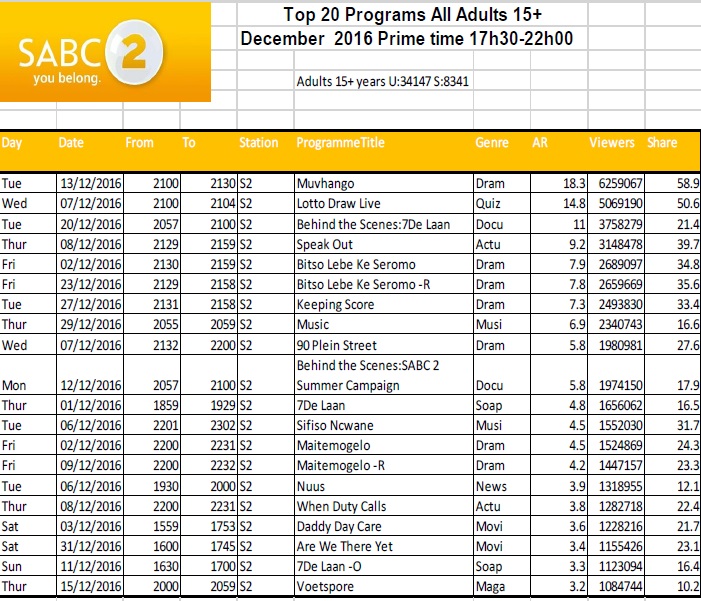
SA TV Ratings: SABC 2 — primetime top 20 for Nov, Dec 2016

by MarkLives (@marklives) The hottest primetime television shows on SABC 2 in South Africa revealed: TV ratings for November and December 2016.

Last year, the Broadcast Research Council of South Africa (BRCSA) has changed its policy about giving away TAMS and now only monthly reports, highlighting the top 20 or 30 primetime shows on several popular channels, are available.

SABC 2 December 2016

BRCSA TV Ratings December 2016 primetime SABC 2

Source: BRCSA December 2016


SABC 2 November 2016

BRCSA TV Ratings November 2016 primetime SABC 2

Source: BRCSA November 2016

Broadcast Research Council of South Africa


The Broadcast Research Council of South Africa (the BRC) is a non-profit, industry body that was incorporated in 2015 to cater to the audience research needs of the radio and television industry in South Africa.

— Sign up now for the MarkLives email newsletter every Monday and Thursday, now including headlines from the Ramify.biz company newsroom service!

MagLove: The best magazine covers this week (24 February 2017)

MediaSlut (@MediaSlut)’s choice of the best international magazine covers this week:

  • CR Fashion Book
  • Money Fashion Power
  • Süddeutsche Zeitung Magazin
  • TIME
  • Wonderland

Find a cover we should know about? Tweet us at @Marklives and @MediaSlut.
Pinterest icon Want to view all the covers at a glance? See our MagLove Pinterest board!


CR Fashion Book, Issue 10

CR Fashion Book, Issue 10: Paris Jackson

Paris Jackson, the 19-year-old daughter of pop icon Michael Jackson and Debbie Rowe, is looking ravishing on this particular cover of a split-cover series, with her stunning ice-blue eyes complimenting this royal-blue dress she’s holding over some sexy lingerie. It’s a bold cover, showing that Jackson is anything but a little girl anymore. Read the full interview here.


Money Fashion Power, Issue 1

Money Fashion Power, Issue 1

A striking and clever cover for the first issue of Money Fashion Power, where it investigates “[a]t what cost do your purchases empower or exploit?” Anyone in the retail industry should take some time read the digital issue as it has some very interesting insights that even we in South Africa could learn from. Or you may also view a review of this issue by Slack, as it will give you some very interesting insight of what you can expect, too:


Süddeutsche Zeitung Magazin, 10 February 2017

Suddeutsche Zeitung Magazin, 10 February 2017

Valentine’s Day has come and gone, with more and more people not even noticing it (or rather embracing it as our parents might have), partly due to our love with the screens of our devices… Süddeutsche Zeitung Magazin illustrates the reality perfectly with this cover and a coverline which reads: “A book about love”.


TIME, 27 February 2017

TIME, 27 February 2017: Donald Trump

I’m surprised that Donald ‘Tweeting’ Trump hasn’t slammed back at TIME yet by tweeting something like “The failing @TIME” or “worst artists” and “sad”. I’m sure this cover, and the cover story, got his goat, as he firmly believes everything is the best it’s ever been, but the article tells a different story. This masterpiece, which I’m sure will become as iconic as some other TIME covers, was done by artist Tim O’Brien, who has produced “over two dozen TIME covers since 1989”. By hand. Make sure you watch this short interview of him telling TIME readers about this specific cover…


Wonderland, Spring 2017

Wonderland, Spring 2017: Brooklyn Beckham

Keeping to children of superstars who’ve grown up to be their own people, here’s Brooklyn Beckham. He definitely “ain’t a boy no more”, and has become a talented young gentleman — and someone to keep an eye on! Also a fan? Then read the interview and enjoy the extra pictures.


MediaSlutMagLove by @MediaSlut is a regular slot featuring the best local and international magazine covers every week, recognising well thought-out, powerful and interesting (and hopefully all three-in-one) covers and celebrating the mix of pragmatism, creativity and personal taste that created each of them. The anonymous (for now) blogger behind MediaSlut knows way too much for his own good about media in South Africa, magazines in particular. His mission is to show when SA magazines fail but, most importantly, also when they succeed. If you’re looking for a library about SA magazines and news, this is your one-stop pitstop.

— Sign up now for the MarkLives email newsletter every Monday and Thursday, now including headlines from the Ramify.biz company newsroom service!

Online CPD Courses Psychology Online CPD Courses Marketing analytics software Marketing analytics software for small business Business management software Business accounting software Gearbox repair company Makeup artist