Media Report: Chris Roper on marketing, the media, and its co-dependency

a The Media Report 2014 interview. Chris Roper, editor-in-chief of the Mail & Guardian, answers questions about editorial independence, honest information and offers deep insight into the M&G brand and future trajectory.

Chris Roperthe media report: independence graphicWho are you and what do you do?
Chris Roper:
I am Chris Roper, the editor-in-chief of the Mail & Guardian. I’m responsible both for editorial strategy, and for new business development as it relates to our content platforms.

the media report: independence graphicHow would you describe the Mail & Guardian to someone who’s never read it before?
CR:
M&G is a fiercely independent, multi-platform news offering specialising in investigative and political journalism.

the media report: independence graphicThe Mail & Guardian is often in trouble with government. Why is that?
CR: We’re doing our job, I guess. And sometimes, they’re not doing their job.

the media report: independence graphicWhy should brands advertise in the Mail & Guardian?
CR:
M&G readers, across all platforms, are people who make a difference in South Africa and Africa. They’re critical, yet optimistic, and are highly educated business people, academics, politicians and thought leaders.

the media report: independence graphicSum up the Mail & Guardian brand using one sentence.
CR:
Independent, credible, authoritative and African.

the media report: independence graphicHow is the Mail & Guardian different to any other news service in South Africa?
CR:
The M&G specialises in original content, produced in ways which show respect to our readers.

the media report: independence graphicWhat should marketers know about the fight to free information in South Africa? What role has the Mail & Guardian played in this fight?
CR:
Crucially, marketers should know that if freedom of information is curtailed, it won’t only be bad for civil society, it’ll be bad for business as well. Capitalism doesn’t thrive in a restricted society. The M&G has been at the forefront in the fight to limit some of the restrictions of the pending Secrecy Bill.

the media report: independence graphicWhy is media independence important?
CR:
An independent media is the watchdog for civil society and democracy. Without an independent media, citizens of a country can have their access to honest information compromised.

the media report: independence graphicWhat role has the Mail & Guardian played in promoting democracy in South Africa? Why is this relevant to marketers?
CR:
M&G played an important role in providing important information in the fight against apartheid, and continues to provide the important information necessary to keep democracy transparent. Why is this relevant to marketers? Well, there are at least two reasons. Assuming marketers are human (which we do, of course), one imagines they’d prefer living in a free democracy. But a more industry-specific answer would be that marketers are in an industry that is as creative as journalism, an industry that is also about the dissemination of information. Like journalists, they rely on democratic freedoms to be able to do their job.

the media report: independence graphicAny other thoughts you’d like to share?
CR:
Perhaps just that these questions have made me think about the interrelationship between marketing and the media, and it’s clear that we are more co-dependent than we possibly realise.

the media report: independence graphicWhat are Mail & Guardians vital statistics — those numbers marketers most need to know about? While you’re at it, tell us a little more about your readers.
CR:
Here are our readership stats for August. For print, 54% of our readers have some form of tertiary education, 29% are in the 35 – 50 year-old age bracket, 76% are black, 16% white, and 77% of them are in LSM 7-10. Our online readers are, as you might expect, varied, with, for example, 20% being 15-24, 31% 25-34, 29% 35-50, and 20% 50+.

the media report: independence graphicThis interview first ran in The Media Report 2014, which is published by Ornico with MarkLives.com as its official media partner. Read or download the full magazine via Issuu.

Visuals used are licensed through Creative Commons. Attribution and gratitude go to: Reporters Without Borders and the Give Dictators The Finger campaign; r2hox, who documents urban and street art; Rebel Mouse Digital artist, Surian Soosay; Khalid Albaih, founder of Freestock.ca; Nicolas Raymond, print buyer, and photographer, Karen Roe; photographer SandisterTei; and author, scientist and occasional photographer, Duncan Hull.

— MarkLives’ round-up of top ad and media industry news and opinion in your mailbox every Monday and Thursday . Sign up here!

The Real McCoy: The power of detail

by Sean McCoy (@TheRealMcCoyTRM) My recent immersion in the hospitality industry has brought the notion of internal branding sharply into focus.

Notwithstanding that it was at the premium end of the industry, or even extreme premium, the commitment to the role of people in delivering the brand experience was visibly on display and something to digest.

Google Image Search: The Wheatbaker Hotel LagosSetting a new standard of service excellence

The Wheatbaker Hotel in Lagos is a Legacy Hotel & Resorts property, and is clearly setting a new standard of service excellence for the business tourism community on Victoria Island in a market that has traditionally struggled to deliver service excellence, given a myriad skills, training and infrastructure challenges.

Clearly this is changing, not just at The Wheatbaker but in a number of industry sectors that are increasingly talking the principles of improved competitive advantage through people and the principle of internal branding. The Wheatbaker specifically demonstrated that this can be achieved, even in a challenging business environment.

Spending a few hours in the general business meeting area was extremely cordial and well-presented, followed by a business lunch that was significantly different. The ratio of waiters to patrons was visibly high and the presence of multiple maître ds was evident. The food was simply outstanding, and the overall experience of this business destination has left a clear and lasting impression. (It also happens to be charging in the region of US$550 per person per night as a standard rate — evidence of a premium-priced product for a premium-service experience.)

Internal branding and service excellence are on display in the heart of the West African economy and the hotel should be lauded for this fine effort.

Google Image Search: Singita Ebony Lodge

Redefining the safari experience

A most-privileged visit to the Singita Ebony Lodge* in the Sabi Sand Game Reserve area in South Africa not only redefines the traditional ‘safari experience’, but simply takes hospitality and the delivery of a brand experience to a new level.

Every facet of the brand is finely honed, yet totally natural and integrated into its surrounding. Staff is exceptional, competent and extremely efficient yet go about business with the ease of family hospitality — at one with the philosophy of the business.

Singita has a deep sense of purpose that communicates a 100-year vision to preserve some of Africa’s most rare and iconic ecosystems by partnering with communities to serve its guests unique African experiences — and the very meaning of the name Singita, “Place of Miracles”, plays out in the delivery of the promise.

Strong storytelling culture

Singita has a strong storytelling culture and its guest experiences are core to its brand, shaping it to be intuitive, innovative and sophisticated; catering for its predominantly international clientele.

From arrival at reception it is evident that the experience is different — no queues, no counter administration, just complete comfort, warmth and hospitality — and, of course, in a setting and designed environment that is unparalleled in bush experiences.

Attention to every facet of room décor and detail is evident, and every member of staff, from the lodge manager through the security, cleaning and porter staff, is incredibly attentive and at hand to cater for every requirement — in a non-obtrusive and very engaging way.

The interaction between the game-guiding staff and the hospitality teams is very integrated, and signifies great progress by the business in enhancing the overall experience and ensuring that they function as a single team under a unified conservation and tourism banner. Meals are a culinary delight, and every taste and need is catered for, with wine pairing to suit, a sommelier at hand and every beverage need taken care of.

Unique experience

The list goes on and I would fundamentally run out of column space over multiple editions if I tried to capture every detail of this unique experience.

All of the above, while highly summarised, points to a complete commitment to the internal brand and delivery of a superior experience, enabled through people. Training for service excellence is clearly deeply seated and on display through every interaction of the business.

As an indicator of its philosophy, all members of staff are put through a lodge as fully treated guests, to experience the service and expectations of a Singita guest — an extraordinary approach to ensuring that existing members of staff get to see and feel the good and potential problems of what the guest goes through. This is the ultimate internal immersion in the brand standard.

At U$1400 per person per night, this is not premium; it is elitist and it unashamedly caters for a certain segment of the market, an uber-priced proposition that is matched by corresponding service and brand experience levels.

Taken to a different level

Singita has won multiple global awards in the hospitality industry, including the category as the best overall hotel in the world. With an average ratio of nine staff members per guest, it takes internal branding and service experience to a different level.

Both cases are testimony to African internal branding capability and something we should be proud of. The hospitality sector is leading the way, and there is much we can learn from this.

*Note: Singita has previously been a client of HKLM, but all work has been completed and dormant for more than 18 months.

Sean McCoy


Dr Sean McCoy, MD and founding member of HKLM, is a prominent figure in the branding arena, with his expertise centered on client service, brand strategy and business development. Sean has been chairperson for the Brand Council of South Africa since 2012. He contributes the regular “The Real McCoy” column focusing on internal branding to MarkLives.


— MarkLives’ round-up of top ad and media industry news and opinion in your mailbox every Monday and Thursday. Sign up here!

Creation: Finding a creative job in 2015

by Artwell Nwaila (@artwelln) It’s that time of year when creatives start scratching around for new job opportunities. I don’t know what’s in the air but it reeks of sweet creative success and growth.

I’ve compiled five points that should help your job search be a little bit easier:

Job Interview by phasinphoto courtesy of FreeDigitalPhotos.net
Image courtesy of FreeDigitalPhotos.net

1. Online is not always alright

I genuinely believe that, when you see an online job ad, you are already too late.

The unfortunate truth is that most of the time when jobs are posted online, the employer already knows who it is looking to hire and is posting the position merely to follow the protocol.

Getting the job you really want depends on you using online and real-life connections equally. Unless you’re a friendless 35-year-old living with your folks in Paarl — then best you do the online thing.

Before submitting, check if any of your digital or real-life connections know anyone in the organisation you are applying for. This may sound strange, but it will give you the upper hand if someone in the organisation hands in your CV for you or recommends you.

2. If online is your only option, don’t spray and pray

By spray and pray I mean emailing everyone and anyone; I don’t mean it literally.

When sending out your CV, be sure to send to the positions that fit your qualifications perfectly. Before emailing each potential employer, be sure to adjust your CV to comfortably fit the post.

Do not lie; you will go to hell. Make a short cover sheet, be sure you add keywords from the actual advert and check the spelling

Last, but not least, do not decorate your resume — we know you are creative.

3. Don’t put your picture on your CV

Just don’t.

It’s stupid.

It’s not Home Affairs.

4. Your social resume looks like a warzone

Before submitting a CV, clean up your Facebook, Twitter and Instagram profiles and anything else that maypop on Google.

In fact, if you are serious about getting anywhere in this digital age, you’ll need to stop writing stupid nonsense on your platforms — that picture of you getting sick at that epic baby shower will not do you any justice, regardless of how awesome it was.

5. When you do get the interview

Do not dress like a creative. Also, don’t dress like the CEO — find a balance which represents the organisation and yourself.

Now go forth and get that awesome job!


Artwell Nwaila

Artwell Nwaila (@artwelln) is a creative director at Offlimit Communications and publisher of the award-winning creative publication SA Creatives (@thesacreatives). His monthly column on MarkLives, “Creation”, is a humorous take on life in the creative world, seasoned with practical advice based on experience.


— MarkLives’ round-up of top ad and media industry news and opinion in your mailbox every Monday and Thursday. Sign up here!

Stretching experiential marketing

by Herman Manson (@marklives) Stretch, an experiential marketing agency launched in 2009 by Mike Silver, is one of a number of smaller agencies hoping to raise its profile and growth curve by stepping into the space opened up for independent agencies through the effective vacuuming job by global networks.

WPP and Publicis Groupe especially have been on a buying spree over the 12 months or so, snapping up a number of independent agencies, particularly those with core activation and digital capabilities.

Stretch Experiential Marketing logoApproached by possible buyers

This “has definitely put a strain on the system” says Silver, who acknowledges that his agency, which currently employs a core team of 25 (it expands and contracts depending upon the season — in summer it can grow up to 35), has been approached by a number of possible buyers. But, as with many of his peers, Silver sees gold in moving up into the space vacated by former independents joining global networks.

He believes there is a need for independent specialists in the market, and that his agency is well-positioned to raise its profile and client base. Stretch already works on brands such as adidas, Chevron, Standard Bank, Pernod Ricard and Pepsi.

In 2013, Stretch was runner-up at the Global Pepsico CMO Awards (most-effective global marketing campaign) for its floating vending machine campaign. In the same year, the agency took first spot in the Western Cape Government Entrepreneurship Awards.

Stretch Experimential Marketing Mike Cath Pete
The three Stretch shareholders: Mike Silver, Catherine Mavrocoleas and Pete Hutchings.

Worked at RPM

Silver had worked at UK experiential agency RPM, where he also met Stretch strategy director and fellow shareholder, Pete Hutchings. Catherine Mavrocoleas, who heads up accounts, is the third shareholder.

RPM offered Silver a thorough overview of experiential marketing. Upon his return to South Africa, he judged that the local industry was still catching up to what was happening globally, and — with the insights gained at RPM on international experiential trends — he decided to launch his own company.

Stretch has just launched a new division — Stretch PR (its new communications and social media arm), adding to Stretch experiential (consumer arm) and Stretch employee engagement (B2B, internal and graduate attraction). The agency has four departments: creative technology, strategy, client service and production.

Importance of HR, finance and production

According to Silver, as an entrepreneur, he initially misjudged the importance of strong HR, finance and production systems.

The agency tends to hire younger staffers and then link them to mentors, be that family members, friends, people in his expanded business network and, where necessary, consultants. It’s a model that works well for the agency, he says.

He often finds mentors through mentors, as he puts it, and admires the altruistic nature of mentoring. Silver mentions Andy Sutcliffe (34) and Adrian Hewlett (Publicis Machine) as agency people who helped with advice and guidance when he set up his own shop. It has underscored for Silver the importance of ‘giving back’.

#OutofOffice

To this end, as well as to display its expertise in experience marketing, the agency has recently launched #OutofOffice, an event that aims to draw industry experts out on their take on the role experience plays in their businesses or organisations.

Venues are slightly left of field — ranging from artisan bakeries to rooftops and museums — and venue owners introduce each event, talking about the experiences they have created through their spaces.

— MarkLives’ round-up of top ad and media industry news and opinion in your mailbox every Monday and Thursday. Sign up here!

Smart Africa TV: Gotel’s plans to launch the Al Jazeera of Africa from Abuja

by Russell Southwood (@BalancingActAfr) In this video interview, Abukar Abba Tahir, director of Gotel Communications, discusses the company’s plans to launch the Al Jazeera of Africa from Abuja.

He talks about:

  • how Gotel started in NE Nigeria
  • its radio and TV stations and their coverage
  • the international news channel it’s planning
  • and the importance of the channels being private and independent.

Smart Monkey TV logoRussell Southwood (@BalancingActAfr) is the founder of Balancing Act and the web TV channel Smart Monkey TV (@SmartMonkeyTV), and has been an analyst in telecoms, internet and broadcast in Africa for the last 15 years. Smart Monkey TV aims to capture the energy at the crossroads between African culture and technology. MarkLives is syndicating content from Smart Monkey TV on a weekly basis for the column “Smart Africa TV”.
— MarkLives’ round-up of top ad and media industry news and opinion in your mailbox every Monday and Thursday. Sign up here!


#MagLoveTop10: Sexiest magazine covers of 2014

by MediaSlut (@MediaSlut) Just as with beauty, sexy is in the eye of the beholder. So I put on my straight, gay, kinky and my conservative glasses, too, to include something ‘sexy’ for everyone’s taste… Without further ado, here’s my #MagLoveTop10 list of the Sexiest Covers of 2014.

Our #MagLoveTop10 magazine cover series include:

10. TRUE LOVE, October 2014

True Love, October 2014: Bonang MathebaIs Bonang Matheba going swimming? Is she going to a formal function? Well, I don’t know, but if there’s one person who can pull it all off, and look sexy and glamorous while doing it, it’s Matheba!

9. EAT OUT 2015

Eat Out 2015: Dylan CulhaneA big trend in 2014, including in South Africa, was definitely hot men with beards, and also restaurants. So, if you combine the two and put a hot man with a beard (and blue eyes!) on a restaurant-guide magazine (and very well-styled and produced!), I’m sold!

The fact that Dylan Culhane is a photographer and journalist, based in Cape Town, makes it even more exciting as one may possibly bump into him…

8. Playboy South Africa, November 2014

Playboy, November 2014Men [and some women — ed-at-large] love big, electronic equipment. Now put a beautiful bunny on top of one, and you’ll have people fighting to join this mile-high club…

7. VANITY FAIR (Italy), 27 August 2014

Vanity Fair, 27 August 2014: Lenny KravitzAh, Lenny… You might be 50 but this cover shows once again why you’re part of so many people’s fantasies… Ah…. Lenny!

6. Esquire (various)

Esquire, March 2014: Sienna Miller Esquire, July 2014: Charlize TheronBoth covers are in black and white, and both Sienna Miller and our very own Charlize Theron receive the sexy-stamp for their posing on these covers.

5. GiveMeSport, Issue 1

GiveMeSport #001I might just start watching rugby, thanks to Danny Cipriani! This English rugby player absolutely smoulders on this cover!

4. Interview, June/July 2014

Interview, June/July 2014: Jamie DornanMr Grey, I’ll definitely see you now!

Jamie Dornan, who’s playing Christian Grey in the move adaption of 50 Shades of Grey, actually only teases us with this Interview cover, which in itself is incredibly hot.

But it’s the pictures inside that makes the teasing worth it, and the end result is orgasmic.

3. ELLE South Africa, December 2014

Elle South Africa, December 2014: Lupita Nyong’oLupita Nyong’o, you show that one can be fully dressed (with maybe just a little bit of leg showing, à la Marilyn Monroe…) and be über-sexy!

2. VOLO, Volume 1, 2014

Best of VOLO – in Nature, Volume 1This is the most nude cover in my Top 10, but that’s not the reason it’s in the no. 2 position.

It’s here because as a package, it’s artfully done. It’s playful and shows a beautiful woman being absolutely carefree! This isn’t erotic to me, but a form of beauty.

1. Men’s Health South Africa, October 2014

Men's Health, 10 October 2014: K2 twin Charlie Kotze Men's Health, October 2014: K2 twin Alex KotzeTwice the sex appeal. Twice the hot bodies. Double the amount of farmboy-turned-model.

The K2-twins, Alex and Charlie Kotze (who are making absolute waves in the industry!), absolutely rocked 2014, and I’m personally following their progress and looking forward to see what 2015 has on offer for them.

Appearing on two covers of Men’s Health was a highlight for both of them, and also for me…


Find a cover we should know about? Tweet us at @Marklives and @MediaSlut.
Want to view all the covers at a glance?
See our MagLove Pinterest board!


MediaSlutMagLove by @MediaSlut is a regular slot featuring the best local and international magazine covers every week, recognising well thought-out, powerful and interesting (and hopefully all three-in-one) covers and celebrating the mix of pragmatism, creativity and personal taste that created each of them. The (for now anonymous) blogger behind MediaSlut knows way too much for his own good about media in South Africa, magazines in particular. His mission is to show when SA magazines fail but, most importantly, also when they succeed. If you’re looking for a library about SA magazines and news, this is your one-stop pitstop.

— MarkLives’ round-up of top ad and media industry news and opinion in your mailbox every Monday and Thursday. Sign up here!

Shelf Life: Elegant but with an untamed twist

Louise Marsland (@Louise_Marsland)’s weekly pick of recent product, packaging, design and food launches:

  • An untamed look for KWV Wild Africa Cream
  • USN launches endurance range
  • The Capital aims to take over business travel space, and
  • Nespresso promotions deck the halls

Wild Africa ‘untamed’

KWV Wild Africa Cream liqueur: new packaging late 2014KWV Wild Africa Cream liqueur, which recently won Double Gold at the 2014 Michaelangelo Wine & Spirit Awards and was named ‘Best Liqueur’ Trophy Winner, has been rebranded to drive international sales in 2015 (and in time to take advantage of Christmas sales end of last year), with a self-titled “#EleganceUntamed” theme (hashtag included)

The new look is described as being more elegant and is aimed at “tripling” global sales. Which will probably work — put one of the big five on it and the tourists will buy it (me, too, actually).

Comments Anneke Mackenzie, global brand manager for RTDs and Liqueurs at KWV: “The new packaging, designed by Bravo Design, now more accurately reflects the product’s intrinsic quality, drawing on the leopard, featured in countless African myths and legends, as the inspiration for a new-look Wild Africa Cream. It is elegant but with an untamed twist; it is ‘elegance untamed’.”

The main label has intricate detail printed on metallic paper, with gold-foil detail. High builds have been applied to the logo and the grain of the leopard print to provide a tactile experience. The label shape has been adapted to form a shield at the top, down to the leopard print at the bottom. The capsule in gold has an embossed logo that has been shaved to expose the silver underneath it.

The new customised, more-elongated bottle shape is meant to provide standout value within the category, and the embossed leopard accent around the shoulder of the bottle and the brand name at the base should add brand differentiation. The main ingredients are fresh cream, caramel and brandy.

“We believe that we can triple our current volumes globally by attracting loyal customers who will purchase the brand on many occasions throughout the year,” adds Mackenzie.

KWV Wild Africa Cream liqueur is distributed all over the world and is most popular in Germany, Paraguay, Angola and Japan, according to KWV.

Purefit in a bottle

USN Purefit SeriesUSN has launched a new range of supplements called Purefit Series, which has been developed for both novice and professional endurance sport enthusiasts with performance-enhancing nutrients. There are no artificial colourants, flavourants, sweeteners or preservatives.

Gareth Powell, national marketing coordinator at USN, says the brand has been busy with a sampling campaign to introduce the new range to consumers at various high profile sporting events.

Purefit Series began rolling out at pharmacy retailers from the end of November 2014, and into independent bike shops in early December through appointed wholesaler, TWT.

New hotel group Capital

The new Capital Group logo and Marc WachsbergerThe Capital Empire
EAH Executive Apartments and Hotels rebranded to The Capital Group at the end of last year to capitalise (no pun intended) on its stated expansion plans, which will see 17 properties in total located in and around South Africa and sub-Saharan Africa by 2018, serving the business-travel market predominately.

The Capital’s properties are made up of hotels and fully-serviced luxury apartments, offering a broad range of short, medium and long-term accommodation and conference facilities at affordable rates.

The Capital Group managing director, Marc Wachsberger, explains: “From the outset, we identified an escalating need for safe and cost effective accommodation that would directly address the needs of the ever-growing number blue-chip and multinational firms basing themselves in Gauteng’s bustling Sandton business district.

“This growing demand, coupled with a state of economy dictating that company-travel expenditure be more closely monitored, meant that executive apartments fast presented the more affordable alternative; a quality, yet ‘no frills’ product that delivered real value to business travellers.”

This concept, now a popular global phenomenon, combines the best of both worlds — a full hotel service with the option of self-catering apartments, and a host of facilities geared towards the requirements of both business and leisure travellers.

The current portfolio consists of six properties situated in Sandton, Johannesburg, and average occupancy rate sits at 83% month on month.

“Our ambition is to have 17 properties by 2018, from Sandton to Pretoria, Cape Town, Gaborone and Windhoek. We’re working towards that and the rebrand is one further step. Our existing client base is 95% international, from large corporations, staying for four days and longer. They want their own space and rates are the determining factor,” Wachsberger adds.

Each of the hotels and apartments have their own style, character and grading from five star to three star, so travellers have a choice to suit taste, needs and budget.

Festive coffee

Gateway Shopping Centre: Nespresso cellular hanging banner packageSince December, Nespresso has been ‘owning’ large malls near its main retail outlets and stores to promote its Nespresso machine to Christmas and holiday shoppers. The ‘Festive Delights’ campaign is being run by Primall Media, Primedia Unlimited’s shopping-mall advertising specialist.

“Targeting the LSM 10 bracket, the campaign [is making] use of big, bold centre-court packages and sites that are close to points of sale to make a big impact in the targeted malls,” says Primall Media’s executive: sales and marketing, Lee Curtis.

Digital screens were also used with the objective of increasing awareness levels and the frequency of the message for amplifying the brand message.

The national campaign started in November 2014 and runs until January 2015 in the following malls: Menlyn (Pretoria), Gateway (Umhlanga), V&A Waterfront (Cape Town), Sandton City (Johannesburg), Brooklyn (Pretoria), Canal Walk (Cape Town) and Tygervalley (Cape Town).


Shelf Life is a weekly column by Louise Marsland. Tweet new product, packaging and design launches to @louise_marsland Louise Marslandor email her at louise.marsland at gmail.com. Want to sponsor Shelf Life? Contact us here.

Louise has written about the FMCG, media, marketing and advertising industry for over 20 years as a former editor of magazines AdVantage, Marketing Mix and Progressive Retailing, as well as websites Bizcommunity.com and FMCGFiles. She also edited the weekly Wednesday Media & Marketing Page for The New Age newspaper. She is currently the publishing editor of industry trendwatching portal, TRENDAFRiCA, for consumer insight, research and trends in Africa; a regular industry columnist and speaker; a consultant on content strategy; and contributing editor to Fast Company South Africa magazine, which has just launched in South Africa.

— MarkLives’ round-up of top ad and media industry news and opinion in your mailbox every Monday and Thursday. Sign up here!

#3D: Make data your New Year resolution

by Prakash Patel (@prakashpatel_1) I would like to conclude the Five Steps to Data-Driven Marketing (DDM) by combining the final two steps, 4 and 5, as one as they are so closely connected — data management and marketing, and closing the loop from ‘cradle to grave’.

Prakash Patel's New Year ResolutionsBut, before we dive into them, let’s do a quick checklist and recap on what I have discussed previously to help you become a #DDM organisation:

Checklist

#Step1: Getting strategic

  • You’ve set a clear vision
  • You’ve carried out a data-flow audit end to end
  • You’ve put together a top-level data strategy

#Step2: Building the foundation

  • You’ve started doing so by bridging the gap between CMOs and CIOs — a collaborative partnership
  • You’ve detailed customer experience, mapped out across touch-points

#Step3: Data mining through a single view

  • You’ve created a holistic database that has a single view of its customers/prospects, based on the three key tiers:
    1. Building a single-view data foundation fit for marketing
    2. Data-analysis tools to allow data interrogation etc
    3. Data-visualisation tools to allow you to view and unlock insights to drive DDM

Recap

By covering steps 1 through to 3, you should now be in a pretty strong position as to knowing: a lot more about your organisation’s data flow; how data is viewed and championed; roles and responsibilities from the top down; and how to be more strategic in understanding the single view of a customer — all the way through to understanding the importance of marketing systems that store your data, which is fit for purpose (not just for IT), and the tools required to analyse, manage and process the data.

Five Steps to #DataDrivenMarketing. Designed by Fogg.The prize is in sight!

So, to wrap up the final two steps of this journey, let’s talk frankly about what I think is the best part of this framework: doing DDM with greater emphasis on data quality, targeting and management. Through this, you should then become part of the 20% who do marketing better through data, as reported recently by Adobe, according to Venturebeat.

“Top online marketers achieve more than three times the conversion rates of the bottom third, according to a new digital marketing optimization study from Adobe.

“Why? They invest in a culture of data, testing, optimization, and analytics. “Leading companies prioritize optimization,” Adobe executive director Michael Krypel said. “They invest time, resources, and budget, giving the top 20 percent of companies a conversion rate 1.7X the average rate.”

With these frightening yet beautiful numbers, you have to be, well, insane and irresponsible not to consider DDM for maximising your ROI and conversion rate to ultimately impress your stakeholders.

#Step 4: Data management and marketing

Well you are now positioned to put together a DDM strategy and framework to help you drive DDM. Sounds simple? Nothing in life is really simple, but it can be simpliflied with the right processes, methodologies and tools (which you have or have access to through your partners or agencies).

Doing DDM will require analytical thinking, commitment, perseverance, patience, planning, learnings and, more importantly, having a target in sight that is honed by processes and resource. The following are my final thoughts and tasks for doing DDM:

If you don’t know which of your customers are most likely to defect, how can you stop them?

People

As with any platform or tool, without the right people, they are just tools (good, bad or indifferent). To me, tools are like having the best F1 car, without a F1 driver… You and I may be able to drive a passenger car, but trying to drive an F1 car is a completely different game and we would probably crash within in seconds. This is the same about steps 4 and 5.

You may now have the thinking, the buy-in from C-suites, a strategy and data — you now need to have the right people, with the right mind set to drive everything and to make it a reality, people such as data statisticians and analysts who love data and are able to interrogate, question it, use the tools to truly drive greater and better DDM. They have the skills and experience to know what to ask of the data intelligently.

The second-most important person or skill, I believe, is the data planner.

However, let’s not forget tools currently in the market have the end-user in mind, not just statisticians and technical analysts (as it was years ago) — marketers or agency folks who may be analytically minded and not just database administrators or analysts.

In my experience, it is more about the mindset and approach to looking at data and asking the “why” questions, such as:

  • Why have we got such a high attrition rate?
  • Why are people not converting once they have tested our product?
  • What is the true lifetime value of my customers? And
  • How can I find or predict more likeminded customers?!

Data planner

As with anything in marketing, without planning, the end is never near or in sight. In this context, I am talking about data planning (a convenient job title created about two decades ago by AdLand, when agencies felt data bureaux and data geeks were useful but not sexy, only to realise the personnel with the knowledge and insights were the ones who really pulled the cord at the top table.

So, finding a good data planner is like finding a good strategist — but with data skills.

A typical role of a data planner is to hypothesis, calculate and strategise the data requirements for your campaign through to being able to interrogate the data using tools and software. Without this your campaign is… just a campaign, with no relevance or targeting.

This brings me to my next point:

Targeting

If you read the original marketing definition — which is “the management process of identifying, anticipating and satisfying customer requirements profitable” — then I always ask: Why don’t we do targeted mailings? Surely this one word concludes the requirements of the three words in the definition (identifying, anticipating and satisfying).

Back to my point — if you are about to do a campaign in the new year to 100 000 individuals and have a prospect base of 1m records to select from, what does targeting and DDM look like to you?

For some marketers, this could just be a simply a promotional mailing to its existing customer base by asking its agency to put together some award-winning creative, then asking the IT dept (or your data partner) to select 100 000 records for the mailing… which all would be a complete waste of money, time and another classic example of junk mail where <1% response rate is deemed acceptable.

What about asking whom you are targeting, what the promotional products are and aligning them with your customer base (remember the Target case study in my first article?), through to identifying non-responders, predictive and behavior analysis etc? There is so much that can and should be done before doing any type of mailing — on or offline — which takes me to my next simple point about the power of data in three easy steps:

Data principles: I3 Model

Throughout my articles, I have written about the power of data; now I want to share with you one of my oldest models I created about a decade ago which I use to explore the principles of data and what I believe are the most important questions you should ask about data. I call this the I3 Model:
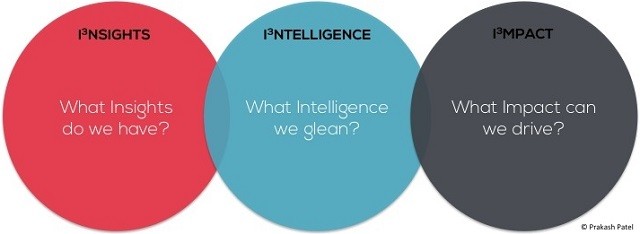
Prakash Patel's I to the power of 3 ModelThese are the three basic questions about data exploration, from what insights can we discover through to data interrogation, then using these insights and applying intelligence in what you want to achieve and then driving more impactful communication.

Surely, at the end of the day, this is exactly what we are all trying to do in using DDM? Driving more relevant and impactful communication to the most responsive selected audiences, at the most appropriate time, using the most relevant medium.

#Step 5: Closing the loop from ‘cradle to grave’

After all the effort, cost, resource and management, the final step is all about closing the loop.

One of my career-long bugbears is when marketers do a campaign and take the results as a fact until the next one. One of the biggest areas of marketing and DDM is the ability to look at data strategically and, more importantly, look at the results (yes, measurements — something we all talk about, brag about in pitches to clients — yet seldom do properly) even more strategically and with an inquisitive mind…

Why? I feel sometimes that we do campaigns, look at the award results and think: “That was brilliant; let’s do it again” through to “Oh no, that wasn’t too good; let’s do something different — umm, let’s change the creative” as opposed to looking at the results, the responses and, ultimately, what the learnings were.

FOGG mantraTo me, it’s all about understanding the entire data journey from ‘cradle to grave”. From the moment customers shares their data with you for the first time, to the moment you create single views, through to all the tactical communications you do and to becoming a customer and finally driving loyalty by building trustworthy and meaningful relationship over time.

Data miner by Fogg Experiential DesignBiggest failure

The biggest failure is when we don’t #learn, we don’t #reapply, we don’t #test and we don’t #review.

Regardless if the work and results are great, learning has to be the most important aspect of our jobs. Understand what worked and what didn’t work; then test and try to always better our results with purpose and longevity. As I wrote in my first article — “there’s gold in those data mines”.

Keep Calm and Follow Five Steps to #DataDrivenMarketing. Designed by Fogg.To conclude my Five Steps to #DDM, think of data as one of your company’s biggest assets. It is not a new phenomenon, or only for geeks and IT personnel, but for the whole organisation from the top down. Understand the power and opportunities it may afford your company.

Never a better time

2014 has come and gone; there is never a better time than now to make a 2015 New Year’s Resolution for work that can add value to your bottom line and help your organisation become more strategic and relevant in results-yielding marketing efforts.

#TheFutureisBright #TheFutureisDigital


Prakash Patel, October 2014


Prakash Patel (@prakashpatel_1) is chief strategy officer at Fogg Experiential Design, a technically-enabled, digitally-led, creatively-inspired, data-driven and strategically-focused design company based in Johannesburg and Cape Town. He has over 25 years of experience in advertising and data planning, a passion for integrated marketing strategies, and believes that the holy grail of marketing has always been — and always will be — data. Prakash contributes the monthly “#3D” (Data-Driven & Digital) column to MarkLives.com, exploring how data-driven and digital marketing can add value to marketing communication.


— MarkLives’ round-up of top ad and media industry news and opinion in your mailbox every Monday and Thursday. Sign up here!

Grubstreet: At Daily Sun, Tokoloshe stays as reportage deepens

by Gill Moodie (@grubstreetSA)  It was odd that the appointment of Reggy Moalusi as editor-in-chief of the Daily Sun and Sunday Sun in October 2014 didn’t get more attention in media circles.

This is the mighty Daily Sun after all — the biggest daily in the country with 260 000 circulation and 5.3-million readers. But the Daily Sun has always been largely ignored by the middle class and elite in this country, not just because it serves the man in the blue overalls – but because it is a rambunctious tabloid filled with tales of tokoloshes, zombies and muti.

Reggy Moalusi
Reggy Moalusi

Now Moalusi must lead this beast – and at a difficult time as both papers have been hit very hard by the economic downturn, with many of its working-class readers opting to share copies of the paper than buy their own.

Spurred by serious disruptions in its distribution network due to a new CRM system put in place by owners Media24, the paper’s circulation started falling in early 2009 after reaching a record 500 000 in 2007. This year the Sunday Sun has been showing signs of turning around circulation decline but it’s not there yet. In the most recent ABCs – for the third quarter of this year – the Sunday Sun was at 166 814 compared with 176 692 year on year and 177 304 in the previous quarter. The Daily Sun was at 262 431 total circulation compared with 291 132 year on year and 274 165 in the previous quarter.

“We used to see in one taxi everyone had a copy of the Daily Sun,” Moalusi told Grubstreet. “Today we see more and more, people passing the paper from one person to the next.

“People go to the spaza shop or to the corner store and they say to themselves: ‘If I’m going to buy this paper for R3, then I don’t have a carton of milk or a loaf of bread. What is my priority here?’ And food will always come out on tops. That’s the economy of the stomach – that’s what it comes down to in the end.

“Money’s tight and unemployment is hitting our blue-collar readers in the townships and the rural areas hard. There are people with no disposable income – or no income at all.

“It’s been a challenge for us,” says Moalusi, who has been with the Daily Sun for nine years. “We just need to keep on doing what we are doing and hopefully the economy returns.”

Moalusi, who was previously deputy editor of the Daily Sun, must also make his mark on the two papers, which besides the short-lived tenure of Mazwi Xaba in 2012, have been without an editor since Themba Khumalo left shortly after the death in September 2011 of legendary founder and publisher Deon du Plessis. (Today Jeremy Gordin is the publisher.)

Daily Sun June 5 2013“Fortunately for me, I had the opportunity to work with Deon and Themba,” Moalusi says. “Since Deon’s death and Themba’s departure, the mix in terms of the news content has been the same. The kind of mark I’d like to make is to look at the content and how we can strengthen it and take it further – how we can be more in your face and how we can bring back lost readers.

“No one can really fill Deon’s shoes. He was giant and he was very clever – really intelligent. Look what he did for this paper after he founded it (in 2002). I would never sit here and say I want to be the next Deon. No one can ever be like him. The onus is on me to work hard and try and achieve what I can and be the kind of leader I want to be for the paper.”

And what kind of leader is that?

“I’m an open-door policy kind of guy,” Moalusi told Grubstreet. “I don’t impose decisions on people and I consult with people. When I chair news conferences, I consult quite a lot in terms of what stories we have. But when decision have to taken, they must be taken.

“It’s very open how we do things and how we interact with each other (at the paper) and that goes back to Deon. We don’t like to keep people in the newsroom in the dark. We like to tell them the good news and the bad news. And we like to tell them now and then they’re doing a good job.”

How does Moalusi aim to strengthen the content mix?

“Look, the content has always been entertaining so the tokoloshe is definitely not going away. Muti stories are not going away. I think we need to go deeper and deeper into the kind of issues facing our readers in townships, where there are service-delivery protests.

“When you look at (coverage of) the protests, they are generalised in most cases. But if you go deeper and start asking questions, you find out the issues are different from one area to the next. These are the kind of stories we need to be breaking and following up but obviously we either have to upskill the reporters we have or we have to get more experienced and in-your-face reporters out there.”

Moalusi is pleased, for instance, with the recent Sunday Sun splash about controversial SABC chairman Ellen Tshabalala and her relationship with President Jacob Zuma.

Moalusi believes that there are still legs left in the tabloids as print products in South Africa (although the Daily Sun also has a thriving mobisite).

“If you look at all the tabloids we have in SA, people buy them for different reasons… you go to Cape Town and look at what the Daily Voice and Son cover. They cover two hugely different audiences and different issues. If you’re in Joburg you have the Sowetan, which still has lots of political reportage in it; and the Daily Sun doesn’t. I think the (tabloid) reader is spoilt for choice.”

GrubstreetSouth Africa’s leading media commentator, Gill Moodie (@grubstreetSA) offers intelligence on media, old and new. Reprinted from her site Grubstreet. This piece was published first on Journalism.co.za, the website of Wits University’s journalism school.

— MarkLives’ round-up of top ad and media industry news and opinion in your mailbox every Monday and Thursday. Sign up here!

Tuned: Wanderlust of the Millennial explorers

by Thabang Leshilo (@Thabang_Leshilo) I have a love-hate relationship with Instagram, particularly when it comes to globe-trotting friends documenting their own versions of Eat, Pray, Love. I love it because it inspires my imaginings of living those experiences myself; I hate it because I am not on the move myself.

Travel Icon by taesmileland at FreeDigitalPhotos.net
Image courtesy of taesmileland at FreeDigitalPhotos.net

And ‘experiences’ are the be-all and end-all for us millennials, that generation of earth’s inhabitants fast defining themselves as global citizens.

As such, our preferences and behaviours will dramatically change the travel industry as we — well, as you non-millennials — know it.

Key insights

A national survey in the US released by PGAV Destinations, a global leader in the planning and design of leisure, entertainment and cultural experiences, highlighted some key insights that make Millennials different to the generations before them when it comes to travel:

  • Nearly six in 10 millennials (58%) say they travel for leisure with friends. That’s nearly 20 percentage points higher than older generations.
  • It follows then that relationships are vital to millennials, and they are highly influenced by others who help to select places to visit and things to do. Through social media, they tell stories to one another, make recommendations and assessments, often in the form of real-time descriptions of their experiences.
  • With their technology acumen, millennials make quick decisions. They plan trips in far less time (75 days) than older generations (93 days). They are adept at accessing information online, where they can search for a deal, read the reviews, book it and go.
  • This most highly educated and diverse generation has a real appetite for learning; 75% say they prefer to learn something new when they travel. Fully seven in 10 millennials say they expect special places to offer immersive experiences. They look for places that are fun and entertaining (78%), and interactive and hands-on (68%).
  • Millennials are also good citizens. Over 77% of respondents say they believe it is essential to connect to causes that are important to them, a trait more important to them than older generations.

“Millennials are not your traditional guests,” explains PGAV Destinations principal, Mike Konzen. “They do not take leisure trips ‘just because,’ but are looking for something that resonates with their need to make a difference.”

Tapping into this

So, how are brands tapping in to this?

For example, KLM has understood and is embracing the digital medium far better than its competitors; its social media interactions really resonate with millennials, making the brand culturally relevant. Its recent ‘High Five’ campaign was a well-executed idea that literally connected total strangers in New York and Amsterdam in a heart-warming way.

Another airline, Air France, is building its brand by taking a different tack, no less successfully. Its approach is that of a lifestyle brand. Air France is building aspiration by selling its most valuable asset: the ever-enduring, timeless France. By reflecting a very modern and culturally relevant image of the country, it goes beyond the ‘on flight’ experience and shows it is a brand that understands consumers’ wants, desires and dreams once they step off the plane. In its most recent global campaign the brand creates a lively and exciting message, in line with the French lifestyle, by curating a mix of heritage and modernity in its creative.

In another example, Air BnB speaks to the notion of millennial behaviour, and how they want to connect with real people when travelling. This brand’s online presence makes anyone who is simply couch surfing feel as if she or he are part of a real local experience.

And then there’s Heineken. Yes, I know it’s not a brand historically associated with the travel category but its brand promise and recent ‘Open Your City’ campaign speaks to the desire of this generation to travel and expose themselves to new experiences of the world. This brand is using the Millennials’ vision of themselves as global citizens to remain culturally relevant.

What to do

Any travel-industry marketer, looking to tap into the millennial generation, must:

  • Build a lifestyle brand that taps into our longing for meaningful experiences
  • Be interactive through social media, and ensure messages are easy to follow, timely and relevant
  • Provide experiences beyond the core service; this must be innovative and memorable, and must provide distinct moments that can easily and very quickly shared with others.

Thabang Leshilo by Jeremy Glyn in June 2014 glynj@fm.co.za


Thabang Leshilo (@Thabang_Leshilo) is a project manager (brand) at strategic marketing consultancy Added Value South Africa. As a ‘next-generation’ marketer with fresh and curious eyes looking into the industry, she has a keen interest for brands that are culturally in tune with and able to integrate and immerse themselves into the everyday realities of the consumer. She contributes the monthly “Tuned” column, sharing marketing insight and analysis, to MarkLives.

— MarkLives’ round-up of top ad and media industry news and opinion in your mailbox every Monday and Thursday. Sign up here!

Online CPD Courses Psychology Online CPD Courses Marketing analytics software Marketing analytics software for small business Business management software Business accounting software Gearbox repair company Makeup artist