The agency as an idea incubator

By Charl Thom, MD, FoxP2.  At the recent memorial and tribute to Steve Jobs, Jonathan Ive, Chief Designer of Apple, had the following to say about ideas: “Steve treated the process of creativity with a rare and wonderful reverence. You see I think he, better than anyone, understood that while ideas ultimately can be so powerful, they begin as fragile, barely formed thoughts. So easily missed. So easily compromised. So easily just squished.”

For an agency to be a successful idea capturer and incubator, it needs to be a company made up of ideas people across every part of the organisation. It needs them in account management, in the creative department, in strategic planning and yes, even in finance, but in particular, and its purest form, it needs them in an actual owner capacity as a Creative Director or Creative Partner.

This is a critical and non-negotiable elixir in the ownership make up when creating an agency that will consistently produce paradigm shifting creative solutions that deliver a disproportionate return on investment. Such a partnership, with a significant and meaningful shareholding by the creative partner, is the only way to guarantee genuine influence by the ultimate creative inspiration and creative orchestrator of the agency.

Without this kind of influence, decision-making will be slowly but surely compromised, which will lead to the gradual erosion of creative integrity across the organisation. As the saying goes, a fish rots from the head down, and the great ideas will eventually be missed, compromised or squished as Ives points out. The agency becomes like an Italian shoemaker owned by a British accountant, or a Swiss watchmaker owned by an American sales rep. The agency’s heart, its raison d’être, will be replaced and driven by other motivations. And the work will suffer.

Steve Jobs briefed Chiat/Day in the early 1980’s to produce a game changing commercial for the release of his new Macintosh product. In answer to this brief, Lee Clow and his creative partner presented the idea for the now famous 1984 commercial. Jobs approved the idea and one of the most iconic ads in history was produced by none other than Ridley Scott. However, when the ad was presented to the Apple board, it was bombed. In fact, Mike Markkula, the then chief of Apple Computer Inc., suggested that Apple do not flight the ad and asked the board to vote in favour of firing Chiat/Day. Markkula, you see, was not an ideas man, he was an accountant, an out and out bean counter. He had missed the powerful potential of the idea and the work, even after it had been produced.

Chiat/Day however, kept their faith in the work despite the reaction of the Apple board. They believed it would create unparalleled awareness of Macintosh and the Apple brand. In fact, when the agency was ordered to sell back two timeslots that had been booked to air the ad on CBS, they defied Apple and only sold back one spot. This act of defiance and unwavering belief was the catalyst to a remarkable series of events that eventually led to the ad being aired during the Superbowl anyway. To this day, 1984 is considered one of the greatest commercials in the history of the SuperBowl. It was updated in 2004, 20 years later, to feature an iPod. Had the ownership of Chiat/Day’s business not included genuine creative partners, this courageous and risky decision to salvage one of the world’s most remarkable commercials, would never have been supported and seen through.

We spend a lot of time filling out documentation for brands that are on the hunt for a new agency partner. Very rarely does the request include information on the exact shareholding of the agency. Like any other business, an agency needs partners with different skill sets and expertise to ensure its all-round commercial success, but it’s worth being sure that the creative partner owns a meaningful share in your chosen agency. One that gives them real influence in the creation and management of the agency, the clients that the agency chooses to work with, the kind of work that is done for those clients and the business imperatives that form the foundation of the operation. And the name of a dead or retired adman on the door doesn’t count – it merely serves as a reminder of how great agencies were born.

Reprinted from the blog of Charl Thom.

Dublin Web 2.0 Summit shows start-ups looking at SA

The Web 2.0 Summit in Dublin was notable for its speaking line-up, but the real surprise was found among the start-ups on show, and their understanding of the South African market, writes ARTHUR GOLDSTUCK.

When one attends a hi-tech expo, one expects to see jaw-dropping new gadgets, applications and ideas at work. At the Web 2.0 Summit in Dublin, Ireland, last month, I had a series of jaw-dropping moments while visiting the stands of Irish start-ups exhibiting at the event. But none of those moments had anything to do with the technology under discussion.

The first came in a chat with Gareth Cuddy, CEO of ePubDirect, which has developed an electronic book distribution system.

“Would it work in South Africa?” was the obvious question. The usual answer, at most expos of this kind around the world, would be that it could be adapted to any country. Cuddy went a step further: “We already have books in Zulu and Afrikaans in the system, and clients in South Africa.”

It was the first time I’d ever met a vendor at an international expo who had even heard of Afrikaans.

The next stand was for a mobile billing system for small payments, called boxPAY.

“So would it work in South Africa”? I asked marketing manager Amanda Keating.

“Well, it includes multiple of Rand denominations, so you could pay as little as R10, R20 or R30,” she said, bemused by my startled expression.

My jaw was no longer dropping by the time I reached CurrencyFair, an innovative exchange marketplace for travellers who want to swop foreign currency before or after a trip anywhere in the world, at a better rate than they’d get from the banks. But it was still startling. Knowing that exchange control restrictions meant South Africans couldn’t take part in this exchange, I asked managing director Brett Meyers whether Rands were included in the system.

Without hesitation, he showed me how many travellers were offering Rands for exchange, and at what rate. He took me through the process visitors to South Africa would follow before their trips if they wanted to obtain Rands, and after their trips if they wanted to get rid of the currency.

One after the other, these small start-ups were demonstrating their ability to think beyond the confines of major Western markets. More than that, they demonstrated their innate knowledge of smaller markets, and their willingness to embrace the specifics of the South African market.

Approach similar start-ups at any American, Asian or European expo or conference, and you’d be hard-pressed to find company representatives on the stands who could place South Africa on a map, let alone talk about its currency or languages.

The cherry on top, at the Web 2.0 Summit, was hearing a South African accent during a panel discussion on the Future of Payments. It turned out to be ex-Capetonian Errol Damelin. He is founder of a British online provider of small loans called Wonga.com. And it recently opened a Cape Town office.

But Damelin was an exception, and not exhibiting. The start-ups on show were all Irish, and they were all hungry for new markets. Very few of them consider the United States a viable market, since it is so well-trampled by America’s own army of start-ups. The United Kingdom is still suffering deep recessionary blues, and it takes a brave soul, perhaps a foreigner like Damelin, to spot the opportunities there.

That leaves only emerging markets as lands of opportunity. But of course, when you don’t even think you are on the same planet as those markets, you will never reach them. The Irish start-ups, along with their bright ideas, skills and enthusiasm, have also done their geography homework.

Next time someone tries to sell you a new hi-tech service or product in South Africa, don’t be surprised if the offer comes with an Irish accent.

* Arthur Goldstuck heads up World Wide Worx (www.worldwideworx.com) and is editor-in-chief of Gadget. Follow him on Twitter on @art2gee. Reprinted from Gadget.

More than a million South Africans active on Twitter

Last week’s announcement of research findings on social media in South Africa highlighted the rise of Twitter. Arthur Goldstuck digs deeper into the data to explain what it all means.

When we were young, oh, about four years ago, tweeting was something you left for the birds. Twittering was high-pitched gossip among ageing busybodies.

Then it was given capital letters and a 140-character limit, and before you knew it Ashton Kutcher was know for something more than marriage guidance.

Yet, while he and other celebrities attract millions of followers who want to know what they have for breakfast, tens of millions of Twitter users get on with using it as a quick information and communications medium. The ability to follow anyone on Twitter – and the prospect of being followed – is exhilarating for most. That is, aside from nervous public relations practitioners who – ironically, of all professions – appear the most likely to block public access to their “tweet stream”.

The Twitter tally is now 200-million people, making it one of the three or four most powerful social networks on the planet. Of those, 1.1-million reside in South Africa.

According to the recently released South African Social Media Landscape 2011 report, Twitter is about to move from a critical mass of early adopters to a mass-market medium. The data, compiled by information analysts Fuseware with World Wide Worx, shows that a total of 115 000 tweets were made per day by South Africans in the six month period to August 2011. This amounted to 3.47-million tweets per month and a total of 20,820,080 tweets for the 6 months.

A total of 405 000 South Africans were actively tweeting in the last three months of the period being measured – with 20 000or so more newcomers having tweeted in the previous three months but probably waiting for a sign that their friends think they’re cool.

This doesn’t mean they’re not on Twitter. The truth is, the active user base does not represent the full user base.  Twitter’s own data has indicated that only about 40% of users also tweet regularly. This ratio would translate into the total number of registered Twitter users in South Africa being approximately 1.1-million. This tallies closely with World Wide Worx’s primary research that had earlier revealed a user base of 1-million.

One of the problems with measuring Twitter is that users are not obliged to say where they’re from. Some have a thing for stalkers, and allow Twitter to show their exact geographical presence, thanks to the GPS chips in their phones. Others allow stalkware like FourSquare to broadcast their location to Twitter whenever they “check in” at a local coffee shop, mall or traffic intersection. Yes, it’s not pretty, so sensible people tend to turn off such intrusions.

That does make it more difficult to figure how who goes where on Twitter, but a high enough proportion of users give their home base on registration to be representative of the population.

Surprisingly, Twitter presence in each city it is not entirely a factor of how many people live in that city, as tends to be the case with Internet use. The most active South African city on Twitter is Johannesburg, with 19 684 users admitting it. The third most populous city in South Africa, Cape Town, comes in second on Twitter, with 14 273 people wanting the world to know. Next is not, as expected, Durban, but Pretoria – at 6 537. Durban follows in a distant fourth place with a mere 2 572 users. The rest of the Durbanites, it appears, were too busy thinking of the beach when they registered.

When SA Twitter users were asked for their occupation during registration, top of the pops was not “journalist”, as you’d expect from all the self-styled reporters of their own lives on Twitter. It was “student”, followed by “artist” and then – oh, the shock and amazement – “writer”.

That’s the thing about Twitter: it gives everyone a forum for self-expression, if ever so brief. Everyone does become a writer, if ever so bad. Luckily for them, the next most common occupation given is “entrepreneur/founder”. Which means, if this 140-character writing thing doesn’t work out for you, chances are you can ask one of your followers for a job.

* For more information on the South African Social Media Landscape 2011 report and to download the executive summary, visit www.worldwideworx.com
* Arthur Goldstuck heads up World Wide Worx (www.worldwideworx.com) and is editor-in-chief of Gadget. Follow him on Twitter on @art2gee. Reprinted from Gadget.

Cover S’Hot: Magazine covers we love (this week)

MarkLives.com runs a regular slot featuring the best local and international magazine covers every week. We recognise well thought out, powerful and interesting (and hopefully all three in one) magazine covers and celebrate the mix of pragmatism, creativity and personal taste that created each of them. By media blogger MediaSlutZA.

INTERNATIONAL
UPPERCASE, #11

Crayola played an important part in the lives of most creative people as kids. Who didn’t draw with Crayola!? This cover takes a simple thing like crayons, and transformed it into a creative masterpiece… (Here’s the fascinating history of the Crayola brand)

Holland Herald, November 2011


A simple and striking concept, but also extremely relevant for an in-flight magazine. I was able to read the complete issue online and it’s great to see how the KLM team incorporated the “Time”-theme throughout the magazine.

Epicure, November 2011


The cover itself is a bit too dark (and healthy) for me, but what caught my attention is the playfulness of colours, fonts and objects. I think more magazines should have fun with their covers.

LOCAL

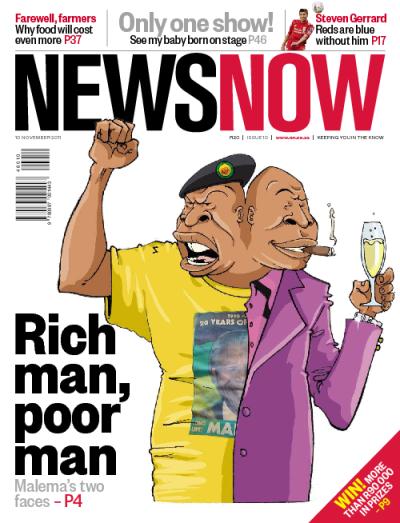
NewsNow, 10 November 2011


The NewsNow team is starting to get a nice following for their covers. I can only imagine how difficult it must be to create a striking and impactful cover week after week, and on such hectic deadlines. But for the past few issues they’ve really hit the nail on the head. This week, the nail is Julius Malema.

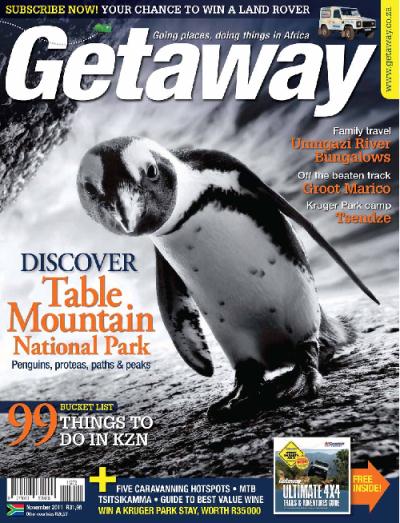
Getaway, November 2011


Last week, there were too many good South African covers, so we decided to have one stand over until this week, that of Getaway, November 2011. The cover model “Curious George” can easily be voted the cover model of the year. The photographer Jade Holing caught a very special moment on film and kudos for the Getaway team for using it on their cover.

– The (for now anonymous) blogger behind MediaSlutZA knows way too much for his own good about media in South Africa. Magazines in particular. His mission is to show when South African magazines might fail, but most importantly, succeed. If you’re looking for a library about South African magazines and news, your one-stop pitstop is MediaSlutZA. #MagazinesForTheWin

– Find a cover we should know about? Tweet us @marklives and @mediaslutza

Prezence promises mobility for the masses

Prezence, the digital agency part-owned by Primedia, has always been proud of its ability in the mobile space, says CTO Tim Bishop, and now, with the appointment of CEO Prakash Patel, it is able to provide a full range of strategic digital solutions to clients.

Patel joined Prezence in early October and is the former chief digital officer of MESH Interactive, the digital arm at Draftfcb South Africa. Prior to that he was managing partner at UK-based digital agency Global Beach for three years, where he worked with Bentley Motors, Sony Playstation, Jaguar, British Telecom, Toyota GB and Barclays.

While Bishop has successfully focussed on the technology side of the business, Patel’s brief is to build the agency’s non-tech credentials. Prezence currently employs 42 people.

Bishop says the agency has spent the last five years pushing mobile solutions and has built an impressive track record on this front, including the hugely successful and popular Ster-Kinekor mobisite.

The aim of its creations has always been to enable all consumers, and not only those with iPhones – or as Bishop puts it, Prezence aims to “mobilise the masses”. Bishop sees it as an organisational responsibility to make mobile products as accessible as possible so that anybody with even the most basic smartphone can use them .

While many organisations lost sight of mobile in their rush to the web, companies such as Prezence that built up a reputation in the field over the past couple of years are now riding a wave as businesses attempt to create practical and user-friendly applications for consumers to interact and, more importantly, transact with their products and brands via mobile handsets, says Patel.

Bishop says technology is becoming a smaller part of a larger puzzle when it comes to successful mobisites. Unfortunately, many mobile applications and sites are still constructed by techies, a bit like the web in 2002, says Bishop, ignoring fundamentals such as usability and user experience (UX) design.

The highly successful Soccer Laduma mobisite is a case in point. The site had a user base of 201 079 by June this year, generating 7.9 million page views a month. The publishers expect traffic to increase further and to make a significant ecommerce play in the future. While the tech backend is hugely important, it is designed to be a simple and uncomplicated user experience, with relevant content that is driving its popularity.

The success of Prezence in making its work work for clients, coupled with a relatively low professional profile to date, has lead Patel to dub Prezence “a diamond in the rough”. Patel will be working on polishing its image in the broader industry and ensuring clients know of its integrated digital offerings.

Primedia bought into the company and, says Bishop, was picked as a partner because he was comfortable that it would not try to swallow up Prezence, keeping the company’s management and culture in place. Bishop says that, while many analysts are focused on Primedia’s more traditional content offerings, the company has built up a great hub of innovative companies, of which Prezence is part.

Currently Prezence is upskilling on its social media capabilities, in tools as well as people, and is seeing growth in demand for these services from clients. It also promises to up the stakes on ROI and measurability with campaign debriefs that will become standard with clients.

Its Johannesburg office is still small but growing and it’s investing in upping its creative skills at that office, says Patel.

Last year, former Primedia Online (and Prezence) CEO Nikki Cockcroft told AdReview that she is tasked with integrating the Prezence business into Primedia Online and with improving its financial performance. Bishop denies that Prezence was an under-performing asset for Primedia and says the business has always been solid and profitable. There were never any plans to fully integrate Prezence and Primedia Online either, even though the two companies shared a CEO at the time, says Bishop.

Both Bishop and Patel sees specialists such as Prezence having a role to play in an increasingly integrated agency scene, saying their skills often help power the digital offerings thought up by agencies which want know their concepts are in expert hands. More and more agencies and clients are taking upfront advice from Prezence and the company aims to add value where it can.

Digital budgets are also growing healthily. The education phase of business as to the promise and opportunity of digital is drawing to a close and they are starting to buy into best practice, says Patel. And, by extension, into the Prezence offering.

Bizcommunity Originally published on Bizcommunity.com Marketing & Media | South Africa – click to see more comments.

Turner Broadcasting System sees growth in African pay-TV market

Turner Broadcasting System (TBS), a Time Warner Company, delivers a number of news and entertainment pay television brands to African audiences through partnerships with MultiChoice (DStv) and On Digital Media’s (ODM) TopTV. Its channels are also available on some smaller platforms across Africa.

Alan Musa, VP and GM, Pan Middle East and Africa (MEA) for Turner Broadcasting System, says that while Turner doesn’t have a physical presence in Africa, instead relying on partners to promote its business interests here, the continent is an increasingly important market for his company. The MEA region is currently managed from London, while CNN runs its own bureaus in a number of African cities, including Johannesburg, Lagos, Nairobi and Cairo.

Musa describes CNN and the Cartoon Network as the group’s two flagship channels on the continent [CNN’s critics will enjoy the irony, I’m sure]. The Cartoon Network is the kid’s brand that has been broadcast into the continent for over 10 years now, thanks to MultiChoice, which also carries Boomerang, the group’s classic cartoon network. Turner also owns TCM (Turner Classic Movies). CNN is its global news channel.

Turner Broadcasting Europe recently bought out Millennium Media Group (MMG), which owns Star!, Showtime and Silver, all broadcast on TopTV.

Musa says the group has a strong business in Africa, with growth primarily tied to that of MultiChoice, which operates in 48 countries in sub-Saharan Africa and the adjacent Indian Ocean islands. MultiChoice has more than five million pay-TV subscribers across the Africa (of which 3.5 million are in South Africa).

With more and more African economies showing positive GDP growth, Musa expects demand for pay-TV services to surge. Bloomberg recently reported that MultiChoice is rolling out low-price pay-TV packages to build scale in African markets. Subscriptions start at around US$7 a month, with decoders costing US$50.

Musa says growth in digital terrestrial television (DTT) across the continent and advancements in mobile TV are both positive indicators for market growth.

The SA market he describes as being well-developed and sophisticated and, apart from its channel brands, Turner also has substantial licensing and merchandising, as well as a live show and events, business here.

Currently TBS is introducing LazyTown, a block of preschool kids programming, to Boomerang. Musa says TBS’s investment in LazyTown shows the group’s growing ambition in the preschool space, and opens opportunities for content companies to create further material for this audience.

Originally published on Bizcommunity.com Marketing & Media | South Africa – click to see more comments.

New Y&R Cape Town MD looks to small wins for big gains

Natalie Tudhope has just taken over the mantle of MD at Young & Rubicam (Y&R) Cape Town from Alan Schreiber, who stays with the group but becomes managing partner of Team Pick n Pay, the agency’s biggest client. Tudhope adds the MD portfolio to that of financial director for the Cape Town agency.

Tudhope has been with Y&R for 10 years and was a director and shareholder in The Gap (founded by Alan McDonald and Peter Southworth), an agency bought by Y&R Gitam, as the company was known then, in 2002.

Tudhope, who was with The Gap for 10 years, was well-known there as the media director at the time and helped develop a financial control model focused on media booking. This was when agencies still did media planning and buying themselves.

Her experience in media and client strategy helps her focus the agency on what it needs to deliver on for clients, says Tudhope. She promises to further engrain the fundamentals of business practice at the agency and believes with her financial experience she can help quantify deliverables for clients.

Tudhope, like many local agency heads, feels that ad agencies gave up media planning and buying to independents such as OMD Media Direction or Mediacom too easily. But they lost the business because they were inflexible and didn’t realise the threat posed by independents, who charged 3-4% commission on media buys to the then-agency standard of 16.5%.

It’s a case study of the industry caught napping, and like her peers, Tudhope seems to be looking for a workable model that would bring media planning and buying services back to the agency. It won’t be terribly expensive, says Tudhope, and would entail an investment in people and Telmar licenses, though no decision has yet been made on whether an attempt should be made in this direction.

As media fragments, Tudhope asks how media strategy can come in and get tagged onto the end of a communication strategy with any real sense of strategic understanding, when it should be helping to steer strategy in the first place.

This doesn’t mean media independents don’t have a good offering as things stand today, Tudhope clarifies, but it’s not the integrated offering an agency could bring to the table.

Y&R Cape Town, as it stands, is solid financially and has solid client relationship in place, says Tudhope, with around 40 people in the Cape Town office. Andrew Welch, CEO of Y&R South Africa, is based in the city, and spends Mondays and Fridays at the local office, keeping it on its toes. Graham Lang, chief creative officer Y&R SA, is also based in the city and commutes between Johannesburg and Cape Town. The two men are leading a renewed focus for Y&R at group level, says Tudhope.

Lang’s presence means the Cape Town office didn’t replace its former ECD, Clinton Bridgeford, who left earlier this year.

Schreiber’s appointment as managing partner of Team Pick n Pay means that client finally has a central national touch point to all the Y&R offices (Jozi, Durbs and Cape Town), explains Tudhope, who also points out that Schreiber enjoys a strong working relationship with Pick n Pay’s CMO, Bronwen Rohland.

Y&R SA has experienced a turbulent time late last year after its management drew a curtain of silence around the departure of former CEO Fraser Lamb, who became executive chairman of McCann WorldGroup Africa in September this year. He was quickly followed by then chief creative officer Mick Blore. Earlier this month Liam Wielopolski, the Joburg agency’s ECD, also left.

Tudhope says Y&R prides itself on positive human relationships within the agency and admits the agency has had to ask itself some tough questions after losing so many key staffers. But she insists that client service relationships have been maintained, in spite of the resignations, thanks to active engagement with clients on the agencies side.

Tudhope doesn’t see much client movement at the moment and says the agency will concentrate on organic growth.

Tudhope says she will focus on building on the strong client relationships already in place, on keeping her team happy and engaged, and on applying the concept of “small wins” which centres on changing the small things that is within your power to change. Cumulatively, the small wins have a big impact on the overall business, the theory suggests, and in effect tackles bigger problems.

Originally published on Bizcommunity.com Marketing & Media | South Africa – click to see more comments.

Gloo eyes expansion to Middle East

Digital agency Gloo is seeing budgets dedicated to digital going up by as much as 50%, says Gloo ECD Pete Case, as corporate South Africa keeps shifting budget towards digital platforms. And it’s going towards more than marketing in its traditional sense, says Case, who cites Spur as one client investing in digital as a means to manage brand material going out to franchises.

Franchisees simply log into the Spur platform, and download the latest marketing material, logos and updates from there, resulting in quick turn-around times, fewer phone calls at HQ and the ability to see which franchises are using what material, allowing the marketing team to see what material is proving popular.

For Case, this shows that digital shops such as his are moving beyond being simply agencies to being consultancies – he looks at business requirements of each client, trying to figure out what digital platforms can do for them, rather than simply trying to channel money into digital marketing efforts such as company websites.

Gloo has already dropped the “Digital Design” part of its name – something that was added in in its early days to “box it in” so agencies would understand what they could do. Those same agencies are increasingly using Gloo beyond execution and production, says Case, bringing the company in at the initial strategic meetings.

It’s all part of a subtle repositioning of Gloo, the writing of the next chapter, as Case puts it, that will see it move on to bigger things. But this is still a couple of months down the line and for the moment Case isn’t prepared to really clearly outline where he is taking the business. Let’s just say it involves other players – both inside and outside the digital space. But more on that a little later.

Gloo is doing very well as a business, in fact Omar Essack, Kagiso’s CEO of broadcasting, recently told Bizcommunity.com that Gloo, in which it holds a 50.1% shareholding, is “probably the fastest-growing asset we’ve ever had – perhaps East Coast Radio was also like that when we first bought it…”

In its annual report for 2011, Kagiso reports that Gloo delivered revenue growth of 76.3%.

Case says other digital players have already put their cards on the table – witness the formation of Native – which merged mobile specialist Brandsh, digital agency Stonewall+ and Cambrient, best known for its content management solutions. Gloo has not; apart from media releases on its numerous award wins, the company doesn’t reveal much information about itself (witness the two page Gloo website as an example).

Gloo is also seeking to expand beyond SA to the Middle East. It is already doing work in Doha for the Qatar Foundation.

Case says he is looking for places where his company can add value, rather. He hopes to make a final decision on a new office in that region soon and says Gloo is currently in a testing phase as to the viability of establishing a presence there. He would like to open the new office there by this time next year.

Case says he is also relooking at Gloo’s strategy of investing in entering creative awards – the agency is one of the most-awarded digital agencies in the country. Case says he might rather choose to invest the money in furthering staff development.

Gloo has certainly proven it can win awards and offer creative communication solutions – point made. Case is asking if there are more relevant investment opportunities for that agency money and the obvious answer does seem staff development and retention, coupled with a culture that thrives on innovation (creative and otherwise), rather than simply awards.

Today, Gloo employs roughly 70 people, split equally between Johannesburg and Cape Town, and the teams in Jozi mirror those in Cape Town, meaning clients can expect the same level of service and strategic advice at either office.

Case believes where digital really adds value to an organisation is in the space where digital and “real-life social networks” meet. The new chapter he promises the company is writing, he suggests, will meet in a similar space, with the stated aim of being the best communication resource/think-tank a client could hope for.

So, as Case prepares to reveal Gloo’s strategic vision of its future, rivals – digital or not – will be watching closely, hoping it won’t stick, and that ‘tradigital’ – that meeting place between digital and traditional – will remain the niche unclaimed.

Originally published on Bizcommunity.com Marketing & Media | South Africa – click to see more comments.

BrandsEye declares its independence

Reputation management practitioners are increasingly keeping an eye on the internet and especially social media as consumer conversations, especially ones on what to – and not buy – shifts online.

Locally BrandsEye has emerged as an important tool in tracking an organisation’s online reputation. Many clients are agencies tracking conversations on client brands and marketing. BrandsEye serves as an early warning system that alerts agencies and brands when a conversation turns negative. It also serves as a tool managing shareholder reputations as per King III and ticks many of King III’s boxes at low cost.

MD Tim Shier says his software tracks brand mentions over across 35 billion open content websites including social media sites and blogs. The company has clients in 89 countries and Shier believes BrandsEye represents a great tale of SA developed technology reaching the world. Telco’s, banks and financial services, FMCG brands and auto manufacturers especially have embraced the product.

Shier joined Quirk as an intern in 2007. He soon worked his way up to become marketing manager at Quirk eMarketing and became MD at BrandsEye in January 2010.

BrandsEye was developed by Quirk eMarketing seven years ago, but has recently been spun off to Quirk Labs, within which it operates as a 100% independent company. Shier says the new structure moves the company away from Quirk agency and allows it to service clients from a broad range of ad agencies.

It completes the companies’ evolution from a business unit to a business proper and will see it physically relocate away from the current Quirk HQ.

The focus for the year ahead rests on expanding the BrandsEye footprint to various African and Middle Eastern markets outside SA, followed by entry into other emerging economies. Shier will be visiting agencies in a number of African markets to educate them in the tools and opportunities BrandsEye brings to market.

Shier says that while he used to think digital is a uniform layer wrapping the globe he has come to realise that digital conversations differ substantially from region to region.

Social media platforms like Twitter especially means the amount of data organisations need to track is exploding, but on the upside, says Shier, it also represents the real world, and real world conversations, in a digital space, making it trackable. Ultimately Shier hopes tools like
BrandsEye will be used to improve governance by highlighting where shortfalls are being experienced by people on ground level.

Find it: www.brandseye.com

Reprinted from the September issue of AdVantage magazine.

Cover S’Hot: Magazine covers we love (this week)

MarkLives.com runs a regular slot featuring the best local and international magazine covers every week. We recognise well thought out, powerful and interesting (and hopefully all three in one) magazine covers and celebrate the mix of pragmatism, creativity and personal taste that created each of them. By media blogger MediaSlutZA.

INTERNATIONAL
Fiasco Homme, October 2011 – February 2012

Since reading a profile on Andrej Pejic in New York magazine, I’ve fell in love with what he does, and what he stands for. This cover embodies that perfectly. If you don’t know the background story of Andrej Pajic, read more here.

Science, 14 October 2011

Bill Nye the Science Guy must love this magazine. I’ll never buy it, but what made me look twice, was the unique angle, exposure and crop of the image. And those whiskers. It actually makes Rodents sexy [for me it just makes them spooky! – ed].

Time Out Singapore, October 2011

It says and sums up everything just with this picture and smart treatment of the coverline.

LOCAL
GQ South Africa, November 2011

The fact that Oscar Pistorius is the first South African male on the cover of GQ in a while might have something to do with it. Not to mention that he looks smoking hot and can compete with any of the previous international stars on GQ South Africa covers.

Zig Zag, November/December 2011

The colours, pictures, treatment – it all just screams “Summer Rules” and the cover makes me look forward to summer in Cape Town more than any other magazine cover has done so far.

Discovery, October 2011

Discovery magazine has had a re-design and this is their 1st new look issue. I haven’t seen the complete issue yet but the cover is awesome!

– The (for now anonymous) blogger behind MediaSlutZA knows way too much for his own good about media in South Africa. Magazines in particular. His mission is to show when South African magazines might fail, but most importantly, succeed. If you’re looking for a library about South African magazines and news, your one-stop pitstop is MediaSlutZA. #MagazinesForTheWin

– Find a cover we should know about? Tweet us @marklives and @mediaslutza

Online CPD Courses Psychology Online CPD Courses Marketing analytics software Marketing analytics software for small business Business management software Business accounting software Gearbox repair company Makeup artist