The Ad Exec: The giant moves redefining South African adland

by Tom Fels (@thomasfels) There is a great quote I remember from a movie: “Nothing ever changes around here except the seasons.” While it rings true for many aspects of life, one area where it falls dramatically short is in the daily demands of the advertising world.

Tom FelsFor, if anything can be said for certain it is that, when it comes to advertising, the only constant is change.

But today is different; today marks an accelerated change that is more like a tectonic shift than the slow release of winter’s grip. Radical movements in three aspects of our industry are redefining the landscape, setting the scene for the next era in adland:

  • The rapid acquisition of many of the country’s leading independent agencies by global networks;
  • The dawn of a new era in agency leadership (both related and unrelated to said acquisition); and
  • A number of sudden and significant account moves.

The big picture

It’s easy to give only a fleeting moment to the latest press release that marks a single change in the fabric of a large and boisterous industry. Chances are the only time you may pay an announcement any more attention is if it is about you; your clients, your services, your awards, your performance.

But the macro view of all that is ongoing will tell you to take heed — what is happening is important and it will probably affect you, whether you like it or not.

The big story of the 12 months is in the agency acquisition space, where WPP and Publicis have in particular gone to town, making over 10 combined prominent local acquisitions.

With an already firmly established presence through the Ogilvy & Mather, Y&R and JWT businesses, among others, WPP looks set to extend its capabilities through the reintroduction of the Grey brand as Volcano/Grey South Africa and a majority stake in The Hardy Boys, along with enhancing its digital offering as it now has interest in Cerebra, Aqua (acquired in 2007), Native VML and, most recently, Quirk.

A significant number

Altogether, these represent a significant number of the country’s big digital players and, according to a recent MarkLives report, the combined revenues of the latter three tip an estimated R375m, making them the largest digital agencies in South Africa.

Not to be outdone, Publicis Groupe has been engaging in broad acquisition activity across both the advertising and media spectrums, carefully architected locally and into Africa, with a clear intent to provide a comprehensive network of powerful specialisations. This will enable the group to lead national and global brands north of our border.

The network has done deals for boutique digital shop, That’s It Communication, pure-play medical agency Blue Parrot and Lighthouse Digital, which now forms part of Starcom Media Vest. Several of the renowned Publicis agency brands are also getting a new burst of local energy as they take on prominent independents to form Publicis Machine, Saatchi & Saatchi BrandsRock (as well as Synergize), Prima Arc, Liquorice (now a DigitasLBi company) and OwenKessel Leo Burnett.

In the pipeline

What with more deals speculated to be in the pipeline in South Africa, Kenya, Tanzania, Angola and Mozambique, as well as with the leading agency in Nigeria, Publicis is set to realise its potential on the continent.

TBWA is the most recent group to show its hand, having indicated its intention to conclude six deals over the next year in SA.

All the bold agency moves are not limited to acquisition alone; Cape Town stalwarts King James and FoxP2 have a growing Johannesburg presence (the latter significantly boosted by its recent FNB win), while MetropolitanRepublic and Joe Public have spread their wings in the Mother City (MetropolitanRepublic has since closed its Cape Town office). Joe Public also recently announced the expansion of its footprint with affiliate partnerships in several African countries, after branching into the European market with Amsterdam-based Joe Public Take-Away. Joe ‘Grow’ indeed.

Shifting leadership

As a natural accompaniment to broader moves, new opportunities have been created in key creative and business leadership positions, which have usurped a number of well-entrenched figures.

Julian Ribeiro recently left Ogilvy & Mather for Lowe Partners, John Dixon has taken the helm at Saatchi & Saatchi BrandsRock after a significant stint at Draftfcb (now FCB) and Jerry Mpufane has transitioned over to M&C Saatchi Abel.

Key creative leadership positions have also been filled, among others, at MetropolitanRepublic by Gareth Lessing and TBWA\Hunt\Lascaris Johannesburg by Peter Khoury, who’s adopted the role of chief creative officer.

This provides a whole host of opportunities in the departed agencies for organic growth and the empowerment of top talent waiting in the wings, just as it was in the case of Gavin Levinsohn’s departure from Ogilvy & Mather Cape Town, which made way for the charismatic Luca Gallarelli to take the reins as MD.

Giant account moves

Lastly, and not surprisingly, clients intent on shaking up their marketing plans have uprooted their business and sought new pastures. Among the significant recent moves are Sanlam moving out of MetropolitanRepublic into King James, Vodacom Retail going to Ogilvy RedWorks, FNB appointing the reliably creative minds of FoxP2 in Joburg and Cell C partnering with FCB SA.

What to expect?

We’re in a window period of operational consolidation across much of adland, both structurally and in terms of settling new leadership teams. One can be assured that, as each of these new entities comes online with full effect, the marketplace is going to ripple in two major ways:

  • The first is a tightening on any global accounts that, with enhanced capabilities on offer, should not be as reliant on specialist external hotshops to service their peripheral needs.
  • The second is a new era in competition for prized large blue-chip accounts in both of our primary local advertising ‘cities’, as the number of potentially suitable agencies in the pitch pool has just increased dramatically and will be fighting tooth and nail for the spoils.

With a far clearer distinction between network agencies and independents, more decisive choices will also need to be made by both clients and industry talent as to whom to partner with.

One might feel that there could be a backlash in two-to-three years as clients seek a new crop of rising independents; however, in the near-term, I would imagine greater pressure being applied upon independents in the mid-to-lower tiers of the industry.

Define the next era

From a talent perspective, the shifts will no doubt provide new avenues of exposure for rising stars, as well as a solid new level of mentorship for those who have had industry veterans appointed into leadership positions.

The sum total of these moves looks set to define the next era in South African advertising — if not for the next few years, perhaps for the next decade. There will be winners and losers, but what I look forward to the most is to see how everyone plays the game.

With a decade of local and international experience in leading brand consulting, design, shopper marketing and integrated advertising roles, Tom Fels (@thomasfels) has gained a deeply relevant understanding of the dynamics of agencies. His skills are put to work daily as group managing director of Publicis Machine. He contributes the monthly “The Ad Exec” column to MarkLives.

— MarkLives’ round-up of top ad and media industry news and opinion in your mailbox every three work days. Sign up here!

Talking Radio: Getting ‘Generation Skip’ to keep listening

by Angela Haarhoff () If you were born prior to 1990, there’s a 50/50 chance that you may know who Malcom Gooding is. You may have spent many an hour of your own life listening to his voice float on the airwaves, or have heard your older siblings and parents reminisce about him and those like him. He and his peers had an 007-esque aura about them.

Malcom Gooding
Malcom Gooding

Going Gooding is a stage show, starring none other than the man himself, that takes you on a journey of South African radio history, getting everyone nodding in recognition of at least one of the ad or shows that Mr Gooding rebirths. Who can forget the After Action Satisfaction of a Lexington or the iconic tune of a Dunhill ad?

Making a connection

Granted, those born post-1990 may have some trouble recognising these skits and making a connection with most of the material, but none the less, the show is educational.

To add to this, the show highlights the real emotional connection that radio has had with audiences through the generations. It reminds us how radio formed such an integral part of our lives as a medium which brought people together. Seldom did you find a lone audience of one in those earlier days. Rather, there would be rooms filled with families huddled together to listen to a radio story or news announcement.

Fair enough, we are describing a time where there really wasn’t much else to do with one’s evenings and that certainly has changed, but the point is modern radio has to come to terms with the fact that those really strong emotional connections are no longer there or have changed so vastly that most of us don’t really know what we are dealing with.

Dirty research

Just to prove a point, we undertook some incredibly rough and unrepresentative dip-stick research, asking friends and colleagues to reminisce about their lives with radio and what it has meant to them and their families. In response, we received some of the most beautiful ‘deep-and-meaningfuls’ from a certain portion of the ‘respondents’ and then deathly silence or somewhat more watered-down versions from the rest. There was a definite age split – not race or gender.

1. Don’t touch me on my radio

Members of the older group, let’s say those from 28 and up, seem to have the fondest memories of radio. Their experience details specific programmes and shows they listened to, and who they listened with. They also mention their favourite DJs, from Martin Bailey and Alex Jay to Bob Mabena and Romeo Khumalo.

This group was also very attached to the actual device emitting the frequency. From mentions of “The Wireless” (and, no, we are not talking cutting-edge tech of 2014 here) to their own personal little radios, complete with stickers and batteries, they loved their radio. The relationship was solid and the memories have stood firm. They’re loyal and emotional when it comes to radio.

2. Radio? Oh, you mean music

This brings us to the younger group in our dirty research survey. Now, this was a hard one to call, as response rates were, well, dire. Of those that we did receive, there was just enough information available for us to deduce that, among this group, it’s not about radio or the DJs or the shows – it’s almost always about the music.

This generation has grown up on music available at the touch of a button. The immediacy with which they have been able to get their hands on a single or an album is a far cry from the months waited for a new record, tape or CD at your local music store. Their favourite singers and stars are closer than they ever were, and everyone wants their five minutes of fame. The world is their oyster and they go for it!

Their lives have had a soundtrack assigned almost as soon as they came out of the womb; their parents very possibly filmed their birth, assigned a soundtrack and posted it to YouTube.

Their radio and music has become more mobile, personal and accessible. It can go anywhere, at any time.

What we know

Dirty research aside, as media specialists, we do know that this younger generation does buy into radio shows and personalities as much as their older counterparts. The music is important, but without the pull of the personality and programming, there wouldn’t be much else to convince them to listen… and they ARE listening.

According to AMPS 2013, 35% of South Africa’s radio audience is between 15-27 years old – that’s over 12 million pairs of young ears. To add to that, 45% of this group listen to radio on their mobile phones. So, radio is still very much a part of their lives.

The difference is then, perhaps, that this generation buys into radio and all that it has to offer, as long as they can have interaction and engagement with their station. They are opinionated and in touch with the world. They don’t want to be spoken to; they want to be spoken with. They want to interact with the DJs they idolise, bringing fame into their realities and not merely left in their imaginations.

An indelible mark

For those of us who still hold on to those very fond memories of earlier radio in South Africa, we can only wish the same for the younger generations – that they, too, will be able to look back and say that radio left an indelible mark in their lives.

The importance of music remains a strong factor, however, as this generation dances along to their own soundtrack. Radio needs to be compelling and shareable enough for this ‘Generation Skip’ to keep listening.

Angela HaarhoffAngela Haarhoff () is an analytics and insights strategist at MEC Notabene Johannesburg. A Psychology and AAA Brand Management graduate, her background includes diverse years spent in strategic planning, marketing services and public relations. She contributes “Talking Radio”, a monthly analysis of South African radio listenership figures, to MarkLives.com. Follow @mecnotabene for regular media updates.

— MarkLives’ round-up of top ad and media industry news and opinion in your mailbox every three work days. Sign up here!

Fast Company’s own Dolly the sheep

by Herman Manson (@marklives) The New York Times  once called Fast Company (in 1998, and rather fondly, I thought) “a feel-good business bible for the generation that never leaves home without a Palm Pilot”.

The magazine had launched in 1995, just as we were all taking some of our first substantial steps into the first dotcom bubble (even if we didn’t know it yet).

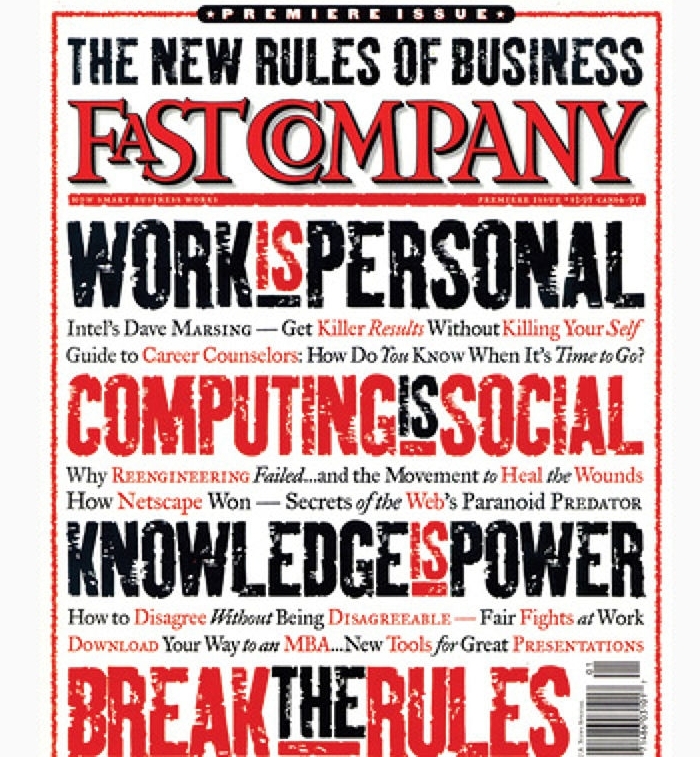
Fast Company: launch issue “The New Rules of Business”

I still remember the launch cover (a copy made its way to South Africa and into my hands through one of those shops where you used to pay for old imported magazines by the kilogram) which offered to set out “The New Rules of Business” (work is personal, computing is social, knowledge is power and, finally, break the rules).

To chronicle the rise of the “new economy”, and to slurp up the glut of ad money start-ups were spending on getting their brands out and more VC money in, a myriad of business magazines saw the light of day.

Apart from Fast Company, there were Red Herring (launched in ’93), Business 2.0 (launched in ’98 – it apparently sold 2000 pages of advertising in its second year of publishing) and The Industry Standard (’98 and chronicled in the book “Starving to Death on $200 Million: The Short, Absurd Life of The Industry Standard”).

Somehow, Fast Company remained

Somehow, as its rivals folded one after the other, Fast Company remained, both in print and online. It broke some rules, but then broke them all over again by staying afloat when rivals sank.

Not everyone managed to hold on for the ride through; Bertelsmann subsidiary Gruner + Jahr, which bought the magazine for US$350 million in 2000, sold it to current owners Mansueto Ventures for US$35 million in 2005 (the price also included tech title Inc.).

Under Mansueto, the magazine has been stabilised and was named Magazine of the Year at the National Magazine Awards held in the US in May this year. It also launched its first international edition — in China.

SA on the radar

Robbie Stammers says, as editor of Leadership magazine, he would go to meetings with people in innovation or creative fields and, like clockwork, there would be a copy of the US edition of Fast Company. After he left the business title to start Insights Publishing, he decided to get hold of the US publishers. They didn’t know much about South Africa, except that a growing list of entrepreneurs and innovators from here were making it onto their radar.

Events such as Design Indaba, and that Cape Town had been named World Design Capital 2014, also attracted the attention of the US publishers, and Stammers convinced them to license the first English language edition of the magazine, outside of the US, to the southernmost point of Africa.

Stammers say business magazines in SA are all boardroom-suit-and-tie, old school and just a little stiff. He wants to tap into a younger, more innovative, business readership.

Dolly the sheep

Being the first English language edition outside the States makes the SA edition Fast Company‘s own Dolly the sheep, jokes Stammers. The US company will follow the success of the SA edition closely, Stammers suggests.

The magazine, which launches with an October 2014 edition, will publish 10 times a year (with combined Dec/Jan and June/July editions). Copies will retail at R35. The first issue will have a print run of 20 000.

Content will be split 60/40 in favour of stories from the US edition, initially. It promises local readers access to interviews and profiles on global business leaders. Stammers will bring out two FC franchises: Most Innovative Companies and Most Creative People in Business. Local lists will supplement those put out by the parent magazine.

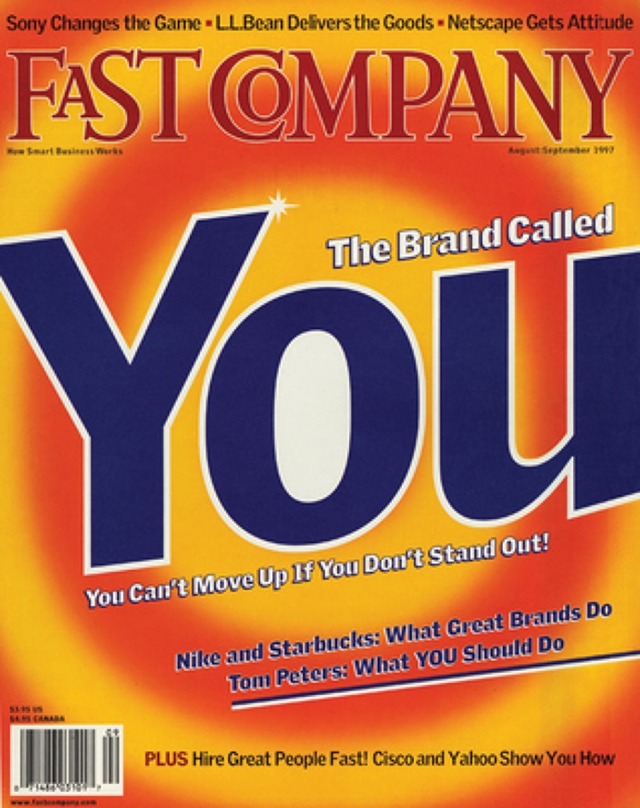
Fast Company: The Brand Called You

Storied editorial history

Fast Company has quite a storied editorial history. It (in)famously helped to launch personal branding as a mini-industry by publishing an essay by Tom Peters called ‘The Brand called You.’

“Regardless of age, regardless of position, regardless of the business we happen to be in, all of us need to understand the importance of branding,” Peters enthused. “We are CEOs of our own companies: Me Inc. To be in business today, our most important job is to be head marketer for the brand called You.”

“I know this may sound like selfishness,” Peters continued. “But being CEO of Me Inc. requires you to act selfishly — to grow yourself, to promote yourself, to get the market to reward yourself. Of course, the other side of the selfish coin is that any company you work for ought to applaud every single one of the efforts you make to develop yourself…”

Manifesto of a generation

It became the manifesto of a generation. We call them Millennials.

The median age for Fast Company‘s readership, according to its rate card, will be 35–40 year-olds. Those trying to figure out how to manage Millennials, at a guess?

The SA edition of the magazine will be jointly overseen by Stammers and newly appointed editor, Evans Manyonga.

Stammers is taking on a number of full-time staff members, thanks to a cash injection by a silent BEE partner. The first three editions of the magazine will be sent free to all current MBA students at the country’s top business schools. On the Dot will distribute to retailers, which will no longer be stocking the US edition. Events and an online presence will add to the brand’s local revenue streams.

Hugely positive for SA’s publishing industry

Fast Company South Africa might well turn out to be the most interesting business publishing initiative around since Maverick and Empire folded some years ago. Seeing independents invest in media is hugely positive for SA’s publishing industry — even more so when these projects become passions. Few business magazines elicit passion (or any emotion or expression, really, other than maybe urgh) — but it’s a trait visible in both the product and in Stammers.

While the Palm Pilot, long forgotten, gathers dust in the corner of little-used drawers, Fast Company keeps renewing its brand. Who would have guessed print would outlive Palm, huh?

Full disclosure: Media Africa, in which Herman Manson was a shareholder, published Fast Company content under licence in 1999. Manson was the online editor for Business 2.0 South Africa.

— MarkLives’ round-up of top ad and media industry news and opinion in your mailbox every three work days. Sign up here!

Smart Africa TV: Lean Startup Machine Johannesburg

by Russell Southwood (@BalancingActAfr) Tefo Mohapi (@TshepoMolope)of Lean Startup Machine Johannesburg (happening October 31 – November 2) talks about:

  • its 3 day intensive workshop approach;
  • the different elements of the workshop;
  • the kinds of people who come to the workshop;
  • the types of projects they want to set up;
  • and the two key barriers in the Johannesburg start-up scene.

Smart MonkeyRussell Southwood is the founder of Balancing Act and the web TV channel Smart Monkey TV, and has been an analyst in telecoms, internet and broadcast in Africa for the last 14 years. Smart Monkey TV aims to capture the energy at the crossroads between African culture and technology. MarkLives is syndicating content from Smart Monkey TV on a weekly basis for the column “Smart Africa TV”.

— MarkLives’ round-up of top ad and media industry news and opinion in your mailbox every three work days. Sign up here!
MagLove: Men’s Health shows off K2 Twins Alex and Charlie Kotze

by MediaSlut (@MediaSlut) My choice of the best international and local magazine covers inMagLove this week:

  • Click
  • Playboy
  • Time Out New York
  • Variety
  • Woolworths TASTE
  • Men’s Health South Africa

INTERNATIONAL

Click, September/October 2014

Click, September/October 2014

C is for “Click” and “CUTE” and “cover”! So basically, a really cute cover by Click magazine…

Playboy, October 2014

Playboy, October 2014

I love it when magazines break the buttons mould and tries something different with cover lines, and this cover of Playboy is the perfect example! Very over-photoshopped, yes, but the cover line patch stickers definitely stand out for me and was done very well. Well, that, and something else ;-)

Time Out New York, 18 September 2014

Time Out New York, 18 September 2014

Definitely one of those covers where the image explains exactly what the cover story is about, illustrates it brilliantly and is really well-executed!

Variety, September 2014

Variety, September 2014

Smart illustration, and a very smart play on words.

LOCAL

Woolworths TASTE, October 2014

 Woolworths TASTE, October 2014

Spring hasn’t completely arrived for me yet, as the wather in Cape Town is still very wishy-washy, but the new October 2014 cover of Woolworths TASTE has definitely brought it home to me (visually!). The colours, styling and final image definitely all come together in one delicious scoop…

Men’s Health South Africa, October 2014

 Men’s Health South Africa, October 2014: K2 Twin Charlie Kotze

Men’s Health South Africa, October 2014: K2 Twin Alex Kotze

I’ve been following the K2 Twins Alex and Charlie Kotze since way before they became ‘famous’, so it’s really nice to see how they’ve shot up in the past few months, and now have their very own Men’s Health South Africa cover. Each!

Brilliantly timed by Men’s Health as they are just about everywhere now, and their fan base is growing week after week.


Find a cover we should know about? Tweet us at @Marklives and @MediaSlut.
Want to view all the covers at a glance?
See our MagLove Pinboard!


MediaSlutMagLove by @MediaSlut is a regular slot featuring the best local and international magazine covers every week, recognising well thought-out, powerful and interesting (and hopefully all three-in-one) covers and celebrating the mix of pragmatism, creativity and personal taste that created each of them. The (for now anonymous) blogger behind MediaSlutknows way too much for his own good about media in South Africa, magazines in particular. His mission is to show when SA magazines fail but, most importantly, also when they succeed. If you’re looking for a library about SA magazines and news, this is your one-stop pitstop.

— MarkLives’ round-up of top ad and media industry news and opinion in your mailbox every three work days. Sign up here!

Motive: Digital mags shaking things up for marketers

by Robyn Daly () The internet has become a real scratch patch for old gems. I had a giggle over one from 2007 on the future of digital magazines.

It’s a Content Marketing Institute interview with Marcus Grimm of NXTbook Media in the US. At the time, it was pretty cutting-edge, but seven years on it’s a reminder of how far we’ve come. Well, some have.

Robyn DalyThe gist of Grimm’s argument was that digital magazines are worth considering if they’re an off-shoot from print. PDF versions of print magazines with a bunch of videos and flash elements were his idea of a digital publishing Pavlova.

Following the vision

Following this vision, consumer publishers the world over are eking out sales by slapping a PDF of an entire mag into digital format and offering it at a fraction of the price. In South Africa, Media24’s gone one up on everyone else and is bundling digital versions of their mags and selling to consumers as a monthly subscription.

But the potential for digital publications is way beyond the PDFers. They’ve evolved into interactive, extravaganzas conceptualised and built from the get-go for the platform. And, in the content marketing world, there is so much opportunity for this medium I’m hopping up and down with excitement as I write this.

From an editor’s perspective, digital magazines give instant feedback because they’ve got a backend like a treasure map.

Deep-dive metrics

The best-in-class platforms give deep-dive metrics, pointing to what content readers are actually consuming, what’s ho-hum, and what’s off the mark. There are stats on what’s being shared and to which platforms, how much time people are spending and so on. Think Google Analytics on steroids.

The vagaries of a print-publication reader survey with tick boxes and respondents muddling Getaway and Men’s Health magazines (yes, it happens! Readers can be a very confused bunch!) are gone. Online, Big Editor is watching every mouse move.

Tennis Tuesday was doing okay until the editors started snooping around the metrics.

Platform insights radically improved readership

They used platform insights to radically improve readership from one issue to the next, simply by noticing that readers were honing in on stories about tennis players’ lives and the funny, silly things they get up to. This changed their cover strategy (leading with celeb-style stories) and shifted the content bias.

The results were almost instant: readership rocketed by 72.8% in just one week, interaction was boosted 250% and social shares went up 76%.

These insights are gold in the brand world, too, because once marketers and their content teams know what customers want, they can tie it up neatly with product.

A click away

Have a look at iFly magazine, the KLM Royal Dutch Airlines magazine which, as its tag suggests, gives readers “reasons to travel”. And while you’re browsing the travel stories, drooling over the visuals, gratification is just a click away: see a destination you like and you can nip through to ticket sales, or hire a car for the journey.

Built in Flash, this must cost a bomb but, from the get-go, KLM reaped the rewards of the investment. Early research, three issues after launch, revealed it was the best marketing tool the airline had ever used to sell repeat tickets and that the click-through rate of iFly was higher than any other online campaign from KLM.

The airline is still sticking with this tactic, now on its 37th issue.

Digital lookbook a biggie

In the UK, digital-magazine platform hosts are riding the online shopping wave and churning out interactive, shoppable digital catalogues and magazines for brands. These are great for fashion brands and the digital lookbook is a biggie. If readers like something, they click on the product and they’re hooked into the shopping portal. As they browse their magazine, they can add and remove items from the basket, then check out when they’re done.

Battle-of-the-bulge retailer, Spanx, which is well-known for its armory of corsetry, found that an online, shoppable catalogue bolstered sales conversion rates by 81% and gave the total order value a boost. Some issues of the Spanx catalogue have added content such as bra-fitting tips, but they are really just the online shop re-skinned.

Certainly, there can be a tighter connection between content and sales: Sweat Shop’s summer lookbook, for example, adds useful content such as how to prepare for race day or how to choose a running watch.

I’m just giving you a toe-dipping of what the digital magazine ocean looks like: as online shopping gathers momentum in SA, the next big opportunity for content marketing is around the corner.

Robyn Daly () is content director of Narrative, a content-marketing media company.

“Motive” is the new by-invitation-only column on MarkLives.com. Contributors are picked by the editors but generally don’t form part of our regular columnist lineup, unless the topic is off-column.

— MarkLives’ round-up of top ad and media industry news and opinion in your mailbox every three work days. Sign up here!

Shelf Life: New skincare range Lipidol launched in SA

Louise Marsland (@Louise_Marsland)’s weekly pick of recent product, packaging and design launches:

  • Lipidol oil-based skin care launches in SA
  • LG demos future of TV
  • Design Indaba launches news portal
  • new nail colours for Spring from Essie.

New skincare range Lipidol launched in SA

Lipidol new product rangeUnion Swiss, the makers of Bio Oil which was originally founded and launched in South Africa, has launched a new skin care oil-based range globally, called Lipidol. The South African launch took place last week in Cape Town and Lipidol is now available in South Africa exclusively at Clicks.

The brand aims to “revolutionise” skin care in the world with the oil-based products as “the world’s first moisture retention range” and “preventative skincare” range, as they believe oil is better suited to keeping in the skin’s natural moisture, as opposed to creams.

At the launch, Kim Lombard, MD of Evolabs which are the distributors of Lipidol in South Africa, said they believe Lipidol will change the skincare market globally. Lipidol is also positioned at bringing quality, affordable skin care to the consumer.

Every product in the Lipidol range, whether for body or the face, retails for R79.95 each. The range consists of: Cleansing Face Oil; Cleansing Body Oil; After Shower Oil; Sunscreen Oil; After Shave Oil; Overnight Face Oil.

Even the packaging is a unique differentiator, with a ‘lab’ feel with clear plastic bottles with coloured liquid – a different colour for each product in the range –retailed in sealed clear plastic wrapping in trays that were inspired by egg boxes. Every detail, down to the ribbing on the plastic screw caps to prevent the bottle slipping, has been considered.

This is the rationale for oil-based skin care: because the outermost layer of the skin is an oily layer which is there to hold moisture in the skin, moisture escapes because of normal daily washing with soap or living in a dry climate. As the skin ages, less oil is produced, so oil-based skin care products are there to supplement the skin’s natural oily layer and help keep the skin moisturised.

The launch is supported by a solid advertising campaign, predominantly in magazines, and highly-visible special product stands inside Clicks stores.

South Africa was the second country that Lipidol launched in, New Zealand being the first. Malaysia is next for 2014 and Lipidol will launch in a further nine countries in 2015.

LG flies in new tech

LG

LG has been demoing its new curved OLED and Ultra HD TVs at OR Tambo International Airport over recent months. The televisions were installed at both the domestic and international retail spaces at the airport.

The OLED and UHDTV’s are billed as “the future of TV viewing” by LG and the curved OLED is currently, the thinnest TV in the world.

Both technologies are already available in the South African market, but these airport installations allow LG to personally demonstrate the immersive qualities of the screens, said Thomas van der Linde, LG Electronics marketing GM.

Design Indaba’s new media platform

New Design Indaba website

Design Indaba has relaunched its site DesignIndaba.com as a “fully fledged online media platform” with a new website that will showcase developments in design and creativity across Africa and the globe.

Apart from supporting the annual Design Indaba Conference and Expo, Interactive Africa has realigned its content strategy to focus on delivering “impactful, intelligent, well-researched stories from the worlds of design and innovation”.

The platform has a new look and design and will be updated daily with original content. Included are regular interviews, profiles, Q&As, emerging talent, inventions and African creativity in particular.

Design Indaba wants to continue its focus of telling the “untold stories” to inspire creativity and design and innovation.

The full talks from Design Indaba Conference, from 2006, remain of the site as valuable industry IP, as well as all the other events and festivals surrounding Design Indaba.

It is a move that was long overdue following the closure of the Design Indaba print magazine last year.

Play Date anyone?

Essie Play DateEssie nail polish, which is a top beauty salon nail brand, and distributed through key retailers by L’Oréal South Africa, has released its new Spring colours in a ‘floral watercolour’ palette, consisting of ‘Tart Deco’, ‘Play Date’, Lapiz of Luxury’, and ‘Blanc’.

The new range was created by Essie brand ambassador Rita Remark, also one of Canada’s top nail artists and comes with a step-by-step guide by Remark on how to apply the just-launched new colours in a floral manicure design on your nails.

Nail art is becoming more popular, with intricate themed designs showing up on red carpets and integrating into real life. (Yes, OK, I am a nail fashionista. And shoes. Alright, alright, handbags too.)

Louise MarslandShelf Life is a weekly column by Louise Marsland on MarkLives. Tweet new product, packaging and design launches to @louise_marsland or email her at louise.marsland at gmail.com. Want to sponsor Shelf Life? Contact us here.

Louise has written about the FMCG, media, marketing and advertising industry for 19 of her more-than-25-year career as a former editor of magazines AdVantage, Marketing Mix and Progressive Retailing, as well as websites Bizcommunity.com and FMCGFiles. Until its cancellation, she edited the weekly Wednesday Media & Marketing Page for The New Age newspaper. She is currently the publishing editor of industry trendwatching portal, TRENDAFRiCA,for consumer insight, research and trends in Africa.

— MarkLives’ round-up of top ad and media industry news and opinion in your mailbox every three work days. Sign up here!

Heroes & Zeros: Keith Rose is our hero of the week

Andy Rice (@ricecommaandy) talks about his best and worst brands of the week — Keith Rose and Ignition, respectively — with Jenny Crwys-Williams (@jcwLIFE) during The Ad Feature on Talk Radio 702 (@Radio702).

Find out why these feature in this week’s Heroes & Zeros webisode by watching below:

Image credit: Loeries 2014

For a fresh look at the world of advertising, Jenny Crwys-Williams of 702 Talk Radio chats to advertising critic Andy Rice on The Ad Feature, every Wednesday 2.30pm — 3pm. The filmed Heroes & Zeroes will appear on MarkLives every Friday as a webisode.

— MarkLives’ round-up of top ad and media industry news and opinion in your mailbox every three work days. Sign up here!

#Top40TVratings: 15–21 September 2014

by SAARF & MarkLives (@marklives) A collaboration between the South African Audience Research Foundation (SAARF) and MarkLives, this SAARF/MarkLives #Top40TVratings column is a weekly roundup of South Africa’s TV audience viewership.

Satellite dishWe reveal the best-watched shows of the week before (in this case, 15–21 September 2014), where they ran and how many South Africans tuned in to watch.

We offer two tables:

  • The first covers all households — free-to-air viewing (the various SABC channels and e.tv), as well as the DStv platform
  • The second charting the best-watched shows on the DStv network of channels only.

SAARF/MarkLives #Top40TVratings Charts: 15–21 September 2014

National

Market Target Activity
National Total Indv (incl guests) Live + VOSDAL
Counter Description (grouped) Channel Level 1 Level 2\Variable (r) AMR % AMR SHR %
1 GENERATIONS SABC 1 Soap opera LOCAL 23.7 10 148 519 71.90%
2 MFOLOZI STREET SABC 1 Drama Drama 17.3 7 442 103 55.36%
3 SOUL CITY SABC 1 Drama Drama 15.8 6 773 858 50.97%
4 SHREDS AND DREAMS SABC 1 Drama Drama 12.4 5 334 908 41.27%
5 STICKS AND STONES SABC 1 Drama Drama 12.1 5 198 304 38.45%
6 SES’TOP LA SABC 1 Sitcom Sitcom 12.1 5 176 823 38.24%
7 ZAZIWA SABC 1 Variety Variety 11.9 5 093 916 37.24%
8 MTN 8 KAIZER CHIEFS VS ORLANDO PIRATES SABC 1 Sport FOOTBALL(SOCCER) 11.8 5 062 400 47.92%
9 MUVHANGO SABC 2 Drama Drama 11.7 5 027 754 41.68%
10 SELIMATHUNZI SABC 1 Variety Variety 11.7 5 024 539 35.89%
11 IHAWU SABC 1 Drama Drama 11.2 4 802 638 37.99%
12 SKEEM SAAM SABC 1 Drama Drama 10.9 4 673 405 39.26%
13 1’S AND 2’S SHOW SABC 1 Music Music 10.7 4 579 868 34.51%
14 ZULU NEWS SABC 1 News News 10.4 4 459 790 35.05%
15 XHOSA NEWS SABC 1 News News 8.7 3 725 002 30.87%
16 THE X FACTOR SOUTH AFRICA SABC 1 Reality Reality 8.0 3 428 859 32.05%
17 POWERBALL SABC 2 Variety Variety 7.8 3 354 812 33.56%
18 SUNDAY LIVE SABC 1 Actuality Actuality 7.2 3 088 862 24.89%
19 KHUMBUL’ EKHAYA SABC 1 Magazine Magazine 7.2 3 074 265 26.83%
20 FAN BASE SABC 1 Music Music 6.4 2 752 959 29.33%
21 SPEAK OUT SABC 2 Actuality Actuality 6.3 2 689 528 31.58%
22 SCANDAL e.tv Drama Drama 6.2 2 665 770 25.74%
23 SKEEM SAAM -R SABC 1 Drama Drama 6.2 2 651 623 56.36%
24 ISIDINGO:THE NEED SABC 3 Soap opera LOCAL 6.0 2 591 583 19.87%
25 REAL GOBOZA SABC 1 Magazine Magazine 6.0 2 569 027 24.42%
26 WWE WRESTLING RAW e.tv Sport WRESTLING 5.8 2 474 226 28.31%
27 SA’S GOT TALENT e.tv Variety Variety 5.7 2 456 218 23.68%
28 VELAPHI -R SABC 1 Sitcom Sitcom 5.7 2 449 670 50.98%
29 STUMBO STOMP AMAPANSTULA SABC 1 Variety Variety 5.6 2 420 947 27.39%
30 MUVHANGO -R SABC 1 Drama Drama 5.6 2 401 955 50.82%
31 MODERN FAMILY e.tv Drama Drama 5.4 2 337 509 18.83%
32 100% YOUTH SABC 1 Variety Variety 5.4 2 320 852 23.99%
33 STAR TREK e.tv Movies SCI-FI 5.3 2 289 275 26.14%
34 BRING IT ON 4:IN IT TO WIN IT SABC 2 Movies DRAMA 5.3 2 283 722 26.51%
35 TAKE ME OUT SA SABC 1 Reality Reality 5.1 2 196 715 21.71%
36 THE LINK (MAGA) SABC 1 Magazine Magazine 5.1 2 167 518 23.58%
37 GENERATIONS -O SABC 1 Soap opera LOCAL 5.0 2 150 450 34.58%
38 EMZINI WEZINSIZWA -R SABC 1 Sitcom Sitcom 5.0 2 124 164 48.09%
39 GENERATIONS -R SABC 1 Soap opera LOCAL 4.9 2 122 222 48.40%
40 PREACHING TO THE CHOIR SABC 1 Movies DRAMA 4.9 2 086 398 20.81%

DStv

Market Target Activity
DStv Total Indv (incl guests) Live + VOSDAL
Counter Description (grouped) Channel Level 1 Level 2\Variable (r) AMR % AMR SHR %
1 GENERATIONS SABC 1 Soap opera LOCAL 17.3 2 338 014 52.51%
2 MUVHANGO SABC 2 Drama Drama 9.3 1 260 276 32.39%
3 ISIBAYA Mzansi Magic Variety Variety 7.2 979 179 23.10%
4 MFOLOZI STREET SABC 1 Drama Drama 6.9 931 181 21.73%
5 ZAZIWA SABC 1 Variety Variety 6.8 923 432 20.46%
6 MTN 8 KAIZER CHIEFS VS ORLANDO PIRATES SABC 1 Sport FOOTBALL(SOCCER) 5.9 799 952 21.86%
7 SuperSport 4 Sport FOOTBALL(SOCCER) 5.9 797 893 22.72%
8 SELIMATHUNZI SABC 1 Variety Variety 5.8 786 700 17.87%
9 SOUL CITY SABC 1 Drama Drama 5.8 786 026 18.55%
10 SES’TOP LA SABC 1 Sitcom Sitcom 5.6 762 585 17.80%
11 SKEEM SAAM SABC 1 Drama Drama 5.6 758 720 19.02%
12 POWERBALL SABC 2 Variety Variety 5.5 738 059 21.23%
13 1’S AND 2’S SHOW SABC 1 Music Music 5.4 733 813 16.57%
14 ZULU NEWS SABC 1 News News 5.2 697 649 16.34%
15 XHOSA NEWS SABC 1 News News 5.0 678 843 16.29%
16 SHREDS AND DREAMS SABC 1 Drama Drama 4.9 666 715 15.91%
17 SPEAK OUT SABC 2 Actuality Actuality 4.9 655 544 21.91%
18 STICKS AND STONES SABC 1 Drama Drama 4.7 634 467 15.02%
19 KHUMBUL’ EKHAYA SABC 1 Magazine Magazine 4.5 605 945 16.90%
20 7DE LAAN SABC 2 Soap opera LOCAL 4.2 567 400 14.25%
21 SCANDAL e.tv Drama Drama 4.0 546 221 15.50%
22 ISIDINGO:THE NEED SABC 3 Soap opera LOCAL 3.8 509 281 11.90%
23 RHYTHM CITY e.tv Drama Drama 3.7 501 085 12.56%
24 SKEEM SAAM -R SABC 1 Drama Drama 3.7 499 265 30.96%
25 NEWS e.tv News News 3.6 483 285 12.20%
26 MUVHANGO -R SABC 1 Drama Drama 3.5 470 208 29.45%
27 OUR PERFECT WEDDING (MAG) Mzansi Magic Magazine Magazine 3.5 470 103 11.54%
28 SOCCER BUILD- UP SuperSport 4 Sport FOOTBALL(SOCCER) 3.2 432 360 11.10%
29 REAL GOBOZA SABC 1 Magazine Magazine 3.2 429 259 10.99%
30 IHAWU SABC 1 Drama Drama 3.1 423 843 10.34%
31 WWE WRESTLING RAW e.tv Sport WRESTLING 3.1 422 248 11.69%
32 GENERATIONS -R SABC 1 Soap opera LOCAL 3.1 419 718 27.89%
33 THE X FACTOR SOUTH AFRICA SABC 1 Reality Reality 3.1 412 571 11.28%
34 TAKE ME OUT SA SABC 1 Reality Reality 3.0 407 620 11.90%
35 MOHLOLAHADI SABC 2 Drama Drama 3.0 405 111 13.12%
36 THE BOLD AND THE BEAUTIFUL SABC 3 Soap opera INTERNATIONAL 2.9 386 905 11.52%
37 VELAPHI -R SABC 1 Sitcom Sitcom 2.8 384 728 23.11%
38 ABSA CURRIE CUP 2014:BLUE BULLS VS SHARKS SuperSport 1 Sport RUGBY(ALL) 2.8 379 000 10.85%
39 SAINTS AND SINNERS[DRAMA] Mzansi Magic Drama Drama 2.7 367 802 10.80%
40 EMZINI WEZINSIZWA -R SABC 1 Sitcom Sitcom 2.7 364 019 23.85%

How to read the tables:

AMR% refers to the number of people in a target market who were watching an event ie programme, expressed as a percentage of the population for that demographic: “On average, 16.3% of adults aged 15+ who watched TV from 28 Jan-3 Feb 2014 watched Society on SABC 1”.

AMR is the number of people in a target market watching a specific event ie programme per minute, expressed in absolute figures: “On average, 1, 541, 066 adults aged 15+ who watched TV from from28 Jan-3 Feb 2014 watched Society on SABC 1”.

Share % (SHR %) is the share or proportion of the available audience (people watching TV at that time) that a specific channel/programme has achieved at that time: “Society achieved a share % of 52.59% from 28 Jan- 3 Feb 2014 on SABC 1″.

saarf 150SAARF is the name by which the South African Audience Research Foundation is familiarly known. SAARF’s main objective is to direct and publish media audience and product/brand research for the benefit of its stake-holders, thereby providing data for target marketing and a common currency for the buying and selling of media space and time. SAARF has thus the responsibility to measure the audiences of all traditional media such as newspapers, magazines, radio, television, cinema and out of home media.

— MarkLives’ round-up of top ad and media industry news and opinion in your mailbox every three work days. Sign up here!

#Loeries2014: Twerking in the dark

Hermaneutics, a column by Herman Manson (@marklives) Loeries 2014 has come and gone, in an avalanche of John Vlismas, balloons, anorexic-looking models in impossible heels, twerking and power outages. The Iron Throne made an appearance, too, as did Helen Zille and her Rottweiler.

Yes, it does sound as if hallucinogens could have been involved in coming up with a mix that… extraordinarily creative. The ad industry gets mad when we journalists mention drugs and advertising in the same sentence. As the blessed Joan Rivers would say: “Oh, grow up!”

Twerk it! (Photo by 2014 Loerie Awards)

Where Vlismas goes, drug jokes follow, as do references to devil worship and, not to box him or anything, dick jokes. And, apparently, a keen eye on making a buck as a presentation on his (booming) business at the seminar on the Friday made clear. It’s a combo that has powered Wall Street for decades, so why not?

Saturday night

The awards ceremony on Saturday evening started out with a twerk. Literally. It was certainly, err, an impressive display of the dance craze that cannot ever be unseen. However. Much. You. Pray. (To the devil, John Vlismas).

2014 Loerie: Saturday Night Awards Ceremony
Xolisa Dyeshana (Chairperson of The Loerie Awards) twerking during the Saturday Night Awards Ceremony. (Photo by 2014 Loerie Awards)

Followed by an avalanche of balloons. And an announcement that two balloons contain R10 000 worth of vouchers! Pop pop pop pop pop. BANG as one gent body-surfs a floor of balloons. No drugs in Cape Town, folks. None.

The funniest moment of the two-night event came when the audience realised the R10 000 vouchers were for free advertising, rather than a free shopping trip. The irony! Ouch!

Zizo Beda was the other MC for the first evening. As the presenters zipped through the student awards at significant speed (to a grateful audience), however, the power went. Apparently, the generators brought in from Joburg went bust (or that’s how Western Cape premier Helen Zille explained it the next evening).

DJ Ready D saved the night, as people danced in the dark. Yeah, it was a moment and it made the evening seem … deliciously human.

Personal favourites

On the student-front, personal favourites included Pylon Typeface by Almari Carosini, North-West University (Craft Gold: Student – Print & Design Crafts – Typography) .

Pylon Typeface

30×12 Exposé by Jodia Steenkamp also impressed and won her Gold in the Student – Collateral Design category.

30x12 ExposeBack to Vlismas’s in-your-face style of comedy. Outdoor & Collateral Media, or the bukkake (don’t Google it, kids — NSFW) of advertising, according to Vlismas, was up next, and proudly brought to you by Continental Outdoor. [You can view the full list of winning work here if you haven’t yet.]

The big winner of the evening was definitely Coca-Cola South Africa and FCB South Africa for “A rainbow for the Rainbow Nation.” It started its winning streak in the Outdoor category, and then just kept on going, taking six trophies and a well-deserved Grand Prix.

Another agency that made a mark on The Loerie Awards this year was M&C Saatchi Abel. Its The Street Store campaign for The Haven Night Shelter won a number of awards, including Gold in the Alternative Media & Field Marketing category. The project has clothed 3500 homeless persons.

Joe Public’s (crowd-pleasing) “Streetpole for dogs” campaign, done for Bobtail , didn’t take home the bone (it got a silver). The crowd loved it, though.

TBWA\Hunt\Lascaris Johannesburg’s campaign “Travel before it’s not fun anymore” for Flight Centre: Student Flights landed a Campaign Craft Golds (Radio Crafts — Original Music & Sound Design),among others.Student Flights: Travel before it's not fun anymoreOgilvy Cape Town got the nod for this poster for Volkswagen, titled ‘Terminal Velocity.

Volkswagen

Hats off to 140 BBDO for the Exclusive S.E.E.D Library — an Ubuntu winner that really exists and really benefits more people that the winning creative team. It’s a passion project for BBDO SA chief creative officer, Mike Schalit, and they are looking for more sponsors to support additional libraries. Hop to, people — and if you’ve recently sold your agency, you have no excuse not to.

The S. E. E. D* LibraryI’m not sure why this one didn’t land a Grand Prix; it was certainly one of the most-integrated campaign winners and feels nearly as ambitious as the big winner of 2012 — Ogilvy Cape Town’s ‘Be the coach’ campaign for Carling Black Label. Nearly as ambitious doesn’t quite fill those footsteps, I guess. Either way I suspect Native VML is now properly on the awards map.

Nedbank Ke Yona

One change to note this year was that both the brand client and the agency were called out for winning, even if only the agency reps went up to collect the award. I would suggest that it might be nice to have the client up on stage as well, but as people are already dry-humping on stage to the extent that, should you throw somebody with money (ie the client) into the mix, real babies might just be made. I’ll stick to the twerking, frankly.

Ok, before we forget, there were three Grands Prix handed out on Saturday evening. One for Coca-Cola and FCB’s “A rainbow for the Rainbow Nation” (in Outdoor Media), another for Anti Est and Grid Worldwide Branding for “#Unlearn”, in the Design Mixed-Media Campaign category) and finally one for Mi-Fone and One Kingdom Creative Studio for “Oju Africa App” (in Digital & Interactive — Mobile Applications & Sites).

In spite of the power outages, the night might go down as the ‘vibiest’ in recent Loerie history. The DJ rocked, Vlismas did well and made up time lost with the power, and nobody got clapped off the stage as happened to Cape Town’s deputy mayor a few years ago (Cape Town now rotates De Lille and Zille at these functions — I don’t know anybody who would go up against either). MC Hammer didn’t even pitch.

FCB SA and Coca-Cola SA selfie

Sunday night

The mood carried over into Sunday evening. People made interesting little moves walking down the stairs to their seats, swayed their hips every time they got up to greet someone and, on the odd occasion, just stood up to shake things loose as Ready D kept the tunes coming. Even one of the ushers headbanged at one stage before the bulk of the audience moved into the auditorium.

John Vlismas during the Sunday Night Awards Ceremony

Vlismas arrived on the Iron Throne. If you don’t do fantasy novels (or series),this is not a reference to Margaret Thatcher’s privy. Vlismas soon called out MetropolitanRepublic (by name), still missing in Loeries action after it was stripped of its birds after last year’s event, and reading between the lines, not really entirely forgiven by the crowd or the organisers. Oh, who are we kidding? There was loud applause all around and more than one intern was pumping fists in the air.

Anele Mdoda co-hosted the evening – she was more like Batman’s Robin to Vlismas’s Walter White.

Zille cracked a few jokes and a few skulls, which was fun to see. She had brought along her son and her Rottweiler, to prove she owns a real dog — rather than one of these:

zille

The Effective Creativity category, which allows previous Loerie-winning entries to be measured for effective business results, was won by Ster-Kinekor and FoxP2 for “Great moments at their Greatest”; and Johnnie Walker and the King James Group for “Johnnie Walker One Bottle.” Keith Rose, director and founding partner of Velocity, was also inducted into the Loeries Hall of Fame.

More favourites

Airtel Uganda and Scanad Uganda took a Campaign Bronze in the Africa & Middle East — Print Communication category for Send Money. I thought it was a really well-executed campaign. I immediately understood the service what they were selling.

scanad uganda

scanad 2

Rescue Radio by Geometry Global Dubai for Sawa Mninja is a brilliant campaign that disguised radio ads aimed at abused domestic workers in the Middle East.

In Live Activations, independent agency Derrick took a Bronze for its Medusa campaign for Oakley. District 9 meets The Adventures of Priscilla, Queen of the Desert, to serenade cyclists. I thought it was pretty funky.

King James’ TVC for Bell’s Whisky — “The Reader” — was another firm crowd-favourite.

Heading in a completely different direction: check out Skrillex ‘Ragga Bomb’ by Egg Films (it took a Craft Gold,
among others).

andrew human
Andrew Human.

The Grand Prix winner on Sunday night was Ogilvy & Mather Johannesburg for Lucozade “Give me strength”. It was a rather fitting end to the evening as, by the time the final award was announced, the audience was rushing the doors. The truth is that Saturday night was fantastic because nobody had to sit through three hours of radio and TV advertising. It was all screengrabs and photos and great music. Sunday was a little bit of music, a little bit of Vlismas and hours of mind-numbing. I’m not sure what that says, except that maybe we are all human after all, rather than ad machines. Treasure the thought.

See past coverage:
Loeries 2013
Loeries 2012

All images supplied by: Loeries

Hermaneutics is a column by MarkLives.com editor Herman Manson. It indicates opinion as much as reporting.

— MarkLives’ round-up of top ad and media industry news and opinion in your mailbox every three work days. Sign up here!

Online CPD Courses Psychology Online CPD Courses Marketing analytics software Marketing analytics software for small business Business management software Business accounting software Gearbox repair company Makeup artist