

by Herman Manson (@marklives) The New York Times once called Fast Company (in 1998, and rather fondly, I thought) “a feel-good business bible for the generation that never leaves home without a Palm Pilot”.
The magazine had launched in 1995, just as we were all taking some of our first substantial steps into the first dotcom bubble (even if we didn’t know it yet).
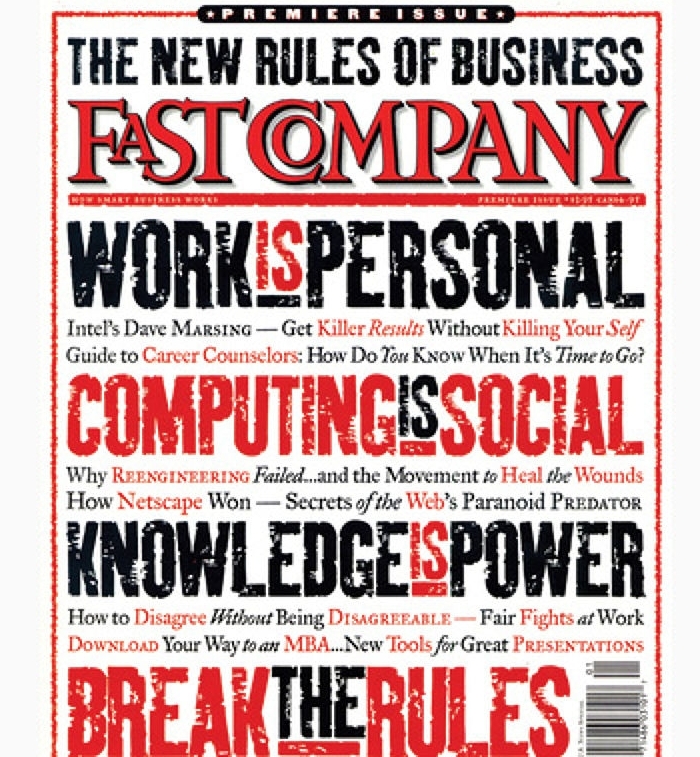 “The New Rules of Business”
I still remember the launch cover (a copy made its way to South Africa and into my hands through one of those shops where you used to pay for old imported magazines by the kilogram) which offered to set out “The New Rules of Business” (work is personal, computing is social, knowledge is power and, finally, break the rules).
To chronicle the rise of the “new economy”, and to slurp up the glut of ad money start-ups were spending on getting their brands out and more VC money in, a myriad of business magazines saw the light of day.
Apart from Fast Company, there were Red Herring (launched in ’93), Business 2.0 (launched in ’98 – it apparently sold 2000 pages of advertising in its second year of publishing) and The Industry Standard (’98 and chronicled in the book “Starving to Death on $200 Million: The Short, Absurd Life of The Industry Standard”).
Somehow, Fast Company remained
Somehow, as its rivals folded one after the other, Fast Company remained, both in print and online. It broke some rules, but then broke them all over again by staying afloat when rivals sank.
Not everyone managed to hold on for the ride through; Bertelsmann subsidiary Gruner + Jahr, which bought the magazine for US$350 million in 2000, sold it to current owners Mansueto Ventures for US$35 million in 2005 (the price also included tech title Inc.).
Under Mansueto, the magazine has been stabilised and was named Magazine of the Year at the National Magazine Awards held in the US in May this year. It also launched its first international edition — in China.
SA on the radar
Robbie Stammers says, as editor of Leadership magazine, he would go to meetings with people in innovation or creative fields and, like clockwork, there would be a copy of the US edition of Fast Company. After he left the business title to start Insights Publishing, he decided to get hold of the US publishers. They didn’t know much about South Africa, except that a growing list of entrepreneurs and innovators from here were making it onto their radar.
Events such as Design Indaba, and that Cape Town had been named World Design Capital 2014, also attracted the attention of the US publishers, and Stammers convinced them to license the first English language edition of the magazine, outside of the US, to the southernmost point of Africa.
Stammers say business magazines in SA are all boardroom-suit-and-tie, old school and just a little stiff. He wants to tap into a younger, more innovative, business readership.
Dolly the sheep
Being the first English language edition outside the States makes the SA edition Fast Company‘s own Dolly the sheep, jokes Stammers. The US company will follow the success of the SA edition closely, Stammers suggests.
The magazine, which launches with an October 2014 edition, will publish 10 times a year (with combined Dec/Jan and June/July editions). Copies will retail at R35. The first issue will have a print run of 20 000.
Content will be split 60/40 in favour of stories from the US edition, initially. It promises local readers access to interviews and profiles on global business leaders. Stammers will bring out two FC franchises: Most Innovative Companies and Most Creative People in Business. Local lists will supplement those put out by the parent magazine.
Storied editorial history
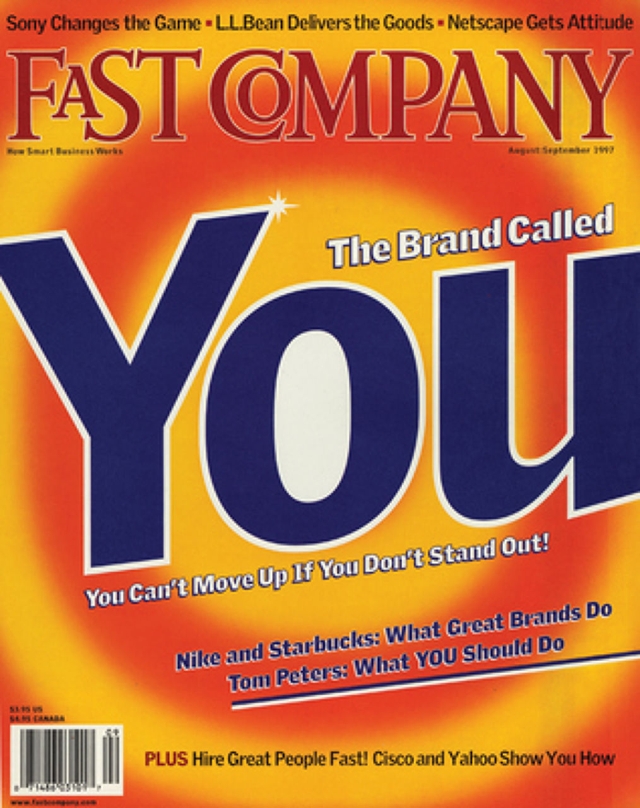
Fast Company has quite a storied editorial history. It (in)famously helped to launch personal branding as a mini-industry by publishing an essay by Tom Peters called ‘The Brand called You.’
“Regardless of age, regardless of position, regardless of the business we happen to be in, all of us need to understand the importance of branding,” Peters enthused. “We are CEOs of our own companies: Me Inc. To be in business today, our most important job is to be head marketer for the brand called You.”
“I know this may sound like selfishness,” Peters continued. “But being CEO of Me Inc. requires you to act selfishly — to grow yourself, to promote yourself, to get the market to reward yourself. Of course, the other side of the selfish coin is that any company you work for ought to applaud every single one of the efforts you make to develop yourself…”
Manifesto of a generation
It became the manifesto of a generation. We call them Millennials.
The median age for Fast Company‘s readership, according to its rate card, will be 35–40 year-olds. Those trying to figure out how to manage Millennials, at a guess?
The SA edition of the magazine will be jointly overseen by Stammers and newly appointed editor, Evans Manyonga.
Stammers is taking on a number of full-time staff members, thanks to a cash injection by a silent BEE partner. The first three editions of the magazine will be sent free to all current MBA students at the country’s top business schools. On the Dot will distribute to retailers, which will no longer be stocking the US edition. Events and an online presence will add to the brand’s local revenue streams.
Hugely positive for SA’s publishing industry
Fast Company South Africa might well turn out to be the most interesting business publishing initiative around since Maverick and Empire folded some years ago. Seeing independents invest in media is hugely positive for SA’s publishing industry — even more so when these projects become passions. Few business magazines elicit passion (or any emotion or expression, really, other than maybe urgh) — but it’s a trait visible in both the product and in Stammers.
While the Palm Pilot, long forgotten, gathers dust in the corner of little-used drawers, Fast Company keeps renewing its brand. Who would have guessed print would outlive Palm, huh?
Full disclosure: Media Africa, in which Herman Manson was a shareholder, published Fast Company content under licence in 1999. Manson was the online editor for Business 2.0 South Africa.
— MarkLives’ round-up of top ad and media industry news and opinion in your mailbox every three work days. Sign up here!