MagLove: Written in blood — message to the world

by MediaSlut (@MediaSlut) My choice of the best international magazine covers in MagLove this week:

  • Bloomberg Businessweek
  • Current
  • GQ Portugal
  • Time Out New York
  • WIRED

INTERNATIONAL

Bloomberg Businessweek, 29 September 2014

Bloomberg Businessweek, 29 September 2014This cover, screaming “EBOLA IS COMING”, gives me chills! The writing reminds me of messages written in blood found in horror movies — and, while the situation is certainly horrific,  at the same time, the colours and textures in this cover have artistic merit.

A scary message, which should make people in the US (and other parts of the world) think hard…

Current, 24 September 2014

Current, 24 September 2014If you work on an outdoor/camping title, keep this cover as reference for possible future inspiration — one of those simple, brilliant and “Why didn’t I think of that?!” concepts.

GQ Portugal, October 2014

GQ Portugal, October 2014I wish I had insight into the sales of all titles and issues, as I think this issue of GQ Portugal would make a great case study. Why? Men’s titles are most popular when the cover model is 1) noticeable and 2) showing as much skin as possible. Yet this cover does the opposite — hiding all of her in freakish-looking blue material, and not making her face instantly recognisable [while still managing to be risqué, thanks to the wet t-shirt look — ed-at-large].

So I’m including this cover, not because it’s that “WOW”, but because it’s going against the grain.

It would be interesting to find out if the same (or more or less?) copies are sold because of this risky move.

Time Out New York, 2 October 2014

Time Out New York, 2 October 2014For the second week in a row, I’m including Time Out New York on this list. That’s probably the great thing about weekly titles, but it makes it more amazing if, week after week, they produce catchy and creative covers deserving of a spot.

The editorial team should sell what it’s giving to its creative teams — gazillions could be made!

WIRED, October 2014

WIRED, October 2014This issue made me stop and think — you have to take time to make sure you’re reading it right.

This is how I read it: “WIRED – The Design Issue” and then “Wrong Theory – The Power of Imperfection”.

It’s not executed as obviously as I’ve seen with other titles, but it’s still smart, nonetheless.

Read the article in question here.


Find a cover we should know about? Tweet us at @Marklives and @MediaSlut.
Want to view all the covers at a glance?
See our MagLove Pinboard!


MediaSlutMagLove by @MediaSlut is a regular slot featuring the best local and international magazine covers every week, recognising well thought-out, powerful and interesting (and hopefully all three-in-one) covers and celebrating the mix of pragmatism, creativity and personal taste that created each of them. The (for now anonymous) blogger behind MediaSlut knows way too much for his own good about media in South Africa, magazines in particular. His mission is to show when SA magazines fail but, most importantly, also when they succeed. If you’re looking for a library about SA magazines and news, this is your one-stop pitstop.

— MarkLives’ round-up of top ad and media industry news and opinion in your mailbox every three work days. Sign up here!

Africa Style: Fifty Shades of Marketing

by Masingita Mazibuko. Fifty Shades of Grey — The Movie, based on British author EL James’ world-conquering trilogy, comes to the silver screen early next year. Given the series’ best-seller status, on the surface, the movie’s success at the box office is surely a given. Or is it?

50 Shades of Grey official trailer #1For many book readers who are also movie goers, and many movie goers who are not book readers, watching such sexually explicit scenes as described in the book could prove an uncomfortable experience in a movie theatre. After all, it’s one thing to get all hot and bothered in the privacy of your own home; doing so when there’s an 18-year-old hottie sitting to your right and your faded hubby is in the seat to your left is another.

Is this perhaps why the promoters appear to adopting Fifty Shades of Marketing?

First step

Naturally, in our digital world, one of the first steps taken by the marketing team was to post the official movie trailer. Official trailer #1 (aha — I wonder how many more we’ll see?) was uploaded almost two months ago on YouTube. It’s been shared many, many times and is now one of the most-watched trailers for 2014, with over 30 million views.

Another step was selection of the release date and a theme. Valentine’s Day 2015 is bang on point, as is the remix of Beyonce’s “Crazy in Love”’.

• Evoking talkability

This initial activity brings to mind the marketing genius witnessed in the mobile telephony space.

Here, Samsung and Apple create so much fanfare and appetite for new devices that the product and its features play second fiddle to the hype and the experience of the launch.

Steve Jobs was, of course, renowned for his showmanship and love for big gestures. He used similar antics to capture his audiences, enthralling all and resulting in an increased fan-base desperately seeking to be first to get the latest digital toy.

• Creating experiences

In the battle to capture attention, our consumers are bombarded by many, many messages and promises of enthralling experiences. Once someone has experienced what you have created, he or she must be sufficiently stimulated to share.

The starting point is, of course, clear insight to the target market, and using this as the thread in every conversation and engagement to ensure consistency and clarity. Importantly, you cannot try to please everyone; that only results in vanilla.

Instead, create and then satisfy a desire so bright that those who buy in ultimately become brand evangelists and mouthpieces. Virility (if you’ll pardon the many puns in this paragraph) is vital in the increasingly digital world.

• Meticulous in execution

An undeniable deliberate approach in every aspect of the marketing mix is critical. Often an idea emerges and execution is rushed. Yet the importance of execution should not be underestimated in creating the desired end result.

Being a devil for the detail in all aspects of execution is ever-more important in an increasingly complex and changing society. Ultimately, detail is what will make or break the experience you are seeking create.

Simplicity is a mean feat. We often underestimate the discipline and time required in deployment. Oddly, it is at the coalface that we either win or lose.

Meticulously planned hype

I’m certain the marketing geniuses tasked with bringing ‘Fifty Shades of Grey’ to the world’s attention know this all too well. Regardless of whether the movie is a good one or not, I’m certain the hype will be meticulously planned to galvanise many to purchase that single movie ticket, and to convince those who may have misgivings to throw caution to the wind and join them.

I can’t wait to see what comes next. Who knows, maybe men or women-only screenings?


  • EL James’s controversial erotic fiction trilogy, Fifty Shades (Fifty Shades of Grey, Fifty Shades Darker and Fifty Shades Freed), has entered the all-time top-selling books list with a total worldwide sale of over 100 million copies. At the peak of its popularity, one book was being sold every second somewhere in the world. The fastest-selling book series in the history of publisher Random House, Fifty Shades, often dubbed ‘mummy porn’, sold 27 million copies in the UK and Commonwealth countries, over 45 million copies in the US (International Business Times, 27 February 2014).

Masingita Mazibuko


Masingita Mazibuko is a marketing director at Unilever. The views expressed within this monthly “Africa Style” column are, however, entirely her own.


— MarkLives’ round-up of top ad and media industry news and opinion in your mailbox every three work days. Sign up here!

Shelf Life: Chill at hot new hotel revamp

Louise Marsland (@Louise_Marsland)’s weekly pick of recent product, packaging and design launches:

  • Chill at the revamped Protea Fire & Ice Cape Town
  • Wolftrap Rosé launches
  • TV moves the news, and
  • A sleek new chair range from Woodbender.

Hot new hotel revamp

Protea Fire & Ice Cape Town communual tableProtea Fire & Ice Cape Town dining room Cape Town’s Protea Fire & Ice ‘evolution’ is complete — gone are the gimmicky themed-loos and coffin-themed smoker’s room (so apt, though). Enter a herb garden in the dining room and cool new chill spaces with designer lighting and a milkshake bar (the adult, alcoholic variations were a hit with the media — personally, I can recommend the Amarula one).

The distinct shark ‘cage’ and ‘cable car’ lifts remain, however, as does the ‘lava’ carpeting which I always thought gave the long passages a rather dark ‘cave-like’ feel. Intended or not.

There’s a new glass bar framed by ice and the bar area boasts a coffee station with “java jockeys”.

Protea Fire & Ice Cape Town herb gardenThe hotel has always been known for its burgers and milkshakes, but the menu boasts new additions such as a salted caramel and popcorn milkshake, triple-espresso milkshake shots, and a breakfast burger. There’s even a Red Bull Bloody Mary dispenser for those who need a “hard kick-start to the day,” says GM, Janneman Britz.

According to Protea Hotel director of sales, marketing and revenue, Danny Bryer, the Protea Hotel Fire & Ice is evolving to meet the more sophisticated needs of its “millennial” guests, who want spaces that meet their specific needs: aspirational, technology-friendly, uncluttered.

“We started off eight years ago with a concept hotel in Cape Town that got famous very quickly because it was the quirkiest hotel the country had ever seen. The themed unisex toilets got more column inches than many celebrities and at the time it worked. But as a brand we’ve had to grow…”

The third Protea Fire & Ice will open in Menlyn in Pretoria early-2015.

A new Rosé with bite

Boekenhoutskloof Winery The Wolftrap Rosé 2014Wolftrap, a wine described as “exceptional value for money” by Platter’s 2014 Wine Guide, has just released its 2014 Rosé. Produced by the Boekenhoutskloof Winery in Franschoek, 2012 Winery of the Year, the premium wines also include the popular Porcupine Ridge range.

Described as a blend of Syrah, Grenache and Cinsault, it is a “fresh, crisp, bright, dry wine” with a “juicy red berry fruit” flavour. It also comes with a legend…

As the story goes, a wolf trap was discovered on the farm when Boekenhoutskloof Farm was founded. But, while there are known to be leopards in the mountains, no signs of wolves were ever found!

The Wolftrap Rosé complements the other two Rhône-style Wolftrap wines: The Wolftrap White: Viognier Chenin Blanc Grenache 2013, and The Wolftrap Red: Syrah Mourvèdre Viognier 2013. All three Wolftrap wines are packaged with screw cap closures and retail nationally at leading liquor stores and grocers for around R40 per bottle.

Media that travels well

Transit.TVTransit.TV by Provantage Media Group now has a captive audience of over 7 million commuters, according to Provantage MD, Jacques du Preez, and to deliver the latest news, Transit.TV has strategically partnered with Reuters, Sowetan and Sunday World.

“When reworking the Transit.TV channel offering, we kept in mind that Transit.TV is not like a favourite channel at home — the audience sees the screens because they are in a taxi, at a taxi rank or at a train station. The aim was for the content to create an emotional connection with the audience in order to ensure the efficacy of advertising. Audiences want to be entertained, they want humour and they want strong creative that has an impact. The content needs to make it worth their while to engage,” explains Du Preez.

Transit media is one of the few media growth channels in recent years, not only because 19.8 million people commute by taxi and train in South Africa, but also because of sophisticated transit developments such as the Gautrain and MyCiTi and Rea Vaya bus rapid transit (BRT) systems.

These chairs stack up

Woodbender stackable Parklane setTo optimise space, Cape Town-based bentwood furniture manufacturer, Woodbender, has released the stylish and minimalist Parklane stacking chair for corporate dining or conferencing options.

The handmade-in-South-Africa chair can be stacked five high; has a rounded leg which is currently on trend; is manufactured with solid bentwood components; and comes in two different fabrics to create contrast.

The sleek chair comes standard and also with a showwood top option, which helps protect the fabric.


Louise MarslandShelf Life is a weekly column by Louise Marsland on MarkLives. Tweet new product, packaging and design launches to @louise_marsland or email her at louise.marsland at gmail.com. Want to sponsor Shelf Life? Contact us here.

Louise has written about the FMCG, media, marketing and advertising industry for 19 of her more-than-25-year career as a former editor of magazines AdVantage, Marketing Mix and Progressive Retailing, as well as websites Bizcommunity.com and FMCGFiles. Until its cancellation, she edited the weekly Wednesday Media & Marketing Page for The New Age newspaper. She is currently the publishing editor of industry trendwatching portal, TRENDAFRiCA,for consumer insight, research and trends in Africa.

— MarkLives’ round-up of top ad and media industry news and opinion in your mailbox every three work days. Sign up here!

#Top40TVratings: 22–28 September 2014

by SAARF & MarkLives (@marklives) A collaboration between the South African Audience Research Foundation (SAARF) and MarkLives, this SAARF/MarkLives #Top40TVratings column is a weekly roundup of South Africa’s TV audience viewership.

Satellite dishWe reveal the best-watched shows of the week before (in this case, 22–28 September 2014), where they ran and how many South Africans tuned in to watch.

We offer two tables:

  • The first covers all households — free-to-air viewing (the various SABC channels and e.tv), as well as the DStv platform.
  • The second charts the best-watched shows on the DStv network of channels only.

SAARF/MarkLives #Top40TVratings Charts: 22–28 September 2014

National

Market Target Activity
National Total Indv (incl guests) Live + VOSDAL
Counter Description (grouped) Channel Level 1 Level 2\Variable (r) AMR % AMR SHR %
1 GENERATIONS SABC 1 Soap opera LOCAL 24.0 10 315 115 73.69%
2 MFOLOZI STREET SABC 1 Drama Drama 16.7 7 146 844 52.84%
3 SOUL CITY SABC 1 Drama Drama 15.5 6 652 353 49.51%
4 SHREDS AND DREAMS SABC 1 Drama Drama 13.6 5 851 731 45.90%
5 STICKS AND STONES SABC 1 Drama Drama 12.8 5 473 993 41.33%
6 SES’TOP LA SABC 1 Sitcom Sitcom 12.3 5 287 501 38.53%
7 MUVHANGO SABC 2 Drama Drama 12.0 5 159 636 43.22%
8 SKEEM SAAM SABC 1 Drama Drama 11.5 4 935 756 42.43%
9 ZAZIWA SABC 1 Variety Variety 11.4 4 905 037 36.64%
10 IHAWU SABC 1 Drama Drama 11.4 4 893 649 39.13%
11 ZULU NEWS SABC 1 News News 11.0 4 732 362 37.13%
12 SELIMATHUNZI SABC 1 Variety Variety 11.0 4 725 436 35.09%
13 1’S AND 2’S SHOW SABC 1 Music Music 9.8 4 183 180 33.58%
14 XHOSA NEWS SABC 1 News News 9.7 4 157 601 34.26%
15 SCANDAL e.tv Drama Drama 9.3 4 010 979 30.05%
16 POWERBALL SABC 2 Variety Variety 8.8 3 775 290 36.16%
17 REAL GOBOZA SABC 1 Magazine Magazine 8.6 3 694 159 32.37%
18 THE X FACTOR SOUTH AFRICA SABC 1 Reality Reality 8.1 3 475 189 36.20%
19 WWE WRESTLING RAW e.tv Sport WRESTLING 8.0 3 434 385 35.07%
20 SPEAK OUT SABC 2 Actuality Actuality 7.5 3 199 121 38.42%
21 AVATAR (MOVIE) e.tv Movies FANTASY 7.2 3 077 012 37.86%
22 SA’S GOT TALENT e.tv Variety Variety 6.8 2 917 968 26.68%
23 SKEEM SAAM -R SABC 1 Drama Drama 6.7 2 878 170 54.91%
24 MODERN FAMILY e.tv Drama Drama 6.3 2 708 465 22.02%
25 STUMBO STOMP AMAPANSTULA SABC 1 Variety Variety 6.3 2 687 704 30.49%
26 MUVHANGO -R SABC 1 Drama Drama 6.2 2 666 077 50.65%
27 KHUMBUL’ EKHAYA SABC 1 Magazine Magazine 6.2 2 663 318 25.70%
28 VELAPHI -R SABC 1 Sitcom Sitcom 6.2 2 641 167 50.17%
29 EKASI OUR STORIES:UXOLO e.tv Drama Drama 6.0 2 563 388 23.75%
30 THE LINK (MAGA) SABC 1 Magazine Magazine 5.9 2 511 079 26.21%
31 ISIDINGO:THE NEED SABC 3 Soap opera LOCAL 5.8 2 492 296 19.60%
32 NIGHT AT THE MUSEUM:BATTLE OF THE SMITHSONIAN e.tv Movies ACTION/ADVENTURE 5.8 2 491 764 24.27%
33 GENERATIONS -O SABC 1 Soap opera LOCAL 5.7 2 440 749 37.14%
34 TAKE ME OUT SA SABC 1 Reality Reality 5.7 2 428 972 23.37%
35 GENERATIONS -R SABC 1 Soap opera LOCAL 5.7 2 424 773 49.42%
36 NOW OR NEVER -R SABC 1 Documentary Documentary 5.6 2 397 185 34.00%
37 MOHLOLAHADI SABC 2 Drama Drama 5.4 2 330 409 26.07%
38 FAN BASE SABC 1 Music Music 5.4 2 308 753 26.50%
39 ABSA PREMIERSHIP BLOEMFONTEIN CELTIC VS SUPERSPORT UNITED SABC 1 Sport FOOTBALL(SOCCER) 5.3 2 279 083 22.69%
40 KHUMBUL’ EKHAYA -R SABC 1 Magazine Magazine 4.8 2 055 686 28.86%

DStv

Market Target Activity
DStv Total Indv (incl guests) Live + VOSDAL
Counter Description (grouped) Channel Level 1 Level 2\Variable (r) AMR % AMR SHR %
1 GENERATIONS SABC 1 Soap opera LOCAL 17.8 2 401 914 54.45%
2 MUVHANGO SABC 2 Drama Drama 9.6 1 297 559 33.47%
3 ISIBAYA Mzansi Magic Variety Variety 7.1 965 324 22.92%
4 SELIMATHUNZI SABC 1 Variety Variety 6.8 922 806 20.47%
5 SPEAK OUT SABC 2 Actuality Actuality 6.8 920 237 30.13%
6 SCANDAL e.tv Drama Drama 6.6 889 421 20.67%
7 MFOLOZI STREET SABC 1 Drama Drama 6.5 884 628 19.98%
8 SES’TOP LA SABC 1 Sitcom Sitcom 6.4 858 360 19.52%
9 ZAZIWA SABC 1 Variety Variety 6.2 841 292 19.77%
10 SKEEM SAAM SABC 1 Drama Drama 5.8 786 761 19.87%
11 POWERBALL SABC 2 Variety Variety 5.6 760 291 21.80%
12 ZULU NEWS SABC 1 News News 5.6 755 265 18.02%
13 SOUL CITY SABC 1 Drama Drama 5.4 734 915 16.45%
14 XHOSA NEWS SABC 1 News News 4.9 655 524 15.77%
15 STICKS AND STONES SABC 1 Drama Drama 4.8 653 316 15.94%
16 SHREDS AND DREAMS SABC 1 Drama Drama 4.8 648 802 16.44%
17 RUGBY CHAMPIONSHIP 2014: SOUTH AFRICA VS AUSTRALIA SuperSport 1 Sport RUGBY(ALL) 4.6 626 287 18.62%
18 OUR PERFECT WEDDING (MAG) Mzansi Magic Magazine Magazine 4.5 609 341 15.36%
19 ABSA PREMIERSHIP KAIZER CHIEFS VS MARAITZBURG UNITED SuperSport 4 Sport FOOTBALL(SOCCER) 4.1 552 671 16.36%
20 KHUMBUL’ EKHAYA SABC 1 Magazine Magazine 4.1 551 139 16.38%
21 IHAWU SABC 1 Drama Drama 4.1 549 963 13.10%
22 REAL GOBOZA SABC 1 Magazine Magazine 4.0 545 876 14.11%
23 1’S AND 2’S SHOW SABC 1 Music Music 4.0 545 009 13.78%
24 SKEEM SAAM -R SABC 1 Drama Drama 4.0 535 189 29.14%
25 7DE LAAN SABC 2 Soap opera LOCAL 3.9 532 859 13.61%
26 WWE WRESTLING RAW e.tv Sport WRESTLING 3.8 517 331 14.23%
27 MUVHANGO -R SABC 1 Drama Drama 3.7 501 432 27.22%
28 ISIDINGO:THE NEED SABC 3 Soap opera LOCAL 3.7 493 991 11.73%
29 GENERATIONS -R SABC 1 Soap opera LOCAL 3.4 457 564 26.10%
30 RHYTHM CITY e.tv Drama Drama 3.3 445 077 11.28%
31 NEWS e.tv News News 3.1 425 035 11.24%
32 MOHLOLAHADI SABC 2 Drama Drama 3.1 417 502 13.89%
33 VELAPHI -R SABC 1 Sitcom Sitcom 2.9 398 157 21.57%
34 TRANSPORTER 2 M-Net Movies Action Movies ACTION/ADVENTURE 2.9 393 763 9.68%
35 THE BOLD AND THE BEAUTIFUL SABC 3 Soap opera INTERNATIONAL 2.8 384 430 11.51%
36 EKASI OUR STORIES:UXOLO e.tv Drama Drama 2.8 377 593 10.84%
37 SA’S GOT TALENT e.tv Variety Variety 2.8 374 335 9.66%
38 THE X FACTOR SOUTH AFRICA SABC 1 Reality Reality 2.7 369 199 10.53%
39 TAKE ME OUT SA SABC 1 Reality Reality 2.6 347 665 9.44%
40 AVATAR (MOVIE) e.tv Movies FANTASY 2.5 339 830 11.49%

How to read the tables:

AMR% refers to the number of people in a target market who were watching an event ie programme, expressed as a percentage of the population for that demographic: “On average, 16.3% of adults aged 15+ who watched TV from 28 Jan-3 Feb 2014 watched Society on SABC 1”.

AMR is the number of people in a target market watching a specific event ie programme per minute, expressed in absolute figures: “On average, 1, 541, 066 adults aged 15+ who watched TV from from28 Jan-3 Feb 2014 watched Society on SABC 1”.

Share % (SHR %) is the share or proportion of the available audience (people watching TV at that time) that a specific channel/programme has achieved at that time: “Society achieved a share % of 52.59% from 28 Jan- 3 Feb 2014 on SABC 1″.

saarf 150SAARF is the name by which the South African Audience Research Foundation is familiarly known. SAARF’s main objective is to direct and publish media audience and product/brand research for the benefit of its stake-holders, thereby providing data for target marketing and a common currency for the buying and selling of media space and time. SAARF has thus the responsibility to measure the audiences of all traditional media such as newspapers, magazines, radio, television, cinema and out of home media.

— MarkLives’ round-up of top ad and media industry news and opinion in your mailbox every three work days. Sign up here!

Ad of the Week: The smoking gun

by Oresti Patricios (@orestaki) The 2014 Loeries are now over and, Cape Town, you may go back to sleep again. Just kidding — anybody who’s in the know understands that the Mother City has become a creative force that’s winning renown the world over. Part of this is that the city designated the World Design Capital for 2014, a title awarded biennially by the International Council of Societies of Industrial Design. Creative awards are another.


Gun Free South Africa Two Hands 1Courting controversy

For those who were there, Loeries was a feast of South Africa’s top creative talent. Y&R was one of the agencies that proudly announced a bumper crop of awards this year. One in particular — not a Gold winner, but a Silver in print/newspaper advertising — is courting controversy, and I’ve chosen it for my Ad of the Week.

In May this year, Y&R produced a TV public service announcement (PSA) for Gun Free South Africa, an organisation that lobbies for stricter gun control legislation. Gun Free SA tries to persuade people to hand in their firearms, but also to take greater responsibility for the firearms they own.

Gun Free South Africa Two Hands 3The TV ad for this campaign showed a man’s hand holding a gun in a darkened alleyway, and then a woman’s arm comes into shot, to load the gun. The slogan is “If your stolen gun was there, so were you.”

Additional information

This was followed up with a print ad campaign, that supplies some additional information, and a call to action — for people to hand in their firearms. The three strikingly visual print pieces provide a ‘double-take’ moment that works so well in print.

Each of the three shows a criminal with a gun. At first glance, one may not even notice that the second arm holding the firearm doesn’t belong to the criminal. In one case, it’s a businessman’s arm; in another, it’s a woman’s; in the third, it’s a t-shirted arm that contrasts with the gangster’s leather jacket.

Gun Free South Africa Two Hands 2Each ad has the same slogan, “If your stolen gun was there, so were you.”

A slightly different message

In the copy, each one of the ads communicates a slightly different message. One reads: “Eighteen South Africans are shot and killed each day.” Another reads, “Over 50 firearms are reported misplaced or stolen every day in South Africa.” In the third, a variation of this scary statistic: “An average of 19 500 firearms are reported stolen or misplaced each year in South Africa.”

The TV spot has been criticised for its lack of a clear call to action, but these print ads make it perfectly clear in the copy: “Take responsibility. Hand in your gun. Visit gfsa.org.za for more information.”

Simple, clear, concise.

Improvement upon the TV ad

And an improvement upon the TV ad, which was taken to the Advertising Standards Authority (ASA) by the South Africa Gun Owners Association (SAGA).

The ASA ruled that the TV PSA implied a causal link between the stolen firearms and crime. It found that the advert ‘oversimplifies’ the matter, and places what appears to be an unjustified blame on gun owners. Because of this, the television ad, as it was, is no longer being aired.

Be that as it may, it seems the only people complaining were the SAGA members, who promote the use of firearms for sport and self-defence, and forum members of www.gunsite.co.za.

The gun-ownership debate seems to be heating up in SA and taking central stage, particularly after the bloody details of the Oscar Pistorius murder trial and Pistorius’ fascination with weapons were heard in court. The gun-loving global athlete, who shot his girlfriend dead in his home during the early hours of 14 February 2013, has escaped being found guilty of murder. Instead, the athlete was found guilty of culpable homicide mid-September 2014.

Challenge was particularly fraught

It is a difficult and emotionally charged subject to tackle, and one that has champions and detractors who fight with equal ferocity on both sides of the fence. This is why the challenge set to Y&R was particularly fraught, and why the agency demands a nod for taking the Gun Free Campaign on, not just for its awards*.

Guns in the wrong hands wreak havoc and cause massive tragedy and loss in this country. The more people who are aware of — and involved in — this debate, the better.


*At the 2014 Loeries, Y&R won metal in the traditional and design categories, earning itself two Gold, four Bronze Loeries, and two Craft Certificates in addition to the Silver awarded for Gun Free ads.


Oresti PatriciosAd of the Week, published on MarkLives every Wednesday, is penned by Oresti Patricios (@orestaki), the CEO of Ornico, a Brand Intelligence® firm that focuses on media, reputation and brand research.


If you are involved in making advertising that is smart, funny and/or engaging,
please let Oresti know about it at info@ornicogroup.co.za.


— MarkLives’ round-up of top ad and media industry news and opinion in your mailbox every three work days. Sign up here!

Brand Politics: Don’t be a broad church

by Alistair Mackay (@almackay) People have been prophesising a split in the African National Congress (ANC) for as long as I can remember. It’s too much of a “broad church”, they say, to be able to continue to function coherently. There are communists in the ANC alliance (SACP), socialists and labour (COSATU), capitalists and liberals (Ramaphosa; the NDP) and African nationalists.

These conflicting ideologies and the camps that believe in them are at war within the ANC, and this power struggle results in official party positions and policies that seem confused and directionless, but are really just a patchwork of compromises.

megaphoneThis problem isn’t confined to the ANC. In its own way, the official opposition is also a “broad church”.

The Democratic Alliance (DA) brands itself as liberal, broadly speaking, but it includes hard-core free-market neoliberals, social liberals, social democrats from when it absorbed the ID, and, though it hates to admit it, ex-Nats.

It’s the nature of politics in a country as diverse as ours that parties will have to gloss over differences in ideology in order to build a majority. Politicians become experts at appeasing all the various camps that support them, even when those camps disagree.

It’s for this reason that politicians earn shady reputations for speaking at length without actually saying anything. It makes clear strategic direction almost impossible.

One clear brand ideology

In the private sector, this condition is fatal for a business or brand. Consumers have much more choice than they do in the political arena, and so they will ignore the vague, catch-all brands and pay attention to those that have a clear, focused and relevant value proposition. You can’t be all things to all people.

The temptation to try and appeal to everyone is strong. Every marketing director and CEO would like to have more customers. It’s great for sales to have every LSM and every kind of customer buying your products and services. The problem is — it’s impossible. Building a powerful brand requires focus, not distraction. Brands can only have one ideology, not many.

Private sector brands that have attempted to be “broad churches” have failed spectacularly. One of the most famous failures was BIC.

Known primarily for its ballpoint pens, but having also been successful with disposable razors and lighters, BIC attempted to launch a range of disposable underwear for women. Its logic was that the BIC brand is known for ‘disposability’ and that this would work across any category.

It didn’t.

Restaurant chains, on the one hand, have attempted to broaden their appeal to the emerging South African middle class by removing the pricier items from their menus in Soweto, for example. This results in customers feeling insulted, rather than included.

Woolworths, on the other hand, has broadened its appeal to new markets while keeping its ‘brand ideology’ of quality sharply in focus. Its value offerings are meal-combinations and smart marketing ideas, rather than a reduction in quality or price.

The power of ‘No’

Brand strategy requires making tough choices. It requires understanding that your brand can’t stand for everything, and it can’t appeal to everyone.

Core to brand strategy is focusing on what you want your business to be known for and the steps for making that happen. The part that people don’t talk about is how it also requires giving things up that don’t build that reputation, deciding on what you won’t do, and don’t want to be known for.

Without saying ‘no’ to some things, there is no strategy and no clear differentiation to your brand.

  • No, we won’t target those consumers
  • No, we don’t believe in that
  • No, that medium / message / trend / extension isn’t right for this brand
  • No, we won’t offer those kinds of products and services with this brand

A strong brand is known for one or two key things. Marketers may be tempted to build a brand that is known for ALL of the good things: fast and cheap and sexy and reliable and affordable and happy. In the end, though, that just dilutes the message, blurs the focus and results in generic marketing that consumers ignore or forget.

You need to put your stake in the ground and decide on the key thing you want to be known for and say ‘no’ to all the rest.

It feels safer to cover all the bases, but there’s nothing safe about a “broad church” brand with competing ideologies. It’s almost certain to fail.

Alistair MackayAlistair Mackay (@almackay) is marketing manager and head of content at Yellowwood, (@askYellowwood) a leading marketing strategy and brand development consultancy. He has experience both as a brand strategist and as the digital media manager for the Democratic Alliance, and believes that innovative, insightful and generous marketing is both good for business and social change in South Africa. He contributes the monthly “Brand Politics” column, exploring lessons brands can learn and apply from politics, to MarkLives.

— MarkLives’ round-up of top ad and media industry news and opinion in your mailbox every three work days. Sign up here!

Tuned: The revival of the African aesthetic

by Thabang Leshilo (@Thabang_Leshilo) I have not yet travelled the world as much as I would like to. And being the curious individual that I am, I have had to find other ways of satisfying my appetite for cultural exchange. Along with my imagination, I gather the many traces of culture found in literature, traditional music, photography, food, art, documentaries and more, to transport myself into another part of the world.

For instance, I’ve never been to Japan but I believe I have some understanding of that society’s most defining principles. I’ve seen it in its art of food making in director David Gelb’s documentary film, Jiro Dreams of Sushi. And Japanese design has certainly influenced modern society.

While some cultural references have become clichéd narratives in popular culture, I believe the African aesthetic may be the very next big thing across the globe.

Afropunk screengrab
Screengrab of Afropunk.com.

“A cliché within itself”

Afropunk contributor, Edward Kgosidintsi, puts it very well in his article, “South African Illustrators Redefining the Afro-Aesthetic”:

“The Afrocentric aesthetic has become a cliché within itself. It’s been muffled with defunct and ill-informed iconography and filled to brim with afros, fists and animal prints referenced from overly exhausted templates that expired lifetimes ago … A captivating movement of young black illustrators, alternative designers and urban artists has recently emerged in South Africa; and it aims to remedy the semiotic misconceptions of Africa by redefining Afrocentrism one pixel at a time.”

In his feature, Kgosidintsi features some of the exceptional work of these young artists. This new creative wave can be seen in just about any medium or form.

It can be heard in the sounds of LA-based afro-global noise makers, Fool’s Gold’s hit song, Surprise Hotel — an infectious blend of Malian, Afro-pop and electro music.

Karabo Poppy Molestane - Bliksem
Bliksem by Karabo Poppy Moletsane. Source: 10and5.com.

It looks like the art festivals taking place in the streets of Senegal’s capital city, “Dakar’s new creative wave” (source: Design Indaba), and the works of illustrator Karabo Poppy Moletsane (source: 10and5.com)

Tapped into a great shift

Interestingly, this month at the Wits Art Museum, iconic hair company Black like Me has sponsored the Doing Hair: Hair and Art in Africa exhibition. As L’Oreal has done, the brand has tapped into a great shift in society where we see Africans proudly wearing their natural hair in defiance of the western aesthetic.

Doing Hair: Hair and Art in Africa. Wits Art Museum
Source: Wits Art Museum.

All over South Africa, and many other parts of the continent, we see young people expressing themselves through what they wear. We even see it reaching as far as America with the likes of singer Solange Knowles (source: Elle.co.za), who has created her own unique sense of style and fashion based on bright, bold African prints.

Researchers and curators

These are designers, artists and everyday people who take inspiration from Africa’s ancient history, art, architecture, gods and goddesses, our natural ingredients and more. They have become the researchers and curators of this aesthetic.

It’s not an entirely new aesthetic; it’s just being revived and rejuvenated with the swelling pride and energy of a new generation of Africans.

Elle, November 2012: Solange Knowles
Elle, November 2012, featuring Solange Knowles.

Soon enough I believe we will see kids in Paris or New Delhi sporting this aesthetic in some way or other.

Look to Africa!

And, as marketers in developed markets try to find new sources of inspiration in ways to talk about their brands and product ingredients, or for those who are trying to connect with the African consumer, I believe they should look to Africa for some inspiration.

The African aesthetic is rooted, bright, bold and pulsating!

See also:

Thabang Leshilo by Jeremy Glyn in June 2014 glynj@fm.co.zaThabang Leshilo (@Thabang_Leshilo) is a project manager (brand) at strategic marketing consultancy Added Value South Africa. As a ‘next-generation’ marketer with fresh and curious eyes looking into the industry, she has a keen interest for brands that are culturally in tune with and able to integrate and immerse themselves into the everyday realities of the consumer. She contributes the monthly “Tuned” column, sharing marketing insight and analysis, to MarkLives.

— MarkLives’ round-up of top ad and media industry news and opinion in your mailbox every three work days. Sign up here!

The Sell: Dancing chickens DO make you buy more

by Mimi Nicklin (@MimiNicklin) Can a dancing chicken make you buy more? According to Lowe’s Foods in the US, the answer is yes!

While I personally would not have confidently believed that a giant flashing chicken-chandelier installation, or life-size dancing chicken mascots and store staff, would be the solution to a retailer’s falling sales, there is a team that did just that, and it is reaping the rewards!

Lowe's Foods: Chicken Sightings
Credit: www.lowesfoods.com

Changing the grocery model

Lowes Foods is a supermarket grocery store fighting against the “big boys”, with the likes of Walmart and Target just round the corner.

When the executive team came to the realisation that it wasn’t product selection but brand experience that would set it apart, with the help of Martin Lindstrom, it embarked on a journey to turn its stores into shopping experiences– changing the grocery model for and encouraging spending in its stores that it had previously been losing out on.

First of all, as described in a CNBC.com report, in each renovated store, every time a new batch of fresh hot chicken comes out the kitchen, the chandelier ‘goes off’ and the staff begin to dance — much to the delight of waiting customers!

It has to be seen to be believed — and hold on to your inner cringe while watching in the knowledge that this entertainment is responsible in part for the 23% volume turnaround (!!) in just six months:

Secondly, and beyond the chickens, the retail-engagement tactics include a SausageWorks factory, where kids can turn handles and press buttons in a virtual sauasage factory to choose from 20 new varieties of sausage (including bacon cheeseburger, bourbon or sweet tea flavor!), as well as a Pick & Prep section.

Lowe's Foods: Sausage Works
Credit: www.lowesfoods.com

The Pick & Prep allows shoppers to select their fruit and veg and then get a Lowe’s kitchen ‘host’ to chop, slice or julienne them to their own personal requirements.

Love to watch

Kids love to watch and talk to the hosts at work, and parents love the ease of being able to take home perfectly prepared fruit and vegetables for their favorite family recipes or snack time — the perfect balance of in-store theatre, convenience, customisation and retail entertainment.

Last month, I wrote about the the oldest principles of retail success and the need to allow shoppers to engage with, touch and taste when making shopping decisions —Lowe’s Foods has got this right, too.

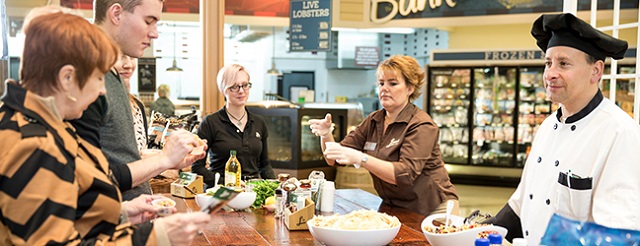
The introduction of the ‘Community Table’ allows shoppers (and kids!) to sample new foods and even learn how to prepare them. The drama is all created live in-store and, of course, set next to beautiful merchandised — and easy-to-shop — displays, prompting shoppers to trial new goods.

Calmer, quicker, more-efficient

When the ‘Community Table’ isn’t full of tasters, kids are allowed to take part in craft workshops while moms shop (allowing moms a calmer, quicker, more-efficient shop) and, monthly, couponing workshops are held to teach moms how to get better value from discounting! In the bakery section, kids are allowed to blow out birthday candles on their special day.

Why would moms shop anywhere else?

Lowe's Foods: Community Table
Credit: www.lowesfood.com

The store has so far seen basket-size rise by 7%, with transaction volumes up by 23% since January 2014, reports CNBC.com.

So much for shoppers only shopping on autopilot and wanting cheap and convenient, over and above everything else!

You can compete

Lowe’s Foods knew that it couldn’t compete on volume and it knew it wasn’t a pure price-battle either: as Lindstrom told CNBC, “You can’t compete on prices because the online retailer will always win,” but you can compete with real retail experience, in-store entertainment and a “sense of community”.

This retail-entertainment move has been a brave one — with 30% of its executive team leaving during the process — claiming lack of belief and alignment to the “entertainment” strategy. When the execs heard the store planned an amalgamation of “the farmers market with the theme park”, many of them flew off to more “traditionally” minded careers.

However, with Lindstrom on board as a key brand consultant and a host of Walt Disney writers hired to create the storyline, this didn’t put the retailer off.

Revamp proves so much

The revamp that followed is a unique example that proves so much of what I try to convince our brands and retailers of here in South Africa. Put simply:

Experience sells, shoppers want more engagement, grocery shopping can become a destination for experience plus purchase, and, critically, that shopper marketing is not a trade promo with a prize giveaway!

According to WhyFive Brandmap data 2014, 43% of SA shoppers believe shops here (vs abroad) are worse in quality, product and service, with only 6% thinking SA has “better stores.” Further to this, the Brandmap data shows that 56% of shoppers see SA customer service as poor or terrible!

Opportunity for South Africa

The opportunity for us to learn from brands such as Lowes is wide open, and our shoppers are screaming out for improvements on all levels. After all, when there are five senses which we can appeal to when selling to people in-store, why is it in SA we so often only stick with referring to the same two?

#dancingchickensells


Mimi NicklinMimi Nicklin (@MimiNicklin) followed her passion and experience in the consumer, retail and shopper space from regional roles in Europe and Asia, to South African shores in 2010. Having led global brands through the line for Procter & Gamble, and two of London and Hong Kong’s top agencies, her background gives her an international perspective to add to her depth of SA understanding. She serves as strategic director and a partner at 34 Group. Mimi contributes the monthly “The Sell” column concerning shopper marketing to MarkLives.

— MarkLives’ round-up of top ad and media industry news and opinion in your mailbox every three work days. Sign up here!

The Real McCoy: A space in time

by Sean McCoy (@TheRealMcCoyTRM) The experience economy was highlighted by Pine and Gilmore in the late 1990s, with great emphasis placed on delivering the ultimate consumer experience and a focus on customer delight to drive premium-brand pricing and competitive advantage, taking the product or service beyond the levels of parity found in so many industry segments today.

This would often transcend the notion of space or environments as theatres in which brands get to stage their performance and stand prepared for audience or, in this case, customer judgement, often dictated by purchase and brand loyalty — or, less excitingly, brand rejection.

Sean McCoyDestination branding

Elements of destination branding or environmental design, as we jargonise it in the industry, will cover a myriad dimensions, from pre-store communication and attention flagging; zoning of a retail branch to manage customer movement and experience; through the use of lighting, colour, material finishes and sound to influence sensory experiences which can impact upon consumer behaviour and emotions if designed strategically.

In certain cases, even the olfactory experience — or highly influential sense of smell — is engaged to trigger emotional responses and purchase behaviour — a carefully considered and persuasive marketing science.

Why, then, do we fail to consider a similar approach when it comes to our internal audience?

Sweeping statement

Yes, this is a sweeping statement and there certainly are organisations that get it right, but I would suggest that this is the exception.

In most instances, our approach to the internal customer is best confined to how we optimise space usage with minimal allocation per square meter for each individual and, possibly, with some basic hot-desking or workplace ergonomics thrown in as good measure.

While there a business necessity to optimise space usage and the cost impact of people, there is a need to more deeply consider the role of the internal experience design and its connection to service delivery — in my view, the ultimate opportunity for competitive advantage.

Extreme scenarios

Look at the extreme scenarios. At one level, consider the search success story, Google. It is a well-documented case study with a multitude of learnings, one of which is Google’s approach to environmental design and the role and impact it has upon corporate culture.

Its spaces are filled with engaging, innovative and inspiring design, completely reflective of its corporate culture — informal, people-centric and fun — while totally professional in every facet and pointing to the heart of its technology-based business. Cool is more than a statement in its case; it is a philosophy and reflection of who Google is.

Spaces are highly directed toward specific behaviours. Pause areas are well-considered and deliver real space in which to chill, be inspired and be at one’s innovative and creative best in the business — something that Google thrives on as an organisation and can show a direct correlation to.

Staff wellbeing

Sleep pods were introduced into the business as in-work capsules, specifically designed to facilitate power napping and supporting the notion that well-rested and balanced individuals will deliver their best work. Add to this the commitment to staff wellbeing through canteen facilities, also taken to a different level in the business.

Google employed its first chef when there were a mere 40 employees and today has a culinary team of 150 people deployed across the company, often hosting celebrity-chef visits and MasterChef-styled cook-off competitions — inspiring in themselves.

Admittedly not everyone is Google, nor has its budget capability; but, at the other end, of the spectrum, consider the alternative. Without singling out any individual entity, let’s contrast this to. Say, a typical government department in South Africa, whom we have targeted before for the contradictory concept of ‘service delivery’.

Local municipal level

Examine one of its work environments at a local municipal level and consider the impact of the work environment upon employee morale, customer care and service commitment. Issues such as experience, ambience and environmental design considerations do not feature in its language at all — seldom at a customer level, let alone the internal brand — so hardly an inspiring environment to facilitate service excellence.

There is no shortage of taxpayer funding to address these issues sensibly and appropriately, without reckless expenditure, but it takes a willingness and capacity to act upon this idea and a fundamental understanding of the importance of internal branding in the first instance.

The internal brand discussion should not be seen as a bias that neglects the critical external client perspective. Rather, it should be seen as a complimentary, ongoing investment in our people capability that translates into culture alignment and differentiation, enabling us to compete.

Key role

The environment has a key role to play in that — give it the attention and investment that it deserves.

Dr Sean McCoy, MD and founding member of HKLM, is a prominent figure in the branding arena, with his expertise centered on client service, brand strategy and business development. Sean has been chairperson for the Brand Council of South Africa since 2012. He contributes the regular “The Real McCoy” column focusing on internal branding to MarkLives.

— MarkLives’ round-up of top ad and media industry news and opinion in your mailbox every three work days. Sign up here!

Online CPD Courses Psychology Online CPD Courses Marketing analytics software Marketing analytics software for small business Business management software Business accounting software Gearbox repair company Makeup artist