The Business of Business: Unconventional quickly becomes conventional

by Jerry Mpufane (@JerryMpufane) The face of the advertising industry is its creativity. Our ability to create, however, goes beyond the work. It is important to remember that creativity is defined by more than just the work we produce.

The advertising-agency business is filled with countless examples of agencies that have their foundations in having done the unconventional. Those agencies started with the mission to hire a special kind of talent, working for clients who wanted extraordinary work, produced the “I wish I did that’-type campaigns, gained recognition and fame, and made money.

Jerry Mpufane, July 2014The founders of these agencies have one regret only, and that is allowing the conventional to take over. And the conventional takes over quickly!

They regret having allowed their innovative shops to become stock-standard businesses. They rue the day they allowed many other reasons, except for creativity, to define their choices about the future.

Creativity is the non-negotiable

When it comes to advertising agency success, creativity is not the icing on the cake; it is the cake.

That virtuous circle involving talent, client, idea, recognition and profit requires that we constantly revisit our raison d’etre. Creativity is, after all, the reason our customers come to us.

Agency leaders are required to always remind themselves that creativity affects the manner in which they source insight and that creativity inspires the thinking process, as well as guiding campaign design all the way to production.

Agency leaders should perhaps begin by always re-evaluating success based upon the very reasons that brought all of us together in the first place:

  1. Do we have talented people who are brave — who constantly challenge all the rules?
  2. Do we partner clients who genuinely require fresh and new approaches to solving business problems?
  3. Are our ideas always truly unique and new?
  4. Do our peers recognise and reward real work on real clients?
  5. Is money the no.1 motive or part reward for success?

The ad industry will succeed when agency leaders have the courage to confront all of these questions. Beyond interrogating the questions, we must be bold and deliberate about doing something about the answers that are anything less than true.

If one looks around, it is very clear that the people who get real attention are doing so because they are setting some kind of new agenda. That is what creativity is all about. Fostering an environment that fosters a permanent state of creativity is hard work, but it is doable.

Let’s take some time and compare notes on one of the key ingredients to achieving success, focusing this time on talent.

The right environment for great talent

The ad industry’s goal, to remain at the cutting-edge of creativity, can only be achieved when we create the right environmental conditions for our most precious asset. Talented people want the opportunity to set the agenda, and creative industries such as ours are lucky to be employers of first choice for these people.

Here are some thoughts, practised to varying degrees by very successful organisations, which I hope will create interesting conversation at your next think-tank:

  1. Flexible work arrangements, particularly for but not limited to strategy and creative talent, allow teams to focus on quality outcomes, as opposed to clock-watching. Discipline is key, however; we cannot sacrifice the opportunity for innovative thinking on the basis of the clock.
  2. Establishing project teams for very specialised tasks without enforcing formal employment. This approach helps to free up talent to pursue projects that match their passion points, and leads to better outcomes.
  3. Offering a guaranteed and formalised inspiration-time away from work for the talent pool. This can take many forms, from a week attending an ideas and innovation festival to a month working on a brief in an agency office in the Far East.
  4. Implementing fixed-term exposure to a client portfolio, thus providing an opportunity for diversity and variety. Today’s economy requires a skills set that has both breadth and depth. This will also help manage some softer dynamics, eg preventing a likely burnout from working on very intensive and pressured account portfolios.
  5. Tapping into people’s wider purpose — what they define for themselves to be of service to society. Agencies must support their people’s passions and make this a part of the broader community programme. This way no one needs to be coerced into giving some of their time for charitable causes. And last but not least,
  6. Creating opportunity for ownership in order to link personal goals to the business goals. In an environment where everyone shares in the success of the business, collaboration with one another and the clients comes naturally.

Defeat of habit

Creativity is the defeat of habit. One never achieves creativity by staying in the same space.

Seeking to find the new, originality and constant change may well be the lost ingredient to the success we so cherish.

Jerry Mpufane has executive experience in both ad agency and client organisations. He’s only got one goal in life, which is to be an inspiring leader. Jerry is currently group MD, Gauteng of M&C Saatchi Abel. His monthly column on MarkLives, “The Business of Business”, focuses on what it takes to run a great AND sustainable ad agency.

— MarkLives’ round-up of top ad and media industry news and opinion in your mailbox every Monday and Thursday. Sign up here!


Fair Exchange: Matching retail value and brands

by Erna George. South Africa’s retail environment is in flux, and retailers are having to be far more aggressive when it comes to fighting for their share of cash-strapped consumers’ wallets. This is particularly true of the grocery sector, where the cost of a basket of food items changes with every interest rate hike, or each upward movement in the price of petrol.

There’s increased competition in the form of new entrants (Massmart and OK have turned their sights on the grocery sector, given the slump in white- and brown-goods purchases) and in the form of more activity from existing players (Makro and Game are upping the ante for much the same reasons).

3D shopping cart by David Castillo Dominici at FreeDigitalPhotos.net

Even less obvious players are enhancing and marketing their FMCG offers (Kalahari.com [which is to merge with takealot.com, pending Competition Commission approval — ed-at-large]).

A step change or more of the same?

How are retailers engaging with consumers to deliver a great package deal (value, optimal shopping experience etc) so that — in exchange for patronage — consumers are assured of truly getting something better? Has there been a step change or is it just more of the same?

On the surface, retailers do appear to have enhanced the offering — there’s lifestyle experience such as the in-store sushi chef, and the convenience of being able to purchase theatre tickets at the cigarette counter. But much more than that, I cannot see.

What I do see is everyone playing the pricing game. However, it is not always a fair trade.

Price-promotion flash cards on packs do not always draw attention to the lowest-priced item. I understand that slots in the promotional calendar are booked and paid for months in advance, but I know consumers will often buy the pack with the big red flash and not stop to compare prices.

Losing faith and turning resentful

If they are taken advantage of in this way too often, two things will happen. First, consumers will lose faith in the retailer promise and, secondly, they’ll start to resent that — despite a promise of a low, low price — they still have to do comparisons, and that shopping begins to feel more and more like hard work.

It’s time for a breath of fresh air.

All retailers have loyalty programmes; most have a magazine. But, in reality, there’s not much difference between Woolworths’ ‘Dinner for 4 for R150’, Clicks’ ‘3 for 2’ specials and Checkers’ ‘Management of Inflation’. In today’s environment, retailers need a stronger experiential differentiator if they are going to be noticed.

Enter Pick n Pay’s Brand Match

Have you seen the ad?

It features a little toddler boy tired of spending all day driving from store to store to find the best deal. He’s ‘rescued’ by Pick n Pay Brand Match, which promises to check prices on 1 000 items at other retailers on a weekly basis, even when they’re on special. When you check out, it then compares the total cost of the price-checked products in your basket against those other supermarkets to see if they would have cost less. If the total cost of those price-checked products would have been less at the time of the price check, Pick n Pay refunds you the difference.

My knee-jerk reaction was YAY! Something innovative! Instead of my having to shop around, Pick n Pay has done it for me!

No leg work

It reminded me somewhat of Game’s promise from a few years back: ‘If you find it cheaper elsewhere we’ll match it and give you 10% (I think) discount’. Except I didn’t have to do the leg work and find it cheaper somewhere else!

Value genes a-buzzing, I set off for Pick n Pay. In-store, I was spurred on by the many blue and yellow Brand Match signs everywhere. But, slowly, my enthusiasm cooled — it seemed as if there weren’t too many of those 1 000 items on my shopping list.

At the till, I queried my discount, because I was certain I should have earned one. The cashier politely pointed to an amount of 86 cents printed on my slip, which would be discounted to me on my next shopping trip!

I had obviously not listened to the advert properly.

Cash-back coupon

Further investigation revealed that the promise is a cash-back coupon for the difference to use on your next shop (keep your till slip) — to the maximum value of R50. There are also a host of terms and conditions to protect Pick n Pay.

For example, Brand Match is only applicable ‘when you buy 10 or more different bar-coded products and at least one is on the list of 1 000’. For example, the 1 000 products exclude categories or products including deli; bakery; cheese & meat & fish & fruit & vegetables (any product where price is determined by weight); Pick n Pay private labels (for example, PnP, PnP NoName, PnP Finest); all liquor except for wine and cigarettes (granted, Pick n Pay can’t be seen to contributing to social ills); clothing and accessories; general merchandise, including but not limited to pool chemicals, charcoal, stationery, magazines and newspapers and similar merchandise; and fuel.

If those aren’t in your basket, what is? Fish fingers, yoghurt and rusks?

Lured in and let down

My hopes for something new, bright and sparkly were dashed by the complexity and limitations. It felt like smoke and mirrors; I feel as if I’d been lured in and let down. Frankly, Game’s old offer is better!

Do not get me wrong: pricing is important, especially given the shape of our economy and consumer profile — but it must be a balanced value equation. When product-pricing parity exists across retailers — and let’s face it, it’s very close — more and more consumers in SA’s slowly growing middle class will choose a place to shop based on their connection with the brand and its total offer.

Many people I interact with openly admit that grocery shopping is becoming more and more demotivating, that when they see how little their money buys them, they resent handing over the cash or the credit card.

Equal give-and-take

Yes, shopping for groceries is on the slippery slope to becoming a grudge purchase, like insurance. Retailers need to halt the growing sense that they have an unfair monopoly over life’s staples —they need to offer something that is at least more of an equal give-and-take.

Retailers:

  • Can you champion the consumer’s cause, as well as your own, when it comes to pricing by creating a fair value mix?
  • What are you offering in your proposition beyond price to take retail to the next level?

How can you innovate to move consumers beyond the grind of a sluggish economy and inspire them to spend with you again, happily?


Erna George


Erna George is the business director heading up quality research at brand development and marketing insight consultancy, Added Value. She works with diverse brands and categories — from FMCG, alcohol and agriculture to financial services and entertainment — in countries across many geographies, including South Africa, Mozambique, Nigeria, Kenya, India, Philippines and Brazil. She contributes the monthly “Fair Exchange” column about business relationships and partnerships in adland to MarkLives.


— MarkLives’ round-up of top ad and media industry news and opinion in your mailbox every Monday and Thursday. Sign up here!

The Word: Top Brands build customer evangelists

by Mongezi Mtati (@Mongezi) It’s awards season in South Africa, with agencies across the country vying for a piece of the Top Brands, Loeries, Most, AMASA, Pendorings, Assegais and The Annual AdFocus pies, to name a few. My interest is focused on the Sunday Times Top Brands 2014, because of its customer focus and its somewhat old-school survey methods.

It is always interesting to see which brands take the top rankings in the eyes of consumers, and this year’s results gave me food for thought: Samsung was favoured over Apple, as was Standard Bank over First National Bank (FNB).

@AskSBSA vs @RBJacobsBehind the social-media scenes

It would be easy to assume that FNB is the most-loved consumer bank brand. The @RBJacobs Twitter handle boasts an enormous following, and it is definitely the most-active and -responsive bank. At the time of screen capture, @RBJacobs had than 44 000 followers and 223 000 tweets.

Conversely, Standard Bank’s @askSBSA had just 8 611 followers and had only tweeted just over 13 000 times [but @StandardBankZA has over 41 000 followers and 39.7 000 tweets at time of editing — ed-at-large].

On Facebook, too, FNB dominates with over 660 000 likes versus Standard Bank’s just over 122 000 likes.

But how important is online conversation? Is it the all-powerful platform that converts possible clients and retains the focused loyalty of existing ones?

It was FNB which outperformed its competitors with its approach to banking, which earned itself a spot amongst the Innovation Masters in Accenture’s first South African Innovation Index in October 2013. Today, most of the social-media conversations taking place across the banking industry are as a result of FNB’s initial forward-thinking and embracing of digital.

At that point, FNB was said to have more than 8 160 innovations, fully implemented, since 2004, and it had been named the Most Innovative Bank in South Africa for the previous seven years — in the Banking Innovation Study conducted by the Innovation Agency.

With a history of engaging its customers, it would be expected that FNB would take top honours as the leading consumer bank, but it did not. It was, however, named the most favourite business-banking brand, an accolade that one might possibly have thought would have gone to Standard Bank instead, as it has a long history of focusing on business.

The people have spoken

Following the Sunday Times Top Brands survey, whose sample size comprises 3 500 South African adults and is broken down into 2 500 interviews in metro South Africa and 1 000 in non-metro areas, it turns out that Standard Bank is the leading consumer-bank of choice according to South Africans.

Taking the two brands’ social-media interactions with consumers, it shows that consumers are looking at more than just online interactions. But it also reveals that FNB customers are also potentially more social-media savvy than its Standard Bank counterparts.

At the end of the day, performance, in-bank customer service and product offerings are still critical aspects of the customer experience, and they generate customer loyalty. These are more likely to be critical factors in the interviewees’ response of nominating Standard Bank as their bank of choice over FNB.

Samsung vs iPhone: The battle for top corporate phone brand

Also of interest at Top Brands is the result of the ongoing battle for market-share between the iPhone and Samsung.

When the Android operating system first emerged in 2008, the recurring debate amongst early adopters was whether it would be better than iOS and whether it would become a worthy adversary for Apple. At the time, Samsung was relying on the archaic Symbian operating system.

The adoption of the Android operating system, that was first tested and sold on the HTC Dream Smartphone, allowed the brand to claw its way back from relative obscurity and take its place in the mobile phone giants’ arena.

Fast-forward to 2014, and Samsung has emerged ahead of the iPhone in the business category for mobile phones, and as the second against 10 brands in the consumer mobile phone category.

In the consumer space, Nokia retained its position as the leading consumer mobile phone brand — a position it has held since 2010 —followed by Samsung and Blackberry.

Reflections

When you look at the way various brands are engaging their audiences, it’s easy to look to the digital space and say “we’re streaks ahead of our competitors”. At the end of the day — should brands be putting all their eggs in one social-media-styled basket, or is there still a place for offline conversations and building brand loyalty through consumer evangelists?

The key seems to be in getting to know your audiences better, and paying attention to the online and offline conversations to understand what your customer really wants from you, in terms of products, communication and the overall consumer experience.

There is a place where digital and old school intersects, a sweet spot where the customer can experience the best of both worlds, and that is where brands should be focusing their efforts.

For Apple and FNB, perhaps, the time has come to ask what their biggest competitors are doing differently and which is proving to so effectively engage their customers and ensure brand loyalty and the creation of the all-important brand ambassador.

Mongezi Mtati


Mongezi Mtati (@Mongezi) is the founding MD of WordStart (www.wordstart.co.za). Apart from being a kiteboarding and sandboarding adventurer, Mongezi connects companies and brands with measurable word-of-mouth. He contributes the monthly “The Word” column on word-of-mouth marketing and social media strategy to MarkLives.


— MarkLives’ round-up of top ad and media industry news and opinion in your mailbox every Monday and Thursday. Sign up here!

Dissident Spin Doctor: Demystifing PR jargon

What to do when your PR agency is force-feeding you the corporate Kool-Aid

by Emma King (@EmmainSA) I have little patience for PR agencies and consultants who bamboozle their clients into paying for complex services and offerings by confusing the hell out of them. They overwhelm clients with textbook PR-speak and outdated jargon, while not saying very much, leaving clients confused as to what they are signing up for, and fearful they haven’t got all bases covered.

Public Relations Means Press Release And Magnification stock image by Stuart Miles at FreeDigitalPhotos.net
Image courtesy of Stuart Miles at FreeDigitalPhotos.net

“Eeeeek!!” the poor client thinks, while being overwhelmed with stats about influencers and A-list bloggers and ROI numbers and cost-per-head figures.

“Help!” they silently scream, while being threatened that their brands will collapse without multiple social platforms and convoluted content calendars.

No better than charlatans

Well, I call BS, because, let’s face it, none of what we do is rocket science (rather, common sense) — and, if we sell it as such, we are no better than charlatans.

Your PR agency, as much as any of your other agencies (and even more so, I would argue — more of this later) should be a partner. And what is a partnership, if not a meeting of mutual respect and understanding?

So, after much crowd-sourcing (or in this case, whinging with colleagues over a glass of chilled chardonnay), here are my tips on finding the right PR consultant for your brand:

  1. Make sure you know what PR means (and what its value is)

This sounds patronising, but if I had a rand for everyone who thought that PR stands for “press release”, I’d be able to retire to my own wine farm by now. Sadly, I don’t, so all I have left is to implore you to interrogate and understand what the words “public relations” stand for. They mean creating relationships with your public — whether that be your customers, your staff, your investors, or the general public at large.

And, yes, this does often mean via the traditional media outlets, but not always (and increasingly less so) — and a PR practitioner whose only talent is farming out press releases is a waste of your money.

A good PR practitioner will understand that your brand’s reputation and standing among your publics are made and strengthened through so much more than that which you spout out in a media release — and will look for multiple ways to engage them and grow their trust.

Pro-tip: if your agency measures its time and success only by a list of media that it farms information out to and then “follow up by phone” to see if they have received it, it is doing it wrong.

  1. Get actively involved

I often see clients who want to hand over a bunch of stuff, close their eyes and walk away, hoping that everything will just magically happen without them having to think about it.

Similarly mistaken, I think, are brands that hand over their entire social-media accounts to an agency. This is because an external person can never live, breath and understand a brand or a business as well as someone who lives every day within it.

By all means, use an agency or a consultant to add a level of strategy, planning or slick content to an account. But the real magic comes from the day-to-day peeks into a business or customer service responses that only someone in-house can bring.

  1. Share knowledge

The best PR comes from over-sharing. Many times a client is so close to the brand that all they can see are stories or information that the BRAND finds interesting.

But providing lots and lots of information — even that which at first glance is not of use — to a good PR consultant will allow her or him to delve in and dig out little nuggets that would normally be overlooked, and which often have that magic element which differentiates a good from average PR campaign.

So, contribute ideas, share information and spot things that you think are interesting. Your PR partner will be able to turn these into gold.

  1. Find someone whom you can trust

Great PR stems from great relationships where trust is at the core. Some of the best results I have seen are where a client and agency have worked together for years, and where the PR consultant is treated as exactly that — a consultant, rather than a supplier.

When you are leaning on a PR agency to build your brand’s reputation — in good times and bad — it cannot do it without a complete and thorough understanding of your brand. And that means warts and all.

In times of crisis, if your PR consultant does not know what skeletons are hiding in your closet, she or he cannot build a strong defence for you. So let her or him know everything — the truth always comes out and, I promise, it is better to have them on your side and helping you, than sitting in ignorance.

So, finally

Find someone who tells you the truth (when you’ve been sucking on your own corporate Kool-Aid and can’t see the wood for the trees), and who helps you create a plan that you understand and are proud of, rather than some who bewilders you.

Simple.

Emma King


Emma King (@EmmainSA) is the owner and MD of The Friday Street Club (@TheFridayStClub). Previously, she was head of PR at The Jupiter Drawing Room (Cape Town). She contributes the monthly “The Dissident Spin Doctor” column on PR and communication issues to MarkLives.com.


— MarkLives’ round-up of top ad and media industry news and opinion in your mailbox every Monday and Thursday. Sign up here!

Ireland/Davenport creates VIRUS, new digital division

by Herman Manson (@marklives) Ireland/Davenport is expanding its digital capabilities with the launch of VIRUS, its new digital specialist agency. VIRUS combines existing in-house talent with the yet-to-be announced acquisition of a digital agency.

Nevo Hadas, partner at consultancy & innovation, has been tasked to lead the WPP agency’s digital charge. The strategy is being built around three pillars, he says.

Virus logo (Ireland/Davenport)It kicked off with internal training at Ireland/Davenport specific focused on getting account managers skilled in digital. This assists the agency in producing digital work as part of its through-the-line offering.

Hadas says the new generation of creative directors were all born digital, so have needed little training — instead, they are being encouraged to integrate digital thinking into their work.

Focus on content marketing

The second part of the strategy consists of the launch of a new specialist digital unit within Ireland/Davenport. Called VIRUS, its focus initially is on content marketing. According to Hadas, the agency has noted strong growth in this segment as the need for well-crafted and produced visual content continues to rise. The specialist agency will work closely with Ireland/Davenport but intends to build a reputation for specialist digital skills as well.

Finally, Ireland/Davenport is in the process of acquiring a digital agency, with an announcement expected towards the end of the year. The agency, which Hadas did not name, is focused on product development and R&D type work.

According to Hadas, the agency wanted to avoid buying into a digital specialist that offers little more than click-bait content or campaigns launched to pull in additional customer data unlinked to a brand’s core offering.

A strategy that fits

Ireland/Davenport has had a couple of digital misses in the past, Hadas acknowledges, but says it has more been an issue of finding a strategy that fits than a lack of commitment to digital work. In fact, Ireland/Davenport recently had a finalist at the Webby Awards, and more and more digital thinking is coming out in mixed campaigns.

Hadas says Ireland/Davenport has been working on its new digital strategy for about a year. He is excited to see the final steps of the strategy being put in place and to see where its new capabilities take the agency in the year ahead.

— MarkLives’ round-up of top ad and media industry news and opinion in your mailbox every Monday and Thursday. Sign up here!

The mobile agency that became a R65m digital-content play

by Herman Manson (@marklives) How does a small mobile marketing agency morph into a R65m digital and mobile publishing and ad-sales business you’ve probably never heard of? For starters, you get ahead in the game — in this instance, the mobile game.

Launched in 2009 by Desere Orrill and Tim Legg as MobiMedia, the duo quietly built a customer base for their strategy-lead mobile marketing agency. Legg had worked for a wireless application service provider, while Orrill had worked on marketing in the hospitality industry. Both realised mobile was a marketer’s game that went beyond bulk messaging.

Ole Media Group logoMerged expertise

Merging their expertise, they worked with media houses and brands and, by 2011, had a 12-person-strong agency.

One of their publishing clients was TEAMtalk Media, then owned by UK broadcaster Sky Broadcasting. They invested in the company in 2012 and lead a management buyout. Suddenly, they were a marketing agency that owned a publishing business and added 60 members to their staff.

Orrill and Legg set about changing the focus and culture of the media business. They set up content-syndication deals for the various sport media properties they now owned, including football411.com, planetrugby.com, planetf1.com, planetsport.com, cricket365.com, golf365.com and extreme365.com, to brands and other publishers.

Syndication

Today, the group’s sports content, and more recently news and entertainment content, is syndicated to brands such as Sky Sports, SuperSport, Primedia, Times Media, Orange, Virgin, MTN, Vodacom, MSN, and Yahoo. TEAMTalk is the exclusive data licence holder for the English Premier League in Africa and provides the official match-data-gathering service to the PSL. TEAMtalk Media is also the official sales house for Sky.com, skysports.com and News.Sky.com in Africa.

In addition, it set about building a real-time online ad buying/bidding company, called AddSwitch (since writing, it has been clarified that the company Addswitch rebranded to AddSuite end of last month, and this company has the rights to the tool “Switch”), which is also available to other publishers (current clients include IOL, Bidorbuy and Gumtree) to place unsold inventory, and which is already profitable. AddSuite now offers as many as 50-billion impressions a month in inventory to brands.

Currently, the business manages ad inventory for client sites, including Manchester United. Apart from the ad-bidding tool for unsold inventory, Ole Media also sells premium inventory directly to brands.

With an offering that stretches from marketing to publishing and ad sales business, Ole! Media Group officially emerged in 2013.

Digital as pollinator

Through the mobile agency, Ole Media has also expended to establish a digital agency called HoneyKome. Orrill sees digital as a pollinator for all media, hence the name.

The agency is strategically lead by Dylan Kruger, the former head of strategy at HelloComputer Cape Town. The idea of cross-pollination works throughout the group, as the mobile and digital agencies, the ad sales platform and the content house can all be rolled out to offer client solutions.

Sticking to staying one step ahead in the game, Orrill says the group has just acquired* an online production house called LoveDigital. Digital is visual, argues Orrill and, right now, visual is video. The unit will produce content for TEAMTalk Media and clients.

Independent operations

Each of the Ole Media Group companies operate independently, with its own manager and business targets. According to Orrill, if one does particularly well, everybody feels proud, and if one stumbles, the rest are there to back you up. Around 80% of Ole Media Group revenue comes from publishing, while the rest is generated by the agency businesses. Orrill says the current structure allows units to remain small and flexible.

Ole Media Group has offices in London, from where it services some of its UK clients and manages the relationship with Sky, and more recently in Kenya. The Johannesburg office is sales-driven, while production takes place in Cape Town.

*A previous version of this story had that LoveDigital had been launched.

— MarkLives’ round-up of top ad and media industry news and opinion in your mailbox every Monday and Thursday. Sign up here!

Smart Africa TV: Africa’s biggest football website

Goal.comby Russell Southwood (@BalancingActAfr) In this video interview, Babatunde Olaifa, country manager for Perform for Nigeria, talks about:

  • the size and use of Goal.com;
  • how the Nigerian local edition works;
  • the new apps associated with the site;
  • and why advertisers are not yet spending money on digital.


Smart MonkeyRussell Southwood is the founder of Balancing Act and the web TV channel Smart Monkey TV, and has been an analyst in telecoms, internet and broadcast in Africa for the last 14 years. Smart Monkey TV aims to capture the energy at the crossroads between African culture and technology. MarkLives is syndicating content from Smart Monkey TV on a weekly basis for the column “Smart Africa TV”.

— MarkLives’ round-up of top ad and media industry news and opinion in your mailbox every three work days. Sign up here!

MagLove: Showcasing the variety of women’s power

by MediaSlut (@MediaSlut) My choice of the best international magazine covers in MagLove this week:

  • Entertainment Weekly
  • N, by Norwegian
  • Stylist
  • The-Art-Form
  • The New Republic
  • Variety

INTERNATIONAL

Entertainment Weekly, 17 October 2014

Entertainment Weekly, 17 October 2014Entertainment Weekly is featuring Michael Keaton, who is playing in the new movie “Birdman” (see trailer below), with a brilliantly simple-styled photographed, with a ‘small’ hint to the movie that “will change his career”.

N by Norwegian, October 2014

N by Norwegian, October 2014Love it! Partly because I loved my own little Troll collection, partly for its simple brilliance, but mainly because, thanks to this cover, I now know that DreamWorks is working on a “Troll doll film” about the Dam troll which “was an icon in the 1960s and 1990s”! Über excited!

You can read more about the new movie and the history of the Dam troll, right here.

Stylist, 8 October 2014

Stylist, 8 October 2014: 5th Birthday SpecialLena Dunham, of Girls-fame, was the guest editor (how fab!) on this issue, and seems to have left her stamp and style all over it!

Also in the issue: “Lena interview Lena and talks trolling, hos and therapy”. A must-read for any and all Lena fans!

The-Art-Form, Issue 1

The-Art-Form, Issue 1I really want to try and get my hands on a copy of the new The-Art-Form, which is a limited-edition publication about Art and Artist, not only because its beautiful and different but because it has a limited print run of 1 000 copies (with the copy number you bought on the cover).

Love the way its indicting the details within the issue, and all general information!

The New Republic, 27 October 2014

The New Republic, 27 October 2014Such a great conceptual cover to illustrate “Amazon must be stopped”. It really made me go “What!?” and want to find out more and the reason this is being said.

I’ll quote the intro and first sentence, but you click here to read the full and interesting (debatable) article:

It’s too big. It’s cannibalizing the economy. It’s time for a radical plan.
Before we speak ill of Amazon, let us kneel down before it. Twenty years ago, the company began with the stated goal of creating a bookstore as comprehensive as the great Library of Alexandria, and then quickly managed to make even that grandiloquent ambition look puny.

Variety, October 2014

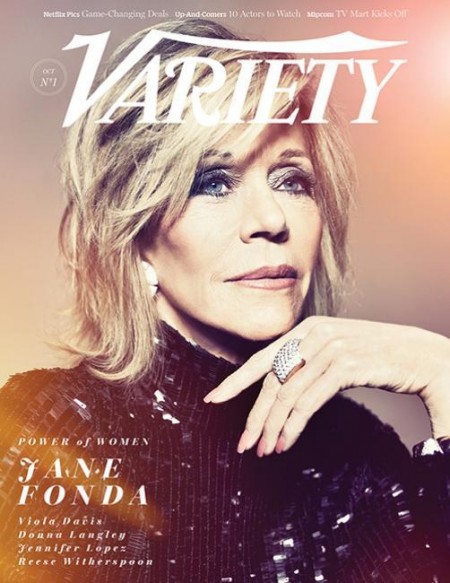
Variety, October 2014: Power of Women - Donna LangleyVariety, October 2014: Power of Women - Viola DavisVariety, October 2014: Power of Women - Jennifer LopezVariety, October 2014: Power of Women - Jane FondaVariety, October 2014: Power of Women - Reese Witherspoon
Variety’s annual “Power of Women” list has been released, and this year the five recipients are once again featured on split covers. As a totality, it’s even more beautiful and special than last year’s selection and covers.

Variety has captured the true beauty and power of Viola Davis, Jane Fonda, Jennifer Lopez, Reese Witherspoon and Donna Langley. Read more, and view more pictures, here.


Find a cover we should know about? Tweet us at @Marklives and @MediaSlut.
Want to view all the covers at a glance?
See our MagLove Pinboard!


MediaSlutMagLove by @MediaSlut is a regular slot featuring the best local and international magazine covers every week, recognising well thought-out, powerful and interesting (and hopefully all three-in-one) covers and celebrating the mix of pragmatism, creativity and personal taste that created each of them. The (for now anonymous) blogger behind MediaSlut knows way too much for his own good about media in South Africa, magazines in particular. His mission is to show when SA magazines fail but, most importantly, also when they succeed. If you’re looking for a library about SA magazines and news, this is your one-stop pitstop.

— MarkLives’ round-up of top ad and media industry news and opinion in your mailbox every Monday and Thursday. Sign up here!

R/GA in Cape Town by late 2015/early 2016

by Herman Manson (@marklives) A new R/GA office in Cape Town is definitely on the international ad agency’s roadmap but it is probably a late 2015/early 2016 endeavour. This is according to Barry Wacksman, global chief growth officer at R/GA.

RGA logoWacksman confirmed that a number of new offices are in the works over the course of the next year, but the proposed Cape Town office hasn’t reached the formal planning stage yet. The timing may change, depending upon some clients’ needs that are emerging, particularly with Samsung, he says, but it is too early to know definitively if this will speed things up.

News of a future Cape Town office for R/GA broke at the 2014 AdForum Worldwide Summit in New York City late last week.

R/GA is an international ad agency headquartered in New York, with additional offices in Austin, Chicago, Los Angeles, Portland, San Francisco, Buenos Aires, São Paulo, Bucharest, London, Stockholm, Singapore and Sydney. It is part of the Interpublic Group (IPG).

— MarkLives’ round-up of top ad and media industry news and opinion in your mailbox every Monday and Thursday. Sign up here!

The Switch: Respect money

by Alistair Mokoena (@AlistairMokoena) I read somewhere that the no. 1 reason for divorce is communication, with money being a close second. As a result, most pre-marital courses tend to focus on these two topics. I took away two key lessons from my own such class:

  1. Effective communication means you should always mean what you say and say what you mean.
  2. You should respect money, but never worship it.

The focus of this month’s piece is on the role that money plays in souring good client-agency relationships. Let’s face it, no matter how clear-cut the contractual provisions that deal with money are, money still makes us fight.

Piggy Bank Stock Photo by suphakit73 on FreeDigitalPhotos.net
Image courtesy of suphakit73 at FreeDigitalPhotos.net

We are all in business to create shareholder value, clients and agencies alike. Money is the most common proxy for shareholder value. For agencies, value means client revenue and profitability, while for clients it is sales revenue and profit. As you can see, these two definitions of value are not mutually exclusive; however, we often perceive them to be.

Value for money

Value for money simply means the perceived value of outputs should, at minimum, be commensurate to the perceived value of inputs — all the better if the perceived value of outputs exceeds the perceived value of inputs. We all get frustrated when we feel like we are getting less than what we give.

Because marketers, in general, are so bad at defining marketing return on investment, the perceived value of advertising inputs and outputs is less than what it should be. Clients often feel that they are being ripped off and agencies often feel they are being short-changed.

The advertising industry needs to get better at defining, quantifying and justifying their intellectual property. Professions such as medicine, law and accounting have done a good job of this; why can’t we do the same?

Is it because their results are more immediate and tangible, while brand-building takes time as it is more slow-burn?

Attitudes to money

One of the questions you get asked in a pre-marital course is “what is your relationship with money?” In other words, what is your attitude to money?

I really think this is an important conversation to be had between agencies and clients.

Here are a few thought-starters:

  • Do you see money as evil and must therefore not be pursued?
  • Do you see money as a scarce resource which must be guarded at all costs?
  • Do you think money is everything and must therefore be pursued at all costs?
  • Do you see money as something that flows through hands and flows back, and should therefore not be hoarded?
  • Do you see money as a carrot or stick, or do you see it as a facilitator of value?

What I learnt about money

When I was younger my dad had a pub. One of my duties was to count and bank the money he made. This exposure to money at an early age made me comfortable with the idea of money and not fear that it was in short supply.

Watching the life-cycle of a R100 note, from the minute it went into the cash register into the bank account and out again to buy stock, taught me that money should change hands and not be hoarded. Watching my dad use the money from his business, to take my family on holiday and send my brothers and I to school, taught me that money represents value.

No matter how upset my dad would get with us, he never denied us pocket-money, nor did he bribe us into studying harder towards our degree. He scolded us and had tough chats with us but I don’t remember him using money to accelerate or decelerate our activity levels. He trusted us inherently to do our best, no matter how much maintenance money we got.

Watching him work hard for every rand he made made me realise the value of money and, with this, the need to spend it wisely.

Mistrust

Mistrust between clients and agencies may be traced back to attitudes towards money.

Some clients perceive their agencies as greedy and money-hungry, while some agencies perceive their clients to be stingy and shrewd. A bit like a T-rex with short arms that don’t reach his pockets.

Some clients think their agencies misuse and abuse budgets because they don’t appreciate the value of money. Some agencies feel that their clients are not completely honest about how much money they have. The theory is that some clients withhold budget until they are happy with their agency or cut their budgets midstream when unhappy with their agency.

In other words, budgets are sometimes used as a carrot and a stick. The danger with using money as a stick-and-carrot approach is that it presupposes that agencies are only motivated by money.

My advice

My advice is: make time to reflect on your relationship with money and don’t shy away from asking tough questions. The truth is your attitude towards money comes through in your interactions with your staff as well as your agency.

So what message do you want to send out? Do you know how your clients view money? A healthy relationship with money means you are playing to win. An unhealthy relationship with money means you are avoiding losing.

Take your pick.

Alistair Mokoena

Alistair Mokoena (@AlistairMokoena) is a Unilever-trained Chartered Marketer with lots of blue-chip marketing experience who is currently MD of FCB Joburg. One of his favourite pastimes is driving around in the bush, photographing wild animals. Alistair, who switched from client- to agency side at the end of 2012, contributes the monthly “The Switch” column, covering relationships inside agencies and between agencies and clients, to MarkLives.com.


— MarkLives’ round-up of top ad and media industry news and opinion in your mailbox every Monday and Thursday. Sign up here!

Online CPD Courses Psychology Online CPD Courses Marketing analytics software Marketing analytics software for small business Business management software Business accounting software Gearbox repair company Makeup artist