#Top40TVratings: 6–12 October 2014

by SAARF & MarkLives (@marklives) South Africa has a new top-ranked TV show, following the hiatus of Generations — found out more as we reveal the best-watched shows of the week before (in this case, 6–12 October 2014), where they ran and how many South Africans tuned in to watch!

Skeem Saam logoIt remains to be seen, though, whether SABC 1’s Skeem Saam will have the same dominance of market share as Generations has had in the past, as there are a couple of factors at play.

A collaboration between the South African Audience Research Foundation (SAARF) and MarkLives, this SAARF/MarkLives #Top40TVratings column is a weekly roundup of South Africa’s TV audience viewership.

We offer two tables:

  • The first covers all households — free-to-air viewing (the various SABC channels and e.tv), as well as the DStv platform.
  • The second charts the best-watched shows on the DStv network of channels only.

SAARF/MarkLives #Top40TVratings Charts: 6–12 October 2014

National

Market Target Activity
National Total Indv (incl guests) Live + VOSDAL
Counter Description (grouped) Channel Level 1 Level 2\variable (r) AMR % AMR SHR %
1 SKEEM SAAM SABC 1 Drama Drama 21.3 9 117 190 66.00%
2 MFOLOZI STREET SABC 1 Drama Drama 16.1 6 899 331 51.20%
3 SOUL CITY SABC 1 Drama Drama 14.2 6 098 118 47.64%
4 STICKS AND STONES SABC 1 Drama Drama 13.7 5 860 106 43.53%
5 MUVHANGO SABC 2 Drama Drama 12.3 5 263 376 43.59%
6 SHREDS AND DREAMS SABC 1 Drama Drama 11.8 5 082 589 39.48%
7 SES’TOP LA SABC 1 Sitcom Sitcom 11.2 4 818 346 35.96%
8 SELIMATHUNZI SABC 1 Variety Variety 10.7 4 588 367 35.29%
9 IHAWU SABC 1 Drama Drama 10.4 4 480 861 34.97%
10 12 ROUNDS e.tv Movies Action/adventure 9.6 4 130 793 40.22%
11 SCANDAL e.tv Drama Drama 9.4 4 019 468 30.48%
12 ZULU NEWS SABC 1 News News 9.2 3 959 670 31.86%
13 ZAZIWA SABC 1 Variety Variety 9.2 3 930 804 29.52%
14 XHOSA NEWS SABC 1 News News 9.1 3 894 067 32.91%
15 ROOTS SABC 1 Music Music 9.0 3 865 769 36.73%
16 1’S AND 2’S SHOW SABC 1 Music Music 8.8 3 775 347 29.33%
17 POWERBALL SABC 2 Variety Variety 8.3 3 572 015 34.73%
18 NGEMPELA SABC 1 Drama Drama 8.1 3 477 606 31.06%
19 SKEEM SAAM -R SABC 1 Drama Drama 8.1 3 462 317 52.91%
20 VELAPHI -R SABC 1 Sitcom Sitcom 8.0 3 451 298 51.78%
21 ORANGE AFRICA CUP OF NATIONS QUALIFIER:CONGO VS SOUTH AFRICA SABC 1 Sport Football (soccer) 7.8 3 339 838 35.48%
22 REAL GOBOZA SABC 1 Magazine Magazine 7.8 3 329 966 28.40%
23 THE X FACTOR SOUTH AFRICA SABC 1 Reality Reality 7.3 3 126 980 27.68%
24 KHUMBUL’ EKHAYA SABC 1 Magazine Magazine 6.9 2 966 939 26.52%
25 MUVHANGO -R SABC 1 Drama Drama 6.8 2 908 035 45.70%
26 SPEAK OUT SABC 2 Actuality Actuality 6.8 2 898 080 29.74%
27 FAN BASE SABC 1 Music Music 6.7 2 873 963 29.63%
28 MODERN FAMILY e.tv Drama Drama 6.4 2 743 043 23.45%
29 MACUFE CUP:BLOEMFONTEIN CELTICS VS KAIZER CHIEFS SABC 1 Sport Football (soccer) 6.3 2 723 845 33.78%
30 NGEMPELA -R SABC 1 Drama Drama 6.3 2 716 905 46.02%
31 CUTTING EDGE -R SABC 1 Actuality Actuality 6.3 2 706 296 39.99%
32 SA’S GOT TALENT e.tv Variety Variety 6.3 2 682 989 26.88%
33 ISIDINGO:THE NEED SABC 3 Soap opera Local 6.2 2 662 097 21.49%
34 STUMBO STOMP AMAPANSTULA SABC 1 Variety Variety 6.0 2 582 345 30.04%
35 WIPEOUT SABC 2 Competition Competition 5.8 2 471 802 21.52%
36 WWE NIGHT OF CHAMPIONS e.tv Sport Wrestling 5.7 2 427 786 33.77%
37 WWE WRESTLING RAW e.tv Sport Wrestling 5.6 2 394 032 26.36%
38 ISIDINGO -R SABC 1 Soap opera Local 5.5 2 356 478 44.89%
39 CUTTING EDGE SABC 1 Actuality Actuality 5.5 2 351 168 24.04%
40 THE LINK (MAGA) SABC 1 Magazine Magazine 5.4 2 327 433 26.15%

DStv

Market Target Activity
DStv Total Indv (incl guests) Live + VOSDAL
Counter Description (grouped) Channel Level 1 Level 2\variable (r) AMR % AMR SHR %
1 SKEEM SAAM SABC 1 Drama Drama 14.8 1 999 552 44.97%
2 MUVHANGO SABC 2 Drama Drama 10.1 1 370 102 33.61%
3 ISIBAYA Mzansi Magic Variety Variety 7.4 997 305 22.89%
4 SCANDAL e.tv Drama Drama 7.0 940 441 21.65%
5 SELIMATHUNZI SABC 1 Variety Variety 6.5 877 468 20.34%
6 SPEAK OUT SABC 2 Actuality Actuality 5.8 780 095 22.39%
7 POWERBALL SABC 2 Variety Variety 5.7 770 792 21.25%
8 SES’TOP LA SABC 1 Sitcom Sitcom 5.5 748 488 17.31%
9 MFOLOZI STREET SABC 1 Drama Drama 5.4 734 251 17.06%
10 ZAZIWA SABC 1 Variety Variety 5.0 678 620 15.22%
11 SOUL CITY SABC 1 Drama Drama 4.9 666 064 15.39%
12 ZULU NEWS SABC 1 News News 4.9 661 135 16.04%
13 ORANGE AFRICA CUP OF NATIONS QUALIFIER:CONGO VS SOUTH AFRICA SABC 1 Sport Football (soccer) 4.9 660 015 18.91%
14 ROOTS SABC 1 Music Music 4.7 638 856 16.34%
15 XHOSA NEWS SABC 1 News News 4.7 635 656 15.13%
16 STICKS AND STONES SABC 1 Drama Drama 4.6 627 173 14.66%
17 1’S AND 2’S SHOW SABC 1 Music Music 4.6 623 934 14.49%
18 KHUMBUL’ EKHAYA SABC 1 Magazine Magazine 4.6 616 359 16.69%
19 RHYTHM CITY e.tv Drama Drama 4.5 605 360 15.85%
20 12 ROUNDS e.tv Movies Action/adventure 4.4 590 774 15.50%
21 THE X FACTOR SOUTH AFRICA SABC 1 Reality Reality 4.3 575 316 14.17%
22 SHREDS AND DREAMS SABC 1 Drama Drama 4.2 570 336 13.11%
23 MACUFE CUP:BLOEMFONTEIN CELTICS VS KAIZER CHIEFS SABC 1 Sport Football (soccer) 4.1 548 507 17.82%
24 REAL GOBOZA SABC 1 Magazine Magazine 4.0 545 500 13.17%
25 IHAWU SABC 1 Drama Drama 4.0 542 653 11.99%
26 7DE LAAN SABC 2 Soap opera Local 4.0 535 782 14.05%
27 SKEEM SAAM -R SABC 1 Drama Drama 4.0 533 861 23.43%
28 ISIDINGO:THE NEED SABC 3 Soap opera Local 3.9 532 937 12.77%
29 ABSA CURRIE CUP 2014:W PROVINCE VS SHARKS SuperSport 1 Sport Rugby (all) 3.6 482 371 13.07%
30 VELAPHI -R SABC 1 Sitcom Sitcom 3.3 447 127 19.35%
31 NGEMPELA SABC 1 Drama Drama 3.2 430 650 11.27%
32 MUVHANGO -R SABC 1 Drama Drama 3.0 407 197 18.38%
33 HOMEFRONT(MOVIES) M-Net Movies Action/adventure 3.0 406 692 10.07%
34 CARTE BLANCHE M-Net Actuality Actuality 3.0 401 789 9.33%
35 THE BOLD AND THE BEAUTIFUL SABC 3 Soap opera International 2.9 396 886 11.73%
36 OUR PERFECT WEDDING (MAG) Mzansi Magic Magazine Magazine 2.9 391 864 9.68%
37 CUTTING EDGE SABC 1 Actuality Actuality 2.8 384 102 10.99%
38 NEWS e.tv News News 2.8 374 919 10.25%
39 WWE NIGHT OF CHAMPIONS e.tv Sport Wrestling 2.8 371 868 13.11%
40 FAN BASE SABC 1 Music Music 2.7 369 875 10.41%

How to read the tables

AMR% refers to the number of people in a target market who were watching an event ie programme, expressed as a percentage of the population for that demographic: “On average, 16.3% of adults aged 15+ who watched TV from 28 Jan-3 Feb 2014 watched Society on SABC 1”.

AMR is the number of people in a target market watching a specific event ie programme per minute, expressed in absolute figures: “On average, 1, 541, 066 adults aged 15+ who watched TV from from28 Jan-3 Feb 2014 watched Society on SABC 1”.

Share % (SHR %) is the share or proportion of the available audience (people watching TV at that time) that a specific channel/programme has achieved at that time: “Society achieved a share % of 52.59% from 28 Jan- 3 Feb 2014 on SABC 1″.

saarf 150SAARF is the name by which the South African Audience Research Foundation is familiarly known. SAARF’s main objective is to direct and publish media audience and product/brand research for the benefit of its stake-holders, thereby providing data for target marketing and a common currency for the buying and selling of media space and time. SAARF has thus the responsibility to measure the audiences of all traditional media such as newspapers, magazines, radio, television, cinema and out of home media.

— MarkLives’ round-up of top ad and media industry news and opinion in your mailbox every Monday and Thursday. Sign up here!

Shelf Life: Tashas takes Dubai

Louise Marsland (@Louise_Marsland)’s weekly pick of recent product, packaging and design launches:

  • Tashas opens first international store in Dubai
  • Premium Cruz Vintage Black Vodka available in South Africa
  • James Malone Fabrics now at Hertex, and
  • Magnum Cream Liqueur a keepsake.

Tashas takes Dubai

Tashas DubaiTrendy Tashas from Famous Brands is going global with its first international restaurant having opened up in Dubai recently. Specialist hospitality interior design agency, Design Partnership, was responsible for the new addition to the group’s portfolio and Tashas Dubai got the five-star treatment, with an added glam element for the international clientele while preserving brand authenticity.

In order to survive in the extremely competitive hospitality industry of Dubai, the store needed to be both a daytime café and a nighttime dining venue, and Design Partnership had to factor this into its layout and colour scheme.

“The idea was to replicate the South African-inspired interior for the first international store,” says Neydine Bak, Design Partnership lead designer on the project. “The feel we are going for is warm, friendly, comfortable, light and breezy, but with a slight local twist.”

The colonial style of the Gateway branch is the benchmark for the store in suburban Dubai. The primary material selection remained consistent with the solid timbre, brass, greenery and marble of local stores, all of which were shipped in from SA.

Functional objects such as cutlery and crockery were locally sourced. The intention is to introduce a hint of SA flare to Dubai and, as a result, the works of SA designers are showcased in the interior.

Tashas Dubai ceiling paper art installation by Elonah O'Neil Reid from Studio Meer in South AfricaOf course, Tashas’ famous paper ceiling art installations, commissioned for each site with a unique theme for each store, remains a memorable feature. The installation in Dubai was created by Elonah O’Neil Reid from Studio Meer in SA.

Vintage vodka

Cruz Vintage Black VodkaWith only 10 weeks left until Christmas, press releases on new wine and spirits launches and special commemorative bottles are coming faster than the cornucopia of Christmas decorations appearing in store. Just in time to be added to seasonal shopping lists, Cruz Vintage Black Vodka — in an elegant jet black bottle and packaging — just won gold at the Consumers Choice Award at the SIP Awards in California.

Cruz Vintage Black is handcrafted and developed in New York, NY — five-times distilled and three-times charcoal-filtered. It is available in all leading night clubs, premium bars and restaurants, and retails at approximately R199 in leading liquor stores.

Hertex presents James Malone

James Malone Fabrics

Hertex Fabrics has been appointed the sole SA distributor and representative for James Malone, a new British editeur based in Spain.

Malone left the UK as a teenager to work for a Spanish textile house, and became involved in the production, selection and colouration of fabric. He now owns the textile house in Malaga, Spain, producing colourful textile fabrics with the influence of vibrant Spain mixed with English country living.

The prints are bold and colourful and beautiful. I can see a couch in my future in the black and white pattern…

Indulgent liqueur

Magnum Cream liqueur 1 Litre frostedNow I think Magnum Cream Liqueur is a cool festive season gift too (hint, hint) because it comes with a reusable stainless flask with screw-top and handles — waste not! Plus the brand, created from single-malt Scotch whisky and real Dutch cream, has just been awarded a gold medal at the 2014 San Francisco World Spirits Awards.

The luxurious cream liqueur is described as being smooth and creamy, with “hints of caramel, chocolate and rich toffee” and an alcohol content of 17%.

Magnum Cream is widely available nationally at liquor retailers, the 1 litre flask retailing for approximately R129 and the 750ml flask at about R109. (I think we should rename this column ‘Christmas shopping ideas’ for the rest of 2014!)


Shelf Life is a weekly column by Louise Marsland on MarkLives. Tweet new product, packaging and design launches to @louise_marsland Louise Marslandor email her at louise.marsland at gmail.com. Want to sponsor Shelf Life? Contact us here.

Louise has written about the FMCG, media, marketing and advertising industry for 20 years as a former editor of magazines AdVantage, Marketing Mix and Progressive Retailing, as well as websites Bizcommunity.com and FMCGFiles. She also edited the weekly Wednesday Media & Marketing Page for The New Age newspaper. She is currently the publishing editor of industry trendwatching portal, TRENDAFRiCA, for consumer insight, research and trends in Africa; a regular industry columnist and speaker; a consultant on content strategy; and contributing editor to Fast Company South Africa magazine, which has just launched in South Africa.

— MarkLives’ round-up of top ad and media industry news and opinion in your mailbox every three work days. Sign up here!

Y&R Labstore launched in South Africa

by Herman Manson (@marklives) Y&R South Africa (part of WWP) has launched a new retail and shopper marketing specialist — Y&R Labstore — into the South African market. Labstore is Y&R Advertising’s new global retail and shopper marketing network that already operates in 20 markets.

The office in Johannesburg will be its first in Africa. Y&R took over independent shopper agency, SOAP, which had an existing infrastructure and client base, to launch Labstore in SA.

Y&R SA Labstore: Dr Sarah Britten, Carolyn White and Brian Ferns, October 2014 by Jeremy Glyn
Y&R SA Labstore (L-R): Dr Sarah Britten, Carolyn White and Brian Ferns. Credit: Jeremy Glyn.

Management

The new agency will be managed by Carolyn White (regional business director), Sarah Britten (regional strategic director) and Brian Ferns (creative director).

White, Britten and Ferns met at Y&R South Africa in 2010 before launching their own shopper agency – SOAP.

Y&R Labstore has taken over SOAP’s clients and is now working on shopper and retailing strategies for brands in the Tiger Brands stable, Citroën South Africa and Sodastream. The new agency also successfully pitched with Y&R Advertising on three Distell wine brands: Two Oceans, Nederburg and Drostdy-Hof.

Jon Bird, global managing director at Labstore, is visiting the country 15–20 October 2014 to introduce the new agency. Bird used to run his own retail-marketing agency, IdeaWorks, in Australia and New Zealand, before moving to Labstore (Labstore still trades as IdeaWorks in these markets).

Increasingly personalised

Bird views the global retail market as increasingly globalised, digitised, polarised and increasingly personalised.

White, meanwhile, notes that more local marketing spend is shifting to retail marketing, and that the retail market is becoming more globalised, so both the local Y&R agency and the international network have reason to benefit from the launch of Labstore into the SA market.

Y&R Labstore SA, continues White, aims to effectively marry retail and shopper marketing, with an emphasis on strategy and data to offer clients a comprehensive strategy. The team will shortly consist of eight people, including staff skilled in digital, content, strategy and design, and a three-to-five-year expansion strategy into other African countries is already in place.

According to Ferns, through loyalty cards, retailers have gained significant insight into shopper behaviour and have adjusted their store design to shift from only moving product to also becoming experiential spaces. The agency will focus on data to better understand retail environments and consumer needs.

Y&R Labstore brand IDSocial a key step

Consumer needs are exactly why shopper-marketing and social media can be aligned in a strategic way. Britten says that, while ‘omnichannel’ marketing has been a buzzword for some time, social has become a key step in the path to purchase. It’s one of various nudges that takes us into the retail environment and assists us in our decision-making in-store.

Even if retailers have limited direct engagement with social media, its role in consumer decision-making continues to grow (think peer reviews and endorsements).

Of course, to be talked about, brands need to be relevant. They also need to have meaning — especially if they want to stand out — which is one of the reasons private-label brands are behaving more like brands and less as ‘only’ competing on price.

Look how popular culture now embraces mobile devices, points out Britten. Think about how many retailers still have staff members freaking out when a customer pulls out a phone to take a selfie in-store — at a time when, globally, there are already moves to design stores that encourage use of platforms such as Instagram!

— MarkLives’ round-up of top ad and media industry news and opinion in your mailbox every Monday and Thursday. Sign up here!

Ad of the Week: Not playing ‘litely’ in the beer market

by Oresti Patricios (@orestaki) In the world of 3D animation, giving an inanimate object a personality, emotions and motivations is not a trivial exercise. It’s all too easy to stray into ‘cartoony’ humour, which may undermine the brand and the message.


Amstel Lite TVC: "Make Your Play" bottle screengrabTake a beer bottle. It doesn’t have a face or limbs. To animate it and give it character requires something special in the hands of skilled artists; and this is what Amstel has done with the launch campaign for Amstel Lite: ‘Make Your Play’.

The launch of a new ‘light’ beer, into a market that is already dominated by one or two other brands, is not an exercise to be undertaken lightly.

The campaign is being handled by Owen Kessel Leo Burnett (OKLB), and the trio of ads that spearhead the launch have been produced by Velocity Films, under the direction of Keith Rose.

Each ad begins in the same way, with the journey of a bottle in the beer-bottling plant, from washing and being filled with beer to the cap and label being put onto it. It’s beautiful 3D animation, with plenty of focus on the ‘Lite’ aspect of the logo. The animation transitions seamlessly into ‘live-action’ footage of the crate being loaded into a delivery van. From here, each ad moves into different scenarios that illustrate the concept of ‘make your play’.

OKLB TVC for Amstel Lite: “Make Your Play — The Barber”

In ‘The Barber’, a bottle goes tumbling into a barber shop, and rolls up against the barber’s foot, distracting him. Unfortunately, this causes his razor to slip and shave a weird shape into the client’s hair. No problem for our quick-thinking barber — he creates a radical style for the client that integrates the mistake and, voila! Everyone’s happy.

OKLB TVC for Amstel Lite: “Make Your Play — The Romantic”


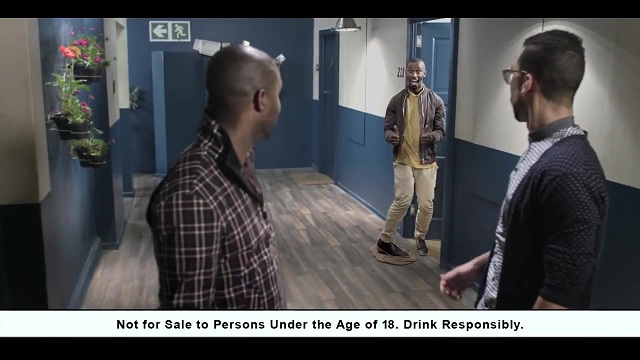
In ‘The Romantic’, the bottle flies into an apartment building (or perhaps it’s a university dorm), as three guys walk down the passage. The bottle knocks on the door, and a pretty girl opens it. As she picks up the bottle, the more attentive one of the guys makes his play — grabs a flower from a nearby display and presents it to the young lady, who naturally finds him charming.

OKLB TVC for Amstel Lite: “Make Your Play — The Drummer”

The third scenario, ‘The Drummer’, has the bottle flying through the air, bouncing against some pots and pans, and providing inspiration for a drummer to create a new drum riff which ultimately leads to a street party.

So, yes, the scenarios are essentially fantasy — but that’s okay — we need a little fantasy in our lives. Each story has its own charm, and the characters are all archetypal for the brand: young, upwardly mobile, urban males, who are the main target of the brand.

These are guys who consider themselves to be that little bit more sophisticated and appreciative of ‘the finer things in life’. It’s someone who can think on his feet and be prepared to take advantage of any situation.

Amstel Lite TVC: "Make Your Play" The Barber social screengrabAmstel Lite TVC: "Make Your Play" The Drummer social scene screengrabAmstel Lite TVC: "Make Your Play" The Romantic social scene screengrabFocus is social

The focus of each story is the people, rather than the act of drinking beer. It’s about the culture of being social and sociable, rather than the obvious act of having a beer with your mates.

Even though the product is branded as ‘Lite’, part of the brand strategy is to retain the core values of the Amstel brand, which is “slow brewed, extra matured”. The idea is that, even though the beer is lighter in calories and alcohol content, it is still full-flavoured and refreshing.

To quote Donovan Bryan, executive creative director at OKLB, “Amstel Lite is more playful; we see it as the Prince Harry of the two princes. You know, the one you’d rather go out with. William is more Lager-like, a bit more serious and meaningful, while Harry is about being out and about with your mates, having fun, enjoying life to the fullest — and being able to remember it all the next morning!”

The campaign is also being rolled out in other media, from in-store activations to social media, capitalising on some 250 000 Facebook fans, as well as Twitter, Instagram and YouTube.

Well thought-out

The TV ads are testament to a well thought-out campaign to launch a product into a highly competitive market.

‘Cheers’ to OKLB and all the creative effort that went into making something that is different, memorable and effective.


Oresti PatriciosAd of the Week, published on MarkLives every Wednesday, is penned by Oresti Patricios (@orestaki), the CEO of Ornico, a Brand Intelligence® firm that focuses on media, reputation and brand research.


If you are involved in making advertising that is smart, funny and/or engaging,
please let Oresti know about it at info@ornicogroup.co.za.


— MarkLives’ round-up of top ad and media industry news and opinion in your mailbox every Monday and Thursday. Sign up here!

Creation: Why I don’t do group brainstorming

by Artwell Nwaila (@artwelln) The creative world lives for group brainstorming; once a big brief comes in, the whole team is called in to one room to bounce ideas around. This is probably true as the practice was created by an ad executive in the 1940s. For me, this is the wrong way to harvest fresh ideas and here is why.

Idea stock image by Dan at FreeDigitalPhotos.net
Image courtesy of Dan at FreeDigitalPhotos.net

Before I continue this post, I’d like to make it clear that I’m in no way implying that group brainstorming doesn’t work. I’m merely sharing my personal beliefs and experiences with regards to the practice. So please don’t send any assassins my way.

Extravert/Introvert

The dominance of the extraverts more than often impairs the ideas-generation of everyone else in the room. Introverts find no comfort in public sharing and therefore withhold ideas. I am the latter.

Anchoring

Every time someone says something, your mind automatically follows that train of thought. This process is called anchoring.

“Early ideas tend to have disproportionate influence over the rest of the conversation,” explains a professor at Kellogg, Loran Nordgren, in a Fastcompany article. The problem here is that brainstorming favors the first ideas and does not open gates for other routes.

Time-consuming

The more people there are in a brainstorm, the longer the session — the longer the brainstorm, the higher the chances of settling for blunt ideas. Brainstorming feels like productivity in action, when in reality a few people are sharing and the rest are praying the session ends soon.

Muted creativity

The idea behind brainstorming is that a group of people gather and ideas burst from every corner. Cognitive psychologist Tony McCaffrey writes in the Harvard Business Review says that brainstorming makes people less creative than when they work alone. What happens is that everyone is distracted by the clutter and no valuable thinking happens in the session.

Richard Wiseman supports this sentiment in his book, 59 Seconds: Think a Little, Change a Lot: “People are more creative away from the crowd. For 70 years, people have been using brainstorming to stifle — not stimulate —their creative juices.”

Leadership

Leadership also contributes to muting creativity as their personal experiences determine what a good idea is. How many times have you been is a brainstorm when the creative lead crashes down all good thoughts based on his or past experience?

In conclusion

For me, group brainstorming is merely a quick way to come to a collective conclusion. Which is great if you’re happy with mediocre creativity.

Personally, I believe that a small core team needs to meet for only 15 minutes, where they get quickly briefed and sent away. At a dedicated time, everyone gets back to share their thoughts, one by one, without interruption.

Results? An array of well thought-out ideas which can be filtered down and refined.

Artwell Nwaila

Artwell Nwaila (@artwelln) is a creative director at Offlimit Communications and publisher of the award-winning creative publication SA Creatives (@thesacreatives). His monthly column on MarkLives, “Creation”, takes a look at creative work from around the world and what we can learn from it in South Africa.


— MarkLives’ round-up of top ad and media industry news and opinion in your mailbox every Monday and Thursday. Sign up here!
Media Future: Don’t start the revolution without Node

by Arthur Goldstuck (@art2gee)  Shortly after VIDI appeared online in South Africa to shake up the movie-on-demand business, another contender, Node, has arrived with a combined satellite-and-data service.

Barely a week after the Times Media Group (TMG) launched the first South African online movie streaming service offering both subscription and rental options, yet another contender for the reinvention of home entertainment took the stage.

Hard on the heels of TMG’s VIDI, electronics conglomerate Altech this week announced Node, a combination of smart home gateway and Node-boxentertainment service.

The fundamental difference – and one which underpins every one of Node’s differentiators, is the fact that it uses a data-and-satellite linked electronic box of tricks not unlike a set-top decoder, as opposed to VIDI depending entirely on the customer’s own devices and Internet connection.

If anything, the Node box competes with DStv’s Explora, a high-definition decoder that has changed many South Africans’ experience of TV movies, series, sports and news, with its dazzling display quality. Altech claims it to be “the world’s first fully converged home gateway console”, going well beyond movie and TV series bouquets.

It is what the company’s strategy and technology executive Willie Oosthuysen describes as a “triple-play-quad-play” service. “Triple-play” refers to a combination of audio, video and data, while “quad-play”, as far as Oosthuysen is concerned, is about taking the service mobile.

“Why are no operators providing a triple-play or quad-play service in South Africa?” he asked this week. “The main challenge is not having access to affordable broadband. So we designed a secure digital media delivery platform, where it doesn’t matter if you have Wi-Fi or 3G, and we added a 10 Megabit per second satellite connection.”

The concept is simple: the slowest of Internet connections can be used to submit or upload requests for content or information, and the satellite connection is then used to download the most high-quality content possible.

Our test of the service was in a location with close to zero data connectivity, yet the signal was strong enough to process account details and request downloads.

“We use it as a big fat pipe into your house,” says Oosthuysen. The idea is that we’ve moved the last mile connection into the home. Any heavy lifting of multimedia content is via satellite: all you need is a 3G card and a satellite connection, and you can have a triple-play service delivered to your house.”

This dual-connectivity results in “smart entertainment” with more than 700 hours of movies, series and sports downloaded into the box, requiring merely a tiny piece of uploaded code to unlock specific content. The content can then be streamed to up to five devices – with each family member potentially able to watch a different movie, documentary or TV episode at the same time.

The Node is also part of a broader ecosystem of services and accessories, such as Smart Plugs that connect a TV set to wireless cameras and even light switches, allowing for monitoring and control of the home environment. E-commerce functionality is also built in, and will allow for airtime, data and electricity recharge services.

If it sounds as if Altech is the answer to entertainment-hungry consumers’ prayers, there is a hard-nosed business strategy behind the concept.

“We wanted to make sure there are multiple revenue streams from the consumer,” says Oosthuysen. “So it’s not a set-top box but an end-to-end system, which includes a content carousel, a content management system, a player server, and an encryption mechanism, so that we can encrypt content from the studios, and send it via satellite to all Nodes.

“There’s a 1TB hard drive in the device, and 80% of that is used for content from the studios. The differentiator is that we can actually deliver DVD-quality high-definition movies. At the press of a button you can watch HD movies in 1080p, with no quality degrade based on the delivery mechanism.”

That feature is a clear swipe at VIDI, which uses “adaptive streaming” to adjust the quality of a movie based on the quality of a user’s Internet connection.

Like VIDI, Node has two viewing models, namely the TVoD (transactional Video on Demand) rental model, and the SVoD (subscription VOD) all-you-can-watch option. As with DStv’s BoxOffice, new rental movies cost R25 and can be viewed over 48 hours. As with VIDI, older movies will cost R15 to rent. The device itself costs R3499, but will be available on a cellphone-style contract at around R190 a month. The SVoD service will cost R299 a month, double that of VIDI.

An Android app is planned both to control the device remotely and to enable downloads from a dedicated app store that will turn a Node-connected TV into a smart TV.

A mobile upstart

Lurking in the app stores is yet another claimant to the title of South African TV disruptor – and this one offers its services for free.

An app called Tuluntulu offers free streaming of broadcast TV via tablets and smartphones. It has launched with 10 channels, including Al Jazeera, ANN7 and the education channel Mindset Learn. The aim appears to be to become a TV version of TuneIn Radio, which provides mobile access to numerous radio stations across the world. However, it is severaly constrained by bandwidth.

Tuluntulu founder Pierre van der Hoven, best known for creating the private satellite TV advertising service Three Blind Mice, believes this will change.

“Smartphone growth in Africa has been way beyond expectations,” he says. “But the exciting part is that this is only set to grow exponentially. We are seeing a steady drop in the cost of smartphones, tablets and data costs fuelling this growth, and video streaming on mobile phones will soon become a part of the African status quo.”

Tuluntulu is intended to be used either with low-bandwidth connections or on free Wi-FI networks, which are beginning to proliferate in Africa.

Launched in June, momentum is building. The app has had 19 000 downloads in the past 30 days, of which about 85% have been from South Africa, while uptake in Nigeria is accelerating.

Clearly, the TV revolution is only just beginning.

Arthur Goldstuck

Arthur Goldstuck heads up World Wide Worx (www.worldwideworx.com) and is editor-in-chief of Gadget. He is a consulting editor to MarkLives and our media tech columnist. Follow him on Twitter on @art2gee. This article has been republished from Gadget.

— MarkLives’ round-up of top ad and media industry news and opinion in your mailbox every three work days. Sign up here!

Emotions and eating: a marketer’s dream?

by Nitika Garg, UNSW Australia Business School Both research and popular media tell us that emotions and eating are intrinsically related. How many times have we seen a character in a TV show reaching for the ice-cream tub when feeling particularly down or after a breakup?

What is it about sadness that leads to such behaviour?

fast foodFeelings of loss and helplessness spurred on by sadness are what drives the unhealthy behaviours, whether it’s overeating or overspending.

Research has shown sad people consume significantly more fatty, tasty food products such as chocolate or buttery popcorn, than those who are feeling happy. They are also willing to pay a higher price for ordinary products such as a bottle of water.

This tendency to compensate and reward by engaging in unhealthy albeit pleasurable behaviours in the short run, has serious consequences in the long run especially with rising concerns about obesity in most developed countries.

We don’t even know we’re doing it

Unlike “retail therapy”, which involves a more conscious decision to engage in a behaviour seen as rewarding and mood-uplifting, these behaviours operate at a more non-conscious level.

Interestingly, much as sad individuals crave a reward, recent research found that merely engaging in rewarding, hedonic activities such as eating fatty foods, is not sufficient to break the sadness-overconsumption link.

This is troublesome as it suggests that in spite of engaging in unhealthy behaviours to alleviate their mood, people still do not find respite. The research suggests this might lead to a vicious cycle where engaging in such behaviours further induces guilt and dampens mood.

So, if engaging in compensatory behaviours is not an answer, then what is? Researchers have been looking for the answer.

Apart from the sense of loss, the theme that dominates sadness is that of helplessness or lack of control over the situation. And so researchers have begun to explore the issue of control.

An important way to gain a sense of control is via choice. When people make a choice, even a trivial, potentially meaningless one; they feel more in control.

New research implemented this idea and found that when sad individuals were given a choice between two common objects (a chocolate bar vs ballpoint pen), regardless of what they chose (and most of them chose the chocolate bar), they were significantly less likely to engage in indulgent consumption. This same effect was not obtained when sad individuals were simply given the chocolate bar as a gift (no choice). This established that rather than getting the chocolate bar, it was the “manner” in which it was obtained that mattered.

Lessons for marketers

Should marketers of tasty and fatty food products start marketing these products as feel-good options that boost consumers’ mood? Although on the surface it might make sense, this is a short-sighted strategy.

It is possible for marketers to create strategies that improve consumption habits as well as profits. One such initiative was the 100 calorie (~400 Kj) packs that let consumers indulge but still stay in control.

In the same vein, research findings suggest it would make sense for product managers to market products which might be low-fat, low energy versions of products as direct choices in contrast to the unhealthy choices the consumer might be drawn to, making the former more attractive.

Lessons for consumers

Consumers can also learn from these findings and develop strategies for the way they shop, especially when they might not be feeling their best.

Rather than looking at purchases in isolation (e.g. need to buy soft drink), they can teach themselves to build choices around such purchases (e.g. need to buy something to drink – soft drink or juice) which would give them a greater sense of control and in turn, help them move away from indulgent consumption.

The same idea can be used for impulse purchases where most of us usually give in to buying things which are pleasurable and hedonic in the immediate but guilt-ridden and adverse (sometimes) in the longer run.

The real issue is not “to choose or not to choose” but rather to have a real choice.

Nitika Garg does not work for, consult to, own shares in or receive funding from any company or organisation that would benefit from this article, and has no relevant affiliations.

This article was originally published on The Conversation. Read the original article.

— MarkLives’ round-up of top ad and media industry news and opinion in your mailbox every Monday and Thursday. Sign up here!

Grubstreet: Trolls, hate speech & robust debate

How South Africa’s online managers are dealing with comment threads

by Gill Moodie (@grubstreetSA) Online comments – and how they can veer off into bigoted nastiness and hate speech – are in the spotlight after Dr Iqbal Survé, the owner of Independent Newspapers, weighed in on comments on a column on his company’s news portal , IOL, that became aggressive and racist.

Survé put together a task team recently to look into how news sites handle comments after the attacks on a column by 16-year-old Kine Dineo smiley-146399_1280Mokwena-Kessi about living in Cape Town as a black teenager.

Zenariah Barends, Independent’s chief of staff, told Grubstreet last week that media lawyer Dario Milo had been added as a panelist on the task team while the team’s report is scheduled to be finalised by the end of November.

“Even though the panel will be making recommendations with regard to IOL, the intention is that the report will be made public as we view this as a matter of public interest,” she said.

Grubstreet spoke to some of the country’ online editors and managers to get their views on this tricky area of digital publishing.

When the News24 network introduced registration with Facebook profiles before allowing comments in early 2012, it seemed to make comments more productive, says Jannie Momberg, editor-in-chief of 24.com that includes the News24 website.

“The key thing for us and everyone is to get people to use their real identities,” says Momberg, adding that the News24 network – like most others – uses software that flags key words in comments while users can report comments they believe are inappropriate (at which point online staff step in to moderate).

“We know we might get nasty comments on some stories so we keep a special eye on them,” he says, adding that more than half of reported comments are not problematic.

“It’s usually a case of someone just disagreeing with someone else.”

News24 gets about 6 000 to 7 000 comments a day – as does IOL. To have staff monitoring and moderating this amount of comments (that come in around the clock) is very difficult.

Most websites simply don’t have the staff for this.

“The comments are the best and worst part of this job,” IOL editor Alastair Otter told Grubstreet. “At all times there is what we would call robust debate and sometimes it can get a bit rough. But the people who are out-and-out racist or sexist or just aggressive are a very small minority.”

However, even if their IP addresses are blacklisted some of the trolls find ways to get back in by changing whatever is used for registration, be it email addresses, Twitter accounts or Facebook profiles.

Moneyweb editor Ryk van Niekerk says digital publishers need to find a balance. On the one hand, user-generated content like comments is often the most read part of a news website. On the other hand, some comments get so out of hand that he believes they will result in a defamation suit in the near future.

Meanwhile, James Myburgh, who runs Politicsweb, told Grubstreet:  “I think there are countervailing advantages to anonymous commenting that need to be borne in mind. One of these is that anonymity allows for honest responses – which is also why voting is by secret ballot and the names of academic peer reviewers are not disclosed.

“When you remove anonymity, the comments might become more ‘moderate’ but this is because people start watching what they say. Moreover, most of those individuals with real, often insider, knowledge about a topic are very unlikely to comment on an article if they have to sign in or reveal their identity.

“Other individuals may want to make a point, on impulse, about a subject but do not want their name attached to that comment for the rest of human history. The problem with removing anonymity then is that while you may get rid of the worst comments, you also get rid of many of the best ones as well.”

Momberg says that if one closes comments, it has an impact on both page views and time spent on site because being able to comment on stories – without a period of delay to allow for approval of the comment – is an integral part of consuming news online for many people.

“Once you publish a story on the web, that’s only the start of the story and it goes on a journey with people discussing it and with people enjoying interacting with each other – and not necessarily around the story anymore.”

Derek Abdinor, the digital GM of Times Media Group, says: “We take comment moderation seriously across the Times Media LIVE network. As much as we promote user engagement, it’s bad for business and the perception of the brands when trolls repeatedly target a site. Times LIVE only opens up certain stories for comment and monitors those very closely, and then closes comments once the newsworthiness has been superseded by something else.

“Sowetan LIVE is the strongest exponent of lively debate and spirit that mirrors a real-life self-regulating community in which some members are, at worst, cheeky… Comments allow readers in a democracy some form of instant response to the matters which affect them. An open comments policy is not of any strong commercial value at all but rather user debate is valuable for our brand building.”

Going into more detail about Sowetan LIVE, Razia van der Schuur, online editor for Sowetan LIVE and Sunday World, told Grubstreet that her team had “extended a lenient policy towards the readers, in order to ascertain their thought processes, [and] not limiting their freedom of speech”.

The online editors have also encouraged those commenting to debate in a positive way and “rewarded” the positive ones with lunch with the Sowetan LIVE team.

“They, in turn, felt like they were now ambassadors of the brand. This has led to them regulating comments and keeping others on the straight path.”

Otter says: “As much as comments can be problematic, we would lose a lot if we took this element out. I think we’d lose the vibrancy and also the sensible things that people are saying about stories. Very often we do have genuine and intriguing discussions – and we get further information out of the comments. It actually takes the story further.”

Often experts contribute to comment threads, says Van Nierkerk. “But the last thing I want is for people to use Moneyweb as a platform to cause trouble. That’s why people do it – to get a reaction… Sometimes you can have a story about flower arrangements and the third comment becomes racist.”

GrubstreetSouth Africa’s leading media commentator, Gill Moodie (@grubstreetSA) offers intelligence on media, old and new. Reprinted from her site Grubstreet. This piece was published first on Journalism.co.za, the website of Wits University’s journalism school.

— MarkLives’ round-up of top ad and media industry news and opinion in your mailbox every three work days. Sign up here!

AdForum Worldwide Summit NYC: R/GA to open in Cape Town

by Johanna McDowell (@jomcdowell) NEW YORK: The 2014 AdForum Worldwide Summit in New York City is done and dusted, and the highlights from Day 5, Friday 10 October, 2014, include the news that R/GA is to open in Cape Town!

AdForum Worldwide SummitRECMA

RECMA, the research organisation that monitors media agencies globally — including South Africa — is branching out into digital agencies and will be providing up-to-date knowledge early next year of what is happening among digital agencies in France, as a starting point.

Most important is the attribute aspect for digital: who are the real digital agencies and what does a genuine full-service digital agency comprise in terms of services, attributes and talent types? This will be a very interesting study and RECMA is highly rated by clients and agencies alike.

Advertising Agency Association of America

We then went to the 4As (Advertising Agency Association of America) and had a good discussion around pitching processes, speculative work, paid-for pitches, and remuneration in general. It is the kind of discussion that all ad industries have everywhere, and South Africa has very similar issues to the US. What was interesting was to hear the various points of view from the different consultants in the different markets.

R/GA

Our final agency visit was a highlight. Visiting R/GA is always a treat and Friday was no exception. It is just so far ahead of the pack — inventing products, solving business issues for clients, coming up with brilliant campaigns — it is one of the best agencies in the world at the moment.

Its network is expanding and, having just won a large chunk of Samsung business, it is opening up five new offices during the course of this year. R/GA will be opening in Cape Town as well, not because of Samsung but because it wants to be in the highly creative Cape Town community — this is a feather in our caps!

One of its innovations is a business-accelerator project for tech start-ups; highly successful, it has changed the way the agency works. Also, R/GA is not so sure that it is an agency any more — but it has not found a suitable replacement word.

Showing us work and case studies for Beats, we were inspired on this final day of the Summit.

And so it ended.

Next year

The Sprint Summit will be in London in 2015, and the New York dates are fixed.

So it is bye-bye, New York, until next year.

All the best
Johanna
@jomcdowell @agencyselection
#adforumsummit

Johanna McDowellJohanna McDowell is managing director of the Independent Agency Search and Selection Company (IAS), which stands at the forefront of the complex world of agency selection in South Africa, and she is one of the few experts driving this mediation and advisory service in SA and globally. Twice a year she attends AdForum Worldwide Summits as an international consultant, which helps her lead the SA advertising industry forward to keep in line with international trends and remain competitive. Follow her on Twitter at @jomcdowell.

— MarkLives’ round-up of top ad and media industry news and opinion in your mailbox every Monday and Thursday. Sign up here!

Motive: Digital addiction — the future needs to be #Balanced

by Prakash Patel (@prakashpatel_1) The definition of addiction by our friends at Wikipedia, in less than 140 characters, “is the continued repetition of behaviour despite adverse consequences, or a neurological impairment leading to such behaviour’s”. So what does this have to do with marketing, advertising, management, leadership or even parenthood for that matter? Nothing or everything?

We are now living in a world that has changed beyond recognition, a world that wouldn’t have been comprehensible only a decade ago, a world in which we have become what I a call “digital addicts”.

Be aware I am a #DigitalAddict. Credit: Fogg Experential Design.Addicts of the digital age

Really? It is actually like being a drug addict or even an alcohol addict. In this case, I explicitly mean addicts of the digital age.

Let me elaborate on my story, concerns and thoughts on this new addiction and the potentially consequences I have felt and seen in so many people’s behaviour…

I am a marketing veteran who is passionate about everything marketing- and digital-related; I am also a strategist who, ironically, helps conceive tactical campaigns and marketing strategies to build relationships between brands and their consumers in the digital age.

We are trained at understanding the array of communication devices and touch-points, the marketing landscape and how to connect with people using any medium, format or device, regardless of where they are, what they are doing and in what context — trust me, with data, platforms and tools at our disposal as marketers, we’ve got it all covered.

However, in the context as a husband and a father of three girls, what does the digital era mean to me as a family man seeing the effects of technology devices and social networks upon today’s modern families (and even in the business world)?

In a nutshell — it has changed my life drastically. I would like to think that it’s for the better in most cases but at the same time, on a personal level, there is also the deterioration of basic human etiquette, behaviour and socialisation skills, from the moment we wake up, attend a meeting, gather together as a family, up until the last second we go to sleep.

Changing times

Way back in the ’90s and at the turn of the 21st century, our lives were so different.

I remember that, as a simple example, going out was a simple event — made easily with a quick phone call from the office to friends to meet for a few pints. I didn’t know whom they might be bringing, if they were going to be late or not (as the Tube line closed down), what we would end up talking about or where we would be ending up at until the moment we got a taxi or the Tube home.

Now days, your friends or partner know exactly where you are in ‘real time’. I can even share a picture of the broken-down train as proof or check in (eg Foursquare) to tell my mates I have arrived at the local pub, then — after a load of pics shared via Instagram (and now probably via Instagram HyperLapse) of the fun we are having — book a cab to take us to the next venue (knowing exactly where the taxi is on route eg Uber). How times have now changed!

But there has been one major downside I have witnessed or partaken in, which I feel I need to address, and that is my addiction to my #SixthSense (smartphone/tablet/phablet etc). According to many addiction specialists, potential addictions may include, but are not limited to, drug abuse, exercise addiction, food addiction, computer addiction and gambling.

My life, like many, is now driven by constantly wanting to grab and look at my smartphone — like an addict waiting for his next fix — for that moment of instant gratification. So let me give you some insights into my personal life (and probably a window into your own life) concerning something that I have been denying for some time now (like a good addict would):

#AddictCase1

The other night, my six-year-old daughter asked me to watch her favourite movie with her, which I gladly did with pleasure. While lying down, as per normal, I was twin-screening: looking at my social feeds and stories on my #SixthSense while at the same time kind of watching TV…

What happened next surprised me.

My daughter turned around and told me to put my phone down.

‘Never’ — so I carried on twin-screening.

She then asked me to give her the phone if I didn’t stop it.

WT#ashtag was that, I thought? My six-year-old was telling me what to do.

Why? Because she knew I was an addict (classic hallmarks of addiction include impaired control over substances or behaviour, preoccupation with substance or behaviour, continued use despite consequences, and denial).

She was basically asking me to give her my full attention in what she was doing. What I had actually been doing was giving up my special one-on-one family time and only paying half of my attention to my daughter and giving the other half to my #SixthSense, reading in some cases pointless drivel or viewing uninspiring photos of a duck’s arse. What can be more precious than the time with your kids?

#AddictCase2

There’s nothing like going out for lunch in South Africa, which has some of the finest eating and drinking venues in the world. I am blessed and live in Franschhoek. A fairytale village. If you love mountains, food and wine — there isn’t a better place to go for lunch or dinner with the family.

Anyway, going out for lunch at the weekend is a treat with F&Fs. But, in between ordering food and waiting for it to arrive, what most people do is have a virtual date with their phones in the virtual world vs enjoying the company (family, friends and acquaintances) you are with. Surely the very reason you have gone out?

I know I am not alone. Just like standing up now and saying, “My name is Prakash Patel and I am an addict”, I know I am surrounded by millions of other people doing the same.

The next time you are out, just look around and see how many other people are doing just this, from couples, to families to friends and colleagues.

My wife always says to me: “Enjoy the moment.” Feel it, live it and remember it vs always wanting to catch it on my phone. She’s right; a photo is a moment captured. But also a moment only seen through a lens.

I am not saying stop capturing moments — but there is always a balance needed.

#AddictCase3

Recently, we were asked to pitch for some sizable business in Cape Town, and the pitch team had been working day and night to get the work done.

Morning came, and the team members were all set to do their job. Present their work with 200% enthusiasm — which they did. But what upset me was watching a number of the people around the table reading emails (or whatever they were doing on their phones).

Where has basic business etiquette gone?

When you are at a meeting and you are not listening but multitasking on the second screen — show some basic courtesy and think about the person talking or presenting (it’s never easy). Yes, I know it could be a very important email but let’s not forget how we managed to get by decades ago, before the digital revolution, without missing a life-threateningly important email or crisis at work. I am sure we can do the same now.

Let’s think about business etiquette in this instance and put your phone down. It’s also just another form of digital addiction that needs to be managed.

Kick the habit: now entering a #DigitalAddict free zone. Credit: Fogg Experiential Design.How to kick the habit

So here’s how I am going to kick the habit.

Digital plays — and will continue to play — a pivotal role in our lives, both at work and at home — and I love it! But, as with anything in life, it is all relative.

In some cases, the digital revolution has afforded human beings opportunities never imagined before, conveniences never experienced before, the ability to convey freedom of speech to billions, or engagements that were just never possible due to technological advancements (bar science-fiction movies such as Running Man, Minority Report or now even Almost Human — the future of future is just around the corner).

But where does the real-world and virtual-world life-balance sit? With us making informed decisions in how we want digital to not only enhance our lives at work and home but to stop from becoming an obsession and addiction in our family and social lives.

Therefore, I want to make a concerted effort to manage my addiction for my family’s sake; we simply just need to sometimes stop and enjoy the moment, as my wife would say, where we are breathing in, touching, seeing, hearing, tasting — senses we are fortunate to have, senses that computers yet cannot do (well, breathe, anyway) — and enjoy the moments away from your #SixthSense.

Balancing the future

Life is all about getting the balance right. Being switched on 24/7 isn’t right; it’s unhealthy. For me, I have been starting my own journey in going cold, as they say — where I believe I need to set the boundaries in enjoying life with my family, friends and colleagues — with balance in mind in how I want technology and devices to enrich and enhance my work/life balance.

So, the next time you are out — with friends at a braai, enjoying family time, or in a business meeting — think before you grab your #SixthSense and make time for the real world.

For me, as a digital marketer, #TheFutureisBright #TheFutureisDigital but the future needs to be #Balanced.


Signs of computer or #SixthSense addiction


Here is a list of signs of addictions. How many do you tick out of 10? Will you be joining me and giving your addiction the cold shoulder?

  • Having a constant preoccupation with the computer, either online or offline
  • Feeling an intense desire to go online, play a computer game, or socialise
  • Being drawn by the computer as soon as you wake up and before you go to bed
  • Spending time on the computer despite family functions taking place, special events, or other activities that you were once happy to be a part of
  • Replacing old hobbies with excessive use of the computer and using the computer as your primary source of entertainment and procrastination
  • Lying to your family and friends about the activities that you perform while on the computer, such as saying that you are working on homework when you are actually playing a game
  • Exhibiting mood swings or irritability when you are not allowed to spend as much time on the computer as you would like to or if your computer time is interrupted
  • Using the computer as a form of escapism from reality (Wikipedia)
  • Having an emotional attachment to your #SixthSense
  • Losing track of time while on the computer and spending more time on it than intended.

Prakash Patel, 2014Prakash Patel (@prakashpatel_1) is chief strategy officer at Fogg Experiential Design, a technically-enabled, digitally-led, creatively-inspired, data-driven and strategically-focused design company based in Johannesburg and Cape Town.

“Motive” is the new by-invitation-only column on MarkLives.com. Contributors are picked by the editors but generally don’t form part of our regular columnist lineup, unless the topic is off-column.


— MarkLives’ round-up of top ad and media industry news and opinion in your mailbox every three work days. Sign up here!

Online CPD Courses Psychology Online CPD Courses Marketing analytics software Marketing analytics software for small business Business management software Business accounting software Gearbox repair company Makeup artist