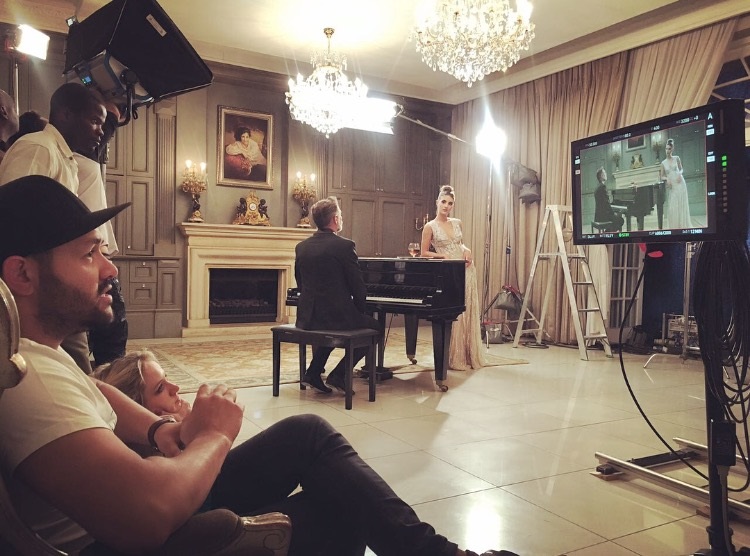
Digital transformation — biggest risk may be doing nothing at all

by Kim Penstone. Digital transformation. It’s a phrase that strikes fear into the very heart and soul of anyone who isn’t a digital transformer. Or a consultant.

Personally, it conjures up an image of Optimus Prime slamming his very large robotic fist into a stereotypical open-plan ’80s office space, obliterating everything in its path, leaving a trail of mass destruction and confusion. But not so much for the crew at Fogg, who drop the phrase into conversation as casually as they talk about dropping consumers into virtual worlds. And just as casually as they dropped this unsuspecting writer on a wreck at the bottom of the Pacific Ocean to be eyeballed by a blue whale.

Fogg logoAlthough Fogg bills itself as a digitally led creative agency, it is clear that the offering has expanded as the agency has evolved, and that what it really offers — over and above the bells and whistles of augmented and virtual reality (AR and VR) experiences — are “digital solutions to marketing problems”.

Providing solutions

Digital transformation is what happens when you provide those solutions.

“Digital transformation unnerves brands, marketers and businesses, because it challenges their status quo and function — and, in some cases, their entire business’s existence,” comments Prakash Patel, Fogg’s chief strategy officer, who also heads up the agency’s Cape Town branch. Brands that haven’t transformed run the risk of becoming redundant and obsolete, he explains. Just look at Kodak and Nokia. By contrast, brands such as Uber and AirBnB have used digital technology to single-handedly transform the centuries-old business models of hospitality and travel to become the world’s largest taxi service and hotel business — in under a decade.

The problem is that the phrase “digital transformation” is so all-encompassing, referring (in Patel’s words) to “the transformation and reshaping of an entire businesses operation, through digital technology, from the backend to front office, including business models, processes, operations, customer facing activities, marketing and customer touch points”. No wonder businesses and brands are running scared.

Kim Penstone does VRUndaunted

But Patel and the team at Fogg remain undaunted.

“I have always believed that, ultimately, all communications, connections and business will be digitally led,” says founder Shervin Pruthab.

It’s easy to spout the rhetoric; we’ve heard it all before. But, at Fogg, the team does walk the digital talk.

A case in point: the company recently placed some bets on the growth of AR and VR as a marketing tool for the not-so-distant future. In order to get to grips with the technology and expertise that this involves, Fogg has been investigating and investing in AR and VR tech since 2013, culminating in the development of its own VR game. Not for a client. Nor for payment. Just for themselves, to gain firsthand understanding of this new world, so that when it is hit with its first VR brief — and it will happen, sooner rather than later — it won’t have to use clients as guinea pigs.

“We are excited, rather than scared, by anything new,” says Fogg joint MD and head of client relations, Lara de Angeli.

“Understanding”

But her partner and co-MD, Mqondisi Gumede, is quick to add that the agency is not interested in “every piece of shiny new tech”. “The paradox of living and working in this digitally enabled world is understanding what has changed, what needs to change, and what will never change. Technology changes and evolves all the time, but our humanness — what makes us human — doesn’t change. What technology enables us to do is to meet those human needs in faster, more-efficient, more-convenient, and more-entertaining ways,” he says.

And this is the realm in which Fogg operates: where technology and humanity meet. The agency was founded on the belief that technological innovation could unleash a new level of competitive advantage and client success — but only for those who have the courage to embrace this technology.

“Technology is changing and evolving at such a rapid pace today; we recognise that it is a very challenging time for brands: trying to unpack the future, while still staying on top of the present,” says Gumede.

“Strategic level”

“That’s why we are passionate about partnering with our clients at a strategic level, to help them understand the advantages of employing a digital strategy, and demonstrating the real-life benefits that technology can bring to their business,” adds Deangeli.

Although no one says it out aloud, it’s clear that many, many brands remain more than a little scared of digital technology.

“This is why Fogg continues to invest in tomorrow’s technology today; to ensure that — through our understanding of the tech — our clients can remain at the forefront of innovation,” says Patel.

On that note, Fogg offers a full range of marketing services from insights, strategy, design and creative development to content and music production, media and campaign implementation, even gamification, and yes, digital transformation and consultancy services. Founded in 2005 and with offices in Cape Town and Johannesburg, the company is Level 1 BBBEE, being 100% black-owned, of which 50% is black-women-owned — and 100% South African-owned.

“Hyper-connectivity”

“We live in a world of hyper-connectivity, when brands are expected to be open for business 24/7. The only way that brands can meet the increased demands of the consumer is through employing the technology that is now at our fingertips,” says Gumede.

“It’s vital to recognise that, when it comes to digital transformation or disruption, the biggest risk may in fact be doing nothing at all,” Patel concludes.


Kim PenstoneKim Penstone is a freelance journalist, specialising in marketing, media and advertising. Over the past 15 years, she has worked for a variety of leading marketing industry publications, including Marketing Mix, Marketingweb and Brand Magazine, and in her freelance capacity contributes regularly to specialist titles, such as Brands & Branding, AdFocus and MarkLives. She has recently started a blog, www.runlikeamom.co.za, which is completely unrelated to the marketing industry.

Sign up now for the MarkLives email newsletter every Monday and Thursday, now including headlines from the Ramify.biz company newsroom service!

SA TV Ratings: DStv — primetime top 30 for Jun 2017

by MarkLives (@marklives) The hottest primetime television shows on DStv in South Africa revealed: TV ratings for June 2017.

In 2016, the Broadcast Research Council of South Africa (BRCSA) changed its policy about giving away TAMS and now only monthly reports, highlighting the top 20 or 30 primetime shows on several popular channels, are available.

DStv June 2017

BRCSA TV Ratings June 2017 primetime DStv

Source: BRCSA June 2017

Broadcast Research Council of South Africa


The Broadcast Research Council of South Africa (the BRC) is a non-profit, industry body that was incorporated in 2015 to cater to the audience research needs of the radio and television industry in South Africa.

Sign up now for the MarkLives email newsletter every Monday and Thursday, now including headlines from the Ramify.biz company newsroom service!

MagLove: The best magazine covers this week (14 July 2017)

MediaSlut (@MediaSlut)’s choice of the best South African and international magazine covers this week:

  • Financial Mail
  • OBJEKT International (South Africa)
  • ProCycling
  • TIME

Find a cover we should know about? Tweet us at @Marklives and @MediaSlut.
Pinterest icon Want to view all the covers at a glance? See our MagLove Pinterest board!


Financial Mail, 6 July 2017

Financial Mail, 6 July 2017

These clever buggers! FinancialMail has produced another great cover illustrating its cover story brilliantly! The article delves into the history of Cell C’s problems, and asks whether Blue Label (“South Africa’s largest distributor of prepaid airtime and starter packs for mobile operators”) could possibly save it the 15-year-old mobile network operator…


OBJEKT International (South Africa), Issue 19

OBJEKT International (South Africa), Issue 19

Everything about this latest cover just oozes luxury, style and quality! Great work!


ProCycling, July 2017

ProCycling, July 2017 - Chris Froome

ProCycling, Europe’s no. 1 cycling magazine, features Chris Froome, three-time Tour de France winner (and two-time Olympic medalist from the London and Rio Olympics) on its latest cover — a winner on every level!


TIME, 26 June 2017

TIME, 26 June 2017 - Travis Kalanick

Over the past few months, Uber (and, more specifically, former CEO Travis Kalanick) has been in the news again and again, and TIME’s illustration — inspired by the transport app’s iconic interface — is on point. Read the full article about the chaos being experienced, and the big wakeup call it is for Silicon Valley in San Francisco.


MediaSlutMagLove by @MediaSlut is a regular slot featuring the best local and international magazine covers every week, recognising well thought-out, powerful and interesting (and hopefully all three-in-one) covers and celebrating the mix of pragmatism, creativity and personal taste that created each of them. The anonymous (for now) blogger behind MediaSlut knows way too much for his own good about media in South Africa, magazines in particular. His mission is to show when SA magazines fail but, most importantly, also when they succeed. If you’re looking for a library about SA magazines and news, this is your one-stop pitstop.

Sign up now for the MarkLives email newsletter every Monday and Thursday, now including headlines from the Ramify.biz company newsroom service!

Global Headline Makers: Hungry and Foolish, France

by Mark Tungate (@MarkTungate) Hungry and Foolish is the latest in a wave of agencies shaking up the French ad scene. Here the founders tell us how they reinvented their business by thinking outside the box. Don’t groan — this time we mean it literally.

How does a small Parisian agency reinvent itself from top to bottom and prove that hunger gains?

Hungry and Foolish is an apt name for this young agency, in many ways. For a start, and more obviously, it’s a partial quote from a speech by the late Steve Jobs. “Stay hungry. Stay foolish,” he told students at Stanford University. Like the early Apple, the agency has humble roots and big ambitions. But “hungry” is also appropriate because the agency’s founders, Vincent Barbate and Matthieu Reinartz, started out placing advertising messages on pizza boxes. “Everything grew from there,” says Barbate. “We’ve never spent an hour at a traditional agency.”

Overturn conventions

If you want to overturn conventions, that’s probably no bad thing. Barbate and Reinartz were freshly minted graduates in their early 20s when they started their business. “We gradually immersed ourselves in the world of tactical media but, the more media buyers and agencies we met, the more we realised that media placement wasn’t what inspired us — it was advertising and communications.”

And so in 2006 they created their first official agency, Ledouze (“The Twelve”), named after a directory-enquiries phone number that had just been phased out. “The media kept saying ‘le douze is dead’, so we came along and said, ‘no, Ledouze is alive!’”

Slowly, the agency began to grow, “with quite a lot of naivety and candour”, says Barbate. “We understood that we needed to surround ourselves with people who were better than us, which has been our philosophy ever since.” With more experience came more clients, notably Jack Daniel’s and BNP Paribas bank. Continues Barbate, “Jack Daniel’s was the first internationally renowned brand that we went after in a pitch and won. We went in with a bit of culot [cheek, or audacity], proposing something they hadn’t even asked for, which was a social media strategy.”

Thirty-year ad veteran

But the agency underwent perhaps its most-radical transformation in September 2016, when it relaunched as Hungry and Foolish. The change was partially sparked by the arrival of Marc Audrit, a 30-year veteran of the ad business who had worked at agencies (DDB, Publicis and Young & Rubicam) and then on the client side at Western Union.

Audrit says, “They initially contacted me to sound me out for advice over a coffee. I met one of the partners on the terrace of a café, and at the time both of us had an open mind — we were there to discuss ideas. But as I’d spent the last 10 years dealing with agencies that worked or not, that were sexy or not, I had the feeling I could advise them on their next steps.”

A subsequent, slightly more official, meeting turned into a job, and Audrit became head of creative and strategy. A giant leap in the agency’s evolution then followed. “The metaphor I always use is that they were a nice neighbourhood bistro, but we needed to become a Michelin-starred restaurant,” says Audrit.

No typecasting

Alongside the name change, the first step was to create a solid brand — one that could compete alongside established French names such as Fred & Farid and Buzzman — with a recognisable culture and values. The idea of an agency “with creative and strategic audacity” quickly came to the fore. It’s also fair to say that, given the founders’ non-existent experience in traditional agencies, Hungry and Foolish has been swimming happily in the waters of digital and social media, without having felt the need to typecast itself as a “digital” or “social” entity.

Ironically, one of the projects Barbate is most proud of is a poster campaign, for BNP Paribas. This involves donating space in the bank’s windows to small businesses for their own advertising messages. Each poster is created specifically by the agency for each entrepreneur, so each one is different. “It’s emblematic of the kind of challenge we enjoy,” says Barbate.

Another key figure in the agency’s recent history is Enguerran Barreau, its senior strategic planner, who previously worked in the luxury sector at the agency Reflex. “What’s important about this experience is that we’ve gone so much further than just changing two or three slides in our agency presentation. We changed our name, we changed our location and we changed our way of working.”

“Flexible” working

Hungry and Foolish now occupies airy, comfortable offices in the 9th arrondissement. With a café space in the entrance, a scattering of sofas, contemporary furniture with a “vintage” touch, as well as big computer screens and plenty of natural light, the agency is as far from the cubicle-filled, corporate-slave camp as it’s possible to imagine. “Flexible” working means that there are no fixed desk spaces, encouraging mobility and interaction.

Hungry and Foolish offices collageSays Barbate, “Instead of fixed teams working for specific clients, we can now create project teams, depending on the situation. One person with a particular skill could be working on two different projects. In other words, we can assemble the perfect team for every project.”

But the transformation is not just better for clients; it’s about being better for employees, too. Barreau points out: “Everything is conceived in a manner that makes it easier to do good work. The agency is bright, it’s spacious, and there are a number of smaller details that make you feel positive and motivated.”

Plus, oversized egos are not welcome. People are not only hired because they’re competent but because they’re pleasant to work with. Barbate perhaps sums it up best: “We like people who are extremely talented but who are not too aware of it.”


Mark TungateMark Tungate (@MarkTungate) is the editorial director of the Epica Awards (@EpicaAwards), the only global creative prize judged by the specialist press. A British journalist based in Paris, Tungate is also the author of seven books about branding and advertising, including Adland: A Global History of Advertising and, most recently, The Escape Industry, a journey through the business of travel. Over his 30-year career, he has has written for leading newspapers and magazines in the UK, France and the US.

This “Global Headline Makers” column, which profiles creative stars making headlines in their home markets, is syndicated monthly from Epica.

Sign up now for the MarkLives email newsletter every Monday and Thursday, now including headlines from the Ramify.biz company newsroom service!

Young, Gifted & Killing It: Amr Singh

by Veli Ngubane (@TheNduna) From working with Hollywood funnyman, Kevin Hart, and shooting music videos for rapper AKA to an award-winning short film about Nepal, 32-year-old Amr Singh (@amrsingh) has already crammed into a lot into his filmmaking career. And he is only just beginning. The co-founder of Fort — a creative agency of “storytellers for a connected world”, based in Johannesburg with offices in Cape Town, Nairobi and Lagos — Singh talks about his favourite films, the cinematic potential of virtual reality, and why more diversity is needed in the industry.

Veli Ngubane: Tell us more about yourself: where did you grow up and what did you want to be when you were growing up?
Amr Singh: I grew up in Cape Town in a neighbourhood called Walmer Estate. It is a sub-section of the former District Six area in Cape Town. Like most kids, what I wanted to be changed a lot growing up. For a long time, I wanted to be a palaeontologist — we can blame Jurassic Park for that. By my teenage years, I knew that I wanted to create and started to grow a strong affinity towards filmmaking.

VN: Please explain what you actually do and how an average day looks for you?
AS: I’m a film director, and co-founder of Fort. If I’m not on a shoot, a typical day starts pretty early in the office. What I do is varied, so the top of my to-do list could be anything from reviewing concepts to script development. If I’m on a production, the director’s role is one with many responsibilities. Whether in pre-production or on shoot days, there’s a lot of preparation and planning so that the few hours you have with all the crew, cast and equipment is well-spent. As a business owner, there are also many strategic discussions and planning meetings with our management team.

VN: How have your roots influenced your art?
AS: I grew up in a predominantly Muslim, working-class community. My mother was a pattern maker, so I spent most of my formative years in a very creative environment, interacting with many different characters from the fashion and creative industries.

Amr SinghVN: What films have been the most-inspiring or -influential to you and why?
AS: Different films have inspired me in different ways. Early on, Tarantino films like Reservoir Dogs and Pulp Fiction really got me hooked on cinema. Along with Spike Lee’s early work, they ooze style and favour story and character, above all else. Later, the work of David Fincher and Chris Nolan have become huge influences on my visual style.

More recently, I’ve become really fond of Denis Villeneuve’s body of work, particularly Sicario. It’s a combination of superlative storytelling, brilliant cinematography and really compelling performances. I think his style, especially when working with Roger Deakins, is defining contemporary cinema.

Special mention to The Secret Life of Walter Mitty. It’s not everyone’s cup of tea, but there’s something about the tonality and pacing of the film that feels very relevant to creatives working in advertising — somehow it’s struck a wanderlust-inspired chord.

VN: You are an award-winning director and have worked with big names: can you share with us some of things you’ve learnt that you weren’t aware of when you started but have made a difference to your current work ethic?
AS: I have had the privilege of working with some of the most-talented big name artists in the world. Last year I completed a ten-day shoot with Kevin Hart for Universal Studios, and I was lucky enough to work incredibly close to him and the studio execs from Universal.

It taught me a lot about the entertainment industry but, moreover, I learnt how constantly committed you have to be to your craft to succeed. Kevin was always switched on, and always challenging our approach to a scene. I initially didn’t expect a Hollywood star to be as engaged, but he was always fully committed to the project, and never took any decision for granted. I try to take this mindset forward onto all my projects.

VN: What is your philosophy in life that influences your creative work?
AS: Everyone has a favourite film, television commercial or music video. I have my favourites, and they have touched me in profound and wonderful ways throughout my life. They’ve encouraged me to think of the world differently, to see my surroundings in new and beautiful ways. To craft a piece of work that can touch others in a similar way is a really inspiring thought.

Creating pieces of work that can enter popular culture, and [have] the potential to influence people’s opinions and behaviour can be a powerful thing. I try to keep this top of mind — we create worlds from nothing and it’s our responsibility to strive for authentic representations of our audiences.

Working in the creative industries is a privilege and I’m grateful every day for the opportunity to make a living by making and creating.

VN: What makes a film great for you? Are there certain qualities that make a film better for you?
AS: The starting point to good film is a story that deserves to be told. But making a great film requires something more. This is pretty subjective, but for me, great films have immersive worlds. Whether it’s Scorsese’s Taxi Driver or Del Toro’s Pan’s Labyrinth, films that offer the viewer a deeply visceral world, layered with characters and spaces that feel like they truly belong within it, make for great cinematic experiences.

I’d recommend watching the awe-inspiring documentary, Hearts of Darkness. It follows Francis Ford Coppola as he makes Apocalypse Now. It shows the casual viewer the level of commitment it takes to create textured and immersive cinematic worlds.

Amr SinghVN: What do you feel is missing in entertainment today?
AS: I honestly think that entertainment today is in a progressive state. The offerings and genres are varied, and audiences are becoming more-sophisticated, pushing things like television series into more-experimental spaces.

Still though, with the exception perhaps of Blackish, we’re facing a crisis of diversity. All stories are not equal, it seems, and female filmmakers are still very much in the minority. Diversity of story and themes start by encouraging the growth of a more-diverse pool of writers and filmmakers, and then having the confidence to empower them to tell stories that ring true to them.

I’m glad that Get Out got the recognition it did. I’m also really excited for Black Panther — the trailer just dropped — and it seems like a bold step in the right direction.

VN: Tell us about Fort and how it came about?
AS: Fort started as a means to pay back our student loans. I met my business partner, and co-founder of Fort, Shukri Toefy, while at UCT. It was initially a practical means to an end, but opportunities to formalise the business came early and, as two penniless students, we immediately tried to make the most of it.

Back then, we didn’t have a car and would take the train to meetings. Our first office was upstairs in warehouse and, instead of rent, we would agree to sign deliveries in and out. We’ve come a long way since then, but we hope to never lose the passion that we’ve had since day one.

VN: How have things changed since you got into the business?
AS: When myself and Shukri started Fort in 2006, the industry seemed quite set in its ways. We were fresh out of university and ready to take on the impenetrable barrier that was entry into advertising.

The digital revolution of the last 10 years has brought a level of democracy to creativity and content creation, and things are more-open now. Change has become the only certainty. I enjoy that. Disruption has become the norm it seems. A disruptive environment can be a very positive thing, but real tangible positive change is still slow.

VN: What advice can you give to people wanting to get into the business?

AS: Do. No generation has ever been more empowered. Knowledge and means are more attainable now than ever before. Use this, use resources like YouTube tutorials, desktop publishing, editing software, your camera phone, etc.

Never underestimate the value of apprenticeship though. Find a mentor, too.

VN: What exciting projects are you working on at the moment?
AS: One of the most-globally awarded pieces we’ve ever made was an independent short film. We’re working on some more independent projects at the moment — watch this space.

VN: What industry trend do you predict for the next year?
AS: Brands and publishers will continue to embrace live-streaming through products like Facebook Live and Periscope.

VR is not there yet, but I still have high hopes for the medium. When we really understand how to leverage the medium, the ultimate user interface will be the human body. Quickly, technology will disappear, and intuitive interaction with virtual worlds will be the new frontier.

But, for now, live-streaming.

VN: Tell us something about yourself not generally known.
AS: I like watching YouTube videos on quantum mechanics.

VN: Please would you supply two or three pieces of work you have been involved in?


Veli NgubaneVeli Ngubane (@TheNduna) entered the world of advertising with a passion after completing his BSocSci (law, politics and economics) at the University of Cape Town and a post-graduate marketing diploma at Red & Yellow, where he also currently serves as advisory board chairman. He is the chief creative officer and founding partner of one of the fastest-growing agencies in the country, AVATAR. A full-service marketing agency with digital at the core, its clients include Brand South Africa, FOX Africa, National Geographic, SAA and Chevron. Veli hails from Kosi Bay in the rural KwaMhlaba Uyalingana area of KZN. In his monthly column “Young, Gifted & Killing It”, he profiles award-winning, kick-ass black creative talent in South Africa.

Sign up now for the MarkLives email newsletter every Monday and Thursday, now including headlines from the Ramify.biz company newsroom service!

Ad of the Week: Sanlam’s WhatsApp soapie is a first for SA

by Oresti Patricios (@orestaki) South Africans love soap operas and are WhatsApp fanatics. King James has traded on these two insights to create a campaign for Sanlam that knocks the ball way out of the park for a service that’s notoriously tough to sell.

Telling stories is acknowledged as an effective way to get people to listen to your message, which is why some of the most-effective ads on TV manage to create characters, a story arc and a resolution in just 30 seconds or two minutes. But how about using social media, itself such a fleeting and transitory medium, to tell a story, in real time, that ultimately sells a product? King James has done just this, with an ad that played out on WhatsApp, a chat app designed to make instant messaging (or text) chat easier and cheaper.

WhatsApp not only does text messaging but also allows for voice messaging, photos, video messaging and even voice-over-internet telephony (VoIP). One of its strengths is its ability to create chat groups, much like forums, where people with a common interest may share information. So it was only a matter of time before savvy marketers recognised how effective WhatsApp might be as a storytelling device that also engages with a target market.


Pinterest icon View all the Ads of the Week at a glance on our #AdoftheWeek Pinterest board!
YouTube icon Watch our 2017 #AdoftheWeek playlist on YouTube


The mechanics of the ad campaign were simple. A pre-launch campaign invited people to join the WhatsApp group by sending an SMS, and adding a number to their address book. (Of course, one had to have WhatsApp installed.) The group was then opened to the user, although the ability to comment was disabled, for obvious reasons.

Starting on 4 June 2017, over seven days, users could watch the plot unfold in the group, with messages, photos and sound or video clips being shared on the group by various characters — cast members played by well-known actors from SA radio and TV dramas and ‘soapies’. The script was co-written by Generations scriptwriter, Bongi Ndaba. The story revolved around the death of one of the family members, and the drama followed the events leading up to the funeral.

As told to our sister column, Shelf Life, the response exceeded expectations. WhatsApp has a limit of 256 people per group and, anticipating that some people might only sign up after the first date, a staggered release of new groups was planned for — at one stage, there were even 12 groups running simultaneously.

Funeral insurance can be a difficult sell and, for a long time, financial companies have tackled this by using direct marketing, hard selling, the fear factor or a number of other methods to try and make their brand top of mind. With their campaign, Sanlam and King James show that they get that advertising is changing. Engagement and hot content are critical to try and ensure people tune into a brand particularly for something that might be seen as a grudge purchase.

Uk’shona Kwelanga shows the kind of innovation that gets people talking, and listening. More so, this campaign has generated loads of media coverage and gotten people talking about the brand, which is a big win for Sanlan.

Well done to Sanlam and King James for a campaign that should be taught in business and advertising schools to explain key tenets about advertising that works. This initiative is relevant, real, has top-class production values, is mobile and cuts through advertising clutter.

Smart scripting, clever integration and an ingenious use of media makes Uk’shona Kwelanga an engagement on steroids. Financial companies targeting the same sector better watch and learn — or be left behind.

Credits

Advertising agency: King James Group (Cape Town)
Creative director: Dan Pinch
Art director: Kagiso Tshepe
Copywriters: Dominique Sweigers, Bongi Ndaba
Strategist: Lesego Kotane
Client service: Cara Bulteel, Lameez Domingo
Project management: Christia Wollner
Producer: Kim-Lara King

Edited at 10.30am on 12 July 2017.


Oresti PatriciosAd of the Week, published on MarkLives every Wednesday, is penned by Oresti Patricios (@orestaki), the CEO of Ornico, a Brand Intelligence® firm that focuses on media, reputation and brand research. If you are involved in making advertising that is smart, funny and/or engaging, please let Oresti know about it at clientservice@ornicogroup.co.za.

Sign up now for the MarkLives email newsletter every Monday and Thursday, now including headlines from the Ramify.biz company newsroom service!

Back2Basics: How the brand impacts the business

by Mark Eardley. Want a brand that generates sales, strengthens margins and side-lines competitors? Who doesn’t?

Let me tell you a story. A while back I was asked by an ad agency to help define its approach to B2B marketing. It wanted a methodology that could be presented to a potential client and thereby describe how the agency would manage the account to attract and retain profitable customers.

Even by Neal Armstrong’s standards, implementing such a methodology would be a giant leap forward for the agency’s potential client whose existing brand is a logo and a slogan. Which would be terrifically groovy, except for the debilitating fact that the logo signifies nothing and the slogan could be for anything from golf clubs to washing machines. The brand’s current manifestation serves no commercial purpose because it has no commercial relevance.

Four-step methodology

I knew enough about the client and its markets to propose that the agency presents a four-step methodology: differentiate, segment, target and track.

In terms of differentiation, the task would be to highlight evidence proving how the client’s offering is distinct from its competitors’ and why this is positively significant to customers. For segmentation, the goal would be to identify everyone who influences buying decisions in the client’s markets and then define how the client contributes directly to the success of each and every one of them. Once those first steps were completed, the client would have a series of distinguishing messages that address its markets’ buying motivators. Its marketing would be on track to generate sales and reinforce margins.

It would have a brand that represented what it does, how it does it and why it matters to customers. (B2B marketing 101…) It would have a brand that was the sum of all the credible, relevant reasons why its markets should buy from it — and not its competitors.

The next two steps would then be straightforward: translate the messages into content, and target that through channels and formats known to be appropriate for each audience of influencers. Then track the results against the benchmarks of sales and margins.

You are what the market thinks you are:
Why a B2B brand seriously matters

Unless the client in question adopts a marketing methodology — any methodology — that will measurably attract and retain profitable customers, the multimillions it’s already budgeted to spend on strengthening its brand are going to be completely wasted.

Why is that? Brands are created by the perceptions of the markets they seek to serve. Broadly, you are what the market thinks you are. What your market thinks you are is your brand. If what you think your brand represents is at variance with what your market thinks, then your perception of the brand is irrelevant. And so is everything you do to promote it.

More specifically, the significance of a B2B brand only exists in the minds of the people who influence and make business buying decisions. Nobody else’s perceptions matter. Nobody’s. And influencers’ perceptions are based on answers to just two questions: May I trust this supplier, above all others, to advance my success and the success of my organisation?

The function of the brand is to build that trust by demonstrating how compelling promises are consistently kept.

Brand management is therefore most definitely not the job of communications agencies. Their job is to help communicate what customers may expect — and do that in ways that are relevant, credible and trusted so that positive, sales-creating perceptions of the brand are instilled in the minds of everyone who influences the decision to buy from a particular brand.

Agencies have no control over how the brand is managed day-to-day and how that management ensures that expectations are matched by customer experiences. Brand management has always been — and always will be — about managing customer experience. It’s about consistently keeping compelling promises.

How the story ends. Who knows?

In this case, it’s going to be interesting eventually to hear the client’s promises to customers, how it describes the ways it will keep them and the results its marketing consequently achieves.

Experience tells me that I should keep my expectations low. I shouldn’t be surprised when the same, irrelevant, blah-cliché-blah marcoms appear dolled-up in bright new guises. Nor should I be surprised when its big-ticket marketing spend contributes exactly zero to increasing sales and strengthening margins.


Mark EardleyMark Eardley advises B2B companies on how to govern their marketing to attract and retain profitable customers; several of his clients have grown to become market leaders. He is the author, together with Charlie Stewart, of Business-to-Business Marketing: A Step-by-Step Guide (Penguin Random House), which offers practical, actionable advice on how to make marketing make money. Mark contributes the monthly “Back2Basics” column, covering how B2B companies and their agencies should manage their marketing, to MarkLives.com.

Sign up now for the MarkLives email newsletter every Monday and Thursday, now including headlines from the Ramify.biz company newsroom service!

Shelf Life: Intl quick-service restaurant player opening in SA

Cheryl Hunter (shelflife at marklives.com)’s weekly pick of all things new — product, packaging, design, insight, food, décor and more!

  • Popeyes’ fried chicken comes to South Africa
  • The Brazzi SunBra in-store
  • Peppadew’s new Jalapeño range

Popeyes Louisiana Kitchen to launch first restaurant in SA

There’s a new fried-chicken player in the crowded quick-service restaurant (QSR) segment: South Africans can look forward to the arrival of American brand, Popeyes Louisiana Kitchen, when SA franchisee, Siyaghopa Trading Group, opens its first local restaurant in Sandton City this week Thursday, 13 July 2017.

Popeyes Louisiana Kitchen mealBased on restaurant unit counts, Popeyes is currently ranked as the world’s second-largest QSR chicken concept, with more than 2 700 restaurants in the US and around the world. Popeyes was founded in 1972 in New Orleans and is now a global player, having carved a niche in the market with its authentic Louisiana-style cuisine across more than 25 countries, with SA being the latest to join the fold.

Says Jaye Sinclair, CEO for SA-based Siyaghopa Trading Group, “The brand is founded on a 300-year old culinary tradition, which incorporates a fusion of cooking styles, spices and ingredients, derived from African, European, North American and Native American cultural influences. We are bringing the best of the American South to meet Africa’s South and we have no doubt that the culinary similarities — including the melting pot of flavours and festive traditions — will be well-received by SA guests.”

Going forward, Sinclair plans to expand the brand nationally, in a variety of locations, venues and formats, to ensure that the majority of South Africans have access to Popeyes in the near future.

popeyes.co.zaFacebookTwitter


Sun-smart

Spending time in the great outdoors and playing sport is as much a part of SA culture as biltong, braais and boerewors, but the need to be sun-smart is increasing: Enter the new Brazzi SunBra.

Brazzi SunBra collageThe Brazzi SunBra is a new sports bra that gives maximum support and comfort while protecting arms and shoulders from the sun with its integrated, UV-protective sleeves. The brainchild of Durban sports and outdoor enthusiast, Joslyn Ivison, the underwear is made from a performance stretch fabric that can regulate body temperature by drawing moisture away from the skin.

Brazzi fabrics are tested to UPF 50+ and block at least 98% of the sun’s UVA and UVB rays. Perfect for gardening or spending extensive time in the sun, the bra is described as also providing the ultimate active wear support during any sporting pastime, from golf and cycling to hiking and horse riding.

brazzisunbra.co.zaFacebookInstagram


Hello Jalapeño

Peppadew has extended its pickled Jalapeno range and developed a range of recipes to encourage consumers to use the peppers in daily cooking.

Peppadew Jalapeno collageThe range of Mild Halves, Hot Slices and Mild Cones allow for garnish with a zesty bite, sauces with slices, halves to skewer or cones to roast for poppers. The simple recipes offer a variety of ideas and are accompanied by images that may only be described as food porn and are sure to get mouths watering.

Available from leading supermarkets and retailers, the peppers are kosher- and halaal-certified, contain no artificial colourants and have a 12-month shelf life.

peppadew.comFacebookTwitter


Cheryl HunterShelf Life is MarkLives.com’s weekly column covering all things new. Notify us of yours at shelflife at marklives dot com. Want to sponsor Shelf Life? Contact us here.

Cheryl Hunter (@cherylhunter) has written for the South African media, marketing and advertising industries for more than 15 years. A former editor of M&M in Independent Newspapers and contributor to Bizcommunity, AdFocus, AdReview and the Ad Annual, she has also produced for various television networks and currently consults on communication strategy and media liaison.

Sign up now for the MarkLives email newsletter every Monday and Thursday, now including headlines from the Ramify.biz company newsroom service!

Media Future: Can VR become a billion-user platform?

by Arthur Goldstuck (@art2gee) Virtual reality is suddenly the flavour of the moment, for anything from product launches to test drives. Now a gaming guru believes it will be the next billion-user platform.

In November 2016, iconic car brand, Jaguar, set the marketing world alight with the launch of its I-PACE Concept, an all-electric sport utility vehicle — not because the car looked so great but because the Los Angeles event was the world’s first live virtual reality (VR) unveiling of a new vehicle.

Five groups of 66 guests, at the launch venue and in a VR hub in London, were fitted with HTC Vive Business Edition headsets, powered by Dell Precision workstations. This gave them an almost photo-realistic experience of being inside the concept car and interacting live with other participants. The big deal? They could watch the concept built piece by piece around them while a live presenter explained what was happening.

VR campaigns

Now, Mercedes-Benz South Africa has put together a series of virtual reality campaigns, working with animation agency, Sinister Studio, to develop four test-drive videos. The new Mercedes-Benz C-Class Coupé, E-Class, AMG C 63 and a new range of roadsters and cabriolets have all been given the VR treatment.

https://youtu.be/ugbGrwy0BVs

Suddenly, VR has moved out of the gaming and gimmicks realm to become a serious marketing option. The problem is that only a few people own VR headsets.

“In 2017, VR is a niche technology,” says Piers Harding-Rolls, research director of global research consultancy, IHS Markit. “The market is going to grow, but it will still be a niche market by 2020.” Speaking at the IFA global press conference in Lisbon recently, he said it would take three-to-five years for the technology to broaden its appeal.

“Revolution”

As a result, it was startling to hear one of the gurus of the gaming world declare in May 2017 that VR, along with augmented reality (AR) — which overlays digital information on the real world — would be “the next billion-user platform”. “We can expect a revolution in computer graphics to change the way people interact with computers,” said Tim Sweeney, founder of leading gaming software company, Epic Games, part owned by Tencent — which is in turn part-owned by South Africa’s Naspers.

Sweeney was talking during a “guru session” at Dell EMC World, an annual event in Las Vegas, where he shared the stage with Frank Azor, co-founder of Alienware, an iconic gaming computer brand owned by Dell.

Azof shared Sweeney’s enthusiasm: “This revolution is not 10 or 20 years away. Much like the PC industry in the 1980s, VR has come very far in very short time, but we have a lot more tools and technology today than we had 30 years ago. There’s been a little pessimism around the take-up of VR. It’s been 14 months since the Oculus Rift and HTC have been around. People expected 10m headsets in use by now, and there’s only a million.”

It’s coming

But, said Azof, it’s coming. The fact that it was now in use in motoring, real estate and even hospitals was the signal: “If you’re not already working on how to apply these technologies into your businesses and into your lives, you’re already behind.” He gave the example of real-estate businesses that now show homes to prospective buyers in a much more-immersive way than relying on pictures and descriptions.

“You don’t need to deploy a US$2000 high-end rig. A US$100 set of glasses can give you a pretty immersive experience. Small and large hospitals use it for patient education. We learn better through experience than through literature, so hospital discharge information is being put into an experience instead of the patient reading literature.”

Sweeney believes the reason it hasn’t taken off until now is that VR doesn’t allow for the high tolerance that PC or mobile game players have for graphics that aren’t realistic. “VR has to be realistic because it has to convince you that you’re immersed in the real world. Even for non-photo-realistic animated experiences, your brain still has high expectations of how graphics appear around you, how lights reflect in eyes, and so on.”

Rendered in real-time

The answer lies in photo-realistic computer graphics being rendered in real-time, meaning that the scene changes instantly and in a realistic way as one moves through it, with accurate simulations of how light interacts with objects in the real world. “This requires an enormous amount of detail in an object, and it becomes impractical for artists to draw every object. Now artists can scan objects in the real world and use geometry and other techniques for rendering and accurately simulating the way cameras work in the real world.

“Outside the games industry, we are seeing a lot of non-fiction, non-game stuff, like architectural renderings in real time. Architects have high expectations of real-time rendering, accurate shading of wood, and the like.”

Sweeney believes automobile manufacturers will be early beneficiaries.

Not left behind

“Car makers like McLaren are using real-time rendering for pre-production. In future, when car designers are designing cars, they will be constantly building it in VR and testing and retesting it before building the car itself. This means real-time has to be done very accurately. GM wants customers to walk into a dealership and configure a car and then watch themselves in their own car. And customers want to see themselves in the car they configured before they buy it.”

Not that gamers will be left behind.

“The next really interesting step is multiplayer games. Doom was the first game that really defined multiplayers, but they haven’t changed much in 20 years. All lo-fi and low bandwidth, you shooting and having simple dialogue; it’s not very interesting. We’re going to see more change in multiplayer gaming in the next two years than in the last 20 years. This is the most exciting time I’ve ever seen in the industry. These funny VR helmets you wear now are just the start of the revolution.”


Arthur GoldstuckArthur Goldstuck heads up World Wide Worx (www.worldwideworx.com) and is editor-in-chief of Gadget. He is a consulting editor to MarkLives and our media tech columnist. Follow him on Twitter on @art2gee. This article has been republished from Gadget.

Sign up now for the MarkLives email newsletter every Monday and Thursday, now including headlines from the Ramify.biz company newsroom service!

Brands & Branding: Neuroscience, brand equity & Coca-Cola

by Erik du Plessis. Today I want to discuss the much more-valid implication of Prof Read Montague’s research: advertising creates a new reality which adds to the value of the brand and even the experience of consuming the brand.

Blind taste test

In 1975, Pepsi started a campaign showing ordinary consumers, who said they are Coca-Cola users taking a blind taste test of Pepsi and Coca-Cola. Invariably, more people preferred Pepsi in the blind taste test. Here’s one of the ads.

The implication was that Coca-Cola’s marketing had been causing consumers to behave irrationally; making them drink an inferior product. This was at a time when the public were suspicious of the intentions of advertising. The successes of this campaign by Pepsi lead to Coca-Cola reformulating its product. This became known as New Coke. There was a significant consumer backlash and the original formulation was brought back.

Prof Montague, a neuroscientist, repeated this challenge in 2004 inside a brain-scanning machine (fMRI) (Neural Correlates of Behavioral Preference for Culturally Familiar Drinks). Unfortunately, some of the reports on this experiment in popular press played on its implications that advertising is unethically, causing a brand preference for an inferior brand (or, at least, non-discriminated brands).

According to Millward Brown’s BrandZ study. Coca-Cola is the world’s 13th most-valuable brand. In the USA, BrandZ estimates the Coca-Cola brand value to be US$68 billion and Pepsi’s to be US$10 billion.

Brand equity

In this article, I discuss the importance of Montague’s experiment with Coke and Pepsi and the implication that brand equity is really the outcome of neural structures in the brain relating to the brand. Simply put: Brand equity is not just a term based in accountancy principles, but is based on neuroscientific biological facts as well.

The published paper contains scarcely a marketing word. It makes interesting reading to see how neuroscientists describe the marketing problem: “However, the modern problem is different. Cultural influences on our behavioral preferences for food and drink are now intertwined with the biological expediency that shaped the early version of the underlying preference mechanisms. In many cases, cultural influences dominate what we eat and drink. Behavioral evidence suggests that cultural messages can insinuate themselves into the decision-making processes that yield preferences for one consumable or another. Consequently, the appeal or repulsion of culturally relevant sights, sounds, and their associated memories all contribute to the modern construction of food and drink preferences. The neural substrates underlying food and drink preferences and their influence by cultural images have not been explored. As alluded to above, the majority of work on olfaction and gustation has focused on sensory processing. In this paper, we combine simple taste tests and event-related functional magnetic resonance imaging (fMRI) to probe the neural responses that correlate with the behavioral preference for noncarbonated versions of Coke® and Pepsi®. We further investigate the influence of the brand image on behavioral choice and brain response to both drinks.”

An fMRI machine looks like the jet engine of an aeroplane. When it runs, the sound is similar to that of the engines of a Boeing. Having signed a disclaimer and taken off all the metal objects you have, you are strapped on a gurney which is inserted in the middle of this. Your head has to be kept still and is trapped as well. You can communicate via earphones and a mike, all this while clutching an emergency eject button in case of claustrophobia. (I know because I had my brain scanned for one of my books and it is not for the faint-hearted.)

Feeding a liquid to a person, lying on their back in this environment, without their moving their head or choking, is a challenge. They used a plastic tube to squirt 6ml into the respondent’s mouth after a visual signal. This signal was also used as the brand cue, sometimes a brand name and sometimes just a flash.

How the study worked

The study comprised of 67 respondents divided into four groups. (Note: in neuroscientific experiments, much smaller samples than what we use in market research is standard. This has to do with the variance of the phenomenon being measured and is statistically viable. Example: if you want to determine the number of legs people have you need a small sample; if you want to determine the average height of males vs females, you need a much-bigger sample.) All these groups had to express their preferred brand and were put through a taste test. Some of the taste test contained branded samples and some a mixture of branded samples, etc. Then they were scanned with different cues being given to the different groups about the products that they were tasting. In some cases no information; in some, branded information about the one sample; in some they were told that they were tasting two brands and given branded sample where, in fact, both samples were the same brand. In some cases, they were given a brand name but the opposite brand was given. This was a truly comprehensive design.

Here are some quotes from the Montague paper:

“Thus, it seems that brand knowledge for Coke and Pepsi have truly different responses both in terms of affecting behavioral preference and in terms of modifying brain responses.” …

“In these experiments, we used functional brain scanning to find correlates of people’s preferences for two similar sugared drinks: Coke and Pepsi. We report the finding that two separate systems are involved in generating preferences. When judgments are based solely on sensory information, relative activity in the VMPFC predicts people’s preferences. However, in the case of Coke and Pepsi, sensory information plays only a part in determining people’s behavior. Indeed, brand knowledge (at least in the case of Coke in our study) biases preference decisions and recruits the hippocampus, DLPFC, and midbrain. Our results suggest that the VMPFC and hippocampus/DLPFC/midbrain might function independently to bias preferences based on sensory and cultural information, respectively.”…

“To test for effects of brand knowledge, we conducted a series of semianonymous taste tests and imaging experiments. In the taste tests, we found no significant influence of brand knowledge for Pepsi contrasted with the anonymous task. However, there is a dramatic effect of the Coke label on subjects’ behavioral preference. Despite the fact that there was Coke in all cups during the taste test, subjects in this part of the experiment preferred Coke in the labeled cups significantly more than Coke in the anonymous task and significantly more than Pepsi in the parallel semianonymous task.”…

“It is an interesting possibility that the hippocampus and DLPFC are specifically involved in biasing perception based on prior affective bias, whereas the other brain areas listed above are more involved in altering behavioral output.”…

“Determining preferences in our experiment appears to result from the interaction of two separate brain systems situated principally in the prefrontal cortex. The ventromedial region of the prefrontal cortex plays a prominent role when preferences are determined solely from sensory information. The relative activity in the VMPFC is a very good indicator of which sensory stimulus is preferred by the subject. However, cultural influences have a strong influence on expressed behavioral preferences. We found this to be particularly the case with Coca-Cola, for which brand information significantly influences subjects’ expressed preferences. We hypothesize that cultural information biases preference decisions through the dorsolateral region of the prefrontal cortex, with the hippocampus engaged to recall the associated information. These two systems appear to function independently in our experiment, since VMPFC activity was unaffected by brand knowledge. In judging stimuli based on multifaceted sensory and cultural influences, independent brain systems appear to cooperate to bias preferences.”

Neuroscientists

This study was undertaken for neuroscientists to better understand the contribution of different brain regions to the decision making process and not to help marketers to better understand what they do. This would be why the report itself is difficult to understand if you are a marketer, rather than a neuroscientist. This could also be why some of the reports in the popular press report the findings in a negative light to advertising.

The most-important conclusion of this study is that cultural influences can develop responses from the hippocampus, which is the area associated with feelings (and memory formation). When this area reacts to a brand name, it influences stated brand preference and also behaviour (buying). The result of this behaviour, when viewed from a marketer’s perspective, is brand equity.

Under the term “cultural influences” would be included advertising, all forms of marketing, promotions, pack design, and the actual experiences of past consumption. In modern marketing, the relevant phrase would be all touchpoints.

In marketing terminology, we would call this hippocampal reaction that Montague talks about a number of things: brand image, extrinsics, emotional reactions, etc.

This hippocampal reaction was only found for Coca-Cola among Coke users. The experimental design was such that, if there had been a similar reaction for Pepsi, it would have been found. This was not so. The implication is that some brands in a category may have no reaction in the hippocampus. This is a finding one has to start to consider from a marketing perspective.

Questions arising

There are at least two important questions, to my mind, that arise from this study:

  1. Feelings influence decisions; all marketers know that. However, when a consumer evaluates two brands, do they have hippocampal reactions (feelings) for both and then get influenced to choose the one they have the strongest affinity to?

This would imply that one should be looking for relative brand preferences in our research design. Should one be asking for preference by rating scales or simply ‘which brand do you prefer?’ or first choice, second choice, etc?

How should one then treat the attribute association information one collected if these are a dichotomous associations?

This study indicates that there is no hippocampal reaction to Pepsi. What are the implications for the way we interpret research findings?

  1. All biological systems work on two counter systems controlling it. Your limbs has one set of muscles pulling in one direction and another pulling in another — the same muscles that pulls do not push. Hunger is created by a hormone called ghrelin, but stopping the feeling of hunger is controlled by a hormone called leptin. And so on.

The major function of the brain is to create an approach/avoid behaviour. It seems possible, to me, that Montague identified the approach Coke centres in the brains of the Coke users. Is there an avoid centre in the brain that he missed? In other words, dp Pepsi users have an avoid-Coke reaction, rather than an approach-Pepsi reaction?

If this is the case, then its marketing strategy would be significantly different.


Brands & Branding 2017 preliminary coverErik du Plessis is emeritus chairman of Kantar Millward Brown South Africa. He launched Impact Information in 1984, which became Millward Brown (South Africa) in 2000. He is the author of two books: The Advertised Mind (2005) and The Branded Mind (2012). His books are prescribed at several universities, and have been translated into Japanese, Chines, Russian and, more recently, Korean.

The article first appeared in the 2016 edition of Brands & Branding in South Africa, an annual review of all aspects of brand marketing — consisting of case-studies, profiles, articles and research. Editorial contributions and sponsored brand profiles accepted until early August for the 2017 edition. Copies of the current edition are still available — buy one here.

Sign up now for the MarkLives email newsletter every Monday and Thursday, now including headlines from the Ramify.biz company newsroom service!

Online CPD Courses Psychology Online CPD Courses Marketing analytics software Marketing analytics software for small business Business management software Business accounting software Gearbox repair company Makeup artist