New African holding company to challenge global networks

by Herman Manson (@marklives) Zibusiso Mkhwanazi and Veli Ngubane have rebranded their agency holding company to M&N Brands. This puts distance between their 80%-owned, fast-growing agency group, AVATAR360 Group (owners of AVATAR Johannesburg and Cape Town), and the new holding company, which was previously (and somewhat confusingly) known as AVATAR Investment Holdings (AIH).

SA and African agency network

The rebranded holding vehicle will be used to expand and build their South African and African agency network. The intention is to create a group with scale to take on global agency networks operating on the continent, such as Dentsu Aegis Network, Havas, Interpublic Group, Omnicom, Publicis and WPP.

Zibusiso Mkhwanazi and Veli Ngubane, M&N Brands

M&N Brands is 100%-owned by Mkhwanazi and Ngubane (hence the “M&N” in “M&N Brands”).  According to Mkhwanazi, the idea had always been to build an African holding business but that the project became more-urgent with the rise of network-only pitches. For example, last year MTN only invited global networks to pitch and the SA-born brand wouldn’t open its pitch to SA’s remaining independent agencies. M&N Brands intends to change this and also support SA brands expanding into other markets on the continent.

Apart from its investment in AVATAR360, Group M&N Brands also owns a minority stake in M&C Saatchi’s South African agency network. These two groups already employ close to 400 people between them. Growth into new markets will be driven by client needs; Avatar is already producing work for several markets for a London based client.

As many as five independent agencies

Mkhwanazi says M&N Brands is in discussion with as many as five independent agencies to join the network (it is at various stages of the negotiation process). The first investment announcement should follow by the end of July. Fundi Mbangi, previously with Yardstick, has been appointed group network director for M&N Brands. Mbangi’s role will be to facilitate collaboration between the new network’s agencies and to ensure that any collaboration is commercially viable for clients.

BBBEE gazetteA solid performance at AVATAR360 Group is allowing M&N Brands to self finance initially, says Mkhwanazi, but it also has financiers lined up to fund upcoming deals. The new network offers a unique value proposition for SA’s independent agencies who need to adhere to the BBBEE target set out by the SA industry’s Marketing, Advertising and Communication (MAC) Charter (view the charter here for full details). M&N Brands will offer them continued SA ownership; assist with meeting BBBEE ownership and management targets; allow access to shared resources and a shared service offering; and even facilitate merger opportunities between network agencies.

M&N Brands will bring on board more owner-partners as it develops and grows, continues Mkhwanazi, making agencies partners, rather than simply acquisition targets, by creating sub-ownership structures across different businesses in the long term. He wants employees of new partner agencies to also become part of the group’s ownership structure, backed by M&N’s ability to raise capital, as some agencies are simply too big and expensive for such deals to be funded by employees by themselves. Not all deals will be cashed-based — some agencies are simply too big and expensive — but the value offering is certainly compelling.

Transformation should make good sense for your business

For agency owners, transformation shouldn’t be about giving part of  their business away, or simply be about compliance; it should make good sense for the business. M&N Brands hopes to make it just that. It attempts to fill the gap for a South African-and African- (owned and managed) holding company, driven by transformation.

Agencies in the M&N Brands network will be encouraged to retain their own culture — the secret to their individual successes — a message the group will take to its partners elsewhere in Africa as well. Respecting local culture will be key to its operations inside and outside of SA.

Mkhwanazi says the network will be careful not too take on more than it can chew. It will also avoid the sometimes-underhanded way a certain network tends to yank away business from smaller agencies it owns to fit them with flagship properties.

Building agencies, people and entrepreneurs

Some agencies have, in the past, been acquired by networks simply because they were on the rise and posed a threat to existing established businesses, argues Mkhwanazi. The networks would then impose strenuous operating conditions, kill the agency culture and ultimately move its business elsewhere. There is simply no benefit in this scenario for local entrepreneurs. M&N Brands hopes to offer SA and Africa’s agency entrepreneurs a viable alternative to this scenario: one that will build agencies, their people and the entrepreneurs that started them.


Herman MansonHerman Manson (@marklives) is the founder and editor of MarkLives.com.

Sign up now for the MarkLives email newsletter every Monday and Thursday, now including headlines from the Ramify.biz company newsroom service!

Accurate LGBTI representation needed in the media

by Donovan White (@DonoWhite) Is it me or is it a daily routine for the media to offend me and at least 45% of the 4.9m known gay, lesbian, bisexual or transsexual South African commuters?

It’s a bright and exciting time to be alive. Creatives need only to step outside to bask in the diversity. We’re in an age where we actually don’t need stock photography and ‘Shutterstock’ definitions of people, because it’s so vibrant and eclectic, and marketers are so conscious of how people are represented that approvals on Facebook creative are taking longer, just so we can get the right racial and gender balance. Yet it seems as if we LGBTI aren’t part of these ‘people to represent’ considerations in South Africa — unless we become the creative concept designed for ‘normal’ clients.

Sadly, my stomach churns every time I hear the radio ads where Harold’s twangy voice proposes straight men and women buying flowers and ‘choccies’ for every occasion, from Valentine’s Day to Father’s Day. It’s as if the voice is saying: “Trust me, I am an effeminate gay best friend; I know what works”. There’s also the well-known car brand using the vehicle’s “unbelievable” benefits to help a boy come out to his father. “That’s brilliant”, the brand’s managers must be thinking, “we are so brave and progressive.”

Are you kidding me? The one-dimensional stereotype is so obvious, coming at a critical time when these communities need to be accurately represented.

How LGBTI South Africa feels

In 2012, Lunchbox Media conducted the world’s most-ambitious and largest LGBTI marketing census and study. I have yet to see something more comprehensive, but there are bouts of value in research done by the likes of The Other Foundation. Stats quoted here may have definitely increased since 2012, but it is worth noting 76% of SA LGBTs will support brands if advertised to them (instead of poking fun at them), 83% want more brands identifying with them, and 57% feel ignored as customers. So why would any brand want to offend them?

No wonder LGBTI media, such as Attitude or Instinct Magazine, clutch at straws and make a big deal of every two-second flash of a gay, lesbian or transgendered featured in ‘progressive’ advert content, from lesbians in Finding Dory to Beyoncé’s “All Night” and Axe asking if “it’s ok to experiment with other guys”.

That’s generally what we get: 2s and the stereotype of either being effeminate, sad, ‘a girl’s best friend’, theatrical, pedos or sex maniacs and predators.

LGBTI reality locally and abroad

South Africa, on paper, is the most-progressive African country with regards to LGBTI rights, becoming the first country in the world to prohibit discrimination in 1993 and the fifth country globally to legally allow same-sex marriage in 2006. The sad reality was proven by The Other Foundation, however. In real life, we may have seen a 10-fold increase in South Africans agreeing to marriage equality, and 51% of South Africans may believe LGBTs should have human rights, but 72% believe it’s morally wrong and 70% say LGBTs are “disgusting”.

While inaccurate perceptions of gay men, lesbian women, bisexuals and transsexuals are disseminated via the media, 31% of us is considering suicide and 21% has tried, according to The Other Foundation. So, thanks for the sensitivity, car brand mentioned above; while we’re trying to accept ourselves, 1% of the SA population says it will actively go out and hurt us, leading to a crisis such as ‘corrective’ rape of lesbians.

These are not the only things happening to us. Globally, only after an outcry has YouTube lifted its ban on LGBTI video content; gay men are currently being tortured in Chechen concentration camps (the first since World War II); and ISIS is throwing blindfolded gay boys off building rooftops.

LGBT marketing recommendations in SA

With regard to LGBT representation, I generally see three types of creatives and marketing managers in South Africa.

  1. The kind who “wouldn’t want to put their brand at risk” by being inclusive. I call this group “Kadyrovs”, after Chechen leader, Ramzan Kadyrov, who believes LGBTs don’t exist.
  2. The kind who feel they are “brave and progressive” but tend to use LGBTs as a form of humour to commercialise and sell their brand to the masses. I call this group the Harolds after the flower-selling radio personality.
  3. The kind who see humans, understands the deep human insights about being LGBT, and seek to educate their normality in society. I call this group the Hendricks, after Imam Muhsin Hendricks, a Muslim leader in Cape Town who gives gay muslim men hope and the opportunity to practice their religion with dignity, peace and respect.

Harolds and Kadrovs are ‘un-South African’. To be a Hendricks marketing manager, look to the likes of local soapie, 7de Laan, which aired the first same-sex kiss between Logan and Divan during prime time TV on 3 March 2017. The backlash from the SA public on Facebook and Twitter was horrendous but the show handled it like a pro, allowing South Africans to show their true colours on a global platform.

There are tonnes of examples of brands doing it right globally but few in SA, such as the Google Home advert, Nike’s #WeBelieveInThePowerOfLove, Coca-Cola’s ad where brother and sister hilariously fight for the pool boy and Dove’s advert showcasing a transexual mother.

https://youtu.be/wWBQP-bxfX0

https://youtu.be/9dE9AnU3MaI

Four recommendations

For the marketing manager seeing the value of the LGBT market and seeking to be a Hendricks, I have four personal recommendations:

  1. Know your audiences channels: 80% of SA LGBTs use social media, with 65% preferring digital, followed by a 50% who couple that with TV consumption. Work harder, and use algorithms to get your LGBT friendly adverts to your market. Think of immersive second-screen experiences as well.
  2. Get to know your LGBT sub-segment: The Other Foundation found that only 27% of SA knows someone gay, lesbian, bisexual or transexual. We are not all bottoms or tops, nor are we all lipstick lesbians. Know who you are talking to — we are more! We are pilots, top SA creative agency owners, top SA creative directors, top SA digital strategists, finance gurus, Muslims, Christians, Buddhists, Jewish, After 9s, bodybuilders, skinny, dads, young, old, black, white, coloured, Asian, Indian, athletes, physically challenged, rugby players, artists, g0ys, news anchors, surfers, skaters, men, women, womxn, non-binary, taxi drivers, Pokémon masters, geeks, nerds, Zulu, English, Afrikaans, Tswana, Xhosa, Ndebele, Pedi, Sotho, Tswana, Venda, Swazi, Tsonga, Hindi, Tamil, Telugu, Urdu, Punjabi, Gujurati, your son or your daughter.
  3. Bravery lies in educating the human truths: Shockingly, The Other Foundation also found that only 20% of South Africans actually know and understand our constitution. Like Vodacom’s “Yebo Gogo” educated a racially inclusive society, so today’s brands have a responsibility to LGBTI SA. Look to the Jozi Cats and Exclusive Books — break stereotypes, and promote education and self-love.
  4. Give us our own airtime: We are worth more than 2s in your brand montage. Could we please have exclusive LGBTI executions online and on TV? More so, could we represent LGBTI as racially diverse? We are not only white, which is why the new pride flag was recently adopted. Additionally, Facebook has recognised well over 50 different genders, so brands have a lot to represent. If there is an outcry, your beautiful brand values will shine through and people’s lack thereof will, too.

On the flip side, it is time for the LGBTI community to come together and accept the love of each other and those unlike them. The Other Foundation found that religious groups in SA are the most-accepting of us. If we want the country to stop stereotyping us and let us in, then we need to do the same. A lot of this, and a lot less body shaming and racism within the LGBTI community, will go a very long way!

Love, after all, is love.

Disclaimer: This article was inspired by Harold and written because I have a love for those brilliant creatives who make amazing work beyond his dated creation. Their great work at One Show proved they can take the brand to greater heights without him.


Donovan WhiteDonovan White (@DonoWhite) is a digital strategist at NATIVE VML and is the lead digital strategist for Nedbank and Amstel. He has been named and awarded as the IAB South Africa’s Best Digital Strategist 2017 for his work on Nedbank.

“Motive” is a by-invitation-only column on MarkLives.com. Contributors are picked by the editors but generally don’t form part of our regular columnist lineup, unless the topic is off-column.

Sign up now for the MarkLives email newsletter every Monday and Thursday, now including headlines from the Ramify.biz company newsroom service!

BREAKING: Abey Mokgwatsane resigns from Ogilvy & Mather SA

by MarkLives (@marklives) Ogilvy & Mather South Africa has confirmed the resignation of Abey Mokgwatsane as its chief executive officer. Mokgwatsane leaves at the end of September 2017 to join Vodacom as its new managing executive for brand and communications.

Ogilvy&Mather logoMokgwatsane helped oversee the acquisition of Gloo Digital and the agency’s drive towards digital integration. During his tenure, Ogilvy reports it has been the no. 1 ranked agency in SA for five years in a row. Mokgwatsane has also been instrumental in accelerating Ogilvy’s transformation agenda.

“Abey has been a transformational leader for our business and we are disappointed to see him go,” says O&M SA board chairman, Moss Mashishi, in a statement released to MarkLives. “We thank him for all he has done to grow the Ogilvy business, our brand and our people to where we are today — at the top of our industry.”

Says Paul O’Donnell, Ogilvy EMEA CEO and chairman, “While Abey’s departure is unfortunate, he leaves behind a strong agency, good leadership and cutting edge modern marketing capabilities. Ogilvy’s loss is Vodacom’s gain and we wish him all the very best for his new challenge.”

Ogilvy will announce its succession plans in due course.

Sign up now for the MarkLives email newsletter every Monday and Thursday, now including headlines from the Ramify.biz company newsroom service!

Bell Pottinger apologises, blames staffers

by MarkLives (@marklives) PR firm, Bell Pottinger, has apologised for its role in South Africa’s state capture project through work done for the Gupta-owned “Oakbay Capital” (Oakbay Investments, actually). The statement was issued on its Twitter account on Thursday afternoon, 6 July 2017.

https://twitter.com/BellPottinger/status/882978273243930624

Confirms

In its statement, Bell Pottinger confirms that;

  • An investigation by law firm, Herbert Smith Freehills LLP, is ongoing and that its findings will be released to the public,
  • Interim evidence “has dismayed us”,
  • That “throughout the tenure of the Oakbay account, senior management have been misled about what has been done”,
  • It fired the lead partner involved (said to be Victoria Geoghegan) and suspended another partner and two employees,
  • Its own employees are angered by what has happened,
  • “We wish to issue a full, unequivocal and absolute apology to anyone impacted. These activities should never have been undertaken. We are deeply sorry that this happened.”

The apology follows sustained pressure applied by South Africans forBell Pottinger clients to distance themselves from the organisation. In recent months, Investec, Richemont and South African Tourism all cut ties with the PR firm.

Full statement

Three months ago, Bell Pottinger announced that it had decided to cease work for Oakbay Capital. We had worked for them for a year, following a competitive bid process. When we terminated our work with Oakbay, we said we were doing so because of increasingly strong social media attacks on our staff and our business from South Africa, and that we regarded the criticisms of what our team had done as unfair.

These attacks on, and criticisms of, our staff continued and were clearly the result of strong and sincere anger. Most seriously, it was said that we had supported or aided campaigns to stir up racial division in South Africa. Therefore, we called in the leading independent international law firm, Herbert Smith Freehills LLP, to review the account and the work done on it. That investigation is still continuing and will be completed in the next few weeks. We intend to publish the findings of that report and take appropriate action.

However, we have already been shown interim evidence which has dismayed us. Much of what has been alleged about our work is, we believe, not true – but enough of it is to be of deep concern. There has been a social media campaign that highlights the issue of economic emancipation in a way that we, having now seen it, consider to be inappropriate and offensive. At various points throughout the tenure of the Oakbay account, senior management have been misled about what has been done.

For it to be done in South Africa, a country which has become an international beacon of hope for its progress towards racial reconciliation, is a matter of profound regret and in no way reflects the values of Bell Pottinger.

Though the inquiry is ongoing, we have dismissed the lead partner involved and suspended another partner and two employees so that we can determine their precise role in what took place. As soon as we were made aware that we had been misled and that work was being done which goes against the very core of our ethical policies, we acted immediately.

At Bell Pottinger – a proudly diverse and international team – we have good, decent people who will be as angered by what has been discovered as we are.

We wish to issue a full, unequivocal and absolute apology to anyone impacted. These activities should never have been undertaken. We are deeply sorry that this happened.

James Henderson
Chief Executive

/ends

South Africans react

https://twitter.com/nombonisogasa/status/882996241248002049

Sign up now for the MarkLives email newsletter every Monday and Thursday, now including headlines from the Ramify.biz company newsroom service!

MagLove: The best magazine covers this week (7 July 2017)

MediaSlut (@MediaSlut)’s choice of the best South African magazine covers this week:

  • Escapes
  • House and Leisure
  • Marie Claire (South Africa)
  • MyKitchen
  • Woolworths TASTE

Find a cover we should know about? Tweet us at @Marklives and @MediaSlut.
Pinterest icon Want to view all the covers at a glance? See our MagLove Pinterest board!


Escapes, July 2017

Escapes, July 2017

A cheerful cover, with cheerful colours and typography, and a touch of humour.


House and Leisure, July 2017

House and Leisure, July 2017

Beautiful styling and photography, and also art direction, on the latest House and Leisure cover, celebrating its Black & White issue (and with a touch of gold!). On its website, readers are given five reasons to dive into this stunning issue.


Marie Claire (South Africa), July 2017

Marie Claire, Naked Issue, July 2017 - Nomzamo Mbatha

After skipping this annual tradition last year (I honestly don’t know why… could be because the magazine changed editors around that time), the Marie Claire South African team is back with its extremely popular, and widely spoken about, Naked Issue. Previously, it was the published with the March issue but this has now changed to the July one (to coincide with Mandela Day). In 2017, it has 19 celebrities who posed nude for 19 different good causes. View all of them and their respective causes right here; you may also then donate directly to the charities.


MyKitchen, July 2017

MyKitchen, July 2017

Spicing things up during this winter, MyKitchen gives readers “the Best ever Curry Issue”, and the cover itself looks absolutely beautiful and really well-styled.


Woolworths TASTE, July 2017

Woolworths TASTE, July 2017

Sticking with food, Woolworths TASTE is making readers drool with this stunner: the lemon-curd lava pudding! You may, of course, make it yourself… but I doubt it will look as delicious as this ;-)


MediaSlutMagLove by @MediaSlut is a regular slot featuring the best local and international magazine covers every week, recognising well thought-out, powerful and interesting (and hopefully all three-in-one) covers and celebrating the mix of pragmatism, creativity and personal taste that created each of them. The anonymous (for now) blogger behind MediaSlut knows way too much for his own good about media in South Africa, magazines in particular. His mission is to show when SA magazines fail but, most importantly, also when they succeed. If you’re looking for a library about SA magazines and news, this is your one-stop pitstop.

Sign up now for the MarkLives email newsletter every Monday and Thursday, now including headlines from the Ramify.biz company newsroom service!


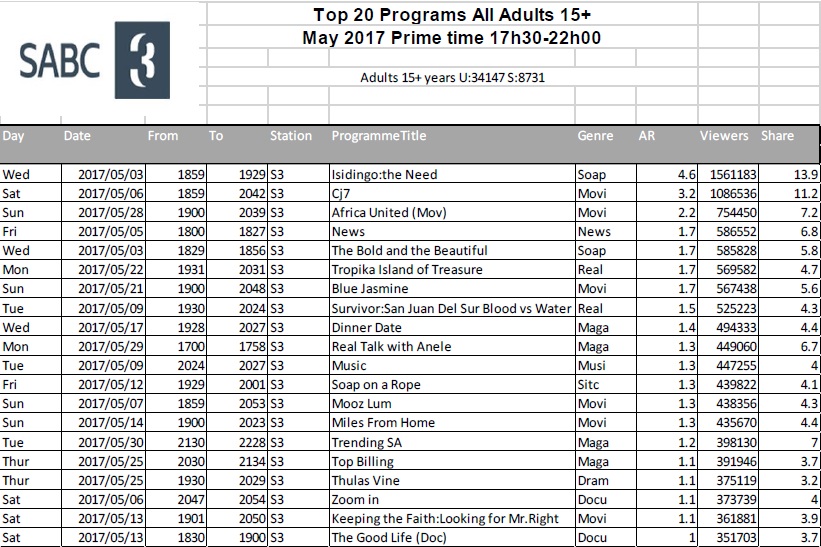
SA TV Ratings: SABC 3 — primetime top 20 for May 2017

by MarkLives (@marklives) The hottest primetime television shows on SABC 3 in South Africa revealed: TV ratings for May 2017.

In 2016, the Broadcast Research Council of South Africa (BRCSA) changed its policy about giving away TAMS and now only monthly reports, highlighting the top 20 or 30 primetime shows on several popular channels, are available.

SABC 3 May 2017

BRCSA TV Ratings May 2017 primetime SABC 3

Source: BRCSA May 2017

Broadcast Research Council of South Africa


The Broadcast Research Council of South Africa (the BRC) is a non-profit, industry body that was incorporated in 2015 to cater to the audience research needs of the radio and television industry in South Africa.

Sign up now for the MarkLives email newsletter every Monday and Thursday, now including headlines from the Ramify.biz company newsroom service!

EDITORIAL: A quick resource for PRCA’s Bell Pottinger investigation

by Herman Manson (@marklives) Professional industry bodies either need to act on or throw away the charters on which they have built their relevance and credibility.

PRCA to investigate Bell Pottinger

PRCA logoThe Public Relations and Communications Association (PRCA), a UK-based PR and communications membership body, has confirmed that it will be investigating PR firm Bell Pottinger’s work for Gupta-owned company, Oakbay Investments, which also allegedly involved a wide spectrum of individuals and organisations broadly aligned with South African president Jacob Zuma’s alleged (a very well-documented allegation) state capture project. Bell Pottinger is a member of the PRCA.

“We can confirm that we have received a complaint against Bell Pottinger, filed by Democratic Alliance (the South African political party),” states Francis Ingham MPRCA, director general, PRCA. “Bell Pottinger has been notified of this. We will now begin the formal process set out in the PRCA Professional Charter and Code of Conduct to investigate this alleged complaint.”

PRCA charter

The charter of the PRCA demands members not “[e]ngage in any practice nor be seen to conduct themselves in any manner detrimental to the reputation of the Association or the reputation and interests of the Public Relations and Communications profession”. It also demands members “conduct their professional activities with proper regard to the public interest,” and that members “have a positive duty at all times to respect the truth and shall not disseminate false or misleading information knowingly or recklessly, and to use proper care to avoid doing so inadvertently.”

The charter also demands members “[n]either propose nor undertake any action which would constitute an improper influence on organs of government, or on legislation, or on the media of communication.” Finally, “[a] member is required to take all reasonable care that professional duties are conducted without causing offence on the grounds of gender, race, religion, disability or any other form of discrimination or unacceptable reference.”

BP claims victimisation

Since resigning the account earlier this year, Bell Pottinger has consistently portrayed itself as a victim of South Africa’s volatile political environment. In April 2017, it told the Financial Times that it was “the target of a politically driven smear campaign in South Africa over the last few months, with a number of totally false and damaging accusations levelled at it”.

In May, PR trade publication PRWeek UK was told the company had dropped the Gupta brothers’ business because of “abusive and threatening” comments made by South Africans on social media, and had lost the South African Tourism business because of “gross misrepresentation of our work for former client Oakbay”.

“Political narrative”

A tranche of 200 000 or so emails to and from the Gupta family — verified as true by a number of senior politicians — shows that Bell Pottinger suggested to Oakbay that it create a “political narrative around the existence of economic apartheid and the vital need for more economic emancipation” (read white monopoly capital), that it would “utilise compelling research, case studies and data which illustrate the apartheid that still exists, and the need for truly inclusive growth”. All this would be done by “setting up of a vehicle (the ‘entity’) to be the public face of the narrative”.

Bell Pottinger’s Nick Lambert thanked ANCYL leader Collen Maine for “some very interesting remarks by the Youth Leader, and some good messages for us” after viewing a YouTube clip of Maine. Some of the points he highlighted, according to independent investigative journalists at Scorpio and amaBhungane, included: “White monopoly capital continues its stranglehold on economy. White monopoly capital decides what is printed in media. Unemployment persists”, as well as “the EFF seeks to destroy those who tell good news in the media, and which is in the interests of our country – in particular ANN7 and New Age – these are for the people”, and “ANC respects the people, the markets do not. The markets are controlled in London. What they are doing to the Rand is not ok.”

Judicial inquiry

Bell Pottinger has been exposed as knowing (and leaking) the recommendations for a judicial inquiry into South Africa’s banks at least seven weeks before they were published. At the time, it put out a statement saying, “Bell Pottinger has encountered widespread sympathy for the way Oakbay has been treated and did not seek to obtain this information, but was made aware of it. Given its relevance to the issue of Oakbay’s closed accounts, the public interest and the ongoing media coverage of the story, Bell Pottinger contacted Fin24/News24 to put the information into the public domain.” [Read the full statement here.]

Dates back to 2010

For insight into the Gupta family and its business dealings in South Africa dating back all the way to 2010 (which Bell Pottinger executives would have had free access to, just in case you wondered what they did or didn’t know about their well-paying clients):

Not the first time

Bell Pottinger has a history of allegedly editing client profiles on Wikipedia (also read Did Bell Pottinger Help Get Rid Of Pravin Gordhan?), writing speeches that reframe abuses by governments (also read Bell Pottinger, ANCYL and MK veterans – the early days) and the creation of fake content (pretty much all the links in this piece).

Unprecedented attack on civil society

In conclusion, Bell Pottinger knew who it was taking on as clients, and it would have been obvious as to what would have been required to ‘rehabilitate’ the public perceptions of these clients, given the well-documented, and wide-spread, allegations of state capture against them.

The revised narrative, constructed by Bell Pottinger for its clients, not only allowed the alleged continued looting of South Africa’s state coffers but also resulted (whether motivated or not) in an unprecedented attack on civil society as it tried to stem the tide of state corruption, including against those who oppose this from within the ruling party, opposition politicians, journalists, religious leaders and (actual) struggle veterans.

Nothing that Bell Pottinger planned, executed or advised its clients on could possibly be construed as to having been in the public interest, nor did it seemingly, the #GuptaLeak emails show, not disseminate false or misleading information “knowingly or recklessly.”

No longer an option

The broader PR industry, and the brands which associate and ultimately enable Bell Pottinger and its ilk, may shrug its shoulders and say, “This has nothing to do with us.” In truth, that is no longer an option. Civil society, here in South Africa but also in the home territories of these brands, have indicated that the social contract between business and communities has changed. This is the reason that we don’t buy clothes made by child labourers — or accept and shrug off sub-standard products and repairs which lead to tragedies such as Grenfell Tower in London.

Change has come slowly for the PR industry but is now inevitable. Embrace it or fall on the wrong side of history. The days where you can shrug off responsibility for your actions are over.

See also


Herman MansonHerman Manson (@marklives) is the founder and editor of MarkLives.com.

Sign up now for the MarkLives email newsletter every Monday and Thursday, now including headlines from the Ramify.biz company newsroom service!

Adnalysis: How strategists may help brands be important

by Bogosi Motshegwa (@Thinkerneur) How important are brands in the role they play in our society and can they, in the modern South African context, afford to operate as if it’s 1995, the first anniversary of the rainbow nation? Strategists are well-empowered to give direction to ensure that brands play a far more important role than just selling.

Not business as usual

During apartheid, most brands carried on as usual, in itself worrying. Today, amid record unemployment, ever-increasing financial pressure, junk status and political crises, brands still carry on as if everything is normal —still worrying (think KPMG). It seems as if brands are less-inclined to partake in efforts that matter, because what matters is taxing, financially and otherwise. But all of this is still not an excuse.

I believe that brands have a huge role in ensuring that the country is in a better place, in every aspect imaginable. It can’t be business as usual.

It is mindboggling that a brand such as Virgin, which stands for a meaningful purpose —challenging the status quo — still will not offer free and safe transportation to its employees late at night.

Role of business

Brands operating here can’t operate as if the country is okay. We’re not. It’s great to be optimistic about the country —we must be optimists — but oblivious optimism may be detrimental as it sweeps the dirty realities under the carpet and smothers the air with a sickly sweet aerosol.

Brands need to be real about the realities of this country. Brands are part of our everyday lives. Yet brands and businesses also exploit people. Brands and businesses also exacerbate the levels of poverty and stifle progress in the country. Here are some examples:

In the fast-food world, employees I’ve engaged with exclaim how they are paid dismally. In one pizza restaurant, there was a young lady serving us. Being a typical strategist, I started engaging her about life in general. I was curious about her plans and why she was working, because she seemed so young. The industry is not desirable for many because of the low wages, and I was curious to hear her reasons. We spoke about her dreams and, without my prompting her, she divulged her salary. Which is, literally, nothing. Her only source of income? Tips offered by patrons. No tip; no income. How are people going to get out of the low quality of life and elevate themselves if brands continuously exploit people?

In one pharmaceutical retailer, after having a conversation with one of the tellers (I don’t know why but people tend to trust me with how much they earn), she told me that she earns less than R3000 a month. “So how much money do you make per day on your till?” I enquired. +R30 000, she responded, and this is on a bad day.

“Advertising is not the only way to communicate your brand or message” —LebogangMukansi, intergratedplanning director, Ogilvy

I totally agree with the above statement. The implication is that there is absolutely no reason that brands shouldn’t explore other ways to communicate, and no reason that they shouldn’t do so while doing and executing on brand-building efforts that leave people in a better place.

Fundamental challenges lie ahead

Big business makes huge profits but do the people who work for it benefit? If a small (compared to Shoprite) creative agency called FORT, which believes in shared prosperity, can give its employees some shares in the business, imagine what corporate SA could do?

Ford South Africa has been refusing to take responsibility for the loss of life that reportedly occurred due to product malfunction, instead taking the bereaved family from pillar to post and generating excuses not to be accountable.

If brands can’t do the basics of taking care of their employees and be accountable for product faults, how are they to do more for the country? It would seem that creating better communities is going beyond the call of duty, and businesses are fundamentally not structured in that manner.

Strategy should lead this

If strategy really is the compass of brand-building, then strategists have the responsibility to ensure that brands, agencies and client commit to more than just offering their core products and services. A healthy country economically is good for business and is sustainable.

Businesses have a bigger role to play than they realise. I’m not asking for brands to create or set-up more SBUs to deal with the country’s issues; on the contrary, I’m asking brands to use their core offerings more strategically in order to add value and make life better for all (I use “all” loosely; the point is that each company plays a significant role, so, accumulatively, businesses will make life better for all). If you think about it, all operate in spaces where there are inefficiencies from a social point of view.

According to Nielsen, at the end of 2016, SA’s top two advertisers spent just R5 990 335 shy of R1.5bn in advertising spend. [Note that the rate card value was reflected and discounts excluded — ed-at-large.]

Strategy and creative

Instead of putting so much financial investment into advertising, as strategists, let’s advise brands and clients to engage in meaningful efforts that help move people forward while building sustainable equities. Strategists are accountable for how brands operate and how they choose what matters to them. There’s absolutely no reason that brands can’t engage consumers or customers to promote their brands and still add value beyond their offerings.

We need to alter the lens through which we view business as a whole. We can absolutely do more. Doing good should be at the core, and the products or services on offer should be the conduit through which that purpose is carried and value is delivered.

Strategists and creative collectively should be flexible and brave in exploring routes that don’t just default to advertising. As professionals within this space, we need to be cognisant of the true power we hold. We’re not just communicators; we have the power to influence and change lives for the sustainable better.

It’s therefore our collective responsibility to ensure that we lead the way in achieving this business vision of helping build a sustainable and enriched country full of empowered citizens through the brands we manage. Let’s create brands that are truly important.


Bogosi MotshegwaBogosi Motshegwa (@Thinkerneur) truly believes that advertising can really change the world. Every single day he tries to prove this. He shares his thoughts on the industry and sometimes has unconventional views. Bogosi is a committee member of AMASA, an Advisory Council member and guest speaker at Vega, and also does speaker management at TEDxJohannesburg. He is currently a strategic planner at The Creative Counsel. He contributes the new monthly column, “Adnalysis”, which analyses adland from a strategist’s viewpoint, to MarkLives.com.

Sign up now for the MarkLives email newsletter every Monday and Thursday, now including headlines from the Ramify.biz company newsroom service!

Clicks ’n Tricks: Google’s ad-blocking Catch 22

by Charlie Stewart (@CStewart_ZA) Ad-blocking was back in the news in early June 2017, when Google came out with a double-think announcement that would have made George Orwell proud: it was to include a blocker in Chrome to penalise publishers which flight low-quality ads on their websites; and it was going to penalise web visitors by creating a mechanism for publishers to charge those who use ad blockers.

The industry’s been relatively quiet on the topic of ad-blocking the past few years. Back in 2015, the announcement that Apple was introducing ad-blockers to iOS9 induced a frenzy of chest-beating and hand-wringing from the publishing community. It was going to go out of business, it told us. The industry even commissioned a report by PageFair and Adobe to show that ad-blocking would cost it US$22bn in lost revenue that year.

But, a couple of years on from the hysteria, it’s clear that ad-blocking didn’t portend Armageddon for publishers. While many consumers did install blockers into their browsers, I suspect most of us were just too lazy to do so.

Other ways to monetise content

And publishers, recognising that display revenues were in permanent decline, started finding other ways to monetise content. The FT’s been particularly clever with its native-content approach (allowing it to make more money from online that it does from print advertising), and platforms such as this have done really well with premium press offices.

By preventing crappy ads from showing on websites, Google’s putting the narrative where it belongs: people don’t visit websites to view ads — they go to view content. If the content they want to see is surrounded by a hotchpotch of flashing distractions, chances are they won’t revisit the site, so the publisher won’t make any future revenue from them.

As most people find websites through Google (and it’s terrified they’ll stop using its services if it sends them to irrelevant sites), it’s decided to wage war on low-quality publishers via Chrome, a browser that the majority of us use and it, conveniently, owns. The Chrome blocker prevents the ad being shown, which means the publisher won’t be paid. All told, it’s a pretty elegant fix.

More-puzzling

So on to the second, and more-puzzling, part of its announcement. It’s created a programme called Funding Choices that seeks to compensate publishers by charging visitors who use ad-blockers.

Let’s get this right: Google wants to penalise crappy publishers by creating an ad-blocker installed in a browser we all use, but it wants to penalise any of us who are brazen enough to use it. If I were to mix my metaphors as much as the search giant’s done, I’d be inclined to say that’s a Catch 22 straight out of 1984, isn’t it?

The perverse part of it all is that the type of display advertising ad-blockers target doesn’t generate high-enough margins for publishers to risk alienating audiences: it’s typically used to build awareness rather than drive sales — as such, it’s low value (and its CPMs have fallen significantly since the advent of programmatic buying).

Trade-off

Most credible publishers spotted this ages ago and stopped flighting ads that would disrupt our reading experience. And most sensible web-users have come to recognise that ‘free’ content comes with some form of trade-off — and seeing an ad somewhere in the periphery of our vision is hardly an encumbrance.

So, while I laud Google for trying to clean up the interwebs, I can’t help thinking this issue’s likely to be self-regulating. Perhaps it should give up on the double think and shift its attention to dealing with a bigger web scourge — such as fake news.


Charlie StewartCharlie Stewart (@CStewart_ZA) is CEO of Rogerwilco, a multi-award-winning independent digital agency best known for its expertise with Drupal, SEO and content marketing. A Scot by birth, he moved to South Africa in the early 2000s in his quest to support a winning rugby team — a search he’s reluctantly forsaken. Together with Mark Eardley, he co-authored Business to Business Marketing: A Step by Step Guide, (Penguin Random House, 2016) and may be found on LinkedIn. Charlie contributes the monthly “Clicks ‘n Tricks” column, which looks at how brands are using digital channels to engage their customers, to MarkLives.

Sign up now for the MarkLives email newsletter every Monday and Thursday, now including headlines from the Ramify.biz company newsroom service!

Design Plus: Claire Bridges & the elements of creativity

by Mark Tungate (@MarkTungate) Claire Bridges is the author of In Your Creative Element, a book that delivers “a formula for creative success in business”. Here she shares some of her secrets for unlocking creativity.

When you teach creativity, the question you inevitably get asked all the time is: “But can creativity really be taught?” Bridges has a very clear answer, which I’ll get to later. But first I have another question. We’re often told that children are naturally creative. So what happens? How does life leach the creativity out of us?

“I think it’s because children don’t know the rules yet,” she says. “They can colour outside the lines; they can make the sun purple or a tree pink. A teacher actually told a friend of mine’s child that her painting was ‘wrong’ because her trees were pink. That’s when it all starts. Once we think we have to follow the rules, once we have constraints, we start colouring inside the lines.”

No straight-jackets

So the secret is to resist — you may have a brief and a budget but don’t let them straight-jacket you. Also, says Bridges, don’t let others undermine you. “The teacher incident is really telling. One of the things that creativity thrives upon is confidence. People lose confidence in their ability to be creative, when in fact we’re all inherently creative. I’ve actually heard about a meeting where a creative director told someone to shush when they were about to suggest an idea. That kind of thing really puts the brakes on creativity.”

Bridges didn’t think of herself as creative at the outset of her career. She comes from a consumer PR background and, at one point, found herself typecast as the “sensible, rational” figure in an outfit of mavericks. In her next job, however, she was pegged as the creative person. Creative and insights director, to be exact.

“Once I had the word ‘creative’ in my job title I had a sort of imposters’ syndrome, which drove me to study creativity more formally. I read everything I could get my hands on.”

MSc in innovation, creativity and leadership

This led her to Cass Business School in London, from which she emerged in 2015 with an MSc in innovation, creativity and leadership — one of only 55 people in the UK to hold the qualification (and the only person in the PR sector). The groundwork for her book, In Your Creative Element (Kogan Page), was done here. The book is based, rather cleverly, on the periodic table of chemical elements. Appropriately, the inspiration came from an unexpected source.

“When I needed to relax, I was bingeing on Breaking Bad box sets,” she says, referring to the TV series about a high-school chemistry teacher who becomes a drug dealer. “So I’d go to bed with all these chemical formulas floating around in my head. I realised that the periodic table gave me a structure. When you’re starting with a blank page, a structure can be useful.”

Her book would mirror the periodic table, with nine groupings (or chapters) and 62 elements. “The original periodic table was about using known elements to predict unknown ones; I liked the idea of using a framework that combined the known and the unknown, which for me is the essence of creativity.”

But the book doesn’t just sit on shelves waiting for readers. Bridges uses the ideas inside on a daily basis for clients of her consultancy, Now Go Create. For her, there’s clearly no question that creativity can be taught. “If you’re faced with a challenge or a blank page, there are processes that can help you break the deadlock. In fact, there’s a whole toolkit at your disposal to help you overcome the situation of ‘I need an idea and I need it now’.”

Unlearn what you know

Sometimes the best way of solving a problem is to look in the opposite direction. One of my favourite quotes in the book comes from actor and Monty Python member, John Cleese, who says: “We don’t know where we get our ideas from. What we do know is that we do not get them from our laptops.”

Getting out and about — wandering, being curious, seeking new stimuli — is a classic way of gathering creative fuel. Or, as Bridges puts it, “Habit is a creativity killer. Let’s say you’ve been working for the same client for a long time: you may find yourself stuck in a rut and unable find a new angle. That’s because neural pathways have been formed, so you’re always going down the same mental groove. What tools and techniques can do is take you on a mental detour. They can help you unlearn what you know.”

During her Now Go Create sessions, she often takes people out of their workplaces — on “creative safaris” where they can seek inspiration from the world around them — but, she adds, “there is a hard reality to creativity, particularly in business, which is that sometimes you are going to be in a cold grey room and you have to be creative, no matter what.”

Genuine briefs

That’s why her courses often tackle genuine briefs. Her clients, she points out, are looking for an edge over their competitors, whether they are a clothing retailer, a drinks manufacturer or a sponsorship agency. “Their currency is ideas, and what they want out of this [are] better ideas.”

So if we had to combine three elements from the book to make ourselves more creative, what would they be? Bridges protests that different people require different elements. “Having said that, if you combine curiosity, self-belief and grit, you’re getting there.” Curiosity means not being satisfied with the status quo; and not being afraid to ask questions. Self-belief is about the confidence to carry on, to stay true to your idea. And grit is the ability to overcome setbacks, to pick yourself up when things don’t go your way, and to keep working until the job is done.

So, there you have it. Bridges has set you on the right path. Now go create.


Mark TungateMark Tungate (@MarkTungate) is the editorial director of the Epica Awards (@EpicaAwards), the only global creative prize judged by the specialist press. In this series of articles called Design Plus, Epica highlights creativity in the design field.

Sign up now for the MarkLives email newsletter every Monday and Thursday, now including headlines from the Ramify.biz company newsroom&nbspservice!

Online CPD Courses Psychology Online CPD Courses Marketing analytics software Marketing analytics software for small business Business management software Business accounting software Gearbox repair company Makeup artist