Mike Abel: Start building your ark

by Mike Abel (@abelmike) Some things have me a tad concerned right now about our economy. Here are the simple facts: South Africans are optimists. We definitely don’t have a savings culture. Never have.“Moenieworrienie. Allessalregkom” (“She’ll be right, mate” as they say down-unda).

Mike AbelBleeding obvious

For some of you, this may be bleeding obvious but it is still worth a reflection: With South Africans having had easy access to easy money for a decade and with the stock market having been at record highs, most of our kinsmen have maxed out on credit at lower interest rates and with a growing economy.

The Rand, until six or so months ago, was doing generally ok. A poor Rand on the downside now means literally everything will cost us more. The only possible benefit is growth in export, and thereby more hard currency and job creation.

Interest rates are climbing and are likely to continue to do so. Therefore, if people are at their absolute credit threshold at the current interest rates, what will be the impact of increases in house and car payments, the petrol price and basics? The answer is obvious.

Always the first casualty

What will advertisers do? A shortage of cash usually impacts sales and, with that, marketing spend is always the first casualty.

Here’s the first fault: looking through a prism of marketing spend versus marketing investment. It’s marketing spend if you are simply telling your existing market what they already know about your business, ie your messaging is more of the same, with a few tweaks.

It’s marketing investment if you are sharing relevant new benefits with your existing customers to retain and grow them (often an effective defensive growth strategy) and you are investing to attract new customers from fresh ponds to your brand and business (usually an offensive strategy).

Truth is, no matter how you throw the ball in the air, if you don’t spend more on retention and attraction strategies during tough times, it’s going to land on predetermining a poor business outcome. It doesn’t get more basic than that.

Explore your marketing strategies

So, the thing to truly explore is your actual marketing strategies. And when I say marketing, I’m not referring just to advertising; we’re talking product, pricing, distribution and channel here as well. Unfortunately it needs to be said, as most marketing today is simply, and sadly, communications.

If there’s less cash around, how do you make your fees more compelling? How do you offer responsible access to bridging finance — not more rope but actual help? If you’re a car company, how do you position yourself to encourage customers to trade down but get them into your brand, to punt your service and parts offering? For retailers, how do you push your value drivers, create new aspirational cheap-chic brands that give you the look without the bite?

Customers will be looking for help in the form of those who allow them to best retain their lifestyles but at more-cost effective rates. Restaurants can put fun “budget dinners” together and change their wine lists. The options are literally endless if you embrace tough times.

Real value vs distress marketing

Now is the moment, just before the ‘drizzle’ starts, to develop and adopt aggressive market-share offensive strategies which are specifically ‘tough-time’ friendly. These must provide customers with real value versus distress marketing tactics or margin erosion. So,rather create a calculated strategic plan that seeks sustainable business solutions through a protracted and unfriendly trading environment.

The one thing we must encourage customers never to do is stop their health insurance, their retirement annuities and trade down on education. The long- (or even potentially short-) term results will be disastrous — and often unrecoverable.

Banks and life companies need to educate and help their customers ahead of and through these times.
As an old friend of mine once said,“If you were there for the wedding, then be at the funeral”— in marketing terms, when the economy turns, and it will, there will be another wedding. But don’t send out the diary blocker just yet.

This is the time to start thinking far less about awareness ads (which probably make up 90% of what we see) and to think much more about smart and creative defensive and offensive strategies. This will be the ark that navigates you through the coming storms.

Mike Abel (@abelmike) is founder and chief executive of M&C Saatchi Abel. This article has been republished with permission from Mike’s blog, Mike & Friends.

— MarkLives’ round-up of top ad and media industry news and opinion in your mailbox every three work days. Sign up here!

Design Annotator: “ABC’s of Xhosa Names” and election TV ads

10and5logosmall1by Uno de Waal (@Unodewaal) This week on Design Annotator we’re highlighting:

  • An alphabet of Xhosa names in the form of illustrated GIFs by Thandiwe Tshabalala
  • Art and illustration by Cape Town-based illustrator Ninjabreadboy
  • Graphic design and art direction by Aldo Pulella
  • A look at the background of Greg and Roché Dry, founders of Egg Design
  • An ongoing photography project by Hanro Havenga, called BestRand
  • A documentary about train surfing in South Africa
  • Cloudy With a Chance of Pixels, an upcoming creative symposium
  • A case study of the Russian Bear #UrbanExpressions campaign
  • The South African winners of the 2014 Cinemark Cannes Young Lions Competition
  • This year’s election TVCs for the ANC and the DA


The “ABC’s of Xhosa Names”, a series of illustrated GIFs by Thandiwe Tshabalala

The “ABC’s of Xhosa Names” by Thandiwe Tshabalala

South African illustrator Thandiwe Tshabalala has created a series of GIFs which celebrate the beautiful and unusual names in Xhosa, her mother tongue.

The vibrant GIFs take us through the “ABC’s of Xhosa Names”, such as Gcobani, Yonela and Sikelela, and give us insight into their meanings.

See Tshabalala’s entire alphabet of Xhosa names.

New work by Cape Town-based illustrator Ninjabreadboy

Karate Water by Ninjabreadboy for the Lost and Found exhibition 2

Growing up, anything that involved creating something appealed to Ninjabreadboy, who always knew that he would do something involving drawing in one way or another.

Now a freelance illustrator, his line-based illustrations draw influence from the visual aspects of the skateboarding sub-culture, as well as from graffiti and tattooing.

Read our interview with Ninjabreadboy and see his latest work.

Graphic design and art direction by Aldo Pulella

Pulella Road Trip

Aldo Pulella is a graphic designer who comes from a line of creatives: his mother was a graphic designer, too, and his grandfather was a sculptor.

Pulella gets to explore his creativity in his own time with personal projects and as an art director at OgilvyOne in Johannesburg. His designs are eye-catching and beautiful, and combine features from both the digital and real world.

Here we ask Pulella a few questions to learn more.

Furniture, products and interiors by Egg Designs

Desert Rose Locker by Egg Designs

Founded by Greg and Roché Dry in 1996, Egg Designs specialises in creating carefully layered interior spaces, as well as bespoke furniture and products.

Their work itself is “unashamedly rooted in Africa” and each individual item is well-crafted, eclectic, and can easily find a home anywhere in the world.

See more by Egg Designs and read about its journey so far.

BestRand | A photography project by Hanro Havenga

BestRand by Hanro Havenga (32)

Hanro Havenga is a photographer based in Johannesburg. A while back, he began a new personal project called BestRand, which is a growing collection of photographs taken of the things he sees on, as he puts it, a daily-ish basis.

Having watched the development of this for some time now, we got in touch with Havenga to find out more about it. He hand-delivered his answers printed on the back of a collection of photographic postcards.

See the postcards, a selection of work from BestRand and read Havenga’s musings here.

Staff Riding | A documentary on train surfing in SA


STAFF RIDING SUB ENG from MARCO CASINO on Vimeo.
Italian photographer Marco Casino and his team recently visited SA to make Staff Riding, a documentary on the dangerous sport of train surfing.

Part of a long-term project inspired by township lifestyle 20 years into democracy, Staff Riding was shot in Katlehong, a township outside of Johannesburg.

Find the credits and read more about Staff Riding.

Cloudy with a Chance of Pixels | Creative Symposium

Cloudy with a Chance of Pixels

Cloudy with a Chance of Pixels is a one-day creative symposium being hosted in Johannesburg and Cape Town, celebrating innovative design thinking. The symposium kicks off in Johannesburg on 10 April 2014, and travels down to Cape Town on 15 May.

The team behind it consists of Mohammed Jogie, Rehana Rajah, Sean Petersen and Avril Petersen. They’ve been working together for a while, and decided to go all-out on this one.

Check out all the details and the lineup of speakers.

Case study: Russian Bear #UrbanExpressions campaign


Russian Bear Urban Expressions Case Study from Platinum Seed Digital Marketing on Vimeo.
On 1 October 2013, Social Seed launched the Urban Expressions campaign for Russian Bear, for which 10 local artist were given the chance to express their understanding of urban culture by creating an artwork for a limited-edition black Russian Bear bottle.

Ten artists were chosen, and their designs were put to public vote before a final winner was chosen from the three finalists.

Read about creating the campaign, as well as the outcome, here.

SA’s 2014 Cannes Young Lions winners

The SA winners of the 2014 Cinemark Cannes Young Lions Competition have been revealed, and they are Joe Public’s Marina Andreoli and Sonia Dearling.

These two have earned themselves a trip to the Cannes Lions International Festival of Creativity to compete against some of the best and brightest young creatives in the world.

Find out more about the competition and the winning entry.

Let Them Talk vs #LookingForwardTo | The 2014 elections TVCs for the ANC and DA

During the run-up to the 2014 general elections on 7 May come the inevitable promises and ad campaigns. We’ve yet to find out what will happen at the polls but who has released the winning TV campaign?

SA’s leading party, the ANC, has launched one beautifully shot TV ad with the message “Together We Move South Africa Forward.”

The official opposition party, the Democratic Alliance, has opted for a series of ads asking “What are you #LookingForwardTo under a DA government?”

See the DA’s series of adverts here.


Uno de WaalDesign Annotator is a regular column on MarkLives featuring the top design work from South Africa’s biggest online creative showcase, Between 10 and 5, which is curated by publisher Uno de Waal (@Unodewaal), inaugural South African winner of the British Council South Africa‘s Young Creative Entrepreneur (#YCE) Digital Publishing Award in March 2014.

— MarkLives’ round-up of top ad and media industry news and opinion in your mailbox every three work days. Sign up here!

April 1: Punk’d by the media

by Herman Manson (@marklives) It’s 1 April 2014 and news sites, newspapers and broadcasters are out to get you. Last year, Mxlish was included as South Africa’s 12th official language, Oscar Pistorius signed up for North Korea’s inaugural Friendship Run and Juju joined the DA.

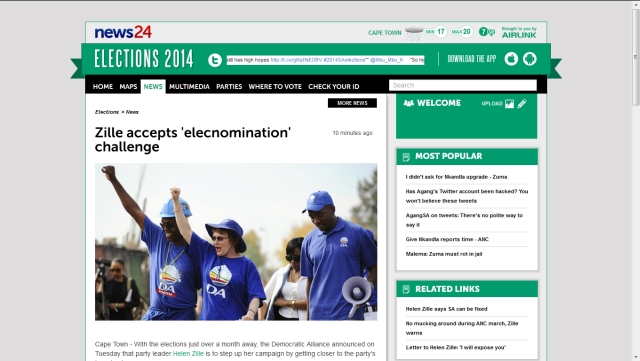
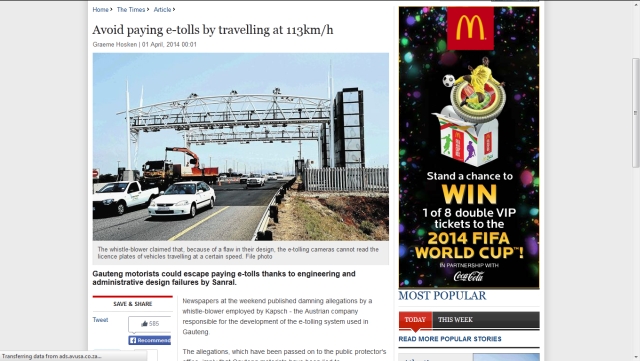
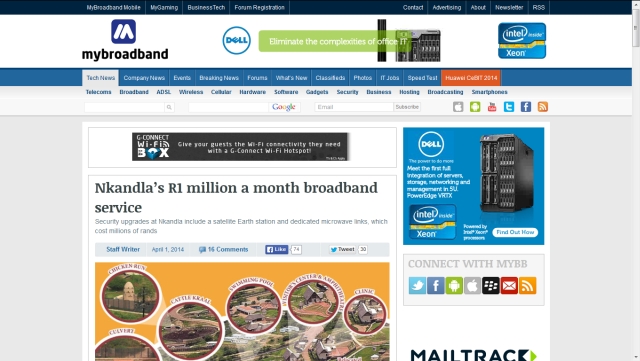
What with elections just around the corner, this year’s April Fool’s stories dealt with popular voter gripes. News24 announced Western Cape premier Helen Zille is moving to Khayelitsha; MyBroadband tackled Nkandla’s ‘but I never asked for it’ telecommunications infrastructure; and TimesLive reported that you can dodge paying e-tolls by driving exactly 113 km/h.

The story of the day goes to The Daily Maverick for announcing the merger of the SABC, Independent News & Media, The New Age and ANN 7.

Some April Fool’s highlights from around the South African web

1 April 2014: News24

News24: Helen Zille moves to Khayelitsha

Helen Zille would be forgoing her normal lifestyle as Western Cape premier and be moving into the township of Khayelitsha for the last two weeks before the 7 May elections. Other party leaders would take over her final campaign commitments.

1 April 2014: Daily Maverick

The Daily Maverick: The SABC, Independent News & Media, The New Age & ANN 7 to merge

In a move that surprised many and brought joy to even more, The SABC, Independent News & Media and Gupta-owned The New Age/ANN7 are set to announce today that they are merging into one giant entity whose goal would be to, once and for all, tell the definitive truth about South Africa; day in, day out, on all media channels, until Jesus comes.

…

“No more will the imperial powers own this country’s truth through their daily print mouthpieces that are still stuffed with unreformed racists and so-called journalists that refuse to acknowledge the reality of South Africa’s good story to tell. No more will the foreigners, foreign or local, decide what is truth and what is not truth. No more will the media consumers of this beautiful country be straitjacketed into the darkness of the fact-based reporting and the hopelessness that is so much at odds with all the sunshine we enjoy every day these days.”

1 April 2014: Times Live

Times Live: Avoid paying e-tolls by travelling at 113km/h

Documents seen by The Times and confirmed by Sanral insiders show that, if motorists travel at exactly 113km/h, the special camera systems cannot capture their vehicle’s registration number.

Kapsch has warned Sanral to remove the glitch from the system, known as Prying on Every Person Holding Out Legally (Poephol).

1 April 2014: mybroadband

MyBroadband: Nkandla’s R1 million a month broadband service

Security upgrades at Nkandla include a satellite Earth station and dedicated microwave links, which cost millions of rands… The operational costs for Nkandla’s telecoms services include satellite bandwidth, and the maintenance of the Earth station, teleport dish and microwave equipment. These costs can easily exceed R1 million per month.

1 April 2014: IOL

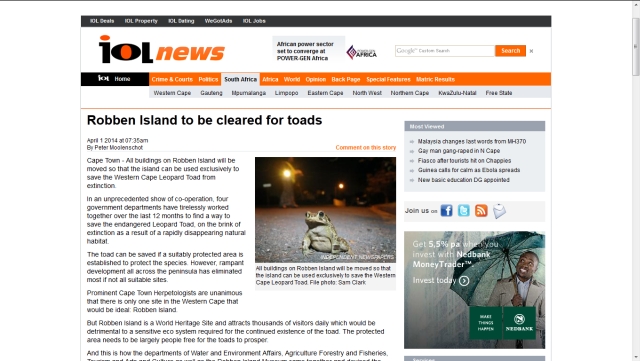
IOL: Western Cape Leopard Toad exiled to Robben Island

In an unprecedented show of co-operation, four government departments have tirelessly worked together over the last 12 months to find a way to save the endangered Leopard Toad, on the brink of extinction as a result of a rapidly disappearing natural habitat.

The toad can be saved if a suitably protected area is established to protect the species. However, rampant development all across the peninsula has eliminated most if not all suitable sites.

Prominent Cape Town Herpetologists are unanimous that there is only one site in the Western Cape that would be ideal: Robben Island.

…

According to sources, the opening of the new heritage site is planned for April 1, 2015 and the budget will not exceed R246 million.

1 April 2014: Mail & Guardian

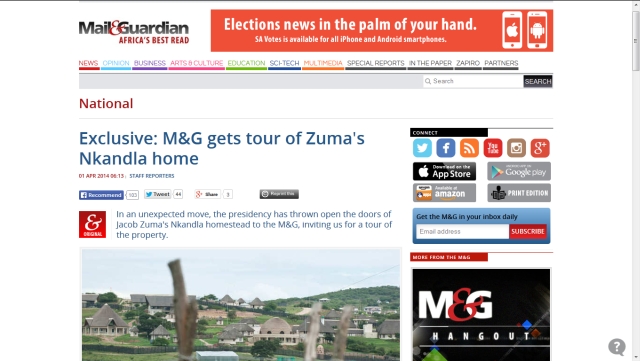
M&G Online: M&G gets tour of Zuma’s Nkandla home

In an unexpected move, the presidency has thrown open the doors of Jacob Zuma’s Nkandla homestead to the M&G, inviting us for a tour of the property.

…

We can now also exclusively report that:

  • the fire pool at the compound is not, in fact, on fire;
  • the visitors’ centre features a number of arcade games to compensate for long waiting times to see the president, including Dance Dance Revolution; and
  • what has come to be known as the “cattle kraal” is actually [REDACTED FOR REASONS OF STATE SECURITY]

Local brand pranking

Absa: New-look Springbok jersey revealed

Absa, Official Team Sponsor of the Springboks, announced that the team will be debuting a new red and gold kit in 2014.

International pranking

april 1 guardian

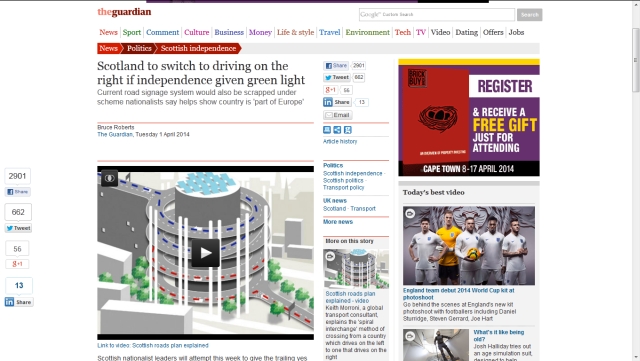
The Guardian: Scotland to switch to driving on the right if independence given green light

Seeking to capitalise on the arguments this week about “bullying” England and keeping the pound, they will unveil an ambitious scheme to scrap the current – English inspired – road signage system. M for motorway will be replaced with a new S – for Scotland and the A trunk roads will become N roads – for Nationalist in honour of the new country. Blue will be the predominant backing colour.

…

It is estimated that 58,000 signs will have to be replaced – scrapping the famous road sign font known as “Transport” with a new Celtic-tinged typeface, Proclaimer. And it could be that they may take the opportunity to renumber all of Scotland’s roads, beginning at one.

— MarkLives’ round-up of top ad and media industry news and opinion in your mailbox every three work days. Sign up here!

Live from Qunu – reporting from the funeral of Nelson Mandela

by Gill Moodie (@grubstreetSA) Three journalists:  all East Londoners and deeply connected to the Daily Dispatch, the hometown newspaper of Nelson Mandela. All three covered THE once-in-a-lifetime story: the funeral of Mandela in Qunu in the Transkei last year but with totally different world views and media experience.

The three – Andrew Stone, the Dispatch’s metro editor; Sibongile Mkani-Mpolweni, who cut her teeth as a reporter at the Daily-Dispatch_201312163Dispatch and now a reporter for eNCA TV news channel in Johannesburg; and Andrew Austin, once the Dispatch news editor who is now the editor of the Hawke’s Bay Today newspaper in New Zealand – told Grubstreet what it was like to cover the biggest story on the planet in their home patch.

Stone headed to the Dispatch base camp in a secondary school close to Mandela’s Qunu home (prearranged with the school’s principal) the night Mandela’s death was announced. With the exception of a trip back to East London to get supplies, he was there for the entire 10 days’ mourning period with a team of other Dispatch reporters, including the paper’s deputy editor, Brett Horner.

“I was on the ground by about 8am (the next morning) and they were still setting up the (security) cordon around Qunu,” Stone told Grubstreet.

Initially, there were few journalists from other news organisations in the area. “It was weird. Qunu was completely ignored in the beginning and then as it got closer to Mandela being flown down, there was this massive build-up of journalists and the police and the army.

“I was quite surprised by a lack of interest from the (Qunu) locals. People just got on with lives. We wondered if it was because of poverty – that day-to-day survival was more important than anything else… And on the day of the funeral, I really expected the area to fill up but at the one public viewing centre, when we got there, the journalists outnumbered the villagers by about two to one.”

As it got closer to the funeral, some journalists were excluded from the area even though they had arranged accommodation with locals. The Dispatch, however, was left where it was.

“During that week (before the funeral), we were visited by everyone – government officials, Icasa, the army, police, you name it,” says Stone. “They all looked around and then one of the officials at a press conference said something along the lines of: ‘We know about those journalists on the hill in the school but they don’t have a significant advantage’. And I think that’s why we were left to stay there. We were a stone’s throw away from the boundary wall (of Mandela’s home) but we couldn’t actually see into the house.

“In hindsight, we could have arranged a better place. There were no ablutions or running water. You had to walk to the long drop… We had electricity in parts (of the school) but of about 10 classrooms, only three or four were really usable.  It was a bit of eye-opener for all of us to see this is what kids are being taught in.

“You know, I was glad when it was all over and living like that for over a week was tough,” Stone says. “But I’m stoked I was part of it. I wouldn’t have wanted it any other way… It was our backyard and we didn’t want to be out-reported in our backyard. And it was big story for our readers.”

Because of the security clampdown, the only option left for reporters inside the security cordon was to interview the locals, Stone says. “In part, the Dispatch was pretty lucky as we already had contacts. Some of our reporters knew the royal families so we managed to get a better mix of stories but I felt sorry for the foreign journalists.”

eNCA’s Mkani-Mpolweni  agrees that the security clampdown  made covering the funeral  very difficult. “I wanted to interview the Qunu chief, who is a woman,” she told Grubstreet. “She stays opposite Mandela’s house but when were in the house talking to her, the police came in to say that we had to leave, we couldn’t do interviews…  We said to them they couldn’t do this as it was her house but, in the end, we had to go. Neither her nor us had any choice.

“Qunu was frustrating for us journalists – and for the residents as well. There were always cops around.

“We spoke mostly to the residents and they told us mostly of their memories of Mandela. Some told us Mandela was not theirs in the end because they saw the hearse coming and it just drove past them. They didn’t get to see him whereas in Pretoria, people got to view the body.

“They wanted to go the house and be at the funeral, says Mkani-Mpolweni says, “but very few Qunu people were invited so on the day they went about their lives in their homes, washing and cooking.  ‘Why must we go watch it on TV as if we are in Jo’burg?’ they are told us. ‘For us, this is not happening’.

“I don’t know what I expected (of the story)… but I was pleased with what we were able to produce. ”

For Austin, being put on an aeroplane to fly right around the world to the Eastern Cape was an unexpected turn of events.

“I was in my office in the newspaper that I edit in Hawke’s Bay when the news came over the agency wires that Mandela had died. Months before, I had pre-written an obituary for the newspapers in my group, APN, including the biggest paper, The New Zealand Herald. It was a case of dusting it off and sending it on.

“The feature, about my impressions and experiences of Mandela, was published on the Saturday after his death and it set off a chain of events that led me home,” he told Grubstreet in an email. “The editor of the NZ Herald, Shayne Currie, phoned me on Saturday afternoon to ask me if I would like to go to South Africa. By the Monday morning (New Zealand time) I was on a plane to Johannesburg via Singapore.

“It was the start of a seven-day whirlwind. My brief was quite unusual because I was not there to cover the hard news, as my newspapers could get that from the wire services. ‘Don’t be afraid to put yourself in the story,’ NZ Herald editor-in-chief Tim Murphy told me before I left. The newspapers wanted my personal insights, the comparisons between now and when I was last there and, most of all, the emotion – of the country and from me.

“Make no mistake; it was a tough assignment logistically. With New Zealand being 10 hours ahead of South Africa, I got into a routine of filing in the morning (SA Time) to meet the evening deadlines for the following day’s paper and then filing in the evening (SA Time) to meet deadlines for the websites in the morning in New Zealand. I slept for three hours a night, fell asleep at a traffic light for a few seconds and even managed to do a radio interview at 3am (SA time) with a station in New Zealand.

“As the week went on, I had to turn my attention to big reads for the weekend papers – a 2 000-word piece for the Saturday paper, the Weekend Herald, on how the country had changed since I was last there and a 1 000-word piece on my identity crisis – a South African living in New Zealand – for the Herald on Sunday. Seventeen stories, for online and print, were filed in total.

“Because I was late in arriving, I only got my accreditation on the Tuesday night. Although I had filed a few stories by then already, work began in earnest the next day in Pretoria where Mandela lay in state. I took the simple philosophy that I would talk to as many people as possible to build up a picture of what Mandela meant to them and also their hopes and fears for the future.

“The great thing about the assignment was that almost anything was part of the story because it was about my reaction to events and South Africa as a whole. As the New Zealand Prime Minister John Key was also in town, there was an expectation to get something from him as well, so it made for a busy time.

“The moment it all hit for me was when I was standing in the grounds of the Union Buildings and I became quite emotional. It set the tone for the rest of the trip. I had a story to tell and I needed to get over my hard-news instincts and tell it with emotion and passion.

“But the best part of the trip for me was when I travelled back to my home province – the Eastern Cape. I was born in Port Elizabeth and grew up in East London. My first job – the one that formed me as a journalist – was at the Daily Dispatch. This was my patch and I felt very comfortable as I drove into the Transkei on the Saturday morning (the day before Mandela’s funeral).

“Having been the assigning editor on many an assignment over the years, I was in the unusual situation of being on the other side of the desk but it meant I knew what was expected of me.

“With limited access to WiFi, things were difficult out in the field. Standing at a roadblock waiting for Mandela’s body to arrive home, my main job became tweeting what I saw. Because it was night in New Zealand, it meant that New Zealanders were waking up to my tweets, which were being retweeted by the New Zealand Herald, a substantial newspaper with a larger readership than most in South Africa. I was the only New Zealand journalist in Qunu so I felt it was important to inform the readers.

“The next two days were quite an amazing experience and made me appreciate the country of my birth. I felt privileged to be able to share what I was experiencing with my adopted land. By all accounts, my assigning editors and the readers were happy with the service I provided.

“It was not without its trials and tribulations but this is one assignment I would not have missed for the world.”

SEE ALSO: Andrew Austin: The great man with the common touch, The New Zealand Herald, Dec 2013; and Andrew Austin: Loving the best of both worlds, The New Zealand Herald, Dec 2013

GrubstreetSouth Africa’s leading media commentator Gill Moodie (@grubstreetSA) offers intelligence on media, old and new. Reprinted from her site Grubstreet. This piece was published first on Journalism.co.za, the website of Wits University’s journalism school.

— MarkLives’ round-up of top ad and media industry news and opinion in your mailbox every three work days. Sign up here!

Brand Politics: Voters as heroes and the art of brand loyalty

by Alistair Mackay (@almackay) The level of loyalty and emotional investment that political parties in this country get out of their supporters is staggering, especially when you consider that they are only allowed big ‘advertising’ campaigns once every five years. If private sector brands could illicit such customer loyalty, their marketing directors would retire at 40 — rich, happy and fulfilled.

So how do they do it? How do our political brands get such fervent support, even in the absence of tangible products and services and, in some cases, poor or skewed records of delivery?

Alistair MackayNumber of reasons

There are a number of reasons for it and some, such as our oppressive past and a lingering sense that politics is a zero-sum game, are awful and not particularly helpful for marketers.

But I believe that there are two things political parties do that other brands can learn from, things that connect with our emotions and make us willing to forgive shortcomings, rather than jump ship:

  1. Political parties inspire us through storytelling, and
  2. They show that they are on our side.

Storytelling

Storytelling, as a discipline, has been getting a lot of attention recently but there are still very few brands that get it right. It requires the storyteller to give up talking about product features unless they support or add to the narrative. Even more difficult for brands, storytelling requires conflict.

Good stories are not just a sequence of happy marketing jingles: they have obstacles, and heroes who triumph over them.

Political parties weave grand, elaborate stories that capture our imaginations and give a sense of history and importance to our lives. Whether it’s a national democratic revolution, a fight for economic freedom, or a battle to restore the dreams of 1994, political brands are stories about overcoming injustice and oppression.

As a citizen and voter, it’s almost impossible not to be drawn in.

The hero is you

But political parties do more than that — they cast the hero in their stories as you.

The fight is to improve your life; the struggles they talk about are the struggles you face every day. And that is where the real marketing magic lies.

It is a simple principle, but so often forgotten by marketers — be on your customers’ side. Have your customers’ interests at heart.

What customer-focused means

Being customer-focused is such an over-used phrase that marketers don’t stop to think about what it means.

  • It means that your customers will not trust you and will not be loyal to you unless they truly believe you are trying to make their lives better, not sell them things. So make their lives better.
  • It means you need to really understand what is important to your customers. You need to invest time, energy and resources into understanding their needs, motivations, frustrations, life contexts, passions and struggles. It requires insight well beyond how they interact with your category.
  • It means demonstrating that your customers’ well-being is important to your business.

Brand-damaging

I have recently had an infuriating and profoundly brand-damaging experience with an airline’s customer-service centre, in which I had to pay twice for the same flight because of a hidden clause in its terms and conditions.

Instead of any attempts to understand my predicament, I was simply met with a speech about how I should have behaved differently. It was the perfect demonstration of how most brands fail to understand this basic of brand-building.

‘Putting customers first’ means nothing if you just intend it as a line for your ad. Customers will see right through that. It only means something when you actually care about their interests, and maybe even consider those ahead of your terms and conditions.

Powerful forces

Political brands are powerful forces to be reckoned with. They do a much better job at earning and holding loyalty than most other brands, largely because we love the stories they tell, because they understand our worries and frustrations and, most importantly, because we believe they are fighting in our corner for us.

Alistair Mackay (@almackay) is marketing manager and head of content at Yellowwood, (@askYellowwood) a leading marketing strategy and brand development consultancy. He has experience both as a brand strategist and as the digital media manager for the Democratic Alliance, and believes that innovative, insightful and generous marketing is both good for business and social change in South Africa. He will contribute the monthly “Brand Politics” column, exploring lessons brands can learn and apply from politics, to MarkLives.

— MarkLives’ round-up of top ad and media industry news and opinion in your mailbox every three work days. Sign up here!

Smart Africa TV: Ringtones in Africa — the US$500 million market

by Russell Southwood (@BalancingActAfr) In this interview, Rob Marshall, who is responsible digital music business development at Sony Music, talks about the potential for the music business on the continent, and how ringtones are already a US$500 million market.

The interview covers:

    • what Sony Music is doing in Africa and its local partnerships;
    • how Nigerian music has travelled across the continent;
    • the new digital online platforms;
    • estimated spend in the ringtone market;
    • the African online music platforms;
    • iTunes and Deezer’s expansion in Africa;
    • and what success might look like for Sony in three years time.

Smart MonkeyRussell Southwood is the founder of Balancing Act and the web TV channel Smart Monkey TV, and has been an analyst in telecoms, internet and broadcast in Africa for the last 14 years. Smart Monkey TV aims to capture the energy at the crossroads between African culture and technology. MarkLives is syndicating content from Smart Monkey TV on a weekly basis for the column “Smart Africa TV”.

— MarkLives’ round-up of top ad and media industry news and opinion in your mailbox every three work days. Sign up here!


MagLove: The rise and fall of Oscar Pistorius, as chronicled on magazine covers

by MediaSlut (@MediaSlut) Oscar Pistorius is on everyone’s lips and too many newspaper front pages to even keep track of, but he’s also had a history of some other brilliant magazine covers, pre- and post-14 February 2013.

Today, Barry Roux will start presenting his case, and everyone is waiting to see if Pistorius will be testifying himself. So, in light of this, we’ve curated some of Pistorius’s previous and most current covers, which all tell a story…

  • INSIG, May 2005
  • NewsNow/NuusNou, 10 September 2011
  • The New York Times Magazine, 22 January 2012
  • FT Weekend Magazine, 26 May 2012
  • Men’s Health South Africa, August 2012
  • SARIE, February 2013
  • Huisgenoot/YOU, 28 February 2013
  • TIME, 11 March 2013
  • Business Day Sport Monthly, April 2013

INSIG, May 2005

Insig, May 2005: Oscar Pistorius

A fresh-faced Pistorius came onto the scene early in the new millenium, with INSIG magazine (now closed) being one of the first titles to feature him when he was still relatively unknown. “Die man met ses paar bene”, it wrote on its cover (“The man with six pairs of legs”)

It also featured some great (and unique) photography with the article, which may be viewed here.

(Apologies for poor quality, but pictures were taken of the actual magazine). 

NewsNow/NuusNou, 10 September 2011

NewsNow 1.2, 10 September 2011 English NewsNow, 1.2 10 September 2011 Afrikaans

“Not so Fast, Oscar!”, NewsNow and NuusNou blasted on this very creative (and second cover after launching), which, of course, featured Pistorius.

And everyone knew whom it was, even though his face wasn’t published, because he was so top of mind as the athlete went through processes to become the first paraplegic runner to participate with able-bodied athletes in the 2012 Olympics.

The New York Times Magazine, 22 January 2012

New York Times Magazine, 22 January 2012

His brand just got bigger and bigger, with everyone wanting a piece of the Oscar-Pie.

The New York Times Magazines featured his “need for speed” with a brilliant article and Oscar-cover with the signature no-smile…

Read the full article and view the extra pictures here.

FT Weekend Magazine, 26 May 2012

FT Weekend, 26 May 2012

Continuing the Oscar-on-prosthetics trend was FT Weekend Magazine, with a bold cover line featuring his speed in seconds, based on the 400m track he runs.

Read the full article here.

Men’s Health South Africa, August 2012

Men's Health, 8 August 2012

Personally, one of my favourite Oscar Pistorius (and Men’s Health South Africa) covers, focusing on the person, not the blades — and the man is oh so fit and attractive!

The colour combination screams Oscar-Gold to me, too.

This issue was published just before the 2012 London Olympics started.

SARIE, February 2013

Sarie, 2 February 2013

The much-spoken-about SARIE-cover…

  • Reason no. 1: Because this issue was on shelf at the time the shooting happened on 14 February 2013. (It was on shelf for another week afterwards, I think.)
  • Reason no. 2: It’s one of the few covers in which he actually smiles (a bit), and he and his sister Aimée both look stunning.
  • Reason no. 3: A paragraph of this exclusive article was used against Pistorius when he applied for bail, as he talks in the article about a house in Gemona (Italy), which he didn’t declare earlier.

Read more about the article, and the story surrounding it, here.

Huisgenoot/YOU, 28 February 2013

Huisgenoot 1.7, 28 February 2013YOU 1.7, 28 February 2013

Just more than a week after the fateful morning of 14 February 2013, YOU and Huisgenoot both showed why they are so popular in South Africa, and why they are the best at doing what they do:

They didn’t only have one of the most striking images and covers of Pistorius; their extensive coverage inside was just mind-blowing.

View examples of their coverage here.

TIME, 11 March 2013

TIME, 11 March 2013

Probably the most talked about Oscar-cover, as it spread like wild-fire after it was released.

And why not? It captures everything just perfectly at that moment: “Man. Superman. Gunman”.

The article is an interesting read (and investigates our gun-culture in South Africa); view it here.

Business Day Sport Monthly, April 2013

Business Day Sport Monthly, 3 April 2013

Business Day Sport Monthly showed that Pistorius has “nowhere to hide”, and featured a court room image with the “O” of “SPORT” very strategically placed to symbolise a halo.

Boy, how the mighty have fallen…


Find a cover we should know about? Tweet us at @Marklives and @MediaSlut. Want to view all the covers at a glance? See our MagLove Pinboard!


MediaSlutMagLove by @MediaSlut is a regular slot featuring the best local and international magazine covers every week, recognising well thought-out, powerful and interesting (and hopefully all three-in-one) covers and celebrating the mix of pragmatism, creativity and personal taste that created each of them. The (for now anonymous) blogger behind MediaSlut knows way too much for his own good about media in South Africa, magazines in particular. His mission is to show when SA magazines fail but, most importantly, also when they succeed. If you’re looking for a library about SA magazines and news, this is your one-stop pitstop.

— MarkLives’ round-up of top ad and media industry news and opinion in your mailbox every three work days. Sign up here!

The Ad Contrarian: Vehicle marketers are stupid. Here’s why.

by Bob Hoffman (@adcontrarian), San Francisco Bay Today we’ll be chatting about one of my favorite subjects: stupidity. Typically my stupidity rants center on digital stupidity. But today we’ll be talking about good old-fashioned traditional stupidity.

The Ad Contrarian logoA significant part of what I am doing these days is trying to explain to marketers the silliness of ignoring people over 50 (in the US they are responsible for almost 50% of consumer spending, but are the target for about 5% of advertising.)

A perfect example of this occurs in the automobile industry where the facts and the practices are in complete opposition.

People over 50 buy 62% of all new cars (in the US), but are not in any auto maker’s media target. Auto makers typically buy 18-49 years-olds or 25-54 year-olds.

In other words, auto sellers direct about 100% of their effort at 38% of the market and about 0% of their effort at 62% of the market.

Even more remarkable are “youth cars” like the Ford Focus, the Toyota Scion, and the Chevy Cruz. These cars are targeted at 18-34 year-olds. And yet 18-34 year-olds buy only 12% of these cars – 88% are bought by older people.

When I describe this anomaly to marketers and agency people, I often get the following response: “Yeah, but older people want to be like young people.”

Now, this may be — I doubt it*, but it’s possible. But it’s irrelevant. Here’s why.

Let’s say these folks are right and older people want to be just like young people. That is still no reason to target young people. Young people don’t buy cars. Showing young people in an ad is one thing, but targeting young people makes no sense at all.

Let’s create an analogy.

Let’s say we want to sell milk to cats. Cats love milk and they drink 90% of the milk. Dogs don’t buy much milk. They only buy 10% of the milk.

But here’s the catch: cats want to be like dogs. So the way to convince cats to drink our brand of milk is to tell them that dogs like it. Okay, maybe there’s some logic here.

But why would you target dogs? Targeting dogs misses the milk drinkers — cats. We are confusing message strategy with media strategy. Maybe we need to show dogs drinking our milk in our spots to influence the cats. But in order to influence the cats, the spots need to be seen by cats. Not dogs.

In the same way, even if it is true that older people want to be like young people, the message needs to be seen by the people who buy cars — older people.

This is not rocket science. It’s not even kindergarten science. It’s fucking logic and it is completely lost on the dimwits who call themselves marketers.

* This may be the oldest and perhaps dumbest  fairy tale about older people. Do older people want to be youthful? Yes. Do they want to be like young people? No. This is a crucial distinction which seems to be completely lost on marketers. People over 50 have their own idea of what it means to be youthful, and I promise you it has nothing whatever to do with Justin Beiber, Miley Cyrus or the young, hip doofuses we are bombarded with in advertising.

The Ad Contrarian is Bob Hoffman (@adcontrarian), the author of The Ad Contrarian and 101 Contrarian Ideas About Advertising.

This column has been republished from his blog The Ad Contrarian.

— MarkLives’ round-up of top ad and media industry news and opinion in your mailbox every three work days. Sign up here!

Africa’s first tablet magazine, iMaverick, closed down

by Herman Manson (@marklives) Africa’s first tablet magazine, iMaverick, has ceased operation. The title, from the publishers of the Daily Maverick, stopped publishing at the end of January 2014.

iMaverick, 2 November 2012“Whilst reader interest and growth [were] there, advertisers just weren’t taking to the medium,” says publisher Styli Charalambous. “And being such a small team, we decided to focus our energies on web and mobile.”

“It may have been a different story if we had existing print advertisers that we could convert, but trying to eke out budgets from digital spenders was a task too big for a team this size,” says Charalambous. “In other words, we’re picking our battles.”

Stretched the small team

Charalambous says a manual production process stretched the small team. By ending publication, energy can be reverted to Daily Maverick, which just broke through the 400 000 unique users mark.

iMaverick launched in mid 2011 as a daily, then morphed into a weekly one year later. At the time that it went weekly, subscriptions had climbed to 7800. When it closed down at the start of 2014, it had only grown to around 8000.

No formal retrenchments have taken place but some freelance relationships have been ended. The Daily Maverick will launch a new-look website later in the year and is focusing on mobile and events to make up for lost revenue.

— MarkLives’ round-up of top ad and media industry news and opinion in your mailbox every three work days. Sign up here!

Heroes & Zeros: Andy Rice’s best (Cheerios) & worst (Gauteng govt) ads of the week

Andy Rice (@ricecommaandy) talks about his best (Cheerios) and worst (Gauteng govt) adverts of the week with Jenny Crwys-Williams (@jcwLIFE) during The Ad Feature on Talk Radio 702 (@Radio702). Find out why these brands feature in this week’s Heroes & Zeros webisode.

For a fresh look at the world of advertising, Jenny Crwys-Williams of 702 Talk Radio chats to advertising critic Andy Rice on The Ad Feature, every Wednesday 2.30pm — 3pm. The filmed Heroes & Zeroes will appear on MarkLives every Thursday morning as a webisode.

— MarkLives’ round-up of top ad and media industry news and opinion in your mailbox every three work days. Sign up here!

Online CPD Courses Psychology Online CPD Courses Marketing analytics software Marketing analytics software for small business Business management software Business accounting software Gearbox repair company Makeup artist