The Martini Shot: Why prompt payment ensures smooth production

by Bobby Amm. The way agencies pay production companies to make their commercials is unconventional and anomalous, to say the least. Unlike other industries — where payment terms are set out in black and white, where contracts are signed upfront and payment is made before the commencement of a big expensive project — in adland, commercials are still often made on an order number and a handshake.

Over 25 years ago

The practice goes back over 25 years when the Association for Communication and Advertising (ACA, then the AAA) and the Commercial Producers Association (CPA) negotiated an agreement recognised by the two associations in the interests of getting things done quickly and without too much fuss, considering this was necessary in an environment where quick turnaround was essential. Aside from a number of other important issues, the agreement dealt with the payment terms and specified that the first 50% would be paid by the agency to the production company at least seven (7) calendar days prior to the commencement of the shoot. This would enable production companies to take on the commitments of the production, bearing in mind that they are, by their nature, smaller companies not capable of financing cash-intensive projects.

The payment of the second 50% was a little more complex — the agreement between the two associations said that the balance would be due after completion of the production (which is defined as the final on-line day) “by no later than the end of the month in which the invoice is dated if the invoice is received before the 16th of that month or by no later than the 15th of the following month if the invoice is dated later than the 15th of the month. If the commercial is scheduled to be broadcast prior to the date on which the 2nd 50% is due, then the 2nd 50% automatically becomes payable before the commercial is flighted.” The agreement goes on to state that payment to the production company may not be deferred or delayed as a result of the agency not receiving payment from their principal. This usually allows for a 15-to-30-day period for payment, which is in line with most-accepted payment terms and is legitimate in that production companies are often required to pay their suppliers either a sizeable deposit or the full amount upfront and their crew (who can account for up to 35% of the budget) within a 20-day period. The commitment and financial risk on a production also lies exclusively with the production company, which adds considerably to the pressure.

The upside of prompt payment for the agency is that it enables production companies to be so much more cost-effective and confident in the execution of the commercial. If the necessary cash flow is available and there is less stress, the production company is in a better position to service its client efficiently and deliver a better end product.

Suiting all parties

The “ACA CPA Agreement” has worked very well for many years and has made the process of commissioning the production of TVCs a very straightforward one, suiting all parties. The recommended agreement has been updated through a process of negotiation between the associations when this became necessary and the last round of major changes was finalised in 2010. If there was a dispute between the parties and, provided a separate agreement had not been entered into, the ACA and CPA would simply refer to the agreement and advise their members accordingly. As a result, differences of opinion have been quickly and easily remedied, and both parties have understood exactly what has been expected of them.

In recent years, the situation has changed as the industry has become increasingly corporate and the culture and practices of the multinationals have taken root. Agencies are now questioning where this ACA CPA arrangement came from and if it’s really such a good idea. As a result, fewer agencies — even if they are ACA members — are recognising and sticking to the payment terms, and this has had a negative knock-on effect for production companies that are finding themselves under increasing pressure in these demanding times. The absence of prompt payment by agencies poses an increased risk which production companies are finding challenging to mitigate.

With things no longer working optimally, production companies are now under pressure to draw up their own contracts which stipulate payment terms and other conditions, and so the production of each commercial could soon become an individual negotiation between agency and production company — which will be time-consuming and delay schedules considerably. These job-by-job negotiations will also need to involve legal practitioners, adding to the cost of producing commercials.

Makes for better relationships

Due to the impracticalities of this new way of working and the pressure created when agencies don’t pay timeously, the CPA would like to see agencies recommitting to the agreement which has worked so well for over quarter of a century. If agencies can’t meet the default payment deadlines, they should advise production companies of their constraints when they brief out the job and set out exactly when payment will be made, thereby enabling production companies to plan accordingly and eliminate the many headaches that accompany unforeseen payment delays.

This makes for better communication and good working relationships between agencies and production companies.


Bobby AmmBobby Amm is chief executive of the Commercial Producers Association of South Africa (CPA), the trade association of production companies that produce television, cinema and internet commercials for the local and international market. After a brief stint in journalism, she began her career in the industry at the Consultative Committee for the Entertainment Industry in the early 1990s. She first joined the CPA in 1997 but left three years later to join a production company. After finding that she missed the big-picture perspective of the CPA and the interesting issues which continuously perplex the production industry, Bobby returned to the CPA in 2003. She contributes “The Martini Shot” column monthly, covering developments, trends and insights into the commercial production and film services industries in South Africa, to MarkLives.

— One subscription form, three newsletters: sign up now for the twice-weekly MarkLives newsletter, including Ramify headlines; The Interlocker, our new monthly comms-focused mailer; and/or MarkLives Zambia!

Why Things Matter: Transferred — tangible vs intangible

by Marguerite Coetzee. People are cultural beings. Everything we do is cultural — our behaviour, language, relationships. Material culture forms part of our cultural make up — it constitutes part of our physical world. Some even argue that “there is no single type of human activity without its material accessories”. So, what would a tangible material culture look like in an intangible world, then?

Imagined

In theory, materiality refers to objects that are created, exchanged, and consumed. Material culture explores behaviours, rituals, and norms around these objects. Anthropologically, researchers are concerned with the production, history, value, and meaning of material objects. Philosophically, there are theories around the relationship between objects, and between people and things.

Computer-generated imagery (CGI), augmented reality (AR), and virtual reality (VR) have been around for a while but have more recently found their way into advertising. On the one hand, this often raises questions surrounding the ethical use of computer-generated celebrities (who have long passed) to star in commercials, such as the Galaxy chocolate ad that features a digitally created Audrey Hepburn. AR, on the other hand, juxtaposes real life with CGI to alter the way the viewer sees the world (through a technological lens).

Here are 15 impressive adverts that employ AR to communicate an impactful message or experience. It’s been argued that digital is either the death or future of advertising, depending on how you view it or how you make use of technological advancements.

Invented

We are creating new material culture through technological innovations and social networks — merging digital with cultural. The digital era and increasingly globalised world we find ourselves in has given rise to a new kind of material culture. We have terms and laws for intellectual and cultural property — for intangible property. We are able to connect with others and make transactions or exchanges across time and space — in cyberspace. We are able to create alternate realities — virtual and augmented realities. This is the future of consumption and advertising. The trick to this is not to keep up with social trends (like McDonalds) or falsely mirror them (like Disney) but to invent and anticipate them (like Amazon).

Social scientists have long observed social changes and changing societies to understand how these systems and structures operate, and where they are headed. Two such examples are the McDonaldisation and Disneyfication of society. The former is a theory of a homogenised and hybridised society in which fast-food principles dominate: efficiency (completing a task in minimal time), calculability (a quantifiable objective or outcome, not a subjective one), predictability (routine and repetition create similar service delivery), and control (replacing people with technology). Disneyfication is the process of removing a place or event of its original character and replacing it with something watered down and unrealistically positive. We have more recently experienced the Amazonisation of everything — creating a customer-led and customer-focused culture by merging technological innovations with customer experience.

Further reading

For further reading on material culture, and why things matter, anthropologist Daniel Miller explores this topic in depth, particularly: virtualism (claiming to reveal reality but actually masking it), semiotics (the relationship between levels of representation), and relative materiality (the assumption that objects represent people). These topics are important to consider as we venture further into a technological, digital, and consumer-centric era.


Marguerite de VilliersMarguerite Coetzee is an anthropologist at strategic marketing consultancy, Kantar Consulting. “Why Things Matter”, her latest regular column on MarkLives, applies an anthropological lens to the world of commercials and commodities.

— One subscription form, three newsletters: sign up now for the twice-weekly MarkLives newsletter, including Ramify headlines; The Interlocker, our new monthly comms-focused mailer; and/or MarkLives Zambia!

Cover Stories: Thoughtfulness in design (23 Mar 2018)

by Shane de Lange (@shanenilfunct) Let’s delve into great media design from South Africa and around the world:

  • International/print: Fiddler’s Green took eccentricity in publication design to the next level
  • Local/print: Finweek cleverly illustrates concerns over the investment potential of South African media and ecommerce company, Naspers
  • Online: MacGuffin exposes the day-to-day of the humble cabinet
  • International/print: National Geographic challenges established notions about race, rethinking issues of colour in society today
  • Iconic: Ver Sacrum was one of the pioneers in magazine publication design
  • Local/print: Zombie was a little-known publication from one of South Africa’s most underrated creatives.

Find a cover we should know about? Tweet us at @Marklives and @shanenilfunct.
Pinterest icon Want to view all the covers at a glance? See our Pinterest board!


Print

Finweek (South Africa), 15–28 March 2018

Finweek, 15-28 March 2018

Illustration is a powerful narrative devise to use in magazine-cover design, on par with the power of typography, with many of the most-influential publications in the world (such as The New Yorker and Der Spiegel ) using the discipline as the foundation for all their covers. Finweek is one local publication that is increasingly taking the cue from international trends in cover design, observing the gravitas of good illustration on a magazine cover.

The cover to the 15–28 March edition illustrates in a simple and single-minded manner how analysts are finding themselves on the fence regarding the future of media and ecommerce company Naspers. From one angle, the company maintains growth potential; from another, there are many issues that suggest investment in the company as a very-risky option. A throw of the dice, nonetheless — one that will affect the lives of many people.


National Geographic (US, Special Issue), April 2018

National Geographic, special issue, April 2018 - Marcia and Mille Biggs

Last week, Colors magazine took the stage as the featured iconic publication. An important point to draw from that piece was the notion of pluralism within an internationalist worldview, where people’s differences need to be embraced as unifying factors and with the understanding that diversity is a common denominator that should bind people across the globe. In short, difference should not divide; it should unify. There is a distinction to be made here between sameness (which falls within the realms of fraternity) and equality (which veers towards liberty).

In light of these sentiments, the April 2018 issue of National Geographic focuses on perhaps the most-divisive issue today: the subject of race. The cover features twin sisters, one ‘black’ and the other ‘white’. The portrait is fetching, challenging the way that we understand the idea of race. It has been found that there is no scientific evidence that race should divide us; it is largely a social construct engineered to separate us, and make people think in terms of “us and them”. In a world where communication networks are becoming increasingly ubiquitous and where information and connectivity are vital empowering factors that may easily be hampered by social divides, segregation is a brand of tribalism that is severely outdated and at odds with the overall wellbeing of human beings across the planet.

There are some interesting reads inside the magazine as well, including the article on the twins, an investigation into historically black tertiary education institutions, and an examination of anxiety that African-Americans experience as police always single individuals out over other ethnic groups.


Spotlight on the past

Zombie (South Africa), 2008

Zombie, 2008

Zombie was a strip magazine created and edited by Mark Kannemeyer (also known as Lorcan White), one of South Africa’s most-underrated and prolific artists who is often confused with his equally prolific brother, artist Anton Kannemeyer (of Bitterkomix fame). Published with contributions from students at Open Window School of Visual Communication in Pretoria, the mantra of this zine is as follows: “Zombie is not art, it’s absurd. It is its own kind of underground” (translated from the original Afrikaans). Only one issue was published, and included some influential local illustrators and artists, such as Heine Coetzee (aka Elbowgrease), Nicolene Louw, Norman Catherine, Jonah Sack, Johan de Lange (aka Joh Del, not related), and Black Koki. Although most publications of this kind don’t tend to last very long in print in South Africa, they do in many cases become important historical documents. This is a call to action: more Zombies are required — let’s produce more culture and make history.


Fiddler’s Green (US), Issue 4, June 2017

Fiddler's Green issue 4 June 2017, Gandalf's Garden and Century Guild Hobby Horse

Hailing back to the esoteric aesthetic of 1960s underground-hippie magazines such as Gandalf’s Garden, and arguably inspired by Victorian arts and crafts publications such as The Century Guild’s Hobby Horse, Fiddler’s Green is a bohemian bricolage of folklore and sub-cultural simulacra. Curious and mesmerising, the magazine’s strapline says it all: “Art and Magic for Tea Drinking Anarchists, Convivial Conjurors & Closeted Optimists”. Peculiarity being the essence of the publication, the title Fiddler’s Green is a reference a 19th century vision of the afterlife, especially in maritime folklore, founded upon everlasting joy, where a happy fiddle continuously plays for dancers with inexhaustible enthusiasm.

The magazine depends on donations to stay in print, and hence is produced sporadically. Published June 2017, the fourth issue of Fiddler’s Green is themed “Crown & Crossroads”and is accented with beautiful design considerations, such as the gold foiling of the masthead and a Pre-Raphaelite-esque cover illustration by Timothy Renner, advocating an olde-worlde feel. This tone is continued with article titles such as “Gettin’ On Okay: Self-Reliance and the Witch”, and “The Ring of Truth: The Casting and Use of the Magic Circle. The world needs more of this brand of circus freakery.


Online

MacGuffin (Netherlands), Issue 5, March 2018

MacGuffin homepage, issue 5, March 2018

MacGuffin is a print magazine focused on design and crafts, with an online iteration that is as impressive as its real-world presence. The website is accessible and easy to use, and easy on the eye, especially with its intuitive mix of horizontal and vertical navigation. Each edition places emphasis on one single object, particularly ones that are underappreciated, taken-for-granted, or disregarded. With a design sensibility that would rival the most-tasteful platforms out there, #5 delves into the everyday life of the humble cabinet, featuring works by iconic designers such as Ettore Sottsass, William Graatsma, and Wolfgang Tillmans, to name a few. Produced biannually, MacGuffin sets an impressive standard for storytelling about seemingly banal and mundane things, revealing the often-unobserved, intimate relationships people have with the objects that surround them and staying true to the publication’s strapline, “The Life of Things”.


Iconic

Ver Sacrum (Germany/Austria), 1898

Ver Sacrum,1898

Latin for “Sacred Spring”, Ver Sacrum was one of the earliest avant-garde magazines to exist and set a precedent for magazine design to come. The first issue was published in 1898, an offshoot of the prolific Vienna Secession, loosely associated with art nouveau exponents in France and inspired by the approach of the Arts and Crafts movement in England (of which Hobby Horse, mentioned earlier, was an early printed manifestation). Every issue of Ver Sacrum was dedicated to a specific artist, who doubled as the editor and designer; Gustav Klimt, Alphonse Mucha, Fernand Khnopff, Joseph Hoffman and Joseph Olbrich were only some of the prominent names

The cover of the first issue is decorated with a stylised illustration of a potted tree, roots bursting from the confines its barrel. This was meant to be symbolic of the anti-establishment position that the Vienna Secessionists had identified themselves with, introducing their proto-modernist vision to an ever-growing cosmopolitan public. True to their name, they declared: “We have dedicated ourselves with our whole power and future hopes, with everything that we are to the Sacred Springtime”.

Utopian and idealistic in typical early modernist fashion, Ver Sacrum was an ode to the archetypal idea of youth, rebellious and free, similar in perspective to a parallel movement of the time called Jugendstil. All of this blended with a modernist obsession with progress, the future and anything new, and a focus on all the arts, including fine arts, poetry, design, architecture, music, theater and the like. The magazine had a square format which allowed for inventive and unorthodox layouts for the time, including the use of multiple columns, decorative borders, and an embrace of negative space — a precursor to the late-modernist grid system still used today.

Ver Sacrum ended print in 1903, due to a degradation in quality thanks to an increase in supply from 12 to 24 issues per year. Demand slumped and funds simply ran dry in the process of choosing quantity over quality.

References


Shane de LangeShane de Lange (@shanenilfunct) is a designer, writer, and educator currently based in Cape Town, South Africa, working in the fields of communication design and digital media. He works from Gilgamesh, a small design studio, and is a senior lecturer in graphic design at Vega School in Cape Town. Connect on Pinterest and Instagram.

Cover Stories, formerly MagLove, is a regular slot deconstructing media cover design, both past and present.

— One subscription form, three newsletters: sign up now for the twice-weekly MarkLives newsletter, including Ramify headlines; The Interlocker, our new monthly comms-focused mailer; and/or MarkLives Zambia!

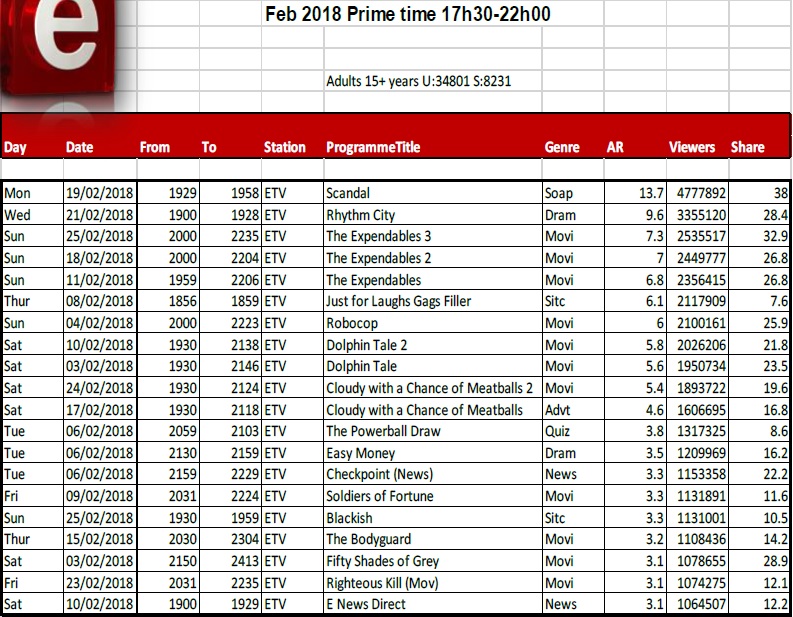
SA TV Ratings: e.tv — primetime top 20 for Feb 2018

by MarkLives (@marklives) The hottest primetime television shows on e.tv in South Africa revealed: TV ratings for February 2018.

e.tv February 2018

BRCSA TV Ratings February 2018 primetime e.tv
Click to enlarge and view clearly.

Source: BRCSA February 2018

In 2016, the Broadcast Research Council of South Africa (BRCSA) changed its policy about giving away TAMS and now only monthly reports, highlighting the top 20 or 30 primetime shows on several popular channels, are available.

Broadcast Research Council of South Africa


The Broadcast Research Council of South Africa (the BRC) is a non-profit, industry body that was incorporated in 2015 to cater to the audience research needs of the radio and television industry in South Africa.

Sign up now for the MarkLives email newsletter every Monday and Thursday, now including headlines from the Ramify.biz company newsroom service!

EDITORIAL: The ACA struck out on Telkom. We need to talk about it.

by The Editors, MarkLives.com The Association for Communication and Advertising (ACA) carries remarkable clout within the broader South African marketing and agency community. It is consistently voted as the most-admired industry organisation by agency execs in our annual Agency Leaders’ Most Admired poll. It plays an important role in self-regulating the advertising industry and has initiated important pieces of regulation, including the MAC Charter, which is assisting in ensuring transformation in the South African industry. Its CEO, Odette van der Haar, similarly holds a uniquely powerful position in the industry.

Such authority, freely granted by member agencies, and which extends well into the broader industry, comes with a set of responsibilities, including the requirement of transparent engagement with all stakeholders. For better or for worse, this includes the media covering the agency and marketing business, as well as member agencies and non-member agencies (which are still impacted by the ACA’s decisions), and the broader marketing community.

At the moment, the ACA finds itself in a troubled position of its own making. If you were unaware of this, it may be because the ACA has clammed up (its limited communication on the issue indicates it considers this a ‘closed topic’) on discussing and dissecting an issue that has already resulted in a major brand shrugging its shoulders at the rules for managing pitches and has seen three important South African agencies having their memberships suspended.

Van den Haar is well-known for enforcing the ACA’s rules on pitches — a call from her has ended the participation of more than one agency in a client pitch (as has been freely admitted by numerous agency execs over the years). This is an extraordinary power that has a real effect on both member agencies (and their people), as well as marketers.

These phone calls seemed to have been less than effective when the massive prize that is the Telkom account pitch swung into view in mid-2017. The brand spent a cool R479 536 387 on advertising in 2016, according to Nielsen Adex, making it South Africa’s 13th biggest advertiser, and a major prize in a slowing economy and with many agencies being stung by the rapid move of adspend to online media (OK, to Facebook and Google, then).

The ACA isn’t the only trade organisation trying to guide pitch processes. The World Federation of Advertisers (WFA) and the European Association of Communications Agencies (WFA/EACA) offer their own set of guidelines to assist marketers and agencies with following industry best practice. Note that the ACA offers “rules of engagement“; the two global bodies offer “guidelines”. It’s an important distinction.

The WFA/EACA guidelines note that a “long list will normally be around six agencies” and recommends that the shortlist should “consist of three or four agencies, including the incumbent if relevant.” On pitch fees it states, “Unless there are local rules or customs dictating the payment of a pitch fee, it is up to the advertiser whether they offer one or not.”

The ACA rules, meanwhile, require that the number of agencies shortlisted shouldn’t exceed five; that only credentials and case studies should be submitted and/or presented by agencies during pitches; and that a pitch fee of at least R50 000, excluding VAT, is to be paid to each unsuccessful agency when agencies are briefed to provide strategic and/or creative work. The ACA rules also notes that intellectual property of agencies, created during pitches, is protected and retained by the agencies, unless paid for (the pitch fee doesn’t count) and that sufficient time must be afforded to agencies for preparation of their submissions. At least fifteen (15) working days are required.

While it is important to guide the industry towards best practice when participating in pitches and tenders, and the process is intended to protect member agencies, as well as marketers, even the best of intentions may have adverse effects. When this happens, it’s important to look beyond intent and at the end result.

When it picked its fight with Telkom, it had no qualms about doing so in a very public manner. The ACA outlined the issues it had with how the pitch process was managed clearly, including on our pages. Similarly, it publicly announced the suspension of members DDB South Africa, Ireland/Davenport (since relaunched as Collective ID) and Wunderman South Africa, after the three agencies were found guilty of transgressing the ACA’s Code of Conduct governing tenders and pitches.

The ACA finally, and once more publicly, announced a committee to hear the appeals from the three agencies, scheduled for 3 August 2017. Then suddenly the doors were slammed shut. When MarkLives enquired about the appeals process or results, Van den Haar told us that “the ACA deems this matter closed and we will not be commenting on it anymore.”

Before we continue, let us state the obvious. The three suspended agencies did indeed breach ACA rules, and we don’t question the right of the ACA to suspend members; however, we do need to point that their suspension is part of the nett result of the ACA’s rules and regulations, and raises questions about how and why we had to come to this point in the first place. This requires open, transparent interrogation and introspection on behalf of the ACA. Even if it decides that its rules and regulations are correct and enforcable, the ACA needs to be seen to be capable of such engagement and self-reflection, which can’t happen when it seeks to shut down discussion through non-engagement.

On the issue of non-engagement, how can the ACA not release the results of the appeal, or not even admit if it is still ongoing? It’s in the industry’s best interest to know whether the initial decision to suspend its members, and announced in such a public way, stands or not. Surely this case goes to heart of the ACA rules on pitches and whether they are, in reality, enforceable?

Still, more than three months of chasing comment, and trying to persuade the ACA to continue communicating on the matter, has yielded no result.

The ACA seems to have simply lit the match and walked away. It now seems possible that the organisation may be taken to the competition commission for anti-competitive behaviour (by limiting the number of agencies that may participate in a pitch). The demand for pitch fees could also constrain the competitive environment by limiting the number of agencies a client may afford to invite into the process.

A new wave of black owned startups have been complaining that the ACA’s demand that only credentials and case studies should be submitted and/or presented by agencies during pitches puts them at a competitive disadvantage (the only way they can hope to be competitive is to present a concept; many start-ups have no case studies yet to put forward) but this seems to have been falling on deaf ears for several years.

That the ACA demanded that Telkom’s incumbent agency not participate in the pitch process, given the number of resulting redundancies the loss of the account would mean, seems cold-hearted. When this is how you treat your own members and their staff, it should serve as a first indication that your process requires a more-thorough interrogation — and possibly a dose of humanity.

The industry, and its wide range of stakeholders, has every right to expect the ACA to engage with it openly and transparently. As a trade organisation, it needs to be responsive, rather than inflexible, and it can’t shirk from taking responsibility for processes and procedures it has put in place, or the consequences which may result. The ACA’s pitch rules, if they are indeed enforceable, need continuous interrogation and engagement. We all need to talk about it. Not least the ACA.

We call on the ACA to open up on the ongoing consequences of its decisions regarding the Telkom pitch and to reengage the industry, including marketers and non-member agencies, on best practice during pitches, as well as to the enforceability of the international guidelines and/or local rules now in place. Now is the time to put egos aside to work alongside one another — openly and transparently — towards the best interest of all stakeholders. If it doesn’t, it fails in its directive to serve its core constituency, and we will all be the poorer for its loss of influence and relevance.

Herman Manson
Simone Puterman

PS: We invite you to add your name to our call for further and substantive engagement on this matter by the ACA. Simply add it, along with your job title, in our comments section below.

#WaterWise: CT agencies focused on changing behaviour — part 4

by MarkLives (@marklives) We emailed a panel of key industry executives for their take on the business impact of Cape Town’s water crisis, and their contribution towards avoiding it. Last up are Taryn Walker of King James in Cape Town and Andrew Brand of Ninety9cents.

#WaterWise: CT agencies focused on changing behaviour — part 3 — Hero
#WaterWise: CT agencies focused on changing behaviour — part 2 — FCB Cape Town & VML South Africa
#WaterWise: Cape Town agencies focused on changing behaviour — M&C Saatchi Abel & John Brown Media SA

While Day Zero — the day water runs out in Cape Town and residents are expected to queue for water at water collection posts — has been pushed back several times, Cape Town still faces a water crisis. This has numerous implications for agencies and the people in their employ. We asked a number of organisations how they are planning for any possible business disruptions and how they are assisting in saving water.

Taryn Walker

Taryn WalkerTaryn Walker is the managing director of King James in Cape Town. With a background that has spanned tech incubators, digital startups, client-side advertising and traditional marketing, her experience has always been held together with an unwavering passion for creativity. She holds an MBA from GSB and a bachelor of business science in information systems.

The biggest challenge facing businesses — or citizens in general, for that matter — during this water crisis is the uncertainty inherent in the situation. No-one knows quite when, or in some opinions, if, Day Zero will hit. And what will happen after the unthinkable occurs is anyone’s guess. We’re all entering unchartered territory.

Planning for the unknown

In our business, we’re doing everything we can both to conserve water now, and plan for the worst-case scenario. In the immediate term, we’ve implemented rain-capture systems to ensure not a drop gets wasted. We’ve shut off our dishwashers and replaced crockery with compostable wares. We’re all mellowing our yellows and we’ve implemented handless sanitisers where previously taps might run errantly unattended for minutes. These, among many other similar, are seemingly small initiatives that we believe all add up.

To manage the day zero implications, our independence as an agency is once again something we are fortunately able to leverage. Our plans are built around the personal challenges and needs of each of our staff members. Where possible, we will enable remote working and flexible hours to accommodate for the water collection and childcare challenges of our staff. We’ve asked our team how they’re planning in their personal capacities, and we’re doing our best to work with everyone individually to accommodate.

Planning for the future

But it’s not just the immediate problem that is being solved. Through the implementation of long-term infrastructure that makes smart use of water, we’re able to futureproof our business. The crisis has, to some extent, been a fortunate “kick in the pants”. What is important to us is not to succumb to the immediacy of the situation. Instead, and despite the pressure, we’re doing our best to make sure the actions we are taking build a sustainable, alternative future for us, our team and our community.

A bigger conversation

If there’s one thing that’s for certain, the crisis has elevated the conversation around this precious resource. We’ve been involved in the water conversation through Sanlam and its WWF partnership for a number of years, and most recently we launched Sanlam’s 2-Minute Shower Songs campaign, where we invited some of South Africa’s top-selling musicians to remix their hit tracks into two minute versions you can, literally, time your shower by.

And because tourism plays such a large role in the consideration on how best to manage the crisis, especially during the busy summer months in Cape Town, we launched the #SiemensAirDrop initiative through our partnership in our Johannesburg office to raise awareness amongst Gauteng travelers venturing to the Mother City on holiday. Visitors were encouraged to trade 5kg of their baggage allowance for 5kg of water — very valuable cargo indeed.

All these efforts have been done to raise awareness of the situation but there’s nothing like a crisis to escalate the urgency, and really (really) get everyone to stand up and take notice. Day Zero will come. We’ll adjust and innovate. We’ll rethink how we do things to ensure business (and life) continuity. But our relationship with water will never be the same. With South Africa ranking among the 30th driest countries in the world, the actions being taken now to deal with the immediate crisis will surely give Cape Town a significant head start on a challenge we all need to address.


Andrew Brand

Andrew BrandAndrew Brand (@99cbrand) is founder and managing director, as well as group CEO, at Ninety9cents (99c), the Cape Town agency best-known for its work on Shoprite/Checkers but which also works on Ackermans, Bryte and Capitec. He was a joint runner-up for most-admired agency boss in Cape Town in our 2017 Agency Leaders’ Most Admired Poll.

As Day Zero — albeit a moving target — looms, Cape Town companies are planning for the worst. However, there remains only a murky idea of what ‘the worst’ entails, as no major global city has ever run out of water before, and our provincial government failed to come to terms with the drought early enough to ensure the probability could be better managed.

Mitigate the impact

We can mitigate the impact to our business by rapidly adapting to our impending reality, planning carefully, and keeping channels of communication with our staff and other stakeholders open.

Fortunately, it appears that, because our agency’s offices are based within the City Bowl, it’s likely that our water supply will remain on if this day arrives. Regardless, it is still our responsibility to do everything within our means to save as much water as possible, and to ensure the wellbeing of our staff.

We have implemented a number of water saving initiatives internally, including replacing soaps with handless sanitisers and placing bottles of Eco Flush in the toilet cubicles. We have been in the process of rolling out alternative water sources, such as installing inverters which capture moisture from the air and convert it to drinking water, which will be used in all staff drinking fountains, and for tea and coffee. The aim is also to allow employees to fill personal containers with any surplus to take home, thereby augmenting their own supply. Naturally, we will also allow staff the necessary time to visit collection points to collect their daily water allocation. As we do not own our building, we are also relying on our landlord to implement additional water-saving initiatives, and it has already decreased the internal water flow; invested in aerators on all taps, and will be trucking in non-potable water for the toilet plumbing system.

Shoprite Group initiatives

We are also proud to have also worked on a number of campaigns on behalf of our clients, which promote more-rigorous water savings. Some of Shoprite Group’s initiatives include:

  • Widespread in-store and POS collateral offering tangible water-saving tips to customers
  • The installation of in-store water-saving ‘zones’ that house waterless and water-saving products
  • Ongoing CRM and DM campaigns — particularly via its email marketing ecosystem — detailing water-saving tips and information
  • The installation by Shoprite of smart water meters at 100 high-usage schools in Cape Town and a challenge to corporates to take the pledge and sponsor a water mater as part of its Smart Water Meter Challenge. Every installation saves around 1m litres of water a month and 99c has stepped in to sponsor one of the installations

The time is ripe

If any good is to come from this, it’s that we will become more conservation-focused and less wasteful. This event has the power to also change our city’s consumption habits across other areas, such as electricity and waste. The time is ripe for our government to use this current crisis as an opportunity to create a far more sustainable city.


MarkLives logo— One subscription form, three newsletters: sign up now for the twice-weekly MarkLives newsletter, including Ramify headlines; The Interlocker, our new monthly comms-focused mailer; and/or MarkLives Zambia!

Only Connect: The real secret to influencer marketing

by Bradley Elliott (@BradElliottSA) What is influencer marketing? Is it Selena Gomez promoting Coach on Instagram? Or Roger Federer celebrating with Moet & Chandon on Twitter? While it’s tempting to yell “NO!”, I’ll settle for a conditional “not quite.” Because influencer marketing and celebrity endorsement are very different, but related, aspects of the social media marketing landscape.

Celebrities are influential — nobody can deny this — and celebrities with large social media followings are very aware of the power of their influence. Selena Gomez, with 122m social media followers, charges in the region of US$550 000 for just one post.

Nothing new

Celebrity endorsement isn’t new. In the 18th century, marketers in England would vie to be appointed to a royal house. Why? The royal crest added lustre and perceptual value to the merchants’ products. Two centuries later, cigarette brands used comedians, movie stars and sports heroes to endorse products — ‘influencer’ marketing was already in full swing.

All that’s changed now is the channel. But the terrain has become a lot more tricky. Today, brands face sceptical and distrustful social media users (millennials, Gen Y and Gen X) who are savvy to blatant marketing of products, even by their heroes.

While celebrities boast reach, do they drive real engagement? Gomez, Pantene’s brand ambassador, is the highest-paid celebrity with the greatest reach but reportedly only 3% of Pantene’s target demographic engage with her photos.

Credibility

Then there’s the question of credibility. When Naomi Campbell signed up with Adidas, she made a disastrous copy-paste mistake. Instead of promoting the sneakers with a snappy message, she reposted the entire message request from Adidas’ marketers:

“Naomi, so nice to see you in good spirits. Could you put something like: Thanks to my friend @gary.aspden and all at adidas — loving these adidas 350 SPZL from adidas Spezial range. @adidasoriginals.”

But thanks to technology and smart algorithms, brands are now learning that there is gold in their social communities. Here we’re talking everyday people who love your brand, and love ‘talking’ about your brand. Let’s call these influencers ‘brand influencers’. These influencers may not have a lot of reach (less than 1000 followers) but have a huge amount of relevance and resonance. They like your brand; some of them even love your brand. They engage, they retweet, they share stories about your brand. And they spend their money on your brand.

Bait-and-switch

Brands have spent millions building audiences on big social networks. But, in return, the titans of social networks — Facebook, Twitter and Google — have pulled the biggest bait-and-switch of all time. They’re making marketers pay to engage with the very audiences that brands helped grow. Did you know that organic reach on Facebook is now only about 2%? Brands have to dig deep to rise above the noise and connect with social communities.

Despite the massive investments in social media, brands have no control over the algorithms or management of these platforms. Social giants make changes that suit their business models, not those of advertisers. Another important factor is that brands don’t own social data. Facebook, Twitter and Google do.

But, with the right technology, brands can migrate their social audiences into loyalty programmes, onto ecommerce platforms, or even into CRM databases.

Inauthentic relationships

So why are brands spending thousands of dollars building inauthentic relationships with people who often aren’t regular users of a brands products? Wouldn’t it be a better idea to tap into a pool of real influencers already in your online community?

Engaging with people who genuinely love your product may reap significant rewards. How is this done? Once these influencers are identified, one of the ways is to invite them to try out new products or attend special, ‘sneak-peek’ events.

In the US, PAX Labs held events in Los Angeles and New York to preview two new products. The e-cigarette company invited people which it had identified as influencers on its social media channels. All 18 influencers invited showed up and were treated to free samples of the products. They made 21 posts, including photographs, without any extra compensation, which reached more than 1.6m people, and generated some 30 700 likes.

Trust recommendations

Studies (including Neilsen’s Global Trust in Media Report) have shown that people trust recommendations from real people — even strangers — more than any other form of advertising.

This is what brands should be doing — partnering with real people who truly use and love their products. Not only are these people more authentic than celebrities, they’re also easier to engage with over the long term, and much more cost-efficient.

So, let’s keep it real, folks, and remember that real people add real value. Or as John Bohan, founder and CEO of Socialtyze, said in a recent Forbes piece: “Real relationships beget real influence.”


Bradley ElliottThe founder of Continuon and Platinum Seed, Bradley Elliott (@BradElliottSA) is a serial entrepreneur who’s created a number of businesses in the digital and technology sectors. He believes that marketing needs to be reinvented so that it becomes more useful to humans and brands. He’s also a collector of fine whiskey. Bradley contributes the new monthly column, “Only Connect”, which focuses on influencer marketing, to MarkLives.com.

— One subscription form, three newsletters: sign up now for the twice-weekly MarkLives newsletter, including Ramify headlines; The Interlocker, our new monthly comms-focused mailer; and/or MarkLives Zambia!

Media Redefined: How to get creatives to love data

by Martin MacGregor (@MartMacG) What is the biggest myth in advertising? That a brilliant idea may come from anywhere.

I know this pricks the bubble of anyone not in the creative department, and to be fair, I also used to buy into this. It certainly motivated my entry into the industry, and meant I often showered expectantly waiting for the “aha” moment which would brilliantly connect with and excite consumers. (There is the odd exception, though, where the production intern has an epiphany halfway through their weekly yoga session and burst into the creative director’s office. carrying a golden nugget.)

Specific kind of mind

What I have come to appreciate is the specific kind of mind required to be creative. It really is a professional art, a craft learnt and honed over years of doing nothing else. Lateral thinking will never come easy to the literal. And that’s fine. Everyone needs to play to their strengths.

However, there is a new stream of creative output that clients are demanding and which creatives need to embrace. This was highlighted when I recently saw a Twitter rant from a senior creative, bemoaning the current obsession with data and ROI when actually creativity and purpose was the real key to the future of the advertising business. This seems to be a widespread view.

In reality, a key line needs to be drawn. Creative that is tasked to build brand and inspire brand love with softer noting and liking metrics should absolutely be developed on “gut and feel” with every ounce of left-field creativity. But clients are demanding something else: creative formulated and executed entirely on what the data says. This requires a creative team to be geared to respond quickly and inexpensively to consumer action and engagement.

Pure response data

This is about pure response data, data which immediately and accurately measures the response to an execution. It already exists in digital and, more and more, it’s being applied in other media, especially TV. Whether it is sales, clicks or call-centre calls that clients are looking for, if they have this data, they are going want to analyse it and want the messaging to adapt dependent on what the data says.

It’s understandable that creatives are not attracted to this. It’s the equivalent of telling Leonardo da Vinci that research showed that people prefer their painting subjects to be happy, so could he paint Mona with a bit more of a glint in her eye?

The crafting of this creative needs two key components.

  1. It needs to be flexible to be able to be expressed in a number of different ways — an experimental approach aimed at achieving the most-optimal outcome.
  2. And it needs incredibly quick turnaround. Data has a very short lifespan, and the ability to move fast is what will give data-led creative the edge.

Requirements

What does this require? It will require a certain kind of creative skill-set, one that buys into and is willing to listen to what the data says and, ultimately, that will be listening to the people closest to the data — the media team and the client research team.

Let’s be honest, this is not popular development. But, just like Steve Jobs insisted on “technology married with the humanities”, creatives shouldn’t be scared of the potential impact of data married to creative. After all, we’re trying to sell our clients’ products here.


Martin MacGregorMartin MacGregor (@MartMacG) is managing director of Connect, an M&C Saatchi Company, with offices in Johannesburg and Cape Town. Martin has spent 18 years in the industry, and has previously worked at Ogilvy and was MD of MEC Nota Bene in Cape Town. He contributes the monthly “Media Redefined” column, in which he challenges norms in the media space, to MarkLives.com.

— One subscription form, three newsletters: sign up now for the MarkLives newsletter, including Ramify headlines; The Interlocker, our new monthly comms-focused mailer; and Brands & Branding, launching soon!

Shelf Life: Webafrica’s effing fast campaign from Jupiter CT

Cheryl Hunter (shelflife at marklives.com)’s weekly pick of all things new — product, packaging, design, insight, food, décor and more!

  • Webafrica is ‘effing’ up its new campaign
  • PriceCheck revamps
  • Sony’s Peter Rabbit delivers Cadbury this Easter

WTF from Webafrica

When you’re so impressed by something, it’s effing impressive…so that’s what Webafrica decided to call its latest campaign about ‘effing fast fibre’, created by The Jupiter Drawing Room Cape Town.

In keeping with Webafrica’s light-hearted and simple approach to its ATL campaigns, the new campaign leaves the consumer with one message to remember: fast internet = Webafrica. Says Tim Wyatt-Gunning, Webafrica CEO, “Our internet is fast, and we call it like it is. Our ‘Skip Ad’ is sitting at over 1.8m views because we all get a bit of joy out of seeing someone struggling to skip for almost two minutes, and this ad is no different. It’s the way we can all relate to someone saying it like it is without mincing his words and getting the facts across without any puffery and nonsense.”

Lucas van Vuuren, Jupiter CT executive creative director, explains: “The brief was to get the ‘fast’ message across to the consumer. From there, we just started having fun with it and seeing how the banter and the idea evolved into something effing unexpected. When we presented it to the team at Webafrica, this was the idea we were hanging our hats on and they were game, which is basically every agency’s dream come true.”

Along with this video, there is an ‘effing fast’ radio campaign and outdoor billboards to support it.

webafrica.co.zaBlogFacebookTwitterInstagram
thejupiterdrawingroom.comFacebookTwitterInstagramRamify


Price-checking made easy

PriceCheck, one of South Africa’s biggest product discovery and comparison platforms, has relaunched — the new look and enhanced functionality are designed to make it easier to filter through extensive product ranges for the best possible prices.

The new service has been built from the ground up, placing customers at the core of the redesign with simplified navigation that enables more-informed buying decisions from a wide range of retailers. The new features include side-by-side product comparison of products, multi-shop orders in a single transaction, detailed product descriptions, themed product pages, high-quality images and good design. The site is also optimised for mobile.

Says Kevin Tucker, PriceCheck CEO, “To keep pace with the rapid evolution of local e-commerce, we’ve regularly improved the PriceCheck user experience. This redesign is geared towards enabling cross-category ecommerce and growing small and large businesses as a result. One of the focal points of modern ecommerce is introducing consumers to quality products from reliable merchants — today we’re doing just that.”

PriceCheck has also placed a special focus on feedback and community engagement: “We have made sure that consumers are equipped to make more-informed decisions while shopping through feedback mechanisms such as product reviews that other shoppers are able to read before making their purchase.”

pricecheck.co.zaFacebookTwitter


Owning Easter

As Sony Pictures launches Peter Rabbit, Cadbury Dairy Milk has launched a limited-edition Peter Rabbit Milk Chocolate Egg, filled with Astros, to entice consumers this Easter.

The latest product offering rolls out with a newly launched TVC that sees a floppy-eared Cadbury Dairy Milk Easter Bunny off on a mission to deliver joy to the nation. The ad was done by Ogilvy Australia, with Ogilvy & Mather South Africa doing minor edits.

The campaign celebrates a partnership with Sony Pictures, which is bringing the beloved Beatrix Potter storybook character, Peter Rabbit, to the big screen in a new movie that launches nationwide on 29 March 2018.

Says Grant van Niekerk, Mondelez SA category lead for chocolate, “We are very excited about our partnership with Peter Rabbit. The adventurous character and comedic story resonated well with our brand and presented a great opportunity to include an Easter offering.”

The Peter Rabbit Cadbury Dairy Milk Chocolate Easter Egg is available in participating retail stores at a recommended retail price of R39.99.

sonypictures.comFacebookTwitter
cadbury.co.zaFacebookTwitter


Cheryl HunterShelf Life is MarkLives.com’s weekly column covering all things new. Notify us of yours at shelflife at marklives dot com. Want to sponsor Shelf Life? Contact us here.

Cheryl Hunter (@cherylhunter) has written for the South African media, marketing and advertising industries for more than 15 years. A former editor of M&M in Independent Newspapers and contributor to Bizcommunity, AdFocus, AdReview and the Ad Annual, she has also produced for various television networks and currently consults on communication strategy and media liaison.

— One subscription form, three newsletters: sign up now for the twice-weekly MarkLives newsletter, including Ramify headlines; The Interlocker, our new monthly comms-focused mailer; and/or MarkLives Zambia!

#AgencyLeaders2017: Most-rated brand, pitch consultant & trade org

by Herman Manson (@marklives) In our annual Agency Leaders’ Most Admired poll for 2017, we asked ad execs to take a broader view of the marketing environment and nominate the brand they would most want their agencies to work on (which must operate in South Africa and excluding their current clients); which pitch consultant they would recommend to a client; and the industry body they rate the most highly.

Over the past several weeks, we’ve revealed the South African, Johannesburg and Cape Town winners of the new Agency Diversity & Transformation awards, and, before that, we revealed the most-admired agencies and agency leaders in South Africa’s primary ad markets of Cape Town and Johannesburg, as well as nationally, over several weeks.

1. The brands (tied) that agencies most want to work on in South Africa

Coca-Cola logo

Volkswagen logo

Coca-Cola

Volkswagen

The lucky agency which has the account:

FCB Africa

The lucky agency which has the account:

Ogilvy & Mather Cape Town

Previously

In 2016, it was Nando’s (this year it placed third) and, in 2015, it was Coca-Cola. Nike was the runner-up. In 2014, the first time we polled this category, it was Coca-Cola, too, with FNB close behind Coke.


2. The most-recommended pitch consultant in South Africa

IAS logoIndependent Agency Selection (IAS)

Previously

In the previous three years, it was Yardstick every time.


YardstickRunner-up

Yardstick

Previously

In the previous three years, it was IAS every time.


3. The most-admired ad industry body in South Africa

ACA logoAssociation for Communication and Advertising (ACA)

Previously

In 2016, it was the ACA. In 2015 the ACA and the IAB tied for top spot. In 2014, the ACA was the most-admired by a good margin. 


How the poll works

Towards the end of 2017, we invited agency executives to nominate their most-admired agency, creative leader and most-admired agency both in their region (Johannesburg or Cape Town) and nationally. We also asked them which agency did the best at digital integration and at transformation (a new question), and which agency they saw as the one to watch in the future. Execs couldn’t nominate their own agencies or staff members. All the nominations were then tallied up for the final result. The editors of MarkLives had two votes in the final poll.

Note: Runner-up(s) will only be named if they achieved a good nomination tally relative to the winner’s position. Contenders are named if they stand out significantly above other nominees but weren’t able to close in on the winner’s tally. The most-admired agency of the year is disqualified from the One to Watch category; votes cast in its favour in this category are discarded.

See also


Herman Manson 2017Herman Manson (@marklives) is the founder and editor of MarkLives.com.

— One subscription form, three newsletters: sign up now for the twice-weekly MarkLives newsletter, including Ramify headlines; The Interlocker, our new monthly comms-focused mailer; and/or MarkLives Zambia!

Online CPD Courses Psychology Online CPD Courses Marketing analytics software Marketing analytics software for small business Business management software Business accounting software Gearbox repair company Makeup artist