Gestalt: Martech and ‘marchitecture’ — customer first

by Leeya Hendricks (@LeeyaHendricks) When was the last time you had a memorable experience when purchasing a product or service? To what extent was technology used to enable an end-to-end engagement, making you feel truly integral to the entire journey?

My own personal experience happened while I was jogging to my yoga class and realised I’d left my bottle of water and wallet at home. But, with my smart watch literally on hand, I was able to do three things to turn this ‘fail’ into a win — it allowed me to 1. use Apple Pay to buy another water without a card, 2. summon Siri to use Maps as part of my run, not only to locate the nearest corner café where I could buy the water but also 3. to track my fitness goals for the day and edge me closer to achieving my daily exercise activity. All of this in one effortless, seamless experience.

What enables seamless customer experiences?

Delivering great customer experiences such as the one I had is more important than ever. Business leaders need to keep pace with connected consumers and an evolving customer journey that’s becoming increasingly mobile-centric and voice-enabled. To this end, a solid ‘marchitecture’ should be an essential part of your customer strategy, as it may bridge the gap between technology infrastructure and customer needs.

A marchitecture — or marketecture — comprises software or hardware architecture designed with marketing as its primary consideration[1]. To build the agility needed to keep pace with the connected consumer, it’s vital to have an effective marchitecture strategy to make sure your product and tech stand out from the crowd and may easily be absorbed by prospects and customers.

Ultimately, an effective marchitecture may help provide customers with experiences that satisfy them on their customer journey, boosting companies’ overall marketing performance.

Martech

While marchitecture refers to the architectural underpinnings of digital marketing, martech involves the permeation of tech in marketing at every point in the customer journey. Virtually anyone involved in digital marketing deals with martech, since digital by its very nature is technological. [2]

As organisations become increasingly aligned with their customers’ needs, an increasing convergence of marketing spend across tech, data, media and content will inevitably happen, resulting in less-siloed initiatives. This will serve the development of martech stacks that drive ever-deeper personalisation, richer experiences and improved engagement across all stages of the customer journey. But it will only reap real rewards with the right technology architecture and martech.

The need for this is clear from the huge challenge of positioning your organisation prominently in a crowded and increasingly complex martech ecosystem. For example, many marketers and vendors fail to communicate clearly how their offerings meet market demand and customer needs. A sound marchitecture may help them position complex products and services as customer-centric solutions. At the core of this is the convergence of the tech solution you offer and the tech-enabled ways in which you market it to reach the right customers and speak to them in language that they can understand.

Marchitecture for success

Building the right marchitecture is a journey that accelerates and evolves with your organisation. Going through a rigorous value proposition study in the build stage will put you in an ideal position to analyse and uncover competitor challenges and identify new opportunities.

The key points to building a solid marchitecture are simple:

  1. Start with a solid value proposition
  2. Align all key internal stakeholders (CFO, CTO, CMO, etc)
  3. Identify audiences and industry segments
  4. Build a messaging and positioning framework
  5. Build a basic representation of your technology stack
  6. Map marchitecture initiatives to the customer life cycle in support of product marketing.

Ultimately, an ideal marchitecture focuses on that last point — how your product solves buyer problems. This allows business leaders to plot their solution throughout the marketing stack[3] and deliver messaging across the whole organisation to sell in line with key business objectives. [4]

As with my water bottle and wallet problem that was resolved with the use of my wearable, the customer journey should always be a seamless and effortless experience whose value is communicated simply and clearly throughout the journey, using the right blend of digital marketing technologies that are in turn underpinned by the right marchitecture.

Ultimately, it got me the only thing I really wanted at that point — a solution to my problem.

References

[1] springer.com/gb/book/9783540287148
[2] itknowledgeexchange.techtarget.com/overheard/overheard-it-diagrams-for-the-business-side-marketecture
[3] blog.loginradius.com/2015/01/8-ways-data-boosts-marketing-strategy
[4] martechtoday.com/cmo-martech-marchitecture-messaging-matters-customers-209183

Updated on 19 November 2018.


Leeya HendricksLeeya Hendricks (@LeeyaHendricks) is a chartered marketer, global marketing strategist, a digital driver and a Women in Tech leader. She joined Oracle South Africa in 2016 as marketing director SADC, responsible for leading integrated modern marketing strategies for the business across the southern African region, and is currently marketing director for the ECEMEA region, based at Oracle UK, responsible for driving digital strategy, demand generation and transforms portfolios to develop sustainable revenue growth. Leeya contributes the new monthly column “Gestalt”, about putting customer first for sustainable business success, to Marklives.

— One subscription form, three newsletters: sign up now for the twice-weekly MarkLives newsletter, including Ramify headlines; The Interlocker, our new monthly comms-focused mailer; and/or MarkLives Zambia!

Clicks ’n Tricks: Internet censorship bill will break media, marketing

by Charlie Stewart (@CStewart_ZA) Amid the euphoria of the Rama-presidency, some pretty darned scary — and largely unreported — news slipped out of Parliament last week: our legislators approved the internet censorship bill. Over the past month or two, it’s seemed that control of the asylum was gradually being wrestled back from the lunatics. But, on this evidence, it seems the crazies are still in charge.

Apathy

Nearly half of our 400 MPs were too apathetic to pitch up for one of the most-significant debates seen by Parliament in recent years. And, of the 224 elected representatives who deigned to vote, a staggering 189 supported a bill that is so preposterous it’s almost comedic.

The Film and Publications Amendment Bill gives the erstwhile Film and Publications Board the right to regulate online content. Ostensibly, the bill is designed to protect children from being exposed to disturbing content. Laudably, it aims to curb revenge porn and hate speech while also addressing the scourge of fake news.

The bill determines that any person or entity who distributes or exhibits any film, game or digital publication is governed by its legislation. This means that the government will be given the power to restrict and censor online content, such as social media messages, distributed by companies and individuals. It’s Big Brother 2.0.

You can’t breathe

It’s akin to the government laying claim to oxygen and telling us that it’ll be the final arbiter in determining how much of the stuff we’re each able to breathe. Like oxygen, online content is ethereal. It’s all around us and, short of forcing us all to install a censor program on our laptops and phones, it’s going to be impossible to regulate.

The bill does try to differentiate between commercial and non-commercial distributors — the implication here is that organisations (and people) who make a living from online media will be subject to greater scrutiny than those who merely publish the odd meme or blog for personal gratification.

Online publishers will be forced to register with the FCB, pay a fee in order to distribute content and submit anything they intend to post for pre-classification/approval before it’s published. Step out of line and they’ll be fined.

Broken news

At a practical level, this piece of revisionism will take us back to the days of the printing press where two-month lead times predicated the release of the latest happenings. Breaking news will become broken news. Broken news means broke publishers.

The erosion of the fourth estate won’t just hamper free speech. It’ll kill the very watchdogs whose fearless reporting have exposed state capture and forced the Guptas to flee. Perhaps that’s motivation enough for the corpulent cowards who sit on the seats of power.

But, beyond the horrifying impact the bill will have on the press, it also has profound implications for the marketing industry. In recent years, storytelling and content production have taken the lion’s share of brand budgets. And most of this content is surfaced online. Nando’s topical double entendres will be no more. Spree’s personalised recommendation emailers will stop. Bonang’s Instagram product placements will cease to be. Perhaps some of that doesn’t sound like such bad news — but the idea that our every utterance will be subject to scrutiny most certainly is.

Unenforceable, expensive mess

So where to from here? While Parliament has approved the bill, it still needs to be debated and rubber stamped by the Council of Provinces. From there, it’ll go to the president for final authorisation. Somewhere in this process, surely someone will recognise that it’s going to another unenforceable, expensive mess.


Charlie StewartCharlie Stewart (@CStewart_ZA) is CEO of Rogerwilco, a multi-award-winning independent digital agency best known for its expertise with Drupal, SEO and content marketing. A Scot by birth, he moved to South Africa in the early 2000s in his quest to support a winning rugby team — a search he’s reluctantly forsaken. Together with Mark Eardley, he co-authored Business to Business Marketing: A Step by Step Guide, (Penguin Random House, 2016) and may be found on LinkedIn. Charlie contributes the monthly “Clicks ‘n Tricks” column, which looks at how brands are using digital channels to engage their customers, to MarkLives.

— One subscription form, three newsletters: sign up now for the twice-weekly MarkLives newsletter, including Ramify headlines; The Interlocker, our new monthly comms-focused mailer; and/or MarkLives Zambia!

Adnalysis: Agile brand marketing is essential in today’s world

by Bogosi Motshegwa (@Thinkerneur) Most investments in marketing have no guarantee. If they do, you can bet that these are safe investments. Activities that have been done before. But, if you’re engaging your target market in innovative ways where there is neither guardrail nor template, there are no guarantees. How many brands, marketers and agencies engage in “never-seen-before brand executions”? That’s a story for another day.

Whether we engage in expected or novel activities, when we set big and audacious goals, we decide on a strategic direction and we have our intermediate goals that help us achieve our big audacious goals. We plan, which is fantastic. Yet planning ahead is great for long-term but may be stifling for the short-term in leading to the long-term success. Basically, having long-term goals is not sufficient; we need to have agile, flexible and nimble short-term goals.

Here’s what I mean

Brands, marketers and advertisers embark on yearly plans and, once those have been developed and agreed upon, the documents become the holy grail. The caution I have with yearly or multiple-year plans is that, while they provide direction on how brand-building will be implemented for the year or years to come, at the same time, the same plans rule out any other opportunities that may come about as these may fall outside the budget or scope of work that’s already been outlined.

In today’s world, technological advancements are moving businesses forward at a rapid pace. Big data, AI, machine learning and programmatic tools are allowing us to be nimble and flexible (at least in theory). Our thinking and planning are set in the future, and yet our ability is stifled to take advantage of opportunities immediately.

What we need to do

Planning is necessary, and I do advocate for it. To have a vision is a sign of life. I also know that budgets are tight as they need to be allocated and signed way ahead of time. I would like to add one more thing to yearly plans, however. It won’t be easy to execute but is worth including.

Businesses which are agile and nimble in their actions are the ones that win and provide the most value for customers and people — the operative word being “value”. If tech is shaping how we do business, and interact with our audiences and how they in turn interact with brands, surely how we plan should also be informed by these uncertain times?

Things change rapidly and this is the primary reason why brands need to be flexible, agile and nimble. I’ve seen brands miss opportunities — great opportunities — because “the idea is not part of our brand plans” or because “we have already set budgets aside”. In a rapidly changing world, shouldn’t our plans be changing accordingly?

How to be flexible, agile and nimble

  1. Keep reviewing the strategy: There’s no such thing as a complete strategy. I believe that strategy is a consistent work-in-progress for the better. This may sound schizophrenic but it’s not. If strategic thinking is fixed, creative ideas also get fixed.
  2. Keep refining creative ideas: Again, there’s no such thing as the perfect idea. Great ideas keep being iterated. There’s always an opportunity to finesse, to refine, to do something better. Creative ideas are no different to strategy, especially so because these are what people get to consume directly.
  3. Keep asking if this is the best way: I’ve found that, the more you ask this question, the more loopholes you see, and therefore you can close them. This question is a win-win because should there be no loopholes; interrogating the ideas allows you to gain confidence in those ideas. Confidence is key to achieving your goals because, once you believe in them, making them possible becomes easy.
  4. What do you think? Collaboration is key. Ask people what they think; there’s value is listening to others. You’ll be surprised by the quality of feedback you’ll get from people you didn’t expect. Brand marketing at its core is based on human relations. So, it’s not a bad idea to ask people to review your ideas. After all, no single idea may purely be attributed to a single person.
  5. Have the ‘agile’ budget: Easier said than done. Why would you have ‘agile’ budget when you can deploy every rand into something that you believe will yield desired results? See points 3 and 4. No matter how smart you think you are, you never really have it figured out as there’s no way that you had all the world’s information at your fingertips when you were planning and, therefore, chances are you may’ve missed something. This may very well be what could literally change the direction of your campaign or brand-building efforts for the better. This is literally money for what you may have missed. But, as humans, we don’t like to think about things we might have done; it’s better for our egos that everything that can be done has been done. Perspective is everything, and there is absolutely no way that one human being can have a view of all possible viewpoints or perspective. We are only human; therefore, we have our shortcomings. This ‘agile’ budget is for our shortcomings.

In conclusion

Being agile, flexible and nimble are what brands need to do to win and the five points above are fundamental to achieving great successes. It’s not necessarily about ‘technology’ but the thinking. The more flexible, nimble and agile the mind is, the greater the chances for achieving unprecedented success.


Bogosi MotshegwaBogosi Motshegwa (@Thinkerneur) truly believes that advertising can really change the world. Every single day he tries to prove this. He shares his thoughts on the industry and sometimes has unconventional views. Bogosi is the co-founder of Melanoid Éclat (for finding black entrepreneurs), a committee member of AMASA, an Advisory Council member and guest speaker at Vega, and also does speaker management at TEDxJohannesburg. He is currently a strategic planner at Net#work BBDO. He contributes the monthly column, “Adnalysis”, which analyses adland from a strategist’s point of view, to MarkLives.com.

— One subscription form, three newsletters: sign up now for the twice-weekly MarkLives newsletter, including Ramify headlines; The Interlocker, our new monthly comms-focused mailer; and/or MarkLives Zambia!

#AgencyLeaders2017 South Africa: Agency diversity & transformation

by Herman Manson (@marklives) Today, we announce the national winner of our new Agency Diversity & Transformation award. Instead of only naming the agency here, we invited it to share with us what agency diversity and transformation means to it — the business, its people and its clients.

During the course of 2017, this agency, in the minds of its regional peers, made the most-significant contribution to agency diversity and transformation in the country. While many of our voters would have focused on BBBEE as a primary criteria informing their votes, a positive contribution to gender and LGBTQI diversity would have come into play in some votes.

Over the last two weeks, we’ve revealed the Johannesburg and Cape Town regional winners and, before that, we revealed the most-admired agencies and agency leaders in South Africa’s primary ad markets of Cape Town and Johannesburg, as well as nationally, over several weeks.

South Africa: Agency diversity & transformation

Avatar South Africa exterior shotAVATAR

Zibusiso Mkhwanazi
Zibusiso Mkhwanazi, CEO & co-founder of AVATAR South Africa.

by Zibusiso Mkhwanazi (@ZibusisoSays) A sustainable agency is not built on an individual but a collective. Diverse voices, diverse views, diverse backgrounds. It gives us the institutional intelligence to solve complex problems for our clients.

Our USP on diversity means we can speak to broader audiences — our high pitch-win rate is testament to that; our client retention rate is testament to that. Diverse voices give us perspective when branding and communication and advertising in this country are desperately in need of it. It’s become part of our culture and our dynamic at Avatar: a greater understanding of the person next to you unlocks solutions to a challenging brief. We are a better business because we offer different perspectives, and our clients see the power of work that comes from our culture.

Clients are driving this need faster than agencies are, to be frank. It is why we have expanded to Cape Town, and where our team has tripled in size in under a year. And it’s not just about racial diversity or geographical diversity (we make a conscious effort to have as many people from rural backgrounds as urban backgrounds) but gender diversity as well.

Challenged

We get challenged, too! Most recently, in a quick turnaround global pitch, we were asked where all the women were. Timings and diaries had not allowed our key female voices to be there, but that was a good wakeup call to ourselves about not being complacent on these issues.

Our head of social media, media, client service, communications, operations are all women. At management and executive level, we’re diverse and represented. We’re especially cognisant about increasing and growing the number of black woman creatives in the industry. We also have the Esihlahleni Women’s Empowerment, a non-profit initiative from M&N Brands, that aids in micro-financing women-owned enterprises and provides bursaries for women from disadvantaged communities to enter the industry. This is self-funded.

And we’re completely transformed.

Right thing to do

So why are we doing this? Because it’s the right thing to do. It’s no longer enough to transform an agency; it’s time to transform the industry. Agency leaders shouldn’t be driven by codes or policies but an innate need to correct the imbalances. I’m seeing such complex trusts and structures being put in place to essentially cheat the system so agencies can proudly boast they are Level 1 or 2 BBBEE. An unwillingness to embrace diversity and transformation may win you a life-line short term but isn’t going to build your agency long term.

The landscape is changing — we’re past the time when black agencies are simply indulged. Black agencies may now compete on the field of ideas because clients are coming around to understanding the benefit of diverse voices.


How the poll works

Towards the end of 2017, we invited agency executives to nominate their most-admired agency, creative leader and most-admired agency both in their region (Johannesburg or Cape Town) and nationally. We also asked them which agency did the best at digital integration and at transformation (a new question), and which agency they saw as the one to watch in the future. Execs couldn’t nominate their own agencies or staff members. All the nominations were then tallied up for the final result. The editors of MarkLives had two votes in the final poll.

Note: Runner-up(s) will only be named if they achieved a good nomination tally relative to the winner’s position. Contenders are named if they stand out significantly above other nominees but weren’t able to close in on the winner’s tally. The most-admired agency of the year is disqualified from the One to Watch category; votes cast in its favour in this category are discarded.

See also


Herman Manson 2017Herman Manson (@marklives) is the founder and editor of MarkLives.com.

— One subscription form, three newsletters: sign up now for the twice-weekly MarkLives newsletter, including Ramify headlines; The Interlocker, our new monthly comms-focused mailer; and/or MarkLives Zambia!

[CARTOON] The Marketing Mice on SA’s public trust deficit

by Charlie Mathews (@CharlesLeeZAThe 2018 Edelman Trust Barometer shows that we have become distrusters — South Africans don’t trust business, government, media and NGOs “to do what is right”. This is because South Africans have suffered an onslaught of failure and disappointments from big public brands.

Marketing Mice 2018 03 12 Trust deficit


Charlie MathewsA serial entrepreneur who founded, and sold, two marketing companies, Charlie Mathews (@CharlesLeeZA) has grown brands for Naspers, Shoprite Checkers and Absa, and helped a number of tech startups go to market, raise VC funding, and grow. The former co-founder of Idea Engineers, Mathews grew the business into a multi-million rand agency before exiting, and also helped establish one of the fastest-growing offices for global tech PR company, Text 100, winning the Chairman’s award for growth. These days, Charlie is a growth hacker at WorldBrain.io and Continuon.co. When not writing or thinking about growth-hacking or -marketing, Charlie creates The Marketing Mice exclusively for MarkLives.

— One subscription form, three newsletters: sign up now for the twice-weekly MarkLives newsletter, including Ramify headlines; The Interlocker, our new monthly comms-focused mailer; and/or MarkLives Zambia!

ABC of Scale: Traction. The book for startups every brand owner must read

by Charlie Mathews (@CharlesLeeZA) How did DuckDuckGo grow from a few thousand queries a day to a search engine that today manages some 16bn queries daily? Traction: How Any Startup Can Achieve Explosive Customer Growth answers this question, and a whole lot more, in a book for startups that everybody who works with brands should read.

Why? The top challenge facing marketers today is generating traffic and leads. After polling thousands of marketers annually for the past nine years, Hubspot’s State Of Inbound 2017 report shows that converting leads to customers, growing website traffic and increasing revenue remains the biggest challenges that marketers face.

Top takeaways

One of the top takeaways that brand owners and managers will get from Traction is how to think like a startup whose very survival depends on getting customers. Another is how to think analytically and to consider channels that likely live outside of your brand’s marketing purview.

Given how digital has forever fragmented and changed media channels, the 19 means of connecting with, and converting, customers explored in #Traction deserve close examination.

Written by Gabriel Weinberg, the founder and CEO of DuckDuckGo, and Justin Mares, the former director of revenue at software company, Exceptional, the book includes interviews with a constellation of DotCom rockstars. These luminaries include Colin Nederkoorn, CEO of Customer.io; Nikhil Sethi, founder of Adaptly; Dan Martell, CEO of Clarity.fm; Alexis Ohanian, who cofounded reddit; Jimmy Wales, the co-founder of Wikipedia; Sandi MacPherson, who founded Quibb; and more.

Channels

Among the 19 channels you should be using to scale your customer base?

  • Targeting blogs: Here the big story is how Noah Kagan, former marketing director of Mint, used blogs to acquire the first 40000 users for the personal financial management company before launch.
  • Publicity: In this section, former TechCrunch writer, Jason Kincaid, reveals what to do and what not to do when trying to forge relationships with journalists to get editorial coverage.
  • Unconventional PR: Here the authors list two types of unconventional PR, stunts and the often-overlooked tactic of personal appreciation that make customers feel valued.
  • Viral marketing: This chapter considers how to ensure that each new customer you onboard brings at least one other customer with them.

Other channels the authors advocate include search engine marketing; social and display ads; sales; affiliate programs; trade shows; offline events; speaker opportunities; existing platforms like websites and apps; offline ads; search engine optimisation (SEO); content marketing; and email marketing. Engineering as marketing is also considered a channel — this means building the resources and tools that are useful for people and, subsequently. drive reach. The last channel is community building, which Wikipedia has done particularly well.

Tactics

Weinberg offers this advice in a blog that examines these tactics for acquiring customers: “When considering these 19 traction channels, try your best not to dismiss them as irrelevant for your company. Each traction channel has worked for startups of all kinds and phases. The right channel is often an underutilized one. Get one channel working that your competitors dismiss, and you can grow rapidly while they languish.”

One of the unfortunate problems with scale is what happens once you’ve achieved it. There’s nothing like having no customers to light a fire in your belly. But, once you’ve achieved growth, it’s likely that you won’t still be the same hungry entrepreneur you once were. This book reminds you of the best part of what it is to be a startup, which is all about using smart and calculated thinking to drive growth.

Thanks for reading this, my first column on #GrowthHacking and the art of scale. If there’s anything you’d like me to cover in future, please email me at charlie [at] charlesleemathews.com

Further reading


Charlie MathewsA serial entrepreneur who founded, and sold, two marketing companies, Charlie Mathews (@CharlesLeeZA) has grown brands for Naspers, Shoprite Checkers and Absa, and helped a number of tech startups go to market, raise VC funding, and grow. The former co-founder of Idea Engineers, Mathews grew the business into a multi-million rand agency before exiting, and also helped establish one of the fastest-growing offices for global tech PR company, Text 100, winning the Chairman’s award for growth. These days, Charlie is a growth hacker at WorldBrain.io and Continuon.co. “ABC of Scale” is a MarkLives column focusing on growth-hacking and -marketing.

— One subscription form, three newsletters: sign up now for the twice-weekly MarkLives newsletter, including Ramify headlines; The Interlocker, our new monthly comms-focused mailer; and/or MarkLives Zambia!

#HoldMyBeer pushes Castle Lite to do better

by MarkLives (@marklives) A social media post by radio and TV personality, Dineo Ranaka, has led at least one beer brand to rethink its misogynist advertising practices on International Women’s Day yesterday, 8 March 2018. Using the hashtag “#HoldMyBeer“, social media users discussed the misrepresentation of women in beer commercials.

Ranaka wrote, “After such a long day making magic, a cold beer is all that’s needed to unwind. #HoldMyBeer” — and posted an image of an open Castle Light.

Numerous men took issue with women drinking beer, which has prompted Castle Light to consider the role of its communications in stereotyping beer as a drink only for men.

https://twitter.com/Bee_Loaded/status/971476773539065856

The beer brand tweeted that it promises a more-inclusive communication strategy in future:”#HoldMyBeer pushed us to take a long hard look at the role we play in shaping cultural norms. From now #CastleLite promises to be better, to stop the exclusion & unlock more inclusion because women should do anything, be anything, drink anything. #InternationalWomensDay”

https://twitter.com/castlelitesa/status/971749334197981185

“We at Castle Lite recognise that women are not accessories to men; they sit at the corporate board table and the pub too,” says Becky Opdyke, Castle Lite brand director, in a media statement. “Our ads and communications will never again degrade or objectify women. We celebrate the more than 1m women who drink Castle Lite and will treat them with the respect they deserve in all of our brand communications moving forward.”

The apology ad was executed by Ogilvy & Mather Cape Town and the social media strategy by DNA Brand Architects.

Video Credits:

Ogilvy
Associate Creative Director; Neil White
Copywriter: Zanele Kabane

DNA Brand Architects
Marcus Modimokwane
Gugu Ndabezitha
Thabo Manenje

Castle Lite Marketing Manager
Silke Bucker


See also

— One subscription form, three newsletters: sign up now for the twice-weekly MarkLives newsletter, including Ramify headlines; The Interlocker, our new monthly comms-focused mailer; and/or MarkLives Zambia!

Cover Stories: Thoughtfulness in design (9 Mar 2018)

by Shane de Lange (@shanenilfunct) Let’s delve into great media design from South Africa and around the world:

  • International/print: Fortune India effectively uses typography and colour to extend an economic narrative
  • Local/print: Get It (Joburg North) sets a precedent when it comes to contemporary culture in the suburbs, pushing the design sensibility of the bourgeoisie to the limits
  • Online: 99% Invisible provides a weekly investigation into the mechanisms and influence of design in our lived lives
  • Local/print: Where It’s At offers a well-curated and beautifully crafted survey of the SA art and design community
  • International/print: Metropolitan celebrates a genius within the fashion design community through succinct illustrated vignettes
  • Iconic: Colors finds that the common denominator that connects us all is difference. Best we respect it.

Find a cover we should know about? Tweet us at @Marklives and @shanenilfunct.
Pinterest icon Want to view all the covers at a glance? See our Pinterest board!


Print

Get It (Joburg North) (South Africa), March 2018

Get It Joburg North, March 2018 - Koos Groenewald and Jana Hamman

Infamous Johannesburg design duo, Jana Hamman and Koos Groenewald from studio Jana + Koos, emblazon the cover of Get It (Joburg North). With a flare of orange to segregate the masthead from the prolific Braamfontein-based collaborative pair, this cover makes a statement. As opposed to the customary covers for suburban magazines like Get it, with its various sibling publications across South Africa, this Get It cover gets it, giving Joburg’s northern suburbs a serious injection of chic design pedigree and tastefully separating it from the rest of the franchise. Informed about important exponents in the South African design community, this editorial team seems to have a clear sense of culture by placing these two insanely talented creatives on the cover. Good form all round, a precedent set.


Fortune India (India), March 2018

Fortune India, March 2018

New Delhi-based Fortune India continues to deliver magazine covers that are aesthetically pleasing and, at best on a formal foundation, reveal a keen awareness of the importance of fundamentals in design and visual communication, particularly typography, layout and colour. Designed by art director, Anirban Ghosh, his animated use of typography effectively strings together the narrative implied by the headline in the top left corner of the cover. The composition of the information hierarchy remains uncluttered despite the effective use of fragmented type in the bottom third of the cover. This narrative is further emphasised by the bold contrasts in colour and warm colour relations, using a classic mix of red, yellow and black that suggests the urgency, or rather emergency, of the implied narrative. All in all, textbook stuff.


Where It’s At (South Africa), once-off, 2014

Where It's At slip cover folded and unfolded

In 2012, Design Indaba commissioned Durban-based Disturbance Design Studio, currently known as The Hardy Boys, to curate and produce an overview of South African art and design. Co-founder and senior designer at Disturbance, Richard Hart (who now lives and works in New York), took charge of the curatorship. Hart had also been a speaker at the 2011 Design Indaba conference, making him a well-considered choice for the job. The resulting publication was refreshingly experimental, taking the form of a limited-edition once-off magazine, guest-edited in order to objectively reflect upon, and engage with, SA creatives in the most-detailed and -layered manner. Titled “Where It’s At”, the magazine showcased 30 of SA’s top creatives, piecing together a snapshot of contemporary creative output from our country.

Proving that SA has a definite place within the global design community, the magazine demonstrates how SA creativity may still remain faithful to identities and forms of representation innate to Africa while being able to compete on a global stage. The cover reiterates this point, with a bespoke, foldout, die-cut dust cover that opens-up to become a colourful and expressive depiction of the continent of Africa. This interactive and tactile approach is mirrored inside as well, with each creative exponent separated by gatefold posters and other foldout elements crafted by the contributing designers, illustrators and artists themselves. Overall, an impressive collaborative editorial experience, of which we need to see much more of in South Africa.


Metropolitan (UK), March 2018

Metropolitan Mar 2018, The Washington Post Magazine 18 Feb 2018 & New Yorker 12 & 19 Feb 2018

Likely one of the most-prolific illustrators working today, Malika Favre‏ makes a succinct contribution, with no political inclinations, in her classic Favre style, to the cover to the March 2018 issue of Metropolitan magazine. The cover illustration is an ode to enigmatic fashion icon, Martin Margiela, complemented by two more illustrations within the spread. This follows from Favre’s recent contributions to The Washington Post Magazine’s 18 February issue, titled “Stepping Up”, and The New Yorker’s 12 &19 February issue, titled “The Butterfly Effect”, both setting standards in illustrated narrative for magazine publication. A very busy woman indeed.


Online

99% Invisible (US), March 2018

99 Percent Invisible, March 2018

99% Invisible (99PI) is a weekly investigation into the mechanisms of design in our lived lives, especially in spaces where we have simply stopped noticing. Independently produced by Roman Mars, 99PI is a podcast and website centred on the influence of design, particularly that of architecture and the built environment. As an independent publishing platform, production depends on funding from its listeners. Free from the constraints of advertising that commercial radio stations need to deal with, 99PI points out the often-overlooked obvious things in our lives that makes the world tick, from taken-for-granted architecture to omnipresent, street-level design. Riffing off of a quote by Buckminster Fuller that inspired its name, “Ninety-nine percent of who you are is invisible and untouchable”, 99PI declares that design is everywhere; it only requires an eye with the ability to observe and a sensibility to allow it to do so. The website is textbook in execution, allowing access to near 300 podcasts. Any curious soul out there who hasn’t made the effort to listen should do so as a matter of urgency.


Iconic

Colors (Italy), issue #1, July 1991

Colors, July 1991 and United Colors of Benetton ad

Colors magazine was conceived as a publication with a clear internationalist agenda focused on pluralism, which embraces difference as a unifying factor and sees diversity as a common denominator across the globe. True to its nomadic nature, the magazine uprooted regularly after originally being founded in New York in 1991, first to Rome and then to Paris; it eventually settled down in Treviso, Italy in 1997. The creation of photographer, Oliviero Toscani, and art director, Tibor Kalman, the publication was controversial from its inception. The cover for issue #1 depicts a newly born, vernix-covered infant so new that the umbilical cord is still attached. The image, shot by Toscani himself, symbolised the birth of the magazine, and was also used in the now-iconic 1993 advertising campaign for Benetton. In fact, the magazine’s mantra, based on the celebration of diversity, can be said to be directly influenced by Benetton’s experimental advertising, following the banner “United Colors of Benetton”.

Colors magazine approached various social issues across the globe, with interviews supporting the core strength of the magazine, which was photography. The understanding was that images told the story so much better than words alone. Classical graphic design, accessible language and being printed on non-glossy, recycled paper placed Color outside the vestiges of traditional journalistic form. Each issue had a theme, often associated with locations where the wandering publication was temporarily grounded, from Baracoa (Cuba) and Venice (Italy) to Birmingham (UK) and even the Amazon. Colors’ last few years before its demise saw it based at Fabrica, Benetton’s communication research centre in Italy. Pushing the limits of how globalisation is understood and how it affects our lives, Colors ended print after 90 issues. Practically owning the phrase “think global, act local”, Colors stressed the important point that cultural diversity is vital in an over-accelerated, homogenised global village.


Shane de LangeShane de Lange (@shanenilfunct) is a designer, writer, and educator currently based in Cape Town, South Africa, working in the fields of communication design and digital media. He works from Gilgamesh, a small design studio, and is a senior lecturer in graphic design at Vega School in Cape Town. Connect on Pinterest and Instagram.

Cover Stories, formerly MagLove, is a regular slot deconstructing media cover design, both past and present.

— One subscription form, three newsletters: sign up now for the twice-weekly MarkLives newsletter, including Ramify headlines; The Interlocker, our new monthly comms-focused mailer; and/or MarkLives Zambia!

SA TV Ratings: SABC 2 — primetime top 20 for Feb, Jan 2018

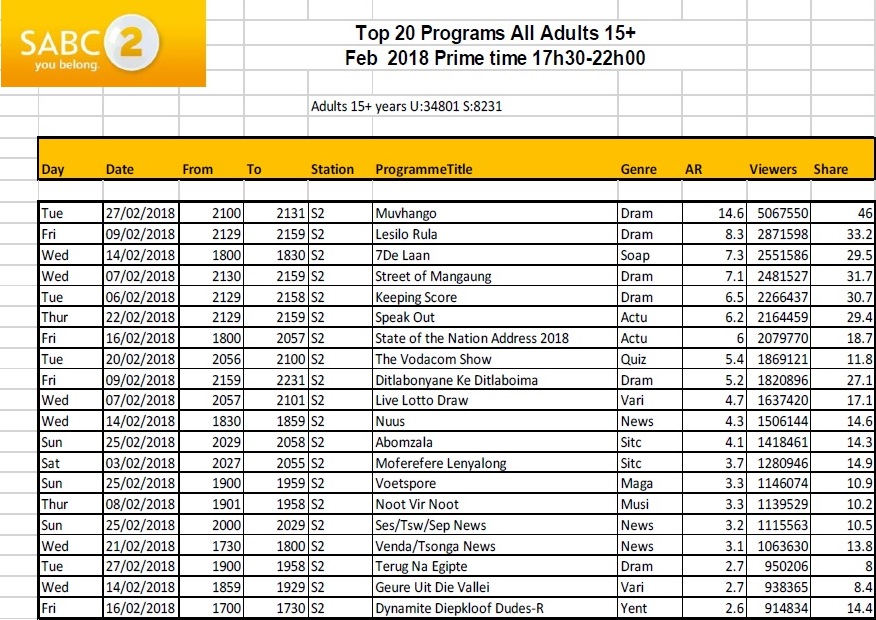
by MarkLives (@marklives) The hottest primetime television shows on SABC 2 in South Africa revealed: TV ratings for February and January 2018.

In 2016, the Broadcast Research Council of South Africa (BRCSA) changed its policy about giving away TAMS and now only monthly reports, highlighting the top 20 or 30 primetime shows on several popular channels, are available.

SABC 2 February 2018

BRCSA TV Ratings February 2018 primetime SABC 2
Click to enlarge to view clearly.

Source: BRCSA February 2018


SABC 2 January 2018

BRCSA TV Ratings January 2018 primetime SABC 2
Click to enlarge to view clearly.

Source: BRCSA January 2018


Broadcast Research Council of South AfricaThe Broadcast Research Council of South Africa (the BRC) is a non-profit, industry body that was incorporated in 2015 to cater to the audience research needs of the radio and television industry in South Africa.

— One subscription form, three newsletters: sign up now for the twice-weekly MarkLives newsletter, including Ramify headlines; The Interlocker, our new monthly comms-focused mailer; and/or MarkLives Zambia!

#WaterWise: CT agencies focused on changing behaviour — part 2

by MarkLives (@marklivesWe’ve emailed a panel of key industry executives for their take on the business impact of  Cape Town’s water crisis, and their contribution towards avoiding it. Next up are Eric D’Oliveira of FCB Cape Town and Ben Wagner of VML South Africa.

#WaterWise: CT agencies focused on changing behaviour — part 4 — King James & 99c
#WaterWise: CT agencies focused on changing behaviour — part 3 — Hero
#WaterWise: Cape Town agencies focused on changing behaviour — M&C Saatchi Abel & John Brown Media SA

While Day Zero — the day water runs out in Cape Town and residents are expected to queue for water at water collection posts — has been pushed back several times, Cape Town still faces a water crisis. This has numerous implications for agencies and the people in their employ. We asked a number of organisations how they are planning for any possible business disruptions and how they are assisting in saving water.

Eric d’Oliveira

Eric d'OliveiraEric d’Oliveira is currently managing director of FCB Cape Town, one of the agencies in the FCB South Africa network. Prior to joining FCB, he headed up 140 BBDO (recently incorporated into Net#work BBDO), an agency that had considerable success under his command, both creatively and business-wise. Before joining BBDO, Eric worked at Ogilvy Cape Town for many years.

FCB Cape Town has, like so many other businesses in Cape Town, already put plans in place to minimise water use in the agency. From mid-January:

  • The hydro-boils were turned off in the kitchen
  • The water supply to all the sinks in the kitchen was cut-off
  • The agency started using bottled water for refreshment, drinking and washing up
  • The water supply to sinks in the bathrooms was cut off, too, and hand sanitisers and wet wipes provided
  • Signs have been posted around the agency requesting staff to minimise water use, and in the bathrooms urging them to only flush when required
  • The coffee machine has been limited to operating between 8am and 10.30am, and then 2pm– 4pm. Staff have been limited to two cups from this machine a day.
  • Dishwasher use has been limited to twice a day.

From April onwards — in anticipation of Day Zero arriving in April or May [now July 2018 now not this year if water-saving patterns continue and the winter rains come] — the agency will:

  • Have portable toilets on site
  • Will continue to purchase bottled water in bulk, sourced from outside of the region
  • Possibly replace crockery and cutlery with disposable or recyclable alternatives

Discussions are already underway with:

  • The agency’s landlord regarding rainwater tank installation; and/or the possibility of sinking a borehole
  • Staff members who could potentially work from home or the Johannesburg office. These discussions are addressing financial support for internet and cellphone use, as well as insurance. In addition, we are looking at systems and processes to make this work seamlessly

Staff members have responded well to these initiatives and have been asked to come forward with any ideas they believe will improve the agency’s water savings.

Finally, we regularly distribute as much information about the drought, the issues surrounding it and potential solutions — such as the WWF Water File, as well as water-saving tips. An informed community is a well-prepared and responsible community, and this is exactly what the FCB Cape Town community is.

In terms of clients, the agency works with both Wesgro and the Western Cape Government, and is assisting on campaigns they have been and will be launching.

Western Cape Government save water by FCB Cape Town

Ben Wagner

Ben WagnerPreviously the CEO of Stonewall+ Digital Marketing, which merged to form NATIVE following the amalgamation of Cambrient, Brandsh and Stonewall+, Ben Wagner grew the agency into a formidable force in the South African marketing arena and garnered multiple accolades and awards during his stewardship of the agency. Ben is now head of VML Cape Town, part of VML South Africa, and is tasked with driving and promoting the agency into the hearts and minds of marketers, clients, potential partners and staffing talent.

VML South Africa has a long association in creating inspiring connections between consumers and social activism, including one of its earliest campaigns — Close the Tap, which was produced in 2012 for FLOW (For the Love of Water).

Day Zero has been front and centre of our operational planning since mid-2017 and, thankfully, we’ve worked collaboratively with our landlord at the Old Castle Brewery in ensuring that we’re reducing our dependence on the current municipal water supply, as well as being ready to continue business as usual if Day Zero materialises, currently anticipated on [9 July 2017].

What we’ve done to date:

  • Landlord has sunk four well points at Old Castle Brewery, and has installed JoJo tanks that hold 22 500 litres of grey water, which were at 30% full at the time of writing
  • 70% of the Old Castle Brewery’s toilets now run off grey water, with VML South Africa’s toilets being converted to grey water by the end of March 2018
  • We’ve opted to switch all taps off in all of our bathrooms, only using disinfectant.
  • We only use water-cooler water supply for drinking water
  • We’ve redesigned our lunch menus to exclude water in the cooking process and only use peelable fruit (complimentary to staff/clients)
  • All of these measures will create an 80% independency on the municipal water supply
  • We have continuous awareness and education of the crisis to all staff in our monthly staff gatherings and Slack Channels.

Should Day Zero arrive:

  • VML South Africa will continue to run, with drinking water provided for all staff and clients
  • Toilets will continue to function with newly installed grey water system. Should grey water run out, executive portaloos have been provisioned in the event we require them
  • Waterless catering will continue
  • VML South Africa already has a flexible worktime culture, so staff who require water collection will be enabled to do so without any question.

WPP as a holding company is also planning on creating a supply chain of potable water for all agencies as an active demonstration of our group horizontality, as well as creating awareness campaigns within the individual agencies within the group.

Updated at 11.03am on 14 March 2018, and 9.24am and 11.04am on 8 March 2018.


MarkLives logo— One subscription form, three newsletters: sign up now for the twice-weekly MarkLives newsletter, including Ramify headlines; The Interlocker, our new monthly comms-focused mailer; and/or MarkLives Zambia!

Online CPD Courses Psychology Online CPD Courses Marketing analytics software Marketing analytics software for small business Business management software Business accounting software Gearbox repair company Makeup artist