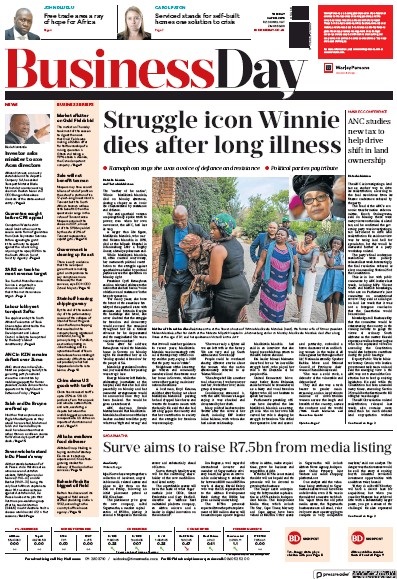
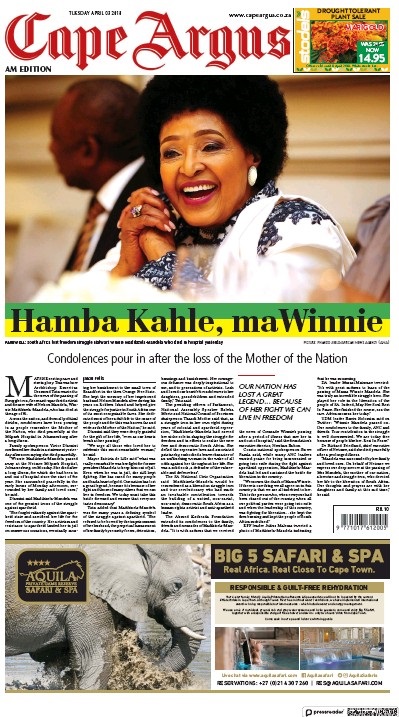
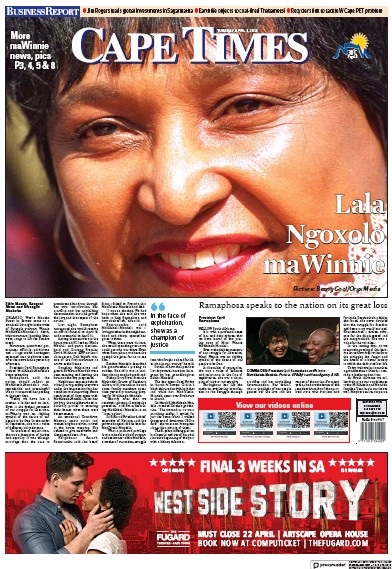
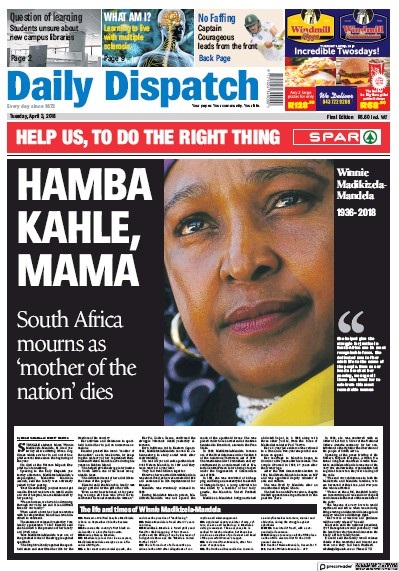
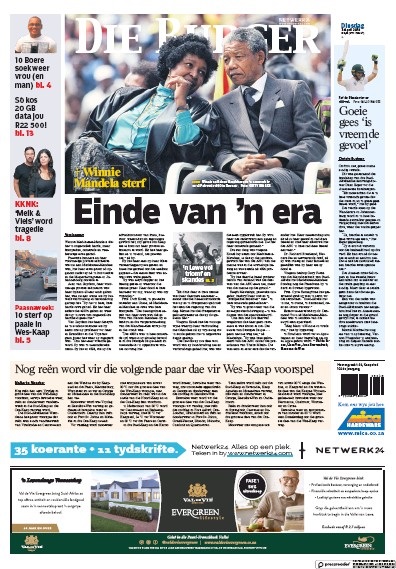
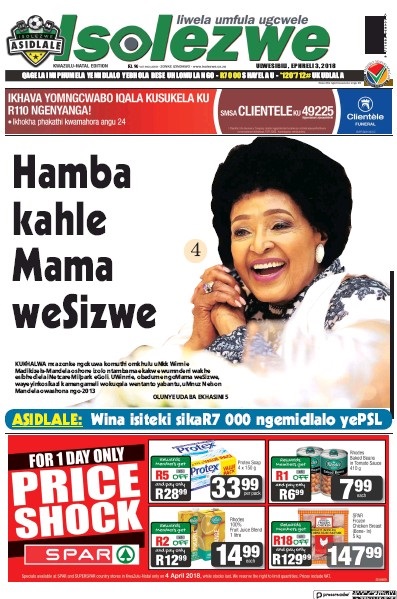
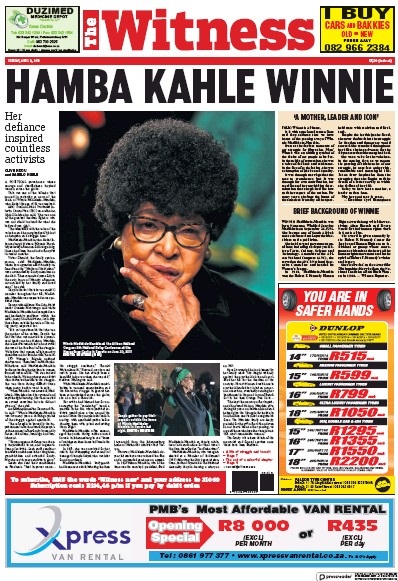
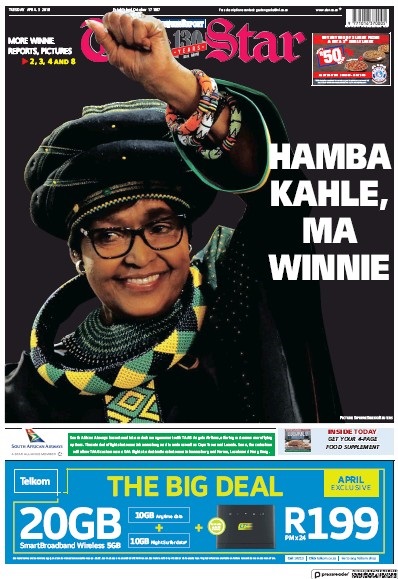
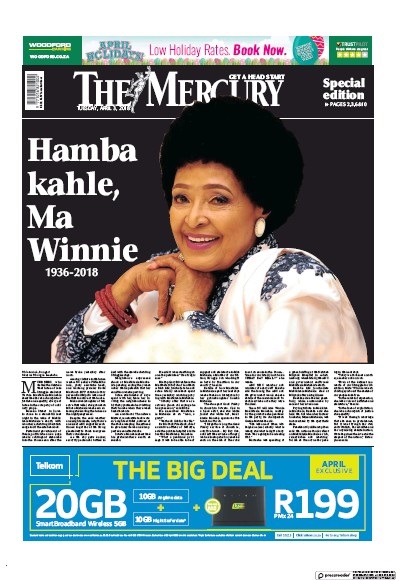
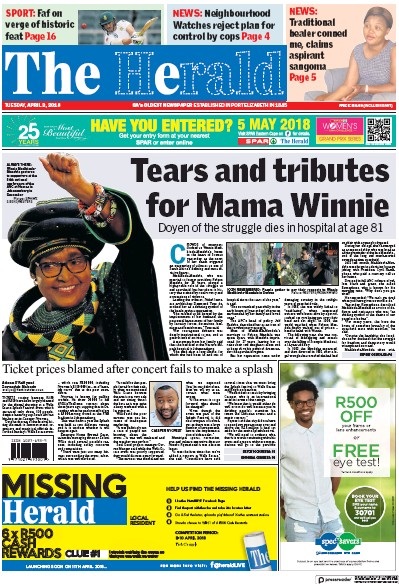
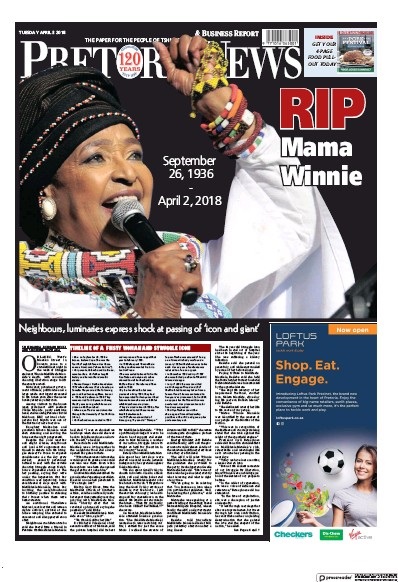
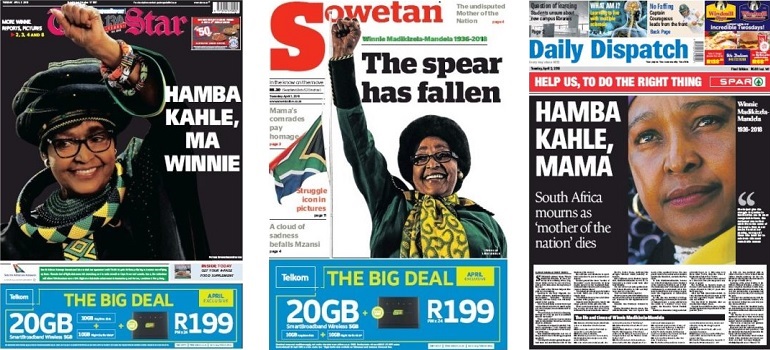
Front page tributes to #WinnieMadikizelaMandela

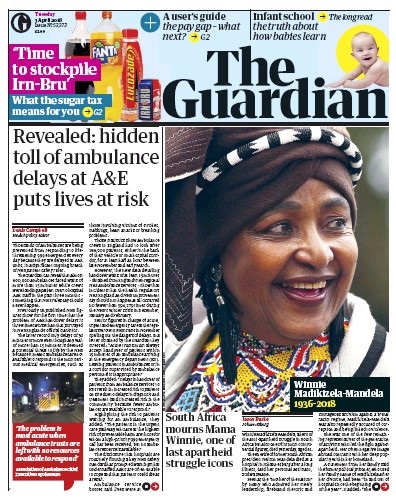
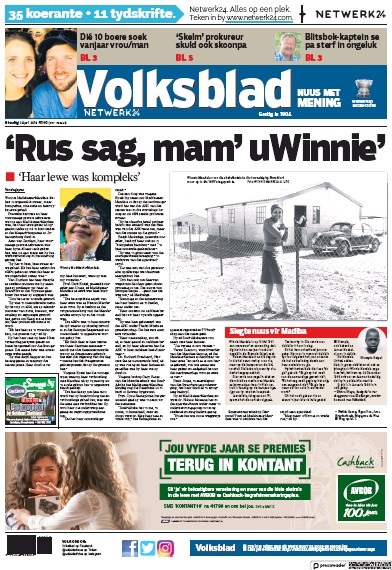
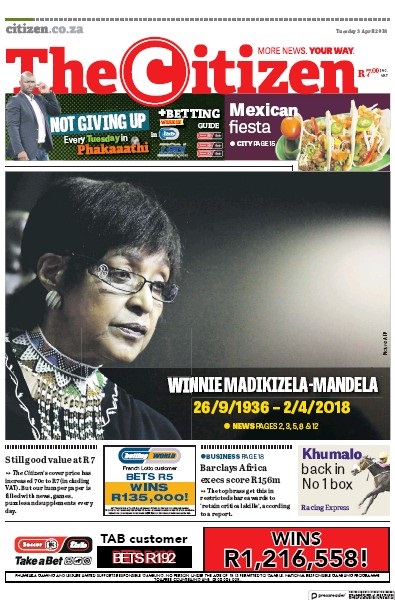
by MarkLives (@marklives) Newspaper front pages pay tribute to the life of Winnie Madikizela-Mandela, who passed away on Monday, 2 April 2018 after a long illness.

Sowetan, 3 April 2018 - Winnie Madikizela-MandelaThe Guardian, 3 April 2018 - Winnie Madikizela-MandelaVolksblad, 3 April 2018 - Winnie Madikizela-Mandela The Citizen, 3 April 2018 - Winnie Madikizela-MandelaBusiness Day, 3 April 2018 - Winnie Madikizela-MandelaCape Argus, 3 April 2018 - Winnie Madikizela-MandelaCape Times, 3 April 2018 - Winnie Madikizela-MandelaDaily Dispatch, 3 April 2018 - Winnie Madikizela-MandelaDie Burger, 3 April 2018 - Winnie Madikizela-MandelaIsolezwe, 3 April 2018 - Winnie Madikizela-MandelaThe Witness, 3 April 2018 - Winnie Madikizela-Mandela The Star, 3 April 2018 - Winnie Madikizela-Mandela The Mercury, 3 April 2018 - Winnie Madikizela-Mandela The Herald, 3 April 2018 - Winnie Madikizela-Mandela Pretoria News, 3 April 2018 - Winnie Madikizela-Mandela Daily Mirror, 3 April 2018 - Winnie Madikizela-Mandela
Images courtesy of Twitter, Facebook, Paperboy and Newseum.

— One subscription form, three newsletters: sign up now for the twice-weekly MarkLives newsletter, including Ramify headlines; The Interlocker, our new monthly comms-focused mailer; and/or MarkLives Zambia!

Masterclass Notes: New business approaches that work

by Johanna McDowell (@jomcdowell) What is the secret? What is the magic ingredient that will get agencies through the doors of marketers?

Three leading marketers assisted us with this masterclass — Leo Smit, Kyknet marketing lead; Roberta Donovan, Ascendis Health head of marketing, skin & beauty; and Katharine Liese, 1Life Insurance marketing GM — as well as the input from 217 marketers who contributed to the SCOPEN agencyScope 2017/2018 study on this particular topic.

[Full disclosure: Scopen Global and Mazole Holdings (the company that owns IAS 100%) have formed a company in South Africa called Scopen Africa. Scopen Global holds the majority of the shares; Mazole is a minority shareholder. Johanna McDowell is a director of Scopen Africa, as is Cesar Vacchiano, Global CEO of Scopen.]

Cold calls

AgencyScope revealed that creative agencies in South Africa on average are making about 14 cold calls (email or telephone) to marketers per annum. This is the lowest rate among the agencies and marketers in 12 countries where SCOPEN conducts its agencyScope study. Of those calls, agencies are only invited to present in about one out of six instances. So, the hit rate is low — and again the lowest among the 12 Scopen countries (UK, Spain, Portugal, Mexico, Brazil, Argentina, Colombia, Chile, China, South East Asia and India, plus South Africa).

Interestingly, when the agencies do get in to see and present to the marketers, there is a high success rate in being appointed — more than 50% of those presentations result in a successful agency appointment. If that is the case, we could encourage agencies to make more calls, meet more marketers, make more presentations. But what is the secret? What is the magic ingredient that will get the agency through the door?

According to agencyScope, it is “research about my sector” that will intrigue marketers enough to want to see an agency. Ideas and new information tailored to meet the marketers’ needs, not necessarily creative work, — will open those doors.

Tips from the panel

Our panel confirmed this in person as follows:

  • Phone calls don’t work — all three marketers avoid answering the phone if they don’t know who it is
  • LinkedIn works, especially if the approach is tailored to suit the marketer
  • If an agency is going to send credentials through, don’t use an out-of-date marketer’s logo to personalise them
  • Referrals from other marketers
  • Inventive desk drops, as long as these are not bribes or seen to be bribes by procurement
  • Seminars hosted by agencies “where we will learn something new”
  • Reputation of an agency is important: marketers will find out about the agencies if they are in contact — it will help if the agency has a good profile via business wins and growth
  • Chemistry, an essential ingredient in the relationship
  • Proposals should always include costs so that marketers know in advance if they can afford the agency, otherwise time and effort will be wasted by both parties
  • Will the marketer be important in that agency? Size matters as attention is important
  • Marketers would rather test an agency out with a project to begin with
  • Marketers know that it is hard to find a “one-size-fits-all” agency; marketers expect to work with a few agencies
  • Lead generation is important to the success of the marketer, and may easily be incentivised on a risk-and-reward basis
  • Retainers work but need regular reviews in order to correctly allocate resources and reallocate as necessary
  • Procurement vs marketing: yes, there are tensions — part of the territory — it may take up to three months to get registered on the vendor database
  • New agencies will always interest marketers, especially if they’re doing new things

Tips from marketers

Finally, some tips for agencies from the marketers:

  • Build the relationship — don’t expect to sign a deal at the first meeting
  • Have a strategy to reach that marketer
  • Focus on the key clients that you really want
  • Be disruptive — how will your agency stand out?
  • Build your agency’s reputation — through good sustainable PR.


Johanna McDowellJohanna McDowell (@jomcdowell) is managing director of the Independent Agency Search and Selection Company (IAS), which is partnered with the AAR Group in the UK. Johanna is one of the few experts driving this mediation and advisory service in SA and globally. Currently she is running the IAS Marketers Masterclass, a programme consisting of masterclasses held in Cape Town and in Johannesburg. Twice a year she attends AdForum Worldwide Summits.

— One subscription form, three newsletters: sign up now for the twice-weekly MarkLives newsletter, including Ramify headlines; The Interlocker, our new monthly comms-focused mailer; and/or MarkLives Zambia!

Gestalt: Enhancing the customer’s path to purchase

by Leeya Hendricks (@LeeyaHendricks) Good customer experience (CX) is the responsibility of everyone in a business, not just the sales teams, service centre or — increasingly — marketing. This shared approach is especially important as we consider the customer’s path to purchase. Companies that create unforgettable CX focus on the entire journey, highlighting the need to move from isolated touchpoints to a journey that flows.

We can liken this approach to the difference between video and stop-motion animation. The latter moves jerkily with little regard for realism, while the former flows fluidly to tell a life-like story. Your CX journey should be just like that — a flow of movement taking your customer gracefully through a journey from start to end, and not a series of jolting experiences.

McKinsey & Company perfectly sums up the benefit of getting it right: “[M]aximising satisfaction with customer journeys has the potential not only to increase customer satisfaction by 20% but also to lift revenue by up to 15% while lowering the cost of servicing customers by as much as 20%.”[1]

And who doesn’t want to raise their revenues while reducing their costs?

Customer experience mapping vs customer journey mapping

To achieve fluid CX at all points in the customer journey, we need to consider the difference between mapping the customer journey and mapping the customer experience: While a customer journey map summarises the interactions between consumers and organisations, from their first interaction through to conversion and subsequent interactions, a customer experience map goes one better. The latter builds a comprehensive canvas of the customer’s experience with the brand, while also analysing the customer’s behaviour and interactions across touchpoints and channels.

Rather than portraying this series of interactions as a straight line from point A to point B, a customer experience map provides an understanding of the true complex nature of the process that customers go through in multiple interactions with your brand.

Unpacking the path to purchase

Using customer experience mapping, we can unpack the path to purchase at the hand of total customer experience.

Traditionally, companies have modelled this path by focusing on individual customer touchpoints, such as their interaction with support or front desk staff. However, this is a fragmented way of looking at it. Modern assessments of the path to purchase takes a more-holistic view by exploring customer experience, thus modelling the path to purchase in three stages: awareness, consideration and purchase.

Unlike the customer journey, the consumer’s path to purchase is a complex, non-linear construct. Much may be learnt from it, requiring the company to be firmly embedded at every step along the journey.

The data that may be captured along this path study shows how consumers behave from the start of their shopping journey — including what they look for, where they are looking and more. Knowing this captures the search terms to be incorporated into content, allowing marketers to advertise on key apps or build their own, thereby driving consumers to the company right from the start.

Keeping customers on track

Ultimately, the path to purchase is about much more than making consumers warm and fuzzy about your brand; it enables brands to pinpoint where they might lose prospects and existing customers at any point in their journeys. Using path to purchase insights into online and in-store shopping behaviours is a good way to customise your marketing approach to get consumers back on track to the purchase point.

With knowing where your charges are going off course, the next step is to study what your competitors are doing. Knowing which other sites your consumers are researching is a good way to start improving competitive value.

Acting on this data can turn your company’s customer experience on its head and keep consumers on the straight and narrow, resulting in customer satisfaction and increased profitability.

It’s important to understand the totality of the experiences customers go through if we are to master the subtle art of hitting the right person with the right message at the right time and through the right channels. Get all four elements of the successful connection right, and sales will surge.

References

[1] mckinsey.com/industries/retail/our-insights/the-three-cs-of-customer-satisfaction-consistency-consistency-consistency

Further reading

Updated on 19 November 2018.


Leeya HendricksLeeya Hendricks (@LeeyaHendricks) is a designated chartered marketer, global marketing strategist, digital driver and a Women in Tech leader. She holds a BA degree in fine arts, a BA honours degree in brand marketing management and is currently completing her MBA.  She is currently director marketing for the ECEMEA region at ORACLE, responsible for driving digital strategy, demand generation and transforming portfolios to develop sustainable revenue growth. Leeya contributes the monthly column “Gestalt”, about putting customer first for sustainable business success, to Marklives.

— One subscription form, three newsletters: sign up now for the twice-weekly MarkLives newsletter, including Ramify headlines; The Interlocker, our new monthly comms-focused mailer; and/or MarkLives Zambia!

Cover Stories: Thoughtfulness in design (29 Mar 2018)

by Shane de Lange (@shanenilfunct) Let’s delve into great media design from South Africa and around the world:

  • International/print: British Journal of Photography focuses on the theme of community and how photography is a collaboration between photographers and their subjects
  • Local/print: House and Leisure is inspired by timeless Delftware to portray this month’s kitchen theme
  • Online: The I Am Women Project promotes young female voices using the power of community
  • International/print: Bloomberg Businessweek, Süddeutsche Zeitung Magazin and The Economist uses the humble hand cursor icon to conceptually illustrate Facebook’s trustworthiness crisis
  • Iconic: S.M.S. (Shit Must Stop) altered the traditional journey of the artwork from studio to gallery, and blurred the roles of artist, editor and curator.
  • Local/print: The Lake turns the spectacle into a positive vision for the future of queer identity

Find a cover we should know about? Tweet us at @Marklives and @shanenilfunct.
Pinterest icon Want to view all the covers at a glance? See our Pinterest board!


Print

House and Leisure (South Africa), Kitchen Issue, April 2018

House and Leisure, Kitchen Issue, April 2018

The latest issue of House and Leisure makes a subtle reference to classic Dutch Delft ceramic ware, with the use of iconic Delft Blue providing a decent amount of shelf appeal. Delft was an attempt to mimic 14th century Chinese Ming porcelain. Developed in the Netherlands during the 16th century, the pottery became extremely fashionable in Europe, produced mostly in the form of plates, ornaments and tiles. The affect was achieved using tin-glazed earthenware, and an application of similar floral decorative elements to that of the original Chinese porcelain.

The cover doesn’t emulate the subject matter of traditional Delft but rather implies a narrative surrounding the theme of the magazine, The Kitchen Issue. Despite Delft being seen in certain cultural circles as a kind of kitsch, it is always good to see a publication flex its aesthetic taste muscles like this.


Bloomberg Businessweek (US), 26 March 2018
Süddeutsche Zeitung Magazin (Germany), no. 12, 23 March 2018
The Economist (US), 24-30 March 2018

Bloomberg Businessweek 26 Mar 2018, Süddeutsche Zeitung 23 Mar 2018 and The Economist 24-30 Mar 2018

Perceptions about Facebook aren’t good at present after reports that a company associated with US president Donald Trump suspiciously sourced the personal information of about 50m Facebook users, which influenced the 2016 campaign to win the highest seat of power in the US. The result? Facebook shares have dwindled by 9% as rampant rumors about fake news and propaganda have begun to make many feel that Facebook is not trustworthy and in a major slump. The social media giant, the eighth-largest listed company in the world, seems to be in total denial about this potential reputational nightmare, which has been reflected upon by many recent magazine covers, notably Bloomberg Businessweek (US), Süddeutsche Zeitung Magazin (Germany) and The Economist (US). The first two publications have both used a hand cursor icon in a symbolic manner to suggest that many people will likely be closing their Facebook accounts because of this supposed meltdown.


The Lake (South Africa), issue 19, 2018

The Lake, issue 19, March 2018 - Angel-Ho

Themed “Spectacle”, #19 of The Lake magazine showcases local experimental electronic music artist, Angel-Ho, who has built a substantial following by deconstructing notions of classism and gender politics from the perspective of queer identity. Insistent on being referred to in the plural as “their instead of “he” or “she”, glamour is a noun and fashion is a verb as Angel-Ho’s career evolves, especially as their debut album is about to be released on the prestigious record label, Hyperdub, responsible for producing some of the most-influential electronic music albums of all time, including Burial’s “Burial” and “Untrue”. Through music and performance, Angelo-Ho presents queer identity in a whole new light, building a positive foundation for queer and trans youths, and developing a viable heritage towards the future where spectacle should no doubt be understood as positive.


British Journal of Photography (UK), The Community Issue, #7869, 2018

British Journal of Photography, Community Issue, 2018

The British Journal of Photography (BJP) is a monthly that has been in print since the birth of the medium during the mid-1800s. The magazine focuses on contemporary photography across the globe, with an emphasis on emerging talent. The March 2018 issue is themed The Community Issue; it is focused in on various forms of collaboration within the medium, particularly projects that emphasise the dialogue between photographers and their subjects. The cover image is by American photographer, Carolyn Drake, whose work dissects the way our perception of reality is constructed and edited throughout history, and how photography may disrupt engineered narratives.


Online

The I Am Woman Project (US), March 2018

The I Am Women Project, online, March 2018

Founded in 2016 by cultural feminist, DJ, producer and music executive, Kitty Cash, The I Am Woman Project (IAWP) is a community of sorts, focused on uplifting and bolstering women by sharing experiences and stories that celebrate womanhood. The mission here is to create a bustling creative community comprising young and hungry female talent and provide a discursive platform for women to establish their respective creative voices. The website sports a well-resolved identity system that speaks in a relatable tone of voice, with a particularly fresh logo, supported by print-like web layout with an inventive mix of horizontal and vertical navigation. A textbook mix of great graphic design, typography, art direction, web design and relevant storytelling.


Iconic

S.M.S. (Shit Must Stop) (US), 1968

Shit Must Stop issue 1 and collection, 1968

Short-lived and published as a bi-weekly February–December 1968, S.M.S. (Shit Must Stop) was a series of curated portfolios edited by surrealist artists William Copley and Dimitri Petrov. Relying on his art industry connections, Copley packaged S.M.S as a tactile, interactive, multipart portfolio reminiscent of George Maciunas’ Fluxus “Fluxkits” and Dadaist Marcel Duchamp’s “Boîte-en-valise” (gallery in a box). Consisting of various printed works, these portfolios encompassed a large variety of different influences, notably dadaism, surrealism, neo-dada and aspects of pop art, all presented using a mix of drawings photography, sound and literature.

S.M.S.’s mission was not dissimilar to that of Fluxus: anti-authoritarian and innately against the influence of galleries and other institutions to declare what the value of art was. As an attempt to unite artists, S.M.S. was an experiment in alternative means of artistic production outside the influence of galleries and museums. Every issue was a kind of dossier detailing each individual artist’s inquiry, practice and artistic narrative, showing how artists deal with the differing circumstances that lead them into the studio and allow them to produce art in the first place. This view altered the traditional journey of the artwork from studio to gallery, and blurred the roles of artist, editor and curator.

Utopian and democratizing, S.M.S. placed no restrictions on the contributing artists, who would submit original work for the portfolios which would be reproduced in print, sparing no expense in an edition of 2000. The cover for no.1 took the form of a cardboard mailer designed by Irving Petling, containing the work of various established and emerging artists for the time, such as Richard Hamilton, Roy Lichtenstein, Man Ray, Yoko Ono, and La Monte Young, to name a few.

References


Shane de LangeShane de Lange (@shanenilfunct) is a designer, writer, and educator currently based in Cape Town, South Africa, working in the fields of communication design and digital media. He works from Gilgamesh, a small design studio, and is a senior lecturer in graphic design at Vega School in Cape Town. Connect on Pinterest and Instagram.

Cover Stories, formerly MagLove, is a regular slot deconstructing media cover design, both past and present.

— One subscription form, three newsletters: sign up now for the twice-weekly MarkLives newsletter, including Ramify headlines; The Interlocker, our new monthly comms-focused mailer; and/or MarkLives Zambia!

SA TV Ratings: SABC 1 — primetime top 20 for Feb 2018

by MarkLives (@marklives) The hottest primetime television shows on SABC 1 in South Africa revealed: TV ratings for February 2018.

SABC 1 February 2018

BRCSA TV Ratings February 2018 primetime SABC 1
Click to enlarge and view clearly.

Source: BRCSA February 2018

In 2016, the Broadcast Research Council of South Africa (BRCSA) changed its policy about giving away TAMS and now only monthly reports, highlighting the top 20 or 30 primetime shows on several popular channels, are available.

Broadcast Research Council of South Africa


The Broadcast Research Council of South Africa (the BRC) is a non-profit, industry body that was incorporated in 2015 to cater to the audience research needs of the radio and television industry in South Africa.

— One subscription form, three newsletters: sign up now for the twice-weekly MarkLives newsletter, including Ramify headlines; The Interlocker, our new monthly comms-focused mailer; and/or MarkLives Zambia!

#TheInterlocker: Africa leading, Gen-Z, WOAN & mobile-first

by MarkLives (@marklives) Every month we ask a handpicked selection of PR execs to each select ONE feature, news article or research report (accessible online) that they believe their peers would benefit from reading. Next up are Nelisa Ngqulana, Vusi Mbatha, Bianca Gardella, Samantha Perry, Mandlakazi Sigcawu and Cheryl Barnett. Bond, connect, engage, involve, join — welcome to The Interlocker!


To receive future issues of The Interlocker, a new monthly newsletter covering the communications industry
by the editors of MarkLives, please update your newsletter subscription preferences here.


Nelisa Ngqulana’s pick

Africa Communications Week: Communications experts call for greater role in Africa’s development

Nelisa NgqulanaThe Africa Communications Leadership Report was published in February 2018 featuring the expert opinion of 40 professionals from different countries, institutions, sectors and disciplines on the role of communications in the socio-economic development of the African continent. The report is an initiative of Africa Communications Week, a global campaign that takes place 21–25 May 2018. It highlights what we’ve always known: communication is a tool that can contribute to Africa’s development.

  • Comms is a strategic tool that deserves a seat at the highest tables in the corporate sector and in policy-making.
  • The use of language: we need to develop a language that influences and positions a balanced narrative of the continent and its nations through telling our own stories and sharing them with the world.
  • Communications practitioners are in a great position to monitor and correct any misrepresentation about Africa. Perceptions have an impact on investment into Africa.

PR’ing Africa must be a deliberate agenda among African communicators within the continent and in the diaspora.

— Nelisa Ngqulana (@neli_ngqulana) is founder and senior communications strategist at PR Trends ZA


Vusi Mbatha’s pick

Adweek: 4 Steps for Effectively Managing a PR Crisis

Vusi MbathaWhat did a crisis actually look like for brands before the digital age? Before millennials knew how to torment brands on their smartphones with video cameras and social media platforms such as Facebook and Twitter? Despite the advancement of technology (or what would be considered paraffin to a crisis), the principles of crisis management remain the same.

Social media experts, PR specialists and brand managers have one thing in common when it comes to a crisis; they need to align on one solid strategy. In the social media led world we live in, it has become a question of when, rather than if. It is apparent, given some of the recent crises, that a brand can never be too prepared for what could not only be considered a reputational but an economical risk. Where do you begin to protect a brand in an age of digital media that is in the hands of consumers? What is your plan?

Everyone has their way of tackling a crisis, but the core of it is highlighted in this article that provides a great guideline of how to go about it.

— Vusi Mbatha (@VooseMoose) is a senior social media manager at Ogilvy & Mather South Africa


Bianca Gardella’s pick

Forbes: 13 Strategies For Marketing To Generation Z

Bianca GardellaFrom millennials to the next generation — Gen Z — these are our new consumers. And, so, we need to carefully consider how we adapt our communications to ensure relevance and therefore effectiveness. Using the same strategies and tactics simply won’t work; they are true digital natives and they, as consumers, are very different from their older siblings, the millennials. We will be communicating to a generation who have only known social media and technology; who are easily distracted and use multi-platforms for news and information; and who come with more distrust of brands and ask for more engaging, relevant and meaningful content.

This piece highlights the need for communicating on multiple touch points; the need to move away from fluff; to speak to their needs; to entertain; to understand that data is key; and to inform.

For me, the opportunity of adapting strategy and communication to a new generation is an exciting one: we have the opportunity of speaking to consumers who are really invested in a company culture, who are open-minded and who are accepting of small brands and companies with valuable missions.

— Bianca Gardella is an account director at OFYT


Samantha Perry’s pick

ITWeb: WOAN monopoly a ‘terrible idea’ – MTN

Samantha PerryWhat I’ve been reading? Coverage of the hearings that Icasa held on the Electronic Communications Amendment Bill — specifically the submissions on the proposed wholesale access network (WOAN) getting sole access to high-demand spectrum used for mobile data networks. I won’t bore you all to tears with a discussion on infrastructure competition in the telecoms sector but let’s take it as a given that competition is a good thing and that business is, in this case, better positioned than government to rollout and manage telecommunications networks. If you don’t believe me, ask anyone who was trying to do business in the Telkom monopoly era. It’s expensive and inefficient. Short version? Government is trying to create a wholesale access network monopoly on high-speed spectrum. Industry is, for the most part, divided on the issue. ITWeb has provided a pretty good round up of the opposing views.

Why am I reading it? Because things like this impact our ability to do our jobs. Without decent, fast, affordable internet infrastructure, the very fabric of how our businesses operate changes, costs rise and… you get the idea.

— Samantha Perry (@samanthaperry) is Johannesburg agency lead at Irvine Partners


Mandlakazi Sigcawu’s pick

General news: Learning from the Tiger Brands listeriosis fiasco 

Mandlakazi SigcawuThe Tiger Brands listeriosis fiasco has brought home a fundamental truth about modern corporate reputation management. Quite simply, in the time of social media-fuelled consumer activism, there is no place to hide in a crisis. But more than that, a company’s reputation and its behaviour are inextricably linked, and can’t be separated by means of public relations, no matter how sophisticated. This means what a company does, more than what it says, is a key driver of reputation building and requires a rethink of traditional reputation management.

It means a company’s values and ethics matter more than ever. These cannot simply be a set of lofty ideals hanging on the boardroom wall. They must be lived by the leadership and infused in every aspect of company behaviour. That way, employees will know how to act in any situation without being told, and the chances of the organisation being caught with its pants down dramatically reduced.

— Mandlakazi Sigcawu is corporate affairs manager, southern Africa area for British American Tobacco SA


Cheryl Barnett’s pick

The Media Online: Hang on for the ride: Why mobile marketing is the most exciting thing in 2018

It still surprises me how many businesses have not considered their mobile Cheryl Barnettpresence as an important part of their strategy, with an impressive 74% of the 40m local browsers in December coming from mobile devices, according to Effective Measure’s “South Africa Online” report. There are effective ways to make thumb-stopping content using programmatic native video and live content, virtual reality and 360-degree video. A brand can ensure its message is read when it’s most convenient for the audience.

I feel mobile-first is a vital step to bear in mind when you are working on any communication plan regardless of the industry.

— Cheryl Barnett (@CherylABarnett) is chief digital enthusiast at $0c1@L Consultancy


MarkLives logoLaunched in 2018, The Interlocker is a monthly newsletter (available as a regular column on MarkLives, too) in which we ask a handpicked selection of PR execs to each select ONE feature, news article or research report (accessible online) that they believe would benefit their peers to read and why. Sign up here!

— One subscription form, three newsletters: sign up now for the twice-weekly MarkLives newsletter, including Ramify headlines; The Interlocker, our new monthly comms-focused mailer; and/or MarkLives Zambia!
Shelf Life: Joe Public goes 2.0 for Chicken Licken

Cheryl Hunter (shelflife at marklives.com)’s weekly pick of all things new — product, packaging, design, insight, food, décor and more!

  • Chicken Licken embraces AI
  • Pizza Hut’s 100th African outlet
  • Helping the Underdog with The Friday Street Club

Chicken science

We live in a world on the brink of an artificial intelligence revolution, which makes Chicken Licken’s latest TVC for its Hotwings product — “Sbu 2.0” — relevant and funny, thanks to the creative talent of ad agency Joe Public.

For the latest ad, the agency worked with director Greg Gray from Romance Films to create a quirky comedy about a science teacher who invents a robotic version of himself to fill in whenever the craving strikes. It is perfectly set to Rag’n’Bone Man’s hit song, Human.

We meet S’bu, an unassuming science teacher who’s up to something in his garage workshop late at night, and quickly discover that he has managed to pull off what could possibly be his greatest achievement: using a mismatch of recycled metal and computer parts, he’s created a functioning, somewhat autonomous, robotic version of himself: S’bu 2.0.

The ad plays out a variety of scenarios where the real S’bu has been replaced with his 2.0 version; confusion and chaos ensue.

Says Martin Schlumpf, Joe Public creative director, “With such a proudly South African client, we always try to create ideas that are relevant. We try to showcase real South Africans at the forefront of global playing fields in an entertaining and humorous way. Whether it involves sending a South African to space, a South African archaeologist exploring an ancient Egyptian tomb or. like now, a South African science teacher that has built a real life, functioning, robotic replica of himself, we’re always trying to create a sense of pride and patriotism through our commercials.”

chickenlicken.co.zaFacebookTwitter
joepublic.co.zaFacebookTwitterRamify
romancefilms.tvFacebookTwitter


African opportunities

It’s been only three-and-a-half years since Pizza Hut re-entered the African market with a restaurant in Johannesburg; now the world’s largest pizza restaurant company (a division of global giant Yum! Brands Inc), is celebrating the opening of its 100th store in sub-Saharan Africa in the historic Ghandi Square.

Pizza Hut, Ghandi Square, South AfricaPizza Hut restaurants now trade in 13 sub-Saharan African countries, with an additional 90 stores in Morocco, Egypt and Algeria, bringing the total to 190 across Africa. Says Ewan Davenport, Pizza Hut Africa GM, “This aggressive growth in Africa reflects the untapped opportunities offered by emerging markets. As we expand our footprint in these markets, we continue to add and develop strong local supply-chain partners so that we can bring our pizza to customers in African regions where pizza is not as prevalent as elsewhere in the world.”

South Africa’s Gauteng and Western Cape provinces currently have the most restaurants within sub-Saharan Africa. Hot, free and fast delivery for online orders was recently successfully launched in the competitive South African market and Davenport says this will be available in African markets in the near future. “We’re ensuring that we bring our high global standards and full offering, including online ordering, to all our restaurants in Africa.”

Davenport believes the surface of growth has just been scratched and that there will be many more stores to follow: “We’re passionate about accelerating our expansion across the continent. We are prepped, ready and looking forward to developing Pizza Hut restaurants in more African countries, ultimately making us not only the largest pizza brand in the world, but also on the African continent.”

pizzahut.co.zaFacebookTwitterInstagram
yum.com


#ISupportTheUnderdog

The Underdog Project, a South African community initiative that is committed to helping at-risk youth and shelter dogs, has launched #ISupportTheUnderdog. This challenge-based campaign calls on like-minded and compassionate people to keep their doors open.

The Underdog ProjectThe Hout Bay programme uses a unique combination of animal training techniques and therapeutic workshops to help the children develop crucial life skills and refocus their lives. Children are paired with shelter dogs for animal-assisted therapy, dog training, life-skills workshops and humane education classes. Not only does The Underdog Project help shelter dogs get adopted but it also helps change the lives of many young people.

Each workshop training session costs R250 per child and dog team, and the goal is to raise R250 000 to keep the programme running for 2018. With this ambitious target in mind, it enlisted the help of PR specialists, The Friday Street Club, to get the word out by encouraging people to share a picture of their underdog (two- or four-legged) and caption the image with their favourite underdog story.

underdogproject.orgFacebookTwitterInstagram
thefridaystreetclub.co.zaFacebookTwitterRamify


Cheryl HunterShelf Life is MarkLives.com’s weekly column covering all things new. Notify us of yours at shelflife at marklives dot com. Want to sponsor Shelf Life? Contact us here.

Cheryl Hunter (@cherylhunter) has written for the South African media, marketing and advertising industries for more than 15 years. A former editor of M&M in Independent Newspapers and contributor to Bizcommunity, AdFocus, AdReview and the Ad Annual, she has also produced for various television networks and currently consults on communication strategy and media liaison.

— One subscription form, three newsletters: sign up now for the twice-weekly MarkLives newsletter, including Ramify headlines; The Interlocker, our new monthly comms-focused mailer; and/or MarkLives Zambia!
Young, Gifted & Killing It: Mbuso Ndlovu

by Veli Ngubane (@TheNduna) Someone who’s led creative at a Vietnam agency, clocked up international awards from Cannes to Clios to Epicas and even sung solo for the pope, Mbuso Ndlovu (@NdlovuMbuso) has strong opinions about influencers, transformation and freelance life. Read more about him in this interview.

Mbuso NdlovuVeli Ngubane: Tell us more about yourself: where did you grow up and what did you want to be when you were growing up?
Mbuso Ndlovu
: I spent a fair amount of my childhood in the Zululand Empangeni/Richards Bay area, until we had to move to Northern Natal, where we lived in a farm being a young ‘Farmer Brown’.

VN: Please explain what you actually do and what an average day looks like for you?
MN:
The best way to answer this question is that I’m a creative curator. My day-to-day entails finding creative solutions for brands and clients through different use of media to communicate a specific point. I’d like to believe that what we do essentially shapes and influences culture.

VN: What is your philosophy in life that influences your creative work?
MN:
The creative director job is hard. It really is. When you get your team all involved going in the same direction, that’s when you make great work. Trust your dope!

VN: What advice would you give someone in a 9-to-5 job in an agency who is considering leaving their job to freelance full time?
MN:
If your work mode only applies between 9–5, then you are in the wrong business. I also think the term freelance is outdated. Rather consider people like myself brand/agency consultants.

VN: What are your views on why the industry is slow to transform?
MN:
Transformation in our industry has been slow because, all these years, we have been applying this thing I like to call ‘one black at a time’. That there can only be one of you sitting in management, or in a senior position and, as soon as you try to bring in new talent, the reaction has always been, “But wait, why are you bringing others? We chose you.”

VN: When and why did you decide to be an independent?
MN:
There’s a lot of average work that is out there, focused on the wrong insights, and at times you find yourself doing work you might not necessary believe in. You are also able to choose the work/projects that speak to you.

VN: Tell us more about your experience working in Vietnam?
MN:
Vietnam was a great experience where I had the privilege of leading a very dynamic team of individuals from different parts of the world, which is already a win on its own. There’s something very exciting about being in a new country where you know nothing about [its] culture and way of doing things. Unlearning some of the things you thought you knew about [Vietnamese] culture and starting at the beginning by adapting to the [Vietnamese] way of doing things. That was one the hardest things I had to do, but I had lots of fun while doing it.

VN: What advice can you give to people wanting to get into the creative industry?
MN:
You gotta have the love for it, as what we do might seem easy but a great amount of thinking, creating and crafting goes into it. That’s what sets you apart from being just a mediocre creative or a dope creative.

VN: What do you like most about your work? What is most challenging?
MN:
I like the fact that we can sit and influence culture by being involved in the different stages of the creative process. I like the point where the idea has been created and it’s time to put everything together and the crafting begins.

VN: What is your favourite ad campaign, past and present, and why?
MN
: My favourite piece of work that has come out recently has to be the Kanye West new Yeezy line launch. An integrated campaign that, in my view, has been the only campaign that has used influencers really well, in what I actually think was a genius piece of work. A very good use of medium by simply understanding your consumer and their behaviour. Up until that point, that whole influencer thing has been rubbish. And, also, let’s stop thinking that consumers can’t see through the bullshit.

VN: What has been a highlight in your career?
MN
: I think I have been lucky to have a few highlights in my career from the time I was awarded Young Creative of the Year in 2010, winning big awards around the world, leading creative for a global agency in Asia and, the most recent one, working with Orlando Pirates capturing and documenting the history of the club over the 80 years through every legend that has ever played for the club.

VN: What are the key trends to look out for in 2018 from an ad industry perspective?
MN:
I think the advertising charter being implemented is going to shake things up in the industry, given that we can hope to see great transformation in work being more authentic. We can also hope that, unlike previously, this is more than just a cosmetic change and the black faces won’t just be executing their white counterparts’ agenda. The role of black creatives in leadership has become even more important because we have to make sure that the right amount, and quality, of black creatives comes through and stays in the industry.

VN: Tell us something about yourself not generally known.
MN:
I was a soloist for the KZN Youth Choir/Orchestra and have travelled the world performing alongside the Drakensberg Boy Choir in countries like Austria, Netherlands, Czech Republic. Even performed for the pope!

VN: Please would you supply two or three pieces of work you have been involved in?
MN:
http://mbusondlovu.wixsite.com/work/print-


Veli NgubaneVeli Ngubane (@TheNduna) entered the world of advertising with a passion after completing his BSocSci (law, politics and economics) at UCT and a post-graduate marketing diploma at Red & Yellow, where he’s currently advisory board chairman. He also sits on the IAB’s Transformation & Education Council, is a DMA board member and has judged the Loeries, Apex and AdFocus awards. He is CCO and founding partner of the largest black-owned and -managed full-service agencies in the country, AVATAR. He is also co-founder of M&N Brands, which is building an African network of agencies to rival the global giants. In his monthly column “Young, Gifted & Killing It”, he profiles award-winning, kick-ass black creative talent in South Africa.

— One subscription form, three newsletters: sign up now for the twice-weekly MarkLives newsletter, including Ramify headlines; The Interlocker, our new monthly comms-focused mailer; and/or MarkLives Zambia!
Headspace: Wellness in the consumer journey towards self-actualisation

by Tenielle Maris. Trendwatching describes self-actualisation as the future of consumerism and hence the greatest opportunity for brands this year. Simply put, consumers are looking to escape superficial self-gratification and are, instead, looking for something much deeper. The path of self-exploration, and being driven to achieve a higher state of self, has been attributed to more uncertain and stressful times globally: something that has propelled consumers to look inwards, self-reflect and make some meaningful, personal changes.

Transformational consumerism is a concept explored by author Tara Nicholle Nelson and is based on the global movement of consumers looking for products, services and brands that will aid them in living healthier, wealthier, and wiser lives. She goes on to unpack how consumers are more likely to become entrenched in and devoted to a brand or organisation that is able to facilitate their tranformation quest more effectively, easily, beautifully, or joyously than they could do it on their own.

A rising star in the journey of self-actualisation

Health and wellness have evolved from a symbol of status to the imperative and powerful driver in one’s journey towards self-improvement, and the relentless quest towards finding a personal state of self-actualisation.

One only needs to consider the plethora of products, services and initiatives from brands determined to pave the way for consumers to lead healthier lifestyles — from new meat and dairy alternatives making their way onto the menus of top restaurants to urban farming infrastructure popping up in big cities and to big airline and coffee brands incorporating mood-enhancing lighting into their environments to promote relaxation and meditation — body- and mind-awareness are infiltrating every corner of the consumer arena.

The health-innovation wave

This movement has also given rise to unprecedented innovation that has enabled consumers to dive even deeper than ever before: according to Euromonitor’s 2018 trend report, people’s growing curiosity about their genetic makeup and a rising interest in personalised health care are key areas to watch for brand and marketers over the next few years.

The explosion of wellness-enhancing activities from brands is something that has fuelled the ever-growing consumer demand for new-age health and wellness products and services, in place of more-conventional choices.

Fitcations — or holidays geared around health and wellness — are a shining example of this: holidaymakers are forgoing their regular holiday indulgences for yoga, fitness classes and activities like organic gardening to facilitate their quest for some much-needed self-improvement.

Getting it right

The Marriott Group seems to constantly be on the radar as a brand to watch when it comes to matching innovation with understanding what customers want: by leveraging the insight that travellers aren’t always able to follow their regular health routines when on holiday or business, the group has developed partnerships and programmes that provide travellers with the tools they need to stay fit and healthy.

By partnering with celebrity trainer and wellness coach, Nora Tobin, the hotel and resort group will roll out a variety of wellness experiences this year, including a series of fitness videos made accessible to guests, an in-room menu of smoothies and juices, and wellness retreats complete with curated fitness training sessions and wellbeing seminars.

https://www.youtube.com/watch?v=Sz1iY46g9Zk&list=PLKoEUqsJ-jxj0NOCiZzTBv70j7cTmWwus

In order to stay ahead of the pack, brands and marketers need to leverage health and wellness is a way that will facilitate their customers’ journey of transformation while simultaneously remaining true to a brand’s purpose. In so doing, this will lay the foundation for that brand to be authentically woven into a personal experience that transcends self-gratification into something far more meaningful — something that cannot easily be matched.

References


Tenielle MarisTenielle Maris is strategic director at TTL agency, 34°, in Johannesburg. Beginning her career in branding and communications, she has spent the last decade in the marketing industry where she has worked upon big brands spanning the African continent. Having found her passion in understanding what drives human beings to connect with particular brands, her time is spent getting up close and personal with the people whom brands are trying to connect with. Tenielle contributes the monthly “Headspace” column, which unpacks anything and everything that helps marketers and advertisers understand why people connect with brands, to MarkLives.com.

— One subscription form, three newsletters: sign up now for the MarkLives newsletter, including Ramify headlines; The Interlocker, our new monthly comms-focused mailer; and Brands & Branding, launching soon!

Dear Radio: Radio awards a good thing

by Paulo Dias (@therealptp) In the early part of my career, there were no formal or regular award shows that recognised excellence in radio and that were judged by radio people and for radio people. The local radio awards, previously sponsored by MTN and now by Liberty, gives the industry a chance to deservedly pat ourselves on the back.

We spend 364 days of the year selling our souls to advertisers and putting listeners first, very seldom taking the time to reflect on what we are doing well. So, over the entry period and for one night, it’s a great opportunity to take stock of your respective station free from RAMs, ROI, social media engagement and listener turnout and just enjoy being in a room with people who love radio as much as you do. The people you expect to do well do well — but the upstarts, especially in the digital space, and the next generation use the awards as a chance to tell the industry they are coming if, in fact, they haven’t already arrived.

The excitement was clear across the airwaves, social media and the inexplicably large number of radio-focused Whatsapp groups I’m on last week as the finalists for the 2018 Liberty Radio Awards were announced. Stations and presenters promptly took their moment to announce ‘‘What an honour it is to be nominated’’ ahead of the awards evening in Johannesburg on 14 April 2018.

Key categories

In his press release announcing the nominees, Lance Rothschild, Liberty Radio Awards CEO, claimed that, played back-to-back, the entries “would amount to more than one week of non-stop listening”. Since modern radio listeners don’t have anywhere near that sort of attention span, let me help break down some of the key categories and, no, I’m not foolish enough to try predict winners.

I’m a big fan of what is happening on campus and community stations, and the respective categories raise some interesting match ups.

Tuks FM has long been a hot bed of radio talent and, once again, it reflects in the nominations with strong showings in the key categories of Best Breakfast and Afternoon Drive shows, along with nominations for the hosts of those shows.

Community-station-wise, Hot 91.9 (which broadcasts predominantly to the northern suburbs of Joburg) dominates all the categories it appears in. I don’t foresee a repeat of the virtual clean sweep of last year but, surely, it can’t be long before it makes that move to a fully-fledged commercial station. It goes without saying that it’s easier said than done, for reasons outside of its control.

East Coast is strong in all its categories but it’s also nice to see good showings from Gagasi, which will push East Coast over the next few years as the premium commercial station in that market.

Shrewd move

David O’Sullivan’s nomination for Best Breakfast Presenter shows what a shrewd move Kaya FM has made putting him at the helm of its station, while nominations for Martin and Tumi on Jacaranda FM and Darren Simpson and his team prove that their respective moves have been the right ones.

The Content Producer category has caught my attention. With content being the absolute buzzword/drinking game prompt over the past half-a-decade, credit must go to the likes of Cape Talk, Gagasi, Power and Umhlobo Wenene, less-heralded stations owning this category.

There’s a nice lineup in the Radio Documentary and Dramas sections as well. This type of programming will absolutely be the future of audio consumption and the stations buying into them and putting them forward will reap the benefits far beyond awards.

I love that internet radio and podcasts have their own category; similar to my previous point, this is the distribution channel of the future. Both media have sat in a bit of limbo with high-profile ‘failings’ in both sectors but it’s refreshing that the radio industry has embraced this, rather than fear them and write them off — traditional listening and online listening must live together instead of fighting each other, and welcoming the digital in-laws into the radio family is great to see.

A real understanding

Really interesting things are happening at The Eye (mainly because Jon Savage is beyond interesting). It’s nominated for Best Internet/Online Radio Show but, across all its programming, there is a real understanding of what audio consumption should become.

I also love the nominees in the Podcast category: supported by high-profile players, well-produced, listener-first-advertiser-somewhere down the line, and storytelling that podcasting is crying out for.

The awards show, as mentioned, happens on 14 April 2018. As far as I know, it won’t be live-streamed on Facebook, it won’t be on air and, for one night only, we’ll do radio for ourselves, if you don’t mind.

Full disclosure: Two of Paulo Dias’s colleagues at Ultimate Media have shows on Hot 91.9, one on breakfast and one on afternoon drive.

See also


Paulo DiasPaulo Dias (@therealptp) is the head of creative integration at Ultimate Media. He works closely with the programming teams at leading radio stations to help implement commercial messaging into their existing formats. He contributes the regular column, “Dear Radio”, looking at the changing radio landscape in South Africa, to MarkLives.com

— One subscription form, three newsletters: sign up now for the twice-weekly MarkLives newsletter, including Ramify headlines; The Interlocker, our new monthly comms-focused mailer; and/or MarkLives Zambia!
Online CPD Courses Psychology Online CPD Courses Marketing analytics software Marketing analytics software for small business Business management software Business accounting software Gearbox repair company Makeup artist