Opinion: Lessons from Lush — why quitting social is a terrible idea

by Craig Wight. Earlier this month, UK-based cosmetics company, Lush, announced that it was quitting social media. While the reasons it gave for doing so — that it was “tired of fighting with algorithms” and didn’t want to “pay to appear” in newsfeeds — will be familiar to anyone who’s ever run a corporate social media account, they simply don’t warrant such drastic action, in my opinion. In fact, in doing so, Lush risks a slide into obscurity and irrelevance.

In the statement announcing its decision to quit social media, ironically posted on Twitter, LushUK revealed that it would be abandoning its Twitter (202 000 followers), Instagram (569 000 followers), and Facebook (423 000 likes) platforms, as well as an array of sub-brands. It also stated that it was intent on “cutting out the middleman between ourselves and the Lush community”. Somewhat bizarrely, the cosmetics giant suggested that anyone wanting to communicate with it could do so using a hashtag.

“We don’t want to limit ourselves to holding conversations in one place, we want social to be placed back in the hands of our communities — from our founders to our friends,” it said in a statement.

Some have suggested that this may see Lush make greater use of influencers. The thing is, consumers are wising up to this and realise that big-brand influencers are paid to influence. This has, in turn, resulted in influencer platforms turning to nano-influencers with smaller niche-based followings. Even ignoring those kinds of issues, an influencer campaign is never going to be the main driver for leads or brand awareness. It might be a useful element in a bigger digital campaign strategy but great creative content and personalisation are what really drive performance.

Killing communities

And before quitting social media, Lush had that in spades.

While Lush isn’t the first company to quit social (UK pub chain Wetherspoons did so last year), it’s the most high profile to do so. As the size of Lush’s following shows, it’s also giving up more than almost any other company by quitting social media. The beautiful thing about social media is that it’s always growing, both in terms of audience size and the number of brands available to use. So, to take yourself off channels where the user base is continually increasing, and where people are spending more time on the channels available to them, makes no sense from a brand point of view.

The rule of media has always been the matrix of reach, time, frequency and impact — and social media ticks all of those boxes. That Lush has attracted such a huge following is a testament to the colourful handmade soaps, bath bombs, and other body products it produces being a natural fit for social media. To give up on content which people clearly want to see and engage with suggests a major misreading of its audience.

To do so out of frustration with algorithms suggests a failure to understand that all forms of digital marketing, including search, PPC, and display, are contingent on algorithms.

Moreover, the belief that it should be able to appear in people’s newsfeeds without paying is misguided. While Lush claims that it owes much of its success to it not paying for advertising, that’s questionable. It’s obvious to anyone who’s walked past one of its storefronts and displays that it spends a lot of money on them; in other words, it invests in being visible in high-traffic areas. Given how busy most people’s newsfeeds are, doesn’t spending a little for online visibility follow the same principle?

Controlling the message

Perhaps, most worryingly, Lush’s decision robs it of the ability to control the message around its brand. While individual stores will be allowed to keep their accounts, they simply cannot speak with authority to the positions of the brand as a whole. Concerns about a middleman between you and your community are one thing; abandoning those communities is a completely different kettle of fish. In doing so, Lush is giving up the ability to call on its grassroots base to support the campaigns it believes are meaningful.

Will it get the same kind of support by engaging with its customers by email and web-chat? Maybe, but it’s unlikely. For a brand which creates beautiful products and which otherwise has a business ethos in line with the zeitgeist, it feels Lush is absolving itself of responsibility. When that happens, someone else will be waiting, happy to step into the space left behind.

Knowing that, what action should any brand dealing with same frustrations as Lush take? Ultimately, as with any media or digital plan, a balanced well-structured approach that makes use of the relevant data always wins.


Craig WightCraig Wight is head of digital growth at Hoorah Digital. He has over 20 years’ experience building brands, having started and sold Graffiti before on to head up Primedia Unlimited in the Middle East for seven years. On the digital front, he was also sales director at Popimedia. He has a passion for social media and driving performance across all digital channels, using creative content and data to work together in unison.

“Motive” is a by-invitation-only column on MarkLives.com. Contributors are picked by the editors but generally don’t form part of our regular columnist lineup, unless the topic is off-column.

— One subscription form, three newsletters: sign up now for the MarkLives newsletter, including Ramify headlines; The Interlocker, our new monthly comms-focused mailer; and Brands & Branding, launching soon!

The Suit: That one time I dressed up as Darth Vader for a presentation

by Jason Harrison. Spring-o-ween, October 2015. A true nightmare of a day etched firmly in my mind for all eternity. The agency had organized a combo Spring & Halloween party and I had decided to get into the spirit of things and really dress up properly. Like full-on-Darth-Vader-properly. But, before we could gorge ourselves, I decided to hold a staff meeting to deliver a killer presentation.

At precisely 4.50pm on a Friday, I cued IT to pump the music and proceeded to waltz into the staff meeting in full Darth Vader regalia to the haunting sounds of The Emperor Strikes Back. As the music stopped and all the staff stared back at me in bewilderment, I realised I’d erred in my judgement. Badly. Very, very badly. (Why is it that IT never, ever works for big presentations but this time it was right on the money?)

“Most-embarrassing moment”

Ensconced in the latex helmet, sweating profusely and completely unable to see or breathe out of the cheap knockoff face mask, I seriously considered just running out of the room. But, before I could make a dash for it, the next level of the hellish nightmare kicked in: I began having an allergic reaction to the latex and my neck, ears and cheeks started to swell and heat up to atomic proportions. In a complete panic. I gave up all sense of dignity and whipped the mask off, wheezing uncontrollably, my whole face swollen and completely pink. Half man, half Vader, I managed a few slides looking like a swollen pork sausage in black latex and finally called it off with “Listen, this is the most-embarrassing moment of my career. Can we just do this next week, rather — and, oh, does anyone have an Allergex?”

Copious amounts of cheap tequila late into that night helped. Kinda. Needless to say, it was (and still is) the worst presentation of my entire career. There are a lot of learnings in that story, most important of all — don’t be an #idiot. But it did remind me of a couple of presentations I did early on in my career: sweating profusely, unable to breathe and pink all over.

Presentation tips

No one is made for presenting and it’s a daunting task at the best of times. Yet it’s a suit’s core job and most powerful weapon, so how do you master this crucial skill?

1. Dress ups

I think we’ve covered the first obvious point. Dress up is only applicable for stag dos, 40th mid-life-crisis parties and your child’s first-birthday celebrations. Don’t ever do it at work. Ever. Not even a team-branded T-shirt or pitch outfit. You may not get an allergic reaction but your clients most certainly will.

2. Post-it notes are your very best friend

Plotting out the storyline with post-its is a great way to get the flow right by visualising the moments of impact and key thoughts. It’s easy to move things around, and it’s also easy to show an objective person the flow to get their view before you commit anything to keynote.

3. Your job is to take clients down the terror curve.

Put yourself in their shoes. Four weeks ago, they gave you a brief for what they thought they wanted: a beautiful braised lamb shank with baby potatoes. Today, you are about to remove the silver cloche and reveal a stunning sea bass with creamed spinach. The story you tell in your presentation needs to very carefully build a bridge from logic to magic and land on the right solution for their problem. Even better, call them a week out and take them through your story on the phone as a pre-sell.

4. The power of three

It’s well-known that humans are more likely to remember key points when they are grouped into threes or start with the same letter. Watch any presentation that Steve Jobs ever did and you’ll see how he mastered this technique. Great presentations are about: confidence, clarity and conviction.

5. Roleplay

Not that Comicon nonsense (see point #1). Once you have your presentation sorted, put it up on screen and go through it with someone you trust. Your peer. Your mentor. Your boss. Your spouse. They will always have an objective view and will soon spot the logic flaws for you to iron out ahead of the big day.

6. “Spontaneity is a meticulously prepared art,” said Oscar Wilde

Great orators and debaters have one thing in common. They practice. It’s weird at first but, the more you hear the words, the inflection, the intent, the better you are at delivering them. If you haven’t practiced your speech at least three times, you’re setting yourself up for failure.

7. “Ja, so I’ll quickly recap the brief and then hand over to the creatives,” said the worst suit ever

There’s not one iota of value in that. Your job is to start the presentation off with a bang and get positive momentum. Think of yourself as the Olympic 4 x 100m relay team. Every runner has a role to play in winning that gold medal. If you can’t run a sub-10s 100m, then step off the track and give your place to someone who can on that day. Then fight for your place in the next race as a matter of pride.

•~•~•

Of course, there’s no set formula for a successful presentation and even Darth Vader has his off days but, as that famous scene in The Empire Strikes Back goes: Luke, you do not yet realise your importance. You have only begun to discover your power.”


Jason HarrisonJason Harrison started as a 23-year-old account executive at Ogilvy & Mather before moving to London five years later to run three agency teams in three different European countries. He joined his old mates again in 2011 as one of the founding partners of the M&C Saatchi Group at 33. He believes that creating beautifully simple solutions for an increasingly complex world will, in fact, save the world. His MarkLives column, “The Suit” is about inspiring and helping up-and-coming suits to be better at their craft. He is no longer on Twitter.

— One subscription form, three newsletters: sign up now for the MarkLives newsletter, including Ramify headlines; The Interlocker, our new monthly comms-focused mailer; and Brands & Branding, launching soon!

Q5: Hannah Barry on how art holds us together [interview]

by Carey Finn (@carey_finn) The curator and founder of southeast London’s not-for-profit, carpark-based Bold Tendencies art organisation and the Hannah Barry Gallery shares her thoughts on increasing inclusivity and creative engagement in public spaces, including those in Cape Town. Barry was a speaker at this year’s Design Indaba.

https://youtu.be/0zHsx04VI6c

Q5: What can cities, towns and villages do to encourage greater public engagement with the arts?
Hannah Barry:
For us, ensuring that people feel welcome is crucial in encouraging the circumstances where everyone has the possibility to feel and be included, to feel and be part of something. At our (Bold Tendencies) site, this begins at the threshold. Step across and you are immersed in hi boo i love you (commissioned in 2016): Simon Whybray’s monumental pink entrance staircase, with its seven flights of stairs taking you to the top of the site. The sense of inclusion and welcome, collective experience and even authorship that the staircase provides is a very good example of how Bold Tendencies aims to encourage public involvement and ownership: in a context of amazement and curiosity, passive modes of consumption are replaced with dynamic and mutual dialogues between audience and works of art.

Beyond this, we think of public spirit and public space working and existing together. Over the past 12 years of work at Bold Tendencies, we have evolved and intensified our thoughts around ideas of civic opportunity, responsibility and attitude. Why do people gather together? What do they do when they gather together? Why is it important to gather together? And, therefore, why is it urgent to protect public space where this is possible? All these kinds of considerations certainly sit around the commissioning project as a whole: there is no substitute for the joy of being welcome!

Q5: Where did it all start, and what was the greatest challenge in getting Bold Tendencies up and running?
HB:
Bold Tendencies began in the summer of 2007 as an exhibition of outdoor sculpture. In 2008, it had the opportunity to repeat the exercise and so, in short, an annual project was begun. Bold Tendencies has had the chance since then to pursue a desire to support the progress of artists and their ideas; to focus on realising commissions that value experimentation and risk, discussion and debate.

When Bold Tendencies started, there were fewer opportunities than there are today in London for the commissioning of ambitious-scale new works — at the time [it was] the Fourth Plinth Commission in Trafalgar Square, the Duveen Galleries at Tate Britain and the (then called) Unilever Series for the Turbine Hall at Tate Modern.

As with any nascent organisation that starts from the ground up, there is a substantial amount of work to be done at the beginning — basic things like letting people know who where you are and how to find you (which in our case, housed on the top four floors of Peckham’s multi-storey car park wasn’t always easy …). That said, the work is always ongoing; the greatest challenge is always ahead!

Our ambition is to make and share, for and with everyone, experiences of art, orchestral music, dance, opera and architecture in a civic space that visitors and audiences can find memorable, inspiring and useful. We are consistently improving how we do this. The circumstances of our space afford us the opportunity to realise this aspiration through our ambitious commissioning programme. We intend to continue to deliver excellence in our summertime programme and further extend the appeal and reach of the project. We always intend to do more with and for the artists and creative people we work with, with and for our varied audiences and with and for our workforce.

Q5: How do you bring art, civic responsibility and community engagement together in a meaningful way?
HB:
Cultural establishments belong to everyone [emphasis added]. This principle has been at the core of Bold Tendencies’ thinking since its inception and continues to inform our work on site. It is our responsibility to offer the best possible annual programme of contemporary art, orchestral music, opera, dance and architecture. It is also equally important that we understand the civic character of our site and the needs and ambitions of all those involved with it, and acknowledge the opportunity this presents us.

Q5: What was your perception of the public space available for art in Cape Town?
HB:
It struck me during my short visit that there, for sure, is interesting space and spaces in the city, and with that comes interesting and surprising opportunities to do something new. Design Indaba is a great example of using the large-scale traditional auditorium and transforming it into an intensive centre for the gathering and disseminating of radical creative ideas in application.

Q5: Our art spaces and general public spaces seem quite remote from one another. Any ideas on how we could mesh them together?
HB:
The obvious answer to this is to always increase PROXIMITY, whether in practical ideas or other terms.

Featured image courtesy of Bold Tendencies: Bold Tendencies 2018 Commissions, photography by Peter Landers; and Hannah Barry on the steps of Simon Whybray’s hi boo i love you (2016) at Bold Tendencies.


Carey FinnCarey Finn (@carey_finn) is a writer and editor with a decade and a half of industry experience, having covered everything from ethical sushi in Japan to the technicalities of roofing, agriculture, medical stuff and more. She’s also taught English and journalism, and dabbled in various other communications ventures along the way, including risk reporting. As a contributing writer to MarkLives.com, her new regular column “Q5” aims to hone in on strategic insights, analysis and data through punchy interviews with experts in media, marketing and design.

— One subscription form, three newsletters: sign up now for the MarkLives newsletter, including Ramify headlines; The Interlocker, our new monthly comms-focused mailer; and Brands & Branding, launching soon!

RIP #MatthewBuckland — industry reaction and tributes

by MarkLives (@marklives) Matthew Buckland — digital media entrepreneur, journalist and adman — has died. Buckland ran Burn Media, the publishers of Memeburn.com, Ventureburn.com, Gearburn.com, Motoburn.com and Jobsburn.com. He was also the founder of agency, Creative Spark, which he sold to M&C Saatchi in 2015. For the past year, he had been an entrepreneur in residence for the Media Development Investment Fund.

A graduate of Rhodes University, in the late 1990s he served as a web developer and producer at the BBC in London, and also enjoyed a stint at iafrica.com. He was head of the Mail & Guardian’s online division before he joined News24. He is survived by his wife and two daughters.

Tributes

The team at MarkLives wishes to extend our condolences to the family, friends and colleagues of Matthew Buckland, one of the early South African journalists to embrace the world of digital news and media. There is little doubt he was a pioneer in the field of digital media and that he played an important role in the understanding and development of digital news in South Africa. We will miss his brilliant smile and mischievous sense of humour.

— Herman & Simone.


Via Twitter

https://twitter.com/MichaelJordaan/status/1120639832932405250

Via Facebook


MarkLives logo— One subscription form, three newsletters: sign up now for the MarkLives newsletter, including Ramify headlines; The Interlocker, our new monthly comms-focused mailer; and Brands & Branding, launching soon!

#BrandFocus: Vriesenhof — turning a product into a brand

by Sabrina Forbes. With a recent rebrand including modern imagery, cheeky copy, and a peacock ambassador who isn’t afraid to speak his mind, Vriesenhof and 3Verse are bringing fun and playfulness back to an industry notorious for taking itself too seriously.

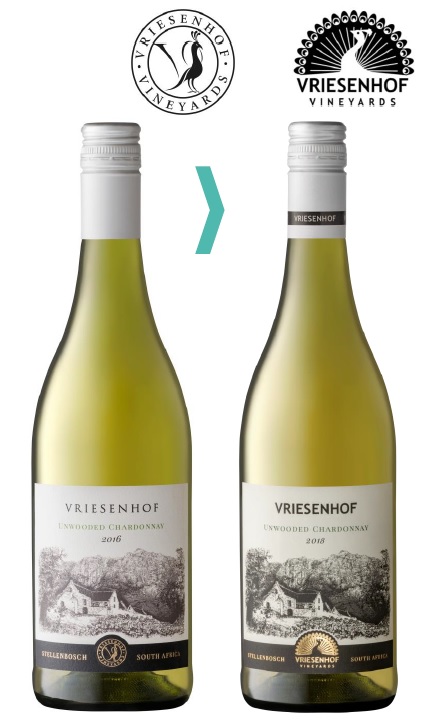
Vriesenhof old wine label vs newHidden on top of a hill in Paradyskloof, Stellenbosch, the vineyard has avoided tourist-trap status, focusing instead on its vision of creating great wines. Legendary ex-Springbok, Jan “Boland” Coetzee, bought it in 1980, producing his first batch of wine the following year. It’s not a destination wine farm with restaurants and other offerings, but one may simply enjoy wine and a cold meat and cheese platter in intimate, scenic surroundings.

Move with the times

As a well-known personality, Coetzee recalls it being easy to sell his wine when he first launched but, as the brand became more established and as new players continued to enter the market, he and his team realised that the need to move with the times was more important than ever: the original customers of Vriesenhof wines, lovingly called “The Jan Boland Coetzee fan club”, have been aging and a new market of wine lovers, and potential customers, is on the rise.

It was with this in mind that the brand gave a challenge (and a completely clean slate) to 3Verse, a Cape Town-based creative content agency, to recreate the Vriesenhof brand, look and tone of voice. “We’ve got a great product and now we want to become a brand,” explains Eddie Smit, Vriesenhof Vineyards CEO.

Ivan Johnson, 3Verse founder and partner, explains that the strategy behind the work is to establish Vriesenhof as a great product in the mind of new consumers — a solid wine made using traditional French methods. Winemaker Nicky Claasens studied in France, and he and his team do as little as possible to the wine and the land to allow its true colours to come through. “Vriesenhof still believes in the old methods and ways; they believe in the farm and the terroir,” he says.

“We don’t want to change the wine in such a way that nobody knows where it’s coming from,” says Smit.

Terroir tells the story

The new brand story speaks to how the road less travelled has now become a traffic jam of similar thinkers, that innovation has become convention — wine isn’t made to order and vines shouldn’t be twisted to suit trends. The people behind the brand see themselves as humble servants of nature, as guardians and caretakers of the wine-making process. You’ll never see a Vriesenhof blend that’s got unnatural flavouring or modern concepts. “Making a coffee pinotage is not what we do. That’s over-interference,” says Coetzee.

Vriesenhof’s rebrand includes a tone of voice that’s cheeky but still professional and cultured, like a wine label is expected to be. This voice and the rebranding of the label and logo aren’t meant to take away from the high-quality workmanship of the wine itself; instead, they position Vriesenhof Vineyards as an existing brand that’s done a shakeup to be in line with the now more-digital means of communication in marketing. So, while the brand is playing a lot more in the digital space, its messaging remains old-school in thinking.

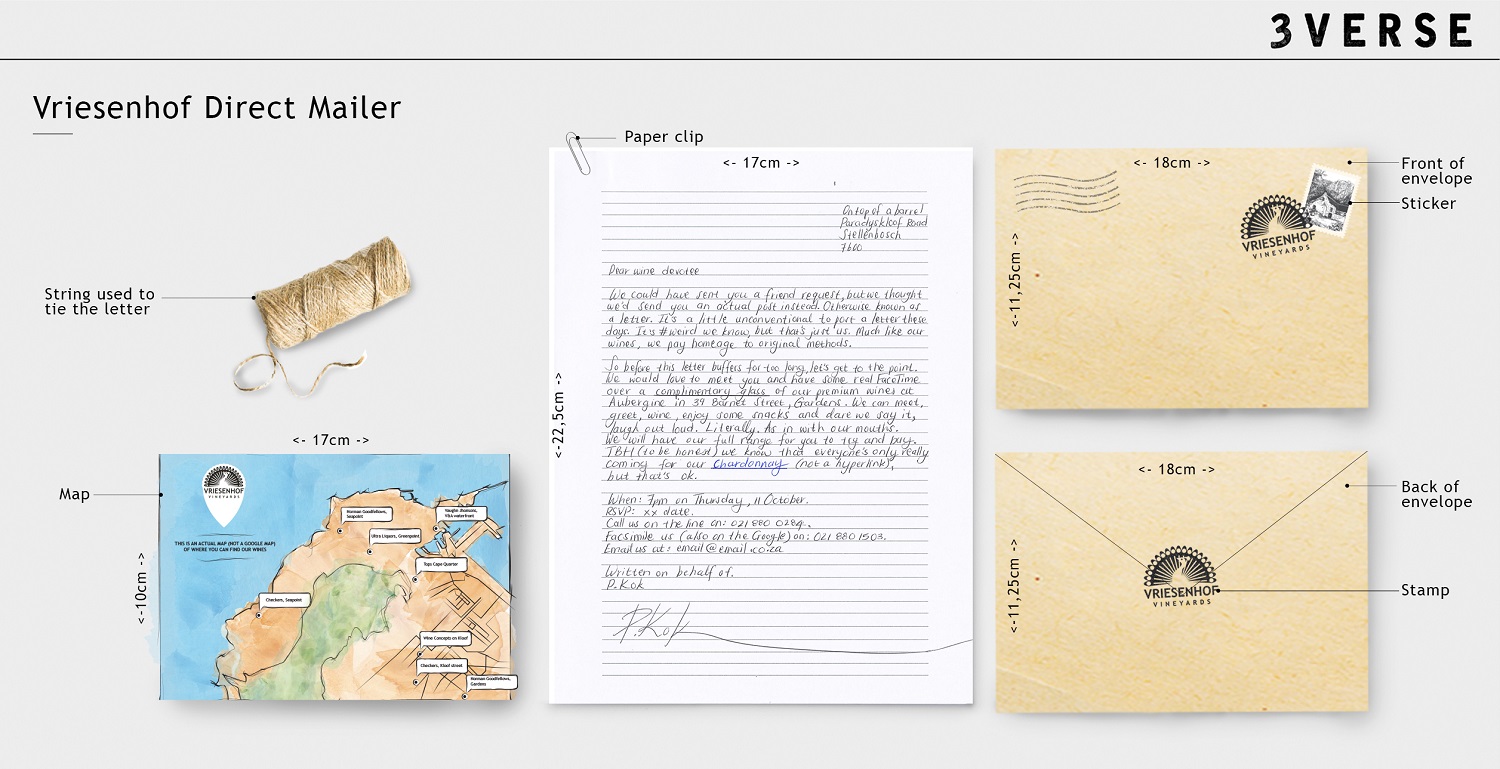
Vriesenhof direct mailer

Continuing to pay homage to original methods, much like when it comes to wine making, a recent PR campaign involved a photocopied hand-written letter that was put in every postbox in core Cape Town areas, inviting local wine-lovers to come and sample the range at a nearby restaurant. The playfulness of the new voice is seen with the word “Chardonnay” being written in blue and highlighted, just like a hyperlink would be if the invite had been sent digitally.

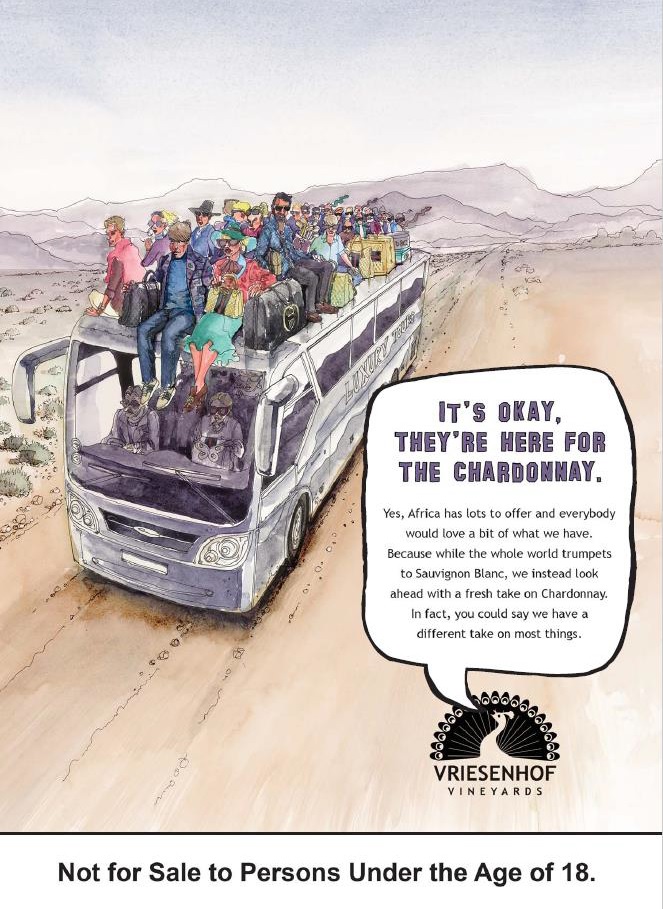
Vriesenhof Chardonnay poster
This print ad highlights the way in which many people leave Africa in search of a different life and turn the concept on its head to highlight how Europeans flock to South Africa, and particularly Vriesenhof Vineyards for its wine, namely the chardonnay. Chardonnay is the lead for this campaign as it’s the best product (from the full Vriesenhof range) for recruiting new consumers to the brand.

Chardonnay leads the way

Vriesenhof’s most-popular wine in the range, and its current talking point, is its chardonnay; it makes no other white other than a crisp unwooded and wooded chardonnay. According to the team, the plan is to make chardonnay the darling of the world again, with a price point to match. “We want to first introduce the unwooded chardonnay to sauvignon blanc lovers to get them used to the flavours and then hit them with barrel-fermented chardonnay,” says Coetzee, who earlier this month was awarded an honorary science in agriculture doctorate from Stellenbosch University for his “pursuit of excellence in the development of technology and management in the South African wine industry, and in the crafting of fine South African wines; and for his engaged citizenship to improve the working and living conditions of farm workers.”

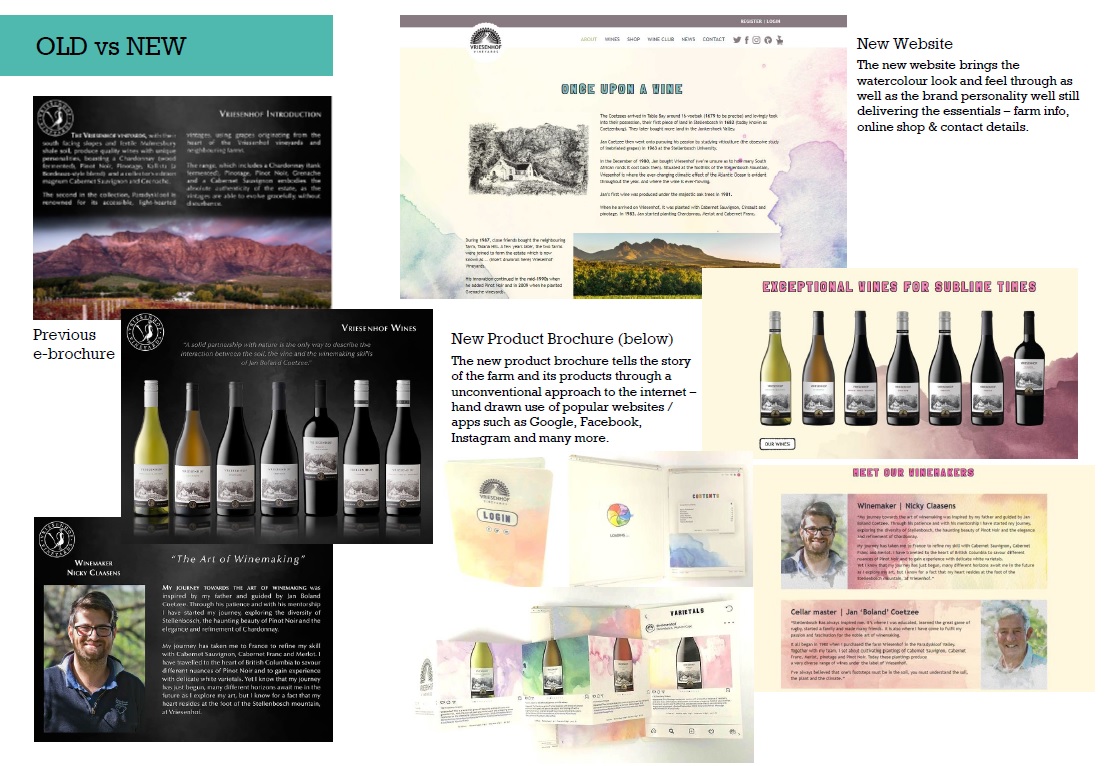
The new, foldout product brochure tells the story of the farm and highlights tasting notes of each wine in the range, using hand-drawn elements of popular platforms such as Facebook, Instagram, and Google.

The label itself has been designed in such a way that the wine bottle should ideally be turned around on shelf, with the back facing forwards. Whether or not this is possible in store and manageable from afar, the idea is to grab customers’ attention by playing on their need for order. According to Coetzee, “if they pick up the bottle, they’re already half committed.”

Another quirky element is the introduction of Mr P Kok, the personality behind the peacock on the brand’s logo, who has a Twitter account (@mr_p_kok)and is not shy of telling it like it is. He’s there to “cause shit” and be the part of the brand allowed to be a little out there while the rest remains premium.

“Relevant voice”

Altogether, the above shows how traditional elements play an important role in modern life.

“We’re not throwing away our story to please a new market. We’re old-fashioned but that’s nothing to be ashamed of. When you average out your advertising to make everyone happy, nobody hears it. This is who we are; all we can do is speak in a relevant voice,” says Johnson.

Vriesenhof old vs new
Click to enlarge.


Sabrina Forbes“#AgencyFocus/#BrandFocus” is an ongoing weekly series updating the market on ad agency performance and brand, including innovation, initiatives, the work, awards, people and business performance.

Sabrina Forbes (IG) is an experienced writer covering the food, health, lifestyle, beverage, marketing and media industries. She runs her own full-stack web/app development and digital-first content creation company. For more, go to moonwrench.com. She is a contributing writer to MarkLives.com.

— One subscription form, three newsletters: sign up now for the MarkLives newsletter, including Ramify headlines; The Interlocker, our new monthly comms-focused mailer; and Brands & Branding, launching soon!

Gestalt: Coordination, connection of marketing insights to lead growth

by Leeya Hendricks (@LeeyaHendricks) Most companies tend to organise their skills and knowledge divisionally — by product, service and geography. This filters through in ‘ivory tower’ offerings and top-down marketing, informed not by free-flowing market data and customer insights but by domain knowledge. To deliver truly customer-centric solutions, companies need to eliminate organisational silos, thereby facilitating easier sharing of customer-related information and better decision-making across divisional lines.

One way of overcoming divisional silos is to replace them with customer silos but, more often, companies simply develop better divisional coordination and collaboration processes in response.

Besides better internal coordination, customer-centric solutions may also require external expertise that isn’t resident in the business. For this reason, companies need to redefine their external boundaries to connect more tightly with external partners. In doing so, they may leverage the necessary skills to remain competitive through higher-value solutions while cutting costs.

Marry data and customer insights

By breaking organisational barriers in these ways, marketers may gain a big-picture view of business objectives and trends in the corporate ecosystem that will help them manage the high pace of change and time campaigns correctly.

Seeing across enterprise lines lets them take a step back and ask: Does it fit in with the company’s vision and mission? Does it match the data?

To achieve this level of insight, marketing needs to master data acquisition across business silos and align it with customer insights. Both are necessary but they’re very different pursuits. I’ve seldom encountered customer insight in marketing data. Those tend to come from talking to customers. To add value, marketers must compare customer behaviour with data and build on it with data.

To have success in the future, marketers need to do both — understand data, know how to get it, and marry it with customer insight, instinct and creativity.

Lead business growth through data and instinct

By doing all this right, marketing can lead, drive and grow the business by being among the select few in the organisation to break internal and external divisions, study the data and map it to customer insights.

  1. To cope with the rapid pace of change, they must first be aware of what’s going on across the wider business. We can’t get stuck in our divisional areas of focus, be it product, service or geography.
  2. Secondly, marketers can exert a greater influence across the entire organisation if they take an interest in decisions, regardless of whether it “officially involves marketing”. They need to get involved in other functional areas too.
  3. Thirdly, they need to do it by and for themselves by focusing on product launches, service and design experiences, as well as user and customer experiences. These things can’t be communicated by other areas of business. Marketing need to be more proactive, less passive.
  4. Lastly, by becoming more data- and customer-centric and integrating with the rest of the business, marketing can take the lead on innovation. This is because innovation is led by customer needs, something traditional marketers may not even be aware of.

Coordinate, connect, extract and collaborate

In summary, to meet customers’ expectations in future, marketers need to coordinate and connect across organisational boundaries to achieve seamless knowledge sharing. Additionally, they need to become data experts and work directly with customers and the various lines of business to gather the insights necessary to achieve both customer outcomes and the business vision.

Think about it — marketing is there to lead business growth. Marketers are in prime position to take advantage.


Leeya HendricksLeeya Hendricks (@LeeyaHendricks) is a designated chartered marketer, global marketing strategist, digital driver and a Women in Tech leader. She holds a BA degree in fine arts, a BA honours degree in brand marketing management, an MBA in business management and is completing her PhD in management sciences, focusing on the customer and business transformation. She is now director of customer first marketing at ORACLE UKI, responsible for driving customer success through customer advocacy, and building strategic partnerships focused on emerging technology and the changed customers’ buying behaviour. Leeya contributes the monthly column “Gestalt”, about putting customers first for sustainable business success, to MarkLives.

— One subscription form, three newsletters: sign up now for the MarkLives newsletter, including Ramify headlines; The Interlocker, our new monthly comms-focused mailer; and Brands & Branding, launching soon!

Brands & Branding: Preventing an issue becoming a crisis

by Kajsa Claude (@KajsaClaude‏) When working in crisis communications, it’s very important to differentiate between a crisis and an issue. You participate in a crisis but you manage an issue. This is an important distinction that will allow you to concentrate your knowledge and experience quickly and effectively.

Context

Before I go into more detail, it is important that we put the current risk and reputation environment in context.

In the age of ubiquitous social media and the emergence of ‘fake news’, the reputation and crisis management environment has become increasingly difficult to manage. According to the Reputation Institute, 2018 was the first year of significant reputation decline since the Great Depression. Indeed, the same report indicates that there has been a 38.5% decline in trust of corporates and corporate leadership. This is coupled with a 7.9% decline in purchase intent (customer spending).

Let’s look more closely at the difference between an issue and a crisis and why it is good practice to do this.

Issue vs crisis

An issue, on the one hand, is an event or activity that, in most cases, simply requires a response to a question from a third party, usually the media. It requires a willingness to respond to the enquiry and should be planned as part of general communications support for a particular project or programme, for example as part of your FAQs.

A crisis, on the other hand, develops when there is a sustained ‘attack’ on an organisation or entity despite all efforts to provide context and content. A crisis typically develops over a 3–5-day period of continuous coverage in traditional media but, as indicated earlier, this is rapidly becoming an area where social media can take the lead and significantly enable the narrative to run out of control.

Another factor in escalating an issue to a crisis is the inability (and sometimes the unwillingness) to communicate a response. This may be due to a number of factors, including a lack of information, lack of accountability and various other factors often not related to the crisis itself.

Procedures and processes

For both issue-handling and crisis-management, there is a series of procedures and processes that allows us to manage each incident efficiently and effectively. This means gauging the level of response required, if any.

In South Africa, issues usually revolve around three things:

  • the way a business operates;
  • the long-term commitment to SA, and
  • matters of reputation and perception.

So, for matters involving the way the business operates, one should be prepared to answer questions around business sustainability, BBBEE and business transformation or the environmental impact of your business

Sentiment

When it comes to sentiment, often expressed on social media, one should be able to demonstrate a commitment to SA through measurable impact on communities or on consumer uptake. A company should also have a clear roadmap for future investments, as well as the transformation of management and the workforce in general. Environmental impact and issues around sustainability are in the spotlight these days and all organisations must have a clear environmental policy in place, backed by facts and figures, not hot air.

Sentiment around an organisation’s commitment to the county and, in particular, to future growth and investment is also something an organisation must be able to illustrate, whether it be a clear growth and investment path, the leadership profile of the audience, community and corporate social responsibility and environmental impact. You should have a clear response to any questions raised around these issues. Social media is a useful channel for communicating facts and information around these issues

When dealing with the issue of perception and reputation, any organisation needs to be aware of the importance of sustainability, investment value, relationships with government and support of the NDP (National Development Plan), together with performance and leadership. Traditional media, be it print or radio, is excellent media for communications around these issues.

Preparation

Preparation on all of the issues above will be crucial in preventing any issue escalating into a full-blown crisis. Crises are stressful, damaging, time-consuming and may prove terminal, if not handled correctly.

I cannot overemphasise the importance of having a structured operational programme. Bear in mind that, in some situations, a crisis is the result of an operational failure and cannot be resolved through communication but rather through structural reform. In this case, communication will be used to explain the reforms as a means to resolve the crisis. Your crisis-communication model is divided into three phases: 1. Prepare, 2. Respond and 3. Recover. Let’s look at each phase in a little more detail.

Phase 1: Prepare

The essence of this phase is to prevent a crisis from spiralling out of control. I cannot overemphasise the importance of preparation. As the saying goes, “Train hard, fight easy.”

You should have a crisis team set up and trained in various scenarios but also equipped, through audits and analysis, to think on its feet. Testing of scenarios and running simulations play a big role here. Investment in this early phase will mitigate costs at the end. A draft crisis-strategy and -messaging, based on various scenarios, must be in place and all media channels clear and understood, both primary and secondary.

Phase 2: Respond

This is the damage-limitation phase. Here the strategy is one of refinement and evolution: tefinement of the messaging based on feedback and evolution of message delivery based on circumstances. There must be a proper documentation of all actions taken and messages sent. This will assist in the post-mortem of the communications effort as a whole.

Phase 3: Recover

This is the rebuilding and learning phase. It is amazing how little emphasis is often placed on ‘lessons learnt’. This phase includes analysis of: the crisis itself, the operational phase, the communications component and post-crisis audits involving stakeholders and the business itself. It is important that any gaps in any process are closed and that ongoing monitoring of this process takes place.

That, in a nutshell, is my approach to crisis communication. Note that dealing with issues will avoid a crisis, and planning and preparation, or lack thereof, will play a massive role in determining the outcome of any given crisis.


Brands & Branding 2018 now available!
2018 edition now available!

Kajsa Claude (@KajsaClaude‏) is head of client services at Ogilvy Public Relations and Influence in Johannesburg. She has over 20 years of experience working in strategic internal and external corporate communications, mainly in Europe but the last 10 years in South, as well as southern, Africa. She has worked on designing and implementing several strategic media campaigns in both the commercial and non-profit sector and she has managed teams across both national and company borders.

The article first appeared in the 2018 edition of Brands & Branding in South Africa, an annual review from Affinity Publishing of all aspects of brand marketing — consisting of case-studies, profiles, articles and research — also accessible at Brands.MarkLives.com. Order your copy of the 2018 edition now!

— One subscription form, three newsletters: sign up now for the MarkLives newsletter, including Ramify headlines; The Interlocker, our new monthly comms-focused mailer; and Brands & Branding, launching soon!
SA TV Ratings: SABC 2 — primetime top 20 for Mar, Feb 2019

by MarkLives (@marklives) The hottest primetime shows on SABC 2 in South Africa revealed: TV ratings for March and February 2019.

SABC 2 logoSABC 2, March 2019

Top 20 Programmes All Adults 15+
March 2019 Prime Time 5.30pm—10pm
Adults 15+ years U:35679 S:8175

Source: BRCSA March 2019

Day

Date

From

To

Station

Programme title

Genre

AR

Viewers

Share

 Tue 26/03/2019 2100 2131 S2 Muvhango Dram 16.06 5 731 178 46.1
Wed 13/03/2019 2101 2106 S2 Lotto Draw Live Quiz 9.25 3 301 693 28.4
Wed 27/03/2019 1759 1830 S2 7De Laan Soap 6.53 2 329 691 23.7
Thur 28/03/2019 2130 2159 S2 Speak Out Actu 4.19 1 494 820 15.5
Sat 02/03/2019 2000 2310 S2 South African Film & Television Awards Vari 4.05 1 444 894 17.8
Wed 27/03/2019 1830 1900 S2 Nuus News 3.71 1 324 555 11.2
Mon 25/03/2019 2132 2200 S2 Hillside Dram 3.02 1 078 732 14.1
Sun 31/03/2019 2030 2100 S2 Ga Re Dumele Sitc 2.89 1 030 240 9.9
Sat 30/03/2019 1900 1959 S2 American Ninja Warriors Vari 2.8 1 000 020 9.5
Sat 30/03/2019 2000 2027 S2 Ses/Tsw/Sep News News 2.78 993 325 9.3
Sun 10/03/2019 1801 1827 S2 Fokus Actu 2.63 940 065 10.4
Wed 27/03/2019 1730 1759 S2 Venda/Tsonga News News 2.62 932 911 11.6
Mon 11/03/2019 2130 2159 S2 90 Plein Street Dram 2.56 912 174 10.9
Sun 10/03/2019 1756 1801 S2 Music Musi 2.52 898 575 10.5
Tue 12/03/2019 2056 2100 S2 The Vodacom Show Quiz 2.45 874 549 9.3
Sat 02/03/2019 1930 2000 S2 Abomzala Sitc 2.34 833 502 8.7
Sat 23/03/2019 2030 2056 S2 Ke Ba Bolelletse Sitc 2.28 814 633 9.1
Mon 04/03/2019 1900 1930 S2 Treknet Dram 2.22 791 015 7.1
Sat 30/03/2019 2056 2100 S2 Live Lotto Draw Vari 2.2 783 763 6.9
Mon 25/03/2019 2029 2100 S2 Leihlo La Sechaba Actu 2.2 783 529 6.5


SABC 2 logoSABC 2, February 2019

Top 20 Programmes All Adults 15+
February 2019 Prime Time 5.30pm—10pm
Adults 15+ years U:35679 S:8315

Source: BRCSA February 2019

Day

Date

From

To

Station

Programme title

Genre

AR

Viewers

Share

Thur 28/02/2019 2059 2130 S2 Muvhango Dram 15.26 5 445 246 45.7
Mon 18/02/2019 1800 1830 S2 7De Laan Soap 6.19 2 209 427 25.9
Thur 07/02/2019 1800 2100 S2 State of the Nation Address 2009 Actu 6.14 2 191 512 19
Tue 12/02/2019 2056 2100 S2 The Vodacom Show Quiz 5.7 2 032 946 12.6
Wed 20/02/2019 2055 2100 S2 Lotto Draw Live Quiz 4.91 1 750 990 10.2
Thur 28/02/2019 2130 2159 S2 Speak Out Actu 3.98 1 418 652 15.5
Mon 18/02/2019 1830 1900 S2 Nuus News 3.97 1 417 169 13.7
Sat 16/02/2019 2000 2029 S2 Ses/Tsw/Sep News News 3.21 1 146 023 10.7
Mon 04/02/2019 2129 2158 S2 90 Plein Street Dram 3.15 1 123 553 14.6
Mon 11/02/2019 2057 2101 S2 Music Musi 3.05 1 089 242 17.5
Sat 16/02/2019 1900 1955 S2 American Ninja Warriors Vari 3 1 068 575 10.5
Sat 16/02/2019 2029 2057 S2 Ke Ba Bolelletse Sitc 2.96 1 054 937 10.2
Fri 08/02/2019 2129 2159 S2 Legend of the Hidden City Dram 2.89 1 029 689 11.9
Sun 17/02/2019 2059 2155 S2 It’s Gospel Time Musi 2.49 886 869 10.4
Mon 18/02/2019 1900 1929 S2 Treknet Dram 2.43 866 229 7.6
Sun 24/02/2019 1900 1958 S2 50/50 Docu 2.42 864 592 8.4
Wed 20/02/2019 1730 1800 S2 Venda/Tsonga News News 2.38 848 961 11.8
Sun 17/02/2019 2029 2058 S2 Ga Re Dumele Sitc 2.36 840 496 7.7
Thur 21/02/2019 1900 1959 S2 Musiek Roulette Musi 2.32 828 596 6.7
Sun 24/02/2019 1530 1749 S2 Partition Movi 2.23 795 856 10.7

In 2016, the Broadcast Research Council of South Africa (BRCSA) changed its policy about giving away TAMS and now only monthly reports, highlighting the top 20 or 30 primetime shows on several popular channels, are available.


Broadcast Research Council of South AfricaThe Broadcast Research Council of South Africa (the BRC) is a non-profit, industry body that was incorporated in 2015 to cater to the audience research needs of the radio and television industry in South Africa.

— One subscription form, three newsletters: sign up now for the MarkLives newsletter, including Ramify headlines; The Interlocker, our new monthly comms-focused mailer; and Brands & Branding, launching soon!
Q5: Flicking through House & Leisure 2.0 with Julia Raphaely [interview]

by Carey Finn (@carey_finn) The new-look House & Leisure hit shelves on Monday, 15 April 2019, boldly positioning itself in the Here and Now with its tagline to that effect. Julia Raphaely, the CEO of Associated Media Publishing, takes us through the design decisions and other aspects of the brand revamp.

House and Leisure, May/June 2019 — Kitchen IssueQ5: Could you walk us through the research and design process that went into developing the new aesthetic?
Julia Raphaely:
House & Leisure (HL) is a homegrown and very established brand but, as we know, the newsstand is quite a challenging space for publishers. We decided we wanted to come up with something exciting in this space which would keep the HL brand top of mind. And not just while on the newsstand — ultimately a concept that would live across all HL platforms.

Our intention was also to come up with a concept that will get a new generation of décor enthusiasts to purchase HL. Our biggest challenge remains how to grow print readership when most of the audience these days are happy with the digital content.

Our short-term objective is always to increase magazine sales, but our long-term objective is always building our brand that acts as platform for décor content through any channel.

This thinking required a strong concept which builds on the narrative that is HL. We worked with a brilliant design agency called MUTANT and a concept was born around the HL “lens on leisure”. The team then worked to explore how to deliver the new look with the latest issue as well as across all platforms.

Q5: In your own words, could you explain the elements of the new look?
JR:
Modern, brave, relevant, arresting, iconic, original and standout from a visual and brand point of view.

Q5: What are you hoping the redesign will inspire in readers?
JR:
I hope the new look will catch their attention and inspire them to refocus on the brand, as well as all magazine media. I hope it will create conversation and interest. Last, but not least, I hope it will showcase magic partnerships between all creatives (agencies and publishers), and that together we will keep innovating and reinventing ourselves.

Q5: Will the identity shift ripple into the content of the magazine?
JR:
Our content will remain the same in its origination, as HL at its core is a consumer-facing content brand that focuses on architecture, interior design, food, arts and culture with a purpose to inspire their audience to make the most of living here now. However, the presentation of the content across all channels will now be presented in a way that reflects a multichannel approach, and with the strong concept of the lens behind everything we create going forward.

Over the last two years, we have tackled our content with a more multilayered strategy: how we tell the story in print is totally different to how we unpack it digitally, how we “experience” that same home in video form, how the inspirational elements in the book are instantly shoppable, and how we breadcrumb it all via social media. So, this new identity simply reaffirms and strongly reinforces our layered but curated content approach.

New vs old design: House and Leisure Kitchen Issue in 2019, 2018 and 2017.

Q5: Looking at circulation figures, some would say that print publications in South Africa ought to adopt the “brace” position — what is your response to that?
JR:
The print industry has been “bracing” for a while. From our point of view, we are no longer print publications. We see ourselves as magazine media brands with content that is relevant to a valuable audience and accessible across all platforms. Our job is to continue building audiences by inspiring, curating, remaining relevant and, most importantly, innovating.

  • Explore the new House & Leisure online and/or in stores.


Carey FinnCarey Finn (@carey_finn) is a writer and editor with a decade and a half of industry experience, having covered everything from ethical sushi in Japan to the technicalities of roofing, agriculture, medical stuff and more. She’s also taught English and journalism, and dabbled in various other communications ventures along the way, including risk reporting. As a contributing writer to MarkLives.com, her new regular column “Q5” aims to hone in on strategic insights, analysis and data through punchy interviews with experts in media, marketing and design.

— One subscription form, three newsletters: sign up now for the MarkLives newsletter, including Ramify headlines; The Interlocker, our new monthly comms-focused mailer; and Brands & Branding, launching soon!
#AdForumSummit LA: Film, branded content growth now exponential

by Johanna McDowell (@jomcdowell) LOS ANGELES: On our fifth and final day of the AdForum Worldwide Summit LA, 25 weary pitch consultants set out for a packed day of meetings with three agencies: Spark44, 180 LA and Deutsch.

Spark44

First up was a very unusual agency called Spark44, which is the first independent global agency group to be a joint venture with a client. With 1100 people and 18 offices in the world, including Johannesburg, it has organised the group into hubs in the various regions. It’s a partner model with 50% owned by the client, 25% by the agency partners and 25% owned by agency staff. The agency was formed in 2011 and has seen significant growth since the outset.

The main client partner is Jaguar Land Rover, which wanted a new business model with its agency partners. The result has been a gamechanger within the industry, according to Spark44, and at a time when 85% of companies consider themselves in a state of transformation (according to Gartner); this is an agency model which could gain traction.

Spark44 does absolutely everything in marketing communications for Jaguar Land Rover, which has also made for great cost-efficiencies for the brand (which used to have about 70 agencies across the world). Although the agency started out with the two car brands, it now has recently won other brands such as Tetley Tea, Master & Dynamics, Alliance, TATA and Harley Davidson.

Originally the name was going to be Spark4, which relates to the automotive sector, but Spark44 is where it has landed up.

It talked about the fact that it’s able to save up to 27% of costs per head as a result of its model, making it a very attractive agency from a cost perspective.

180 LA

180 was formed 20 years ago in Amsterdam and it opened in LA in 2006 as a result of client needs. There are two offices for 180, with 55 people in the LA office and 95 in Amsterdam. (Interestingly, since then and most recently, LA has seen a renaissance in its advertising industry and, of course, in tech there’s continuous innovation.) The name 180 is all about turning 180 degrees in order to obtain a different perspective.

Omnicom owns this agency but yet the agency has retained its independence while being able to access all of the different services that the group has — hugely beneficial to the agency. Even more interesting is that the original founder of 180 is now back in the agency after an absence of a couple of years post-buyout.

It talked about three different perspectives:

  • Monitoring of 60+ wave forms for insights and opportunities
  • Creating emotional future case studies
  • Creating teams within their own structure and with specialists within Omnicom

We were shown some highly creative work and case studies for:

  • Boost
  • Expedia: bringing the world to children — sharing the power of travel
  • Lululemon: a yoga brand needing to find some white space in running
  • University of Phoenix: gender equity in IT
  • Replay: Hyperflex
  • Bonprix — boring housewives

Definitely an agency that every brand would want on a pitch list — inspirational and strong team skills, great chemistry.

Deutsch

And finally, Deutsch, with 400 people in LA, plus an office in New York of 300. It is part of the IPG network and so can work with other agencies in the group across the globe, should the need arise with clients.

In LA, it has full production studios and capabilities, and we were shown the extent of these very impressive facilities along with the type of work that it does for clients such as VW, Taco Bell, H&R Block and Hulu.

It sees itself as strong in business consulting, awareness-level modelling and business-opportunity analysis, and has developed its digital skills to an in-depth level, able to assist clients in all sorts of business transformation eg with VW and the way to shop for a car.

And, so, yet another summit came to an end and with some interesting learnings:

  • Most teens and young adults put their no. 1 job preference as creating video content for YouTube — creators
  • More digital video content is watched via TV now as opposed to via the computer
  • While there’s very slow growth in traditional media adspend, digital media is growing very fast and those agencies which are already in that territory are growing, too
  • The growth of film and branded content is now exponential and businesses are being formed around this extraordinary phenomenon, which tends to be more pronounced within youth culture.
  • Agency positioning is becoming more and more critical in defining the types of clients to work with and in order to attract the best type of clients.

See also


Johanna McDowellJohanna McDowell (@jomcdowell) is managing director of the Independent Agency Search and Selection Company (IAS), which is partnered with the AAR Group in the UK. She will be presenting detailed and in-depth reports and case studies on each agency from this 2019 AdForum Summit at her masterclass presentation in Johannesburg in May.

— One subscription form, three newsletters: sign up now for the MarkLives newsletter, including Ramify headlines; The Interlocker, our new monthly comms-focused mailer; and Brands & Branding, launching soon!
Online CPD Courses Psychology Online CPD Courses Marketing analytics software Marketing analytics software for small business Business management software Business accounting software Gearbox repair company Makeup artist