Africa Style: Back to basics

by Masingita Mazibuko. I am a self-confessed child of ’90s hip-hop, and often visited by music that I loved in my youth. Most recently, it’s been Heavy D’s ‘Nuttin but love’1 on continuous play in my mind. But I don’t draw your attention to honour Heavy D’s music; rather, it’s that this ditty was an anthem to heroism.

And, much as I hate to admit it, the awful truth of today’s marketing environment is that brands are no longer heroes. Instead, the customer reigns and dictates what brands should be.

Masingita MazibukoListen, share and let go

Even more awful is that we, the marketers, sometimes can’t even see this. We often become so enamoured by our brands that we chart their journeys and, in doing so, inadvertently create a gulf between the brand and the consumer. How do we prevent this from happening?

The answer is to go back to basics — listen, share and let go.

  • Listening as an art form

Journalist, editor, freelance writer, and teacher of writing, Brenda Ueland, said ‘listening is a magnetic and strange thing, a creative force’. However, listening is a skill that has to a large degree been lost by today’s society.

It is also a skill that marketers need to hone to ensure relevant and insightful engagement with our consumers, despite the cacophony of brand messages that engulf them. The underlying principle of marketing today is that brands need to seek permission from consumers to enter their world, as opposed to bombarding them.

If we don’t deliver relevant and insightful engagement, the consumer will tune out the brand. A colleague asked an audience to name the billboards they have encountered in Johannesburg. No-one in that audience could name a single one — ‘tune out’ in practice.

  • What is yours is mine

The consumer should be the inspiration behind everything that marketers do. To quote Heavy D, ‘What’s yours is mine’.

Here is the reality: we are merely custodians of brands. Ultimately, the brand’s success or failure is determined by consumers, and so we have to actively and relentlessly seek to forge relationships that not only satisfy their desires but ignite and inspire their passions.

  • Let it go

Yes, it’s the name of the theme from Disney’s ‘Frozen’, that story of ultimate sibling bonding. Inherent in Disney’s story is a willingness to risk what we think is ours to help and satisfy another’s desires.

Consumers are increasingly the heroes of the conversations that we ignite. Acknowledging this, creating the relevant platforms on which they can stand, and letting go will see our brands become bigger than we could have ever conceived.


Note1: I got nothing but love for you, baby {Uh-huh}
I got nothing but love for you, honey {Yeah, whatever}
I got nothing but love for you, baby {What you got?}
I got nothing but love for you, honey {Yeah, whatever} (What’s yours is mine)
I got nothing but love for you, baby {Uh-huh} (What’s mine is mine)


Masingita Mazibuko is a marketing director at Unilever. The views expressed within this monthly “Africa Style” column are, however, entirely her own.

— MarkLives’ round-up of top ad and media industry news and opinion in your mailbox every three work days. Sign up here!

The end of body art rebellion as corporate logos get under the skin

by Benjamin Voyer, ESCP Europe How far are consumers ready to go to show their love to brands? As the BBC recently noted, tattoos representing brands are getting more and more common. But why? And what does it tells us about the psychology of consumers and brand identities?

One simple way to explain this phenomenon is the changing perception people have of tattoos. They have been “de-marginalised” and have tattoosgone from being a sign of rebellion to acceptance by the masses. They are now an almost ubiquitous part of pop culture, just like the brands who have worked so hard to get there. The widespread popularity of tattoos among all social classes reflects the fact that body art is increasingly seen as a product like any other. In this context, why would consumers limit themselves?

Brands have also mastered the art of selling lifestyles and ideals, which has, in return, inspired their consumers to develop very close psychological connections with them. Researchers talk about “brand-extended self-construals” when consumers use brands they hold dear as a way to define themselves. Think Nike, Apple, Volkswagen, and, of course, Harley Davidson. These have in common a strong following and a sense of “community” you might ordinarily associate with sports teams.

Harley Davidson is probably the best example, as this was one of the first brands widely used for tattoos. When the brand is inked under the skin it signifies a consumer’s commitment to the community and an adhesion to the brand’s supposed lifestyle.

Chasing identity

There is a third possibility that the choice of brand logos and names can be seen as an ironic take on consumption. This could be the case for a consumer wearing a luxury brand or logo tattoo, suggesting that although they might not be able to afford the products, they can still “wear” the tattoo. Maybe too it can be a reaction against “traditional” tattoo designs and the quite specific culture surrounding these. Brand tattoos are seen as more fun and less serious than traditional ones.

From a psychological point of view, tattoos are concerned with both individual and social identity. That is, they are about helping individuals to construct and reach an ideal self – the person they would like to be. Brands these days are becoming a crucial provider of identity, in the same way that religions have in the past.

Consumer psychologists have also long suggested that possessions could act as an extension of the self. Brand tattoos can therefore help individuals to become one with their possessions. This also suggests a certain degree of anthropomorphism, meaning that consumers treat brands as their friends or ideal partners. Of course, those relationships can be fragile beasts, as the man who got himself a Mitt Romney face tattoo discovered.

Tattoos are also about social identity. A tattoo is a membership token, which gives access to a group, and is connected to a sense of legacy and a sense of history as we can see in markings from clans, tribes or family mottos. The fact that brands are now being used as tattoo symbols suggests they have acquired this capacity. Typically consumers started inking brands that had a strong community spirit. Biker groups, and Harley Davidson in particular – one of the most popular brand-logos for tattoos in Northern America – are a good example.

Power game

It can also be about taking on the achievements and attributes of the brand, especially for a sports-related firm such as Nike. This goes back to another meaning of tattoos: power display. Individuals are increasingly involved in what marketers call “personal branding”; constructing and marketing an identity to others, just like brands market products.

Social media has greatly contributed to this development. Aside from the sense of community we talked about above, people can also derive some power and prestige from the brand. “If I wear this tattoo, I can do more, achieve more and be seen by others as powerful.|” This also goes back to the more magical meaning and origins of tattoos, and can be interpreted as a form of co-branding.

Your heading here…

The obvious question is whether many of these people with a tattoo of a brand will come to regret it in later life. Regrets can indeed occur, as with any form of permanent body transformation. But using a brand name or logo as a tattoo brings additional sources of regret.

Brands can change, and can reposition themselves. As they undergo identity changes – maybe by becoming less exclusive and more mass-market – they might lose the power that inspired the permanent association in the first place. Brands can also become involved in wrongdoing or company scandals which entirely change people’s understanding of the meaning behind the image. And brands tend to be less “durable” than Celtic designs or emotional reminders of your parents – if Nike goes under then the meaning disappears and the power wanes.

And pity the person with the corporate tattoo who it would grant access to the tattoo subculture where, frankly, an Apple logo on the wrist is more likely to spark derision than inclusion.

The ConversationBenjamin Voyer does not work for, consult to, own shares in or receive funding from any company or organisation that would benefit from this article, and has no relevant affiliations.

This article was originally published on The Conversation.
Read the original article.

— MarkLives’ round-up of top ad and media industry news and opinion in your mailbox every three work days. Sign up here!

Brand Politics: The reign of the evangelists

by Alistair Mackay (@almackay) Brand evangelists can be hugely damaging for a brand, whether in politics or the private sector. It’s not just people bad-mouthing a brand that can influence others to avoid it; it’s the characteristics of those singing its praises, too.

In politics, supporters often say and do the most horrendous things in the name of the party.

Alistair Mackay

“Off message”

South African news is full of stories of ANC, COSATU or EFF leaders distancing themselves from things that were said at their rallies and gatherings. Many people have also remarked that the DA’s biggest challenge in attracting new voters is its own supporters — many of whom are vocal on social media and entirely “off message”.

Fuelled with self-righteous fury, these DA supporters go into battle as if they represent the party and all that it stands for, when often they don’t understand the party’s policy position at all. Many of these people have no official connection with the party, other than liking it, and believing that it furthers their interests. They are not even members, let alone have any influence in its decision-making bodies.

And yet the public backlash is almost always directed at the party itself. “The ANC are a bunch of hooligans!” bark the commentators after a violent protest. “The EFF/DA is racist!” they cry, after a racist poster appears at a rally or a musician fights with people on twitter.

Negative halo effect

It makes things difficult for parties that want to change their image. Supporters of a party influence how people feel about that party — and that halo effect can be negative.

It happens in the private sector, too.

With BMW, for example, there is a whole set of prejudices that kick in when people think of BMW drivers. Their reputation includes being rude, driving aggressively and being overly pleased with themselves. There’s even that joke about indicators being an optional extra on BMW cars, since they so seldom get used.

I’d bet my little hatchback

Of course, these are just silly stereotypes and I’m sure we all know perfectly nice BMW drivers, but the perception exists. And I’d bet my little hatchback that preconceived ideas about BMW drivers have put off potential buyers from buying their cars. These potential buyers may not feel like they belong in that group; they may not like what it says about them.

And, yet, BMW’s marketing isn’t about status at all, or speed. It’s about joy, and it has been since about 2009 when that global strategy began rolling out. This means that the “stereotypical BMW driver” is either oblivious of or indifferent to the kind of brand message that BMW is trying to create. And its community of fans probably has as much influence, for better or worse, as its marketing campaigns do.

Luxury fashion label Burberry was almost destroyed by its own popularity with the ‘wrong’ crowd, when its iconic beige check pattern became so widespread that the brand became associated with football hooliganism and chavs. No one wanted to buy what the chavs were buying, and it has taken the company years of smart marketing and eye-wateringly high prices to regain its appeal as a luxury brand.

What to do

We’ve all heard of marketing “tribes”, and “social” and “influencer marketing” are still buzzwords in the industry. Using your own consumers to influence others has enormous potential, because all of us trust people more than we trust advertising.

But what happens when one of your tribes damages the brand? What if the people who love you aren’t your target market, and actually put people off from engaging with your brand?

Here are a few tips for ensuring the dog still wags the tail:

  1. Understand exactly who is buying your brand, and why. Don’t believe your own hype or assume that it is necessarily the people you are targeting. Understand how these different tribes influence your desired target market. If their influence is positive or neutral, you don’t have a problem. But your target market may want to distance themselves from the kinds of people who most visibly associate with your brand. Brandy producers, for example, struggle with building super-premium brandy brands because of the popularity of low-end brandies and consumer prejudices against the people who drink them.
  2. Find the right influencers and educate them. Identify the people that your target market trusts and empower them to tell the brand story that you want told. Collaborate with them, and create easy-reference guides so that they have the information they need when taking on rogue brand fans.
  3. Be relentless in focusing on the target market that’s good for brand growth — understand what they need, their context and viewpoints. Hone your messaging to push the right buttons to catch and hold their attention, without being distracted by the noise from your vocal, off-strategy fans.
  4. Tackle the issue head on. If a group of brand fans really does hold your brand back, it may be worth challenging the relationship. It’s a risky and bold move to make, as it will damage existing sales, yet it may be necessary for long-term brand survival. The DA has lashed out at its more conservative supporters before. Burberry quietly clamped down on all illegal vendors of its check pattern and bought back the licences from all the other companies that had licences to produce it. It improved its design and its narrative, and increased its pricing to give the brand premium appeal.

Important for marketers to understand

When your brand has huge appeal and is flying off the shelves, it’s strange to think that there could be a problem.

But, as social media brings down the walls between brands and people — as marketing becomes all about community and conversation again — it’s important for marketers to understand who their community is and how these tribes of people influence one another and potential new consumers and markets.

If brands are like people, as so many people love to say these days, then they need to make sure they like their circle of friends.


For more on brand evangelism, social and influencer marketing,
read our columnists Mongezi Mtati and Jason Stewart.


Alistair Mackay (@almackay) is marketing manager and head of content at Yellowwood, (@askYellowwood) a leading marketing strategy and brand development consultancy. He has experience both as a brand strategist and as the digital media manager for the Democratic Alliance, and believes that innovative, insightful and generous marketing is both good for business and social change in South Africa. He contributes the monthly “Brand Politics” column, exploring lessons brands can learn and apply from politics, to MarkLives.

— MarkLives’ round-up of top ad and media industry news and opinion in your mailbox every three work days. Sign up here!

Media Future: Welcome to the data divide

by Arthur Goldstuck (@art2gee) The digital divide is vanishing as the masses embrace smartphones. In its place, we have the data divide.

It should be obvious by now that the days of the basic cellphone are waning, as smartphones begin to invade the mass market. By the end of 2015, it is likely that half of all South African adults will be using a smartphone. By 2020, all phones will probably be smartphones.

This means that the digital divide, in terms of having the physical means of access to the Internet, will have all but vanished. data

What remains in its place, however, is an equally big divide. This time, it’s the data divide. Because you may put the means of access in the hands of everyone, but if you keep the cost of access too high, the divide remains.

The data divide can be defined by simple arithmetic. The average revenue per user (ARPU) on the MTN network is R100 per month. The average user typically cannot afford to buy a large data bundle or is not accustomed to the idea of buying data by the bundle at all. As a result, any data use comes off airtime, based on the ad hoc cost of data. In other words, R1 per Megabyte on the MTN network.

Last month, the average web page of the world’s 1000 most visited sites, according to HTTParchive.org, which “tracks how the Web is built”, was 1,85 Megabytes – and growing fast every few months.

This means that reading just three of the main news items from two online newspapers will use up a tenth of the average MTN user’s budget if no bundle is being used.

Applying this arithmetic to pre-paid customers only is even more eye-opening. On Vodacom, pre-paid ARPU is a mere R67. Its ad hoc data rate, on the other hand, is a jaw-dropping R2 per Megabyte. The same reader will use up a third of an average month’s spend on a single morning’s quick flick through the main news stories.

Now add all of that together, and what does the arithmetic tell you? Simply that the mass market that is embracing smartphones is not ready to embrace the Internet wholeheartedly. What should it tell the operators? There is no justification in this country to charge R1 or R2 per Megabyte when the operators are talking the language of digital inclusion.

Vodacom in fact has a great offering for bridging the divide: an option called a Power Bundle, allowing users to buy 50MB of data for R3 – effectively 6c per Megabyte. That’s on a par with the per-MB cost of Vodacom’s most expensive bundles – but it has to be used within 60 minutes of activation.

On the one hand, that’s the equivalent of consuming all the latest news on several newspapers, watching a few YouTube videos and downloading a few music tracks. On the other hand, the user has to know about it to take advantage of it, and can’t use it as needed. It’s still a significantly better option than MTN’s cheapest bundle, 30MB for R10, or 33c per Megabyte.

The puzzling aspect of these prices is that, if data can be sold to low-end users at anywhere from 6c to 33c per Megabyte, why retain the R1 and R2 ceiling prices? When it merely creates bad public relations for the networks?

Cell C rubs salt into the wound by claiming that 99c per Megabyte is “a good rate”. It then contradicts itself with an argument that the high out-of-bundle rate is designed to push consumers to buy bundles, which help the networks better plan capacity and load “dimensions”. However, it is hard to see how this can be the case when there is no specific timeframe on when data bundles will be activated or used.

Let’s take one more look at the shape of the digital divide:

The more well-off data users among us regularly buy by the Gigabyte. If we can afford from R399 to R699 a month, we can buy one of the following 10GB bundles:

MTN: R399 (4c/MB)
Vodacom: R599 (6c/MB)
Cell C: R699 (7c/MB)
Telkom Mobile: R698 (7c/MB)

The least well-off among us, who believe they cannot afford to buy any bundle upfront, will pay 99c per MB on Cell C, R1 on MTN and Telkom Mobile and R2 on Vodacom. Given the current cost of the smallest bundles, why not bring this ceiling down to 33c? That is, in effect, what it would take just to begin crossing the data divide. It would also pull the teeth from the most severe criticism the operators face in the second half of 2014.

Free Wi-FI hotspots, such as those being rolled out by Project Isizwe, help to minimise the impact of the data divide, but their reach is limited.

While the networks grapple with the arithmetic, though, there is something they can do to ease the burden: they can zero rate key educational sites, like the global Wikipedia encyclopaedia and the South African open source maths and science syllabus site Siyavula, allowing free access to these – and other – revolutionary tools of learning.

They could also add Government sites, online and mobile health advice and counselling services, and directories of public service entities like clinics and police stations. The impact on their networks would be negligible, yet the impact on those stuck on the wrong side of the data divide could be immense. And it would go some way to burnishing the image of the operators.

Arthur Goldstuck

Arthur Goldstuck heads up World Wide Worx (www.worldwideworx.com) and is editor-in-chief of Gadget. He is a consulting editor to MarkLives and our media tech columnist. Follow him on Twitter on @art2gee. This article has been republished from Gadget.

— MarkLives’ round-up of top ad and media industry news and opinion in your mailbox every three work days. Sign up here!

Smart Africa TV: Intel’s John Davies on the digital divide

by Russell Southwood (@BalancingActAfr) In this video interview,John Davies, World Ahead VP at Intel, talks about: John Davies of Intel

  • how big the remaining digital divide is and the reasons for the gap;
  • new models for connecting people;
  • examples of new models in Africa;
  • making the Internet useful to people;
  • and how Colombia is tackling the digital divide.


Smart MonkeyRussell Southwood is the founder of Balancing Act and the web TV channel Smart Monkey TV, and has been an analyst in telecoms, internet and broadcast in Africa for the last 14 years. Smart Monkey TV aims to capture the energy at the crossroads between African culture and technology. MarkLives is syndicating content from Smart Monkey TV on a weekly basis for the column “Smart Africa TV”.

— MarkLives’ round-up of top ad and media industry news and opinion in your mailbox every three work days. Sign up here!

From flyers to through the line, and how Artifact landed Domino’s

by Herman Manson (@marklives) The story of Artifact Advertising is one of entrepreneurial tenacity, a couple of near-misses and, finally, a series of success that is quickly putting the agency on the map.

It was started in 1994 by Andy Taoushiani and a business partner. The former was fresh out of college. His family’s entrepreneurial can-do spirit — they had been involved in running a number of Greek corner cafés and restaurants — meant Taoushiani never seriously considered working for anybody but himself.

Artifact Advertising: co-founder Andy TaoushianiStarted small

He ran a bar with his brother while he was studying graphic design, with the intention of running his own studio and print shop once he had the know-how.

It started small. Flyers and business-cards and letterheads small, in fact. In the mid-90’s, people still got stuff printed and there were fewer small studios around. Entry into the market went smoother than expected.

But the partners were pulling in different directions, and each ended up going their own way. Taoushiani now ran the business after hours while he worked at a local repro house.

Key differentiator

Traditional agencies didn’t understand repro, says Taoushiani, and it would be a key differentiator for the Artifact Advertising Taoushiani relaunched in 1997.

The agency was getting more and more below-the-line work in, doing design jobs, brochures, corporate IDs and leaflets. By 2000 it was employing five people. Then it won the Epson account. It was a big win for a five-man company, and a turning point for the business.

In 2001, Wimpy went out to pitch. Taoushiani remembers several dozen agencies competing for the business. These were the days before ACA codes and best practice. It was late December and client needed some posters printed (it had nothing to do with the actual the pitch, but it would be Artifact’s foot in the door) — quickly. Most of the ad agencies had already closed their doors. Taoushiani ran the job. He’d also hired a ‘web design guy’ at a time when many ad agencies were still figuring out email.

Combined effect

The combined effect was to get Artifact into round two of the pitch and it walked away as the new Wimpy below-the-line agency. The agency quickly grew to 12 people.

Then disaster struck. Pleasure Foods (owners of Wimpy) got sold off to Famous Brands in 2003, and Artifact lost the account and 70% of its revenues. Taoushiani says the agency had built up some reserves in the good years and had kept its overheads low. It was hard times but survivable.

Artifact Advertising: genuine good work served with a smileGradually, the agency brought on board new business, and Taoushiani expanded its digital reach through a new online division. As a result, Taoushiani and his team were learning a lot about online marketing, attending conferences and courses. The new studio didn’t last and was quickly integrated back into the main agency after it failed to pick up any significant business.

Just become TTL

Less strategy than circumstance, Artifact Advertising had just become a through-the-line business.

Also, the loss of Wimpy wasn’t a complete disaster. In due course, the agency picked up the Taste Group business (first as its below-the-line agency and, more recently, the through-the-line business), which includes brands such as Scooters Pizza, St Elmo’s Woodfired Pizza, Maxi’s Restaurants, Zebro’s Chicken and The Fish & Chip Co.

Then, unexpectedly, Artifact won the Infinity business (the luxury vehicle division of Japanese automaker Nissan) in 2011. Not the BTL business, or the digital business, but all of it. It gave the agency confidence in itself and Taoushiani decided to really start competing.

Inventory sold out

Infinity lead to the digital business for Nissan, and its Nissan Micro activation sold out inventory across the country.

While the agency’s mind had already shifted, its string of successes  made clients sit up and take notice, and more work came its way. It subsequently landed the digital business from Datsun, which is soon relaunching in South Africa.

At the end of 2013, it picked up SupaQuick after a competitive pitch involving five agencies. Then came the news that Taste is bringing Domino’s to SA and that it would retain Artifact as its agency on the brand launch.

Current operations and plans

The team of 40 now operates out of offices in Johannesburg and, more recently, Cape Town.

Currently, Taoushiani is working on the agency’s two-year plan to stay competitive in a changing market; it will identify key marketing trends to see where Artifact should be investing resources (think mobile and content management) while also strengthening its ATL credentials.

— MarkLives’ round-up of top ad and media industry news and opinion in your mailbox every three work days. Sign up here!

MagLove: The art of busy magazine covers

by MediaSlut (@MediaSlut) My choice of the best international magazine covers in MagLove this week:

  • Boston
  • Esquire
  • Time Out New York
  • Best of VOLO
  • Shukanjosei 週刊女性

INTERNATIONAL

Boston, September 2014

Boston, September 2014The bitten pencil. The epitome of stress to me, especially while at school, when I used my trusty Staedtler HB pencil for exams!

The link between ‘school’ and ‘stress’ has been captured perfectly in this cover.

Esquire, September 2014

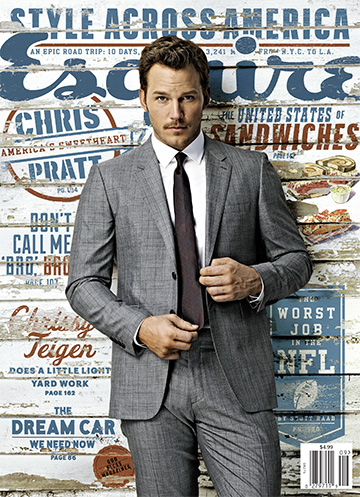
Esquire, September 2014Yes, the cover is busy (a lot going on!), but its execution is successful, with the overall look and feel reminding me of something nautical and also a little restaurant on a dock somewhere…

Just not sure how it all links back to Chris Pratt but, overall, it looks cool.

Time Out New York, Fall 2014

Time Out New York, Fall 2014Sjoe, but this cover is playing with my eyes!

Impressive how the lines have been lined up with the those on Michael Cera’s shirt…

Best of VOLO – in Nature, Volume 1

Best of VOLO – in Nature, Volume 1It’s billed as the “World’s #1 Nude Art Magazine”, and it’s created a special “Best of VOLO” looking at Nude Landscapes — all 178 pages!

Yes, the image is quite naked, but we’re all adults here and can appreciate beauty, and a beautiful cover…

Shukanjosei 週刊女性

Shukanjosei (Women's Weekly Magazine)Stay with me, I haven’t gone crazy by thinking this cover is a work of art…

I wanted to include this as I find the amount of cover lines extremely interesting, as they it take up probably 90%+ up of the cover! In some small way, the craziness of it all makes it interesting and arty.

Still wondering what Shukanjosei is? It’s Japan’s oldest women’s magazine, and is all about gossip, society, lifestyle and cooking.


Find a cover we should know about? Tweet us at @Marklives and @MediaSlut.
Want to view all the covers at a glance?
See our MagLove Pinboard!


MediaSlutMagLove by @MediaSlut is a regular slot featuring the best local and international magazine covers every week, recognising well thought-out, powerful and interesting (and hopefully all three-in-one) covers and celebrating the mix of pragmatism, creativity and personal taste that created each of them. The (for now anonymous) blogger behind MediaSlutknows way too much for his own good about media in South Africa, magazines in particular. His mission is to show when SA magazines fail but, most importantly, also when they succeed. If you’re looking for a library about SA magazines and news, this is your one-stop pitstop.

— MarkLives’ round-up of top ad and media industry news and opinion in your mailbox every three work days. Sign up here!

Heroes & Zeros: RMB & Energizer — best & worst brands of the week

Andy Rice (@ricecommaandy) talks about his best and worst brands of the week — Rand Merchant Bank and Energizer — with Jenny Crwys-Williams (@jcwLIFE) during The Ad Feature on Talk Radio 702 (@Radio702).

Find out why these feature in this week’s Heroes & Zeros webisode by watching below:


For a fresh look at the world of advertising, Jenny Crwys-Williams of 702 Talk Radio chats to advertising critic Andy Rice on The Ad Feature, every Wednesday 2.30pm — 3pm. The filmed Heroes & Zeroes will appear on MarkLives every Friday morning as a webisode.

— MarkLives’ round-up of top ad and media industry news and opinion in your mailbox every three work days. Sign up here!

#Top40TVratings: Schuster does it again!

by SAARF & MarkLives (@marklives) Leon Schuster has done it again, coming in at no. 4 on both our SAARF/MarkLives #Top40TVratings national and DStv charts with “Mr Bones 2: Back to the Past” on SABC 1 during the week of 18-24 August 2014!

Mr Bones 2: Back from the PastA collaboration between the South African Audience Research Foundation (SAARF) and MarkLives, this SAARF/MarkLives #Top40TVratings column is a weekly roundup of South Africa’s TV audience viewership.

It reveals the best-watched shows of the week before, where it ran and how many South Africans tuned in to watch.

We offer two tables, the first covering all households — free-to-air viewing (the various SABC channels and e.tv) as well as the DStv platform — and the second charting the best-watched shows on the DStv network of channels only.

SAARF/MarkLives #Top40TVratings Charts: 18–24 August 2014

National

Market Target Activity
National Total Indv (incl guests) Live + VOSDAL
Counter Description (grouped) Channel Level 1 Level 2\variable (r) AMR % AMR SHR %
1 GENERATIONS SABC 1 Soap opera Local 24.0 10 310 015 72.16%
2 MFOLOZI STREET SABC 1 Drama Drama 17.7 7 584 377 55.01%
3 SOUL CITY SABC 1 Drama Drama 15.1 6 494 569 48.23%
4 MR BONES 2:BACK FROM THE PAST SABC 1 Movies Comedy 14.3 6 125 856 53.11%
5 STICKS AND STONES SABC 1 Drama Drama 12.9 5 555 108 41.23%
6 SHREDS AND DREAMS SABC 1 Drama Drama 12.5 5 375 354 42.63%
7 SELIMATHUNZI SABC 1 Variety Variety 12.1 5 178 030 34.88%
8 SES’TOP LA SABC 1 Sitcom Sitcom 11.7 5 010 741 35.48%
9 XHOSA NEWS SABC 1 News News 11.3 4 840 191 36.39%
10 MUVHANGO SABC 2 Drama Drama 11.2 4 816 326 40.08%
11 ZULU NEWS SABC 1 News News 10.7 4 590 930 35.06%
12 ZAZIWA SABC 1 Variety Variety 10.4 4 467 886 32.50%
13 IHAWU SABC 1 Drama Drama 10.4 4 458 215 36.48%
14 SCANDAL e.tv Drama Drama 10.3 4 427 917 31.81%
15 SKEEM SAAM SABC 1 Drama Drama 10.0 4 275 061 34.97%
16 FRIENDS LIKE THESE SABC 1 Variety Variety 9.7 4 159 784 37.02%
17 REAL GOBOZA SABC 1 Magazine Magazine 9.3 3 990 479 30.67%
18 MTN 8 ORLANDO PIRATES VS BIDVEST WITS SABC 1 Sport Football (soccer) 9.3 3 982 227 35.39%
19 1’S AND 2’S SHOW SABC 1 Music Music 9.1 3 883 057 30.41%
20 SUNDAY LIVE SABC 1 Actuality Actuality 8.6 3 680 101 27.16%
21 POWERBALL SABC 2 Variety Variety 8.3 3 580 507 35.06%
22 MTN 8 KAIZER CHIEFS VS PLATINUM STARS SABC 1 Sport Football (soccer) 8.2 3 521 116 39.33%
23 MADAGASCAR 2: ESCAPE TO AFRICA e.tv Movies Animation 7.2 3 076 906 24.96%
24 KHUMBUL’ EKHAYA SABC 1 Magazine Magazine 6.8 2 915 751 26.90%
25 K’SHUBILE SABC 1 Reality Reality 6.8 2 909 446 25.06%
26 STUMBO STOMP AMAPANSTULA SABC 1 Variety Variety 6.6 2 811 719 27.54%
27 RHYTHM CITY e.tv Drama Drama 6.3 2 704 493 22.15%
28 SKEEM SAAM -R SABC 1 Drama Drama 6.2 2 655 533 57.36%
29 MUVHANGO -R SABC 2 Drama Drama 5.9 2 519 357 38.64%
30 WIPEOUT SABC 2 Competition Competition 5.8 2 504 443 19.46%
31 ISIDINGO:THE NEED SABC 3 Soap opera Local 5.8 2 487 234 18.72%
32 MUVHANGO -R SABC 1 Drama Drama 5.7 2 461 892 53.42%
33 SPEAK OUT SABC 2 Actuality Actuality 5.7 2 424 249 29.60%
34 EMZINI WEZINSIZWA -R SABC 1 Sitcom Sitcom 5.6 2 398 115 51.56%
35 100% YOUTH SABC 1 Variety Variety 5.3 2 289 628 23.67%
36 WWE WRESTLING RAW e.tv Sport Wrestling 5.3 2 280 660 29.96%
37 SAATH SAATH SABC 2 Soap opera Local 5.3 2 270 927 35.97%
38 GUMBA GUMBA e.tv Music Music 5.2 2 241 716 19.84%
39 FAN BASE SABC 1 Music Music 5.2 2 233 106 24.77%
40 MODERN FAMILY e.tv Drama Drama 5.2 2 223 183 16.40%

DStv platform only

Market Target Activity
DStv Total Indv (incl guests) Live + VOSDAL
Counter Description (grouped) Channel Level 1 Level 2\variable (r) AMR % AMR SHR %
1 GENERATIONS SABC 1 Soap opera Local 16.6 2 240 241 49.49%
2 MUVHANGO SABC 2 Drama Drama 8.7 1 174 810 29.90%
3 ISIBAYA Mzansi Magic Variety Variety 6.9 926 941 21.64%
4 MR BONES 2:BACK FROM THE PAST SABC 1 Movies Comedy 6.8 916 249 24.39%
5 MFOLOZI STREET SABC 1 Drama Drama 6.6 886 904 19.78%
6 SCANDAL e.tv Drama Drama 6.3 852 721 19.14%
7 SELIMATHUNZI SABC 1 Variety Variety 6.1 830 479 17.59%
8 XHOSA NEWS SABC 1 News News 5.8 778 827 17.95%
9 POWERBALL SABC 2 Variety Variety 5.5 747 727 21.32%
10 SES’TOP LA SABC 1 Sitcom Sitcom 5.5 739 084 16.34%
11 ZAZIWA SABC 1 Variety Variety 5.3 709 687 15.70%
12 SPEAK OUT SABC 2 Actuality Actuality 5.1 686 640 23.09%
13 ZULU NEWS SABC 1 News News 4.8 644 383 15.13%
14 SHREDS AND DREAMS SABC 1 Drama Drama 4.8 642 861 15.66%
15 RHYTHM CITY e.tv Drama Drama 4.7 635 831 15.92%
16 SOUL CITY SABC 1 Drama Drama 4.6 623 072 14.10%
17 SAINTS AND SINNERS[DRAMA] Mzansi Magic Drama Drama 4.6 618 278 14.42%
18 SKEEM SAAM SABC 1 Drama Drama 4.5 609 842 15.24%
19 7DE LAAN SABC 2 Soap opera Local 4.2 572 971 14.36%
20 STICKS AND STONES SABC 1 Drama Drama 4.1 554 767 12.94%
21 1’S AND 2’S SHOW SABC 1 Music Music 4.0 540 334 13.58%
22 FRIENDS LIKE THESE SABC 1 Variety Variety 3.9 527 108 13.38%
23 REAL GOBOZA SABC 1 Magazine Magazine 3.9 522 923 12.28%
24 NEWS e.tv News News 3.8 508 652 12.73%
25 KHUMBUL’ EKHAYA SABC 1 Magazine Magazine 3.5 467 113 13.28%
26 SKEEM SAAM -R SABC 1 Drama Drama 3.4 465 904 30.24%
27 CASTLE LAGER CHAMPIONSHIP:SOUTH AFRICA VS ARGENTINA SuperSport 1 Sport Rugby (all) 3.4 457 258 16.76%
28 ISIDINGO:THE NEED SABC 3 Soap opera Local 3.4 456 383 10.67%
29 MADAGASCAR 2: ESCAPE TO AFRICA e.tv Movies Animation 3.4 454 139 11.00%
30 ABSA CURRIE CUP 2014:W PROVINCE VS GOLDEN LIONS SuperSport 1 Sport Rugby (all) 3.3 449 151 12.19%
31 MTN 8 ORLANDO PIRATES VS BIDVEST WITS SuperSport 4 Sport Football (soccer) 3.3 447 203 11.93%
32 OUR PERFECT WEDDING (MAG) Mzansi Magic Magazine Magazine 3.2 437 229 10.12%
33 GA BOSE GANGWE SABC 2 Drama Drama 3.2 435 563 13.91%
34 MUVHANGO -R SABC 1 Drama Drama 3.2 430 675 28.76%
35 MTN 8 KAIZER CHIEFS VS PLATINUM STARS SuperSport 4 Sport Football (soccer) 3.2 429 013 13.10%
36 IHAWU SABC 1 Drama Drama 3.2 427 806 10.61%
37 MTN 8 ORLANDO PIRATES VS BIDVEST WITS SABC 1 Sport Football (soccer) 3.1 413 374 10.67%
38 GENERATIONS -R SABC 1 Soap opera Local 3.0 408 711 28.81%
39 THE BOLD AND THE BEAUTIFUL SABC 3 Soap opera International 2.8 385 057 11.34%
40 LOTTO DRAW LIVE e.tv Competition Competition 2.8 381 036 10.35%

How to read the tables:

AMR% refers to the number of people in a target market who were watching an event ie programme, expressed as a percentage of the population for that demographic: “On average, 16.3% of adults aged 15+ who watched TV from 28 Jan-3 Feb 2014 watched Society on SABC 1”.

AMR is the number of people in a target market watching a specific event ie programme per minute, expressed in absolute figures: “On average, 1, 541, 066 adults aged 15+ who watched TV from from28 Jan-3 Feb 2014 watched Society on SABC 1”.

Share % (SHR %) is the share or proportion of the available audience (people watching TV at that time) that a specific channel/programme has achieved at that time: “Society achieved a share % of 52.59% from 28 Jan- 3 Feb 2014 on SABC 1″.

saarf 150SAARF is the name by which the South African Audience Research Foundation is familiarly known. SAARF’s main objective is to direct and publish media audience and product/brand research for the benefit of its stake-holders, thereby providing data for target marketing and a common currency for the buying and selling of media space and time. SAARF has thus the responsibility to measure the audiences of all traditional media such as newspapers, magazines, radio, television, cinema and out of home media.

— MarkLives’ round-up of top ad and media industry news and opinion in your mailbox every three work days. Sign up here!

Beyond Borders: Nigeria’s airport advertising a ‘bridge too far’

by Craig Page-Lee (@cpl_ignite) We know outdoor media on the rest of the continent is highly effective when packaged in the right combinations for the hundreds of millions of African consumers. Unfortunately, there are instances where unsuspecting advertisers are seriously overcharged for out-of-home (OOH) media.

Rate cards vary significantly from region to region, and the media platforms may even appear erratic, unstructured and cluttered at times.

Craig Page-LeeA multitude of levies and other duties

The powers that be (government and outdoor-industry regulatory bodies) have very quickly understood the efficacy and power of the outdoor advertising as a medium and have set in place a multitude of levies and other duties that are passed on to media owners, which in turn are passed on to unsuspecting advertisers.

In some instances, the annual rates quoted for key sites are far higher than it should be. This is nowhere more apparent than at Murtala Muhammed International Airport in Lagos and Nnamdi Azikiwe International Airport in Abuja (both in Nigeria).

Arriving at Nnamdi Azikiwe, one is pleasantly surprised by the magnitude of the airport (although the majority is designated for state-usage only) and the supposed sophistication of infrastructure. One even gets to disembark from one of the two jet bridges connecting one to the international arrivals terminal.

Probably the most expensive ever encountered

Do enjoy the journey and please take in as much of the advertising displayed on these two bridges as they are probably the most expensive I’ve ever encountered when seeking out opportunities for global clients.

These two will set one back a mere €1.2m/year or €100k/month. That equates to R1.412m/month or R16.944m/year. This cost excludes production and the standard 5% VAT levied in Nigeria.

A set of 18 jet bridges, covering both domestic and international terminals at OR Tambo International Airport in Johannesburg, will cost one just over 25% of that rate.

Plan a European campaign for less

One can also plan a multinational European-based airport jet-bridges campaign for less than the rate card of the two at Nnamdi Azikiwe Airport.

Arriving at Murtala Mohammed is equally a major surprise, not because of the cost of jet bridges but because of the impeding chaos and frustration that one will experience when collecting one’s baggage and trying to navigate one’s way through customs control without having to hand over wads of cash to be “fast-tracked” through the process.

Once one does make it through, with passport and Yellow fever certificate still in one’s possession, one is confronted by one of the largest billboard signs that one will ever experience, a 121m long x 5.8m high spectacular sign attached to the airport’s perimeter fence. This 702m.sq face will set one back a mere €1.116m/year or €93k/month. That equates to R1.313m/month or R15.757m/year. This cost again excludes production and the standard 5% VAT levied in Nigeria.

Largest OOH in Nigeria

This is probably the largest OOH location and display opportunity currently in Nigeria, and the first outdoor billboard that one sees when one leaves the airport. A billboard of similar impact and size (504m.sq) is located in the heart of Lagos and the rate card is in the region of approximately €740k/year or €62k/month.

The rate card for a 18m long x 4.5m high, digital LED panel along the N1 in Johannesburg will be in the region of R350k/month and will expose your brand to over 1.7m vehicles daily, while the rate card for 20 faces of a similar-size gantry network in the peri-urban/rural areas of KwaZulu-Natal and Eastern Cape will be in the region of R300k/month, reaching almost half of South Africa’s rural communities.

The rate card for a 16m long x 4m high gantry on the approach to King Shaka International Airport outside Durban will be in the region of R80k/month, while the rate card for a large format drivers’ right billboard on the approach road to Cape Town International Airport will be in the region of R125k/month, and a well-located head-on billboard on the approach road to OR Tambo International Airport will be in the region of R60k/month.

Five months vs one month

An advertiser could buy these three media touch-points for five months, reaching a substantial portion of travellers in SA, in comparison to the one-month rate card for the spectacular sign at Murtala Mohammed!

In the interim, it is important to understand that these rates are absolutely not reasonable compared to what is obtained elsewhere in the world but that regular factors influencing rate cards around the world apply — such as maintenance costs, the need to provide generators for backup electricity in Lagos, and that the site is within the airport vicinity and therefore on concession from government agency to the respective media vendor.

Is it because the rest of the continent presents more than five times the population exposure to brands, when compared to SA, that it warrants such a premium?

This is how it is

Whatever the factors, the rate cards are in place and there is a long way to go before the results of the OOH industry measurability research are released and genuine market-related rate cards are established.

Craig Page-Lee (@cpl_ignite) is the group MD of Posterscope South Africa. He has over 21 years of working experience across the disciplines of architecture and retail design/brand communications and marketing management/advertising and media, across 11 pan-European and six pan-African regions. Craig’s monthly column on MarkLives, “Beyond Borders”, focuses on doing business in various African markets. Also remember to tune into his #eBizRetail slot on www.ebizradio.com.

— MarkLives’ round-up of top ad and media industry news and opinion in your mailbox every three work days. Sign up here!

Online CPD Courses Psychology Online CPD Courses Marketing analytics software Marketing analytics software for small business Business management software Business accounting software Gearbox repair company Makeup artist