SA TV Ratings: e.tv — primetime top 20 for Sep 2017

by MarkLives (@marklives) The hottest primetime television shows on e.tv in South Africa revealed: TV ratings for September 2017.

In 2016, the Broadcast Research Council of South Africa (BRCSA) changed its policy about giving away TAMS and now only monthly reports, highlighting the top 20 or 30 primetime shows on several popular channels, are available.

e.tv September 2017

BRCSA TV Ratings September 2017 primetime etv

Source: BRCSA September 2017

Broadcast Research Council of South Africa


The Broadcast Research Council of South Africa (the BRC) is a non-profit, industry body that was incorporated in 2015 to cater to the audience research needs of the radio and television industry in South Africa.

Sign up now for the MarkLives email newsletter every Monday and Thursday, now including headlines from the Ramify.biz company newsroom service!

Cover Stories: Thoughtfulness in design (27 Oct 2017)

by Shane de Lange (@shanenilfunct) Let’s delve into great media design from South Africa and around the world:

  • Foam calls for the revival of notions that challenge the status quo, experiment with media and embrace otherness — international/print/online
  • GQ South Africa‘s portrait of the contemporary, cosmopolitan African man — local/print
  • The Lake showcases millennial concerns and alternative culture today — local/print
  • The New Yorker portrays Trump as a scary and dangerous clown — international/print
  • Topic undresses various social costumes, both literal and figurative, online and IRL — online
  • VU pioneered the notions of challenging the status quo, experimental media and the embrace of otherness — iconic

Find a cover we should know about? Tweet us at @Marklives and @shanenilfunct.
Pinterest icon Want to view all the covers at a glance? See our Pinterest board!


Print

GQ (South Africa), November 2017

GQ South Africa, November 2017 - Siya Kolisi

In a time when male role models, especially those in leadership roles, are in short supply, even the smallest gesture makes a big difference. The November 2017 issue of GQ South Africa makes such a gesture, featuring Springbok rugby player, Siya Kolisi, known for his ability play in any position, back or or front row, but mostly featuring as a prominent flank in the front guard. Mirroring his abilities on the field, Kolisi establishes the important distinction between style and substance, particularly as a responsible man — accountable — taking ownership of his life. It’s all about the balance between surface and depth, both on the field and off.


The New Yorker (US), 30 October 2017

The New Yorker, 30 October 2017 - Donald Trump

In the context of US politics, it seems apt to appropriate from the plot of “IT” (a popular horror film based on a classic Steven King novel), in which a bloodthirsty and enigmatic clown, known as Pennywise, assumes the appearance of what his victims fear most, ultimately leading to their demise. The cover for the 30 October 2017 issue of The New Yorker shows Donald Trump assuming the guise of Pennywise, within a dark, imposing forest that acquaints the surrealism of Rene Magritte with the childhood innocence of Maurice Sendak (author and illustrator of Where the Wild Things Are). Illustrator Carter Goodrich, an established New Yorker alumnus, riffs off “IT” in presenting the president of the United States as a “dangerous clown”.

Simply put, this is a nightmarish situation, horrific to many people. It is a situation where Trump has irrevocably disrupted lives, not only in America but across the world. To quote the artist, “He’s already a cartoon villain, infantile and strange.” People like Trump eat culture for breakfast, and then proceed to spit it out. We need more culture creators and influencers to fight against the politically diseased and polluted will of those in power.


The Lake (South Africa), Issue 17

The Lake, issue 17 - Kalo Canterbury

It’s easy to assume that the current generation is at a loss, given the common misconceptions that the youth are entitled, apathetic, slothsome, void of a consciousness or movement, and addicted to media and the internet — among a plethora of other gripes about Millennials. Issue #17 challenges this perspective, featuring Kalo Canterbury (aka K-$) who is a picture of Simulacra (following the philosophical writings of Jean Baudrillard): a representation of a representation of a representation. The clever guise that this Cape-Town based DJ imbues is a performance artwork of the highest degree, recalling the work of Cindy Sherman, Joseph Beuys, Tracey Rose and Steven Cohen, to name a few. Androgynous, on first glance schizophrenic in appearance, K-$ owns his identity, represented here as a pastiche of cultural signifiers, a mashup of mediated sources, from subtle references to Cape Coloured community culture and the Sopranos and Tony Bennet, to nostalgic musical memories of Cape Town’s lower class suburbia, the LGBTQ community, and Gucci fashion. Intertextuality meets transgender politics in this colorful and discursively layered cover, showing that there is far more depth to the current generation than meets the eye and announcing that nothing is original anymore. Deal with it.


Foam (Netherlands), Talent Issue, Issue 48, 2017

Foam, Talent issue, issue 48, 2017

Issue 48 of Foam Magazine focuses on the current period of global uncertainty, based upon the theme of “talent”. What will become of talent, given the manner in which the governments and corporations of the world are thinking presently? As an international platform for photography, from documentary to fashion, present and past, known and unknown, Foam is in a special position to express these important cultural and sociopolitical concerns.

This is the 11th edition of the Talent Issue featuring the work of 20 emerging artists, showcasing a number of long-term projects that stress the vital roles that creativity, critical thinking, and other cultural necessities have to play in society. The cover is a detail of a work from a series titled “Traces” by Polish artist, Weronika Gęsicka, one of the featured talents in this issue. This well-curated collection of next-generation artists provides an uplifting forecast for the state of culture today, despite ardent attempts to degrade such efforts from many people in positions of power.

Serving as a curated space, a gallery in a book so to speak, Foam presents eight portfolios. Each is supported by a critical essay explaining the project concept and the meaning behind each body of work. Aside from these, as one of the regular features, a selection from South African artist Zanele Muholi’s ongoing “Somnyama Ngonyama” series has also been included. Although the printed magazine is known for its world-class graphic design, careful choice of paper stocks, choice layout, experimental format and quality printing methods, the website is pretty darn cool in its own right, and stands in perfect synergy with its printed sibling.


Online

Topic (US), issue 4, October 2017

Collage - Topic, issue 4, October 2017

Topic is an unconventional storytelling studio, founded by First Look Media, which supports culture creators and critical thinkers who are actively making things on the edge, from filmmakers and musicians to designers and artists. Emphasis is placed on stories that show how the work of various artists have meaningful effects in society. Explored through a variety of fiction and nonfiction, Topic discovers fresh and independent voices, supported by the hardened experience of established, older voices.

The current issue, #4, is all about the manner in which we present ourselves, in public and in private, online and in real life (IRL). Starting with a digital series titled “aka Wyatt Cenac”, a 21st-century superhero story, this issue fixates on the subject of costumes. Be it as a metaphor for the various social masks that we wear in order to prevent from being exposed for who we are, or a literal costume, this theme investigates the notion of an ‘authentic’ self in society today.

The digital cover is the creation of London-based design collective, La Boca, known for its colorful work for humdrum forgettable clients such as Studio Ghibli, Wired magazine, and Warner Bros.


Iconic

VU (France), 5 March 1934, and 13 May 1931

Collage - VU, March 134 and May 1931

With a publishing canon comprising 600 issues, French pictorial magazine, VU, was in print from 1928 to 1940, and was one of the earliest large format weeklies. It paved the way for the media revolution of the 1920s onwards. With pages filled with images, informed by avant-garde tendencies and all placed within the then-fledgling format of the photographic essay, VU was pioneering in its literary approach and visual language: a clear precursor to the modern photojournalism epitomised by magazines such as Life. Inspired by Russian constructivist perspectives on layout, design and aesthetics — reminiscent of the work of artists such as Alexandre Rodchenko, El Lizzitsky and the Soviet publication USSR in Construction — VU featured dynamic layouts and expressive double-page spreads, with contributions from history’s most-influential photographers, including Cartier-Bresson, Lotar, and Man Ray.

VU’s focus on photography documented an interesting vision of the world, given the time in which it was produced: one that was eclectic and pluralist, embracing diversity and difference, and using images to deliver punchy socio-political criticism. This is evidenced by the cover to the March 1934 issue, featuring a photomontage of an African man (assumedly a colonial slave) supporting, like a mighty Grecian column, various archetypal symbols of the west, such as industry, agriculture and urbanisation. A similar sentiment in support of perceived ‘otherness’ may be seen in the cover to the May 1931 issue, which features a French headline stating: “the inauguration of the colonial exhibition”. Even by contemporary standards, subversive and experimental.


Shane de LangeShane de Lange (@shanenilfunct) is a designer, writer, and educator currently based in Cape Town, South Africa, working in the fields of communication design and digital media. He works from Gilgamesh, a small design studio, and is a senior lecturer in graphic design at Vega School in Cape Town. Connect on Pinterest and Instagram.

Cover Stories, formerly MagLove, is a regular slot deconstructing media cover design, both past and present.

Sign up now for the MarkLives email newsletter every Monday and Thursday, now including headlines from the Ramify.biz company newsroom service!

Clicks ’n Tricks: Amazon set to spark social shopping

by Charlie Stewart (@CStewart_ZA) After years of painful misfires, social commerce — where people buy products directly from their social media feeds — is set to take off.

In what may come as a surprise to many pundits, neither Facebook, its Instagram subsidiary, nor Google, are spearheading the charge — mid-July 2017, in a rather subdued announcement lacking the pizzazz we’ve come to expect when big tech launches a new feature or product, Amazon quietly told us that it had added a new feature to its already overcrowded app.

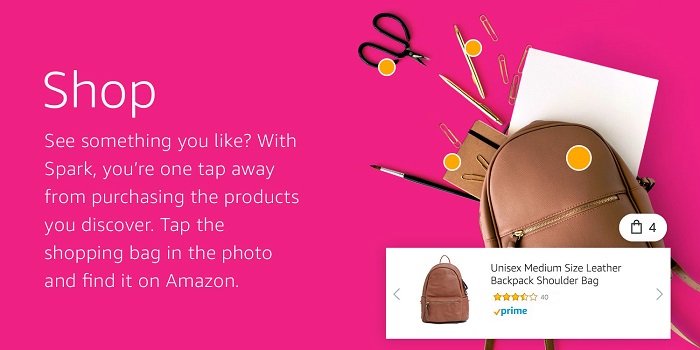
Spark takes products that are available from the retail giant, blending them with an Instagram-style feed. Subscribers choose a series of interests when they register on the app. Once your profile is set up, related content appears in your feed. You can ‘smile’ posts (Spark’s version of likes), comment on items and, more critically, click through to buy items featured in posts.

Bots and buy buttons don’t work

Why is this different to Instagram, where fashion labels’ handles are often tagged in photos, or to Facebook Messenger, where brands use chatbots to lure customers to purchase product? Bots and buy buttons don’t work if there’s too much disruption in the user experience — and, if we’re on a social platform, there will inevitably be a disconnect as a brand tries to manoeuvre us into a shopping cart.

By contrast, Spark adheres to the first rule of ecommerce. It’s frictionless. Each image contains a small shopping bag in the bottom right corner, indicating how many products in the picture are for sale. Click on this and you’re taken to a landing page offering more detail on each item alongside, Amazon’s famed one-click payment option.

Amazon Spark shopBleeding obvious

In a flash of the bleeding obvious, Amazon has recognised what should have been clear to everyone all along: we’re far more likely to buy something if we’re intent on shopping than if we’re merely looking for entertainment.

Unlike Facebook, which is an entertainment platform that’s trying to make us buy stuff, Spark is a shop that uses social media to show us products.

So does this signify an ambition by Amazon to move into social media? Far from it. But it does show that the retailer understands that we may be more predisposed to buy something if we see someone famous wearing it or if we see it in a cool environment. And it’s been savvy enough to see the benefit in taking the best of what social can offer into its own retail environment.

Giving Google a hiding

Will it succeed? Amazon did take Google on and has given it a sound beating in the product search space. Last year, 55% of US consumers looking for a product started their research on Amazon, with a mere 28% going to the world’s largest search engine as their first port of call.

That’s a pretty sure sign that we’ll forgo Instagram or Messenger and choose to get social and shop on Spark in the near future.

But not in Mzansi.

While you can download the iOS app locally and activate Spark, you need to be resident in the US and have an Amazon Prime subscription to use it. Perhaps that’s for the best, given all the difficulties we experience getting Amazon products shipped down here.


Charlie StewartCharlie Stewart (@CStewart_ZA) is CEO of Rogerwilco, a multi-award-winning independent digital agency best known for its expertise with Drupal, SEO and content marketing. A Scot by birth, he moved to South Africa in the early 2000s in his quest to support a winning rugby team — a search he’s reluctantly forsaken. Together with Mark Eardley, he co-authored Business to Business Marketing: A Step by Step Guide, (Penguin Random House, 2016) and may be found on LinkedIn. Charlie contributes the monthly “Clicks ‘n Tricks” column, which looks at how brands are using digital channels to engage their customers, to MarkLives.

Sign up now for the MarkLives email newsletter every Monday and Thursday, now including headlines from the Ramify.biz company newsroom service!

Transforming adland — straddling the line between utopia & reality

by Lynn Madeley (@LynnMadeley) The transformation conversation in marketing and communications in South Africa has been confined to mostly black stalwart ad executives; there’s been much less engagement from us white ad execs. Now, the latter could be because of one of two reasons.

“Copping out”

One could be that the white execs think this topic should be led by black execs so they pass on the proverbial mic to them and give them the space to lead. The other reason could be, and it’s possibly the truer one, that the silence from us white execs is our disinterest in the matter. Ivan Moroke, CEO of Co-Currency, calls it “copping out”. This, frankly, does nothing to move the needle, and stagnates an industry that will most definitely become stronger if we get transformation right.

For an issue that many of us white execs continuously say we must get over and move on from, we are certainly not future-casting. If we must get over it, then we must be active and speed up this process so that we sooner get to where we want to be as a country.

I am a pragmatic utopian. I work towards a utopia where we all get along and sing kumbaya around the proverbial campfire. I also know that the current context is far from this ideal, so I straddle the line between our sometimes-harsh reality of, in this case, gender and racial imbalance, and a utopia where we are all genderless, raceless unicorns doing amazing boundary-pushing work. What does this mean in my day-to-day life as the CEO of a global agency group in present-day South Africa? How does this approach keep us relevant today and fluent in tomorrow?

It’s about time

The new BBBEE codes may be steep, but they are not unfair — it’s about time. We’ve been dragging our feet in effecting this diversity and these amended codes are the result of our complacency. It’s unfortunate that we’ve had to be strong-armed into being more diverse in our agency businesses but we left the powers-that-be little choice. While the requirements of this charter may not necessarily change attitudes towards transformation, they will influence actions, and our actions have the most impact.

I am a firm believer that agencies should be a microcosm of the world around them, that they should mimic the dynamism of their consumer landscape. Let’s be literal about it for a second. We live in a country that has 80% black people. What that means is that in our agencies, across all levels of management and execution staff, 80% of our people should be black talent.

Beyond the literal, being a microcosm of the world within which we exist also means changing our approach to work. It means understanding the consumer landscape morphs and warps and evolves. It means that we become intimately mindful of the nuances that make up the consumer’s various lived experiences because, without that, we miss and omit important cultural markers and memes, and cracks will exist in our work. Mimicking that dynamic landscape means obsessively tracking the consumer, and ensuring that we thoroughly understand what they engage with, when and how, where and for how long, with whom and why. It’s the first step to doing great work in this day and age.

A question of ethics

In SA, it’s safe to say that racial diversity is an ethics question; and I don’t have to take you through the annals of history to explain why. But it has also long been a business question. When we mimic our consumer landscape, as agencies, we become bastions of diversity because South Africans come in many shapes and sizes. If our teams are that, the output of our insight-mining will always give varied answers. The work that comes from those diverse teams will be more representative and, as a result, more engaging to our consumers as a multitude of perspectives have influenced the work. That, however, is only possible if, in this good mix of talent, platforms are availed for voices to be heard. Otherwise, what good is it to have 80% black talent and not listen to them?

When McDonald’s hired Tom Burrell’s agency, then called Burrell McBain in the ’70s and now Burrell Communications, which was the first-ever ‘black agency,’ it engaged and effectively grew McDonald’s in black communities in ways that ad agencies of that time had failed to do. Diversity makes business sense.

So, with that said, how do we fix the plane while flying it?

I’ve heard too many times that there is not enough black talent, especially senior talent, but, in truth, we’ve not done enough to nurture, support and grow black talent. We’ve not mentored enough, coached enough and trained enough. We need to be deliberate about it. Simply put, we need to do more to encourage black talent into the industry and, once there, we need to grow and ensure they stay in an industry that badly needs them.

See also


Lynn MadeleyLynn Madeley (@LynnMadeley), CEO of Havas Southern Africa, has had two careers: one as an international horse rider and another as an ad exec. She has worked for the likes of Saatchi & Saatchi in London and Hong Kong, Ogilvy in Botswana and, in South Africa, was with Lowe before she joined Havas Worldwide Johannesburg, previously known as Euro RSCG South Africa, to run its  SA operation in 2007. Lynn is a member of the ACA Remuneration Committee and also sits on the appeals panel of the Advertising Standards Authority.

“Motive” is a by-invitation-only column on MarkLives.com. Contributors are picked by the editors but generally don’t form part of our regular columnist lineup, unless the topic is off-column.

Sign up now for the MarkLives email newsletter every Monday and Thursday, now including headlines from the Ramify.biz company newsroom service!

Adnalysis: Strategy is creativity before creativity

by Bogosi Motshegwa (@Thinkerneur) Strategy, strategic planning or planning, however you refer to it, is in itself creativity. Yet the lack of respect for it is astonishing.

Many say that they see the value of strategy but they don’t. They talk it but never live it. How can an ad agency that claims to be informed and inspired by strategy only have 2–4 strategists? No training or efforts to upskill the strategists? This makes no sense at all.

Lack of respect

In most cases in advertising, the creative departments are always bigger and larger than the strategy departments. This has become normal, but to me, it’s insanity. That the creative teams are always bigger and larger than the strategy teams/department is indicative of the lack of respect for strategy. People don’t actually understand its value and power as the creative output is the hero; however, it’s the thinking before the creative that’s the real hero.

I call strategy “The Thinking Before The Thinking”. When there’s a beautiful piece of creative work out, rarely do people think of the thinking behind the creative work. We marvel at what we see in front of us but fail to recognise what’s behind it.

Impactful creative work is always driven by insight. While an insight may come from anyone and anywhere, the part of the value chain, where chances of an insight are greater, is within the strategy process.

Four reasons that strategy is taken for granted

  1. Authenticity: Apart from the creative output being the face of the strategy and strategy not being explicitly communicated, what may be contributing to the lack of respect is the way in which strategies are being conducted. Most of them in agencies are born out of secondary research. Every brief requires its own resources, which includes time and tailored interrogation. Tailored interrogations means asking the right questions and doing things based on the problem at hand, and not referring to what was done previously.
  2. Time: Due to constraints and pressures to produce, there’s not enough time to delve into a subject matter in an immersive manner that allows for the uncovering of insights which lead to really inspiring, standout work. Everyone’s always in a hurry, and rushing for insights or to get work out. Strategy is as much a process as is the process of coming up with an idea, a headline, an impactful campaign, a powerful radio spot, and those award-winning pieces of work, and should also be afforded the time to go through its own processes.
  3. Insights: Sometimes, strategists tend to recycle insights, taking from a previous job and simply slapping onto the new job. The worst-case scenario is when they take insights from unrelated categories and apply it to whichever one they’re working on.
  4. Back-engineering: There are also times when strategies are back-engineered to suit the premature creative; creatives are always eager to start creating prior to the thinking before the thinking. This defeats the entire purpose of strategy; it’s not for rationalising the creative thinking — it’s the thinking before the creative work. If strategists in agencies are constantly given the creative thinking prior to them applying their own thinking, this means that there’s no strategy.

Strategy is meant to inspire creative thinking, not the other way round.

What strategy is not

  • It’s not just a positioning line.
  • It’s not just what you decide to do. What you decided not to do is also strategy, as it has a long-term impact.
  • It’s not the number of slides; it’s the thinking embedded in those slides (never judge a strategy by the number of slides contained therein).
  • It’s not the last slide of the 67-page PowerPoint document — it’s every slide.
  • It’s not a once-in-a-while document that is archived — at least, it shouldn’t be. Often, the fully outlined strategic plan ends up living in the agency’s virtual museum (the server), rarely referred to.

What strategy is

When a great strategy is presented, creatives feel inspired and, all of a sudden, the creative process becomes much more exciting and somewhat easier and fun.

If you really think about it, all the best brands in the world are significantly driven by it; strategic thinking is the source of all the major successes of these businesses. As strategists, while our key role is inspiring creatives to produce impactful and effective work, our fundamental job is to solve business problems. That is what we are meant to do. To turn a business’ misfortunes into financial fortunes.

  • It’s the big thinking before the big idea or concept.
  • It initiates and leads any process that forms part of building a brand. It really should.
  • It gives creative direction.
  • It empowers business growth.
  • It sets the tone for brand success.
  • It helps align everyone involved in the brand-building process.
  • It helps stakeholders make relevant and critical business decisions.
  • It helps brands decide on a profitable market.
  • It helps everyone understand consumers or the desired target market better.
  • It helps a brand gain an unfair competitive advantage that’s not easily replicable.
  • It helps identify both untapped and unleveraged opportunities.
  • It enables decisions to be made swiftly and decisively — sometimes the lack of a success for a brand is not just bad decisions but the lack of making them.
  • It mitigates against wrong or emotional decisions.

Strategy is important

Creativity is like finding your way in a multi-tiered or never-ending maze, and strategy is the guide that helps you find your way much easier and faster.


Bogosi MotshegwaBogosi Motshegwa (@Thinkerneur) truly believes that advertising can really change the world. Every single day he tries to prove this. He shares his thoughts on the industry and sometimes has unconventional views. Bogosi is the co-founder of Melanoid Éclat (for finding black entrepreneurs), a committee member of AMASA, an Advisory Council member and guest speaker at Vega, and also does speaker management at TEDxJohannesburg. He is currently a strategic planner at The Creative Counsel. He contributes the monthly column, “Adnalysis”, which analyses adland from a strategist’s point of view, to MarkLives.com.

Sign up now for the MarkLives email newsletter every Monday and Thursday, now including headlines from the Ramify.biz company newsroom service!

Ad of the Week: A South African love story from SA Tourism

by Oresti Patricios (@orestaki) FCB Joburg and director Teboho Mahlatsi of Bomb Commercials create mythical magic for South African Tourism in a commercial story that journeys our beautiful country.

South Africa is exceptional; we are fortunate that we live in a country which has so much that is unique, different, remarkable. Tourism is a major part of SA’s GDP and employment environment. According to Traveller24.com, tourism accounted for 4.5% of the country’s employment in 2014. In that year, the V&A Waterfront, which attracts over 24m visitors each year, contributed some R52bn to South Africa’s GDP alone. It’s a sector that’s easily accessible for entrepreneurs and, despite stricter visa controls and a worldwide economic downturn, tourism has seen steady growth over the past 10 years, adding more jobs to the economy than the trade, agriculture or manufacturing sectors.

To sell this fascinating country, FCB Africa has come up with a campaign for SA Tourism that includes a short movie and an Instagram feed. “Meet South Africa. Meet Bheki the Mbhaco Maker” is a smart campaign that delightfully celebrates our country’s diversity of scenery and culture. Aimed at potential foreign visitors, it’s a kaleidoscopic journey through our country, a narrative trek that is woven together with a charming story based on a Xhosa tradition.


Pinterest icon View all the Ads of the Week at a glance on our #AdoftheWeek Pinterest board!
YouTube icon Watch our 2017 #AdoftheWeek playlist on YouTube


The scene is set from the start with a surreal scene of a band playing on the mountainside. They freeze as a procession passes, led by a praise singer, and accompanied a dozen locals: the wedding entourage. A tall Xhosa bride-to-be is on her way to meet the man who would make her Mbhaco — the most-important dress of her marriage ceremony. This man is Bheki, and he is the centre of the story.

Bheki addresses her as “Nkosazana”, which means ‘princess’ in isiXhosa. This is also a popular name but it seems that this statuesque woman is, in fact, a princess.

Unfortunately, all the design ideas that Bheki offers are rejected, so he has but one option: to seek inspiration elsewhere. This is where the journey really begins. He travels throughout South Africa to find his muse. As he passes through Port St Johns, three ‘swenkas’ point him on further down the road. Our protagonist continues through a herd of Nguni cattle on the beach on to three fishermen at a seaside village, who point him in three different directions. Undeterred, he diligently continues his search.

Meet Bheki the Mbhaco Maker screengrab 02The commercial takes Bheki through the game parks, lodges, and wild areas of the bush. On white water rapids, until he gets to ‘the city of gold’, Johannesburg. Here he explores the street culture and nightlife. His voyage also takes him to the mountains and the skies, to the Valley of a Thousand Hills in KZN, to Durban and, finally, on to Cape Town. In the Mother City, he meets the girl of his dreams.

The narration ends: “Yes, no doubt, Bheki was inspired. So inspired, in fact, he now needed to make not one mbhaco, but two.” Talk about a fairytale ending!

If it’s possible to encapsulate the spirit, beauty and charm of SA on film, this short movie has done so, and more. Showcasing everything that might appeal to most types of tourists, the story of Bheki’s journey wraps it all into a vibrant package that is rich in narrative and incredibly memorable.

The Instagram account and hashtag #meetsouthafrica are important parts of the campaign, drawing crowd collaboration by inviting South Africans to show their love for our beautiful country.

Well done, FCB Joburg, Bomb Commercials and South African Tourism, for creating a vision of our country that resonates with us all but, more importantly, that tourists and offshore candidates will fall in love with again. And again!

Credits

Client: South African Tourism
Chief executive officer: Sisa Ntshona
Chief marketing officer: Margie Whitehouse
Regional general manager (Europe): Ian Utermohlen
Communications manager: Thandiwe Mathibela
Creative agency: FCB Joburg
Chief account leadership officer: Romaine Mackenzie
Account leadership: Jennifer Dupen, Cretienne Vorster
Strategy: Siwelile Thusi, Zoe Willems
Joint chief creative officers: Jonathan Deeb, Ahmed Tilly
Creative director: Collette Wasielewski
Copywriter: Khanyi Mpumlwana
Art director: Nobantu Sibeko
Producer: Wakhile Sithole
Operations manager: Samantha Di Terlizzi
Production company: Bomb Commercials
Director: Teboho Mahlatsi
Junior director: Itumeleng Mohlabane
Executive producer: Gavin Joubert
Director of photography: Werner Maritz
Editor: Andrew Traill, The Upstairs Ludus
Post producer: Joe Erasmus
Final mix: Nathi Luthango, A Nathi Sound
Film score: Black Motion
Music: African Rhythm, DJ Fortee
Wardrobe: Sheli Nyathi
Production designer: Dimitri Repanis
Narrator: Zesuliwe Hadebe
Instagram: Hloni Coleman
Fashion brands: Vernac by Dennis, Maxhosa, Simon and Mary, House of Chesso, Urban Zulu, Ezasekasi, House of Ole, Toygal, Bryntsmoore, Elizabeth Morr


Oresti PatriciosAd of the Week, published on MarkLives every Wednesday, is penned by Oresti Patricios (@orestaki), the CEO of Ornico, a Brand Intelligence® firm that focuses on media, reputation and brand research. If you are involved in making advertising that is smart, funny and/or engaging, please let Oresti know about it at clientservice@ornicogroup.co.za.

Sign up now for the MarkLives email newsletter every Monday and Thursday, now including headlines from the Ramify.biz company newsroom service!

Inside Look: Musonda Kabwe’s Agency Leaders 2016 poster design

by MarkLives (@marklives) Annually since 2012, MarkLives.com has been polling South African ad agency leaders to nominate those among their peers whom they most admire and, since 2014, we’ve commissioned some of SA’s best illustrators and graphic designers to design posters to give to our winners. Musonda Kabwe (@MusOfficial), who created the 2016 Agency Leaders’ Most Admired poster set, gives us the lowdown on his design process.

Collage - 2016 MarkLives Agency Leaders Most Admired posters by Musonda Kabwe
Click to enlarge

MarkLives logoPlease would you tell us more about yourself.

Musonda KabweMy name is Musonda Kabwe but everyone calls me Moose. I am an illustrator based at a studio space called Gather in Kramerville, Johannesburg; I was born in Zambia and moved to South Africa about 17 years ago. I spent some time working with Nathan Reddy at Grid as a graphic designer, before going into illustration full-time. I now run a small illustration studio called Müs (pronounced Moose). I was a Design Indaba Emerging Creative in 2015. My work has been featured by the likes of Design Indaba, Between 10&5, Grolsch Canvas, Conté magazine and now MarkLives.com. I have done illustration work for MTN, Telkom, Motherland Coffee, The Mail & Guardian and Sunday Times, to name a few.


MarkLives logoWhat inspired the design direction for the posters?

Musonda KabweCelebration. The posters depict an abstract and stylised scene of celebration. The posters are also a homage to our rich textile and pattern-making industries.


MarkLives logoPlease talk us through your design process.

Musonda KabweThis was one of the few projects that afforded me the time to start on paper. Like comic book artists, I create a final sketch which I then ink with some tracing paper. After inking, I scan it into the computer and continue to refine the artwork in photoshop. Sometimes I print the refined artwork and re-ink it to paper because the line looks too refined and digital. Then it’s time to add colour to the piece. Usually I create a few colour studies in Adobe Illustrator then narrow them down to the best few. After the final artwork is approved, it goes straight to the printer. This can be a painstaking process but, when I’m afforded the opportunity to do work this way, the work is of a different calibre.

MarkLives logoThe characters in the poster — where did you draw inspiration from?

Musonda KabweAll the characters in the poster art are actually the winners and people who voted from all the different agencies. Their faces were abstracted to suit the style.


MarkLives logoThere are quite a few fine details; please tell us about some of the icons you used and what they represent.

Musonda KabweIf you look closely, you notice that all these faces create a scene of celebration. All the eyes look towards the winner in the center. So, in a way, the poster is a visual celebration of the winner on the trophy held by the figure in the centre.


MarkLives logoPlease would you give us the technical specs about the design, production and printing processes that may be of interest to other designers?

Musonda KabweThe artwork is printed on Felix Schoeller True fibre paper, a museum-quality paper made in Germany. The paper was perfect because of its smooth surface that allows pin-sharp details, vivid colours and a high colour consistency. The artworks were digitally printed in a 12-colour inkjet process. So I’m able to print an RGB file with no colour distortions.

See also

Sign up now for the MarkLives email newsletter every Monday and Thursday, now including headlines from the Ramify.biz company newsroom service!

Shelf Life: The power of consistency with Prudential

Cheryl Hunter (shelflife at marklives.com)’s weekly pick of all things new — product, packaging, design, insight, food, décor and more!

  • OFYT makes a Prudential investment
  • Prima Toys gets behind the rhino with Wildlife ACT
  • Clarion Retail animates in-store

Growing consistency

Creative agency OFYT was briefed by client to find a true-life story that demonstrated the power of long-term consistency. The result is the latest Prudential Investment Managers TVC, using a powerful true story to eloquently underscore its philosophy.

The commercial, which was filmed on Mājuli island, North-East India, and directed by Oscar-winning filmmaker, Asif Kapadia, tells the story of Jadav Payeng. Since 1979, he has single-handedly planted over 1400 acres of trees to save his home from being washed away by the Brahmaputra River. Payeng continues to plant every day and is now known as The Forest Man of India.

Says Sumayya Davenhill, Prudential Investment Managers head of marketing, “Jadav’s mission to save his Indian island home of Mājuli, while facing harsh elements and with limited resources, demonstrates the power of how small consistent increments of behaviour can add up, over time, in the end, to something extraordinary.”

Payeng’s consistent focus on reaching his desired outcome dovetails with Prudential’s goal to build wealth for its clients. “The similarities between Jadav’s story and Prudential are quite remarkable. Thirty-eight years of commitment has seen Jadav save his land from the mighty Brahmaputra and, in turn, grow the most magnificent forest that I have ever seen. At Prudential, short-term conditions don’t matter to us; we ignore the daily bad news and the ups and downs of the market. Instead. we focus on using the same successful investment process to ensure that with time our clients achieve their goals.”

The power of one individual, acting consistently, may be huge. A group of people acting consistently may change the world: “No matter how much you invest, and what day-to-day challenges you feel, Prudential Investment Managers believe that consistency is the only currency that matters.”

OFYT’s national creative director, Chris Gotz, “Sometimes we get the chance to tell really incredible stories. When those stories line up so beautifully with a client’s philosophy, you can make magic. Jadav’s story is the ultimate expression of one person acting consistently to achieve extraordinary results.”

The TVC will be followed by a radio campaign flighting in South Africa and Namibia, and will be supported with a digital, social and trade print campaign.

consistency.co.zaFacebookTwitter
ofyt.co.zaFacebookTwitterRamify


Toys for rhinos

Prima Toys and Wildlife ACT have joined forces in support of the rhino, launching a new coin bank range to facilitate the funding of various organisations that care for and feed baby orphaned rhinos until they are old enough to be released back into the wild.

Rhino coin bankIn past years, Prima Toys and Pick n Pay have raised more than R500 000 for Wildlife ACT through their Baby Rhino and Wild Pals soft toy promotions, all funded by consumers who, through their purchase of these soft toys, donate to the cause. This year, Prima Toys has launched 20 000 rhino coin banks via South African toy retailers. These are soft toy rhino ‘piggy banks’, with plastic interiors and removable stoppers to hold cash and coins inside their bellies. For every purchase, Prima donates R10 to Wildlife ACT.

In addition to this funding, any money that a child saves in his or her rhino coin bank may be donated back to Wildlife ACT. Prima Toys will, in turn, donate 10 toy hamper prizes in a lucky draw competition to five boys and five girls who make a donation through the GivenGain website.

primatoys.co.zaFacebookTwitter
wildlifeact.comFacebookTwitter


In-store animation

Integrated in-store branding specialists, Clarion Retail, has recently launched state-of-the-art LED animated lightboxes in the retail branding space.

This division of The Clarion Group specialises in offering creative in-store print branding solutions, with a focus on industry innovations for the retail sector.

The custom lightbox frame and range of lighting options or LED animations help clients deliver an eye-catching visual brand experience. All frames are flat-packed in kit form with easy assembly instructions, along with electrical conformance and quality certification.

The display system uses aluminium frames, into which textile prints may be easily and quickly installed on-site. Once the lightweight frames have been installed, new prints may easily be interchanged.

impactdisplays.clarion.co.zaFacebookTwitter


Cheryl HunterShelf Life is MarkLives.com’s weekly column covering all things new. Notify us of yours at shelflife at marklives dot com. Want to sponsor Shelf Life? Contact us here.

Cheryl Hunter (@cherylhunter) has written for the South African media, marketing and advertising industries for more than 15 years. A former editor of M&M in Independent Newspapers and contributor to Bizcommunity, AdFocus, AdReview and the Ad Annual, she has also produced for various television networks and currently consults on communication strategy and media liaison.

Sign up now for the MarkLives email newsletter every Monday and Thursday, now including headlines from the Ramify.biz company newsroom service!

Back2Basics: The digital distraction

by Mark Eardley (@mdeardley) Enough! End the digital distraction and focus on B2B’s basics.

During the past 10 years or so, B2B marketers have been increasingly bombarded with a dangerously distracting proposition: a new era is dawning in B2B and it’s being driven by technology.

The shiny new tools and techniques featured in this deviant proposal typically include:

account-based marketing automated marketing inbound marketing
data-based marketing content marketing social media marketing

Nothing but tinsel and glitter. A buzz-pack of smoke-and-mirrors that’s been systemised, branded, priced, hyped and sold.

Digital distraction: an emphasis on tools rather than results

B2B’s sole goal is the same today as it always has been — to attract and retain profitable customers. Over 40 years ago, marketers were given a clear warning about the dangers of losing focus on the goal due to an overreliance on tools and techniques. I’ve quoted it before, but it bears quoting again:

“…the emphasis is on techniques rather than on principles, on mechanics rather than on decisions, on tools rather than on results, and, above all, on efficiency of the part rather than on performance of the whole…” —Peter Drucker: Management: Tasks, Responsibilities, Practices (1973)

B2B companies face threatening challenges. No tools will solve them. For B2B companies today, the two most-threatening challenges are commoditisation and self-sold customers.

Right now, these are the two really hot topics in B2B.

Problem is, there is no technology to counter these challenges. They may only be overcome by proving how products and services create value for the people and companies who buy them.

The skill in B2B has always been to know who those people are, what they value and then communicate how an offering delivers it. That’s not technology. That’s customer insight — which has always been the rock-solid foundation for producing the right messages for the right people.

Marketing vs commoditisation: The only shield against this margin-eating monster is differentiation. And there are no tools to build that shield. Establishing clear differentiation — why you matter to customers — is the only way to avoid being trapped in a ‘game of clones’ where rock-bottom prices are the only way to win.

Marketing vs self-sold customers: Increasingly, the net is being used to inform and guide buying decisions; people are selling to themselves:

“Customers are coming to the table armed to the teeth with a deep understanding of their problem and a well-scoped RFP for a solution. It’s turning many of our sales conversations into fulfilment conversations.” —Harvard Business Review

B2B companies are researching solutions, setting their operational criteria and defining the solution they want to buy — online and on their own In the worst-case scenario, their conversation with a sales team is distilled-down to just two questions: “How much and when can we have it?”

The marketing solution is to develop a highly visible brand that is perceived positively throughout its markets. It means creating a trusted brand-image that is applicable, credible and visible to the people who influence and make buying decisions. It’s about making sure customers sell your brand to themselves. No shiny new too tool for that, either.

From disruption to distraction

Here’s what Keith Reinhard, co-founder of Omnicom and chairman emeritus of DDB Worldwide thinks about the tsunami of shiny new objects marketers and their agencies have been gulled into using:

“We had the digital disruption at the end of the century which, in some cases, I thought became the digital distraction because we became so obsessed with the tools that we forgot about some of the basics.

“Just because we have myriad channels and platforms doesn’t mean we have to use them all. Apple, the world’s most valuable brand, has neither a Facebook page nor a Twitter handle.” —Drum Magazine, Aug 2017

Tools and techniques are servants, not masters

It’s pretty obvious that the servants have jumped up way beyond their station and need taking down a peg a two. Here’s why. None of the objects in the super-hyped, buzz-pack are capable of contributing anything to B2B’s basics.

They offer nothing that enables B2B marketers and their agencies to:

  • identify the people who influence and make the buying decisions that create B2B sales
  • qualify and quantify what those people value and how it motivates their decisions
  • understand how a product or service creates motivating value
  • translate that understanding into relevant, credible content for the right people at the right time

A new era in B2B? Maybe not… A new era in communications? Undeniable. It’s been developing for nearly two decades. For B2B marketers, a smart approach to that genuinely new era is to bear this in mind:

“Adapt your techniques to an idea, not an idea to your techniques.” —Bill Bernbach, from Bill Bernbach Said


Mark EardleyMark Eardley (@mdeardley) advises B2B companies on how to govern their marketing to attract and retain profitable customers; several of his clients have grown to become market leaders. He is the author, together with Charlie Stewart, of Business-to-Business Marketing: A Step-by-Step Guide (Penguin Random House), which offers practical, actionable advice on how to make marketing make money. Mark contributes the monthly “Back2Basics” column, covering how B2B companies and their agencies should manage their marketing, to MarkLives.com.

Sign up now for the MarkLives email newsletter every Monday and Thursday, now including headlines from the Ramify.biz company newsroom service!

Hidden Figures: Hillary Molefe

by Musaba Kangulu (@ThatTypeOfMoose) If ever you find yourself at The Zone@Rosebank in Joburg, pop over to Black River FC and ask for TV and radio producer, Hillary Molefe. With her infectious laugh and wicked sense of humour, I guarantee you’ll learn a thing or two, so it gives me great pleasure in celebrating an unsung heroine who believes we need more advertising movements that celebrate all women, for there is so much beauty that lies within them that the world still needs to see.

Molefe works in an industry where, according to global stats from Deloitte, 68.1% of female producers feel they have to work twice as hard and be twice as good as their male counterparts. A remaining 55.5% have indicated that they have felt discriminated against based on factors such as sexual orientation, religion, family life and income bracket. These kinds of statistics call for a meaningful and immediate fix. In order for us to tackle the challenge, we need to hone down on the why.

Musaba Kangulu: With the rise of transformation in the advertising sector, has the industry made enough of an effort to empower women?
Hillary Molefe:
No, it has not; however, I truly believe that change can only happen if we as individuals share a common vision get together and take action. Like everything in life, things take time; however, I think we’ve all acknowledged that something actively needs to be done about gender inequality. Fortunately, there has been a start that I hope will inspire us to do and be more than our job titles. I’ll make an example of Open Chair. It took three women to say: ‘Hey, here’s an idea; let’s do this and go forward with it.’ We need more of these platforms for nurture and develop upcoming women and those already in the industry already.

MK: When it comes to female empowerment in advertising, what challenges do female producers face and how have you managed to overcome them?
HM:
Definitely high pressure, and with high pressure comes a ton of follow-ups which can cause one to lose their mind. It gets challenging when there’s a formidable amount of pressure hitting you from every corner; however, it’s important to have a system of sorts. I’ve learned to overcome it by prioritising and asking for help. Asking for help does not mean you can’t handle what’s been thrown your way but making sure all boxes have been ticked.

MK: As a female TV and radio producer of colour for close on a decade, have you had to make any sacrifices to move up the ranks?
HM:
I don’t believe I’ve had to. I have put in the time and work as any other. There hasn’t come a point where I needed to sacrifice.

MK: As a mother in the advertising industry, have you had to make any sacrifices to move up the ranks?
HM:
I’ve always been blessed with a support system that has made the transition to being a working mom so much easier. I can’t say I’ve had to make big sacrifices. I mean, sure, there have been late nights but it hasn’t gotten to a point where I feel that I’m sacrificing to move up.

MK: Can you recall a moment where you felt belittled or victimised in your working career and, if so, how did you counteract against that?
HM:
If there’s something that I hate, it’s when someone belittles another. Yes, I’ve been belittled, where a person in a more senior position in a different department felt that I wasn’t doing my job as well and decided to take things into their own hands, neglecting the fact that there are processes that needed to be adhered to. Yes, it got me down; however, it gave me the courage to tell myself “You know what, actually? I’ll show you why you’re not going to do that again.” In some instances, it’s better to let your work speak for itself because, at times, people see and hear what they want to. Let them investigate and come to the conclusion that you’re capable and know what you’re doing.

MK: What are some of the common challenges female producers face today?
HM:
A big budget job comes far and wide. We’ve come to a time in the industry where small budget and tight deadlines are a trend and we need to work with what’s given to us.

MK: It’s no secret the representation of women behind the camera is receiving greater media attention; however, it’s also been noted the status quo has remained stubbornly resistant to change. Why do you feel this is taking so long to achieve?

HM: It’s taken long because we’ve come from waiting for change to coming to the realisation that we actually have to change the dynamics ourselves. I believe that we have been awakened as women and in no time it will no longer be seen as a myth.

MK: When it comes to women in advertising, what similarities do you find in the older vs now generation?
HM:
There’s still a sense of wanting to get things done. An ability to develop relationships that will not only carry you through but make challenges seem less hard.

MK: What unconscious mistakes do women make that sabotage their careers?
HM:
We’re naturally emotional beings and, because of that, we sometimes struggle with placing our emotions. Making emotional decisions as opposed to taking practical steps that work for the cause can leave a bad taste in people’s mouths. Constantly fighting for a place that’s already yours tends to cloud judgement and we end up working against the flow when we should be on the same wavelength.

MK: For an industry that has no trouble attracting women to the field, retaining them is a common problem. Why is that?
HM:
Our industry is still heavily run by males. For retention to be as effective, we need some kind of structure that sees women in more female-run leading positions. At the moment, we just don’t have enough of these platforms.

MK: Do you find you need to put on a certain cut-and-dried attitude that lets everybody know you’re going to run a set a certain way?
HM:
An older generation would tell you that it is ideal to have that kind of attitude in order for one to be taken seriously. I, however, take have a completely different approach. To me, each set has a personality of its own, which then determines how it wants to be run. I think in the past, because of the cut-and-dried attitude, many shoots would be tense. My main objective is to ensure everyone knows they have to come through me for any concerns/what will happen when to make them feel that things are being taken care of.

MK: If you were given the opportunity to introduce new laws to empower women and create the kind of content that changes perceptions of female stereotypes in the advertising environment, what would they be?
HM:
It would start with something as simple as creating a movement where we celebrate each other. Every woman in the industry would partake. There’s so much beauty that lies within us that the world still needs to be shown.

MK: Despite the ongoing hitches women in advertising face, why do you then continue to work in the environment?
HM:
Oh, where do I start? For the love of the job, I get to be part of bringing something to life from conception. To watch it develop from an amazing idea to put it together. Creativity is truly an inspiration. Just seeing how many people it takes and the amount of effort it takes for a consumer to view it in half a minute blows my mind every time. It truly takes a village. You know you have it good when creativity opens your mind to what’s out there.

MK: Having said that, what words of advice will you give to your daughter, should she wish to follow in your footsteps?
HM:
Be confident in everything you do. Doubt can be seen a mile away and, when you doubt yourself, it’s hard for others not to. Dance to your own rhythm. Be YOU. Let it show in your work the person that you are. Open yourself up to learning new approaches in life. Being positive changes your outlook on things.

MK: What soft skills or steps should women maintain to survive in advertising?
HM:
A can-do attitude will take you places. There’s nothing that can’t be done; it’s all about your attitude. There’s always a way to get it done — look at it differently to how you’ve been. If the can-do attitude doesn’t work, check other avenues or find alternative ways to handle or deal with the issue at hand.

MK: Big or small, what steps have you taken to eliminate gender inequality?
HM:
I support women in business, whether in advertising or otherwise. It’s so important to see the gem that is a woman. We do things with passion and care. That support is through referrals, when a service they render is being sought after by others. Another way that is also quite effective is when views and ideas are shared amongst each other, just to let someone know that you either support the direction they are venturing into and will support in physical form by using their services.

MK: Finally, do men have a role to play in gender equality?
HM:
Everyone has a role to play. I think we just need to get rid of the attitude that someone will replace you in the field that you’re in. There’s no space to be having that attitude as every person brings a different kind of value and approach that others may not have thought of or saw in the same light to take us to a new frontier.

MK: What are some of the soft skill traits that are often overlooked in a competitive environment?
HM:
Staying calm under pressure — the calm gives you an opportunity where you can sift through the hiccoughs you’re facing. It doesn’t mean that you, too, have to feel the pressure when it’s elevated. There’s no need for panic as it creates noise and solutions don’t come easy.


Musaba KanguluMusaba Kangulu (@ThatTypeOfMoose) is a firm believer in women using their diversity to push different thinking and bring new insights to the table. Playing in the digital space has taught her to be unashamedly confident in using her expertise and experience to encourage women in their digital career pursuits. Perseverance and self-worth are important messages we need give to younger women. She contributes the new “Hidden Figures” column, which celebrates the unsung heroines of the South African marketing and advertising world.

Sign up now for the MarkLives email newsletter every Monday and Thursday, now including headlines from the Ramify.biz company newsroom service!

Online CPD Courses Psychology Online CPD Courses Marketing analytics software Marketing analytics software for small business Business management software Business accounting software Gearbox repair company Makeup artist