

by Charlie Stewart (@CStewart_ZA) After years of painful misfires, social commerce — where people buy products directly from their social media feeds — is set to take off.
In what may come as a surprise to many pundits, neither Facebook, its Instagram subsidiary, nor Google, are spearheading the charge — mid-July 2017, in a rather subdued announcement lacking the pizzazz we’ve come to expect when big tech launches a new feature or product, Amazon quietly told us that it had added a new feature to its already overcrowded app.
Spark takes products that are available from the retail giant, blending them with an Instagram-style feed. Subscribers choose a series of interests when they register on the app. Once your profile is set up, related content appears in your feed. You can ‘smile’ posts (Spark’s version of likes), comment on items and, more critically, click through to buy items featured in posts.
Bots and buy buttons don’t work
Why is this different to Instagram, where fashion labels’ handles are often tagged in photos, or to Facebook Messenger, where brands use chatbots to lure customers to purchase product? Bots and buy buttons don’t work if there’s too much disruption in the user experience — and, if we’re on a social platform, there will inevitably be a disconnect as a brand tries to manoeuvre us into a shopping cart.
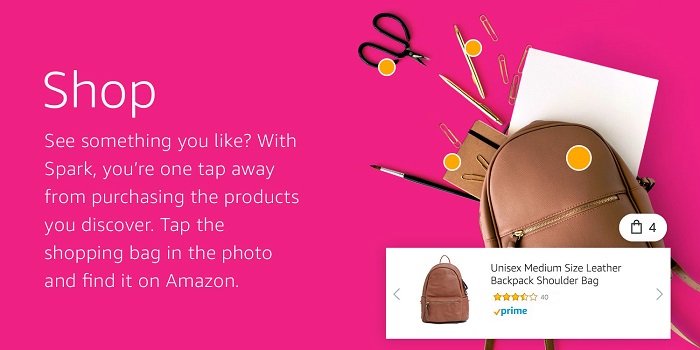
By contrast, Spark adheres to the first rule of ecommerce. It’s frictionless. Each image contains a small shopping bag in the bottom right corner, indicating how many products in the picture are for sale. Click on this and you’re taken to a landing page offering more detail on each item alongside, Amazon’s famed one-click payment option.
 Bleeding obvious
In a flash of the bleeding obvious, Amazon has recognised what should have been clear to everyone all along: we’re far more likely to buy something if we’re intent on shopping than if we’re merely looking for entertainment.
Unlike Facebook, which is an entertainment platform that’s trying to make us buy stuff, Spark is a shop that uses social media to show us products.
So does this signify an ambition by Amazon to move into social media? Far from it. But it does show that the retailer understands that we may be more predisposed to buy something if we see someone famous wearing it or if we see it in a cool environment. And it’s been savvy enough to see the benefit in taking the best of what social can offer into its own retail environment.
Giving Google a hiding
Will it succeed? Amazon did take Google on and has given it a sound beating in the product search space. Last year, 55% of US consumers looking for a product started their research on Amazon, with a mere 28% going to the world’s largest search engine as their first port of call.
That’s a pretty sure sign that we’ll forgo Instagram or Messenger and choose to get social and shop on Spark in the near future.
But not in Mzansi.
While you can download the iOS app locally and activate Spark, you need to be resident in the US and have an Amazon Prime subscription to use it. Perhaps that’s for the best, given all the difficulties we experience getting Amazon products shipped down here.
 Charlie Stewart (@CStewart_ZA) is CEO of Rogerwilco, a multi-award-winning independent digital agency best known for its expertise with Drupal, SEO and content marketing. A Scot by birth, he moved to South Africa in the early 2000s in his quest to support a winning rugby team — a search he’s reluctantly forsaken. Together with Mark Eardley, he co-authored Business to Business Marketing: A Step by Step Guide, (Penguin Random House, 2016) and may be found on LinkedIn. Charlie contributes the monthly “Clicks ‘n Tricks” column, which looks at how brands are using digital channels to engage their customers, to MarkLives.
— Sign up now for the MarkLives email newsletter every Monday and Thursday, now including headlines from the Ramify.biz company newsroom service!
interesting. would love more retailers in SA to investigate this type of technology but not sure how complex and expensive it would be? Fiona