MasterClass Notes: Why media transparency is a tricky topic

by Johanna McDowell (@jomcdowell) I first started talking about media auditing some eight years ago, only because I didn’t know what it was and had heard the term at my first AdForum Worldwide Summit in New York. Media auditing has been growing in importance ever since. There have been some local examples in South Africa and I’m aware that some of the large multinationals have conducted media audits for years — mainly using overseas expertise.

Interesting responses

Mentioning media audits to clients in SA has elicited some interesting responses. Most clients talk about media being a “black hole” and either they have no wish to get into the detail of actual expenditure vs planned or they have no wish to upset their media agencies. There is even greater confusion now that digital media and programmatic buying have become part of our media landscape.

I believe that the responses from marketers are rooted in lack of adequate knowledge and understanding. The time pressures that all marketers are under leads them to keep questions around expenditure to a minimum or on a need-to-know basis, too. When asked about media auditing, there’s also a fear that it might not be worth spending marketing funds on one as it might be too expensive an exercise with little yield.

Time spent on understanding the media, costs and implications is often sacrificed in favour concentrating on the ad content, as opposed to the distribution channels.

Media transparency is surely a corporate governance issue and something that needs to be talked about — with confidence. Media agencies have their own codes of governance and are generally well-respected locally and internationally.

So why, then, is there a need to audit? And what is a meaningful media audit?

It’s not about forensics.

Naturally, part of the process is a typical audit-trail check of invoices from the media owner, invoices from the media agency to clients, client payments to media agencies, and media agency payments to owners. There may well be instances of media discounts not being disclosed or returned to marketers. But this isn’t the only purpose behind a media audit. It’s not designed to ‘catch people out’.

Equally important are the media planning tools that are being used, the rates that are being negotiated and even the choice of media. Media optimisation is a critical part of media auditing and the piece that marketers will feel more comfortable to focus on while, perhaps, procurement looks into the ‘forensics’.

With the advent of trading desks at the media agencies some years ago, suddenly there were questions around media inventory — TV, print and radio and outdoor — that media agencies held and might have recommended to marketers because it was economical, rather than the optimal choice for the marketer’s brand. This has now been extended to digital media, and this becomes even more complex with some of the digital media owners also providing a type of trading desk directly to clients — instead of via the media agencies.

So the landscape is complex.

Is it important enough to warrant the expense of a media audit?

Yes, I believe so, in order to optimise expenditure, track ROI and ensure good media governance and business ethics. I also think that both local and international brands will need to prove that they have conducted business properly in the years to come.

The cost of a media audit relates to the work involved, not necessarily the amount of budget spent by the advertiser. But, clearly, the larger and more-complex budgets will require more auditing. From a governance perspective, it’s not about one media agency auditing another’s media plan and expenditure; this is a recipe for games-playing and manipulation of expenditure to suit the competing agency. I’m aware that this is something that does happen (not only in the SA market but in other markets, too.)

Media audits are not the same as financial audits, although there are some similarities in reference to invoice- and receipt-checking. But there the similarities end. Media auditing is about maximising media options and optimising media expenditure for marketers. It’s not a witch hunt. Media transparency is an increasing demand in the corporate market place where governance is becoming more rigorous — and so much the better for it.

Local players

There was a time, until recently, when marketers might have asked one media agency to evaluate another’s plan and costs. This naturally led to price comparisons, which may or may not have been fair on both parties. These days, the role of a media-auditing company is much clearer and the need for independence much greater. Local players will start coming into the SA market and will be able to offer a competitively priced, independent service with a strong focus on governance and media optimisation.

I believe that the independence of this kind of work is an essential component for a marketer to achieve maximum ROI in an increasingly fragmented media landscape.


Johanna McDowellJohanna McDowell (@jomcdowell) is managing director of the Independent Agency Search and Selection Company (IAS), which is partnered with the AAR Group in the UK. Johanna is one of the few experts driving this mediation and advisory service in SA and globally. Currently she is running the IAS Marketers Masterclass, a programme consisting of masterclasses held in Cape Town and in Johannesburg. Twice a year she attends AdForum Worldwide Summits.

Sign up now for the MarkLives email newsletter every Monday and Thursday, now including headlines from the Ramify.biz company newsroom service!

Shelf Life: King Price creates cyber insurance for SA

Cheryl Hunter (shelflife at marklives.com)’s weekly pick of all things new — product, packaging, design, insight, food, décor and more!

  • Tackling cybercrime with King Price
  • kulula, Red Cross Children’s Hospital launch radio for kids
  • Chivas Regal partners with three SA luminaries

Best defence

Most people know whether they have insurance for their possessions, car accidents, theft, and liability, but few know if they’re covered for cybercrime. This has created a market gap for King Price to launch Cybersure.

In line with its way of taking what it does very seriously but itself not so much, King Price, in partnership with its brand agency Xfacta, has launched Cybersure with a not-so-serious twist by developing an online game to get South Africans thinking and talking about their cyber safety.

Cybersure is insurance for businesses, which covers computer systems, software and data, and also protects businesses against liability arising from cyberattacks on these assets; it includes cover for cyber liability and cybercrime, data-breach expenses, damage to computer systems and data, and associated loss of income.

Wynand van Vuuren, spokesperson at King Price, says cybercrime is on the increase: “In South Africa, 84% of adults who’re online have already been victims of cybercrime, and a massive 74% of these have experienced cybercrime in the past year. SA also ranks in the top 10 on the FBI’s cybercrime predator list, which means that there’s an increasing amount of fraud being perpetrated from SA, too.”

Bots are among the most-sophisticated types of online crime-ware and perform automated tasks for cyber criminals.

Consumers may test their gaming skills and cyber-safety knowhow at cybersure.co.za from now until 28 February 2018, with R1m in Bitcoin up for grabs for players: “This is the largest Bitcoin prize in SA so far. We’re seeing it as an investment into educating South Africans on the very real and ever-increasing need for cyber security.”

kingprice.co.zaFacebookTwitter
xfacta.co.zaTwitter


Connecting children

Low-cost carrier kulula.com has partnered with the Red Cross War Memorial Children’s Hospital in Cape Town to launch a first-of-its-kind radio station by children for children in Africa. Patients are trained as producers and presenters to assist other patients in their struggles to alleviate anxiety and loneliness while in hospital.

The donation of R150 000 made to the hospital will contribute to the launch of RX Radio.

Says Luane Lavery, brand communication manager for kulula.com, “The project connects directly with our brand promise, which strives to connect people in a fun way, and it is our hope that RX Radio will do exactly this. Being in hospital is never easy and we hope that the radio station will make patients, parents, health workers and other children better understand the experience of being in hospital and illness by enhancing their lives while having some fun, too.”

The radio platform will enable the patients to share their experiences, concerns and questions with parents, health professionals and other children. Research has shown that sharing these kinds of conversations helps sick children to cope better with their illnesses and their treatment, improving the overall wellbeing of children through giving them access to recreational and learning activities.

To further strengthen the four-year-old partnership with the hospital, kulula.com will support the organisation with the expansion of the existing oncology ward. This will help position the hospital as the leading center for childhood cancer treatment in Africa.

rxradio.co.za/radio-diariesFacebookTwitter
childrenshospitaltrust.org.zaFacebookTwitter
kulula.comFacebookTwitter


A marriage of values

In an effort to inspire a new generation of South Africans to ‘#WinTheRightWay’, Chivas Regal has partnered with three iconic South Africans — football legend Lucas Radebe, musician Nhlanhla Nciza, and fashionista Laduma Ngxokolo — to show that success is better when shared.

Chivas Regal #WinTheRightWay: Lucas Radebe, Nhlanhla Nciza, Laduma Ngxokolo slider

According to Shelley Reeves, Chivas Regal South Africa’s marketing manager, “our partnership with Nhlanhla, Lucas and Laduma is a marriage of values. As a brand, we are about winning the right way, giving back when you’re successful and sharing worthwhile moments with your friends, fans, and community.”

Through mentorship and a curated financial contribution, the brand partners will be inspiring a new generation while making a positive impact on the lives of others. Nciza has identified two up-and-coming female DJs who will receive record deals and Chivas Regal will support the artists directly by hiring them for regional events. Ngxokolo has identified a Johannesburg-based leather-goods maker and a Port Elizabeth-based ceramicist, whom he will help break into the world of fashion and design, while Chivas Regal uses the mentees as suppliers of branded collateral. Radebe will be hosting a series of interactions in his hometown of Soweto, where he will identify a young entrepreneur that will benefit from mentorship and a curated financial contribution.

chivas.comFacebookTwitter


Cheryl HunterShelf Life is MarkLives.com’s weekly column covering all things new. Notify us of yours at shelflife at marklives dot com. Want to sponsor Shelf Life? Contact us here.

Cheryl Hunter (@cherylhunter) has written for the South African media, marketing and advertising industries for more than 15 years. A former editor of M&M in Independent Newspapers and contributor to Bizcommunity, AdFocus, AdReview and the Ad Annual, she has also produced for various television networks and currently consults on communication strategy and media liaison.

Sign up now for the MarkLives email newsletter every Monday and Thursday, now including headlines from the Ramify.biz company newsroom service!

EXCLUSIVE: Ninety9cents wins Spur Steak Ranches

by Herman Manson (@marklives) Ninety9cents (99c) has been appointed as lead creative and digital agency for Spur Steak Ranches, following a four-way pitch. The account has been held by Haas since 2012, when it followed Francois de Villiers from Draftfcb. Haas declined to repitch, although invited to do so.

99c already works on the John Dory’s, Panarottis and Captain DoRego’s accounts, which fall under the Spur Corporation umbrella.

According to Allen Ambor, Spur founder, while it has been a personal career highlight to work with De Villiers, the brand is in need of a fresh perspective, as demanded by franchise holders. The social media outrage, centred on an alleged assault in a Spur restaurant, didn’t affect its decision to put the business out to pitch (its handling of the case didn’t please anyone and included calls for a boycott of the franchise), he says.

Ninety9cents logoClose race

Ambor describes it as a close race between 99c and TBWA\Hunt Lascaris but, ultimately, Marius van Rensburg, 99c executive creative director, and his team held the edge. Van Rensburg, he says, understands what’s important to Spur clients and what will entice them to return, and has a grasp on the range of experiences customers associate with the brand and good service, from the aroma inside the restaurant to the way they are bid farewell on exiting.

The group will be looking for freshness, a new sense of excitement and new angles to reach the hearts and minds of consumers, which will renew the fondness South Africans already feel for the brand, from the new agency.

“Spur is not only South Africa’s most-successful restaurant group, it’s a huge part of our national identity, and it was important for us to demonstrate a fresh, progressive approach, while honouring its proud heritage,” says Andrew Brand, 99c managing director. “We presented a compelling strategy that supports the business objectives, underpinning a multi-channel execution showcasing exactly what has made Spur one of SA’s most-iconic brands for the past 50 years.”

“Strategic substance”

“We feel that the work presented by 99c has strategic substance, and is in harmony with the evolution of our business,” adds Sacha du Plessis, group marketing executive at Spur Corporation. “We believe their approach will resonate with Spur’s customers, who are the lifeblood of our business.”


Herman Manson 2017Herman Manson (@marklives) is the founder and editor of MarkLives.com.

Sign up now for the MarkLives email newsletter every Monday and Thursday, now including headlines from the Ramify.biz company newsroom service!

The power of consumer insights (plus woke strategy & creative)

by Thomas Sepheka (@ThomasSepheka‏) Never has it been so evident to acknowledge and value the power of consumer insights in 2017.

The world is in a constant state of flux and continuous evolution; so, too, are we as consumers in how we do things, what we stand for and how we share experiences. Therefore, marketing is a shot in the dark without great insights and I would like to believe that any seasoned marketer knows this. The recent campaigns on social media by Dove, as well as earlier ones from Pepsi, H&M, Outsurance and Billabong, that attracted so much opprobrium leave me thinking that maybe not all seasoned marketers know this.

Critical

The aforementioned brands are some of the latest examples of why consumer insights are a critical element in marketing and advertising. We all witnessed on social media the reaction from consumers to these tone-deaf and out-of-touch campaigns.

Even without doing a deep-dive qualitative study, these brands could have easily avoided the public embarrassment they suffered by simply concept testing before launch without spending a lot of money through the variety of methodologies available. While the competitive-brands landscape has given consumers more choice in quality and competitive prices, this doesn’t mean they’re immune to negative reaction from the very same consumers and this has the potential to harm their brand value/equity and, ultimately, their bottom line.

A great example of the latter is the recent Spur incident, where the reaction from its loyal customer base brought the 50-year-old business to its knees through a boycott.

The two isms

The common thread between all these controversial ads is the two isms that are currently a hot topic and plaguing not only South Africa but the world: racism and sexism.

While it’s safe to assume this wasn’t the intended takeout from these campaigns, they certainly have been received as such by consumers or the public in those markets, and naturally struck a nerve.

Before consumers, we are all people. As people, we all want to be recognised for who we are and treated with respect, sensitivity and valued just like anyone would want.

Sense-checked

For these concepts not to have been sense-checked by a simple concept testing for resonance is not only baffling but raises questions of the processes in these companies’ marketing departments for allowing campaigns, that come across as callous, to be released. This leaves one to think there’s a degree of ignorance or lack of market awareness and sensitivity to all that’s been happening.

For the marketing teams involved as the brand custodians, a small qualitative study could’ve been done for feedback. Any business in its right mind not only wants to attract and convert customers/consumers but, ultimately, to retain and turn them into their own evangelists.

In this digital age, one thing for sure is that consumers have great influence over one another and, with social media penetration; the rate of information exchange is as quick as the blink of an eye. Therefore, it is inexcusable for any brand to ever be caught with its own foot in its mouth such as the Dove case or any other similar insensitive campaigns.

Criticially power role to play

The world is constantly changing, and businesses must stay attuned by remaining on the pulse of the ever-evolving consumer landscape through the power of insights. No business or brand should be seen as ignorant, arrogant, out of touch or insensitive and racist unless it’s deliberate, which goes against basic business principles. With that said, brands have a critically powerful role to play in societies as they have the ability to help unite people or divide them. That power, if used wisely, will speak volumes to their bottom lines.

Humanity must be the cornerstone of brand architecture for, if the brand story doesn’t genuinely contribute to the wellbeing of society. it will be seen as against it.


Thomas SephekaThomas Sepheka (@ThomasSepheka‏) is a husband, father to two boys and a research specialist with 10 years’ experience at Insight Story brand consultancy. He’s also the drummer for a Cape Town band, The Urban Legends.

“Motive” is a by-invitation-only column on MarkLives.com. Contributors are picked by the editors but generally don’t form part of our regular columnist lineup, unless the topic is off-column.

Sign up now for the MarkLives email newsletter every Monday and Thursday, now including headlines from the Ramify.biz company newsroom service!

Mariana O’Kelly’s 23c worth on what it takes to be a C#D

by MarkLives (@marklives) Instead of looking back at Net#work BBDO’s last 23-odd years, Mike Schalit, founding partner and CCO, thought it’d be more instructive to look forward and see what wisdom could be identified on what does it really take to direct creativity. He approached as many creatives as possible who’d passed through the agency’s doors since its birth, in May 1994, as the very first agency in the new South Africa, and posed six basic questions. The result? The Creative#Director (C#D) coffee table book, curated by Schalit and designed by Emma Strydom. Over the next few weeks, MarkLives will feature the pearls of wisdom from five of the 30 participants — first up is Mariana O’Kelly.

Creative#Director bookMariana O’Kelly
ECD, Ogilvy & Mather Johannesburg
Years at Net#work BBDO: 7

I wanted to be the best art director in the world but then my talent let me down. What I saw on my screen was never as beautiful and clever and witty as what I had in my head. “Aaaargh. Again,” I thought every time I finished something in disappointment. I doubted every move I made with my cursor and most of the time I was drowning in my own inability to make good quick decisions and to just stick with it. The rainbow-death-ball of self-doubt.

While working on a layout I sometimes chewed the insides of my mouth till it was raw, as I wanted so desperately for it to be great but I didn’t know how to get there quicker. So I fell back on my actual talent. Sheer determination. My blood, sweat and tears would be measured in minutes, hours, days and months. This recipe got me some recognition and I managed to walk on stage a few times. I craved awards so I could feel a little better about what I made, even if it was just for the two very short minutes on stage. And then I would fall back into anxiety as I walked off stage, thinking: “Mariana, you’re just not good enough to make it.”

When I was promoted, something strange happened in a short few months. though. I realised I was able to see the wood from the trees in other’s ideas way more clearly than I was ever able to see in my own work. My instinct clearly wanted to serve others better than myself. I could get their work to places where I struggled getting my own. I was able to connect my vision to their talent seamlessly and gracefully. Finally, something that came easy for me!

So, now, my best days are the ones where I can explore with teams, play in different territories without anxiety and move blocks around without self-doubt. It’s like I get to play conductor and they get to play the beautiful music. I cannot work without them in my life; there would be no point, no sounds. Maybe that’s what it takes to be a CD, to be willing to not cling to your own way, to not try and control everything, to not rule with fear and position, to not impose your will as the only way, but to give teams the confidence and self-belief so your passion and inspiration and belief in what they do is what leads them. And they will reach places and worlds and ideas I have never ever seen. No awards needed then. Job done.

Mike Schalit: Major achievements at Net#work and thereafter?
Mariana O’Kelly: Not waking up on the red sofa with my shoes lying next to me on mornings after the May#Day parties.

MS: Best piece(s) of work at Net#work that made you proudest?
MOK:
Virgin Atlantic Suite Dreams Print campaign and Cell C Art of Conversation Outdoor campaign done, with my very talented partner, Gary.

MS: Most spectacular failure at Net#work?
MOK: Every day.

MS: Most-significant work/achievement post Net#work?
MOK: It was an incredible moment when our team won Ogilvy & Mather Worldwide’s first-ever Cannes Grand Prix for Radio on Lucozade. My husband and kids were with me that year and I was able to take them onto the stage with me. The youngest little Lions ever on stage, at age 8.

MS: Crazy idea that we as a C#D collective could collaborate on to make a dent in the universe?
MOK:
Maybe we can start a C#D Academy where 30 young talented creatives without the means to study at a proper college/school get identified annually and then trained/taught by us?

MS: A final provocation?
MOK: Don’t chase awards. Awards will come if you chase that voice inside you that tells you to go higher, brighter, better and simpler. Learn to listen carefully, as it’s the best creative director you will ever work for.

See also


Mike Schalit and Emma StrydomIn order to inspire the next generation of creative leaders in South Africa, Net#work BBDO has published the Creative#Director (C#D) book — insights into the creative process by 30 of South Africa’s top creative leaders. Beautifully crafted and designed by Emma Strydom, produced by Clinton Mitri and Exhibit Print in the finest of glossy coffee-table book traditions, it’s a riot of provocation and inspiration, edited and curated by Mike Schalit, Net#work BBDO founding partner and CCO, from the responses of 30 creative directors to a few leading questions.

A finer gang of rogues you’ll be hard-pressed to find — they’ve made the Net#work journey infinitely more madcap and magical, building and reinventing brands along the way, and making a difference to bottom lines and society. Some have gone on to become CDs in their own right; some have formed their own agencies; some have simply found themselves; and some are still with the agency today. All proceeds from the special limited-edition book, which costs R995, go towards helping build a library in a disadvantaged community. Donations for the library initiative may also be pledged.

Sign up now for the MarkLives email newsletter every Monday and Thursday, now including headlines from the Ramify.biz company newsroom service!

Cover Stories: Thoughtfulness in design (13 Oct 2017)

by Shane de Lange (@shanenilfunct) Let’s delve into great media design from South Africa and around the world:

  • Online: Boat balances a nomadic lifestyle with remote working, and local culture; moving from city to city
  • Local/print: iJusi showcases local vernacular photography from South Africa
  • International/print: The New Yorker frames one day in a nation of guns
  • International/print: The Tenth Magazine finds the ‘gay’ in technology, moving towards the future
  • Iconic: ZigZag Rock Magazine mapped the history of rock, from folk to punk
  • Local/print: ZigZag Surfing Magazine showcases a double-whammy Alley-Oop fest whilst the sun sets in J-Bay.

Find a cover we should know about? Tweet us at @Marklives and @shanenilfunct.
Pinterest icon Want to view all the covers at a glance? See our Pinterest board!


Print

Zigzag (South Africa), #41.7, October 2017

ZigZag, October 2017 - Filipe Toledo

A bold headline written with a felt-tip marker is emblazoned across the October 2017 issue of ZigZag magazine. The words, “Off the Charts”, are superimposed over a photograph of professional surfer, Filipe Toledo, as he performed an incredible Alley-Oop maneuver to open his account in round four of the 2017 Corona Open J-Bay surf event, held earlier this year. Nature certainly turned on its charm for this, allowing for the warm, contrasting, monochromatic grey, colour space to happen. Ordinarily, handwritten script fonts are one of the points on the graphic designer’s “things to avoid” list. But Studio Kronk pulls it off in stellar fashion, inclined more towards the brash hand-lettered, DIY aesthetic of early punk zines, rather than emulate the clichéd, cute script fonts so often used in wedding invites and food publications.


The New Yorker (US), 16 October 2017

The New Yorker, 16 October 2017

Gun ownership is so prevalent in America, there are as many bullets as people in the country: a nation of guns. The current cover of The New Yorker is an ode to this fact, paying tribute to the tragic mass killing that occurred on 1 October in Las Vegas as 64-year-old, Stephen Paddock, pointed his rifle at a crowd attending a nearby music festival from his room on the 32nd floor of the Mandalay Bay hotel, and opened fire. He murdered 58 people, and injured 489. Illustrator David Plunkert commemorates the victims of this brutal massacre by inscribing the names of the 58 murdered men and women, and encasing them within the gravestone-come-coffin-like silhouettes of bullet shells. A chilling testament to one of the deadliest mass shootings in the history of the US.


iJusi (South Africa), #32, September/October 2017

iJusi 32, September 2017

Issue #32 of iJusi magazine focuses on vernacular South African photographs, sourced from the personal collection of founder and editor, Garth Walker. This issue has been curated using often obscure or eccentric historical occurrences, which at times may become incredibly odd. Consisting of original photographs acquired through over 20 years of collecting and sourced from dealers, found in markets and other places across the country, Walker’s selection of images here provides a compelling narrative about our country.

The cover image is an untitled photograph taken by Vijay Singh (circa 2005) of a young, engaged Zulu woman. Her beadwork, with symbolic colour usage, is indicative of the Maphumulo area of KwaZulu-Natal. An ‘amathikithi’ (“love letter”), made from beaded loops that contain a coded message, runs over her shoulder and down to her skirt, contrasted by her pristine, unused sneakers and plaid socks. All of this is a cosmetic gesture meant to signify the coming of an important occasion. Perhaps the most-peculiar elements in the picture are the R20 notes on the small table behind her — which seem to be random additions — supposedly to announce to the viewer that she has ‘money of her own’. See more of this issue at ijusi.com.


The Tenth Magazine (US), volume 4, The Technology Issue, 2017

The Tenth Magazine, vol 4, 2017

Volume Four of The Tenth Magazine investigates the related themes of technology and the future, within the comparatively unchartered territory of black queer identity. Art direction speaks volumes here, about the pros and cons of technology, and how it is altering us as human beings socially and biologically, changing cultural dynamics, and transforming the planet. The often-ignored social implications of technology towards the future are far-reaching within different social groupings, contemporary tribes, and various sub-cultures. By appropriating retro operating-system graphics, the classic Mac OS interface, and juxtaposing with great photographic direction, this cover crafts an archetype of the present-past, future black and gay professional who works in technology, within a restricted area due the importance of the work being done; solving high-tech problems, innovative to the nth degree. Interestingly, the magazine thwarts its own identity in favour of the concept that drives the theme for the cover, which requires the authentic interface and its related navigational elements to be in place.


Online

Boat (global/international), October 2017

Boat, October 2017

As a roaming publication, by becoming culturally immersed and entrenched within the culture of each city it finds itself situated, Boat magazine can present raw journalism with integrity. Thanks to the absence of any geographic dependency, liberated by the internet, Boat floats around the world, going about its business through spirited interviews, gritty features, vernacular photography and local artwork, among other authentic literary elements. Essentially, Boat is a nomadic, independent travel and culture magazine that approaches the built environment with multiple perspectives in mind.

Supported by a well-considered website and editorial design, all done through UK-based She Was Only studio, the magazine’s content is always balanced and eclectic as it sets up shop in a different city every few weeks. Locals dictate what content goes into each issue in each respective city, broadcasting their stories to the world. In this way, stories are found that would not ordinarily be told, inspired by the knowledge, passion and secrets of the people who live in them and completely altering perceptions about the culture and life in each city. The design and creative direction of Boat’s online and print iterations speak into the pluralism, diversity, multiplicity and internationalism that it embraces and promotes.


Iconic

ZigZag — The Rock Magazine (UK), issue 1, April 1969

ZigZag The Rock Magazine, 1 April 1969 - Sandy Denny

The first issue of London-based rock music magazine, ZigZag, was published mid-April 1969. The magazine gained notoriety after the infamous British radio personality, John Peel, mentioned it on his pioneering rock show, Top Gear. The cover of #1 featured a grayscale photograph of preeminent British folk rock singer, Sandy Denny (lead singer of Fairport Convention). The non-commercial, subversive tonality of the publication was immediate. Founded by Pete Frame, ZigZig became known for its authentic, well-researched and expertly written interviews and articles that often introduced American songwriters to UK audiences. Zigzag was named after the Captain Beefheart song, “Zigzag Wanderer” (also referencing cigarette papers used to roll joints).

The underground scene during the ’70s was marked by the influence of pub rock, a precursor of punk, focusing on British bands such as Dr. Feelgood and The Stranglers. By the late ’70s, with Kris Needs as editor, the publication was dedicated solely to punk. The ’80s, under the editorial direction of Mick Mercer, saw ZigZag evolve with the rock movement into post-punk and early goth. The magazine stopped publication in 1986, after 140 issues had documented rock history and journalism.


Shane de LangeShane de Lange (@shanenilfunct) is a designer, writer, and educator currently based in Cape Town, South Africa, working in the fields of communication design and digital media. He works from Gilgamesh, a small design studio, and is a senior lecturer in graphic design at Vega School in Cape Town. Connect on Pinterest and Instagram.

Cover Stories, formerly MagLove, is a regular slot deconstructing media cover design, both past and present.

Sign up now for the MarkLives email newsletter every Monday and Thursday, now including headlines from the Ramify.biz company newsroom service!

SA TV Ratings: SABC 2 — primetime top 20 for Sep, Aug 2017

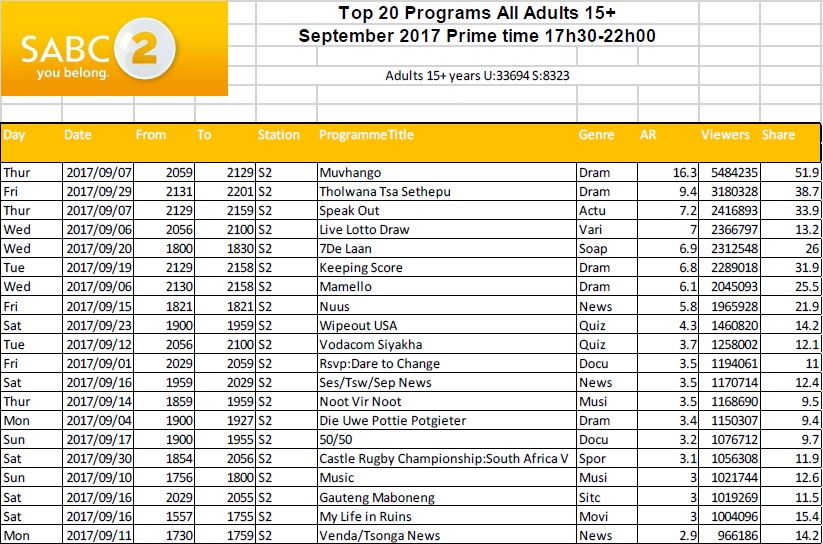
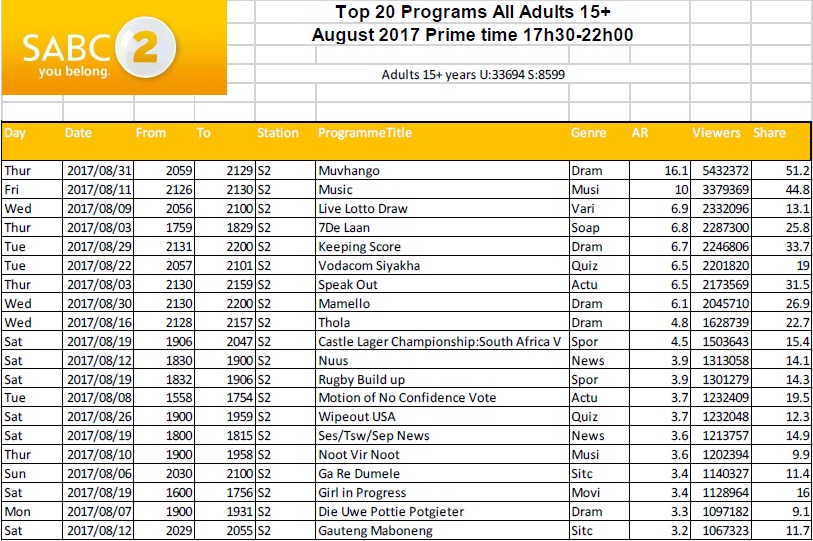
by MarkLives (@marklives) The hottest primetime television shows on SABC 2 in South Africa revealed: TV ratings for September and August 2017.

In 2016, the Broadcast Research Council of South Africa (BRCSA) changed its policy about giving away TAMS and now only monthly reports, highlighting the top 20 or 30 primetime shows on several popular channels, are available.

SABC 2 September 2017

BRCSA TV Ratings September 2017 primetime SABC 2Source: BRCSA September 2017


SABC 2 August 2017

BRCSA TV Ratings August 2017 primetime SABC 2

Source: BRCSA August 2017

Broadcast Research Council of South Africa


The Broadcast Research Council of South Africa (the BRC) is a non-profit, industry body that was incorporated in 2015 to cater to the audience research needs of the radio and television industry in South Africa.

Sign up now for the MarkLives email newsletter every Monday and Thursday, now including headlines from the Ramify.biz company newsroom service!

Global Headline Makers: Lawrence Ribeiro, international man of action

by Mark Tungate (@MarkTungate) Canadian filmmaker, Lawrence Ribeiro, specialises in the kind of action sequences that bring you out in a cold sweat. Here the director tells us why more brands should emulate his “attraction to risk”.

If you’re a movie buff and are short of ideas for your next vacation, you could always follow in the footsteps of this director and cinematographer. He spent months visiting the locations of his favourite action movie sequences, including the Paris car chase from The Bourne Identity and the Istanbul motorbike battle from Skyfall. Once there, he would break down the scenes in his head, picturing how he’d shoot them.

“When I imagine an action sequence, I can see the finished edit in my mind,” he says. “I already know how I’ll approach it.”

Ribeiro has action in his blood. His father was a navy frogman and professional rally driver; as a result, Ribeiro learned to drive before most of us have choked on our first smoke. Then he spent many of his formative years doing insane things with cars. He’s also been an extreme rollerblader and a heli-logger — which, yes, involves logging with a helicopter. When Ribeiro talks about taking a break, he’s probably referring to his arm.

So how did he translate what he describes as “a natural attraction to risk” into a career? “In Los Angeles, in about 2007, I met up with a well-known cinematographer named Howard Wexler, who’s now a very dear friend of mine. He became my mentor.”

This was the time when cameras like the Canon 5D DSLR, which also shot video, were democratising the filmmaking process. Teach yourself to edit with Final Cut Pro and you were in business. “And then, of course, in 2008 there was the crash, which brought with it a demand for a more-economical way of shooting,” Ribeiro observes.

Stunt central

The downside was that the scene quickly became crowded with camera-toting disruptors. Ribeiro had to find a way to stand out. “I’d present myself as the kind of guy who would shoot in conflict zones, or mountains, or jungles. But the technology was evolving so fast, I couldn’t keep up. There were people in Hollywood who could digitally fake a Nicaraguan hut full of bullet holes. They didn’t have to go anywhere.”

Being Ribeiro, he just pushed himself harder. “I’d shoot while roller-blading tied behind a motorcycle. Or while rappelling down a mountain.”

All this risky business eventually led him to a place that felt like home: a stunt boot camp. It was run by stunt innovator Lane Leavitt (Terminator 2, Fast Five, Drive) and his motorcycling champ wife, Debbie Evans (Matrix Reloaded). “It wasn’t really a school — it was more of a place where you could experiment. We could do high falls and fires and stuff with cars and bikes. It was also around the time that drones came onto the scene, which added a whole new dimension to shooting.”

Stunt veterans would regularly drop by to share tips, which is how Ribeiro met Andy Armstrong (who, with his brother Vic, is one of the world’s most-experienced stunt coordinators) and Gary Powell, who has worked on stunts for both the Bond and Bourne franchises. “Gradually I started to get the rhythm of shooting action,” Ribeiro explains. “Sometimes these are very long sequences, and they require a great deal of choreography.”

He also built up a network of friends who could help him with his work. Since then, he’s shot more than 100 action sequences with the best in the business, including his own award-winning short The Chase. His personal style combines art with grit — more Bourne than Marvel.

Branding and sensation

At the time of writing, he’s based in Aix, in the south of France, and in his own words is busy prepping for “a speed bike chase in Morocco, a fight/parkour sequence in Paris, a fight sequence in Rome and a flamenco project in Seville”. Characteristically, he says of the bike chase, “I wanna do it in the vein of Melville meets Kubrick.”

He has strong opinions about branded content, which he worries has become too enslaved to digital shortcuts. He wants viewers to have a visceral, palpable experience. As he wrote recently in an article for the Branded Content Marketing Association: “A truly good product is when it all comes together, in an innovative way, using sound principles and strategy, to convey an unforgettable experience that evokes sensation.”

He adds, “Because of my training as a cinematographer, I have my own ideas of how things should be shot. Then I can get the right guys and I know how to brief them. I can shoot efficiently and innovatively, but my approach is likely to be very different to a traditional advertising guy.”

While regulations concerning stunts vary around the world, clearly the main concern is that somebody is going to be injured. “But, in reality, I’m not going to put anybody’s life in danger, because I know exactly who I need to shoot the sequence safely. It’s all about the set-up that creates the illusion. Let’s say I need a guy to ride a motorcycle at speed and get his knee down. I have plenty of expert riders to choose from but, if the speed isn’t there, I can always find someone with longer legs to cheat the shot. I have options.”

Although he’s a fan of the BMW-branded content series from the early 2000s, particularly Tony Scott’s Beat The Devil, he has the impression that auto advertising today is mostly bland. “A lot of times, they shoot car ads using only one car. If you know anything about how to create the illusion of speed, you’ll know that it’s like trying to shoot a fight sequence with one guy.”

His mission is to educate clients, agencies and production companies about how a combination of the right team and the right techniques can result in genuinely thrilling content that doesn’t cost a fortune. “There are a lot of techniques out there in movies that are frankly not being used in the advertising world… But action and movement are legitimate forms of storytelling.”

When was the last time you watched an ad that had you on the edge of your seat? If Ribeiro has his way, you could be seeing one very soon.


Mark TungateMark Tungate (@MarkTungate) is the editorial director of the Epica Awards (@EpicaAwards), the only global creative prize judged by the specialist press. A British journalist based in Paris, Tungate is also the author of seven books about branding and advertising, including Adland: A Global History of Advertising and, most recently, The Escape Industry, a journey through the business of travel. Over his 30-year career, he has has written for leading newspapers and magazines in the UK, France and the US.

This “Global Headline Makers” column, which profiles creative stars making headlines in their home markets, is syndicated monthly from Epica.

Sign up now for the MarkLives email newsletter every Monday and Thursday, now including headlines from the Ramify.biz company newsroom service!

Young, Gifted & Killing It: Simoné Bosman

by Veli Ngubane (@TheNduna) “Hello Baby” has taken on a new meaning. In isiXhosa, it’s “Molo Sana”, and now it’s become Molo Sana Films. This new production house has assembled a pool of black creative talent, ranging from established film directors to photographers, content producers and writers. Molo Sana, says Simoné Bosman, executive producer and founder, “is on a mission to create work that truly speaks to the hearts of black South Africans and the rest of Africa”. This young and gifted creative tells us how she and her colleagues are working on killing it!

Veli Ngubane: Tell us more about yourself: where did you grow up and what did you want to be when you were growing up?
Simoné Bosman: I am from the city where taxi guards hail “Mowbray-Kaaaap”. Back in the early 2000s, my heart was set on becoming a journalist and saw me graduating with a degree in film and media.

VN: Please explain what you actually do and how an average day looks for you?
SB: My colleagues call me “Super Hustler” so, as an executive producer, everyday sees me seeking and pushing for creative opportunities. To find work opportunities for my company’s talents to dig into and produce outstanding film and photography work.

VN: What is your philosophy in life that influences your creative work?
SB: When you are real, you will always do real.

VN: Tell us about Molo Sana and how it came about?
SB: Molo Sana is an integrated production house that represents the country’s coolest black creative film directors and photographers in the country. We were born due to there being a lack of creative black talent that has the ability to influence commercial work differently, to push for transformation in the commercial production industry. As are result, we have brought to the industry talent who [is] experienced in film and photography. In film we represent Keitumetse Qhali, Que Ntuli, Yash Lucid, Lineo Sekeleoane, Kenny Mumba (Zambia) and Adasa Cookey (Nigeria)… And on photography (going into mixed media), we represent Lebo Lukewarm, Ricardo Marcusk and Austin Malema… and growing.

VN: Where and when do you have your best ideas?
SB: I often try to find a solution when people see a problem. So a lot of my ideas are sparked from this.

VN: How have things changed since you got into the business?
SB: Things became pretty real very quickly. When I was a senior ad agency TV producer, I have to admit that I was pretty sheltered. Now that I am open to the world, I see more of reality and how things really work in our industry. Opportunities and support come from everywhere and not necessarily from the places you thought it would naturally come from.

VN: How do you perceive yourself as a woman leader in the creative industry?
SB: I see myself as an instigator for change and aggressively pushing for transformation. It’s a cutthroat business, where you have to prove yourself as a black woman with creative black talent that [the] ad industry is being introduced to. There are not a lot of black female executive producers in the commercial film and photography industry. And, as Molo Sana is an integrated production house, it makes me the only black woman exec producer dancing in this space.

VN: What advice can you give to people wanting to get into the business?
SB: If you can prove that your business is a solution to a dire need, then don’t be selfish — start it.

VN: What do you like most about your job? What is most challenging?
SB: It brings me joy when we receive a PO for a treatment we presented. But it brings me greater joy when I see Molo Sana’s creatives work airing on TV or is on a billboard. The challenging part is presenting authentic creative solutions that speak in the current tone of the target market. We see that, while creatives are open to authentic solutions, they are often pulled back to stick to the thinking of what their clients has signed off. Coming from agencies, I do understand this dilemma. But the onus is on us as the creative producers of ideas to create authenticity that presents a true and creative reflection of our markets. We need a mind shift in our industry that, when bringing creative producers on board, we all have to work together and trust each other in producing work that is true.

VN: What is your favourite ad campaign, past and present, and why?
SB: Back in the day when I still an ad agency producer, I produced a piece of proactive work for Wimpy called Wimpy Braille. It was heartfelt to document a blind person being given the opportunity to know what they are about to eat by placing a description of their meal on their burger bun by using seeds and placing them in braille. Currently, under Molo Sana, we are working on a few campaigns that will soon become my next favourites.

VN: What has been a highlight in your career?
SB: Receiving the CIPC document that secured our name, Molo Sana Films ☺ — it only hit me then that “we are doing it!”

VN: As a creative, how influenced are you by current trends?
SB: Always! To be relevant and authentic, you need to know what is happening [in] our country. You cannot only rely on the internet to be on par with trends. You actually have to go out and have a bunny chow, gatsby or iskopo with your fellow peeps and know what happening on the ground.

VN: What exciting projects are you working on at the moment?
SB: I have signed a lot of confidentially documents so cannot reveal much. But what I will say is that some digital agencies are developing strong tactical ideas that are changing the way we get across to markets. With minimal budgets, we are working together with these agencies to push for work that has craft and has the ability to pull in great numbers. We are assisting them to push for better budgets, and hope that clients will see that the digital space is a realm that needs great investment as it reaches a lot, real, click-through.

VN: Tell us something about yourself not generally known.
SB: In 2017, we are pushing for “give us back our land”. Well, in 1995, my father and his late mother spearheaded a movement to get back the land where they grew up. The place is called Riemvasmaak, situated in the Northern Cape — close to Augrabies Waterfall. In 2005, Riemvasmaak became the first successful place to have benefited from the land restitution act. And saw it change ownership from the SA military training ground to being home to the Xhosa and Damara people [who] once lived there before. I come from that background; hence my fight for transformation and change for black people to participate fairly within the economy.

VN: Please would you supply two or three pieces of work you have been involved in?

Simone Bosman - Brand South Africa - Laduma MaXhosa
View TVC on Vimeo.


Simone Bosman - Tresemme Botanical launch
View TVC on Vimeo.

For more, go to vimeo.com/molosanafilms.


Veli NgubaneVeli Ngubane (@TheNduna) entered the world of advertising with a passion after completing his BSocSci (law, politics and economics) at the University of Cape Town and a post-graduate marketing diploma at Red & Yellow, where he also currently serves as advisory board chairman. He is the chief creative officer and founding partner of one of the fastest-growing agencies in the country, AVATAR. A full-service marketing agency with digital at the core, its clients include Brand South Africa, FOX Africa, National Geographic, SAA and Chevron. Veli hails from Kosi Bay in the rural KwaMhlaba Uyalingana area of KZN. In his monthly column “Young, Gifted & Killing It”, he profiles award-winning, kick-ass black creative talent in South Africa.

Sign up now for the MarkLives email newsletter every Monday and Thursday, now including headlines from the Ramify.biz company newsroom service!

The Real McCoy: South Africa’s culture of chicken

by Sean McCoy (@TheRealMcCoyTRM) While Nando’s is about peri-peri chicken, the point cofounder, Robbie Brozin, makes is that it is people who deliver and produce the chicken — and therein lies their competitive advantage and point of differentiation.

Nando’s needs no introduction in our chicken-loving country and this irreverent and charismatic peri-peri taste of Africa has done exceptionally well as a global brand, with some 1000 stores in over 30 countries in as many years. From its origins as a recipe exploration in Rosettenville, south of Johannesburg, Brozin and Fernando Duarte have built this into a compelling South African story of which we may be very proud.

In a market that is saturated with chicken options and in a hyper-competitive global quick service restaurant and franchise industry, they have done exceptionally well to carve out a space that is distinctive, unique and flavourful, to say the least.

Marking the occasion

Brozin was recently addressing the housewarming rejuvenation function at the Vega School and he spoke passionately of the partnership and journey that the two organisations have enjoyed, anchored to the principle of creativity at the centre. That is the business of Vega as an educational institution but it intersects well with the ethos and spirit of the Nando’s brand.

More specifically, he highlighted the importance of South African talent on display in the global arena and how the magic of our people has been translated into a unique culture and brand DNA that resonates across the world.

A role reinvented

Brozin stepped down as CEO of Nando’s in 2010, making room for a professional leader; in his own words, he “was a crap CEO” and was better-positioned to occupy a different role as a founder in the business. In this new role, he has the strategic priority of focusing on organisational culture and preserving what is special and unique to the Nando’s way. What is potentially perceived as a C-suite luxury is undoubtedly a key competitive advantage and a unique proposition within the Nando’s business model — culture as capability. It’s fundamentally about protecting and building the Nando’s philosophy, embedded in a particular service and delivery proposition, no matter where in the world it is on offer.

From the onset of the business, the founders expressed a desire to have fun first and foremost, and thereafter to make money. In the Brozin analogy, the two legs of a human cannot chase the four legs of money but the four legs of money can easily pursue the two legs of a human if it is for the right reasons and the business is having fun in doing so. As we well know, the rest is history in their case.

Enter the Nandocas

Nando’s is built on the concept of a family. Whether loud or quiet, settled or challenging, some of the central constructs hold true to this organisation and are reflective of the people centricity, welcoming diversity around their table. Family, or extended family, is a core value and this is further enhanced by the special characteristics of pride, passion, courage and integrity.

Nandocas are the definition of this extended family and an ethos that is played out across the business. This takes it beyond the ordinary of serving a meal in a fast food or dining environment to the level of the extraordinary, delivering a true brand promise and experience on a repeat basis.

People and a cause

This people-centricity is not only self-serving but extends into the communities in which it operates. Brozin talks with equal passion of the Nando’s attack on malaria in Africa, following a life-altering and adventurous exploration trip with Kingsley Holgate and the realisation on that trip that it could make a difference. Its people integration and addressing of this issue in the chilli fields in adjacent Mozambique are inspiring, emotive and real — and the beginning of a new Nando’s journey to help fight what is a leading disease across the continent.

The Harambee programme in South Africa is an initiative that recruits unemployed people and develops and upskills them to prepare them for employment. Since 2012, 3000 of these graduates have been employed within Nando’s and this model is being considered to drive similar such programmes in other parts of the world.

The art of differentiation

While I’ve previously focused on the limitations of the banking sector as an example of product and service parity, I could also argue that a chicken breast is a chicken breast and a thigh is a thigh. Nando’s has, however, taken this to a different level and created a point of distinction. It may be about the peri-peri; it may be about the irreverence and quirkiness of the brand; but it may ultimately also be about the people and the culture. As Brozin says, “It’s about people who make the chicken.”

We often are preoccupied with leading global brands such as Starbucks or McDonald’s, yet we have our very own and compelling international success story right here in SA. Brozin’s challenge to the Vega audience was to use our creative talents as a people to address the many issues that SA faces, rather than leave it to our inept and corrupt politicians. We would do well to heed the challenge. Bem feito, Nando’s!


Sean McCoyDr Sean McCoy, MD and founding member of HKLM, is a prominent figure in the branding arena, with his expertise centered on client service, brand strategy and business development. He contributes the regular “The Real McCoy” column focusing upon internal branding to MarkLives.

Sign up now for the MarkLives email newsletter every Monday and Thursday, now including headlines from the Ramify.biz company newsroom service!

Online CPD Courses Psychology Online CPD Courses Marketing analytics software Marketing analytics software for small business Business management software Business accounting software Gearbox repair company Makeup artist