Cheryl Hunter (research at marklives.com)’s weekly wrap of the latest market and consumer research:
Advanced facial recognition technology in SA
Why Black Friday matters
Wired into faces
Advanced new facial recognition technology is giving ordinary surveillance systems the ability to learn, analyse what cameras see, conduct market research and even proactively mitigate risk. Marius Coetzee, CEO of South African-based identity specialists Ideco (which recently partnered with international firm, IWT, to bring XnapBox intelligent facial recognition technology to SA), explains the opportunities.
by Marius Coetzee. Advanced new facial recognition technology is adding intelligence to surveillance systems, allowing for proactive monitoring and control 24/7, automated facial wrapping and recognition, and even highly accurate identification. This is a growing global market that is expected to be worth over US$10bn by 2025, according to Businesswire’s recent Global Facial Recognition Market Report.
Essentially, advanced new intelligent facial recognition technology uses big data analytics, AI and machine learning to capture faces, establish factors such as their age, gender and ethnicity, analyse their facial expressions, and even match and identify the person.
And because it’s constantly learning, the more you ‘train’ the technology, the better it becomes. There is massive potential for this type of technology. By adding intelligent facial recognition technology to existing video surveillance systems, retailers might not just count how many customers look at a particular area of the store, but also determine how many customers come back more than once, conversions, customer demographics, and how they react to the products — based on their facial expressions.
With this new technology, there is so much more information added to the video feed. You can ‘wrap’ a face, extract the features and expressions, produce an identikit of the individual, identify the person and recognise them every time they pass a camera, identify who they associate with and track how they move through the organisation.
The new “Holiday Shopping Trends” report from market research provider, Euromonitor International, demonstrates why gift-giving holidays and special events such as Black Friday and Cyber Monday matter for the retail industry.
The holiday season presents the most-critical window of the year for retailers. To take advantage of this shopping surge, retailers must understand how consumers prefer to shop and what retail experiences appeal to them.
Says Amanda Bourlier, Euromonitor International senior research analyst, “Shopper behaviour is very different during the holiday shopping season compared with the rest of the year. Time-pressed consumers are especially open to trying new, time-saving services and to visiting retailers; they don’t normally shop to get gifts for others. This makes the holiday season a prime time for retailers to promote new services and channels, and to reach new consumer groups.”
Commenting on SA, she says consumers are changing their purchasing patterns, with many shifting their Christmas shopping to November due to the heavy discounting offered during Black Friday. As a result, many retailers have reassessed their strategies to find ways to increase and maintain traffic during those holidays. In 2017, SA online retailer, Takealot, benefited from its Blue Dot Sale which locked promotional prices on new ranges of products on a timely basis and incentivised shoppers to come back.
Black Friday and Cyber Mondays in countries like South Africa are expected to become as important as — if not more important than — Christmas holidays, with consumers increasingly showing interest in online shopping and hence boosting sales.
• Download the full report free of charge at Euromonitor (registration required).
Cheryl Hunter (@cherylhunter) has written for the South African media, marketing and advertising industries for more than 15 years. A former editor of M&M in Independent Newspapers and contributor to Bizcommunity, AdFocus, AdReview and the Ad Annual, she has also produced for various television networks and currently consults on communication strategy and media liaison. She now does the new weekly “Market Research Wrap” column for MarkLives.com.
by Paulo Dias (@therealptp) WhatsApp with its little blue ticks is an essential way to communicate and radio stations have integrated it seamlessly into the way they’re interacting with their audiences.
Initially, I was skeptical about WhatsApp and radio, as it appeared stations were using voice notes to replace real callers and natural interaction for something more polished — but it seems as if the balance has been struck and WhatsApp is actually allowing more people to have their voice heard on-air than ever before.
So, how are stations using the Facebook-owned messaging platform on-air and does it offer any possibility for advertisers?
Basic messaging platform
A potential stumbling block for WhatsApp could have been the fact that numbers are 10 digits long and not as easy to say on air, compared to easier, five-digit short-code SMS numbers. Not so, as stations receive thousands of WhatsApps everyday for a variety of reasons — from competition entry to song requests, interaction with presenters and a way to send questions to guests, it’s the go-to platform.
In the competitions we’ve run with stations, we don’t see any significant drop-off from SMS response, compared to WhatsApp.
Voice notes
A really great way to get people on-air without having to go through the jammed phone lines is through voice notes. Easy to send and with a sound quality good enough to broadcast — better than a phone line, in fact — more people are able to get their voice on air.
As a listener or contributor, you’re able to self-edit and only send the note once you’re happy and pleased with the point you’re making. It’s a win-win for everyone, as messages are more concise, thought-out and give the on-air product an interactive and engaged feel without compromising on programming gloss.
From a programming aspect, it’s an amazing low-tech way of conducting broadcasts and crossings. 5FM’s Roger Goode did a broadcast from Ibiza purely through WhatsApp voice notes and, during the Comrades Marathon a few years back, East Coast Radio compiled a number of its roadside crossings via voice note when there was a glitch back in the studio. In both cases, listeners were none the wiser.
News alerts
The EWN brand on the Primedia stations has a thriving WhatsApp broadcast group for breaking news and “in case you missed it”’ content. It’s a one-way conversation between EWN and the user, not “spammy” and pushes through loads of multimedia content through links back to the EWN site.
The signup is a little clunky, needing you to add EWN as a contact and then having to verify with an SMS, but this is more to do with WhatsApp’s lack of user-friendly options, rather than EWN.
Constant interaction
Dudu Khoza of Ukhozi FM tells how, for many years, she did a three-hour show and that was it until the next day. Even with social media, the demand on her time was not as much as with WhatsApp. She finds herself being added to listener WhatsApp groups and happily interacts with the people on the group who are fans and embrace her as part of their lives.
It offers a presenter a chance to extend a conversation or campaign beyond the time allocated on-air with a smaller, engaged audience who aren’t going to troll you the way they can on Twitter or Facebook.
[Full disclosure: Ultimate Media helped it integrate the message into radio programming and deliver audiences who love radio soapies and dramas to the Sanlam WhatsApp groups.]
The campaign was hugely successful, making a case for radio and WhatsApp and demonstrating that listeners appreciate the one-on-one aspect, and that they can now extend popular radio segments onto other platforms and the ability to share.
But what about Telegram?
On the face of it, Telegram is a messaging service much like WhatsApp. It was the first messaging app to roll out end-to-end encryption, and the first mainstream messaging app to fully open-source its client code and provide 100%-open APIs for third-party app and bot developers. WhatsApp is limited in comparison but has massive reach and is only going to get bigger and, importantly, more advertiser-friendly.
Algoa FM has switched over to Telegram completely as it allows it to build insights and analytics on audience. From what we’ve seen, the Algoa audience has adopted Telegram as the station have educated listeners about it, and the response to promotions and competitions is comparable, showing that, as long as the station backs something, the audience responds.
I’ve seen WhatsApp setups in stations that range from high-end, standalone, content-aggregating software to some stations simply having a dedicated smartphone or tablet in studio. In the end, as long as listeners are able to get in touch with a station and as WhatsApp evolves, allowing the station to interact with them more intimately on that same number, the platform will continue to be popular.
Paulo Dias (@therealptp) is the head of creative integration at Ultimate Media. He works closely with the programming teams at leading radio stations to help implement commercial messaging into their existing formats. He contributes the regular column, “Dear Radio”, looking at the changing radio landscape in South Africa, to MarkLives.com
by Moonga Mkandawire. Zambia’s economy has been projected to grow at 5.5% in 2018. Tightening of monetary policy by the Bank of Zambia has been effective in stabilising the exchange rate (a Kwacha will cost you about R1.20). However, according to export.gov, most sectors in Zambia are uncompetitive and are dominated by a few large players; banking is no exception. Marketing manager Ndela Sichizya gives us a brief look into the emergence of a new bank, Atlas Mara Zambia.
Moonga Mkandawire: Who are the primary players in the Zambian banking market? Ndela Sichizya: 1) Barclays. 2) Stanbic (Standard Bank). 3) Stanchart (Standard Chartered Bank). 4) ZANACO (Zambia National Commercial Bank). 5) FNB (First National Bank).
MM: What home-grown brands stand out as achieving success in the Zambian market at the moment? NS: Zapit by Zanaco
MM: Can you give us a sense of the wealth management segment of the market and what offerings Atlas Mara has for this segment? NS: We have an asset management segment where we manage collective investment schemes ie pulled funds. The three main products under the segment include: money market funds for the money market instruments; equity funds for the stock markets; and gratuity fund for institutions.
MM: How are Zambians transacting? Is the economy still cash-based or are you seeing a trend towards alternative payment methods? If so, what are they? Mobile wallets? NS: The economy has been moving quite rapidly towards other payment methods. The use of alternative payments has been supported by campaigns from both government and private institutions like banks, Central Bank, Bankers Association and VISA. The proposition of convenience and safety have been the key messages in driving the uptake of these alternative payment platforms.
MM: Where do you see growth opportunities for financial services in the Zambian market? NS: Zambia has total of 19 registered commercial banks providing very similar products and services. There exists, of course, a differentiation in service, efficiencies and capacities in delivery to give a competitive edge on the top players of the industry. Other competitors that have emerged in the recent past include the mobile network service providers [which are] also providing a wide range of money transfer and payment services. This, therefore, makes the industry crowded and a bit difficult for exponential growth. Some potential for growth lies in tapping into the unbanked citizens in the rural and peri-urban areas who are, however, in low numbers owing to the sparse settlements. This fact also makes cost of systems and structural investments huge because these settlements are underdeveloped in terms internet and physical infrastructure.
MM: How did you approach the rebranding exercise of Atlas Mara? NS: The rebranding was both exciting and challenging for the bank but more especially for the marketing team. It was such a huge undertaking as it was three-fold: first, the acquisition of African Banking Corporation Limited which was trading under the brand name BancABC by Atlas Mara group, then acquisition of Finance Bank Zambia, and merging the two local banks in Zambia to form Atlas Mara Zambia. So, in this corporate cocktail, there are three brands that existed ie Atlas Mara, African Banking Corporation and Finance Bank Zambia. The bank obtained an approval from the Central Bank to operate in Zambia as African Banking Corporation Zambia Limited, trading as Atlas Mara Zambia.
The whole rebranding process involved a 360-degree new brand design and positioning. The works included [a] full rebrand of all corporate identity elements like corporate wear, physical building look and feel, website, social media pages, adverts, corporate gifts, taglines, stationery etc. Branding Atlas Mara or any other brand from the scratch is such a great learning and executional experience every marketer would cherish to go through
MM: Is sustainability and environmental impact of business a key consideration of business messaging in Zambia at the moment? NS: Yes, sustainability is a big one [on] our business agenda. We have a comprehensive sustainability policy that is embedded in all that we do and how we relate with our various stakeholders. It should, however, be noted that most organizations are either subtle or only beginning to focus on sustainability issues. The wakeup-call in the recent past has been after a few named organisations have been fined for failure to manage sustainability of the environment.
MM: How do young Zambians enter the local marketing industry? NS: Through formal training in tertiary institutions like colleges and universities. The Zambia Institute of Marketing offers training and certification for professional marketing courses, while the universities offer the academic programs like the Bachelor’s (BSc) and Master’s (MSc) degree in marketing.
Moonga Mkandawire is a writer, editor and analyst. Born in Kitwe, Zambia, he moved to South Africa in 2001 and, with a background in both actuarial science and music, he founded SPARK Gatherings, a communication platform which serves up fresh perspectives on the intersection of urban development, real estate and the creative industries. He contributes the new column, #Immersion, which explores African market dynamics through executive profiles, to MarkLives.
by Herman Manson (@marklives)The Nedbank advertising account has gone out to pitch. “In adherence with principles of good governance, we can confirm that a number of Nedbank accounts\services are out to pitch, including creative, both ATL and BTL,” confirms Khensani Nobanda, Nedbank group executive, marketing and corporate affairs.
“As the process is currently underway, we are not in a position to provide further detail due to confidentiality issues; however, further information will be provided in due course. We have enlisted the services of an independent service provider to rollout the process from a governance perspective. The process is due to conclude in the first quarter of 2019.”
The pitch is being managed by Yardstick. Joe Public United is the incumbent ATL agency.
According to Nielsen, Nedbank spent R417m on advertising between July 2017 and June 2018, making it the 15th largest advertiser in South Africa.
Herman Manson (@marklives) is the founder and editor of MarkLives.com.
by Siwe Thusi (@Siwe_Thusi) My mind is literally the definition of right-brained and left-brained — a stressful mind that is always playing hop-scotch or umagusha between these two hemispheres, at any given time. Oh, and it also doesn’t help that I am a Gemini. Whether you believe in star signs or not, this concept of “two’s” plays out in my life… perhaps more so than in that of others, given I’m a corporate who found her way into a creative sphere.
War of the brains
Okay, okay, enough with the metaphoric dramatism as an icebreaker. My brain is not at war. It’s not a burden… it really isn’t. My brain is just… kept on its toes (excuse the number of body part references but stay with me). It allows me the ability to periscope any given situation: to look at things for what they are (#FactsOnly) and what they can be, as an accountant, and then, where relevant, to also allow for palettes of grey pantones in between as a creative strategist. In. Every. Situation.
What a time to be alive!
So, in a nutshell, this is what I hope to achieve on this platform: I want to share how my left brain reacts to a situation, as well as what my right brain thinks and does. My doing so, I hope, will enable me to learn more about myself as an accountant in advertising plus help me navigate how I can use this mindful umagusha to do a better job for the agency’s clients. And, just maybe, you can take away a few insights as well.
Travels into Africa
Firstly, dear South Africans: It’s into the rest of Africa. It’s wild that we still speak as if South Africa isn’t part of Africa. A few months ago and more recently, I wrote about my trips to Uganda and Zambia. Both countries were incredible and a sensory explosion in their own rights. The sights, smells, numbers and sounds. And my brain was in bliss…
Accountant brain
As an accountant, one of the first things to do in a new country is the currency orientation.
There I was with my iAfrica.com/Business-news security blanket, frantically trying to look up indices and the currencies to the Kwachas and the Ugandan shilling. The Ugandan shilling numbers are so long, eg, on 22 October 2018, R1 = 261,88 Ugandan shilling. So, on the trip, if I had R10 000 in my account, I would have had 2 261 800 Ugandan shillings.
My accountant brain didn’t need Pythagoras to realise that these numbers could make one hungry to spend. “‘Yummy…Okay Siwe, ska phapha’*. It’s basic maths and ratio conversions. Stay in your financial lane.”
Strategist brain
The strategist was awakened every time we landed. People are always the first point of contact when travelling… not a forex index. My eyes allowed me to observe all the differences around me which I could bank for later, to wrestle cultural insights from.
Language was also a big consideration. The make-or-break of engagement begins from that first icebreaker. The rules of engagement are set largely from language. And we all know that accountants are not really part of the ‘get-to-know-you’ crew. So, I was glad that I had icebreaking — my other super[brain]power — with me during my trips so that I could “Ogambakyi” and “Shani” away.
Koolin’ In the City
I welcomed spring in this year by attending a rooftop hip-hop event, hosted by my new hip-hop muso friends.
Accountant brain
It was people-and-engagement time again and but, lucky for me, I’m the accountant that is not stuif around people. What did make me ‘spaz’ out a bit were the prices at the bar.
“What markups are they using at this bar that a bottle of Gordon’s Gin costs R350?” You’d be surprised at how successful this line is as a hubbly-circle conversation starter. People know what markup is. Generally, at parties, this line ultimately leads to other financial woes being dropped one drumbeat after another. Often, most conversation introductions with these strangers at these gatherings are followed by “Oh you’re an accountant? So…I was thinking of how I can get SARS to give me a refund…”
Strategist brain
When all I just really wanted to do was strategise how I’m going to get that price at the bar down. And, you know, engage. “I’m actually also a strategist…” and after that usually the floodgates of jargon from a homie-preneur who is just “doing-my-own-thing” are opened. Spewing an array of generic verbiage such as: LEVERAGE. OPTIMISE. INSIGHT. TAP-INTO-BEHAVIOUR. It’s great that people know the jargon. But it’s concerning that this jargon gets passed around like a hubbly pipe. An interesting observation, nonetheless.
Client VI training conference
Recently, one of my clients had a workshop for all partner agencies to get alignment on the current visual identity (VI).
Accountant brain
The conference room was spectacular: boutique hotel-styled. The room was laced with incense that had a slight nuance to the aroma of money (well, logically because it took money for this day to have happened). What started to interest me…was noticing how there’s a shift in terms of investing in experiences created by this client, for its own people. Staff welfare and staff training must sit as really well-fed numbers on the client’s group income statement. <gasp> Also, how much does it cost a big gun of a brand to invest in a new VI in South Africa? After many credible enquiries, the answer to this question still remains very elusive, because the answer is based on a sliding scale and there are so many variables to consider. So, I looked to a Forbes article: “Ask branding agencies for quotes and you will get prices ranging anywhere from $1,000 to $50,000 and up, and sometimes this includes only the design.” So, as a South African conversation, the answer looks like anywhere from R14 000 and up. (barring our petrol-price gymnastics.)
Strategist brain
A strange thing happens to me when I have to attend talks or workshops like this VI training session. I’m a geek for these things! In my mind, these TED talk-esque events are opportunities to fall in love and dissect the intricacies of the brand I write strategy for. Why a gesture or a symbol is used in a certain way, what we are communicating and all the things that go way beyond a messaging matrix and a strategic platform.
A situationship
So, with all that said, I invite you to be in a situationship with me. Journey with me through the inner ramblings of my brain hemispheres, when looking at different situations, from the most obscure to the most (hopefully) enlightening — situations like having a startup creative agency as an accounting client or the judging of creative awards…
*Translation: to be forward or to get too excited.
Siwe Thusi (@Siwe_Thusi) is a qualified South African chartered-accountant-turned-creative-strategist at FCB Africa and a working photographer. Since mid-2015, she’s been in strategic planning, working on some of South Africa’s big brands in different categories and industries in the ATL space. She contributes the monthly column “An Accountant in Adland” — exploring where, when and how the two ‘disciplines’ overlap… and why they should! — to MarkLives.com.
In 2016, the Broadcast Research Council of South Africa (BRCSA) changed its policy about giving away TAMS and now only monthly reports, highlighting the top 20 or 30 primetime shows on several popular channels, are available.
The Broadcast Research Council of South Africa (the BRC) is a non-profit, industry body that was incorporated in 2015 to cater to the audience research needs of the radio and television industry in South Africa.
by Sabrina Forbes. As the South African social media landscape continues to grow, brands are either bringing digital in-house and trying to figure it out themselves or making use of agencies that’ve added digital as an arm to their existing traditional repertoire (and which are also trying to figure things out). Then there are the agencies born and built for social, such as TILT.
Influence architects
They call themselves influence architects who create magnetic branded content and then amplify it like wildfire, and consider themselves the unfair advantage for brands wanting to market on social.
Co-founders Arye Kellman (of 5FM and CliffCentral fame) and Jason Levin (ex-MD of HDI Youth Marketeers) got their new agency off to a flying start when they launched in May 2017. Within their first month, they had picked up two campaigns with global brands, Kellogg’s and Estee Lauder Companies. The duo didn’t just get their first clients quickly; they agreed on the agency name almost immediately. TILT is about shifting the way you look at things, and according to Kellman, “four-letter words are dope.”
The agency’s core offering is in the influencer-marketing space. “I came from a content background — mostly radio but also podcasting and social media — [and] had watched the rise of influencer marketing and thought I had value to add to the space,” says Kellman.
TILT focuses on using social media content influencers, celebrities, and trendsetters to build deep connections with digital driven audiences, millennials, and other early adopters. By focusing on “bespoke, creative-driven influence architecture”, the way Kellman explains what they do, the now team of six creates content that’s made for social, built in the right style, format, and duration, every time.
https://www.instagram.com/p/BnlqQTNFhj7/
It’s a social world
It’s probably fair to say that chiropractors are making a killing these days with society’s newly discovered 45-degree head position. What was once an odd sight is now becoming more commonplace: groups of humans walking like zombies, heads dropped down with focus, both arms engaged tightly to their side, their hands cradling a device that holds more computing power than the machine that got Apollo 11 to the moon. What are they doing? They’re double-tapping, liking, commenting, LOLing, #tagging, meme-ing, GIF-ing, sharing, posting, and storytelling. Truth is, they’re not about to stop.
The recent South African Social Media Landscape Report uncovered that over 40% of brands are using Facebook effectively. This is probably because most of the people at these brands use Facebook daily for their personal needs. It’s when brands try to use platforms such as SnapChat and WeChat that they fail, specifically here in South Africa. This is another USP of the team at TILT. They’re young and ‘with it’ enough to have large followings and engagements on all social media platforms, not just the typical. This allows them to offer their clients workable campaign ideas that are created for social, with social in mind, and for the social age.
By simply having a social media account, anyone has the ability to share and influence those around them. TILT understands that, for youth and affluent audiences, social is where it’s at and that it’s now easier than it used to be to get TV-sized audiences to view a single social media post for a fraction of the price of broadcast platforms. That you can also deeply target your audience by specific metrics helps to reduce the amount of marketing wastage often experienced by brand budgets going the traditional route. “The rise of the individual as a content creator and content carrier — and therefore a media vehicle — has been huge the past few years,” says Kellman.
But the rise of influencers automatically brings the rise of “chancers and snake-oil salesmen”, as Levin, TILT director and co-founder, put it in a recent Business Live article. Everyone with an Instagram account is trying to jump on the social media influencer gravy train and, for an agency such as TILT, whose USP is working with influencers to create value for brands, this could become a dangerous field to work in if not carefully handled. By using a bespoke, highly vetted set of influencers, the agency hopes to negate any negative or dishonest campaign metrics. It offers 100% transparency on follower bases and market rates achieved per post, plus full reporting during and after each campaign.
On the books
While it doesn’t keep a set of influencers on its books, it’s worked with the likes of Boity Thulo, Kyle Deutsch, Roxy Burger, Locnville, and Rorisang Thandekiso, bringing them into campaigns as and when their offerings fit.
TILT manages its influencers a little differently to other influential agencies, as explained by Levin: “We are differentiated from the ‘system driven’ offerings like Indahash and Webfluential by very careful influencer selection and hands-on talent management, but also by the fact that we produce and co-create content, rather than just brief them and let them do their own thing.”
Kellman and his team say they don’t like to brag and, when asked about recent client wins, the former’s response was: “Our goal is to increase revenue for our clients; so long as we’re doing that, we’re #winning. Advertising agencies can often be self-indulgent in reflecting on what they think they’ve done right. We’re about getting the job done, generating revenue for our clients, and looking to what’s next.”
Nevertheless, the client list after 18 months in operation includes Estée Lauder Companies, Virgin Atlantic, Investec, Kellogg’s, and The Walt Disney Company.
Proudest moment
Reflecting back on the last 18 months, Kellman’s proudest moment is how he’s brought people into the team who are smarter than him. “Our success is 100% rooted in the team of people in the office every day,” he says.
When it comes to finding new collaborative clients to work with, Kellman shares, “We present a lot. We pitch (not necessarily in formal competitive pitch processes) two-to-four times a week. We’re actively out there, locally and internationally, looking for clients and trying to propose better solutions than they have in place, and it’s working. We now have 15 clients. The agency world seems to be unhappy with the way pitches work forever, [but] we’re trucking and rolling with it as, ultimately, great ideas will always speak for themselves. In terms of retention, we stay close to our clients, we talk to them, service them, and deliver on work that ups their revenue.”
Key clients: Investec, Estee Lauder Companies, British Council, Acer, Disney Africa
Services: Social media content creation, influencer marketing
Sabrina Forbes (IG) is an experienced and published writer covering the food, health, lifestyle, beverage, marketing and media industries. She runs her own full-stack web/app development and digital-first content creation company. For more, go to moonwrench.com. She is a contributing writer to MarkLives.com.
“#AgencyFocus” is an ongoing weekly series updating the market on ad agency performance, including business performance, innovation, initiatives, the work, awards and people.
by Charlie Stewart (@CStewart_ZA) Facebook, long the darling of consumers, brands and analysts, has become a demon of late, with 2018 turning into an annus horribilis for the social media behemoth. All the signs also point to a continuation of the scandal and loss of direction that has beset it over the past 12 months.
The year started with a fake news hangover, progressed into the Cambridge Analytica debacle and a belaboured Congress dissection before stumbling into a shocking earnings report (during a 90-min conference call in late July, its market valuation shed an eye-popping R2tn). Over the past few weeks it’s faced renewed criticism that it’s not doing enough to block scamsters, that it’s leaking data, faking its numbers and ripping off advertisers.
Hires UK deputy PM
Desperate to change the narrative, in late October 2018, Facebook announced that it’d appointed a man who used to be the UK’s deputy prime minister as its global communications chief. But so strong is anti-Facebook sentiment that even this news was met with scorn; rumours had been circulating for a while that a senior British politician would be joining, with most pundits hoping it would be the dynamic ex-Labour foreign secretary, David Miliband, instead of the widely disliked and rather wet Nick Clegg.
A malaise born of confusion
Facebook’s malaise may be distilled into three primary issues. It’s uncool, its data is dodgy and it can’t decide whether it’s a publisher or a tech company.
On the first score, youngsters have fallen out of love with Facebook (although it’s debatable that they were ever in love with it in the first place). eMarketer reports that less than half of US-based 12-to-17-year-olds log onto the platform more than once a month. What’s more, the research company projects that it’ll shed around 2m US-based users aged 24 and younger this year. Granted, some of these will migrate over to the Facebook-owned Instagram, but rival Snapchat is likely to be the nett winner.
It’s also falling out of favour with celebs and professionals, with more and more following Jim Carey’s lead by dumping it. While he did so on ethical grounds, others are keen to remove the rabbit-hole distraction of a never-ending (and rather shitty) news feed from their busy lives.
Shady statistics
Facebook’s had an issue with data for some time. And it’s not just that it’s criminally reckless with its customers’ information (in late September, it admitted that the latest in a long line of breaches affected 50m people’s information): it also seems clueless about its own numbers.
In 2017, it was ridiculed for saying it could reach more people than exist: its Australian operation claimed 1.7m more 15-to-39-year-olds as users than there are listed in the country’s official population numbers. The ensuring criticism prompted it to review how it measures accounts. It must have appointed a team of imbeciles to conduct the review as, instead of correcting the imbalance, it actually upped the number of invisible 15-to-39-year-old Aussies using its services for 2018.
Not content with overstating its user-base, it’s also been accused of inflating post and video engagement metrics. This audience distortion, coupled to the shenanigans around fake news, is pissing off the very advertisers on whom it depends (to the tune of $39.9bn last year). Earlier this year, Unilever instructed Facebook to ‘drain the swamp or else…’. Elsewhere, groups of smaller advertisers are launching class-action suits.
Who am I?
To my mind, the greatest cause of Facebook’s failure to please anyone is an underlying confusion over what it is: is it a publisher / media company or an IT company?
In a debate at the recent Festival of Marketing, bulldog commentator Mark Ritson laboured this point with Steve Hatch Facebook’s regional director of Northern Europe. Ritson maintained that, because Facebook has an editorial team, produces original programming and is the primary source of news for one-in-four British people, it should be viewed as a media company and thus should assume a media company’s responsibility for managing the flow, quality and integrity of information that appears on its platform.
Hatch disagreed, stating that Facebook is a tech company that builds products and is driven by engineers, rather than creating content and being staffed by creators. Which allows it to abrogate responsibility for the flow, quality and integrity of information that appears on its platform (ok, he didn’t say that last bit; I did).
Portal to intrusion and leaks
In keeping with its internal view that it’s a tech company, Facebook has just launched Portal, a new video-chat device to compete with Google’s Home and Amazon’s Alexa. For some reason, it really believes that a company that has leaky security, treats users and advertisers like idiots and propagates fake news will convince consumers to entrust it with the intimate details of what goes on inside their homes.
As the saying goes, there’s sucker born every minute. But even Clegg will have his work cut out trying to sell this proposition.
Charlie Stewart (@CStewart_ZA) is CEO of Rogerwilco, a multi-award-winning independent digital agency best known for its expertise with Drupal, SEO and content marketing. A Scot by birth, he moved to South Africa in the early 2000s in his quest to support a winning rugby team — a search he’s reluctantly forsaken. Together with Mark Eardley, he co-authored Business to Business Marketing: A Step by Step Guide, (Penguin Random House, 2016) and may be found on LinkedIn. Charlie contributes the monthly “Clicks ‘n Tricks” column, which looks at how brands are using digital channels to engage their customers, to MarkLives.
by Ailsa Wingfield.With finite time but infinite change, consumers’ expectations don’t stand still. Consumer circumstances and priorities are continually shifting as they seek to rebalance their more complex and crowded lives. Consumers are feeling more stretched than ever before, and are striving to repurpose their time and effort, searching for simpler and easier ways of living…
In our world today, consumers live a ‘hyperconnected hyperlife’. Work-life balance is regularly cited as one of their biggest concerns and busy consumers are demanding products, places and processes to help them overcome everyday obstacles for effortless living. Manufacturer, retail, technology, media and service brands have a vital role to play in providing an overall convenience experience with easy-to-use, automated, intelligent and digitised options for every conceivable lifestyle item, incident and interaction.
But what does true convenience mean? Circumstances, culture, location, market maturity and technology are key influencers and important considerations when tailoring convenience solutions for different segments of society. But, no matter where or for whom, at its essence, convenience has three core attributes: ease, utility, and simplicity. In providing these elements, brand solutions and experiences may enable more fulfilment, enjoyment and balance in people’s busy lives — where time is fast becoming the new currency.
Six factors of change
There are six factors of change driving consumers’ increasing need for convenience:
Rapid urbanisation
People are flocking to urban areas in search of better employment prospects, infrastructure, services and a wider array of lifestyle options. By 2025, 69% of South Africans will live in cities or towns — 39m people in total, 4.7m more than today.
Shrinking households
Average household sizes are declining as fertility rates continue to fall (3.0 people per household by 2025 in SA). With increasing population density, limited space for new housing and high property prices; many consumers are downsizing their physical living areas.
Crowded transport
Limited land and high investment costs are major barriers for many urban areas to develop the transport infrastructure needed for their growing populations. In many cities, congestion is increasing, car ownership is declining and people are spending, on average, two hours commuting every day.
Evolving gender roles
Nearly 52% of South African working-age females participate in the labour force. With more working women, the traditional role of women to take care of shopping, cooking and other domestic duties is shifting to a shared role between men and women.
Generational needs
People are living longer than before. In South Africa, 18% of the population will be aged over 50 by 2025. Shifting age demographics means technology adoption, spending ability and priorities will vary considerably between generations.
Uptake of technology
The scope and scale of technology has exploded, driving a fundamental transformation in the way consumers include and use digitisation in their lives. SA mobile subscription is well over 100% and internet access will reach 68% by 2020 (an increase of 16 points in five years). Growing smartphone penetration and the rise of smart homes and spaces will escalate consumer capability and connectivity to services to streamline their lives.
With the convergence of these factors, consumers feel increasingly overloaded and often overwhelmed. It is no surprise, then, to see that the primary reason for using time-saving products and services is to ‘simplify my life/less stress’, followed by gaining back time to do the things that they value most. Consumers are seeking convenience solutions in three core areas:
Consumption experiences
Usage of products and services is no longer only the domain of in-the-home. The spectrum of where and how products are consumed has extended to incorporate a far larger range of places, spaces and opportunities for brands and marketers. Nineteen percent of SA consumers’ monthly budget is allocated to products for at home but, nowadays, a further 5% is also spent on out-of-home or on-the-go consumption.
The days when meals were prepared and eaten with family at home around the dining table are becoming fewer and fewer. As a result, easy-to-prepare and ready-prepared food options not only save time and energy but can also be tailored to dietary and health preferences, an imperative for our increasingly wellness-conscious societies.
Consumers without the energy or inclination to cook are also adopting ‘send it home to me’ services, with 34% of South Africans using a restaurant/meal delivery service in 2018. To date, many of the home-delivery services have been fast-food meals, but this is changing and set to grow as health considerations and internet penetration expands, and suppliers establish competitive market offerings.
On-the-go and out-of-home meals are becoming more common as consumers spend more time working and commuting. Swift, mobile munching means consumers are looking for accessible, portable, nutritious and tasty out-of-home options. Grab-and-go meals from quick-service/fast-food and street vendors are on the rise, with 63% of SA consumers saying they visited a fast-food outlet during the past six months.
Meanwhile, certain meals are also being completely replaced by snacks. Snacking is now more than just an indulgence, reward or sweet treat; snacking has become purposeful. Brands, therefore, have the opportunity to create smarter, fresher and healthier options, in smaller and more-frequent formats, and delivered in-the-moment.
No matter where consumers are shopping, eating or how they’re cleaning, they are looking for more suitable products. Convenience is one of the top reasons for buying a new product and, as a result, many of the convenience-related attributes such as ease, suitability, relevance and function are important choice-drivers.
Shopping experiences
Retail concepts are often the most-referenced experience when it comes to convenience, especially small, physical store formats and, more recently, the growing ecommerce environment. But the perception of convenience is not limited to any single physical store format or virtual channel. Streamlined services, digital experiences and frictionless commerce are converging with the ‘bricks and mortar’ and ecommerce worlds to shape new shopping experiences that provide personalised and on-demand ease, utility and simplicity.
The retail landscape is also being reshaped by evolving shopper missions. Busy, commuting South Africans who live in smaller spaces increasingly find shopping to be a chore (49%), and are shying away from the big grocery-stocking trip to more frequent top-up and immediate needs-based buying. So, will the physical store cease to exist? The answer is almost certainly no. Recent store closures around the globe does not signify physical retail extinction, but rather retail revolution and transformation.
We are already seeing the change within the brick-and-mortar formats — smaller stores are outpacing the growth of large stores and gaining frequency. Smaller stores often already have the advantage of proximity and are well-placed to optimise their assortment and range of products and services beyond essentials and snacks. Stores located along busy traffic routes that provide efficient in/out and click-and-collect offerings will continue to grow in popularity.
Omnichannel experiences can help provide the much-needed ‘digital makeover’ to integrate physical and virtual shopping. Today’s offline and online purchasing actions rarely happen in isolation and, in addition to more-conventional marketing practices, there are now a number of digital shopping activities that precede and succeed the path to purchase. These actions help to inform decision-making; add value, transparency and interaction; and ultimately lead to better buying experiences for consumers. Omnichannel facilities are an imperative and, for sustained success, physical retailers need to leverage their consumer-relationship information (via their rich datasets and loyalty) — with the right technologies, and a strong focus on convenience — to expand their consumer touchpoints.
The scope for continued growth in online shopping is also undisputed when we consider consumers’ willingness to adopt more digital elements to make their shopping experience easier and simpler. The incidence of SA consumers ordering online for home delivery is 21%, with a further 45% willing, and those using online automatic subscription is 7% but those willing to use this as an option in the future is 32%.
Regardless of whether shopping online or offline, consumers are seeking a more-efficient and -enjoyable experience. Large, small and virtual stores need to be infused with positive sensory encounters, relevant services and technological capabilities that provide ease, utility and simplicity. Eliminating mundane shopping actions with programmatic functions, automated lists and subscriptions that utilise artificial intelligence, augmented reality and virtual reality, as well as tapping into consumers’ connected lifestyles and viewing habits on social media, are the way forward.
Engagement experiences
No matter whether it is before, during or after people eat, clean or shop, there are more opportunities and means to engage consumers than ever. The arrival of the internet and mobile phones has been a game-changer for engagement. Hyperconnected and hyperavailable, 84% of consumers enjoy the freedom of being connected anytime, anywhere. Connected devices and platform fragmentation provide more-convenient, on-demand and -interactive ways to view, read and listen to content. And for brands, this enables more-tangible links with consumers, from product discovery to purchase outcome.
Accordingly, marketers are reallocating their advertising spend, based on ever-increasing data and information about consumer-engagement touchpoints. This is enabling more-relevant and -personalised content to engage with addressable audiences. But there is a caution to this: technology can be complex and information overload is becoming a reality — 54% of consumers say they are overwhelmed by the amount of information available. Marketers will need to simplify their digital systems, consider integrated apps and personalise content, with frictionless links to a purchase outcome.
In many regards, ‘connected consumers’ are navigating their own engagement path. Brands need to be fully immersed in the search, social and shopping spaces and explore new ways to identify consumer interests, needs and touchpoints to provide seamless connections to satisfy them.
The quest for convenience is at the very heart of what most consumers are striving for, but one of the most-important points to appreciate is that convenience does not mean the same to everyone, everywhere or everything. In our increasingly ‘on-demand’ world, consumers will have more control to customise, and summon products and services, where and when they need them.
Brands and marketers will need to match these ‘in the moment’ needs, using data to develop solutions, and deepen relationships with their consumers. Each market, brand, store and service may be at different inflection points on this quest, but one thing is clear — a comprehensive understanding of consumers’ circumstances and pain points gives brands a clear connection with the opportunities and solutions that consumers seek.
2018 edition now available
Ailsa Wingfield is executive director: thought leadership for Nielsen Global Markets. She helps companies capture today and tomorrow’s prospects by identifying and exploring demand-generating trends through strategic foresight, knowledge and thought leadership creation. She has extensive experience in Africa and Middle East, working with global and local brands in multiple countries across the consumer goods, media and telecommunications industry.
Shane de Lange (@shanenilfunct)’s weekly analysis of media design from South Africa and around the world:
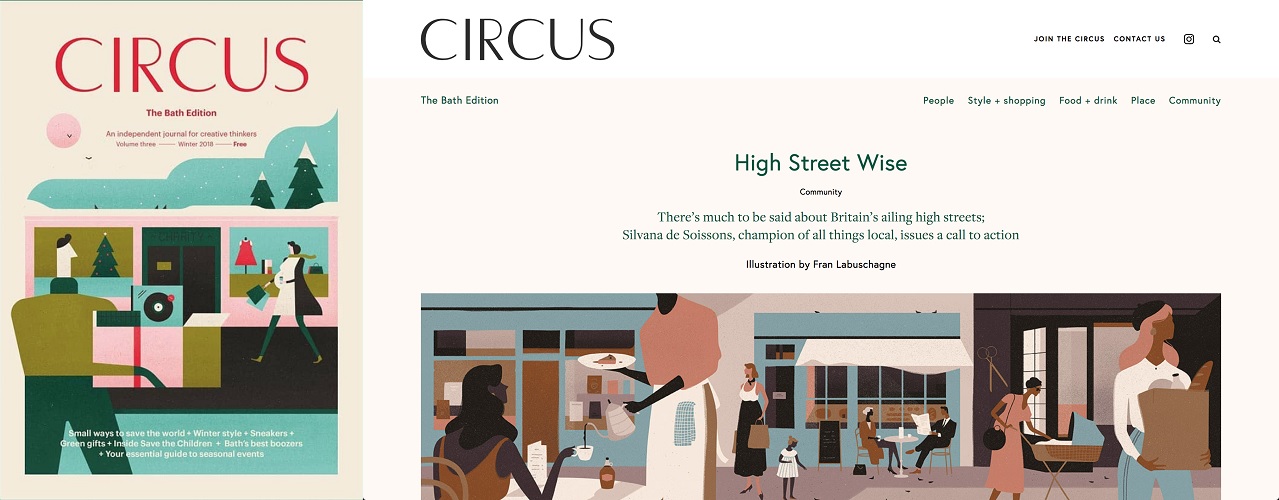
Commercial print: Circus Journal announces the rich culture of the southwest English city of Bath
Iconic: Friends (later Frendz) was a subversive tributary the UK Underground Press, which formed part of the British avant-garde music scene during the ’60s and ’70s
Online: Hong Kong International Photo Festival brings an engaging real-world experience of the art of photography online
Independent print: Ordinaryuses tried and tested conceptual art practices to deliver extraordinary stories about extremely ordinary, yet omnipresent, objects
A creativity-centred journal, Circus is a quarterly offering a fresh perspective on the city of Bath. Titled “The Bath issue”, the third edition has just been released and contains a mixture of lifestyle, culture and community, specifically in relation to the people of Bath and what fuels their collective fire.
It is the largest issue to date, with a cover illustration by South African illustrator, Fran Labuschagne, and features some of the most-talented creatives in England’s southwest. While supporting emergent creative talent — encompassing anything from insightful photography to great design — Circus also promotes local restaurants, boutiques, galleries, and the like, a veritable nucleus of information about like-minded Bathonians.
Circus is free to anybody in the city and, for those who want to access it from around the world, its website is filled with engaging and interactive content, a testament that, given tasteful content and considered design, a Squarespace site can easily make the cut.
Once again, the importance of Marcel Duchamp’s art practices comes to mind here, particularly his seminal conceptual piece, “Fountain”. Reminiscent of the cultural leap that Duchamp took with a urinal in 1917, Ordinary magazine takes a similar stance with its themes for every issue. For its seventh issue, this quarterly focuses on the not-so-humble straw. A subtle parody of Rene Magritte’s 1929 painting, “La Trahison des Images” (The Treachery of Images), which states “ceci n’est pas une pipe” (this is not a pipe) under an image of a pipe, a straw performs as a small pipe on this cover. A silent protest, this is an actual straw, and the fact is straws are mostly made from plastic, and plastic accounts for a lot of waste today, contributing hugely to the pollution of our oceans and severely affecting the creatures that live in them.
The formal, philosophical, aesthetic, ethical and conceptual engagement that every ordinary object gets from Ordinary magazine is far from ordinary. The confluence of art and design in relation to social and cultural matters is no coincidence, as the magazine was founded by artist, Max Siedentopf, and designer, Yuki Kappes. Each issue features an international selection of artists who are given an ordinary object with which to make art, which then acts as content for the magazine. A happy marriage of surface and substance indeed — and synergy across different media, with a neat website to boot.
Arranged by the Hong Kong Photographic Culture Association, and founded in 2010, The Hong Kong International Photo Festival (HKIPF) has a different theme with every edition; the current theme is “The Language to Come”. Showcasing relevant photographers and trends in photography, HKIPF comprises various exhibitions, lectures, seminars, workshops, fairs, and screenings. For 2018, it introduced an open call for satellite exhibitions, with a selection of artists from various backgrounds. Each artist curated their own exhibition based on the festival theme, with photography at the root of it all.
The website for HKIPF is particularly impressive, with textbook execution and incredibly tasteful design elements. Notably, it’s the quasi-modernist aesthetic, inspired by Swiss and Dutch design traditions, accented by a well-considered colour swatch and choice of typographic elements. The layout is dynamic, displaying both text and imagery in a stimulating way. Neat interactive elements, such as a virtual magnifying glass, used sparingly add a little spice to the site. Importantly, the information hierarchy is understandable and navigational elements are accessible and intuitive. Both aesthetically and functionally, a great experience.
First published in London during the late ’60s, initially known as “Friends of Rolling Stone”, Friends magazine (which would later be called “Frendz”) was a subversive tributary of Rolling Stone UK. With strong links to the UK underground press, which included other rebellious magazines such as Oz (featured in this column earlier this year) and Time Out UK, Friends had many influential contributors who formed part of the British avant-garde crowd in the ’60s and ’70s, including William Burroughs for issue #9, Robert Crumb for issue #12, and JG Ballard in issue #17. Themes were also interesting, including a Media Monster issue for #27, and a Women’s Underground Press issue for May 1971.
The magazine was noted for the quality of journalism and other literary content it produced, which tended to focus on the experimental, underground music scene in London at the time. Twenty-eight issues were printed of Friends before the magazine took a more-political route, changed its name to “Frendz” and ran for another 35 issues before its demise in August 1972.
Shane de Lange (@shanenilfunct) is a designer, writer, and educator currently based in Cape Town, South Africa, working in the fields of communication design and digital media. He works from Gilgamesh, a small design studio. Connect with him on Pinterest and Instagram.
Media Design, formerly Cover Stories and MagLove, is a regular slot deconstructing media cover design, both past and present.

 Advanced new facial recognition technology is giving ordinary surveillance systems the ability to learn, analyse what cameras see, conduct market research and even proactively mitigate risk. Marius Coetzee, CEO of South African-based identity specialists Ideco (which recently partnered with international firm, IWT, to bring XnapBox intelligent facial recognition technology to SA), explains the opportunities.
 The new “Holiday Shopping Trends” report from market research provider, Euromonitor International, demonstrates why gift-giving holidays and special events such as Black Friday and Cyber Monday matter for the retail industry.