Only Connect Podcast: How CMOs can use data to be sense-makers

by Bradley Elliott (@BradElliottSA) In a world where consumer expectations are shifting dramatically, data becomes one of the best ways of understanding humans and achieving competitive advantage. In this first Only Connect Podcast, Uber Eats South Africa GM Ailyssa Pretorius and I chat about why data is critical to sustaining competitive brand advantage.

Read the companion column to this podcast here.

Full podcast transcript

Brad Elliott: If customer centricity is so obvious, why are so few businesses truly embracing it as a leading principle?

Ailyssa Pretorius: I think there are two big problems. The one is the data actually isn’t that accessible. And so, as Uber Eats, we’re really lucky, we obviously have an application, that means we can follow data, you know, at every step of the transaction from a customer, and that allows us to get really deep insights. And so the first thing I mean, it was really surprising to me how little detail the current POS systems in South Africa actually provide to a restaurant partner. So basic stuff like stock management actually doesn’t exist in most POS systems. And I think that was quite surprising for me. So I think the first thing is, does the data actually exist? And the second thing that I found is: the idea of using data in a very smart way means that you kind of need to be very clear on what your objective is and what your outcome might be, and how deep you want to be in an investigatory world. So kind of, do you want to decide all I want from my data point is to drive new sales? And to do that, you need to get really deep into segmenting the data, thinking about the data in different ways, and letting the data talk to you. What I found is very often, when people have a ton of data, they go very high level. And so they’re not getting the deep insights that really can drive customer centricity.

BE: So I mean, listen, from my experience, I think you’ve hit the nail on the head with those two problems because it’s what we experience with our clients as well. And I’ve always had, obviously a strong opinion on it.

AP: Quite simplistically. It’s not something that we’ve been our generation has been taught, really, in terms of how to deal with this kind of big data.

And I think it will come and I’m seeing trends within the industry of more and more people investing in basic things like data analysts within their organization, business intelligence,

functions within their orgs. I’m seeing restaurant partners coming to us and asking for more and more data and getting more insights into kind of whatever knowledge that we have, and trying to figure out how to use that and really tap into that.

And I think it’s a natural progression of where we have to go right, if you, it doesn’t make sense to take a big risk when you’ve got a ton of data that will help you mitigate that. And I think people are coming around to that idea above and beyond the customer centricity opportunities.

BE: I started that sounded like you had finished talking about the two main problems. And then I sort of chipped in around access to data, which is one problem, The other problem is once you have the data, everyone’s sort of just taking this high-level view, but it seems like from there you’re seeing quite a bit of skills development and people up-hiring or up-skilling to access that. Yeah, I mean, in my experience has been very much the same. But I’ve always wondered if as businesses, they either don’t understand the value that data can extract or give them because, as you said, they don’t have a clear objective, or whether it’s just laziness. I mean, for me, the technology exists to segment and deep dive into data, do you think Change Management is actually part a crucial part, getting people’s attitudes to change towards data is more the problem and the technology itself?

AP: I guess it’s about how does information filter down and who’s looking at it? So you can imagine a normal salesperson looking at a set of data is interested in two things: What was my sales value? And did I hit my targets? And so I think there’s a piece<?> as the companies need to think about in terms of how you’re incentivizing people. So are you thinking about new sales, attracting new markets, and building an organization that’s thinking in this way, so that people are kind of incentivized — not necessarily financially, but just in terms of how they measure their performance — to think innovatively and in with an entrepreneurial mindset? And I think I think that’s a big piece. I’m not convinced people are lazy. I’m convinced that I think it’s more they’re not clear on where to even begin. And I think, you know, you think about how people perceive people who data analyze, and you imagine a bunch of geeks in every room, have old computer screens and are writing weird data queries. And I think that’s quite intimidating.

So I think it’s more an intimidation factor than a lazy factor.

BE: So who do you think are the top thinkers on customer centricity? Both locally and globally?

AP: After Uber Eats you mean. <laughs>

BE: So that aside, ja, of course!

AP: I’m not sure if I can talk to a specific company that I think is doing this well. But I think the companies that are using tech to speak to their consumers in the way that consumers want to be spoken to, are the guys who are the most forward-thinking on this. So it’s the guys who are smart enough, when you leave your cart to send you a Facebook message to say, Hey, did you have an issue? Is there any way that I can help you? Or it’s the guys who are thinking about WhatsApp shopping because they understand and identify what their consumers need and want. I think the people who are perhaps, maybe not being customer-centric, but are definitely using data in a very strong way, and are thinking through behavioural economics in the way that they’re building loyalty to their platform, the guys that I’ve kind of been inspired by, are Discovery Vitality. What they’re doing in South Africa is the kind of one of a kind in the industry in terms of using data to identify consumer , identify how you can change that , and identify very clearly what makes a consumer tick. And I think that kind of mentality — obviously, they’re using it for a very different objective, but that they’re probably, for me, the leaders in thinking on how to actually speak to a consumer in a very specific way.

BE: Yeah, I agree. I think they’re doing a great job as well.

AP: Listen, I’m obsessed with my Apple Watch, I went for a run this morning even though I had no time, just to make my points.

BE: Exactly. And that’s the thing. So, we talk about data and customer centricity and everyone in sort of defaults back to personalization — which I think is really important, obviously, and meeting customers where it suits them best — but if you talk about true behavioural change, if you look at Vitality and an Apple Watch and points, for me, it’s not even about them debiting an amount off my credit card for the Apple watch anymore. It’s an obsession for me to reach my points. So it’s almost like the stick has fallen away, you know, “Oh my word if I don’t reach my goal I have to pay for my watch”, I think they’ve really actually changed that behaviour.

AP: I think that’s where they’ve totally done it right in terms of balancing that carrot and a stick because I don’t feel like I’m penalized. And, and this they’ve been very specific about this and they’ve experimented a lot with figuring out the right mechanics here, but exactly to your point, I actually don’t know when they charge me into my bank account or not, but I certainly know that I’ve got a leaderboard with my family. I don’t want to make sure I’m the one who doesn’t get their points for the week.

You know, and you’re kind of, doing all sorts of health checks and assessments that I would never do with someone my age, just to get a couple more points on the board. I think it’s really exciting what they’re working through at the moment.

BE: You know I think maybe to your point as well, your point earlier on data and sort of this perception that it’s a bunch of geeks, sitting in a room with old computer screens. I think maybe that was the type of data we used to have. We used to have really dry demographic non-behavioural data, right, a snapshot of a person in time, but with the rise of digital and technology and channels and platforms, the amount of data we can get on behaviour — actual behavioural data is so massive that maybe that’s why companies haven’t really woken up to it as quickly as they should have. I don’t know what your thoughts are on that?

AP: I definitely think so I think, I think a number of companies are starting to think about it. And the guys who’ve started to think about data a little bit earlier are the guys who are starting to do things a little bit differently.

But I also feel like there’s been a long time you had basic data and people just haven’t looked, and it was just because it wasn’t done. And it was okay to just do things based on whatever consultants or marketing company advised.

BE: Makes sense. Are you getting some, some black BMW’s driving behind you there? The President obviously driving past. If you can still hear me then I’ll just go on talking.

I don’t take too much of your time either. So I think yeah I mean, for me the whole data play as well. And I think that’s almost one of the questions that I got to, when I was asking about Uber Eats, is that through data you can really understand people and their behaviour. I think if you use that correctly you can really build trust with them.

And once you do that you’re actually able to transcend into verticals, and businesses that you may have never thought of. So if you take Discovery as an example. I mean they were a health insurance business. They now are basically a full financial services business and they’ll probably transcend into other verticals soon as well. I mean, it really does give you the competitive advantage to not only dominate in your existing vertical industry but actually the outside of it and that sort of speaks to your virtual restaurants anddark restaurants’, as well, you know you’re not just —

AP: Exactly and I think even if you go beyond the spectrum of Uber Eats to Uber as a business overall, if you think about some of the things that Uber has done in terms of, obviously sitting on a ton of data, we’ve built a product called Uber Movement, and I think it launched two years ago almost now. But We sat on all of this data which showed how people were moving around cities, and we realized city planners desperately wanted to understand this because we have that by time-of-day, and where is the starting points and how are people congregating. And you can imagine how much a city planner values understanding what happens on a Friday at two o’clock in the morning and what do I need to do to make sure that the city’s adequately secure, that the roads are okay, where are the words being used more and more, and Uber actually open sourced this. And people are using this to get to a deeper understanding of their cities.

You think about it from an Uber Eats perspective and you think about where the world is going in terms of understanding their food a little bit better, figuring out salt content, figuring out sugar content because of the current rate of obesity.

Does a platform like Uber Eats start to become an information sharer, more than just a place for you to order your food but provides you with the kinds of information that you need to make the right decision making when you’re eating?

But by the same token, does Uber Eats become — and this is not on our roadmap to be super clear — but I just think the world is limitless with some of these things I think there’s a there’s a lot of experimentation going on globally as we start to understand consumer behavior a little bit better. And I think when we talk about customer centricity, it’s putting the customer first, but it’s also about getting a deep knowledge of what the customer is actually looking for and making sure that you’re continuing to provide that and innovate against those insights

BE: Ya, and I guess that’s why the most innovative companies don’t mind making their data open source because they gather more and more and have more and more insight into people, which they can then obviously, let’s be honest, we’re in business for profit at the end of the day, but then they can use that down the line to further understand their customers and obviously increase customer lifetime value and build that relationship.

AP: Yeah, and I think what’s interesting if you look in the tech industry. If you look at the leading kind of technology companies in the world at the moment, I actually would argue that they’re definitely motivated by profitability because everybody needs to get there, if you’re going to be a business. But I think the fundamentals are: figure out a consumer need, solve for the need, and you’ll make a viable business model. Versus maybe some of the old school thinking which is let me make sure that I’m profitable from day one. And that means I have to make adjustments to my service offering unnecessarily to fit a financial model

BE: One hundred percent, that’s a great way of looking at it. Would you be comfortable and telling me who you think is losing in this field, who is losing in customer centricity. We know who’s winning, I think we all kind of — who do you think… It doesn’t have to be one company might have been just an industry.

AP: The adoption of available data that I’m seeing happen a lot, less, a lot slower than I had anticipated, is actually with our restaurant partner base. So, and this is weird, this is where Uber Eats we talk about restaurant partnership and trying to really figure out how we actually provide insights that are more user friendly and make sure that we continue to influence our restaurant partners I feel like this, the industry in South Africa is not using data as quickly as it should. And it’s interesting in South Africa. If you look at Cape Town versus Joburg.

You know if you just started basic stuff like trends, how quickly are Cape Town restaurateurs adapting to trends in global food trends, versus. Sorry. Yeah, Capetonians versus Joburgers, and then similarly, when you start to see changes in consumer habits, how quickly are we adapting? Another good one is the grocers in South Africa and the retailers in South Africa —

BE: Those are the ones I was going to bring up

AP: You know, how, how have we not thought about — Amazon is massive. Virtual shopping and on-demand shopping is something that is definitely a movement, we understand how much more precious time has become and you know this is what makes Uber Eats a success. And I feel like in South Africa some of our retailers have just been a little bit slow to adopt some of the insights that they definitely have.

BE: And that’s for me it is my number one go to, I’m on record for it is Woolworths, I mean Shoprite and them I can sort of, I can sort of them a bit of leeway, because their target market or their typical customer doesn’t — well, maybe that’s an assumption a bad assumption — but in a way doesn’t part with as much data. They’ve definitely got a lot of insight, for sure. But it’s not your Woolworths customer where you’re tracking a card and multiple touch points, so you know I think retailers are really under-investing in unichannel approaches overall.

AP: Even beyond the grocery space, if you think about and I suppose Woolworths isn’t limited to grocery, but think about how long we’ve been offering credit through retailers to consumers. So, that gives you such great insight in terms of when are they shopping, when are they spending the most, when are they defaulting on their payments, what are the trends on purchase, when do people start winter shopping actually, and when do they stop?

BE: Yeah, I mean that went back to my question that I asked you in the write up, was all of these companies have the same — having dealt with him on a one to one basis, lots of them, and not just the retailers and grocers — they all have the same excuse around like,Oh no no that’s you know that data sits separately from that data and everything’s siloed and we’ve got this one customer view project we’re working on but it’s going to take five years to roll out,’ I just sort of nod my head in absolute amazement but, you know, literally one of the biggest retail groups we work with, we went there —So you want a single customer view how long is it going to take to pull this data in?’ And they were likefive years’ I was like that is absolutely mind-blowing. Like, I don’t understand. Yeah, I mean having a siloed data is always a barrier r but I think it’s always an excuse.

AP: I think I think people have been using data for the longest time to send Happy Birthday messages. Yeah.

BE: If you’re lucky. The example I always use is I get mailers for female clothing but don’t read into that.

<laughter>

BE: So yeah, so do I just wanna I know we’ve been talking for 20 minutes which I appreciate I’m just gonna end up with a more general question: are there any great books or podcasts that you’ve read recently, they don’t have to be necessarily on customer centricity but I’m assuming that data and customer centricity are very close to your heart?

AP: I’m obsessed withHow I Built This’ — I don’t know if you’ve heard the podcast? They release a weekly podcast and it’s basically people have started from very little, always, and the best one is the Spanx one if you’ve got time to listen to it, but it’s about entrepreneurs, and how kind of how in the world did they even think about the idea. And what did they do to shift their little idea which usually started in a garage or the back of the house into something that, you know, all of these companies that they interview, are more-than-billion-dollar companies today, and they’ve either sold or made decisions to retain, and it’s not necessarily about data but it definitely, It helps me think a little bit deeper about how are people thinking about these customer insights, how are they thinking about what the customer needs, and how — you know the podcast is amazing because it’s about how relentless people are in their vision, and I think I take two pieces of inspiration for that: one, Uber Eats it’s a very operational business, and sometimes it takes a lot out of me and my team to make magic happen that we do every day happen. And so for me, it’s a, it’s a bit of inspiration on you keep cracking if you believe in what you’re doing because you know you’re doing something great.

And the second piece that is super-clear is you have to continue to innovate. It’s impossible to be static in terms of your offering and succeed long term in a marketplace. And I think that’s why I particularly love it from a book perspective, I’ve actually downloaded, I haven’t read them, I’m on leave tonight. So I’m reading it on the plane. Yeah, yeah absolutely I’m going to New York, I’m super excited.

I have to be in San Fran for work the week after so I’m just making a bit of a holiday slash work trip out of it.

BE: Have you been before?

AP: I have been before, but the times that I’ve been before I’ve been as a… I was one of those terrible tourists who wake up at five did all of the must-do tick off your list thing, which I think is the worst way to do New York. So this time I have seven full nights and absolutely nothing planned which I’m very excited about.

BE: I’ll send you some suggestions if you want because I did everything like a local, but yeah.

AP: Oh, I’d love that.

AP: I was just telling you I’m just actually opening my Kindle to tell you what it is, but this was on the recommendation of somebody from Discovery who spent a lot of time getting deep into behavioural economics.

He recommended I download this book. The book is called Predictably Irrational.

BE: Apparently it’s amazing.

AP: Yeah, so it’s apparently just, and he’s actually this guy Dan Ariely has written — if you’ve actually gone to Amazon — a ton of books, particularly as he starts to learn a little bit more about how humans behave. So I’m quite excited to read this one, the one I really enjoyed wasHow Google works’.

And that was just for me a piece around getting a deeper knowledge of how to motivate people a little bit better, especially in this kind of industry, and then Shoo Dog by Phil Knights.

BE: Shoo Dog is a great book as well. A great entrepreneurial book about tenacity and gearing yourself to the fucken max — a risk taker of note!

AP: If there’s one thing I’ve learned about entrepreneurs is they’re all a little bit cooked, to be honest.

BE: You gotta be you gotta be slightly nuts, you gotta put it all on the line.

Okay, cool. I really appreciate your time, especially on a day that you flying out.

AP: Absolutely and do send me that list I’d love some of that stuff but I think there are some, some hidden gems in there as well.

BE: Enjoy New York it’s my favourite city in the world. I’m jealous.


Bradley ElliottThe founder of Continuon and Platinum Seed, Bradley Elliott (@BradElliottSA) has created a number of businesses in the digital and technology sectors. He believes that marketing needs to be reinvented so that it becomes more useful to humans and brands. He’s also a collector of fine whisky. Bradley contributes “Only Connect”, exclusively to MarkLives.com. In this column and twin podcast, he chats to custodians of the world’s top brands about what matters most to them.

— One subscription form, three newsletters: sign up now for the MarkLives newsletter, including Ramify headlines; The Interlocker, our new monthly comms-focused mailer; and Brands & Branding, launching soon!

EXCLUSIVE: Van Rensburg new Avatar ECD

by MarkLives (@marklives) Avatar South Africa has appointed Sanche van Rensburg as executive creative director*, replacing Brett Wild, who recently moved on to be regional creative director at Ogilvy Africa. Van Rensburg joins the agency from Grid Worldwide, where she had a similar role.

Van Rensburg has over 20 years of experience working as an art director and designer in local and international agencies. At the age of 17, she started at the Reflex Group in Paris, France (a full-service creative agency specialising in luxury branding based in New York, London, Paris and Shanghai), and has spent time at Hirshorn Zuckerman (New York City), TBWA\Hunt Lascaris, Grey Worldwide, Leo Burnett, McCann Worldgroup and The Jupiter Drawing Room.

“Sanche is an award-winning creative and for many years we have been doing excellent work that won us some of the biggest clients and we’re convinced that our current and future clients will benefit greatly from Sanche’s talent and experience,” says Veli Ngubane, Avatar Group MD. “We have invested in our creative team and Avatar is now ready to take our creative excellence to the next level both locally and internationally. We have a great team in Grant and Sanche and I’m looking forward to the great work.”

*Updated 1.40pm on 5 April 2019. A previous version of this story incorrectly stated that Grant Sithole is joint ECD of Avatar. He was promoted to chief creative officer at Avatar mid 2018. We regret the error.


MarkLives logo— One subscription form, three newsletters: sign up now for the MarkLives newsletter, including Ramify headlines; The Interlocker, our new monthly comms-focused mailer; and Brands & Branding, launching soon!

Media Design: Fuck You, On The Grid, Riposte, The Guardian Weekly

Shane de Lange (@shanenilfunct)’s weekly analysis of media design from South Africa and around the world:

  • Iconic: Fuck You was one of the most-influential underground publications of the early 1960s, building a bridge between the beat movement of the ’50s and hippie counterculture of the ’60s
  • Online: On The Grid is a quintessential neighbourhood guide for nomadic creatives who need insider knowledge about the different cities around the world in which they find themselves
  • Independent print: Riposte is a call to action, to be more enlightened, be curious, and ask deeper questions
  • Commercial print: The Guardian Weekly equates the UK’s Brexit crises to Monty Python’s Flying Circus

Find a cover we should know about? Tweet us at @Marklives and @shanenilfunct.
Pinterest icon Want to view all the covers at a glance? See our Pinterest board!


Print

The Guardian Weekly, 5 April 2019Heart-Love-Polygon-Geometric-Flat-Design-Icon-Illustration by lekkyjustdoit courtesy of FreeDigitalPhotos   The Guardian Weekly (UK), 5 April 2019

Appropriating from the surreal brand of British comedy that is Monty Python’s Flying Circus, this week’s edition of The Guardian Weekly makes a satirical statement about Theresa May’s “failing circus”. Unpacking one of the craziest weeks in British history, where the prime minister announced that she would eventually resign if her Brexit deal is passed in parliament, only to have attention drawn away from her by MPs who held their own vote for different solutions to Brexit. After their voices fell on deaf ears, the prime minister once again proposed the same withdrawal deal for the third time in the House of Commons, only to be met with the same failed result. Then, MPs voted again on four new options, only to be met with more failed results. The prime minister then desperately tried to appeal to her opposition, Jeremy Corbyn, the leader of the British Labour Party, to hold talks to resolve their deadlock in order to meet the new deadline, after the old deadline, before the final, final, final deadline from the European Union. The makings of a classic Monty Python skit, if ever there were one.


Independent

Heart-Love-Polygon-Geometric-Flat-Design-Icon-Illustration by lekkyjustdoit courtesy of FreeDigitalPhotos   Riposte (UK), issue #11, April 2019

Riposte, issue 11, 2019 - Stacey-Lee MayIn many ways, contemporary life (dominated as it is by social media) lacks a consciousness and seems increasingly void of any kind of enlightenment. Driven only by those elements considered ‘popular’ or ‘trending’, fuelled by marketing people and influencers — who’re all partaking in mass-manipulation and a collective herding of human beings on a global scale — one would be forgiven for thinking that we’re entering into a modern dark age; the only difference is that we have technology today. Our media seems to have a devolving influence on us and people don’t seem to be awake; there’s no enlightenment at present. It’s all the same, bleached out and indifferent.

In a world directed by formulaic strategies and virulent, drone-like consumerism, Riposte is a magazine that seems to swim against the current. Providing reportage on issues of femininity from many different angles, Riposte attempts to understand who w -are in the world today, asking deeper, more-burgeoning questions — hence the publication’s strapline: “a smart magazine for women.” Consciously lacking a clear theme, issue #11 profiles curious, expressive, and defiant women who ask bigger questions that challenge us to demand more from this world than liking sausage-leg Instagram posts. Telling layered stories about darkness and rage, passion and ambition, the experience of each woman is uncorrupted and raw. A noteworthy addition to this issue is South African car-spinning queen, Stacey-Lee May, who defies all stereotypes while burning rubber, ripping through tarmac and paving the way for others to follow as a law student at the University of South Africa (UNISA).


Online

Heart-Love-Polygon-Geometric-Flat-Design-Icon-Illustration by lekkyjustdoit courtesy of FreeDigitalPhotos   On The Grid (US), March 2019

On The Grid, online, April 2019Not your average tourist guide, On The Grid (OTG) makes a point to avoid popular places to purchase kitsch souvenirs and doesn’t promote gentrified guided tours that visit the most-obvious tourist attractions. Designed to appeal to designers, OTG is produced by Hyperakt, a New York-based design studio devoted to creating unique experiences that help to shape a more-equitable and -creative future. OTG is a worldwide collaborative effort, curated by various designers across the globe, and is meant to be a go-to guide made for nomadic, city-dwelling creatives who need local knowledge, on the ground, making it a reliable guide to the bustling creative places and spaces anywhere on earth. In essence, a designer’s neighbourhood guide, 536 neighbourhoods are already listed on OTG, pieced together by hundreds of contributions from local creatives in 111 cities, all sharing insider knowledge about their area. Much like the experience of the overall site, the guides seem to be very well-considered, with insightful recommendations that will likely help to disguise you as a local. OTG’s network is still growing and new areas are added regularly, with Cape Town being the only South African city listed. OTG has an open call for proposals, submissions and contributions and, with so much on offer, Johannesburg, Durban, et al, where are you?


Iconic

Heart-Love-Polygon-Geometric-Flat-Design-Icon-Illustration by lekkyjustdoit courtesy of FreeDigitalPhotos   Fuck You (US), 1962–1965

Fuck You Magazine, Issue 1, 1962 and issue 5 vol 8, 1965Fuck You (FY) was one of the most influential underground publications of the early ’60s. Edited by Ed Sanders (an American writer, activist, publisher, and singer-songwriter for the band, The Fugs), FY was a literary journal that advocated freedom of expression by defying taboos surrounding sexuality and the use of illegal substances. Based in the Lower East Side, at an undisclosed location, using the strapline “a magazine for the arts”, FY arguably pioneered the practice of free sex and use of psychedelic drugs well before the vanguard of hippie counterculture caught on to the fad during the late ’60s. In essence, FY was a cultural conduit, connecting the ’50s beat generation with ’60s hippie counterculture, effectively passing the baton from one movement to the next.

As its name suggests, the journal was provocative, to say the least. Initially focused on poetry, it eventually evolved to include other literary forms. Illustrated with crude drawings by Sanders for every issue, the magazine had some incredibly noteworthy contributors, including Andy Warhol, Allen Ginsberg, and William Burroughs to name a few. Sanders published 13 issues of FY from 1962 to 1965. The first issue’s mission statement speaks volumes about the nature of the publication, stating verbatim: “Dedicated to Pacifism, Unilateral Disarmament, National Defense thru Nonviolent Resistence, Multilateral Indiscriminate Apertural Conjugation, Anarchism, World Federalism, Civil Disobedience, Obstructers & Submarine Boarders, and All Those Groped by J. Edgar Hoover in the Silent Halls of Congress.” Interestingly, FY is often referred to as the “mimeo revolution publication”, because it was printed with the use of a mimeograph (a stencil duplicator printed on coarse, coloured sugar paper).

FY closed its doors due to its perceived obscene content, and Sanders was charged after his Peace Eye Bookstore was raided by police in 1966. FU’s demise proved how influential it was, after Life magazine called Sanders “a leader of New York’s Other Culture” on the cover of the February 1967 issue.

Sources


Shane de LangeShane de Lange (@shanenilfunct) is a designer, writer, and educator currently based in Cape Town, South Africa, working in the fields of communication design and digital media. He works from Gilgamesh, a small design studio. Connect with him on Pinterest and Instagram.

Media Design is a regular slot deconstructing media design, both past and present.

— One subscription form, three newsletters: sign up now for the MarkLives newsletter, including Ramify headlines; The Interlocker, our new monthly comms-focused mailer; and Brands & Branding, launching soon!

SA TV Ratings: e.tv — primetime top 20 for Feb 2019

by MarkLives (@marklives) The hottest primetime shows on e.tv in South Africa revealed: TV ratings for February 2019.

e.tv logo for SA TV Ratingse.tv, February 2019

Top 20 Programmes All Adults 15+
February 2019 Prime Time 5.30pm—10pm
Adults 15+ years U:35679 S:8315

Source: BRCSA February 2019

 Day

Date

From

To

Station

Programme title

Genre

AR

Viewers

Share

Thur 21/02/2019 1930 1959 ETV Scandal Soap 15.71 5 604 970 43.7
Tue 26/02/2019 2129 2159 ETV Imbewu: the Seed Dram 12.46 4 445 726 48.2
Thur 21/02/2019 1900 1929 ETV Rhythm City Dram 10.74 3 832 189 31.7
Fri 01/02/2019 1928 1929 ETV Scoop Network Docu 10.34 3 690 788 31.3
Sun 03/02/2019 1959 2208 ETV Central Intelligence Movi 7.36 2 626 222 29.5
Sun 24/02/2019 2000 2204 ETV Ride Along 2 Movi 6.95 2 478 373 25.9
Sat 16/02/2019 1930 2237 ETV Pirates of the Caribbean:at World’s End Movi 6.29 2 244 549 24.4
Sat 09/02/2019 1930 2220 ETV Pirates of the Carribean:Dead Man’s Ches Movi 6.19 2 206 882 24.4
Sat 02/02/2019 1930 2206 ETV Pirates of the Caribbean:the Curse of Th Movi 5.72 2 042 382 23.9
Sun 17/02/2019 2001 2219 ETV Grudge Match Movi 5.61 2 001 887 21.9
Sun 10/02/2019 1959 2159 ETV Get Hard Movi 5.58 1 991 875 25.6
Sat 23/02/2019 1930 2219 ETV Pirates of the Caribbean : on Stranger T Movi 5.43 1 937 617 21.9
Fri 08/02/2019 2100 2104 ETV The Powerball Draw Quiz 4.55 1 622 646 11.4
Mon 04/02/2019 2127 2129 ETV Just for Laughs Gags Filler Sitc 4.12 1 470 549 8.6
Sat 16/02/2019 1625 1759 ETV Beverly Hills Chihuahua Movi 3.83 1 366 911 18.5
Sat 16/02/2019 1800 1801 ETV E News Direct Headlines News 3.83 1 365 526 15.6
Sun 17/02/2019 1930 1957 ETV Blackish Sitc 3.82 1 363 079 12.4
Sun 17/02/2019 1805 1855 ETV Little Big Shots Maga 3.81 1 360 084 14.7
Fri 08/02/2019 2000 2027 ETV Enews Direct News 3.72 1 328 587 11.3
Sun 24/02/2019 1929 1958 ETV Modern Family Dram 3.48 1 240 367 11.9

In 2016, the Broadcast Research Council of South Africa (BRCSA) changed its policy about giving away TAMS and now only monthly reports, highlighting the top 20 or 30 primetime shows on several popular channels, are available.


Broadcast Research Council of South AfricaThe Broadcast Research Council of South Africa (the BRC) is a non-profit, industry body that was incorporated in 2015 to cater to the audience research needs of the radio and television industry in South Africa.

— One subscription form, three newsletters: sign up now for the MarkLives newsletter, including Ramify headlines; The Interlocker, our new monthly comms-focused mailer; and Brands & Branding, launching soon!

The Power Report: Brand promises are risky if you’re not crisis-ready

by Megan Power (@Power_Report) Brand promises. I like them bold and unwavering, honest and no-nonsense. But, most of all, I like them kept — and, in an ideal world, that’s not too hard. But, for most businesses today, the environment is unpredictable, the potential risks growing and constantly changing. Too often the pacts that brands make with us are broken, with trust eroded. It’s why anticipating, and preparing, for potential worst-case scenarios before they hit is critical.

Ready vs management

It’s about being crisis-ready. Very different to crisis management, which involves mopping up after the horse has bolted. Many reputable businesses have crisis management plans — with designated people and protocols — in place. I suspect a great deal fewer are truly crisis-ready.

A retail CEO told me the other month that he didn’t think a dangerous product defect that affected a global brand a few years ago (with its damaging impact on reputation, revenue and stakeholder relationships) could have been anticipated. Of course, it could. A robust vulnerability audit of a product or service identifies all manner of hazard. A good starting point is preparing for the top five high-risk threats.

A crisis is dynamic and no amount of preparation leads to a perfect fix but, when your team is ready for the worst, having mapped out as many key scenarios as possible, with all the obstacles and resolutions thought through, things are less likely to spiral out of control. It’s got nothing to do with Plan B; this is Plan C and D territory. It’s about having the difficult discussions upfront, drawing up practical action plans and identifying resources — ahead of time. It’s about considering the full scope of your high-risk situations and examining all likely eventualities linked to them. It’s about doing everything possible to mitigate risk — and avoid upsetting customers.

Surprising

Which is why what happened to NetFlorist, South Africa’s leading online florist and flower delivery site, on its busiest trading day of the year in February 2019, is surprising. NetFlorist promises on its site that “delivering flowers on time with NetFlorist is never a problem”. But it was indeed a very big problem for it and the thousands of customers it let down by failing to deliver Valentine’s Day flowers and gifts on the day of love, breaking hearts and promises across the country. Of the bouquets that were delivered on the day, many didn’t live up to expectation. Social media lit up in outrage and the brand took a hammering.

Tweets about NetFlorist non-delivery and wilted
Click to enlarge

Inadequately prepared

Phone calls and emails from customers querying the delays went unanswered after the sheer volume of enquiries overwhelmed NetFlorist’s systems. The retailer’s social media channels didn’t offer any immediate clarity, either. Weeks later, customers were complaining of refund delays, admin glitches, and poor communication. It seemed an inadequately prepared NetFlorist had been totally blindsided.

Tweets about the refund delays and glitches and poor comms AFTER the fact
Click to enlarge

Heartfelt mea culpa

In a heartfelt mea culpa the day after Valentine’s, MD Ryan Bacher posted a video message on You Tube saying the company has been “hit with a horrible combination of severe rain and loadshedding”.

https://youtu.be/RrfcJV1hhl0

But it’s what he said about his company’s preparation for the big day — a day with reportedly 15 times the orders of any other day — that was most revealing: “We spent the whole year planning with our teams and our growers to make sure we deliver on time… We felt prepared for our deliveries yesterday …” Bacher says in the video. He then concedes: “We weren’t prepared for this; we should have been. It’s our fault and as a result we let down our customers and their loved ones.”

Here’s a company that claims to have spent a year planning for Valentine’s Day but yet admits to its customers it wasn’t prepared? How does that happen? Is adverse weather and loadshedding really not a foreseeable issue? Besides, there was reportedly no rain in Durban or Cape Town or Limpopo where some customers also got stood up.

Loadshedding

As for loadshedding, it’s a major risk to be factored into any preparation. As I type this, we’re into day four of rolling blackouts throughout the country. It’s simply not business as usual. A NetFlorist tweet in the days leading up to the Valentine’s disaster would suggest power cuts were certainly on the retailer’s radar at the time: “Not sure what @Eskom_SA has planned, but we’ve predicted #Stage3 clothes shedding on Valentine’s Day! And another: “Don’t let loadshedding put out the spark this Valentine’s Day! Visit our fiery range for some unforgettable gift options #Eskom #Stage3.” Talk about tweets not ageing well.

Commenting on the delivery bungle, Bacher was quoted in a media report as saying, “I don’t know how we can plan for conditions like those in future, but we have to find a way.”

Tweet highlighting that this has happened before on V Day

Not newbies

Indeed, it does. Besides, it’s not as if Bacher and his team are newbies to Valentine’s Day delivery drama. It’s happened before. In 2014, after NetFlorist left at least 500 customers crying on Valentine’s Day (it wasn’t all roses in 2013 either), I interviewed Bacher for the Sunday Times. In the article, “Where have all the flowers gone?, he gave various reasons for that year’s shambles. They included a driver going AWOL with 27 orders, server problems, an entire batch of roses being sub-standard, and only 20 of 120 temporary drivers hired for the day turning up. Sweltering heat meant the flowers that were delivered were wilted and chocolates melted. Also, it had been a Friday, Bacher told me, and people had left offices early before deliveries could be made.

Just two weeks after its most-recent, and seemingly its worst, Valentine’s Day (a day that ironically coincided with the retailer’s 20th birthday) someone tweeted: “Is it safe to use Netflorist again?”

NetFlorist shot back: “100% safe.”

Perhaps the disclaimer “As long as it’s not February 14” would have been more honest.


Megan PowerMegan Power (@Power_Report) has nearly 30 years’ experience working in South African media, including investigative journalism and news editing; she now runs Power LAB, a strategic communications and customer experience agency focusing on customer journey audits, crisis readiness and brand reputation. Megan’s consumer column, The Power Report, ran weekly in the Sunday Times for six years and has now found a new home on MarkLives.

— One subscription form, three newsletters: sign up now for the MarkLives newsletter, including Ramify headlines; The Interlocker, our new monthly comms-focused mailer; and Brands & Branding, launching soon!

Yuppiechef — disrupting retail convention

by ORiSA. Walk into the new Yuppiechef store in Gardens Centre, Cape Town, and you’ll experience the kind of hedonist luxury that gastronomes long for. Sought-after brands are smartly displayed, showing an impressive depth of range. The store is all soft lighting, chrome surfaces, pleasing music and attentive, intelligent service. Much like Yuppiechef.com, the brick-and-mortar version of the upmarket retailer is yours to explore but, unlike the online store, here in the real world you can pick up an investment kitchen knife and feel its heft.

Yuppiechef Willowbridge StoreEnviable brand

Yuppiechef has created an enviable brand online — the kind that customers respond to with engagement and loyalty, even adoration: “LOVE LOVE LOVE Yuppiechef!!” Lara Reeves, from Johannesburg, recently wrote on the brand’s Facebook page. “I love the immediate online chat I can have with a salesperson who helps me choose the right product from their HUGE range, to the way it arrives like a present just for me, as well as the quality of the goods. You have a customer for life xxx.”

If retail is detail and you’ve mastered creating an online brand, why try to replicate this in the real world during a recession, when other retailers are in pain? Particularly given that Boardmans was closed by Edcon, as part of that group’s recovery plan (Edcon acquired the home store in 2004).

As of October 2018, Yuppiechef has four stores, all situated in Cape Town.

“We’ve been growing for many years online, but we’d often meet people who would say, ‘Oh, Yuppiechef! I love Yuppiechef. We get your newsletters. We know so much about you guys’,” says Andrew Smith, CEO. “We’d say, ‘What have you bought from us?’” Smith acts out the role of a shamefaced fan who has yet to make their first purchase. “‘Oh. Nothing’,” he says in a tiny voice, emulating the awkward response of a fan who has yet to become a customer.

Physical retail experience

Shopping in SA remains overwhelmingly dominated by the physical retail experience. Like their peers in Dubai, locals like to go to malls for fun. This is what we do for entertainment.

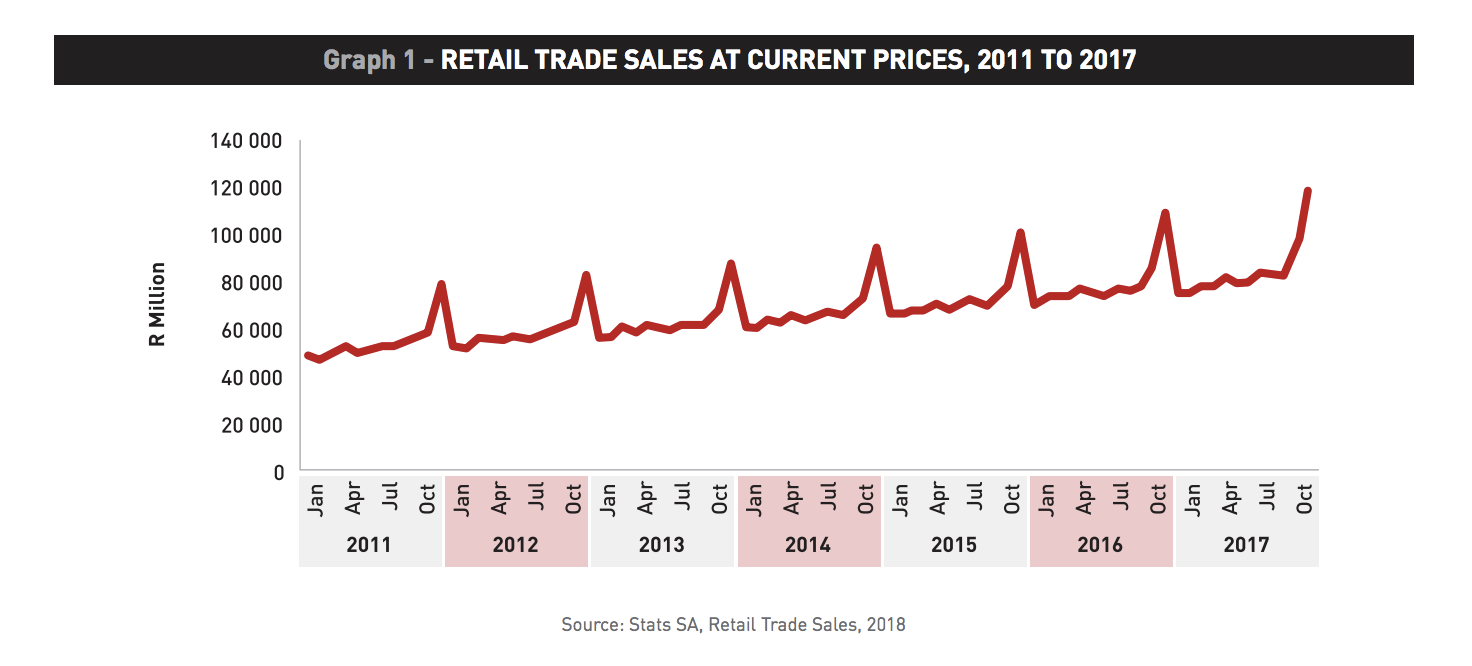
Retail sales figures in SA broke new barriers in 2017 by exceeding the R1tn mark, according to research by the South African Council of Shopping Centres and Urban Studies. The survey, titled SA Shopping Centre Benchmarks 1998–2018, estimates that malls accounted for some 65% of this total.

SA Shopping Centre Benchmarks 1998–2018 graph
Source: SA Shopping Centre Benchmarks 1998–2018

How is online retail doing by comparison? According to Arthur Goldstuck of World Wide Worx, less than 2% of retail revenue is spent online. Considering the rise of real-world retail locally, Yuppiechef’s play, flipping the trolley on the expected practice by going from online to physical makes sense. Fundamentally the luxury retailer’s decision is driven by its vision of retail tomorrow. “This isn’t an ‘either-or’ question,” Smith says. “The future of retail isn’t online or offline; it is omnichannel.”

Omnichannel

Omnichannel is the strategy that smart retailers are looking at to consolidate and effectively deal with digital disruption. The idea is to integrate all one’s marketing channels to provide a unified shopping experience for the user. For Yuppiechef, by way of example, this means having QR codes on every pricetag in store, so that shoppers can quickly read reviews of products online using their phones or tablets. Click, click and items are easily added to wishlists. In an omnichannel world, at checkout, the customer’s delivery and billing details are instantly on hand for guarantee and returns purposes.

“I think the future for most retail is going to be: this is the brand, they are a retail brand, and you can shop on your phone, you can shop on your computer, you can go into the store, or you can phone in. A customer can stand in a store and use their phone if they’d like. Integration is the retailer’s challenge. Customers just want to see one consolidated brand, rather than make choices across fragmented channels,” Yuppiechef’s CEO explains.

A massive advantage for Yuppiechef is that its physical stores operate as individual cost centres divorced from head office costs. In traditional retail, head office costs like HR, marketing, finance, buying, planning, and the like have to be borne by each store. But, for Yuppiechef, the cost of the nerve centre is already covered by the online business. “Yes, there’s rent and staff and shopfitting costs, but none of the head office costs is being put on the stores, so the stores are doing well in that sense,” Smith says, adding that there is a rough equivalence between delivery costs of an online order and rental in a mall, in terms of overheads.

Advantage

Another advantage that Yuppiechef has, Smith says, is the ready availability of skilled professionals in the retail space. “There are so many good people: sales assistants and store managers and regional managers; there are shopfitters, audio guys, people who clean and so on. Because that industry has been going for so long that, even if we don’t know how to do it, it’s relatively easy to find people who do,” he adds.

Yuppiechef believes another competitive edge is its decision never to compromise on quality. “When it came to the physical stores, there wasn’t a technology system that could handle everything the way we wanted. We just couldn’t find an integrated point of sale system that would tick all the boxes, so we built our own,” Smith says.

“When our customers check out, we want them to choose what they want. Now they can say: ‘OK, I’ll take this one with me, but deliver this item directly to my home.’ The system needs to know your address, or help you easily set up a wedding registry, or whatever else a customer needs. We wanted a seamless continuation of the online experience. It was a massive project backed by loads of research, but we just had to figure it out.”

Culture

What helps is Yuppiechef’s innovative, entrepreneurial culture. Smith’s team built the point-of-sale software in under three months. “We have a small team that does miraculous work, and are used to doing things quickly,” he says.

Smith and his partners decided from the start not to try and compete by price — only the top-designed, best-quality items are stocked. Yuppiechef also instituted a tradition that creates a personalised experience for shoppers: with each purchase, a handwritten note is included. In a world of automation, it appears that being intentionally human, and personalised, has made a difference.

“The big differentiator for us is that human touch,” Smith says. “But the biggest challenge remains to get people — even diehard fans — to make that first purchase.”

Takeaways

Andrew Smith’s Yuppiechef Insights

  • “South Africans love shopping in physical stores — that’s the big learning you can’t get away from.”
  • “It is one thing setting up a store and making it perfect on an opening day. Think of this as a wedding with the months, and months, of preparation. Now imagine you have a wedding the next day. And the next. In retail, you can’t afford for the flowers to get old, or the band not to pitch because they’re tired. You have to be on, and pull off a great wedding, every day, 365 days a year. The name of the game is consistency.”
  • “As you grow you need to build up institutional knowledge and momentum, so that day after day, month after month, you are still as perfect as you were on opening day.”

See also

More ORiSA stories


Online Retail in South Africa 2019 (ORiSA) is a study conducted by World Wide Worx and Platinum Seed with the support of Visa, and is endorsed by the Ecommerce Forum of Africa. Marklives.com is the media partner, and Heavy Chef is the learning partner for this initiative, which seeks to actively promote online shopping and the growth of online retail in South Africa. For more info, go to onlineretail.co.za, or download the executive summary.

MarkLives logo— One subscription form, three newsletters: sign up now for the MarkLives newsletter, including Ramify headlines; The Interlocker, our new monthly comms-focused mailer; and Brands & Branding, launching soon!

The Suit: What’s your problem?

by Jason Harrison. When I worked in London, my boss was a genius of a man who didn’t quite fit the mould. He had a restless mind and was constantly doodling and chatting about potential client problems and possible solutions after meetings and conversations with them. His most-powerful problem-solving tools were post-it-notes and A3 sketch pads — and the pub.

Tradition

He used to have a tradition that, on a Friday at one o’clock, we’d take said post-it-notes and sketch pads and walk across the road to a pub, which was affectionately called the Prince of Darkness. His only rule was that we weren’t allowed to order our first delicious pint before we’d sketched out the complete backbone of a radical solution to a client’s present problem. Then he would order the saltiest peanuts known to humankind and encourage us to get cracking.

Unsurprisingly, this radical form of intellectual torture focused the mind with alarming alacrity. We never went beyond three o’clock before the notes and pads were packed away and the pints started arriving.

We did some of our very best thinking on a client’s business unencumbered by a brief [why is it called a brief when it’s always so long?] and when liberated to think about what the actual problems really were. He used to say in a posh English accent, “A brief is the surest way to pre-determine the solution, and probably the wrong one at that.”

Three fundamental shifts

That was over 10 years ago but “the brief” has somehow remained as the starting point for any formal communication with an agency, and internally. If we’re to pitch “the brief” as the starting point for leaps of genius instead, I believe there are three fundamental shifts required:

1. Leverage diversity of thought

The best briefs are the ones that start with a diverse group of people sitting down and unpacking the actual problem together. The more diverse the thinking at the beginning, the more diverse the solution at the end. Any brief that is written alone stands a disproportionate chance of being one dimensional and instructive.

So, whether it’s from the client to the suit or the suit to the creatives, the surest way to a great brief is to actually hardwire the open spaces for the solution into it, based on these rich conversations. Surely, if we spend months making work, we could at least spend a day succinctly articulating the right problem to solve?

  • As a suit, make sure you create that time and invite some interesting people into the room.

2. Ask the right questions

In this collaborative process, how do you dig deeper to uncover the real issues? In an age obsessed with expediency, agility and execution, we need to focus on asking just one word: “why?”. Repeatedly, it seems.

Sakichi Toyoda (1867–1930) was a Japanese inventor, industrialist and the founder of Toyota Industries. He pioneered a scientific approach to actually ask “why” five times whenever a problem was found in the company. By repeating “why” five times, the nature of the problem, as well as its best possible solution, became clear.

I’m going to be honest here. Unless you’re in a kimono, surrounded by incense and drinking green tea, you’ll have to tell people you are going to ‘play this game’ from the outset. Otherwise things get #awks pretty quickly.

  • As a suit, announce your intent, grab a whiteboard marker and lead people through the process. It always gets you to a more-interesting space.

3. Articulate the problem better

I’m not a great fan of headings in a briefing template. They’re roadblocks to clearly articulating the problem statement. I much prefer a crafted paragraph that frames the issue clearly and in an intriguing way for all concerned.

  • As a suit, start to have more fun with your briefs; after all, your first job is to get people excited about the possibility of solving the Rubik’s cube, not reading the Magna Carta.

Favourite brief

Here is one of my favorite briefs for a challenger brand financial service client:

South Africa, home to about 60 million people, is ranked 10th in the world for its number of murders, assaults and other violent crimes. Statistics published by local police suggest that in South Africa, around 50 people are murdered every day. There is an equally alarming (and unseen) criminal act that happens to average South Africans. The financial services industry ensures millions of South Africans are effectively robbed of a staggering 40% of their retirement savings by paying 2% more in fees. This costs average South Africans billions of Rand a year and it means that a mere 6% of people can retire comfortably. No one understands this. No one even cares. Except <X> investments. They charge less than 1% (vs. an industry average of 3%) for their index funds, which means you get 60% more money at retirement. Your job is to shock a country (that truly cannot be shocked anymore) into re-evaluating their retirement decisions, today. You will be successful if you create a massive groundswell amongst everyday South Africans that makes this topic headline news on every newsfeed in the country. You have R <X>. Now, more than ever, your country needs you.

So, before you send in that new brief that just arrived on your desk, ask yourself if you have applied these three shifts. If not, grab some post-it-notes, an A3 sketch pad and head down to the pub with your client and core team. Just remember, the pints only get delivered when you’re holding genius in your hands.


Jason HarrisonJason Harrison started as a 23-year-old account executive at Ogilvy & Mather before moving to London five years later to run three agency teams in three different European countries. He joined his old mates again in 2011 as one of the founding partners of the M&C Saatchi Group at 33. He believes that creating beautifully simple solutions for an increasingly complex world will, in fact, save the world. His MarkLives column, “The Suit” is about inspiring and helping up-and-coming suits to be better at their craft. He is no longer on Twitter.

— One subscription form, three newsletters: sign up now for the MarkLives newsletter, including Ramify headlines; The Interlocker, our new monthly comms-focused mailer; and Brands & Branding, launching soon!

Q5: The good, the bad & the ugly — Alice Rawsthorn on design [interview]

by Carey Finn (@carey_finn) Alice Rawsthorn, the internationally acclaimed design critic and author who was a speaker at this year’s Design Indaba, shares her thoughts on bad design — and integrity as a possible remedy.

Q5: Why do you think there is so much bad design in the world?
Alice Rawsthorn:
Greed. Ignorance. Laziness. Impatience. Clumsiness. Sloppiness. Insecurity. Financial pressure. Dysfunctional corporate cultures. Designing by committee. That’s just for starters. I’ve yet to meet a designer who begins work on a new project with the intention of designing it badly, but that’s what so many of them end up doing.

Q5: How does bad design affect the daily lives of the majority of us?
AR:
Bad design affects every aspect of our lives. Design is a ubiquitous force that determines the quality of our surroundings: from tables and chairs, to transportation systems and biometric identification software. It’s impossible for us to avoid design, however much we may wish to. All we can do is to try to ensure that our design choices are as intelligent, sensitive and responsible as possible in the hope of avoiding bad design.

Q5: Untrustworthy design seems to be something technology firms do particularly well. They are pivoting their business models around data, and lots of it — is there a realistic way we can persuade them to adjust these models?
AR:
Public pressure can help enormously. The tech industry has been embroiled in a succession of damaging controversies triggered by bad design. Having learnt the hard way how costly they can be in terms of money, time, energy and reputation, it should be keen to prevent repetitions. Tech activists are already raising the alarm about data bias and other design flaws in the artificial intelligence-powered systems that are controlling more and more aspects of our lives. The sooner the miscreants are named, shamed and put under political or regulatory pressure to ensure that those technologies are intelligently designed, the better.

Q5: Lots of designers speaking at Design Indaba talked about using good design to improve life. What is good design for you?
AR:
Good design is as elusive a concept as design itself, and our perceptions of it change constantly. Good design can have many qualities, but I believe there are two essential ones. One is that it must fulfil its function efficiently and responsibly. The other is that it must have integrity, leaving us with no reason to feel alarmed or compromised about any aspect of its design. Whatever other merits a design exercise has, whether it is dazzlingly innovative or visually seductive, it can’t be considered to have been well-designed if it doesn’t check those boxes.

Q5: If you could challenge designers to keep one thing foremost in their minds while designing, what would it be?
AR:
Integrity. This is an extraordinary time for design when it has many opportunities to fulfil its potential as an agent of change by addressing new social, political, cultural and environmental challenges. That’s the key theme of my new book, “Design as an Attitude”. We face tumultuous and perilous changes on so many fronts that we urgently need to make the most of design, not as a panacea to our problems but as a powerful tool that can help us to forge a better future. But design needs to prove that it is capable of doing so. Otherwise it will lose the confidence of the politicians, investors and NGOs that are currently eager to experiment with it, making it more important than ever that we eliminate bad design.

Image credits: Michael Leckie.


Carey FinnCarey Finn (@carey_finn) is a writer and editor with a decade and a half of industry experience, having covered everything from ethical sushi in Japan to the technicalities of roofing, agriculture, medical stuff and more. She’s also taught English and journalism, and dabbled in various other communications ventures along the way, including risk reporting. As a contributing writer to MarkLives.com, her new regular column “Q5” aims to hone in on strategic insights, analysis and data through punchy interviews with experts in media, marketing and design.

— One subscription form, three newsletters: sign up now for the MarkLives newsletter, including Ramify headlines; The Interlocker, our new monthly comms-focused mailer; and Brands & Branding, launching soon!

Dear Radio: Finding the next radio innovations

by Paulo Dias (@therealptp) Where and how do we find the next radio innovations?

As I’ve said many times before, radio is a stable and solid industry, and one of its core reasons for being so popular in the face of so many threats over the decades is down to that fact. Nothing sheds listeners quicker than rapid and constant on-air change, and sometimes that safety blanket causes us to be too slow to move and too inward-looking to really disrupt ourselves.

Podcasters

The week I wrote this, Fast Company released its list of the World’s Most Innovative Companies. Under the media section top 10 are two podcast platforms (Cadence13 and Wondery) — no radio businesses. What are the podcasters doing that gets them the recognition that the radio people should be looking at?

Cadence13 specialises in bringing big names such as Malcolm Gladwell, Kobe Bryant and Gwyneth Paltrow to the medium, while Wondery adds TV-quality production values to podcasting but what is it that makes them seem more innovative than radio businesses? If you’re one of the later, that’s what you need to find out.

Innovation is disruption and no radio market will be shook up more than the UK with the announcement that Global Radio will replace the 40+ local breakfast shows across its Capital, Smooth and Heart networks with just three nationwide programmes broadcast out of London. The local stations have had the option to produce their own drive shows up until now but, under the new move, all drive shows will be uniform across the country, with only news and advertising being different. To put this into perspective, it would be like all SABC radio stations cutting their African language breakfast shows and replaced them with Fresh’s show. You win a little but you stand to lose more.

It’s seen by some as a cost-cutting exercise but investment in radio in the UK has never been higher.

What has Global seen that points the way to a new way of running a radio business and, alternatively, how may these now-defunct smaller stations and providers rise from the ashes and carry on their brands on DAB or other platforms?

Other media

Innovation in radio will also come from other media and, personally, that’s where I look the most. What’s happening in TV, app development, comic-book culture and video games that could help us develop the next iteration of radio content?

I got feedback from a station not too long ago that it didn’t want to gamify its content. In the context of that conversation, it made sense — but, in the broader picture, it doesn’t. All content right now is gamified and the consumers of that content are fine with it. They’re fine with the fact that, if they want more of this content or experience, they will either try earn more or pay for more.

I look at Fortnite — a free game. Free like radio. I can experience it to a level for free but, if I want the full experience, I’ve got to work damn hard or pay for more. Paying for content or trying to earn more isn’t a problem as long as the content is good.

A similar thought exists with Twitch, which is a massive streaming, video-game platform (as an aside, If 10-year-old me had known you would be able to be paid for playing video games, I would have had a very different column). If you can’t get over that people watch other people playing video games, you’ll be blown away to find out that, on Twitch, those people pay others to watch them play video games.

Easy

Whichever numbers you look for on Twitch run in either millions or billions and, even though the average age of a Twitch user, or a Fortnite player, is way below the age of an average radio listener — those people will move over to radio some time and will radio offer them an experience they’ve grown up on?

So, it’s easy, then: if you’re sitting in a radio programming department or creating branded content for radio, be more like Fortnite. And, with an income of US$2m a day, that’s not a bad example to follow.


Paulo DiasPaulo Dias (@therealptp) is the head of creative integration at Ultimate Media. He works closely with the programming teams at leading radio stations to help implement commercial messaging into their existing formats. He contributes the regular column, “Dear Radio”, looking at the changing radio landscape in South Africa, to MarkLives.com

— One subscription form, three newsletters: sign up now for the MarkLives newsletter, including Ramify headlines; The Interlocker, our new monthly comms-focused mailer; and Brands & Branding, launching soon!

The algorithm for maximising love and consumption

by Bokang Sibolla. With the rise of new-wave feminism and the unearthing of harmful business practices, our dating and business performances are in need of an update.

The effort required for a successful first date is a lot less than maintaining a long-term relationship. Our focus is on selling the best parts of ourselves while masking the worst. But, once we’re in a relationship, it becomes increasingly difficult to conceal our flaws. The emphasis shifts away from selling a romantic dream toward sustaining interest in a flawed reality.

Sequential steps

There are sequential steps that we follow in our pursuit for a lifelong partner. We wine and dine, making sure that we market ourselves as different from others, and once we’ve built this trust, we create an environment that is suited for commitment and try to maintain our original trademarks as long as possible.

This dating algorithm may go two ways. There are those who see potential in all prospective singles — much like the catcallers who whistle and disturbingly profess their love to strangers. Then there are those who have a ‘type’, saving their attention for those who meet their standard criteria.

But the real value gained from dating, as in marketing, is derived from the feeling you’re left with once you’ve committed to a person or purchased their product. Too often we find ourselves short-changed; we exit relationships feeling worse about ourselves and cynical of promises made during the honeymoon phase.

Comparable to stalking

While it’s noble to put out feelers and select partners at random, not everyone will appreciate what you’re offering. Similarly, targeting a specific partner excludes a majority of potentials based on fetishised criteria and may arguably be compared to stalking.

By putting ourselves and our products on the market, we intrude on others’ valuable time and solicit their resources for our own gain. This is why #MeToo and other human rights movements urge us to consider consent, transparency and reciprocal compassion. To incorporate this into marketing practices, we require authentic business models that are reflective of inner imperfections. The aim is to build a sustainable brand that is conscious of reality and sells an achievable humanitarian fantasy.

In dating, loyalty is gained through invoking emotional connections. In marketing, loyalty is about communicating a story that connects us through a shared vision.

Transformative alignment

Marketing is no longer an outward projection of progressive values that assumes the audience may be easily seduced. Social media and online reviews have opened up exchanges of information where even a first date is overshadowed by past relationship behaviours. To rebuild trust between consumers and marketers requires internal, behind-the-scenes transformative alignment.

The Netherlands-based smartphone company Fairphone attempted to manufacture a device with an ethical supply chain, using recycled components and decent labour practices. While its goal has proven unattainable, its transparent research hasn’t concealed the internal areas in need of considerable labour practice improvements. This honesty, and creation of a platform for the public to hold it accountable for its sales pitch, is the future expectation of consumers and even mingling singles.

Life’s utility is gained from maximising love and consumption for the collective social good. Both these relationships are about preserving long-term interest for mutual growth. For the algorithms to be reliable, we need to reshape the mission of organisations from within.

Live up to marketing promises

Consumers are aware of exploitation, environmental harm and false marketing, making their scepticism of marketers warranted. It’s not that marketing algorithms have failed us; it’s that they have succeeded in perpetuating false truths. Unless companies are able to live up to their marketing promises, the audience has little reason to engage and, ultimately, grow with the brand.

Inspired by Seth Godin’s Permission Marketing (1999): 5 steps to dating your customer.


Bokang SibollaBokang Sibolla is the cofounder and CEO of Algorithm Hackers. Intrigued with algorithms, he has spent his career in digital marketing learning how they impact society at large. His hobbies include documentary filmmaking and teaching; he has shot a documentary called Reconnecting Pangaea and trained over 15 000 African people in digital skills to date. Follow him on Medium: @bokangsibolla.

“Motive” is a by-invitation-only column on MarkLives.com. Contributors are picked by the editors but generally don’t form part of our regular columnist lineup, unless the topic is off-column.

— One subscription form, three newsletters: sign up now for the MarkLives newsletter, including Ramify headlines; The Interlocker, our new monthly comms-focused mailer; and Brands & Branding, launching soon!

Online CPD Courses Psychology Online CPD Courses Marketing analytics software Marketing analytics software for small business Business management software Business accounting software Gearbox repair company Makeup artist