Advertising’s slow death

Loeries 2009: Apocalypse Now? Loeries 2009 happened this past weekend and as creative directors popped corks and downed shooters Jarred Cinman tells us why he believes their job prospects are no longer what it used to be.

jarred_cinmanI have noticed a strange change in the attitudes of “traditional” advertisers toward digital and mobile over the past year or so. I used to hear them saying that digital would be a niche, more akin to direct mailers, and that nothing would challenge the dominance of the big TV ad.

Now they seem considerably more contrite. Suddenly they’re talking about the need for “integrated” campaigns and lauding the digital dream, whilst still emphasizing the need for traditional advertising methods for brand building and emotive messages.

Personally I think we’re seeing nothing short of the slow death of an industry that has basked in its own glory for 100 years.  From the mad men of the 50’s to the massive conglomerates like WPP and Omnicom, these bloated, self-congratulatory businesses have cynically shaped the world’s ideas on everything from the weight you need to be to be happy to the car you need to drive to get sex. And their time is ending.

That doesn’t necessarily mean their values and agendas are being subverted. Instead they are buying digital agencies like crazy and reshaping their stories to sound like they were ones that invented the internet. But it does point to the devaluing of one particular animal: the Creative Director.

These days he is as likely to be asked for an ROI spreadsheet as he is to recommend a good place to get your forehead pierced. And this is the gift and the sword that digital has wielded. To open the eyes of business to the idea that marketing and advertising can be measured, and that smug and self-satisfied post-modernist perfume ads with anorexic women embracing swans probably don’t sell products.

Digital is all about measurement. About truth. And about using that truth to make better decisions, refine messages and calculate your engagement with customers. And as that happens, and the world speeds up, the time allowed to produce ads will decline, along with the budgets to do so, and the great creatives will, I believe, be a thing of past. Replaced by a different kind of genius who understands statistics instead of emotion, and twitter rather than glitter.

And it would be senseless to lament this because, after all, this is not art. It is selling toilet paper and tampons and cheap holidays to Greece. And the less money and energy that is wasted in euphemizing that the better for us all.

Jarred Cinman is software director at Cambrient. He co-founded Johannesburg’s first professional web development company and was one of the founders of VWV Interactive, for many years the premier creative web business in the country, winning numerous Loeries and international awards.

A 10 step guide to surviving the break-up (with your client)

Loeries 2009: Apocalypse Now? As you party at the end ofthe world here is a guide on waving former clients goodbye (hint: no middle finger involved).

In advertising it is inevitable that agencies will win and lose clients. Not everyone takes it equally well. There seems to be a genuine disconnect in how clients and agencies respectively react to the breaking up of their work relationships. For the agency it is often bruising. Egos are upset. The spin begins – “We are divorcing our client” is how one industry executive spun the recent loss of an account his agency held over several decades. Word circles town of how heavy-handed/anti-creative/abusive the client actually is. Anonymous forums like that of BizCommunity offers ample opportunity for packing some punches. On client side there is a polite shrug and vague press release thanking past contributions…We asked some industry veterans from the agency world for their best tips to breaking up etiquette.

* Do not enter into a ‘divorce mentality’. It’s only business.

* It needs to be fair, direct and quick for both parties.

* Be open and honest about the issues that have caused the break up – both agency and Client will learn a lot from it.

* The balance of intellectual depth and strategy rests with the client these days. Changing agencies is really not as cumbersome as it was years ago when the intellectual depth lay with the agency. This shows how the power has shifted in the past 30 years. It’s sad but true.

* Remember that at some future stage that account could be back in the circuit and you might be sexier and more competent than before.

* This is a very small industry and not only do people talk, but they move into new roles that could land them in the potential new client’s head of marketing position that could influence the pitch you’re working on.

* Always have a reason to stay in touch.

* Secret pitches, when the incumbent agency is not even aware that their client is out looking for alternatives, isn’t cool. Clients get a bad name – and so does the replacement agency.

* Ensure that mutual respect is maintained.

* And post break-up no bad mouthing….

– With thanks to Fraser Lamb, Group CEO of Y&R SA; Alistair King, Group Chief Creative at King James Group; Claire Cobbledick, Deputy Managing Director at The Jupiter Drawing Room Cape Town; Danni Vos, Chief Executive Officer at Hello World Agency; Charl Nel, Marketing & Corporate Affairs at Capitec Bank

The Sounds of Success

Why thinking ‘none of my business’ may mean you should get out of the Business.  By Mike Abel, CEO Australia, M&C Saatchi

In my early years in the advertising agency industry, there was a poster on the wall of the office where I worked that read: “A desk is a dangerous place from which to view the world.” I believe John Le Carre got it right when he wrote these words as they sum up the manner in which some members of the Agency world have lost their way.

We’re in an era when creative has been dumbed down through process and formulation and where we rarely see a truly original Big Idea freshly executed.  We’re operating at a time when many agencies – and even some clients – seem to have forgotten the fundamental needs of the consumers: to feel valued and value, loved, affirmed and rewarded. They don’t seem to grasp that the WHAT hasn’t changed but the HOW has. The key word is ‘relevance’. To be truly successful you must have a fundamental ability to help grow your clients’ market share.

Yet for too long, there has been a tendency to focus on what’s irrelevant at the expense of what is important. What do I mean by irrelevant? I am talking about a skittish focus on elements like channel, Web 2.0, winning awards, and ‘me too’ campaigns.  At the same time, there is a dearth of trust between agency and client (remember ‘trust’?) and, with that lack of trust, too little focus on the consumer.

It’s important to realise successful advertising outcomes are achieved not through dumbing down the creative process or ramping up the latest technology but through good old-fashioned approaches such as understanding needs. I include in this, understanding the client’s objectives; understanding their business; understanding what makes them and their markets tick.

Some agencies may have lost sight of the need to get inside their client and learn about the market factors that affect its sector, and its growth potential. Some don’t even think it’s their business. They are too often pursuing a passion for tinsel (read Awards) when they should be passionate about immersion, participation, and resonance.

What ever happened to the good old days when the account executive and the creative got into the car with the company sales rep and went out into the field? That was a great way to get inside a client’s business and really understand its drivers. Yet these days, that function is largely fulfilled by promotional agencies.

I once worked with an account director who came to me complaining he was bored with working on his fuel account and needed a new challenge to keep motivated. I asked him, “What’s happening on the fuel competitor’s forecourts? What do their convenience stores look like? What’s their biggest selling item?” Needless to say, he couldn’t answer any of these questions. Five minutes later he was in his car heading off on a tour of the forecourts – and he found some valuable answers out in the field.

The key message is this: agencies are only valuable when you don’t know where the agency begins and the client ends; where the two function as one effective team and when your business is their business. That’s when you know why you’re in business; and as long as it’s your focus you’ll probably always be in business.

So as you attend this year’s Loeries ceremony, you might reflect upon the sound you’re hearing. Would you rather be listening to the applause of your peers and colleagues – or the loud ringing of the cash registers of your clients? I can tell you which one will keep you the business.

Part 4 of our special Loeries coverage. Check back daily for new stories.

The art of advertising

Loeries 2009: Apocalypse Now? With Loeries 2009 looming Mandy de Waal speaks to Gareth Leck of Joe Public about how creativity is being sold down the river by marketers obsessed by advertising to sell.

Gareth LeckAs the recession bites deep and advertising spend is slashed, the temptation to trade creativity off for a quick sell is overwhelming.  MD of Joe Public, Gareth Leck says only brave brand builders are standing firm and not bowing to the pressure of going for the quick buck.

“The world needs more creativity and advertising is essentially creativity, but it goes without saying that it is creativity based on strategy, well thought through scientific principles and a sound business. I strongly believe if you don’t have creativity then advertising won’t work,” says Leck.

“The 80’s were the golden age of brand building in South Africa but now everyone is more concerned about selling and meeting quarterly targets than building brands. A lot of the work is pure sales generation.

The average tenure of a CEO or marketing director is nothing more than two to three years. When they come in these directors are under an unbelievable level of pressure from shareholders and the board, which effects advertising. The recession has worsened this and now only the bravest are doing good work. Generally marketers are cutting budgets and doing sales promotions. For the most part local advertising has become mediocre.”

This at a time when the rise and rise of social networks and pervasiveness of information together with advertising saturation is seeing consumers crave authenticity and real connections.

“Speaking authentically to your market is highly creative. It is all about creativity. Consumers want to consume authentic brands. They want to be communicated with in a real and authentic way, but for the most part all they’re getting is mediocre sales promotions. Brands aren’t cottoning on to the need for authenticity and connection, and in these tough times tend to stick to old formulas. This is exactly the time that brands need to understand consumers, meet their needs and become a whole lot more creative.

Marketers need to realize that consumers consume creative. That creativity is the product. It should be the only measure of advertising. People largely think the Loeries are a wank filled with drunken kids celebrating advertising. They’re missing the point. You need a driver of creativity in order to celebrate it. Great creative that is on strategy will always deliver to the business that it works on, but this is discounted. The alternative is to do mediocre work and currently there’s more than enough of that on the market.”

Part 3 of our special Loeries coverage. Check back daily for new stories.

Ad Agency business model not innovating or evolving

Loeries 2009: Apocalypse Now? With Loeries 2009 looming Herman Manson asks if the ad agency business model remains sustainable.

Has the business model of ad agencies evolved and innovated to keep up with a changing world? Ask its own executives and the answer seems to be a resounding no. Former agency man and now Marketing Executive for Capitec Bank, Charl Nel, goes so far as to backdate the agency model to the ’70s, with little interest from agencies in evolving their business models (buying a digital outfit doesn’t really cut it), expanding on their intellectual capital, financial models or general management practise. Most could not even be bothered to build their own brands.

“Most advertising agencies still use the business model from the ’70s, when advertising started to become the big boom industry,” says Nel. “Here and there we have cosmetic changes to agency business models. The industry has not kept up with the changes in business and also not with how the marketing departments they serve have evolved over the years.”

Jerry Mpufane, MD of Draftfcb Johannesburg, agrees that the way agencies organise to service its clients is not sustainable.  “There exists an alarming scarcity of talent in key areas, our fees don’t represent of the worth of our work, many agencies are not financially viable, and in the main we still talk (not walk) the through-the-line approach to communications,” says Mpufane.

This says Nel is the reason for the plethora of smaller niche businesses supporting this field and why the real drivers in the industry, the big agencies, are not playing the same role that they did in the past. “Agencies have thus let their own power slip from them by not adapting to the needs of the situation over time,” says Nel. “Unfortunately the genie is out of the bottle and this power-shift will never be corrected.”

It’s not only the agencies that are at fault. Marketers share the blame. “Client compensation models pay as little as possible for ads and only a very few pay for innovative thinking,” says Edward W. Russell, Assistant Professor of Advertising at the S.I. Newhouse School of Public Communications. “As they say, you get what you pay for.”

Russell says that as soon as agency talk compensation models at the client, you get a different department that buys commodity products and doesn’t know one from another. Marketing and Finance (or worse, purchasing) don’t talk, as he points out.

Alistair King, Group Chief Creative of King James, believes that the ad industry must be the one industry in the world that doesn’t get paid according to the quality of the product it produce. “Some agencies make steak, some make meatballs, but we all charge burger prices,” says King. He maintains that in the current model there is no role for measuring and rewarding quality ideas. The agency simply hands over its intellectual capital in return for an hourly fee.

Nel says he used to believe that agencies should be remunerated in the same way as a Deloitte’s or KPMG. Now working on client side he has come to realise that agencies are a supplier like any other and should be remunerated part for its hours and part a professional/experience fee.

Looking towards the future King says he believes agencies will generate ideas, register and own them as intellectual property and sell or franchise it to clients to use.

Agencies need to change in tandem with the expanded role of marketing departments in the corporate environment. Marketing departments enjoy considerably more power than in the past, with increased capacity, intellectual capital and a say in the strategic management of the companies they serve. How this passed agencies by is anybody’s guess. What is clear is that to survive they will need to adapt their business models – and fast.

Part 2 of our special Loeries coverage. Check back daily for new stories.

Apocalypse Now!

With Loeries 2009 looming Mandy de Waal asks whether South Africa’s traditional advertising industry is partying at the end of the world.

Body painted girls_low res

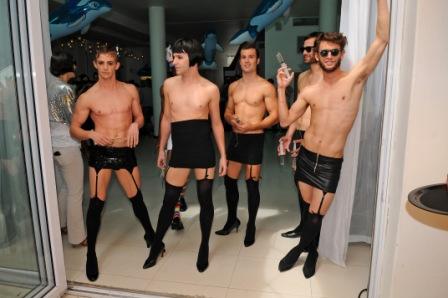
Huge strobes light up the night sky. As I walk toward Young & Rubicam’s roof wetting party (held a couple of weeks ago) it feels a lot more like limbering into a SOHO burlesque club without the comedy or wry intelligence. After passing an albino boa constrictor and fire eater at the entrance, I was met by a handful of nipples.

Bare naked ladies bar slender g-strings covering their modest parts. With erotically painted bodies, they pour cocktails or lean into people to pour shooters into mouths. *A quick chat to the topless tootsies reveal they weren’t told they’d be topless. One says Y&R’s a big agency and you don’t say no to power or people who might book you again.

Behind me a gaggle of dwarves arrive in gypsy satins, ahead jugglers entertain as a number of bands set up for the evening. ‘Liquid chefs’ dazzle with cocktails in one area, but there’s a full bar next to a stage where ladies in lingerie dance.

All that’s missing from this party is a theme tune. Cue Francis Ford Coppola inspired rotor blades chukka-chukking, thrumming and strumming in unison. There’s an eerie silence as dust clouds swirl amid lush palm trees before The Ride of the Valkyries breaks in the background. A dazzling feat of cinematography, the opening sequence of “Apocalypse Now” is forever etched into our collective unconsciousness because of its hypnotic affect and disturbing brilliance in showing the brutality of annihilation. This as Jim Morrison heart achingly moans:

“This is the end
Beautiful friend
This is the end
My only friend, the end

Of our elaborate plans, the end
Of everything that stands, the end
No safety or surprise, the end
Ill never look into your eyes…again”

Traditional advertisers are facing their own ‘apocalypse’, it’s just that many haven’t quite realised it. As the local creative village prepares for the Loeries, our own party at the end of the world, it appears traditional advertisers are blissfully unaware of impending doom. The rotor blades are already being heard on the horizon but the boys are partying up a storm. I say boys because at Y&R the tits and ass were strikingly symbolic of a masculine construction, a relic of a bygone era. A time when advertising was a creative hedonism divorced from the bottom line. When agency bosses and CEOs played golf, chewed cigars and swooned over creative awards.

But there’s blood on the dance floor. The global recession and market melt down has brought an ice age that has frozen credit and shrunk consumer spending. Then there’s the rise and rise social media, the proliferation of mobile and other mediums that directly influence consumer behaviour alongside the unbridled growth and sophistication of search marketing. Each one a clear indicator that “this is the end, beautiful friend”. The traditional model advertising is starting to die, and as it does the tit and ass routine only smacks of denial.

With party plans for the 2009 Loeries nearing completion Herman Manson and Mandy de Waal of MarkLives and MandyLives ponder the apocalypse. We’ll look at the relics, dinosaurs, denial and other death knells of a pending catastrophe. But also focus on the remarkable innovations and mavericks already challenging and changing the advertising world.

Loeries 2009 – Apocolypse Now! Catch all the insight, action, and drama as Cape Town hosts South Africa’s party at the end of the world.

* When questioned, Michelle Cavé, Group PR Director of Young & Rubicam Brands SA advised that the outsourced supplier who provided talent for the party was briefed to ensure the models wore latex nipple caps and were body painted. Says Cavé : “This is the first that I have been made aware of the issue that the shooter girls we hired for our roof-wetting party were not briefed that they were going to work topless. At no point was this brought to my attention even after several queries I made with the girls on the night to ensure that they were happy and comfortable. The brief to our supplier who sourced the girls was to have body painted models serve drinks to our guests, which is what we got.”

Part 1 of our special Loeries coverage. Check back daily for new stories.

Online CPD Courses Psychology Online CPD Courses Marketing analytics software Marketing analytics software for small business Business management software Business accounting software Gearbox repair company Makeup artist