PICA awards evening shows Media24’s dominance

Here is a reminder how powerful a force Media24 is in the South African magazine world. At the 2010 MPASA PICA Awards held late last week in Cape Town, its associate companies, including New Media Publishing and Touchline Media, picked up an incredible 22 awards. Out of 29.

Its closest rival was Cape Media, thanks to the success of Leadership magazine. Media24 took home Magazine of the Year (Consumer), thanks to Sarie, and Magazine of the Year (Custom) with a win by Woolworths Taste from Media24’s New Media Publishing division.

Women’s Health was as near as a sure bet as one can get for wining Launch or Re-launch of the Year (Consumer), with launch editor Kate Wilson taking the titles’ circulation within a hair’s breadth of established Men’s Health – up 35% on Touchline’s internal circulation projections.

Read the full story on BizCommunity

Mercury retrenches third of staff following GCIS move

Media placement house Mercury has had to retrench 10 staff members following a decision by the Government Communication and Information Service (GCIS) to centralise control of Government’s R1.7 billion annual advertising budget (including departmental). The GCIS was a long-standing client of Mercury, which has had considerable success in attracting business from government departments and parastatals over the years.

Sipho James, new business development manager at Mercury, confirmed that while some “key staff members” have been retained, the GCIS team of seven people were unfortunately retrenched, as were two members of the finance department and one receptionist. Mercury CEO Tamoledi Selane claimed a staff compliment of 32 and billings of R300million in a profile published about him in the Financial Mail in August 2010.

James dismissed market speculation that Mercury might be forced to close down. “Like I stated last week in [the Mail & Guardian], we are not closing down, we are going through a structuring process. Yes some staff members have been retrenched, as is the norm in our industry, particularly when you lose an account of the size of GCIS, but the agency is still in operation,” he said.

Read the full story on BizCommunity

Kenny vs. Spenny lands another broadcaster in trouble

The adventures of Canadian comedic duo Kenny and Spenny with a rather unfortunate goat has landed a second South African broadcaster in hot water with the Broadcasting Complaints Commission of South Africa (BCCSA).

Radio station 567 Cape Talk was fined R10 000 by the commission for a segment called “The Week that Wasn’t” on the Redi Direko show where, according to the BCCSA, “a guest presenter (comedian Nick Rabinowitz) in a programme explicitly describes a bestiality scene from a DStv programme called Kenny vs. Spenny. The guest presenter explicitly describes the sexual scene to the listeners and he even adds his own words of encouragement for the goat to take the person on.”

The BCCSA has chosen to interpret the words “scene or scenes” that prohibits the depiction of explicit violent sexual conduct, bestiality, etc. as not limited to visual scenes. According to the BCCSA “a description of bestiality could constitute a contravention of clause 28 (of the Broadcasting code).”

567 Cape Talk had submitted that the show was “a satirical [not a word the BCCSA likes] review of the news stories of the week as seen by a stand-up comedian. 567 Cape Talk’s audience is sophisticated adults who understand satire for what it is.”

The station argued that “a reasonable 567 Cape Talk listener would have understood the broadcast in question as a satirical take of what was topical in that week.”

The BCCSA regularly finds against comedians satirising societal taboos around issues such as sex or religion. It recently found John Vlismas guilty of hate speech after he contravened the BCCSA’s rather subjective view on the “bounds of humour.” In 2002 it fined 5FM R17 500 after the station aired the line “Stupid people have stupid children. If you’re stupid, please don’t have sex! If you insist on having sex then please have sex with animals, preferably animals smarter than you are.”

Read the full story on BizCommunity.

Jock goes to Hollywood

Jock of the Bushveld is leaving for Hollywood, literally, as film director Duncan MacNeillie takes his 3D animated remake of the classic tale to American movie studios in a bid to gain distribution in markets outside South Africa.

MacNeillie was responsible the original film version of Jock, starring Jonathan Rands in 1986. The tale, written by Sir Percy Fitzpatrick and first published in 1907, plays out during the gold rush in the then Eastern Transvaal and follows the adventures of Fitzpatrick as a prospector and transport rider, and his heroic runt Staffordshire terrier named Jock. I remember seeing it as a kid and spending most of the afternoon in tears after Jock gets mistakenly shot and dies at the end of the remarkable tale.

MacNeillie confirms that the animated version will see a happier ending than the original, which should come as a relief to parents, as well as the proprietors of cinemas. The movie will be aimed at the whole family and will play out from the animals’ point of view.

The project started four-and-a-half years ago with actual production lasting three. Budget figures quoted in the media range from US$10 million to R50 million but MacNeillie says the numbers don’t come from him. It was financed by private investors (a story in the Daily Maverick mentions Standard Bank chief executive Jacko Maree and Hollard Insurance founder Miles Japhetand) and a grant from the dti.

Whatever the budget, it is a substantial production (for SA), with around 25 people working on it at Jock Animation, seven being character illustrators.

Release is tentatively scheduled for March 2011 through Ster-Kinekor but the release (and the distribution partner) might be affected by negotiations with international distributors. MacNeillie confirms he will have a clearer picture at the end of December on his return from his US trip

Read the full story on BizCommunity.

Mick & Nick founders join M&C Saatchi Abel Joburg

BizCommunity EXCLUSIVE: The three founders of acclaimed below-the-line agency Mick & Nick, owned by the Lowe Bull Group, have left the agency they helped found to join M&C Saatchi Abel Johannesburg. Nick Liatos and Mick Shepard, along with Mick & Nick’s former MD Michelle de Gouveia, started with M&C Saatchi Abel today, Monday, 1 November 2010. The trio launched Mick & Nick in January 2007 with backing by the Lowe Bull Group. Mick & Nick focused on below-the-line promotions and clients included SAB, Nike, Look & Listen and Ster-Kinekor. Get the full story on Biz.

Satire wasted on BCCSA, Vlismas ruling shows

Right on the heels of a judgement that would potentially complicate South Africa’s television content rating system by adding additional warnings to shows containing strong language (traditionally and recognisably marked with an L), the Broadcasting Complaints Commission of South Africa (BCCSA) has now taken up the mighty task of establishing the “bounds of humour” in a ruling that effectively finds stand-up comedian John Vlismas guilty of hate speech.

Mock sermon

The sketch, broadcast on 16 August 2010, played on East Coast Radio. Vlismas gives a mock sermon in which he jokes that it’s no use killing Hindus because they just come back, thanks to their belief in reincarnation (complainants submitted that Vlismas suggested that, as such bullets, would be wasted on Hindus).

The Tribune Herald, whose journalists listened to a recording of the show, also reports that the “preacher character [created by Vlismas] says that Hindus have ‘lots of gods’ and that ‘they can’t make up their minds’ and then lists the ‘elephant body one, ‘one with eight hands’ and the ‘the monkey one’. After saying that Hindus worship cows, he says, ‘How can you tell a cow, hello God?'”

East Coast Radio pulled Vlismas’ show and issued an apology to listeners. Vlismas can still be heard on Jacaranda 94.2 on Mondays from 9pm to midnight.

Read the full story on BizCommunity.com

When a click doesn’t pay

South African publishers are facing increasing pressure from advertisers to adopt a pricing model based on the clickthrough rate on banner ads, rather than the more traditional CPM (cost per mille or cost per thousand), pricing model, which is based on a fixed price for every 1000 impressions served.
CPC, or cost per click, is a performance-based pricing model, in which the advertiser is charged only for the number of clicks an ad delivers. The model was popularised by search engines such as Google.

Recent research

A recent Research Note by Eyeblaster* cited a survey by Econsultancy and the Rubicom Project, noting that 63% of publishers still price display advertising using CPM, but that CPC has been gaining steady ground over the past five years, with as much as 30% of publishers having already made the switch.

The report, interestingly, suggests that the CPC pricing model could well undermine the viability of online content providers that in turn could affect the pricing of online advertising, which should go up as quality inventory declines.

The Eyeblaster* Research Note argues that the CPC pricing model doesn’t translate effectively beyond search engines. It’s fine to implement a CPC system when you have volumes on the scale Google does (it generates several billion searches a day), but few sites enjoy such volume and, in any case, content sites rely on display advertising (eg banner ads) to monetise their audience. Advertisers link the success of display advertising to clickthroughs, which in turn is reliant on a number of factors outside the control of the media owner, including advertising creative and call to action, which needs to convince users to click on an ad.

“Compensation at the mercy of others”

“When publishers are paid by the click, their compensation is at the mercy of others in the advertising chain who make decisions that affect the success of the campaign,” says the research note authors. “Another concern is whether clicks are the proper metric for discerning the success of a campaign. In many verticals, the actual purchase is made in off-line stores, and therefore the value of the ad is in its retention rather than the click.”

“On the face of it, CPC sounds like a far better scheme for advertisers- publishers only ‘eat what they kill’, and therefore share the risk with the advertiser and marketer,” the Eyeblaster* report continues.

“This research argues that CPC payment schemes are not only impaired because of inequitable allocation of incentive and risk, but also that the spread of CPC may curtail the growth of the display advertising industry. In addition, by linking publishers’ pay with success that they have only partial influence on, CPC may drive some publishers out of business, causing an increase in media prices and as a result driving some advertisers out of the market as well.”

Read the full story on BizCommunity.com

*Please note that Eyeblaster rebranded to MediaMind earlier this year.

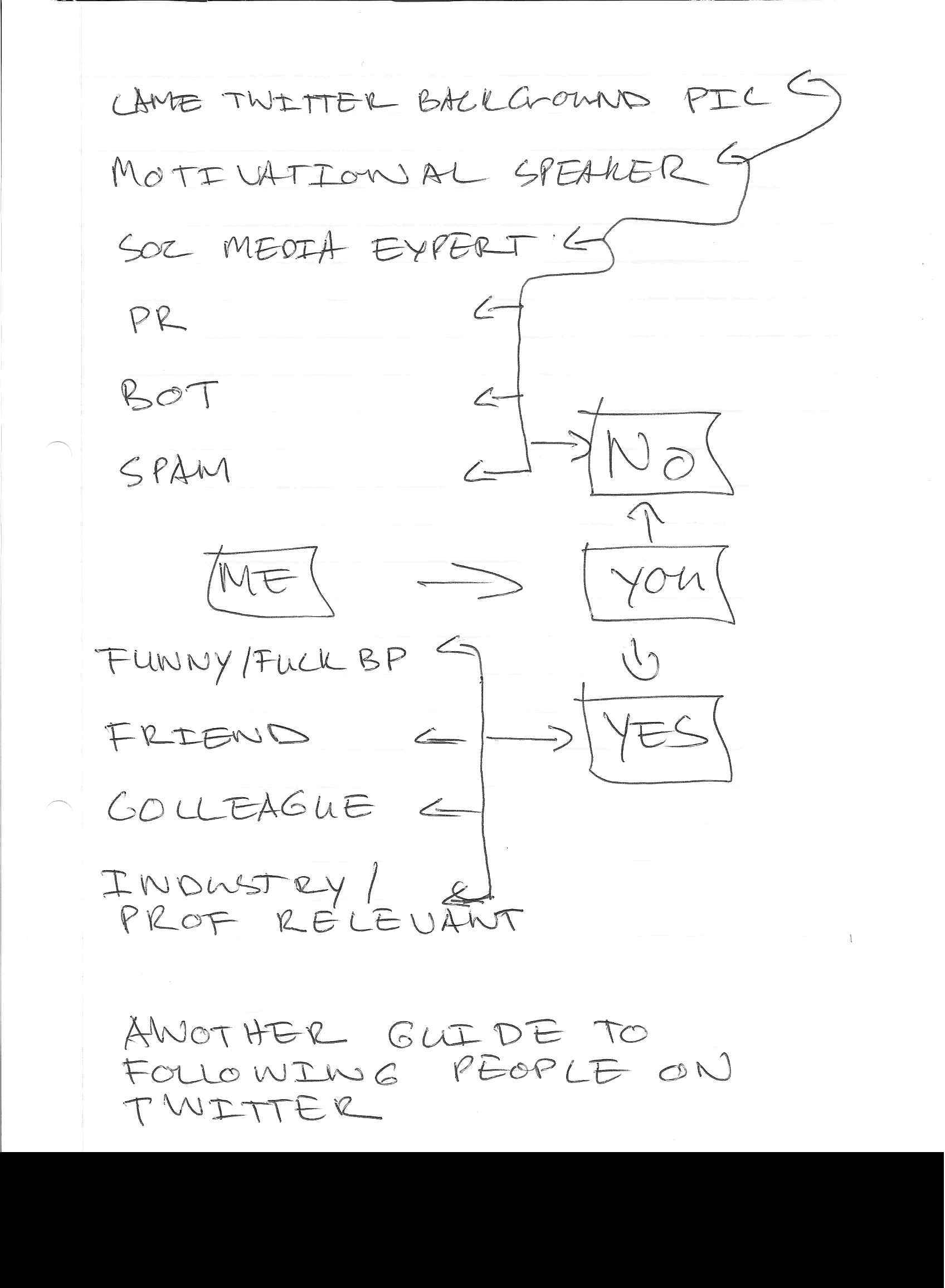
Another Guide to Following People on Twitter

How does one decide who to follow on Twitter? The answer is apparently much more complicated than you would expect. None of that “I don’t like this guy’s face” nonsense. It’s a potentially lengthy process involving multiple steps according to various social media expert types.

‘Social media experts’ and flow charts go together like Google and Verizon or Facebook and privacy-invasion. They just get one another. The web hosts numerous attempts to chart the thought process of you, dear Tweep, in deciding who you will follow.

If only we spent as much time thinking through that decision as flow charts like this one on ReadWriteWeb suggests. Personally I believe the process is a little more chaotic and a little more intuitive.

Generally it takes a couple of seconds for me to decide who I’m prepared to follow on Twitter. You’re in if you are a friend or a colleague. Ditto if you tweet regularly about stuff I’m interested in. I’m not going to hold the absence of a URL or a whacky bio against you. For me content outweighs the Bio any day. That said I’m prepared to admit that you would stand a better chance of being followed if you list your profession upfront as it helps contextualise your Tweets. I don’t care how many Tweeps follow you either, but I’ll be cynical if you follow thousands and only a handful follow you in return.

You’re out if you push spam, if you have a bot uploading all your content, are a motivational speaker or list yourself as a social media expert. A lame background would also do you in.

I don’t follow many brands. I’ll only consider doing so if I’m already engaged with you and if I can see real people manage your account (PR departments don’t count as real people).

Another Guide to Following People on Twitter

5 local Tweeps I followed without a second thought

Pierre de Vos @pierredevos
Blogs on Constitutional Law

Mandy de Waal @mandyldewaal
Investigative Journalist, Blogger

Andrew Brauteseth @brauteseth
Photographer with a great sense of humour

Sipho Hlongwane @comradesipho
Columnist, The Daily Maverick

Arthur Goldstuck @art2gee
Author, Journalist

Refocused 24.com: good news for newspaper brands?

24.com, the largest and one of the most important South African digital media players, earlier this week announced a significant strategic move that will see it restructured and refocused. It will, in effect, move from being standalone to a division integrated with Media24 Newspapers.

It will exit the ecommerce field, with Kalahari.net moving to MIH Internet Africa along with listing business Careers24. 24Games, a mobile and web destination offering free online games, will move to DStv Online.

24.com operates a number of high profile websites, including news24.com, Fin24.com, Food24.com, Gotravel24.com, Health24.com, Sport24.co.za Sport24.co.za, Wheels24.co.za and Women24.com.

The group’s previous CEO, JP Farinha, recently announced he will be joining Korbitec as GM of Property24. His replacement, Geoff Cohen (@geoff_ink), will be titled GM of 24.com.

At this stage the unit’s reporting line to Media24’s management team, of which Farinha was a member, remains unclear. According to Cohen, it remains too early to tell whether 24.com will retain such a direct link to the Media24’s management board or whether it will be represented by Abraham van Zyl, CEO of Media24 Newspapers.

Social network developer Blueworld Communities stands out as a unit not naturally aligned with 24.com’s publishing focus but, according to Cohen, negotiations with other shareholders (the other units that were moved around were wholly owned) as to the unit’s future haven’t yet been concluded.

The full story is up on Bizcom so head on over.

With apologies to Cell C

Cell C CEO Lars Reichelt published a second full page apology this past weekend after the Advertising Standards Authority (ASA) ruled that Cell C must stop using the term “4Gs” in its advertising material. Cell C earlier this year punk’d consumers and commentators with an ad apologising to comedian Trevor Noah for lapses in service in what later turned out to be part of a marketing campaign involving the positioning of Noah as Cell-Cs ‘chief experience officer’. Lars (not the real one this time) seems to be at it again, as I explain on BizCommunity.com, rather cheekily.

Online CPD Courses Psychology Online CPD Courses Marketing analytics software Marketing analytics software for small business Business management software Business accounting software Gearbox repair company Makeup artist