Adnalysis: Millennials not a target market but a generation

by Bogosi Motshegwa (@Thinkerneur) “We are targeting millennials,” said every company and ad agency. But how do you target an entire generation? In doing so, you have already lost the essence of critical nuances that could have made your messaging or branding-building efforts so much richer, textured and layered with substance.

The oh-so infamous millennials. It’s interesting how, irrespective of the category, industry, products and or services, the target segment is always “millennials”. How is it possible, though? Don’t you wonder who or what these millennials are?

Can’t even agree on when they were born

First of all, there isn’t a concise consensus on when millennials were born; different research agencies or organisations have given different time frames for their emergence or existence. According to Tech Target, there are four different time frames in which millennials were born (1977–1994, 1976–1990, 1978–1998 and 1980–2000). Who are these people if we can’t even decide on when they were born? And does it even matter?

It’s is not rocket science that people in each generation tend to think similar or share similar values, as they tend to be influenced and informed by similar external forces of that time, and sometimes it’s a combination of those lingering from the previous generation. For example, Generation X have had their own challenges, and the so-called Millennials may have faced similar challenges but within the mix and context of digital and the internet, thereby resulting in a unique expression. Behavioural patterns may carry similar principles yet vary in nuances.

Millennialism is a mindset

Did you know that Mark Zuckerberg and Julius Malema are millennials? When looking at how millennials are described from a psychographic point-of-view, you start to realise that millennialism may be a state of mind that transcends time. Steve Jobs could easily be a millennial. He was rebellious and he couldn’t really work with anyone; instead of changing jobs like most millennials, he created new companies.

If millennialism is a mindset, I find that corporate South Africa has not fully dug deeper and learned this generation thoroughly. There is so much that is misunderstood about this generation.

American millennials are not the same as South African millennials

You know what they say: context is everything. And this is true for psychographic descriptions of any audience, when doing an archetype or customer profiling. While every company looks to target millennials in South Africa, I am yet to come across a comprehensive research study of millennials in this country. We use global stats with global skew, global percentages and global everything.

We always tend to infer whatever the American studies say. As we know, our context is different. While digital and the internet have made it seem like our experiences are the same, we are different people all together, even if we are born during the same era.

The truth about millennials

Most research studies or findings are generic and fail to provide texture and substance. They speak about millennials from a global point of view, and they fail to contextualise realities of this country.

Frankly, millennials are getting old and are faced with problems of, as their kids say, “adulting”. As a so-called millennial myself, I’m starting to have different and challenging responsibilities that paint a different picture for my reality. Having a baby and trying to raise and support a young family while still supporting my parents and extended family, aka black tax. Trying to establish myself as a reputable professional in the advertising industry, wanting to study further and still have a life in the midst of that?

I doubt that the industry has all of the above as part of ‘who this South African millennial is’. I’m not an American millennial and ,while I can somewhat relate to this global template of what it means to be a millennial, my realities force me to make decisions that are not just unique to me but relevant to my context. On top of that, I’m still trying to figure out how I’m going to secure my son’s future while trying currently to provide a comfortable life. That’s a lot of pressure.

Millennials are under pressure and nobody has really accounted for all the factors that do so. It’s a struggle to provide efficiently for others and myself and save for the future. When will I be able to afford a house?

While we do follow trends and are seen in cool places, we are on our unique paths to defining our individual identities and success (this is actually a dope line to use as part of a strategy).

Implications for brands

The newer and much-fresher generation is the Z Generation. They are young, full of zest and are having a fun ride, because their millennial brothers and sisters are picking up after them. Brands should now focus on this segment.

For brands to resonate or be relevant amongst millennials, they have to take into account the above-mentioned and use it to create meaningful connections. Millennials are not a single target market or segment. You need to dig deeper. You need to break this generation into smaller segments; you need to get personal, get human, and not see us described in global themes.

Get to know us South African millennials. We are people, first and foremost. But who are we?


Bogosi MotshegwaBogosi Motshegwa (@Thinkerneur) truly believes that advertising can really change the world. Every single day he tries to prove this. He shares his thoughts on the industry and sometimes has unconventional views. Bogosi is the co-founder of Melanoid Éclat (for finding black entrepreneurs), a committee member of AMASA, an Advisory Council member and guest speaker at Vega, and also does speaker management at TEDxJohannesburg. He is currently a strategic planner at Net#work BBDO. He contributes the monthly column, “Adnalysis”, which analyses adland from a strategist’s point of view, to MarkLives.com.

Sign up now for the MarkLives email newsletter every Monday and Thursday, now including headlines from the Ramify.biz company newsroom service!

Shelf Life: Ocean Basket gets So Interactive about sushi

Cheryl Hunter (shelflife at marklives.com)’s weekly pick of all things new — product, packaging, design, insight, food, décor and more!

  • So Interactive demonstrates the Art of Fusion
  • 1Life talks about male cancer with Comoonicate and Orange Ink
  • Cruiseabout opens in Hyde Park

Fusing food and fun

The casual dining space in South Africa is cluttered with mediocre TVCs and badly executed food photography so, when So Interactive was given a brief by client Ocean Basket to make a new sushi offering really shine — and to use innovative media to do so — it decided to pull out all the stops.

According to Letitia Lerm, So Interactive creative director, while sushi is already a popular global form of delicate food art, Mediterrasian sushi is unique as it combines Asian and Mediterranean flavours to meet a variety of exotic palates: “It was important for us to give the viewer an experience beyond the copy and photography; to represent the sushi as a feast of flavours, enticing the heart and mouth to experience an all-round adventure.”

The idea was shaped into #TheArtOfFusion and the creative was born from there, using Facebook’s Canvas ad format as the main digital element to launch the campaign. “Facebook Canvas ads are new territory for local food brands. This campaign offered social media audiences a new and authentic visual experience, amplifying the impact of the beautiful imagery and video content,” says Lerm.

The art direction of the photography is intended to capture the essence of food art at its finest and to push the boundaries beyond the scope of previous Ocean Basket campaigns. This has led the way into unchartered territory, resulting in a positive cross-platform rollout, which includes carousel advertising and the full spectrum of social media interfaces. Accompanied by clever descriptors and fun emoticon explanations for some of the original Japanese sushi names, the campaign has been transferred to the big screen, flighting in cinemas around South Africa.

Full disclosure: Cheryl Hunter does PR for So Interactive.

sointeractive.co.zaFacebookTwitterRamify
oceanbasket.comFacebookTwitter


1Life’s Movember campaign

Financial services provider, 1Life, has launched a Movember campaign which encourages male cancer survivors to share their journeys; the aim is to remove the stigma attached to the disease and create a platform for other men to better understand it.

1Life Movember fire fighter cancer survivorSays Laurence Hillman, 1Life CEO, “There is a collective understanding that South African men who have contracted such cancers, testicular cancer in particular, prefer not to talk about it, yet through sharing one’s knowledge, experience and journey to recovery — coming together as males — support networks could be formed, encouraging others to get tested, look out for signs, and to live healthier lifestyles.”

The 1Life campaign, created in-house at 1Life and supported by digital and PR agencies Comoonicate and Orange Ink, sought out three male cancer survivors who have openly shared their journeys and experiences with the brand’s social media and blog followers, encouraging conversation about the topic and increasing awareness. Digital marketer Cameron Green, firefighter Timothy Hart and entrepreneur David Lucas talk about getting tested, survival rates, symptoms and seeking help.

“These men are helping to raise awareness, helping other men to get diagnosed and treated early. 1Life’s ethos is to change lives and we hope that, through this campaign, we are able to make a difference to the lives of South African men.”

1life.co.za/blog/movember-cancer-survivorsFacebookTwitter
comoonicate.co.zaFacebookTwitter


Cruising into Hyde Park

Specialist cruise retailer Cruiseabout, a member of the Flight Centre Travel Group, has launched its 12th store in Hyde Park Corner, Johannesburg, bringing local shoppers dream cruises and expert advice.

Antoinette Turner, Cruiseabout (SA) brand leader and emerging markets, says, “As a growing brand we have expanded our national footprint. We are very selective when searching for locations for our brand and opening a store in Hyde Park matched the customer segmentation with the product we provide. Hyde Park is destined to become one of our flagship stores in the near future. This is a testament to the popularity of cruise holidays amongst South African travellers.”

According to Turner, consultants are able to offer advice on all aspects of cruising, from finding a cruise liner that suits your specific needs to the highlights of each region, or what activities are featured on board each ship: “We have access to all of the latest cruise deals, discounts and savings in the travel industry, including flights and transfers which guarantee fantastic package options.”

cruiseabout.co.zaFacebookTwitter


Cheryl HunterShelf Life is MarkLives.com’s weekly column covering all things new. Notify us of yours at shelflife at marklives dot com. Want to sponsor Shelf Life? Contact us here.

Cheryl Hunter (@cherylhunter) has written for the South African media, marketing and advertising industries for more than 15 years. A former editor of M&M in Independent Newspapers and contributor to Bizcommunity, AdFocus, AdReview and the Ad Annual, she has also produced for various television networks and currently consults on communication strategy and media liaison.

Sign up now for the MarkLives email newsletter every Monday and Thursday, now including headlines from the Ramify.biz company newsroom service!

Brands & Branding: Mr Price, fashion blogging & branded equity

by Nivenia Davis & Franci Cronje. A dynamic shift has taken place in the advertising and marketing landscape. With the growing importance of the internet, marketing communication practices have come to a crossroads — both in the way media is consumed, and how it is created. Brands are now pursuing solutions that go beyond traditional mass communication practices in order to differentiate themselves in increasingly competitive markets. One that has gained considerable attention of late is content marketing, as evidenced by the 69% increase in use of the term over the past four years (Google Trends, 2016).

The internet has also changed the consumer’s buyer journey, as is seen in the fashion industry. These days, consumers spontaneously and powerfully connect with brands instantly. They are also faced with an overload of marketing stimuli. They have become savvy, rejecting the barrage of traditional mass communication messages. Despite this overload, however, they remain hungry for information. The good news is that fashion brands may build relationships with consumers by being present within the consumer journey and guiding them through the clutter with relevant content.

Content marketing and brand equity defined

Contrary to traditional push-strategy advertising, content marketing uses a pull-strategy approach by creating and distributing relevant and consistent content to attract and retain audiences to drive them to action (Content Marketing Institute, 2016). Content messages aid in brand recognition, trust, authority, credibility and authenticity.

Kotler & Keller’s (2009) definition of brand equity, as added value bestowed on products and services, is also reflected in the way consumers think, feel and act with respect to the brand, as well as its prices, market share and profitability. In this article, we consider some vital components to customer-based brand equity. Brand equity arises from differences in consumers’ responses, and consumers reflect these differences in their perceptions, preferences and behaviour related to all aspects of the marketing of a brand.

These components may be found within any of the five stages of Kotler & Keller’s BrandZ brand equity model. The interdependent five stages (2009), namely Presence, Relevance, Performance, Advantage and leading to the final stage of Bonding, illustrates a brand’s marketing activities path towards building equity. Using content marketing may support brand objectives such as awareness, customer attraction and retention, and generating leads, as well as building relationships and loyalty. For successfully building brand equity with content marketing, however, one needs to show brand benefits with informative and entertaining content.

Content marketing through the use of fashion bloggers

The fashion world is a notoriously fast-paced industry. Due to globalisation and the rise of the internet, new trends launch faster than ever before. Within this industry, fashion bloggers have become essential. They are indirect advertisers who circulate trends through the internet, social networks and blogs, triggering purchase intention while relying heavily upon immediate visual stimulation.

Content marketing in fashion brand practices is obviously important, but studies show that brands are facing various adoption challenges. A survey by Curata (2011) found that 73.6% of marketers report their biggest challenge being to produce original content. As a solution, 48% of these marketers are turning to content curation to publish on their blogs, websites and social media channels. Curated content is the process of tailoring existing content from a variety of other sources to fit their own audience. As such, bloggers and social feeds become really important in this sphere. It enables brands to constantly communicate with their audience, and it boosts visibility and reach.

How content marketing can be used to facilitate brand equity

South African fashion brand, Mr Price, is an old hand at curated content marketing. In 2015, the brand approached local bloggers to create content for its new denim range. The content was then posted on the Mr Price Facebook page with the hashtag #MRPDenim. As such, the brand did not create new content but rather shared existing content created by the bloggers.

The researcher wanted to identify the sentiment around the content while also looking at the role the blogger content played in building brand equity. This was done through analysing differential responses by consumers reflected in perceptions, preferences, and behaviour related to the blogger content.

This gave an indication of consumer emotions and the tone of conversations. In turn, this became useful to track positive or negative impact on the brand. In Mr Price’s case, the sentiment was positive overall and it had successfully moved the audience through the lower stages of the BrandZ model. Posts from consumers querying the price, size and store availability of products showcased attested to the positive reception. What is more, words such as “like” indicated a moderate effect towards the product while words of “love” and “in-love” showed an intense desire for the product. The content not only attracted an audience but there was also real engagement taking place between the consumer and the brand.

The activities of the bloggers also created secondary brand associations, brand and product familiarity, as well as product and category awareness, which form part of the foundation upon which brand equity is built. The majority of consumers was also found to be within the second phase of the model, namely relevance, showing an opportunity for the strengthening of relationships through an always-on content strategy that will continue to engage this audience throughout their lifetime.

An always-on communication strategy

Within an increasingly competitive market, it is crucial that a fashion brand maintains and builds its brand equity. Therefore, a brand needs to bond with its consumers by moving them through each phase of the BrandZ model. The resultant loyalty will enable the brand to maintain its market share despite competition from new and established competitors. By facilitating the right knowledge via bloggers, successful brands with high equity will therefore generate positive consumer predispositions based on the products and marketing messages which they communicate, making their brands more meaningful, differentiated and salient than their competitors.

Content marketing should, as such, not be viewed as a once-off tactic but should rather form part of a fashion brand’s always-on communication strategy. In doing this, the content published — whether owned or curated — will continue to engage consumers throughout their life cycle and keep the brand top of mind, creating a passionate subscriber to the brand as opposed to creating just a customer.

References

See also


Brands & Branding 2017Nivenia Davis is the retail social media lead at Promise, a through-the-line agency. She recently graduated with honours in brand communication and leadership from Vega School. Franci Cronje is currently the national manager of blended learning at Vega School and anchors the honours research projects there. Research for this article was conducted in the authors’ capacity as honours in brand leadership students at Vega School, a brand of The Independent Institute of Education.

The article first appeared in the 2017 edition of Brands & Branding in South Africa, an annual review from Affinity Publishing of all aspects of brand marketing — consisting of case-studies, profiles, articles and research — which may also be accessed at the brand-new Brands.MarkLives.com. Order your copy of the 2017 edition now!

Sign up now for the MarkLives email newsletter every Monday and Thursday, now including headlines from the Ramify.biz company newsroom service!

Duke — where John Wayne meets the Naidoos

Courage is being scared to death but saddling up anywayJohn Wayne.

by Herman Manson (@marklives) When Wayne Naidoo stepped from corporate back into adland to launch his venture, Duke, back in early 2015, he had no idea his business would lose its founding client four months after his wife Nino quit as head of traffic at Woolworths’ inhouse agency to join him at the fledgling ad agency. Naidoo was making his first hires; things were looking up and he was confident about Duke’s prospects. Then came that call that kicked him in the teeth and nearly killed off his startup.

Duke CIChanged direction

Naidoo — named after the actor John Wayne, whose nickname was Duke (his father was a huge fan) — had been chief marketing officer and then business development executive of financial services company, AFB. When he left, the company contracted its marketing efforts to Duke. But it shortly changed direction, and its marketing requirements fell away — as in, potentially, Naidoo’s house and car and private school for the kids.

Faced with disaster, he started calling up his network. He had run agency Lowe + Partners South Africa for many years; he’d bet he had enough contacts and goodwill to tie them over. But it was not the case — he suddenly found himself very much alone.

Everybody has a plan until they get punched in the mouth, he jokes. It’s why we act. “When you start a new agency, all the years of experience, awards and titles lose their significance and suddenly cash flow becomes of the utmost importance,” he says. “Also, all that industry experience doesn’t mean that business comes knocking on your door; you have to start from scratch, and get out and find the work. You don’t have the security or guaranteed salary of a corporate. Now it’s 100% up to you to make it work and that involves a huge amount of slog work — it’s certainly not glamorous and very often not fun at all.”

Back to the drawing board

Going back to the drawing board, the husband and wife team, who had also been joined by Wayne’s brother Michael shortly before the business went south (he also stuck it out with the rest of the family team), figured that, if they could save their business, they could save other businesses. And so was born the agency’s secret weapon: its Brains Trust. There are some problems agency people can’t solve. You need business people. With experience in that particular market or niche. To give perspective, insight, advice on what has been tried, what’s worked, and what’s failed (and why).

Here Naidoo’s extensive network finally came into play. A former chair of YPO (Young Presidents Organisation), he had access to a wealth of business contacts and experience in virtually any field of business. He tapped this resource to bring relevant senior industry experience to his clients, giving them a de facto war room to take on the competition.

As the business once again started to grow, Naidoo brought on board Steve Miller to assist on strategy. The latter owns the acclaimed Garagista craft brewery and has a wealth of marketing experience, having spent seven years with Unilever and 10 years as Ogilvy & Mather’s strategic planning director. He has also been group marketing director of National Brands, VP group marketing at Tiger Brands and global innovations director of SABMiller plc in London.

Brains Trust

“The success of the Brains Trust is in part because it’s a non-threatening environment that doesn’t form part of business as usual, where people feel comfortable sharing ideas, no matter how outlandish or off-the-wall because they have nothing to lose,” says Naidoo. “Then, the fact that we employ the services of senior industry executives with extensive experience and unrivalled entrepreneurial thought means that we can tap into a fresh perspective, but one that is also completely relevant. The Brains Trust means that the solutions we provide our clients are credible and backed by tremendous expertise.

“The Brains Trust has also forced us as an agency to walk the talk internally. We employ the same way of thinking inside the agency as we would for our clients. This way of doing things makes you realise that you don’t know everything and you need to be willing to try a new way of thinking and doing things.”

Mike Beukes, who’d had stints at Saatchi & Saatchi, Fallon, ENGINE, IDEO, MetropolitanRepublic, LBi and JWT London, joined as ECD. Finally, Joanne von Malitz came on board as business unit director, joining from The Jupiter Drawing Room (Cape Town) and with past experience at TBWA London, JWT Cape Town and Saatchi & Saatchi Cape Town. Today, the client list includes Truworths, AB InBev, RCS, Cheapflights, YPO, The Bureaux, Debt Busters, The Heart and Stroke Foundation, the SAB Foundation, Garagista (obviously) and Moonlighting Films.

Three pillars

Duke builds its business solutions on three pillars:

  1. understand (current realities)
  2. envision (possibilities) and
  3. align (plans and executions).

Understand encompasses objectives, a research review, a global scan and market segmentation. Envisage takes in brand positioning, value proposition, consumer promise, the brand name, brand architecture, positioning and research. Finally, align encompasses internal launch strategy, consumer marketing strategy, agency briefs and additional research.

According to Naidoo, the agency aims to become a sizeable yet sustainable agency that creates relevant, impactful and effective solutions for its clients.

Case studies

supplied by Duke

Truworths

Brief

To create a campaign which celebrates Truworths’ 100th birthday.

Insight

Fashion is not about what came before, but rather what’s still to come.

The idea

We are 100 | 001

What Duke did

We have created a campaign that literally turns the 100 on its head and makes a statement about this being the first year of its next 100 years.The purpose is to create a framework with which the Truworths internal agency can work and easily develop work within the campaign, while staying true to the year’s big idea.

Results

Campaign ongoing.


Garagista

BrieGaragista Bat Pissf

To create notoriety for Bat Piss, Garagista’s light American lager.

Insight

Talking rubbish, having a laugh and oneupmanship dominates our audience’s drinking occasions.

The idea

The dark, light beer.

What Duke did

Duke turned the campaign into the cult game of Would You Rather. Each execution sees drinking Bat Piss being (bizarrely) the option you’d far prefer, even if the other option started off well.

The agency only had R8 000 media budget, so it opted to make as much noise as it could in a single day and used it all in just 24 hours, with a giant social media game of Would You Rather with anyone who would interact and play. This ranged from a group of loyal Bat Piss fans all the way up to the likes to Ozzy Osbourne and Paige Nick.

Results

In 24 hours, 112 000 impressions were garnered on social channels, even though following across Facebook and Twitter was only a mere 3 000. Following the campaign, Bat Piss store listings increased by 12.5%, which included some of South Africa’s highest profile accounts — a significant achievement for a small craft brewery. For a mere R50k total budget, 125% ROI was created with a campaign which only ran for a single day.


DebtBusters

Brief

We’re in a time when debt is increasingly crippling the lives of South Africans. Our job was to make them aware of a way out and, in doing so, establish DebtBusters as the authority on debt consolidation.

Insight

People living with debt feel like they’re living with an unstoppable, invisible disease, which marks them in ways others can’t see.

The idea

Don’t let debt leave its mark.

What Duke did

The agency created a TV, print and social advertising campaign, aimed at generating awareness in a hard-hitting way to spur people into action. It comes to life through a financial statement mutating across the main character’s body.

Results

The campaign showed a marked increase in success for DebtBusters, with a year-on-year 57% increase in conversions over the same period. Client has kept ROI figures confidential, but has confirmed that leads increased by 33% year-on-year over the same period.A phenomenal success for Duke was that the print started generating calls before it had even run. The agency eventually tracked the calls back to the magazine’s printers.


Herman Manson 2017Herman Manson (@marklives) is the founder and editor of MarkLives.com.

Sign up now for the MarkLives email newsletter every Monday and Thursday, now including headlines from the Ramify.biz company newsroom service!

Agency Life: The black elephant in the room — part 3

by TJ Njozela (@tj_njozela) In the second column in this trilogy on transformation in the ad industry, I addressed how the white peeps contribute to its stumbling along. We’ve still got a long way to go but at least you’ve got a starting point. My people, I’m just going to go straight into it. Sorry, not sorry.

F&$k BLAxellence

Yeah, I said it. And, no, it’s not coconut tendencies. But before you run to Black Twitter to have my black status revoked, let me explain.

Say you want to go out for dinner. It’s pay day, and to give meaning to the end of a broke month, you want something nice. Something foreign. Something Italian. You live in the boujee suburb of Bryanston, Johannesburg, and you have a choice between an Italian-owned restaurant whose owner is a sucker for grappa, beautiful women and sports cars, or a black-owned restaurant whose owner is also a sucker for grappa, beautiful women, and sports cars.

Essentially, you’ve got a choice between going to an Italian restaurant or an Italian Blackstaurant. But, even though the food at the Blackstaurant is exceptionally better, there’s just something about the term “Blackstaurant” that makes you slightly uncomfortable, and it doesn’t help that I keep mentioning the word “Blackstaurant”.

It’s the same thing with BLAxellence. If one restaurant is excellent and the other BLAxellent, the upper case “BLA” doesn’t make it any more comfortable.

Fundamentally, it’s great to celebrate black people who are achieving success or making a difference in their communities, cities, or the world. But let’s just celebrate their excellence in a way that doesn’t make it sort of cheapen what they’ve done.

Ringa boss

This next thing is probably one of the most difficult things for anyone to do. But, if you don’t, how will anything change?

It’s like, you know, that thing with that guy the other time. Already you’re thinking what thing, what guy, what time?! That’s because I’m hinting instead of just saying it.

Now imagine if I didn’t even hint, and then got mad that you don’t know what I’m talking about. It would be unfair. But that’s what most people do every day. They don’t say anything, they become disgruntled and blame their boss for their unhappiness.

Stop it. Just say something.

If you’re unhappy about how much you get paid, don’t sit and hope that the advertising gods will miraculously whisper sweet somethings into your boss’ ear, and she’ll give you a raise out of nowhere. Or, if you just moan in the corridors that you don’t get any nice briefs, they’ll magically fall into your lap.

You’ve got to say something, and not by gossiping or complaining; make a case for yourself like the responsible adult you sort of are. Give valid reasons for why you should get a raise by stating the value you’ve been adding to the business. Ask to be given opportunities to work on stuff that will help you to grow, even if you must work with other people on it.

In the end, no one knows what you want unless you tell them. It’s not easy, I know, but for those who don’t know what “ringa” means, you don’t learn to speak for yourself, you’ll always be in the shadow of those who can. Ok, I’m done now.

Eish, darkies

Ok, I’m not done. Yet. Whether it’s the guy who always rocks up at work late smelling like eau de groovas, the girl who tries to use big words but then English shows her flames, or the guy who ravages chicken bones at a department lunch, we all generally have the same reaction: “Eish, darkies.”

I know, it’s fun to say these things, and we all laugh together at the ‘embarrassing’ things we do but, at the same time, it’s propagating the stereotype that we’re all the same.

And we’re not.

The guy from ekasi who’s fluent in multiple languages is very different to the guy in the ’burbs whose parents bought him his first car, who is very different to the girl who only buys Louis bags and red bottoms. And those are just three kinds of blacks.

In reality, there are more kinds of black people than there are shades of grey, but when they say or do things like I’ve described, everyone who isn’t black thinks we’re all the same. That’s why we have ads with dabbing gogos and desert dances.

And in the age of #BlackInsightsMatter, here’s the best insight into black people: we are not all the same.

~~~

Of course, transformation is a subject that’s so complex and so important that three articles from some creative guy won’t change things overnight. It’s going to take time to get it right. It’s not anyone’s fault (except maybe the apartheid government), but it’s everyone’s responsibility to make it happen.

The key things are that we need to work on changing our personal perceptions and biases, and then work together to create not just an industry but a nation who treats people fairly and equally.

It’s not an impossible task. With understanding, patience, and being aware of our role in shaping the narrative, it’ll be a lot easier to deal with the black elephant in the room.

See also


TJ NjozelaTJ Njozela (@tj_njozela) is a creative group head at Net#work BBDO. With several years of experience in the advertising industry, he’s more than a writer; he is also a reader, a thinker, and an avid liker of things. He once walked from Joburg to Cape Town in 30 days to raise funds to buy wheelchairs for people in need. #30Days30Wheelchairs. TJ contributes the regular “Agency Life” column, in which he gives career advice for working within the advertising industry, to MarkLives.

Sign up now for the MarkLives email newsletter every Monday and Thursday, now including headlines from the Ramify.biz company newsroom service!

Africa’s 2017 Epica Awards winners

by MarkLives (@marklives) The Epica Awards has announced its winning entries for 2017. FP7/CAI (Egypt) has scooped Gold for Coca-Cola, as has Advantage Y&R (Namibia) for Greenpeace Africa and Noah’s Ark Communications (Nigeria) for Airtel. In Kenya, Scanad has won Silver for MASCULAN, as well as a Bronze for KWS. Net#work BBDO (South Africa) has taken a Bronze for SCA.

Egypt

“The Line Up Song”

Award: Gold
Entrant: FP7/CAI
Category: Humour in Advertising
Advertiser: Coca-Cola


Kenya

“Long lasting pleasure”

Long lasting pleasure

Award: Silver
Entrant: Scanad
Category: Illustration
Advertiser: MASCULAN


“Spot the poacher”

Spot the poacher

Award: Bronze – Print
Entrant: Scanad
Category: Corporate Image
Advertiser: KWS


Namibia

African Trash Masks – Grey

African Trash Masks – Grey

Award: Gold – Print
Entrant: Advantage Y&R
Category: Public Interest – Environment
Advertiser: Greenpeace Africa


Nigeria

“Lost”

Award: Gold – Film
Entrant: Noah’s Ark Communications Limited
Category: Communication & Public Services
Advertiser: Airtel


South Africa

“Vagina Varsity”

Award: Bronze
Entrant: Net#work BBDO
Category: Online Campaigns – Health, Beauty & Fashion
Advertiser: SCA

See also

Sign up now for the MarkLives email newsletter every Monday and Thursday, now including headlines from the Ramify.biz company newsroom service!

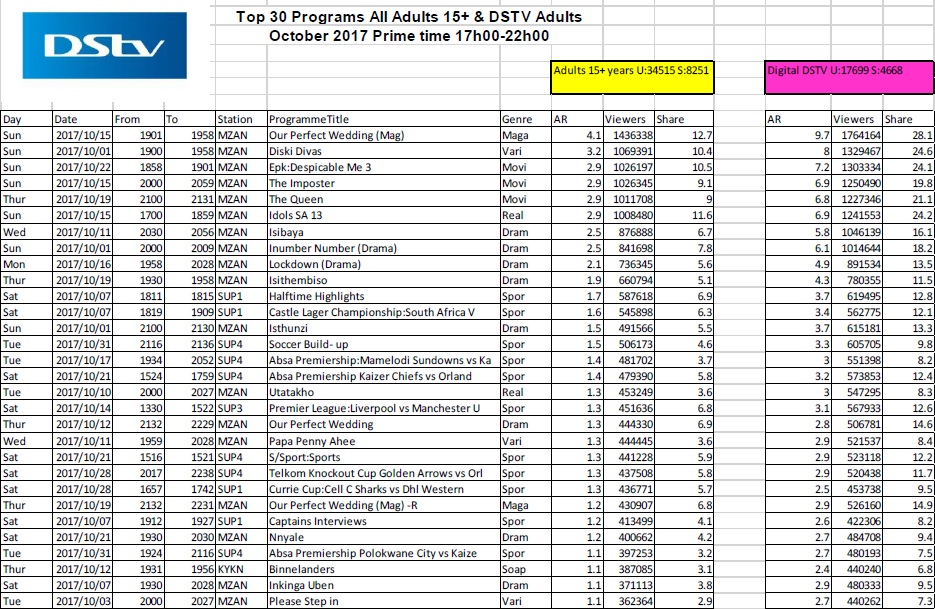
SA TV Ratings: DStv — primetime top 30 for Oct 2017

by MarkLives (@marklives) The hottest primetime television shows on DStv in South Africa revealed: TV ratings for October 2017.

In 2016, the Broadcast Research Council of South Africa (BRCSA) changed its policy about giving away TAMS and now only monthly reports, highlighting the top 20 or 30 primetime shows on several popular channels, are available.

DStv October 2017

BRCSA TV Ratings October 2017 primetime DStv

Source: BRCSA October 2017

Broadcast Research Council of South Africa


The Broadcast Research Council of South Africa (the BRC) is a non-profit, industry body that was incorporated in 2015 to cater to the audience research needs of the radio and television industry in South Africa.

Sign up now for the MarkLives email newsletter every Monday and Thursday, now including headlines from the Ramify.biz company newsroom service!

Cover Stories: Thoughtfulness in design (17 Nov 2017)

by Shane de Lange (@shanenilfunct) Let’s delve into great media design from South Africa and around the world:

  • Local/print: Bat Butt continues its underground offbeat mission in support of local talent with an impactful, prolific combo.
  • Iconic: Communication Arts is a much-needed publication that is incredibly relevant today
  • Online: Design Matters advocates wholeness and thoughtfulness in design, promoting deign inclusivity.
  • International/print: Double Dagger proves that traditional print is still relevant, and that a respect for craft in design is of paramount importance.
  • International/print: The Economist illustrates America’s future as a world economic power.
  • Local/print: The Mission merges the two seemingly opposing worlds of fishing and art.

Find a cover we should know about? Tweet us at @Marklives and @shanenilfunct.
Pinterest icon Want to view all the covers at a glance? See our Pinterest board!


Print

The Mission (South Africa), September/October 2017

The Mission (South Africa), September/October 2017

One would not ordinarily connect a niche sport such as fly fishing with contemporary South African art and illustration. But that is exactly what The Mission, a South African magazine about the “cult of fly fishing”, does in its fifth issue. Following the trend set by its second issue, the September/October 2017 cover for this somewhat-eccentric publication showcases the work of established South African artist, Conrad Botes. Known for his expressive, gestural, and painterly style of illustration, Botes was first introduced into the popular cultural consciousness in the early ’90s, thanks to his contributions to the prolific and subversive publication, Bitterkommix, alongside his regular collaborator and partner in crime, Anton Kannemeyer. It’s refreshing to see a publication of this kind make covers like this, which could so easily fall into the monotone space that many trade magazines tend to fall into, prevented from speaking, a conservative tone of voice. We need more efforts like this, where various facets of society, from sport and science to art begin to creatively meld into interesting hybrids, constructing discourses on multiple fronts. Culture creation in the making.


The Economist (US), 11-17 November 2017

The Economist, 17 November 2017 - Donald Trump - and TIME, 13 and 30 November 2017 - Emmanuel Macron

A rather odd-looking bald eagle decorates the cover for the latest issue of The Economist. Once heavily endangered and on the verge of extinction — a bird of prey, and an apex predator — it’s not difficult to see why this creature is seen as an icon of Americana, and how it could be used as an analogy for America itself. The cover takes advantage of this, taking a satirical approach and depicting this majestic avian critter with a charming hairstyle — an ambiguous metaphor about president Donald Trump and his America — accompanied by the headline: “Endangered — America’s future as a global power.” One may extrapolate the rest of the story from there and, if the covers to the last two issues of Time magazine  — one implying China as America’s economic successor, the other suggesting France as a key player in Europe — are anything to go by, America is likely see itself on display in the museum of past world superpowers.


Bat Butt (South Africa), issues 6 & 7 (released simultaneously), November 2017

Batt Butt South Africa, issues 6 and 7 and in combo, November 2017

Keeping true to its offbeat and lowbrow roots, Bat Butt returns with a double-issue combo pack. Released together in an extremely limited print run, issues #6 and #7 showcase cover artwork by Shaun Hill, the editor of the zine and an established South African illustrator. With its low-budget, DIY, and punk-zine inspired aesthetic, contributors to this double-pack include some of South Africa’s most prominent illustrators, including: Simon Berndt (One Horse Town), Nina Torr, Hanno van Zyl, Maaike Bakker, Ello Xray Eyes, and Daniel Ting Chong, alongside some strong emerging talents such as Amber Smith and Olivié Keck. These zines tend sell out quickly; don’t be the only one who isn’t in the know.


Double Dagger (UK), Issue 2, Autumn 2017

Double Dagger, Issue 2, Autumn 2017

In an age when creativity is increasingly becoming dependent on technology and digital tools to do all the thinking, where artistry and craft are undertaken though staring at a screen, it is heartwarming to see that real, analogue processes are still encouraged and used in a few small corners of the world. Too many designers today depend on their virtual tools to find design solutions, allowing the software and machinery to dominate the message. The result? Cloned and derivative work. Nothing can compare to the human effort of putting pen to paper and making things by hand first, using one’s own brain power and creative acumen without resorting to a scroll of the mouse for design inspiration. Machines simply cannot produce the passion, skill and love that needs to go into this kind of design and the methods of production that make meaningful work.

Double Dagger is one such corner nurturing true creativity. It is an annual journal, printed using traditional letterpress printing processes, accompanied by wood and lead type; all processes that are near impossible to emulate through digital processes. Much like vinyl records, letterpress has seen a revival in recent times, purely because it stimulates all the senses with qualities that become more of an experience than a simple form of communication or entertainment. Commercial printing simply can’t compare.

The current issue, #2, is truly international, featuring handcrafted work from eight presses, including Popolo Press (Montreal) and Virgin Wood Type (New York), and artists such as Stanley Donwood (known for his album covers for Radiohead and Thom Yorke). Published in the UK, Double Dagger advocates tried-and-tested tools that hail all the way back to Gutenberg in order to generate greater depth in design today, reminding us how printing changed the world, and can continue to do so.


Online

Design Matters (US), November 2017

Design Matters, 14 November 2017

Although not technically a magazine, Design Matters is not exactly an ordinary podcast either; it’s one of the world’s first online publications to focus on the subject of design via a web-based media channel across a variety of creative fields. Started in 2005 by Debbie Millman (also a co-founder and chair of the world’s first Masters in Branding Program at the School of Visual Arts in New York, where the show is produced), Design Matters is a favorite amongst many designers and other creatives. The site is incredibly well-designed, with textbook graphic design, UI and UX elements and including great features such as the ability to filter by discipline, from poets and typographers to directors.

The site grants access to an archive of nearly 300 podcasts, including talks with cultural icons such as Massimo Vignelli, Alain de Botton, Milton Glaser, Steven Heller, Louise Fili, and Tobias Frere-Jones; the list of simply goes on and on. Design Matters is published by Design Observer, which is edited by its own list of legendary figures, including Rick Poynor (founder and first editor of Eye magazine), Michael Bierut (partner at Pentagram), Jessica Helfand and William Drenttel (of Winterhouse Studios). Any self-respecting creative person out there who has not listened to this show should remedy the situation immediately.


Iconic

Communication Arts (US), various, 1959–present

Computer Arts, Volume 1, Issue 1 and Communications Arts, November/December 2017

Visual communication is an often-misunderstood term, and it is thanks to historically significant publications such as Communication Arts (CA) that this important creative field is given the prominence that it deserves. CA has been an authoritative source of information about graphic design and art direction, advertising and branding, illustration, typography and photography since 1959 (recently including new disciplines such as interactive design). All these disciplines form part of the rubric of visual communication.

Founded by Richard Coyne and Robert Blanchard, who both still currently advise on the publication, CA is published six times per year, using the format of juried annuals which cover the various disciplines that comprise the entire gamut of visual communication. The magazine also hosts six creative competitions per year based upon the focus of each annual. Complimented by its website, CA magazine is a world leader in the field of visual communication, not to mention the biggest publication of its kind globally. Each discipline acts as the theme for each annual, with content that includes detailed profiles and insightful columns about and from prominent figures from various professions within the visual communication field. A much-needed publication that is incredibly relevant today, especially given that many within the creative industries are still shockingly unaware of what visual communication is.


Shane de LangeShane de Lange (@shanenilfunct) is a designer, writer, and educator currently based in Cape Town, South Africa, working in the fields of communication design and digital media. He works from Gilgamesh, a small design studio, and is a senior lecturer in graphic design at Vega School in Cape Town. Connect on Pinterest and Instagram.

Cover Stories, formerly MagLove, is a regular slot deconstructing media cover design, both past and present.

Sign up now for the MarkLives email newsletter every Monday and Thursday, now including headlines from the Ramify.biz company newsroom service!
Being ‘better for’ consumers vs ‘better than’ competitors

by Ntombizamasala Hlophe (@askYellowwood) As a marketing fraternity, we have for some time defined competitive advantage as a business, product or service that better fulfills a consumer need when compared to competitors. Our innovation pipelines are filled with concepts that we believe will grow organically and not cannibalise current volume. Positively, this notion forms part of a commercial necessity. However, the fundamental challenge is to appreciate, firstly, what will drive a sustainable advantage and, secondly, what the distinguishing factors are that deliver on this advantage.

Fundamental challenge

Generating business growth in a ‘post-recession’ era has been marked with the dilemma of creating more value from fewer resources. Businesses have to respond not only to a tough economy but also to an increasingly cautious and sceptical consumer. Indeed, it has become imperative for business leaders to identify and lead with a distinctive competitive edge in order to deliver sustainable commercial results.

In The Age of You[1] by Stein Arne Nistad, he states that we all need to break away from established rules about communication, relationships and the way in which we do business. Increasingly, in this age “we take control of our personal and commercial relationships and decide who we want to listen to, and with whom we wish to engage.” To test this theory, ask yourself when last you physically went to a bank to transact.

Consumers are looking for brands that are essentially ‘better for’ them and their environment, and not brands that are merely ‘better than’ the competitors.

Key behaviours

Here are some key behaviours that form part of this consumer-defined environment and play a role in the argument of whether brands should lead with a competitive advantage or a consumer advantage.

Beneficial intelligence

One of the most apparent is beneficial intelligence, where the evolution of technology provides a solution to a universal consumer need, rather than the need for the technology itself.

Discovery Insure, for example, applies telematics technology to gain knowledge of its consumers’ motor driving behaviour and then rewards them for that behaviour. The integration of the insurance offering into the overall Vitality reward system creates a self-fulfilling continuum of corrective behaviour. This reward and behaviour loop has allowed Discovery to achieve a clear commercial benefit by delivering a consumer advantage that consistently transcends each category in which it operates.

Linked mobile devices

Another example that has transformed consumer experience is the linked mobile device service. When linked to a person’s lifestyle, mobile devices may inform and measure sleep patterns, weight loss, health alerts and exercise routines, and may also help consumers find directions to destinations previously visited. This information is undoubtedly a great advantage to the provider as it gives insight into the consumer that may be really powerful.

Nike identified the consumer need for easily accessible coaching and partnered with mobile devices to deliver a tangible benefit to its consumers. Whether through an app on a phone, a watch that monitors activity, or an exercise band, Nike is able to deliver an exercise experience to the consumer. The resultant growth in exercising has created the need for active wear that Nike has translated into a commercial benefit; this is visible in the growth of its active-wear range and expansion in retail space in recent years. Nike creates a consumer advantage through mobile devices that is fully integrated with its products.

Flexibility

Flexibility in response to the ever-increasing needs of consumers can be difficult for even the most agile business and more so for businesses built on conventions established over decades. Changing the response to consumer needs when existing systems are already in place is often an inconceivable notion to established businesses.

An example of a brand which thrives on focusing on flexibility is Capitec Bank, which has changed banking conventions by merely changing operating hours to meet the needs of its clients. Its single account product has made conventional banking appear obsolete and left its competitors with the burden of justifying the need for multiple accounts. Indeed, the banking community cannot ignore the success of what Capitec offers South African consumers and the resultant expansion in its reach and customer growth.

Power of consumer advantage

Perhaps the strongest argument for the power of consumer advantage is Capitec’s sentiment on its recent success:

“We are very happy with exceeding the nine million Capitec clients milestone. We are however not in the business of competing for size. Instead, we value the strong brand affinity and positive engagement with our clients. This validates our efforts to help them bank better and live better.” —Francois Viviers, executive: marketing and communications at Capitec Bank (source: BusinessTech).

Finally, in the quest to answer the question of consumer vs competitive advantage, the challenge was to ask why this conundrum exists in the first place. I suspect that it is a misalignment in peoples’ appreciation of the purpose of marketing within business. For a marketer whose role it is to deliver growth through consumer acquisition and cross-sell, it should be encouraging to note that consumers greatly reward the brands that listen and consistently engage with them in meaningful ways.

It is my view that consumer advantage is competitive advantage, and businesses that master the ‘art of the consumer’ are the ones that will thrive in today’s business environment and beyond.

Allow consumers to lead

To convert consumer advantage into commercial advantage, we need to learn how to incorporate the voice of the consumer into our decision-making in new ways. We need to build our brands differently, opting out of the sacred competitive conventions and allowing consumers to lead our choices in business trade-offs in order to deliver new growth.

[1] “The Age of You: How to understand and benefit from social media and the connected society” by Stein Arne Nistad


Ntombizamasala HlopheNtombizamasala “Zama” Hlophe is a strategy director at Yellowwood (@askYellowwood). A Rhodes and UCT graduate, she has 10 years’ experience in the field of marketing and has worked across Africa for FMCG companies such as Unilever, SAB and YUM restaurants.

“Motive” is a by-invitation-only column on MarkLives.com. Contributors are picked by the editors but generally don’t form part of our regular columnist lineup, unless the topic is off-column.

Sign up now for the MarkLives email newsletter every Monday and Thursday, now including headlines from the Ramify.biz company newsroom service!

Thinking B2B: B2B marcomms — inside-out vs outside-in strategy

by Warren Moss (@warrenmoss) When it comes to customer communications strategies, there are two approaches a business may take: one that is outside-in, and another that is inside-out. But what’s the difference between the two?

An outside-in strategy means that a business aims to deliver something of value to meet its customers’ needs, whatever that need may be. It puts itself in the shoes of the customers, and then communicate a solution for that particular client in order to add value. In other words, it says: “How can we help you?”

This approach is more of a consultative sell, because the solutions that are created depend on the specific client and problem in question.

In contrast, an inside-out strategy is when a company looks at the resources and capabilities it has — embodied in the products and services it may offer — and then creates a communication strategy from there. In other words, it says: “This is what we do and what we can offer you, so let’s help you with those particular problems you have.”

This solution is delivered based on a predefined set of constraints and internal abilities that are unique to that company.

So, which is the better strategy?

The reality is that one isn’t better or worse than the other. Both may add value, and both may be used very successfully. For example, if you’re a copywriter, you could either say that you sell copywriting services (inside out: using the capabilities you have in your company), or that you help articulate business ideas more correctly (outside-in: you’re identifying a problem businesses have and then meeting those needs). Neither is right or wrong; they just involve different approaches to how you communicate the work that you do.

The key to success is to define which communications strategy is best for your business, based on what its internal identity is. This, in turn, defines how you communicate with your target market, and which angle you take compared to your competitors.

For example, if you say you’re suited to an outside-in communication strategy but you’re actually inside-out, you’ll quickly run into problems. A big bank may offer very lofty ideals in its communications, saying that it can customise solutions around individual needs. However, its  products and services may be very standard and not easily changed from individual customer to individual customer. Because of this disconnect, it would most likely find itself scrambling to fulfil its initial promise because of its very standardised offering. What may happen in this scenario is that the business director or owner may then say: fix our business accordingly. But, this actually creates chaos, as the business loses its identity, as well as its core focus.

In a B2B context, defining whether you follow an inside-out or outside-in strategy is important because, if you know what you are, you’ll be able to look at a strategy or advertisement and know if it’s representative of you as a business. It offers a different filter through which to measure whether a marketing strategy is achieving its intended objective.

Bottom line

The bottom line is that it’s important to know what you are, and what business you’re in. As classic business theory says: don’t change your business model to match your promise. Change your promise to match your business model.

In other words, it’s better to change your promise so that it’s more honest to what your business can actually deliver. Doing this will make your business significantly more effective, and make your offering much more appealing to your target audience.


Warren MossWarren Moss (@warrenmoss) is the CEO and founder of Demographica, a multi-award winning full service agency that specialises in the B2B category. He is the chair of both the Direct Marketing Association of South Africa (DMASA) and the Assegai Integrated Marketing Awards (Assegais), as well as the only African to judge the B2 Awards, which recognise the top performing B2B marketers in the world. Warren contributes the monthly “Thinking B2B” column, which looks at the latest trends in B2B communications and explains why it is fundamentally different from B2C comms.

Sign up now for the MarkLives email newsletter every Monday and Thursday, now including headlines from the Ramify.biz company newsroom service!

Online CPD Courses Psychology Online CPD Courses Marketing analytics software Marketing analytics software for small business Business management software Business accounting software Gearbox repair company Makeup artist