Shelf Life: WWF launches first brand campaign in 50 years

Cheryl Hunter (shelflife at marklives.com)’s weekly pick of all things new — product, packaging, design, insight, food, décor and more!

  • M&C Saatchi Abel helping create relevance for WWF
  • A franchise creation by Xperiencemakers
  • Valentine bouquets from Doritos

For nature for you

As leading independent conservation organisation, World Wide Fund for Nature (WWF), celebrates its 50th anniversary, it has launched its first integrated brand campaign in South Africa to reawaken the relevance of the brand for South Africans.

Dr Morné du Plessis, WWF South Africa CEO, says this campaign, “For Nature. For You.”, brings people into the centre of its communication: “Our work has always focused on bringing people and nature together but this hasn’t always been properly understood. “With this campaign we wanted to highlight the interconnectedness of people and nature and how we all depend on a healthy natural environment for our wellbeing.

Explains Kayli Levitan, creative group head at M&C Saatchi Abel, the ad agency tasked with developing the brand campaign, “The campaign idea is based on a core insight that, with so many socio-economic issues facing South Africans, the environment is not always top of mind for many people, particularly those of us who live in urban areas. We needed to find a way to reframe the brand message to show how vital the relationship is and that caring about the environment also encompasses caring for people. It was therefore an obvious choice to shoot the adverts in locations that not only show South Africa’s natural beauty but also its close proximity to the lives of everyday South Africans.”

The integrated campaign includes a brand TV commercial, with the idea extending into radio, out-of-home, and print media, amplification via a full PR roll-out, experiential activations, media partners and a digital campaign — with partnerships including Made, Tin Can PR, AndPeople and Mediology.

According to Du Plessis, message is simple: by supporting WWF, we can take care of nature in order to ultimately take care of you and your family: “We have received great support from media companies, with the campaign kicking off on BBC’s much-anticipated new Blue Planet II, a great brand fit and hugely exciting.”

wwf.org.zaFacebookTwitter
mcsaatchiabel.co.zaFacebookTwitterRamify


Franchising experiences

Architecture and design studio, Xperiencemakers, was recently briefed to develop a distinct franchise identity driven by the personality of the Fairview brand and its owner, Charles Back. The result? A ‘nouveau meets modern organic’ experience.

The Butcher, The Baker, Cheese and Winemaker collageProminent wine and cheese producer Charles Back’s latest project, Back’s, is the first outlet of his planned organic deli-cum-restaurant franchise (The Butcher, The Baker, Cheese and Winemaker), situated in Paarl. Xperiencemakers was called in to transform a level-two heritage site on Paarl’s historic main road and create an organic market and restaurant space while allowing it to be scalable for future franchise opportunities.

Says Renee de Waal, founder and managing director of Xperiencemakers, “There is a strong interplay of organic materials set against a white and very fresh background. The entire experience is designed to reflect something fresh and wholesome, with installations that create numerous pockets of surprise.

From the signage through to custom-designed wallpapers and upholstery fabric, as well as shop-fittings and furniture elements that were crafted for the space, every aspect has been considered for the purposes of being translated to future franchise locations.

Back believes Xperiencemakers’ success rests on a shared philosophy of authenticity and innovation, paired with attention to detail and an ability to extract and amplify the quirky aspects of a brand to create something special and unique: “When you leave Back’s, we hope you leave feeling inspired to make even the smallest change towards a healthier, more-harmonious existence with our land, our animals and our communities. If so, we know we’ve done our job.”

fairview.co.zaFacebookTwitter
xperiencemakers.co.zaFacebookTwitter


Bold bouquets

Adding a sprinkle of crunchiness to this year’s Valentine’s Day gift ideas, the team at Doritos South Africa created bunches of Doritos roses, offering free limited-edition bouquets to winning lovers.

Doritos Roses #ForTheBoldOne hundred free #DoritosRoses drops were up for grabs to those who were bold enough to prove the strength of their #RelationshipGoals by declaring why their bae is special on social media.

Bonfire Media was the agency behind the rose production, press packs and media strategy. Hitch Digital was responsible for the social media competition and digital content.

A little quirkiness to crunch through the sweetness this week.


simba.co.za/brands/doritos-and-dipsFacebookTwitter


Cheryl HunterShelf Life is MarkLives.com’s weekly column covering all things new. Notify us of yours at shelflife at marklives dot com. Want to sponsor Shelf Life? Contact us here.

Cheryl Hunter (@cherylhunter) has written for the South African media, marketing and advertising industries for more than 15 years. A former editor of M&M in Independent Newspapers and contributor to Bizcommunity, AdFocus, AdReview and the Ad Annual, she has also produced for various television networks and currently consults on communication strategy and media liaison.

Sign up now for the MarkLives email newsletter every Monday and Thursday, now including headlines from the Ramify.biz company newsroom service!

EXCLUSIVE: Dentsu Aegis, FoxP2 conclude deal

by Herman Manson (@marklives) Dentsu Aegis Network has acquired a majority stake (52.05%) in FoxP2 Holdings after clearing final regulatory hurdles in the form of the Competition Commission; the deal was first announced in October 2017. FoxP2 Design, its design studio set up by Andrew Whitehouse, also forms part of it.

Video supplied by Dentsu Aegis Network


FoxP2 logo FoxP2 — voted “The one to watch in Cape Town in 2018” in our MarkLives Agency Leaders’ Most Admired Poll 2017 results for Cape Town — has always been rated as one of South Africa’s most-creative agencies. It operates out of Johannesburg and Cape Town, and has 83 expert employees. For the year ended 31 December 2016, the agency recorded revenue just over R61m in revenue. Key clients includes Diageo, Namibia Breweries, Hyundai South Africa, Stanlib, Budget Insurance and FNB. Its “Butterfly Effect” and the Elephant Whisperer ads for Coronation Fund Managers remain iconic pieces of South African advertising.

Dentsu Aegis Network is the Dentsu Group’s global business headquarters, based in London, which manages its global network brands: Carat, Dentsu (Dentsu Brand Agencies), dentsu X, iProspect, Isobar, mcgarrybowen, Merkle, MKTG, Posterscope and Vizeum.

Three sets of shareholders

According to Charl Thom, FoxP2 group CEO, the agency will have three sets of shareholders: Dentsu Aegis Network, a staff trust and the founding partners (Whitehouse and Justin Gomes, alongside Thom, in Cape Town, and Grant Jacobsen in Johannesburg).

Dentsu Aegis Network logoInformal discussions started two years ago: the FoxP2 team was attracted by the innovation and technology Dentsu Aegis Network would bring to the table, alongside scale and a footprint across the continent. In return, Dentsu would score both a creative agency and a design agency, two gaps in its local portfolio. The agency partners were looking for a network that would respect the agency culture but also added muscle, says Whitehouse. Where other networks already had multiple creative agencies (and are consolidating them, as in the case with WPP), DAN had none, putting FoxP2 in a rather unique and enviable position.

“Humility and respect are the building blocks of Japanese culture, so it took us a year to really find out all of the Dentsu achievements,” notes Grant Jacobsen, a partner in the Johannesburg office. “And so many of these achievements transcend advertising, which is what really excites us.”

FoxP2 directors
The four FoxP2 partners (L-R): Justin Gomes, Grant Jacobsen, Charl Thom and Andrew Whitehouse.

Nothing changes for clients

Thom says the respective management teams have gotten to know one another well over the last two years; the relationship was essential to securing the deal. Nothing changes for clients — the founding partners remain in place and remain personally invested. The agency now has greater access to talent, strategic tools and a much-wider network which will benefit current and future clients.

“Dentsu Aegis Network SSA is gaining momentum rapidly in the region, and our clients are looking to us for holistic services in many markets,” comments Dawn Rowlands, CEO for Dentsu Aegis Network Sub Saharan Africa says. “Creative services only represent 15% of our revenue, currently making this environment an ideal space to grow our business. It helps us set a high level of standard across the region and will help accelerate capability regionally. We expect high levels of collaboration across our local agency partners to deliver highly relevant work locally.”

In terms of a staff trust, DAN has created a black economic empowerment (BEE) ownership structure within the DAN South Africa group of companies; beneficiaries are selected from the entire DAN group, including all its entities, which will include key black employees from FoxP2.

The team is excited about the evolution and next chapter of the the agency, says Gomes, and is looking ahead to tackling some of the bigger players in the market.


FoxP2: The startup story

Advantage Magazine September 2010 - The evolution of FoxP2Read the startup story of FoxP2 that MarkLives editor, Herman Manson, did for the now-defunct AdVantage magazine in 2010.

You and two mates decide to go it alone and launch your own ad agency. You need to come up with a name. Simple. Hit Google and type in ‘creativity.’ Whoa, information overload, but as you wade through the entries something about a creativity gene catches your eye. It’s called FoxP2.

Your first client is the father-in-law of one of the partners. Your first job is selling his high quality brass taps. This better work. Same partner’s brother-in-law allows you to use the dining room table in his apartment in Sea Point as a base during start-up.

You move on up, get your own office space in the Bo-Kaap, next to a crack-house as it turns out. You meet clients ‘for drinks’ down the street to avoid them falling over your next door neighbours. You’ve started to realise self-financing an agency start-up has its drawbacks.

Pronto condoms gives you their entire budget. Of R50 000. You make a viral video that crashes their servers and scores a million views on YouTube. National Geographic Kids lands you your first Cannes Lion Bronze six months into the new gig.

But, you’ve got R75 bucks in your wallet. You’ve just shoplifted a pack of charcoal. Your name is Justin
Gomes and, along with partners, Andrew Whitehouse and Noel Cottrell, you are about to go bust…

Continue reading [PDF]


Herman Manson 2017Herman Manson (@marklives) is the founder and editor of MarkLives.com.

Sign up now for the MarkLives email newsletter every Monday and Thursday, now including headlines from the Ramify.biz company newsroom service!

#AgencyLeaders2017: Most admired ad agency boss in Jozi

by Herman Manson (@marklives) Today, we reveal which agency leaders were most admired by their peers in Johannesburg during 2017! This is part of this week’s announcement of the 2017 MarkLives Agency Leaders’ Most Admired Poll results for Johannesburg. Next week will be the national results; last week we revealed the Cape Town results.

Every year since 2012, MarkLives has been polling South Africa’s top agency leaders to find out what they think of their competitors, whom they see as effective managers and great creative leaders, and where they believe their future competition is likely to come from. We ask them who’s got digital integration right and — for the first time — who’s done best on transformation.


The most-admired agency boss in Jozi

Brett Morris October 2016 by by Jeremy Glyn.Brett Morris
Group CEO & group CCO
FCB Africa

FCB Africa’s GCEO & GCCO, Brett Morris, remains Joburg’s most admired agency boss for the fourth year in a row; he’s held the title since 2013.

At the 2017 Financial Mail AdFocus Awards, FCB Johannesburg clinched the overall Agency of the Year title, as well as the Large Advertising Agency of the Year Award.

“I have to say that, despite the fact that things are very tough in South Africa at the moment, I have never been more excited about the future of our business and our country,” says Morris. “That’s probably because I believe that, the tougher things are, the more important creativity becomes. There is no such thing as a creative recession and we have an amazing team of people who are deeply passionate about our work and about South Africa. As an industry, we need to continue to take ownership of our craft and focus on becoming better at what we do. At FCB Africa, the adoption of our global ‘Never Finished Scale’ [helped] us considerably on that score in 2017. So, too, [did] our investment in learning and development; something which I am determined to continue to do in the years ahead until we offer our staff the best on the continent.”

Previously

In 2016, 2015 and 2014, it was also Morris; in 2013 and 2012, our inaugural poll, it was Gareth Leck, chief executive officer and co-founder of Joe Public.


The runner-up

Alistair MokoenaAlistair Mokoena
Chief executive officer
Ogilvy & Mather South Africa

Ogilvy South Africa announced the appointment of Alistair Mokoena as its new chief executive officer in October, following Abey Mokgwatsane‘s resignation to join Vodacom as its new managing executive for brand and communications.

Mokoena is a lawyer by training, and has both MBA and chartered marketing qualifications. His career includes experience at blue chip brands such as SAB, Unilever, Tiger Brands and Mondelez. He joined Ogilvy Johannesburg as MD in 2014 from FCB Johannesburg.

Previously

In 2016, 2015 and 2014, Leck was runner-up. In 2013, it was Graham Warsop, founder and chairman of The Jupiter Drawing Room. In 2012, our inaugural poll, it was Nunu Ntshingila (then Ogilvy South Africa).


How the poll works

Towards the end of 2017, we invited agency executives to nominate their most-admired agency, creative leader and most-admired agency both in their region (Johannesburg or Cape Town) and nationally. We also asked them which agency did the best at digital integration and at transformation (a new question), and which agency they saw as the one to watch in the future. Execs couldn’t nominate their own agencies or staff members. All the nominations were then tallied up for the final result. The editors of MarkLives had two votes in the final poll.

Note: Runner-up(s) will only be named if they achieved a good nomination tally relative to the winner’s position. Contenders are named if they stand out significantly above other nominees but weren’t able to close in on the winner’s tally. The most-admired agency of the year is disqualified from the One to Watch category; votes cast in its favour in this category are discarded.

Previous Jozi results


Herman Manson 2017Herman Manson (@marklives) is the founder and editor of MarkLives.com.

Sign up now for the MarkLives email newsletter every Monday and Thursday, now including headlines from the Ramify.biz company newsroom service!

Why Things Matter: Materialised — personified vs objectified

by Marguerite Coetzee. Material culture is the relationship between material systems and the human being. It is the intersection of learned behaviour and instinctual interactions with objects. In other words, it is how we produce, exchange or consume a material object; whether those methods are born into our instincts (nature), or we are taught through socialisation (nurture).

Personified

Material culture is the physical aspect of culture. It is the relationship between people and things. An object has physical properties — the materials it is made up of, and the cost of the production that went into making it — but it also has semiotic and intangible value, meaning and qualities. Have you ever wondered how packaging is designed? Why a tap opens when turned to the left? Why a soda bottle is indented at the middle? Or why a computer mouse is curved? The design is inspired by ergonomics — the process of designing products to fit the people that use them; it is about comfort and function.

Coca-Cola applies this “human tech” way of thinking when creating new pack designs, as well as taking into consideration how to make the most-efficient use of its employees’ time. It prioritises the human factor in the interaction with products.

Objectified

Material culture blurs boundaries. We are able to trade commodities across time and space: transporting goods to/from far-away places, or passing on and receiving heirlooms across generations. Objects have the ability to blur these spatiotemporal boundaries. But material culture also defines barriers. It’s able to take the abstract or imagined aspects of a person — their personal identity, social status, religious belief — and make them tangible. Objects categorise people.

Take, for example, what we wear. Our clothing is a representation of how we see ourselves and how we want to present ourselves to others. It both expresses our individual identity, and it gives an indication of the broader sociocultural context we operate in. How we dress is influenced by who and where we are, both in space and time.

We’ve all seen the recent H&M advert depicting a person of colour wearing an item of clothing that caused much unrest. In order to understand how this material item manifested itself into discussions of oppression, racism and social conflict, it’s important to consider the different elements of this object.

  1. There’s a long, problematic, degrading history of black people being compared with monkeys.
  2. ‘Hoodies’ have been criminalised — often being associated with rebellious connotations. Those who wear hoodies risk becoming victims of social profiling violence.
  3. H&M, a brand situated in a European country, had an African child wear a hoodie with the words “coolest monkey in the jungle” printed on it.

The advert was subject to controversy and public outcry because of what the object represented — historically, socially, personally.

Vitally important

It’s vitally important for marketers, advertisers and brands to take note of all elements of a product:

  • its material composition (its quality)
  • the manufacturing process (its creation)
  • its functional attributes (its use), and
  • its semantic qualities (its value and meaning)

We need to understand the learned and instinctive behaviour around the use and consumption of products, the trading patterns and commercial channels through which products travel, and the semiotic context the products operate in.


Marguerite de VilliersMarguerite Coetzee is an anthropologist at strategic marketing consultancy, Kantar Consulting. “Why Things Matter”, her latest regular column on MarkLives, applies an anthropological lens to the world of commercials and commodities.

Sign up now for the MarkLives email newsletter every Monday and Thursday, now including headlines from the Ramify.biz company newsroom service!

#AgencyLeaders2017: Most digitally integrated ad agency in Cape Town

by Herman Manson (@marklives) Today, we reveal which agency Cape Town’s ad execs consider to be the most digitally integrated in the city! This is part of this week’s announcement of the 2017 MarkLives Agency Leaders’ Most Admired Poll results for Cape Town. Next week will be the Joburg results, followed by the national results in two weeks’ time.

Every year since 2012, MarkLives has been polling South Africa’s top agency leaders to find out what they think of their competitors, whom they see as effective managers and great creative leaders, and where they believe their future competition is likely to come from. We ask them who’s got digital integration right and — for the first time — who’s done best on transformation.


The most digitally integrated ad agency in Cape Town

Ogilvy & Mather Cape Town. Source: Facebook.
Source: Facebook.

Ogilvy & Mather Cape Town

Ogilvy Cape Town still holds onto its crown as Cape Town’s most digitally integrated agency, although both the runners-up are eating into its lead.

In 2017, Ogilvy & Mather Cape Town set about a major internal restructuring process that did away with its previous siloed approach, merging creative studios and account teams across its various specialist agencies and departments, including PR and digital. “What I have personally always loved about our best campaigns was the fact that they were difficult to define by discipline or category,” says MD Luca Gallarelli of the restructuring. “We fundamentally believed that our future would lie in a structure that deployed this kind of thinking across more, more often, faster, and with greater ease for agency staff and clients alike.”

Previously

It’s been Ogilvy & Mather Cape Town every year since our inaugural poll in 2012.


The runners-up (tied)

King James Group and NATIVE VML

For the second year running, we have a tie.

James Barty, King James Cape Town, and Alistair King
Source: www.kingjames.co.za

“As we near our 20th birthday, our agency has continued to achieve creative success in the delivery of truly channel-neutral integrated work that draws on all of the respective specialist disciplines housed within the King James Group,” says James Barty, MD of King James Group. “This success was evidenced through the recognition received for Sanlam’s One Rand Family, Sanlam’s Conspicuous Savers and New Balance’s iComrades at One Show, the Loeries and the Bookmarks.”

King James Digital launched in late 2017, through the merger of several of group agencies, including digital agency Punk and social media specialists, Society, as well as Flint & Tinder and SOC, that were trading as Punk Johannesburg and Punk Media. The new entity launched in October with over 90 digital specialists across Cape Town and Johannesburg and covers expertise from marketing communications, customer experience, data analytics and media.

Native VML Cape Town. Source: VML website.
Source: VML website.

Executives voted NATIVE VML as a runner-up. In 2016, it was announced that NATIVE VML and Y&R South Africa would form a single group and management structure (the Cape Town office of Y&R has since been closed down). In 2017, NATIVE VML was named Entertainment Agency of the Year 2017 in the Cannes Lions Global Creativity Report; it also ranked third among the top South African agencies at the 2017 Loerie Awards, and fourth among agencies from across Africa and the Middle East.

Previously

In 2016, King James Group  and VML and Y&R Africa Group tied as runners-up. There was no runner-up for 2015.


How the poll works

Towards the end of 2017, we invited agency executives to nominate their most-admired agency, creative leader and most-admired agency both in their region (Johannesburg or Cape Town) and nationally. We also asked them which agency did the best at digital integration and at transformation (a new question), and which agency they saw as the one to watch in the future. Execs couldn’t nominate their own agencies or staff members. All the nominations were then tallied up for the final result. The editors of MarkLives had two votes in the final poll.

Note: Runner-up(s) will only be named if they achieved a good nomination tally relative to the winner’s position. Contenders are named if they stand out significantly above other nominees but weren’t able to close in on the winner’s tally. The most-admired agency of the year is disqualified from the One to Watch category; votes cast in its favour in this category are discarded.

Previous Cape Town results


Herman Manson 2017Herman Manson (@marklives) is the founder and editor of MarkLives.com.

Sign up now for the MarkLives email newsletter every Monday and Thursday, now including headlines from the Ramify.biz company newsroom service!

Cover Stories: Top 5 online publications for 2017

by Shane de Lange (@shanenilfunctMy final Top 5 list showcasing publications from 2017 focuses on online publications that have a healthy relationship with print, specifically in terms of historic tradition’s and contemporary conventions in design.

No longer is it abnormal to utter the words “print is dead”; it’s an outdated statement. The point is that print will live on, with self-aware people the world over continuing to appreciate the real, authentic experience of physical and analogue processes. This sentiment is supported by the revival of vinyl records and the renaissance in independent print in Europe and America. It’s rather a matter of finding a healthy mix of various kinds of media, in this context print and online, respecting the special qualities that each has to offer. This balance is important, especially where traditional and contemporary media intersect.


Find a cover we should know about? Tweet us at @Marklives and @shanenilfunct.
Pinterest icon Want to view all the covers at a glance? See our Pinterest board!


#5. Flat File (US), Issue 10, June 2016

Collage - Flat File No 10, 1 June 2016Flat File is an online publication that showcases historic graphic design contributions from the Herb Lubalin Study Center’s collection at The Cooper Union in New York; one piece from the collection is showcased per issue. The point is to cultivate an appreciation for, and connoisseurship of, the commercial and graphic arts — from packaging and editorial design to illustration and typography, among other classic pieces. Didactic in its approach, Flat File aims to unravel the timeless narrative underlying each work and share invaluable information about important design contributions that all designers should know about, and that society at large would benefit from knowing about.

The work of Swiss graphic designer, Fred Troller, was celebrated in issue #10, emphasising the golden age of pharmaceutical design. The work that Troller did for Geigy Chemical Corporation, presently Novartis, is of particular interest here, because it informed the prolific Swiss style of the post-World War II period, and the international typographic style that resulted from it, which remains influential today.


#4. Mayday (US), Issue 1, September 2017

Collage - Mayday, US, Issue 1, September 2017Mayday magazine was first released on 1 September 2017, both in print and online. Independently published, it’s a biannual cultural magazine about the often-extreme and uncertain realities that societies the world over have to deal with today. A celebration of all that is obscure and unorthodox, Mayday is the progeny of Trouble, an experimental studio based in Copenhagen, Denmark, that prides itself on its search for the next ‘new’ new, and anything that still remains unexplored within the world of creativity.

Mayday is for non-conformists who critically engage with difficult ideas surrounding the unpredictable and erratic future, encompassing a broad cultural spectrum from art to technology. The magazine’s online presence is of particular interest, with its stark use of colour, animated contrast between typography and drawing, and its inventive use of parallax scrolling. Disruptive to a tee, Mayday suggests that the future certainly belongs to creativity.


#3. Design Matters (US), November 2017

Design Matters, 14 November 2017Design Matters is not technically a magazine but not exactly a podcast website either. It’s one of the world’s first online publications to focus on the subject of design via a web-based media channel across a variety of creative fields. Started in 2005 by Debbie Millman (who is also a co-founder and chair of the world’s first Masters in Branding Program at the School of Visual Arts in New York, where the show is produced), Design Matters is a favorite among many designers and other creative types.

The site is incredibly well-designed, with textbook graphic design, UI and UX elements, and includes convenient features such as the ability to filter by discipline, from poets and typographers to directors and designers. It grants one access to an archive of nearly 300 podcasts, including talks with cultural icons such as Massimo Vignelli, Alain de Botton, Milton Glaser, Steven Heller, Louise Fili, and Tobias Frere-Jones; the list simply goes on and on.

Design Matters is published by Design Observer, which is edited by its own list of legendary figures, including Rick Poynor (founder and first editor of Eye magazine), Michael Bierut (partner at Pentagram), Jessica Helfand and William Drenttel (of Winterhouse Studios). Any self-respecting creative or curious person out there who hasn’t listened to this show should remedy their situation immediately.


#2. Magenta (global), October 2017

Magenta front page, November 2017Magenta is an online magazine created by digital experience agency, Huge. Curated by an editorial team comprising professionals from a variety of creative fields, Magenta places emphasis on stories about technology and design. In partnership with Medium, Magenta deals with the role that this seemingly simple relationship between technology and design has to play in society. This relationship is like the air we breathe; we cannot exist without technology and the design that has gone into creating it. Many people are surprisingly ignorant of this, when it should be treated, as Magenta believes, “like it’s their job”. The result of this ignorance towards the importance of design and technology in society? We consume culture quicker than we can produce it, and it’s extremely destructive.

Many brands simply don’t get design, or understand the importance of design in the present, ever-expanding technological age. Instead, brands latch onto important concepts turned trendy buzzwords, such as “design thinking”, “disruption”, and “convergence”, among a plethora of other catchy phrases. Often used superficially, these terms — once subversive notions, now common corporate jargon — become empty husks that gain momentum in the opposite direction to what design truly stands for. Design is not ‘human-centered’; it is innately human. Magenta is a critical juncture, announcing that we shouldn’t talk shallowly about such terms simply because they are in vogue. We should rather think about design in every aspect of our lived lives, and turn the often-meaningless effect of superficial strategies, models and formulas into lasting effects based upon considered integrations of technology, always keeping design in mind. Thoughtfulness in design, rather than design thinking.


#1. Topic (US), issue 4, October 2017

Collage - Topic, issue 4, October 2017As an unconventional storytelling platform, Topic creates a space for culture creators and critical thinkers to actively make things on the edge, from filmmakers and musicians to designers and artists. Various artists are showcased, accompanied by a variety of fiction and nonfiction, for discovering fresh creativity and independent voices supported by older, more-established names.

Issue #4 focused on the manner in which we present ourselves publicly and privately, online and in real life. Introduced by a digital series titled “aka Wyatt Cenac”, a 21st-century superhero story, this issue honed in on the subject of costumes. Be it as a metaphor for the various social masks that we wear in order to prevent from being exposed, or a literal costume, this theme investigates the notion of an ‘authentic’ self in society.

The landing page cover was the creation of London-based design collective, La Boca, known for its colorful work for humdrum, forgettable clients such as Studio Ghibli, Wired magazine, and Warner Bros, to name a few.


Shane de LangeShane de Lange (@shanenilfunct) is a designer, writer, and educator currently based in Cape Town, South Africa, working in the fields of communication design and digital media. He works from Gilgamesh, a small design studio, and is a senior lecturer in graphic design at Vega School in Cape Town. Connect on Pinterest and Instagram.

Cover Stories, formerly MagLove, is a regular slot deconstructing media cover design, both past and present.

Sign up now for the MarkLives email newsletter every Monday and Thursday, now including headlines from the Ramify.biz company newsroom service!

SA TV Ratings: DStv — primetime top 30 for Jan 2018, Dec 2017

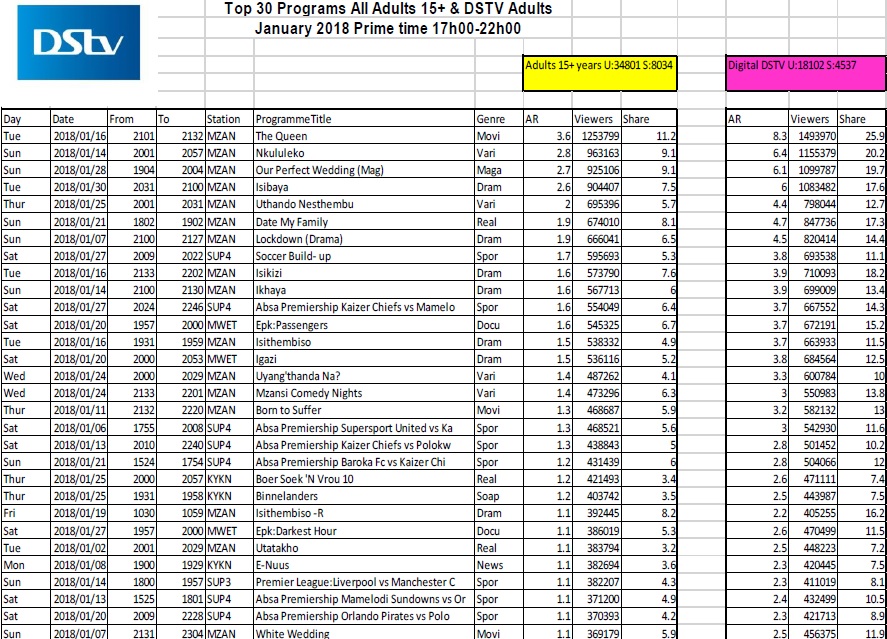
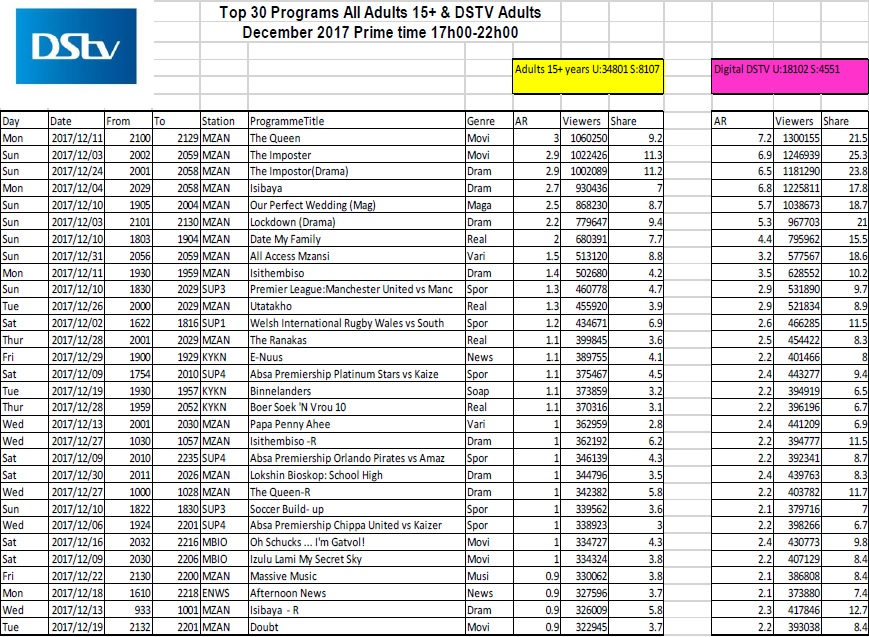
by MarkLives (@marklives) The hottest primetime television shows on DStv in South Africa revealed: TV ratings for January 2018 and December 2017.

In 2016, the Broadcast Research Council of South Africa (BRCSA) changed its policy about giving away TAMS and now only monthly reports, highlighting the top 20 or 30 primetime shows on several popular channels, are available.

DStv January 2018

BRCSA TV Ratings January 2018 primetime DStv
Click to enlarge to view clearly.

Source: BRCSA January 2018

DStv December 2017

BRCSA TV Ratings December 2017 primetime DStv
Click to enlarge to view clearly.

Source: BRCSA December 2017

Updated at 9.38am on 9 February 2017.


Broadcast Research Council of South AfricaThe Broadcast Research Council of South Africa (the BRC) is a non-profit, industry body that was incorporated in 2015 to cater to the audience research needs of the radio and television industry in South Africa.

Sign up now for the MarkLives email newsletter every Monday and Thursday, now including headlines from the Ramify.biz company newsroom service!

Corporate America swings from sobs to silence in this year’s Super Bowl

by Thomas Kolster (@thomaskolster) It was a sad Super Bowl. Sad, as only Trump can say it. Saaad. On the one hand, a fast-talking, cunning clown tried to sell me stuff as adland usually does best. On the other, I felt emotionally mistreated by a sobbing stranger playing curling with my heart. Corporate America appears not to care at all and, if it did, it did too much, which was exactly what was wrong. Of four quarters of fast-paced commercials, only around 10 aimed for something bigger than product plugging. What about some sense of purpose, or is it just products first?

Values first, America first, products first?

The value war from last year seemed to have run out of steam, or perhaps brands wanted to stick to safe waters and steer away from politics. The choice seemed simple: stand up for what you whole-heartedly believe in or stay silent.

Most companies conveniently chose to stay quiet. In doing so, they turned their back on the all-important conversations and topics that need support more than ever: diversity, immigration, climate — some of the biggest challenges of our time. As they say, “Nobody ever got fired for choosing IBM!” The easy option is to turn your back on wrongdoings or injustice. And please don’t pull the non-partisan excuse: for me speaking up is not about politics; it’s about defending basic values and human rights!

Toyota dared to speak up with a series of three commercials touting its mobility efforts, MobilityForAll.com, and the importance of inclusion and diversity. Good on you; I enjoyed at least one (The Woolstencroft) of the three executions.

https://www.youtube.com/watch?v=sefscV3GvWM&list=PLOWw6U-pDBj3VZtWgclF0ZNZAkAiXvvIx

What happened with the truly great ‘goodvertising’ work?

Staying silent is not my only (veggie) beef with Super Bowl this year. Why’s it still so difficult for brands to get goodvertising right? It’s as if their only known trick is to play on our heartstrings, with their love ballads about as believable as a used car salesman’s smile. We’re here to watch an exciting game and have fun with friends — so why all the sobbing?

T-mobile succeeded with its commercial #LittleOnes about equality and babies to make the message as heartwarming as scary serial-killer doll from the horror movie, Chucky. Who manages to mess up babies? Maybe it meant to label it #LittleScaryOnes?

https://youtu.be/C-rumHvmqCA

Normally recognised for its brilliant, emotive and well-written work, Stella Artois aimed for complete compassion fatigue with a dreary cause-marketing approach, together with Water.org. to provide drinking water for every ridiculous-looking French beer glass sold (sorry, read chalice). Cheers to ingenuity.

Another brand that went the cause-marketing direction was Hyundai, with its “Hope Detector” thanking its many customers for the proceeds gone to fund childhood cancer research. A great cause but it felt as if Hyundai was thanking itself on behalf of its drivers; thank me very much! I want to thank Hyundai for continuing its efforts from last year’s Super Bowl in supporting the troops but aren’t we missing a big opportunity to make a difference with some truly great work?

Some other highlights

That said, I want to recognise Budweiser for its timely and well-executed message. “Stand by You” featured a fight for people in need. With beer cans that turned into containers of water, the end shot brought it home nicely.

https://youtu.be/CxGUmtRLm5g

Verizon went a similarly supportive direction with allourthanks.com as a big thanks to all the first responders; hardly a message one may disagree with, regardless of political view.

https://youtu.be/Zn99TMv0vac

A new entrant this year was bargain site, Groupon, with “Who wouldn’t” claiming to support local businesses — always a popular message, and at least it tried a more-humorous approach but I can’t help wonder how sustainable the discount model is for the local businesses involved in the long term?

I care, sometimes

On a happy note, Coca-Cola continued its diversity efforts from last year with “The Wonder of Us”: applaudable, especially set against the silence of the others. If you want to make a difference in people’s lives, that’s not a one-off.

https://youtu.be/OPi9nTE70aA

Many of last year’s goodvertising trumpeting brands went silent. What happened with Kia’s fight for the climate? Or Airbnb’s commitment to diversity? Or Expedia? Or Audi’s cry for empowering women?

With this year’s Super Bowl, corporate America had every chance to prove it wants to be part of the solution, and show its purpose goes further than the writing in green on the CEO’s coffee mug. Unlike the sudden blackout during the game, there is no technical excuse for not taking a stand. So, dear corporate America, why so silent?


Thomas Kolster. Credit: Michael LanghoffAuthor, speaker, thought-leader, Thomas Kolster (@thomaskolster) is a man on a mission — one of the early pioneers in the do-good space who coined the term “Goodvertising” to describe the changing advertising landscape that’s become a movement in itself. A seasoned advertising professional, he’s positioned himself as a vocal voice for advertising and brands as a force for good. His book “Goodvertising” (@dogoodvertising) is the most comprehensive book to date exploring communication for good. As a passionate entrepreneur and change agent, he’s launched impact platforms such as Cph:Change and Wheregoodgrows.

“Motive” is a by-invitation-only column on MarkLives.com. Contributors are picked by the editors but generally don’t form part of our regular columnist lineup, unless the topic is off-column.

Sign up now for the MarkLives email newsletter every Monday and Thursday, now including headlines from the Ramify.biz company newsroom service!

#AgencyLeaders2017: Most admired ad agency in Cape Town

by Herman Manson (@marklives) Today we reveal which ad agencies in Cape Town were most admired by their peers in 2017! This is part of this week’s announcement of the 2017 MarkLives Agency Leaders’ Most Admired Poll results for Cape Town. Next week will be the Joburg results, followed by the national results in two weeks’ time.

Every year since 2012, MarkLives has been polling South Africa’s top agency leaders to find out what they think of their competitors, whom they see as effective managers and great creative leaders, and where they believe their future competition is likely to come from. We ask them who’s got digital integration right and — for the first time — who’s done best on transformation.

The most-admired ad agency in Cape Town

Ninety9cents Facebook cover image
Source: Facebook.

Ninety9Cents (99c)

It’s a surprise upset in a poll that is traditionally dominated by King James and Ogilvy & Mather Cape Town. It’s been a two-horse race since the poll started in 2012, with King James having grabbed the title outright three times and Ogilvy twice (once in a tie with King James, its fourth time with the title).

Ninety9Cents — best-known for its work on the giant Shoprite/Checkers account — also works on Ackermans, Capitec (the second-biggest bank in South Africa today), PUMA and Distell. In late 2017, it was appointed lead creative and digital agency for Spur Steak Ranches after a four-way pitch which saw it go head to head with TBWA\Hunt Lascaris; it already worked on the John Dory’s, Panarottis Pizza Pasta and Captain DoRegos accounts, which fall under the Spur Corporation umbrella.

The agency has added media strategy and planning, as well as search and digital media capabilities, to its offering. It opened an office in Lusaka in 2017, headed up by Natasha Omokhodion-Banda, and although still small, it gives notice of its intentions. Taking on Woolies, it helped Checkers launch “Oh My Goodness” meals, a range of healthy kiddies meals, which the agency says has been extremely well received by customers.

The agency employs 250+ people with offices in Cape Town, Johannesburg and Lusaka.

Previously

In 2015 and in 2016, King James was named our most-admired ad agency in Cape Town. In 2014, King James tied with Ogilvy & Mather Cape Town. In 2013, it was Ogilvy Cape Town. In 2012, our inaugural poll, it was King James.


The runners-up (tied)

James Barty, King James Cape Town, and Alistair King
Source: www.kingjames.co.za

King James Group (Cape Town)

King James Group enjoyed year-on-year revenue growth of 19% during 2017, amid a macro-economic climate that continues to place pressure on our industry and the marketing priorities of our clients, says managing director James Barty (our 2017 Most Admired Ad Agency Boss in Cape Town). After a little over three-and-a-half years apart, Allan Gray returned to the group as one of King James the Second’s leading clients in Johannesburg. King James also won Tyme Digital by Commonwealth Bank SA; the agency will be responsible for all elements of launching the brand into the South African market in 2018. It did, however, lose Parmalat in late 2017.

“Bringing together the ever-growing suite of digital expertise and offerings within the agency group, King James Digital builds on the strong reputation our agency has established in digital over recent years,” says Barty of a move that combined digital agency Punk and social media specialists, Society, with acquisitions Flint & Tinder and SOC (trading as Punk Johannesburg and Punk Media respectively). The new entity launched in October 2017 with over 90 digital specialists across Cape Town and Johannesburg, covering expertise from marketing communications, customer experience, data analytics and media.

Ogilvy & Mather Cape Town
Source: Facebook.

Ogilvy & Mather Cape Town

Ogilvy & Mather Cape Town had a good start to 2017 when it announced it had been appointed global lead agency for Appletiser after a two-way pitch. It also won Tracker South Africa after a competitive pitch against two other agencies (reportedly M&C Saatchi Abel and King James Group) and was appointed lead agency for KFC’s New Africa Markets. However, it lost Allan Gray in mid-2017.

Importantly, it set about a major internal restructuring process to reorientate the agency and the way it operates. “This is the largest structural undertaking by the agency in well over a decade,” explains managing director Luca Gallarelli, done in an effort to meet Ogilvy’s own ambition to be a truly modern agency and configured in a thoroughly reimagined way, underpinned by new systems, processes and personnel to deliver against what the agency has determined are the fundamentals of modern marketing. “With this move, we have made a significant step towards achieving the stated ambition of ourselves, our people and — most importantly — our clients.

“We’ve overcome the obvious disappointment of the Allan Gray loss and bounced back immediately with the news of Investec appointing Ogilvy SA as their agency of record,” he continues. “In addition, we have landed Tiger Brands and will, together with Ogilvy Joburg, be one of two agency partners across their portfolio of tier-one brands, together with FCB Joburg. We have also expanded our AB InBev portfolio of brands to include a number of continental local market brands, which is incredibly exciting as it expands this offices already significant footprint across the continent.”

Aramex, Turkish Airlines and Mondelēz have been significant digital PR/influence wins, as well as a significant KFC mandate for PR across Africa.

Previously

Ogilvy & Mather Cape Town was also our runner-up in 2015 and in 2016. FoxP2 was runner-up in 2014 and 2013. In 2012, our inaugural poll, it was Ogilvy Cape Town.


How the poll works

Towards the end of 2017, we invited agency executives to nominate their most-admired agency, creative leader and most-admired agency both in their region (Johannesburg or Cape Town) and nationally. We also asked them which agency did the best at digital integration and at transformation (a new question), and which agency they saw as the one to watch in the future. Execs couldn’t nominate their own agencies or staff members. All the nominations were then tallied up for the final result. The editors of MarkLives had two votes in the final poll.

Note: Runner-up(s) will only be named if they achieved a good nomination tally relative to the winner’s position. Contenders are named if they stand out significantly above other nominees but weren’t able to close in on the winner’s tally. The most-admired agency of the year is disqualified from the One to Watch category; votes cast in its favour in this category are discarded.

Previous Cape Town results


Herman Manson 2017Herman Manson (@marklives) is the founder and editor of MarkLives.com.

Sign up now for the MarkLives email newsletter every Monday and Thursday, now including headlines from the Ramify.biz company newsroom service!

The Real McCoy: The corporation’s search for meaning

by Sean McCoy (@TheRealMcCoyTRM) In an adaptation of the title of Viktor Frankl’s¹ chronicle on the meaning he took out of the most- horrific life experience in Nazi concentration camps during World War II, this frames a related question of the modern corporation in the 21st century. In “Man’s Search for Meaning”, Frankl suggests that this proposition is easily filtered through our desire to serve ourselves or to serve society. He offers that the latter is the real definition of being human and is what leads to true self-actualisation — often misunderstood as being focused on oneself, as opposed to transcending oneself and being of service to others.

We need look no further than a singular family case in South Africa and the casualties of meaning that surround this saga. Bell Pottinger, KPMG and McKinsey are only a few names implicated in this rolling soap opera that erodes the moral business fabric in certain quarters of SA and puts this very issue under the spotlight. These are clearly corporations guilty of serving their own interest and conscience, or lack thereof, rather than directing their efforts for the greater good of society.

Is capitalism dead?

As an entrepreneur and branding practitioner, I’d like to believe that it’s still a model that has been and can continue to deliver good. It’s very much alive but is often not well, and requires diagnosis and treatment in order to ensure it has a long and healthy life in a changing world.

The perpetual quest for market growth, revenue, bottom line profitability or shareholder returns as a singular and naked set of organisational metrics is over. The massive skew toward shareholders as the priority stakeholder of the business and a blind preoccupation with financial results has to be wrong, and the business of today simply has to have a greater level of social conscience and apply an authentically holistic approach to multiple stakeholder engagement, commitment and shared value.

Beyond the suitcase words

All too often we see this corporate diatribe around multiple stakeholder engagement, shared value, licence to operate and similar such narratives. There is no shortage of jargon and meaningless rhetoric in the typical business and boardroom dictionary. Words such as “authenticity”, “governance” and “transparency” have been claimed for some time but have become so vanilla that they are at risk of being meaningless. Ironically, they have never been more important, as consumer cynicism and broader stakeholder disillusionment has taken hold.

Simply put, brands need to be responsible, and the winning ones should and will only be the ones that are doing good, advancing humanity and fundamentally making the world a better place — not a more-profitable, more-capitalistic and -consumption-driven one — a truly better place for society as a whole, on a sustainable basis.

Back to purpose

None of the above is necessarily new in the world of branding, but why then is such common sense not common practice throughout? This is not only a South African pandemic, as one of my previous columns reflected on the VW emissions falsification issue in pursuit of sales performance. While it appears to have recovered quickly and well, thanks to a strong global brand; and McKinsey currently encourages a legal perspective on the Eskom contract, the issue of organisational purpose gains momentum. This in itself is not a new concept in brand or reputation circles but current evidence, according to Kantar MillwardBrown in its BrandZ Top 100 Global Brands study², suggests that organisations with a clear purpose outperformed their counterpart brands by a factor of three and highlight this strengthening issue in particular among youth segments, going beyond the convention of age old wisdom.

The expectation is that brands will not only improve the lives of individuals but also the world as a whole. And if their purpose cannot facilitate that, then the default position should at least be to not cause harm of any kind. Many corporations could take heed of that minimum requirement.

What better way to conclude this conversation than through a Frankl citation by Dan Ariely in Payoff³, with a direct personal quote that is as applicable to the company as it is the individual: “[L]ife is never made unbearable by circumstances, but only by lack of meaning and purpose.” I suggest that every organisation should be carrying out the very same introspection and building balanced scorecards to reflect this — what real difference do we make in the world through a clear sense of purpose and well-defined meaning?

References


Sean McCoyDr Sean McCoy, MD and founding member of HKLM, is a prominent figure in the branding arena, with his expertise centered on client service, brand strategy and business development. He contributes the regular “The Real McCoy” column focusing upon internal branding to MarkLives.

Sign up now for the MarkLives email newsletter every Monday and Thursday, now including headlines from the Ramify.biz company newsroom service!

Online CPD Courses Psychology Online CPD Courses Marketing analytics software Marketing analytics software for small business Business management software Business accounting software Gearbox repair company Makeup artist