Africa Dispatches: Get social with Sheena Kretzmer [interview]

by Charlie Mathews (@CharlesLeeZA) If you work in social media, it’s unlikely you won’t know Sheena Kretzmer (née Gates) (@SheBeeGee). A writer who gained respect as a blogging pioneer, her ability to capture attention catapulted her into the world of social marketing well before most agencies considered the emerging media viable.

The Social Local logoAfter working at a handful of hot agencies, Kretzmer founded The Social Local, a strategic social media consultancy that has done work for the kind of brands everyone wants in their portfolio. Which? Accenture, Google, Pick n Pay, MTN, Unilever, Land Rover, Ford, Mazda, Tsogo Sun and more. Kretzmer opens up to Africa Dispatches about the early days, philosophy, how crowded social media marketing’s become and her favourite campaign.

Africa Dispatches: How did it all start?
Sheena Kretzmer:
In the early days of social media, I had a popular blog which lead me to engaging on Twitter and Facebook. The landscape was much-smaller back then in 2005, so the few of us [who] were the earlier adopters had a beautiful community going. I launched an online magazine called NerdMag and initiated an annual social media auction and awards programme called The Nerdies, which gained a bit of media attention. Through that I was approached by a few agencies to assist with their digital initiative. I landed up at Aqua, one of Africa’s largest digital agencies, now owned by Wunderman. Back, then we didn’t even have titles in social media so I remember the previous CEO, Brent Shahim, and me, proverbially throwing titles into a hat to see what would work. The titles changed often until, almost by accident, I became what is now known as a social media specialist and then eventually head of social media.

AD: Who are you?
SK:
I’m an ex-blogger who fell in love with social media over 10 years ago, and somehow managed to turn a passion into a career. After many years in both agency and then corporate, I now own and manage a strategic social media consultancy called The Social Local. We specialise in empowering our clients to take their social media work in-house. In recent years, I’ve also tacked on the title of “Wife” to my lovely husband, Jon, and “Mom” to my delightfully naughty son, Aiden.

AD: What have been the biggest lessons learned?
SK:
My biggest lesson, particularly in South Africa, has been to vet content for potential crisis communications, no matter how innocuous it might seem. South Africans have embraced social media; however, it also means they’ve embraced having their own soapbox to attack brands with. Nobody is immune.

Another big lesson is that, as social media professionals, it is not only our job but our duty, to stand up for what is right, and to follow best practice when it comes to social media. This requires lots of preparation and stamina so that we don’t always take the easy way out by listening to what our clients want instead of helping them figure out what they need.

AD: How has the industry changed since you first started?
SK:
So much has changed! For one thing, mainstream media has embraced social media to its fullest. Radios, newspapers and TV have started getting comfortable with how social media can aid them, rather than compete. Brands and companies, ranging from small to enterprise, have realised just how imperative social media is to their end line and reputation. Social media professionals have started to realise that we need some formal training and that we can’t all be mavericks, chasing after the biggest fan following; a strategy must be the first step in building a social media presence.

AD: What’s your philosophy when it comes to social? Do you have a particular approach or philosophy?
SK:
I have several but the first, and most important, is to be honest and transparent with your clients. There’s no point in hiding how you do things from your client in the hopes of retaining their business. Too many peers of mine do this and lose clients anyway. I find empowering my clients to understand what is done, and why, is the most important factor in my business. The more they understand a skill or tactic, the more they prioritise social media in their business.

AD: What’s more important — reach or engagement, and why?
SK:
As much as the more popular answer is “engagement”, that can’t happen without “reach”, right? So ,my answer is always “reach first, then just as importantly, engagement”.

AD: Complete the sentence. “Content …. “
SK:
“Content is not king. If I sent you to a desert island and gave you the choice of taking friends or your movies, you’d choose friends. If you chose movies, we’d call you a sociopath. Conversation is king. Content is just something to talk about.” — Cory Doctorow, Boing Boing

AD: What’s the best strategic advice you could give to a brand who wants to use social media to improve their relationship with their customers?
SK:
Have a plan in place for when the shit hits the fan. You think it’ll never happen to you but it can and will, when you least expect it, for reasons you never fathomed. Start with an internal social media policy and encourage your staff to understand it and engage in it. Then build a plan to show transparency with your business philosophies, processes and turnaround times. At the end of the day, your fans are human; humans appreciate authenticity. Secondly, ensure you have a policy on how to handle online reputation management — who is responsible for these comment replies, who does it get escalated to, who signs it off. Ensure the turnaround times are within a few hours — social media is all about immediacy and the longer you take to contain the problem, the bigger a problem can become.

AD: What’s the best skill/attitude to have to be able to be a smart strategic thinker from a marketing perspective?
SK:
It’s important to find someone who can think about actual business objectives and how you can realistically achieve them, while simultaneously offering value to your social media audience. Always keep yourself honest on your content being not just important for you but being of interest to your audience too. Nobody likes a page that posts about their awards and accolades but never follows through with offering education, entertainment or value. The biggest skill to apply to strategy is objectivity and realism.

AD: What social marketing buzzword would you ban?
SK:
“Social media guru” should be illegalised. Oh, and “Make it viral!”, obviously.

AD: Is social marketing overtraded?
SK:
Of course, but show me one industry that isn’t. The good guys always make it out of the gates and the results speak for themselves. The fly-by-nights don’t last long before their true colours show.

AD: What are the opportunities in the social marketing sector?
SK:
I often get asked if I’m threatened by other peers consulting in their own right or starting agencies. I really don’t understand why people feel we should be threatened by each other. I’m a firm believer that, not only are there enough clients to go around, but that we can all learn from each other and better the industry together. This was the main reason why we started the Social Media & Community Managers support group on Facebook. There are nearly 1600 members all engaging with each other daily and reaching out for support or providing value. To answer your question: the biggest opportunity we should all be striving for is to reach out to each other and share what we learn.

AD: What digital marketing trends can we expect in 2018?
SK:
We’re already seeing a huge shift to mobile and video content. I think we’ll see more of this — live-streaming and VR in 2018. Previously South Africa was the ugly stepchild of video content capabilities but, with bandwidth and fibre upping their games, now everyone has the opportunity of enjoying dynamic content.

AD: What’s the best advice anyone’s ever given you?
SK:
Get a great accountant and don’t quote from desperation. It’s held true since my business’s inception and I’m so glad I followed this advice. Smaller clients who penny pinch are often the most demanding and unrealistic in terms of objectives. I know peers who break their backs trying to keep these clients happy even though they compromise on quality and best practice. At the end of the day, their clients aren’t seeing tangible results for their business, and the specialists aren’t winning accolades for subpar work.

AD: What’s the worst advice anyone’s ever given you?

SK: “You should dress up for your male clients so they like you more.” Ugh.

AD: Favourite digital campaign ever?
SK:
I am absolutely LOVING anything Amarula does on Facebook these days. They are clearly with a great agency and have a good, well rounded team at their social media meetings. The content is dynamic, pushing boundaries and delightful to fans. High five to them.


Charlie Mathews

Charles Lee Mathews (@CharlesLeeZA) is the founder of TheWriters.co.za, a boutique strategy and content shop that helps brands better connect — and engage with — the people who matter most. When not writing, or thinking about human behaviour, she is a contributing editor to MarkLives.com through her monthly “Africa Dispatches” column.

Sign up now for the MarkLives email newsletter every Monday and Thursday, now including headlines from the Ramify.biz company newsroom service!

#BigQ2018: Velocity of change going to be unprecedented & unpredictable

by MarkLives (@marklives) What are the expectations for the marketing and advertising industry in 2018? We emailed a panel of key industry executives for their take on the macro environment, budgets, changes in messaging, movement in the industry and any consumer and communication trends they’ll be looking out for. Next up is Prakash Patel of Fogg.

Prakash Patel

Prakash PatelPrakash Patel (@PrakashPatel_1), a seasoned strategist and data-driven digital marketer, is managing director of Fogg Cape Town. Previously, he was CEO of Prezence and chief digital officer of FCB/Mesh. Prior to moving to SA, Prakash spent over 18 years at some of the world’s largest and independent data and digital agencies in the UK. Now he is trying to keep up with tomorrow today and helping brands add value in the #TraDigital era.

First there were websites, then there were social media platforms, apps, VR/AR and now there is AI, bots and cryptocurrencies.

The advancement of digital, technologies and platforms in the past will be nothing to go by, as the velocity of change in things to come is going to be unprecedented, unpredictable and in a constant flux of adaptation and evolution. Just think about these statements for a minute, then pause and contemplate the possibilities that were once impossible now made possible.

  • In total, there are 400 hours of video uploaded to YouTube every minute, which equates to 65 years of video every day, or
  • The claim that the supercomputer known as IBM Watson will soon be the best diagnostician in the world, according to Andrew McAfee, one of its creators, based on its ability to access and store more information than a human brain.

With the festive season gone and most of us back to work, global political and economical uncertainties continue, and consumers are watching their rands. I am sure most marketing strategists and marketers will be busy working out their strategies for the coming new year, from better understanding who their customers are through to embracing new and emerging technologies in order to connect with their customers in far more meaningful ways.

So, here are a few trends and traits in no particular order, that I believe all marketers need to (continue to) think about in the coming year:

Mobile

That old chestnut — my no. 1 reminder each year. South Africa has always been a mobile-first country and, with the growth of smartphones, it’s no surprise that mobile will continue to be (or should be) top of mind for the marketing and digital industry. If not, as a reminder, it was reported last year in the Effective Measure Mobile in South Africa Report that a whopping 70% of South Africans browsed the web on their mobile, while 44% surf the web in bed and a further 35% go one step further and reach for their smartphones as soon as they wake up. The opportunity continues to grow as the mobile becomes an extension to ourselves, and most marketers have learnt that mobile marketing is now core to their business. In this modern era, consumers interact with products and brands at any time, in any place and across numerous channels — from apps to mobile web, social media sites through to messenger and now even chat bots and geo-targeted ads based upon your geographical location.

So, make mobile experience one of your top priorities, as consumers are more likely to buy and recommend from a business that has a better mobile experience. Plus, it’s worth bearing in mind that a mobile friendly site is a prerequisite for Google’s search algorithm.

Customer experience (CX) and omnichannel

I’ve covered this topic extensively over the years, and have had the privilege of working with a number of brands in defining and producing their total customer experience across all touchpoints by producing a strategic roadmap that brings C-suite executives together across departments and functions. In today’s world, if we continue to see our consumers through the lens of our marketing channels, we have already lost the battle to be customer-centric or consumer-focused. Throw away the rulebook from a strategic perspective and start this year by truly understanding your entire business’s total CZX… from how your consumer researches and finds your brand and reviewing your products both instore and online to engaging with your brand from making a complaint through social media to buying your product, experiencing it and reviewing it for everyone to see.

VR/AR

On the subject of experiences, in my opinion, one thing that has never changed in marketing is that it is still about storytelling and the experiences we deliver.

“Experiences are the new luxury good.” —Will Dean.

One of the biggest developments with respect to experiences and marketing has been virtual reality (VR) and augmented reality (AR) over the past few years — something we believe is changing the landscape in a far deeper and more personal way. Why?

“Virtual reality was once the dream of science fiction. But the Internet was also a dream, and so were smartphones and computers. The future is coming and we have a chance to build it together.” —Mark Zuckerberg.

VR/AR is no longer only for films, music videos, games or luxury sectors. Science fiction becomes a reality for all who wish to embrace it. So, what makes these technologies so powerful and unique?

  • Media drive our senses in a way we are designed to perceive the world. Traditional media is about communicating in 2D by producing multimedia that can be watched on some display, eg TV, phone, tablet or computer.
  • Virtual reality is about communicating in 3D. Simply put, it allows us to transport our customers right into these experiences. They can look around, move around and interact. It feels real. You are virtually immersed in a unique experience
  • It can create the experience of presence, or build a strong sense of empathy and have a powerful psychological impact on its user. For example, go and experience The New York Times VR.

AI and chatbots

According to Forbes writer, Blake Morgan, chatbots are the future of CX and have the power to replace search windows and many apps in the not-so-distant future. For me, it’s far more than simply replacing customer experience or search.

We saw a huge growth in 2017 with the emerging trend in artificial intelligence (AI), where some brands have already embarked on this new journey here in SA and reaping rewards, learnings or feedback, while others are still grappling with how it may be used or asking the question what it is. But as soon as I say “virtual assistants”, the big story of 2017 (such as Siri, Alexa, or now even IBM Watson), most people get it.

Chatbots are simply an AI program designed to imitate a conversation with a person in real time, that isn’t limited by technology because the AI tech is built into the software. A program that is constantly learning after each and every question and answer.

The opportunities are endless as companies continue to use AI to connect, engage and communicate with their customers in ways that were not possible before. But, after judging the 2017 SXSW Interactive Innovations Awards, I believe there’ll be more adoption of voice computing as touchless interfaces evolve away from fingers and swipes that will make voice assistants far more versatile in the year ahead.

Content marketing

As we say now, content is KING (in context); content will continue to dominate conversations around marketing and campaigns — as without good, purposeful relevant content, what is a great idea or website? Content marketing is seen as the ‘engagement’ fuel that powers all digital communications, from search to social to emarketing to drive awareness and reach through to creating websites that entice, convert and retain customers through always-on content-driven plans.

Data

More data has been created over the past few years than in the entire previous history of the human race. So, with all that data, the focus is now more on data quality rather than the amount of data you have.

One of the most-talked about challenges by marketers is the actual transformation of data into actionable insights. Otherwise, it’s just data that becomes both the challenge and opportunity. Size or amount doesn’t matter; it’s what you do with it that will make the difference. The opportunity comes down to focusing first and foremost on the data quality and accuracy and. once established, mining the relevant data to glean insights and applying intelligence to drive more impactful data-driven strategies (an area I wrote about on MarkLives a few years back).

Cryptocurrency and blockchains

Talking about data, this brings me to my final trend that has revolutionised the world’s financial system. Cryptocurrency is a form of digital money that is designed to be secure and, in many cases, anonymous. It’s a currency associated with the internet that uses cryptography, the process of converting legible information into an almost uncrackable code, to track purchases and transfers.

How this new phenomenon will effect marketing is still unclear, and according to AJ Agrawal, a contributor to Entrepreneur, he believes that cryptocurrency might make it more difficult for marketers to collect the kind of data on consumers that often informs advertising strategies.

Currently, it’s easy to collect huge amounts of information on potential customers to attract leads, largely because the platform marketers use, such as Facebook or Google, owns the data and sells it to you. Marketers can use this information to figure out audience segments, test which ads work better than others, predict customer behaviour and more.

However, with cryptocurrency, information is anonymous, secure and encrypted — making it difficult for marketers to figure out who bought what, and how customers are responding to marketing tactics.

But this is only part of the challenge within this complex cryptocurrency world, as it is argued that the opposite may be true, in that the ledger (a blockchain is a massive, decentralizsd ledger; entries in the ledger are generated by transactions using a particular cryptocurrency), should make it easier to track what consumers are spending and where. At the end of the day, cryptocurrency is just another form of payment and not a vehicle that completely changes how consumers shop.

For now, marketers should closely watch the progression of cryptocurrency and blockchains. It is a complicated topic but is explained well in this video:

In summary, we will continue to see the rise in the usage of digital; internet of things (IoT); expansion in the gathering and mining of data; greater appreciation of the total CX; the convergence of the physical and digital worlds; and the rise of the bot through the adoption of AI, used to connect and communicate with customers in ways that are far more efficient and effective or that were once impossible or too expensive.

#BigQ2018 series


MarkLives logoLaunched in 2016, “The Big Q” is a regular column on MarkLives in which we ask key advertising and marketing industry execs for their thoughts on relevant issues facing the industry. If you’d like to be part of our pool of panellists, please contact editor Herman Manson via email (2mark at marklives dot com) or Twitter (@marklives). Suggestions for questions are also welcomed.

Sign up now for the MarkLives email newsletter every Monday and Thursday, now including headlines from the Ramify.biz company newsroom service!

Cover Stories: Top 5 international mag covers for 2017 — niche

by Shane de Lange (@shanenilfunctFrom experimental typography, to social awareness, to philosophical engagement and odes to the past, my 2017 Top 5 list for international niche and independent publications has been selected for their overall cultural impact, with hints of revivalism and reformism while remaining contemporary and relevant.

A point made in last week’s column was that independent print publications are representative of the way that any given society identifies with itself, and so comes to terms with its own cultural identity. As opposed to the low production rate of independent print locally, internationally, such publications seem to be going through a kind of renaissance, with an almost cult following in the major cities of the world. One could go as far as to label it a print movement, a testament to the heightened levels of cultural consciousness and society-wide self-awareness, disseminated through print media. The high number of independent publications being produced internationally is so prolific, one is almost spoilt for choice.


Find a cover we should know about? Tweet us at @Marklives and @shanenilfunct.
Pinterest icon Want to view all the covers at a glance? See our Pinterest board!


#5. Real Review (UK), #4, September 2017

Collage - Real Review, Issue 4, September 2017 plus issues 1, 2 and 3Designed by studio OK-RM, Real Review is a quarterly magazine that veers away from orthodox digital production methods in editorial design. With a captivating tagline, “What It Means to Live Today”, the magazine critically reviews 21st century architecture and other culturally relevant discourse. Issue #4 focuses on the topic of what it means to love today, with a design approach inspired by the underground tradition of hand-crafted Soviet (Russian) Samizdat publications. These were designed to be read, shoved into the reader’s back pocket, thumbed and passed around, as opposed to the detached and mediated forms of interaction we have today. Samizdat publications were aberrant, resourceful, urgent and critical, and meant to disseminate information under the radar within communities.

Presented pre-folded, Real Review’s format is thin and vertical, emphasising the malleability and ‘realness’ of the publication. It unfolds much like a brochure, with quadruple-page spreads instead of double-page spreads. The cover of each issue thus far has been illustrated by prolific UK-based illustrator, Nishant Choksi, accented with a slight Russian constructivist influence.


#4: Double Dagger (UK), Issue 2, Autumn 2017

Double Dagger, Issue 2, Autumn 2017It is heartwarming to see that real, analogue processes are still encouraged in an age when digital tools and methods are ubiquitous. Too many designers today depend on software in order to find design solutions, which ultimately dominates the message. The result? Cloned and derivative work. The fact is, nothing can compare to the act of putting pen to paper and making things by hand, using old-fashioned human brain power and creative acumen without resorting to a scroll of the mouse for design inspiration. Machines simply cannot produce the passion, skill and love needed to supply the kind of creativity needed to make meaningful work.

Double Dagger is one such publication nurturing true creativity through the use of traditional methods of production. It is an annual journal, printed using age-old letterpress printing processes, accompanied by wood and lead type — all processes that are near impossible to emulate through digital processes. Much like vinyl records, letterpress has seen a revival in recent times, purely because it stimulates all the senses with qualities that become more of an experience than a simple form of communication or entertainment. Commercial printing simply can’t compare.


#3. Harvard Design Magazine (US), #44, Fall/Winter, 2017

Harvard Design Magazine, issue 44, 2017Broadly speaking, the core interrelated parts of art, craft, design and discourse form the bulk of the cultural sphere. An appreciation of each part in relation to the other, in dialogue with a plethora of social, economic, political and historical factors within any given society, arguably makes for a coherent cultural sphere. Harvard Design Magazine (HDM) is a publication that advocates this dialogue, looking further than run-of-the-mill, orthodox happenings within various fields of design and aiming to create discourse that is more layered, in search of new perspectives.

Speaking a language akin to a wholeness-in-design, each issue highlights unexpected avenues from various design fields and connects them, linking seemingly unrelated fields such as art and science. Themed “Seventeen”, for the year 2017, the fall/winter issue of HDM describes the millennium as teenager, divided and temperamental. With many upheavals across the globe, much like a teenager, the world is acting on impulse. Recalling early glitch art from the late ’90s on the cover, the magazine’s contents investigate all the narrative blips and design bleeps that have emerged in the 17-odd years since the beginning of the millenium. Glitch as a positive metaphor, defining our current cultural adolescence.


#2. Roll with the Punches (Palestine), issue #1, 2017

Roll with the Punches, Issue 1, 2017Emblazoned with the Palestinian flag, using a triptych of skateboard decks, Roll with the Punches is a publication about skateboarding backed by a social awareness campaign. Promoting the sport as an agent of change within the derelict communities of Palestine, one of the world’s longest-standing conflict zones, this limited-edition magazine stays true to its name, with wheels rolling to the proverbial Israeli punches. Edited and designed by skater, Tom Bird, Roll with the Punches details his work done with SkatePal in the Occupied West Bank. SkatePal is a non-profit organisation that tries to enhance the lives of young people in Palestine through the sport of skateboarding. All money raised by this publication is donated to SkatePal so that it can work with the communities in oppressed areas in order to affect change. A few copies may still be available if you wish to support this cause. For more info on this project, go to rollwiththepunches.co.


#1: Eye Magazine (UK) #94, volume 24, 2017

Eye Magazine, issue 94, 2017 cEye Magazine, issue 94, 2017 bEye Magazine, issue 94, 2017 a
Tailored for critically informed visual-culture junkies, The Eye, takes the notion of iteration to the next level on the cover of its 94th issue. Delivering an education in visual communication on a magazine cover, Paul McNeil and Hamish Muir of MuirMcNeil studio created 8 000 distinctive covers. This project was made possible through the creation 10 ‘seed’ files, each containing iterations of letterforms drawn from the name of the magazine, “The Eye”, with fixed increments in three layers, each set in a variation of MuirMcNeil’s TwoPoint or TwoPlus typeface systems. Each layer is displaced laterally and spaced proportionately, deconstructing conventions in letter spacing and typesetting. Printed digitally on an Indigo 10000 press, these covers rely on HP Mosaic software due to its variable data-printing process that resizes, rotates and alters the colour of the artwork, based on the 10 ‘seed’ files. The cropping process makes a large variety of final cover designs to occur. A clever idea, accompanied by equally beautiful result.


Shane de LangeShane de Lange (@shanenilfunct) is a designer, writer, and educator currently based in Cape Town, South Africa, working in the fields of communication design and digital media. He works from Gilgamesh, a small design studio, and is a senior lecturer in graphic design at Vega School in Cape Town. Connect on Pinterest and Instagram.

Cover Stories, formerly MagLove, is a regular slot deconstructing media cover design, both past and present.

Sign up now for the MarkLives email newsletter every Monday and Thursday, now including headlines from the Ramify.biz company newsroom service!

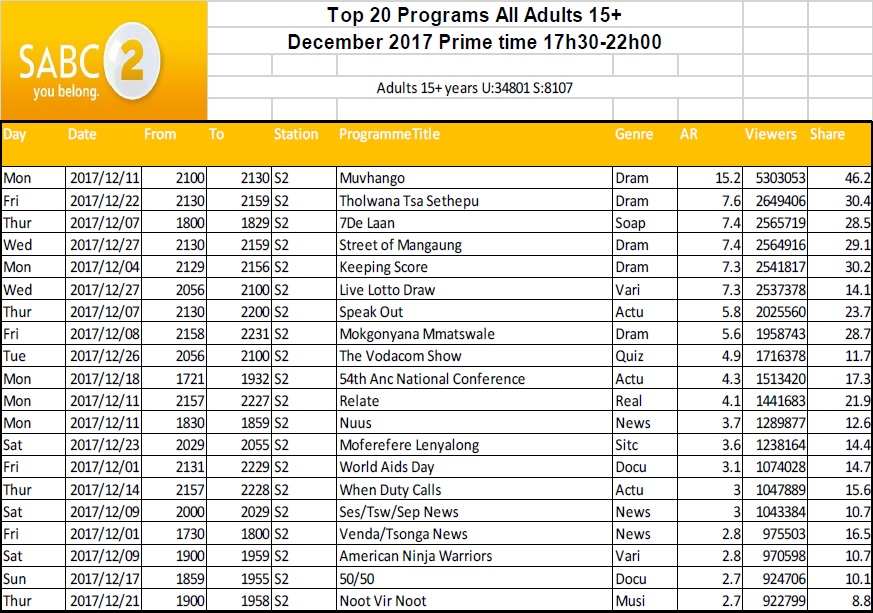
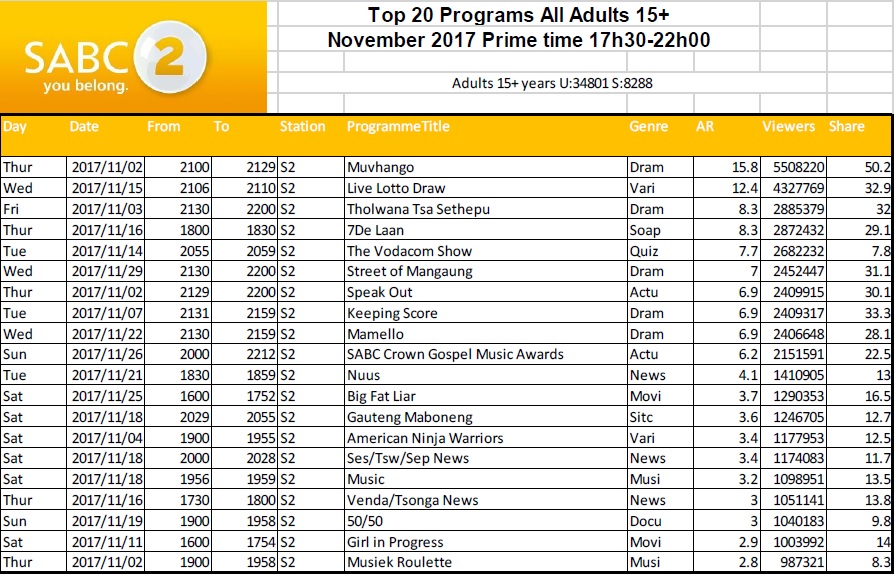
SA TV Ratings: SABC 2 — primetime top 20 for Dec, Nov 2017

by MarkLives (@marklives) The hottest primetime television shows on SABC 2 in South Africa revealed: TV ratings for December and November 2017.

In 2016, the Broadcast Research Council of South Africa (BRCSA) changed its policy about giving away TAMS and now only monthly reports, highlighting the top 20 or 30 primetime shows on several popular channels, are available.

SABC 2 December 2017

BRCSA TV Ratings December 2017 primetime SABC 2Source: BRCSA December 2017

SABC 2 November 2017

BRCSA TV Ratings November 2017 primetime SABC 2Source: BRCSA November 2017

Broadcast Research Council of South Africa


The Broadcast Research Council of South Africa (the BRC) is a non-profit, industry body that was incorporated in 2015 to cater to the audience research needs of the radio and television industry in South Africa.

Sign up now for the MarkLives email newsletter every Monday and Thursday, now including headlines from the Ramify.biz company newsroom service!

#BigQ2018: Strained budgets, profit margins to impact in various ways

by MarkLives (@marklives) What are the expectations for the marketing and advertising industry in 2018? We emailed a panel of key industry executives for their take on the macro environment, budgets, changes in messaging, movement in the industry and any consumer and communication trends they’ll be looking out for. Next up is Xola Nouse of The Odd Number.

Xola Nouse

Xola NouseXola Nouse, a former management consultant at Ernst & Young, holds an MA in business management and a BCom honours in marketing. He is the co-founder and managing director of The Odd Numbervoted small advertising agency of the year in 2017 and ranked among the top 12 agencies in the country. The Odd Number was also voted joint 2017 One to Watch in Jozi and joint runner-up 2017 One to Watch in South Africa in our 2016 MarkLives Agency Leaders’ Most Admired poll.

Macro environment

According to the South African Reserve Bank, growth in our economy is projected to recover from 0.9% in 2017 to roughly 1.4% in 2018. While this may be the case, we continue to lag behind global growth and remain a dual economy with one of the highest inequality rates in the world, perpetuating both inequality and exclusion in the mainstream economy. The nett effect of our decreasing per capita GDP growth, reduced foreign investment appetite, credit rating downgrades and overall insufficient economic growth has resulted in us also falling behind our emerging market peers.

Essentially. what this means is that we’re not completely out of the red and that we’re still in for some tough times ahead, clients and agencies alike. The glaring reality is that client budgets, as well as agency margins, will continue to be strained, specifically for small and emerging agencies.

Strained budgets and profit margins will have an impact on the creative industry in a number of ways:

  1. Smaller budgets will challenge agencies to become more agile and tactical in their plight to communicate to consumers and appeal to their interests.
  2. Clients will continue to split their business across the agency spectrum whereas, before, big brands were handed to big agencies to manage the capacity of outputs. Legacy agencies are now competing with smaller entrepreneurial agencies that are able to deliver sharp, innovative creative work in quicker turn-around times.
  3. Lead times for ideation and implementation of work will require on-trend understanding of market shifts that influence consumer behavior from agency side. Clients will require agile responses in a proactive manner; it will be up to agencies to always remain preemptive of looming shifts and trends. Agency operating models, as well as revenue streams, will need to be adapted in order to remain sustainable, profitable and ultimately remaining relevant to both clients and consumers.

Consistency of trends and patterns

In the year ahead, we’ll continue to see a consistency of trends and patterns, such as the rise of increased communication platforms, as well as new technologies and innovations that have contributed in the shift of doing business in adland.

In addition to these, the competitive landscape is also likely to continue to change. The emergence of management consulting firms such as Accenture, Deloitte and EY will continue to shake up the advertising industry. The narrative that these firms have successfully sold to clients is around their in-depth understanding of client centricity and the consumer experience, and how they (consulting firms) are best placed to build and grow brands through big data and a better holistic understanding of the consumer. Data, analytics and relationship-building with the target consumer will be key in remaining relevant.

With this said, creativity and the proverbial Big Idea will always reign supreme. Successful campaigns will always be driven by powerful nuanced ideas that resonate with the intended audience and deliver on a business challenge or need. What more will happen if you couple this with powerful and meaningful data?

Transformation

The pink elephant in the room will always be transformation in adland. This needs to come to an end. The MAC Charter will go some way in forcing the hands of those who refuse to play ball. Prioritising black and female ownership to achieve the mandated 45% ownership will continue to be a priority for most agencies and, possibly, a challenge for others. Either way, transformational change beckons for marketers, procurement departments and agencies alike.

In closing, 2018 is set to be another bumper year, requiring all of us in the communication value chain to operate somewhat differently in order to adapt to the changing market conditions. These adapted ways of working can only further strengthen the industry.

#BigQ2018 series

See also


MarkLives logoLaunched in 2016, “The Big Q” is a regular column on MarkLives in which we ask key advertising and marketing industry execs for their thoughts on relevant issues facing the industry. If you’d like to be part of our pool of panellists, please contact editor Herman Manson via email (2mark at marklives dot com) or Twitter (@marklives). Suggestions for questions are also welcomed.

Sign up now for the MarkLives email newsletter every Monday and Thursday, now including headlines from the Ramify.biz company newsroom service!

Dear Radio: The people you need to know in a radio station

by Paulo Dias (@therealptp) As radio advertising becomes more complex and campaigns start blurring the line between advertising and programming content, you’ll be put into contact with different departments in a station or group and, with more hyphenated titles appearing on email signatures than ever before, I thought it would be handy to start a guide of who the key people in a station are.

As the internal departments in a radio station evolve from being radio-only businesses to being more-rounded content providers, it’s becoming trickier to navigate who you need to talk to in a radio station. Over the next few columns I will introduce you to these people. Most stations will call them by different names but, by and large, their roles will be similar.

Morning breakfast team

So, let’s start with the most-glamorous and high-profile team in a radio station. The one that generates the majority of the revenue, creates the most talkability and directs the sound and creative tone of the station — the morning breakfast team.

As a client, you won’t always have direct contact with them but it’s helpful to understand their roles.

The breakfast team is like your favourite sitcom with a cast of recurring characters, much like the ones you see on your favourite dysfunctional family show. Actually, most breakfast shows will describe themselves as a dysfunctional family.

The most-popular format for a breakfast team is that of the “morning zoo”. This concept came to prominence in the ’80s and coincided with the rise of “shock jocks”. We all know the term and probably had one name automatically pop into our heads — either John Berks, Jeremy Mansfield or Gareth Cliff — all taking the lead from Howard Stern.

Even in more PC times, when there are better ways to get responses than pure shock value, most ‘zoos’ are led by the dominant “pot-stirring” character. The one with big ideas and bigger mouth who gets the conversations rolling. Anele, Fresh, Roger Goode, Darren Simpson — you get the picture. While none of the above-mentioned are part of double header lineups, they are usually joined by sidekicks who take on two very different roles.

Sidekicks

Depending on who the station is targeting as a listener, one sidekick will take the role of the hand-brake. This is usually a woman; her role is to stop the show descending into chaos and becoming too much like a frat-party. She is not totally a party pooper; done well, this person becomes the voice of the female listener — the mom taking the kids to school who doesn’t want to spend the entire drive explaining the rude word that was just said.

This role, when executed properly, connects with the part of the audience who stays loyal to the station. Great examples are the likes of Sam Cowen, who had a job on her hand controlling Mansfield and Whackhead, and Sureshnie Rider, who’s introduced the “Suspend-o-meter” to the Roger Goode show — a device which measures how close the team are to being suspended. This is a really nice way of adding colour to the role and demonstrating that it’s not a grinch type of role.

The second sidekick walks a tightrope, mainly because they need to keep their own ego in check.

Normally younger or less experienced in radio than the host and main co-host, they have talent but haven’t yet earned the yards. They’re normally great with content, are very funny and insightful — but need to be sure not to compete with the main host and instead compliment them and follow in whichever direction they are leading. The second sidekick is usually one of the more-popular team members with the audience and those who do it well come across as normal people who’ve just wandered into a radio studio and are loving every moment of it.

Who is playing this role well right now? Somizi, so talented in his own right but happy to leave Fresh as the star; Robbie Kruse on 5; and Mal Jan from Jacaranda Breakfast.

News, sport and traffic

Then you have your recurring characters who bring the service features: news, sports and traffic. Depending on their personalities, their parts in the show will be variable: the excellent ones become loved by the audience in their own right and feature more prominently; the good ones… deliver good news, traffic and sports reports.

Admittedly, I’m just touching on the shows that fall broadly into the Top-40-type format stations. African language, talk format and community stations have differing structures depending on their profile but, as advertisers, knowing your way around the breakfast shows on the more-commercial stations would be of most benefit.


Paulo DiasPaulo Dias (@therealptp) is the head of creative integration at Ultimate Media. He works closely with the programming teams at leading radio stations to help implement commercial messaging into their existing formats. He contributes the regular column, “Dear Radio”, looking at the changing radio landscape in South Africa, to MarkLives.com

Sign up now for the MarkLives email newsletter every Monday and Thursday, now including headlines from the Ramify.biz company newsroom service!

What I’ve learnt from interning at a startup agency

by Donald Chauke. I’ve come to realise how valuable being part of a startup business was for me, as an intern. I may have been a client service intern but, because I was in a startup environment, my duties were diverse and dynamic.

On the first day of my internship, I was filled with mixed emotions, anxiety and excitement being the most noticeable. This was my first and all I was looking for was experience and knowledge. It’s not every day that an intern will have the opportunity to gain first-hand experience and work closely with clients but I was fortunate enough to walk into a world of opportunity.

Always in the loop

You will learn a lot about how companies work. By nature, startups entail a small-team setting and this means that you will be around every part of the business. I sat in every client meeting/presentation, design reviews, brainstorm sessions, status meetings and every other meeting I could attend and this ensured that I clearly understood how the different departments linked up. I imagine that, as an intern for a big established company, your exposure will be limited to the department that you are directly working in and it’s nearly impossible to effectively expose yourself to all aspects of the business. So, whether it’s listening in during a design review or a brainstorm session, you’re always in the loop at a startup.

Your work will be seen and assessed; startup interns are considered a critical part of the team and your performance is always visible and your efforts count, as opposed to large companies where your work may get lost. My managing director was willing to spend one-on-one time with me for a weekly update on my performance. This did wonders for my confidence, productivity and skills. Because my work was seen and evaluated on a weekly basis, it was very easy for me to see when and where I had failed. This ensured that I was conscious and aware of my tasks, which helped to eliminate mistakes.

A lot of the time, boring and arbitrary work gets dumped on the intern; this is very unlikely in a startup as no work is regarded as unnecessary. Even if you do get boring work, ask for guidance and support and do the work very well. This will make you stand out like a full-time employee who is expected to have an impact.

Surrounded by experience

Experienced individuals surround you; I was learning from and working closely with the design director and the MD and this, to me, was in itself a big deal. The creative director was the kind of a person who stepped in every morning with profound enthusiasm and every job out of his studio had to have high design standards. The MD upheld a culture of excellence and professionalism; she is the kind of person who is pedantic about grammatical errors and misspelled words in any communication, among other important disciplines. This type of environment enabled me to bring out the best in myself.

Startup businesses will always be looking to attract and retain talent, so living up to the set standards is a step in the right direction.

There is unlimited learning; how much you want to learn and the amount of experience you can gather is entirely up to you. One day I found myself working on an advertising campaign and the very next day working on a brand identity project. With multiple projects running in tandem, you will be learning to thrive under pressure and take on whatever comes your way.

Patience

When I started my internship, there was no computer to spare so, for the first two weeks, I sat at my desk reading advertising books, brand manuals, client services books and any other relevant ones I could get my hands on. The information overload was unbearable but that’s what I was there to do: to absorb as much information as I could.

Have patience; the one quality that will benefit you in every aspect of your life is patience.

For me, patience portrays high moral standards, especially in today’s world where things come really fast. It’s also important to keep in mind that, as an intern, nothing will ever run on your schedule so, if an opportunity to learn or experience something new presents itself at 8pm in the evening, be sure to be there.

Be patient, be tenacious and never be afraid to put in a hard day of work.


Donald ChaukeDonald Chauke met Fiona Hitchcock when he was working for a retailer. A conversation resulted in his starting with Hitchcock & Associates (which became Hitchcock Michalski), in 2014. He has rapidly proven himself in every area of the business and his hard work, willingness and dedication have resulted in him becoming a shareholder of Hitchcock Michalski Africa, a Level 2 BBBEE branding and design company part of the Hitchcock Michalski Group.

“Motive” is a by-invitation-only column on MarkLives.com. Contributors are picked by the editors but generally don’t form part of our regular columnist lineup, unless the topic is off-column.

Sign up now for the MarkLives email newsletter every Monday and Thursday, now including headlines from the Ramify.biz company newsroom service!

Letter to the South African advertising industry — part 2

Dear South African Advertising Industry

It’s no secret that I’ve been in this industry short of three years and, in that time, I’ve gone through, been witness to and have had to be a listening ear and a strong shoulder to some painful experiences and stories [see Letter to the South African advertising industry — part 1]. These experiences have, in my view, demonstrated how insidiously hostile, resistant and violent this industry really is to the black female body, voice and narrative.

American author Zora Neale Hurston has taught me: “If you are silent about your pain, they’ll kill you and say you enjoyed it.” In this letter, I am choosing to speak out about these painful experiences and stories. Some of them are my own and some belong to other black creative women but, when it comes down to it, the pain is carried by all of us.

This world was not designed for us,
This industry was not designed for us.
They hate us.
Why do they hate us?

These painful words come from a black female body with more life and work experience than me but, who like myself, must navigate this world, this industry and the spaces in-between. The words “THEY HATE US” still ring in my ears and the question “WHY DO THEY HATE US?” rings the loudest. Her words reverberate feelings of rejection, exclusion and imply that we black women have done something to warrant being hated.

South Africa is a patriarchal and highly racial society. Working in an industry that is a microcosm of such a society, the word “hate” is not just a passive state. It is demonstrated daily in micro and macro incidents such as in the assertion of personal prejudices and biases, in the formulation of insidiously racialised systems, and in superfluous displays of power by gatekeepers and people with access to power.

I honestly don’t know why they hate us but the events below may shed some light. I must reiterate that these are not all my stories but I have written them as my own because being a black female creative is also my daily regalia.

  • A white female senior told me that she was surprised that I’m “not just a pretty face.” This was one of the rare occasions that she’d engaged with me and those were the words she chose to engage with. I was taken aback by the statement because it made me realise that, from day one, she has clearly judged and labelled me as “pretty-stupid” before I could even say hello. This is terrifying to reflect on — how many other black women who enter the industry feel dismissed, overlooked and forced to disappear purely because people have chosen to judge them on their looks and not their skills?
  • Why do all the good briefs go to white male teams? And all the good “black” briefs go to the black male teams? These are the painful questions that we ask ourselves as black female creatives, individually and when we are in caucus. We have a few theories as to why but it’s concerning that we are in an industry that doesn’t see us as worthy of such briefs. That is a painful reality to try and navigate because you’re constantly fighting to be seen and to prove your worth to an audience of zero.
  • I remember, in the first month of my internship year, asking for training which was on offer for any and everyone, including we mere interns. So, I enthusiastically approached a white female gatekeeper who oversaw dispensing out the training opportunities. But, before I could even finish my rehearsed request, she told me outright that I probably wouldn’t be employed here at the end of the year so why would the company want to waste their money on me. This was painful because it made me realise that, within the first month, people had already decided, sans opportunities to prove myself, that I wasn’t worthy and wouldn’t make it.
  • I was told to stop being emotional by a black male CEO, when I questioned him on why a creative director was letting go of a talented black female creative. The CD, it turned out, was letting her go because he just didn’t want to spend the time training and inducting her into the team. The next week, a white female creative joined his team and he then mysteriously had the time to train and induct her. All I can is: if it sounds, looks and smells like insidious racism, it probably is.
  • My name was left out of the credits of a campaign that I worked on that won an international advertising award. When I confronted the white male ECD responsible, I was simply told oops and expected to keep quiet, forget it and move on. Instead of doing that, I told everyone who was willing to listen. I used my social platforms and online portfolio to celebrate my win. The ECD then had to acknowledge, informally and formally, that a black female creative had worked on the winning campaign. This form of erasure occurs frequently in this industry and, too often, people keep quiet, forget and move on.
  • A meeting was called with all the creatives to address the dress code of the black creative women in that space. We were told in front of our male peers that how we dress provokes the male gaze and sends the wrong message. This is problematic because the meeting was conducted by a white female senior who publicly pinpointed black women as the problem. The policing of black female bodies by a white female is highly problematic and clearly indicates a need to dominate and control black female bodies. It also makes me question who the true guardians of patriarchy really are.

There are many more untold stories and I will be using every soapbox available to me to unpack them. Black female voices, creators, thought-leaders are championing the change towards more meaningful transformation in this industry — and we’re working radically towards carving out an industry that is more inclusive of us, reflects us and celebrates us.

Signed
A young black female creative
Khethiwe Makhubo
Strategic thinker, designer & art director

See also


Khethiwe MakhuboKhethiwe Makhubo (@Katywe) is a black womxn, a creative being, and she has a strong suspicion that black creative womxn are coming for everything. Find her on Instagram.

“Motive” is a by-invitation-only column on MarkLives.com. Contributors are picked by the editors but generally don’t form part of our regular columnist lineup, unless the topic is off-column.

Sign up now for the MarkLives email newsletter every Monday and Thursday, now including headlines from the Ramify.biz company newsroom service!

#BigQ2018: World of marketing & advertising a sea of complexity

by MarkLives (@marklives) What are the expectations for the marketing and advertising industry in 2018? We emailed a panel of key industry executives for their take on the macro environment, budgets, changes in messaging, movement in the industry and any consumer and communication trends they’ll be looking out for. Next up are Tara Turkington and Tiffany Turkington-Palmer of Flow Communications.

Tiffany and Tara Turkington. Pic: Oupa Nkosi.Tara Turkington (@taraturk1) is the CEO of Flow Communications, which she founded in 2005. It specialises in social media, content development, graphic design, web and app development, exhibitions and public relations. Tara is a past journalist and university lecturer. Tiffany Turkington-Palmer (@wooze66) is the MD of Flow. She has a background in graphic design and communications, and often serves as a judge at awards. She is on the VEGA advisory board and is an examiner for the International Society of Typographic Designers (ISTD). Tiffany is also a past university lecturer.

The world of marketing and advertising is a sea of complexity, sometimes turbulent, never calm, often dangerous for both advertisers and marketers. It’s not always easy to identify where currents or trends are going — some are short-lived, some longer term; some come from disruptions outside of the industry, some develop over time from inside it. Here are seven to keep your eye on in 2018 and beyond…

1. Increasing specialisation

The world of marketing, and digital marketing in particular, is becoming increasingly specialised. Take the field of social media, for example.

A few years ago, it was eyebrow-raising to some older members of the industry when companies hired people to work exclusively on Facebook. Facebook is the biggest social network in the world and in South Africa, making it now impossible for marketers to ignore. Around 16m, or 75% of South Africans who are on the internet, are on Facebook, according to research by World Wide Worx released last year. Nowadays, we need several different people to use Facebook as effectively, efficiently and creatively as possible — community managers, digital designers, paid Facebook marketers and content developers.

Similarly, other influential social networks such as Twitter, Instagram and Snapchat require different expertise. Google requires its own set of specialists.

In other areas of the industry such as print, new colours, papers and ways of printing continue to emerge, and contrary to some views that print is dying, it continues to grow globally.

One takeout from this trend is that if you are running an agency, you will need to be continuously looking for or developing new skillsets on your team, just to keep up with your own areas of focus. There are also more opportunities than ever before to do new things. We’re seeing whole new types of specialist agency emerge — such as content marketing, search marketing and social marketing agencies.

2. Increasing integration

While the advertising and marketing industry is becoming more specialised, the need for integration between disciplines is growing. Advertisers want campaigns that are more effective and cost-effective than ever, and this often requires different elements to work in concert to attain the greater goal. Where, in the past, we might have seen a specific PR or social media campaign, often the best campaigns are now integrated, leveraging the best of many worlds.

It’s becoming more and more the norm for advertisers to be appointing either integrated marketing agencies rather than specialists (eg an advertising agency with strong digital capabilities), or a panel of specialist agencies that are required to work together well. We’re increasingly seeing the coming together of elements such as PR, social media, web, app and software development, and offline elements including print, collateral and exhibition design, in single campaigns. One of the most hotly contested categories at the 2017 New Generation Digital and Social Media Awards, for example, was the Integrated Marketing Campaign, which attracted dozens of entries.

3. Artificial intelligence

We are in an age of ever-increasing, ever-improving technology. Never in the history of humanity has technological development moved so fast. A hugely disruptive and exciting trend is the rise of artificial intelligence (AI). AI is an umbrella term for a lot of different things. It is partly about infusing the intelligence of humans into robots, and getting robots to do things humans did previously (eg some international hotels are already using “botlers” — small robots that can even avoid people in passageways — to deliver room service). Humans learn and understand through their senses — by touching, hearing, seeing, etc; the machine learning component of AI is about computers learning to learn the way humans learn.

Probably the coolest and most useful aspect of AI for the marketing and advertising industry is its predictive ability. Statistics say what has happened. Analytics say why and how things happened. But, by using and synthesising big data, AI can say what will happen. AI has the ability to predict things such as demand more accurately than ever. It may help us target markets within highly specific areas. It can discern gender, age and emotions of shoppers.

One example of AI in action is Australia’s Little Ripper Drone which monitors thousands of kilometres of dangerous coastline. It can detect large sharks (and tell them apart from whales and dolphins) and issue warnings to surfers, drop flotation devices and alert coastguards, all at a fraction of the cost of what these types of services would have cost before.

AI is going to mean more for humanity’s technological development than the wheel did. Clever advertisers will figure out ways to tap into it early to gain competitive advantage. As marketers, we have to think hard about how to harness this technology and help our clients be early adopters so, as partners, we can all be leaders in our industries.

4. Big data analytics

AI is useless without “big data” — another rather nebulous term used to capture a wide range of activities including data capture, analysis and synthesis. Big data allows us to capture and mould information to interpret the present, past and even the future in ever-more exciting ways. We all have lazy assets — data we have that we don’t do anything with. What does your company have? Sick-leave data for the past five years? You could use it to interpret what percentage of your staff is likely to be sick at any given time, allowing you to plan better. The National Football League in the US is using big data analytics to predict injuries in particular matches, depending on weather conditions and location.

We’re seeing several different technologies producing and making use of big data.

  • Internet-enabled wearable technology, for example, such as a Fitbit or watch, allows medical aid companies to know more about their subscribers than ever before — from their average heart rates to their exercise and sleeping habits. This type of information allows them to build loyalty and to interact with their markets in individualised, direct ways.
  • The development of the field of external technology is seen in devices that can capture data from a distance, such as temperature screening at airports. New external cancer screening using the study of light can identify cancer cells far earlier than older and more invasive techniques. The military, medical and sport industries are pioneering the use of external technology — marketing won’t be far behind.
  • Then there’s the development of the industry of internal technology — eg tiny swallowable and non-invasive cameras that emit real-time data to replace endoscopies; low-cost computer chips embedded in sugar pills and activated by chemicals in your stomach; and nanotechnology, which for example has enabled the ability to send a chip through the bloodstream of a human body, looking for cancer cells and other abnormalities.

New markets are developing with each of these technologies, providing new opportunities for both advertisers and marketers. Similarly, these technologies themselves have the ability to be transformative in the way we market.

5. Blockchain

The blockchain is a distributed ledger technology that is built over time and on the internet and that underlies cryptocurrencies such as bitcoin. It is another new disruptive technology that has been likened to the invention of the internet in terms of its far reach and multiple applications (bitcoin is only one small application of the blockchain). The blockchain provides a way to indisputably record and transfer data that is transparent, safe, auditable and resistant to outages. It has the ability to make the organisations that use it more transparent, democratic, decentralised, efficient and secure.

It’s a technology that holds a lot of promise for the future, and it is already disrupting many industries, including banking. In marketing, blockchain is likely to help build trust for consumers — eg, blockchain could be used to verify each step of the manufacturing and distribution of a product, ensuring for the purchaser that it is authentic and ethical. This could be used for a wide range of products, from diamonds to coffee to shoes. Big global corporates such as SAP, IBM and UPS are exploring using cryptocurrencies in the next six months.

Blockchain is here to stay, and, like AI and big data, offers advertisers and marketers new markets as well as new ways of doing things. If you don’t understand it yet, now’s the time to explore it more carefully.

6. Knowledge is your competitive edge

The Internet of things (IoT) is the network of physical devices, vehicles, home appliances, and other items embedded with electronics, software, sensors, actuators, and network connectivity which enable these objects to connect and exchange data.

Each thing is uniquely identifiable through its embedded computing system but is able to inter-operate within the existing internet infrastructure. Experts estimate that the IoT will consist of about 30bn objects by 2020, producing trillions of pieces of information per second.

While data is everywhere, knowledge is unique. Knowledge is what you do with your data, seeing correlations, relationships, layers and overlapping patterns. Future job titles will be things like “knowledge carriers” and “knowledge innovators”, and the “chief analytics officer” (CAO) is likely to become one of the most-important roles on the board of the future. How are you creating and using knowledge, possibly through the use of any of the technologies mentioned above?

7. The currency of culture

In this rapidly evolving world that is so dependent on technology, human interaction remains key. For agency owners, now is the time to invest in culture, more than ever. Culture is your brand. Culture is a currency on its own.

Stiffer competition, shrinking budgets, clients who demand more than ever for less than ever, tight cash flows and slow and bad debt are some of the factors contributing to high stress levels and slimmer profits across the marketing and advertising industry. Now, more than ever, our employees need to feel safe and appreciated. A strong, values-based culture is your most-powerful weapon against an uncertain future. It will keep your staff loyal and positive.

#BigQ2018 series


MarkLives logoLaunched in 2016, “The Big Q” is a regular column on MarkLives in which we ask key advertising and marketing industry execs for their thoughts on relevant issues facing the industry. If you’d like to be part of our pool of panellists, please contact editor Herman Manson via email (2mark at marklives dot com) or Twitter (@marklives). Suggestions for questions are also welcomed.

Sign up now for the MarkLives email newsletter every Monday and Thursday, now including headlines from the Ramify.biz company newsroom service!

Modern agency remuneration models focus on shared risk, reward

by Angelika Kempe. Brands are coming under pressure to ensure that they get the best possible return on investment from their marketing spend in a tight economy. One of the areas coming under scrutiny is the model used to determine the fees paid to advertising and marketing agencies. There are several options to choose from, ranging from the traditional monthly retainer to complex formulas that seek to reward agencies for high performance and penalise them for underperformance. Let’s look at six basic models, each of which has its pros and cons:

  1. A retainer based on scope
  2. A retainer based on a percentage of the client’s budget — extraction rate/top down model
  3. Ad-hoc, project-based billing
  4. Value-based compensation
  5. Commission-based compensation
  6. A hybrid combining two or more of the other models
AdOps remuneration model table
Copyright: AdOps.

1. Retainers based on scope

This is one of the most-popular and -straightforward approaches, familiar to experienced marketers and their agencies. You simply give a marketing plan or the anticipated scope of the work you need done by the agency. In turn, the agency will draw up a resource plan and a monthly fee for the services you need.

In return for paying a retainer, the brand will get a preferential rate for the services and resources it uses. When retainers are scoped, agencies will often allocate more-senior resources to the work than they will use, driving up the cost of the retainer to provide a buffer. In most cases, medium-weight staff will do most of the work, with senior directors involved at the periphery of the account.

This model is suitable when you need an agency of record but don’t have a constant requirement for creative work. You would usually pay a small retainer to cover an account management team. Other services would be billed for when you brief in the job. It gives the continuity of an agency that understands your business but with a lower monthly retainer.

This model works well if your workload has a low-strategic and -broadcast requirement.

2. Retainers based on total investment — extraction rate/top down model

It’s more common than it should be but marketers sometimes don’t have a marketing plan defined for the year. The easiest way to set a retainer, in this instance, is to earmark a percentage of the total budget for the agency referred to as the extraction rate. For example, you might extract between 12.5–15% of your total budget for your creative agency.

You’d use a formula that looks like this: media budget + production budget * extraction % = annual fee.

3. Value-based compensation

Under this complex model, the client pays the agency a base fee plus a reward based on the effectiveness of the output. The agency bills the monthly retainer minus a risk rebate. The client will pay back some or all of this rebate according to how well the agency performs against its key performance indicators (KPIs).

This compensation method carries a high risk for the agency. The final cost is fixed with no recourse for the agency to recover overspend.

This model is only suitable for large, sophisticated markets and in a relationship where the client and agency know each other well. The KPIs should be defined and agreed upfront, and the formula used for risk and reward needs to be fair to both parties. You would ideally evaluate the performance of the agency bi-annually to give it an opportunity to fix any areas of concern. This is preferably led by an independent facilitator guiding both parties through the process and drawomg up a solid action plan.

4. Ad-hoc compensation

If you can’t commit to a scope of work and a fixed retainer for the fiscal period, you can commission work and pay for it on a per-project basis. It means you don’t need to commit to a retainer and that you can pick the best agency for each job, rather than working exclusively with one jack-of-all-trades partner.

The drawbacks of this approach include:

  • Higher agency costs with more-expensive rate cards and markups
  • No guarantee that the agency will have resources ready to do the job when you need it
  • The agency will not get to know your business as well as it would in a retainer relationship
  • Generally, the costs are not subject to reconciliation

5. Commission-based compensation

This remuneration model is a dinosaur because it’s expensive and unaccountable but a few clients still use it. The agency earns its fee from commissions from media owners, and may also charge the client for creative supervision, project management and markups on third-party services.

The approach may be expensive for the client; what’s more, the agency will not be neutral on media placements because it will choose them based on the size of the commission, rather than the client’s best interest. Agencies are vulnerable to the client ending its media spending, so it’s risky for them, too.

Conclusion

Agencies are facing demands from brands to drop their fees but they are finding ways to compensate for the lost income. They may, for example, keep credits from recons, unbilled media, media discounts and so on, unless you have a clause forbidding the practice in your contract.

It’s far better to have a fair contract that pays the agency fairly for its work while meeting your objectives.

Getting the billing model right becomes easy if you are clear about:

  • How strategic the work is
  • How creative you want the work to be
  • Your account management requirements

Understanding those factors, you may then identify the right agencies in terms of your budget and the expertise you require.


Angelika KempeAngelika Kempe heads up AdOps as the head consultant for creative and media agency relationship management. Her strengths include managing all media agency types related to all commercial and process-based issues, with a special focus on contract negotiation, performance management and good governance. She also specialises in mediation.

“Motive” is a by-invitation-only column on MarkLives.com. Contributors are picked by the editors but generally don’t form part of our regular columnist lineup, unless the topic is off-column.

Sign up now for the MarkLives email newsletter every Monday and Thursday, now including headlines from the Ramify.biz company newsroom service!

Online CPD Courses Psychology Online CPD Courses Marketing analytics software Marketing analytics software for small business Business management software Business accounting software Gearbox repair company Makeup artist