Ad of the Week: Enjoying the party?

by Oresti Patricios (@orestaki) Last week’s ‘highlight’ was undoubtedly the State of the Nation (SONA) address in Parliament. Most people knew it was going to be exciting — I just don’t know if anyone expected it to be as exciting as it was. Well, until the actual speech got underway, that is.

Many Twitter users streaming #SONA2015 on the day would have spotted the Photoshopped images of President Jacob Zuma, leader of the opposition Helen Zille, and EFF ‘Commander in Chief’ Julius Malema in various different scenes, enjoying a ‘good time’ together. The pictures also found their way onto various blogs, such as Mzansi Girl and 5FM DJ Stephanie B.


In one scene, the three are laughing outrageously on the beach; in another, they are playing a game of poker; in the third, they are screaming with delight on a funfair ride. And there is a fourth person there, but most people were unable to recognise him.

Results for #Barliament on TwitterIt was a mystery, because the pictures were unbranded, and came from an unknown source. And therein lies the smart (if somewhat deceptive) aspect of this campaign.

Following the SONA, the pictures were retweeted, this time clearly from @TOPSatSPAR, and added TOPS branding and a slogan graphic, reading “The language that brings parties together. Help make ‘Party’ SA’s 12th official language. Sign the petition” — with a link to the Facebook page and the hashtag #Barliament.

The Facebook page and other TOPS marketing material are dominated by the same jovial figure seen in the pictures: he is the TOPS “Honourable Minister of Parties & Recreation” — a character created as part of the ongoing TOPS campaign that has spawned terms such as “Drinktionary”, and plays on the double-meaning of the word “party”. The agency behind this? TBWA Durban.
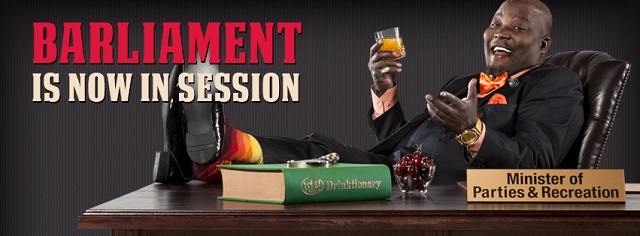
TOPS at Spar - Barliament is now in session

TBWA Durban for TOPS at Spar: “A Message from our HONOURABLE MINISTER”


TOPS is, of course, the liquor retailer run as a sub-brand of Spar in South Africa. It has a very strong social media presence, while also running ads in mainstream media. Most of its messaging focuses on humour and fun, more so than the ‘discount’ and ‘convenience’ aspects of its offering.

But it’s not all joking and laughter.

As with most liquor brands, TOPS has espoused an anti-drunk-driving policy; as part of this, it has produced the free Dryver app for smartphones, which is a social network system that helps you call a buddy or locate a taxi service when you’ve had one too many. This helps to position the brand as also having a caring and socially responsible aspect.

The humourous idea behind the “12th Official Language” and the “Drinktionary” is to create fun new words such as “Braai-hard” — an individual who continues braaiing against all odds — come wind, rain or loadshedding. Or there’s the “Kwaai-toe star” — a woman who has mastered the art of dancing in high heels.

TOPS at Spar - Braai HardThese have all been celebrated in the TV ad campaign, so what is notable in this case is the way in which the power of Twitter has been harnessed to elicit further recognition and traction for the campaign.

On a day when social media was dominated by citizen postings, according to Ornico research, the TOPS brand managed to make its mark by adding a little lightness to the pomp and ceremony leading up to the event.

So let’s raise a glass to TOPS, TBWA Durban, and the 12th Official Language of SA: the language of Party.


Oresti PatriciosAd of the Week, published on MarkLives every Wednesday, is penned by Oresti Patricios (@orestaki), the CEO of Ornico, a Brand Intelligence® firm that focuses on media, reputation and brand research.


If you are involved in making advertising
that is smart, funny and/or engaging,
please let Oresti know about it at info@ornicogroup.co.za.


— MarkLives’ round-up of top ad and media industry news and opinion in your mailbox every Monday and Thursday. Sign up here!

Africa Dispatches: Vlisco, a material part of Africa

by Mandy de Waal (@mandyldewaal) Africa’s most successful fabric company isn’t born of the continent, but rather from the Netherlands. Yet Vlisco has become embedded into African culture and trade because of its fierce understanding of customer intimacy.

In London, Nigerian-born Duro Olowu’s spring and summer collection is a riot of colour — bold prints masterfully combined by a man who’s reinventing urban chic. In fact, Olowu has become known as “the father of prints” after arriving in the UK in 2004, and ascending to the top fashion league.

Vlisco Africa
Vlisco is partnering with Cotton Made in Africa, a ‘trade not aid’ organisation aimed at improving the lives and working conditions of cotton producers on the continent. In terms of the partnership, Vlisco will produce and market fabrics with Cotton Made in Africa, and will share its branding resources with the initiative.

In South Africa, premier fashion label KLûK CGDT has a range of dresses made all the more distinct because of the fabric that was used to make them. More so, Malcolm Kluk and Christiaan Gabriël du Toit’s KLuK CGDT retail outlets were the first to stock bags and scarves using a Dutch fabric that’s become synonymous with high fashion in Africa.

Hans Ouwendijk, Vlisco CEO
Hans Ouwendijk — CEO of Vlisco

“What surprised me most when I first started working for Vlisco,” says Vlisco CEO, Hans Ouwendijk, “was that the African consumers really feel like they own our brand, not the other way around.” Vlisco, which creates ethnic fabrics and comprises four brands, namely Vlisco, Woodin, Uniwax and GTP, has been doing business in Africa for more than one-and-a-half centuries.

Vlisco’s relationship with the West Africa’s fashion trade started in 1846 and flourished in the late 1800s, after Ghanaian soldiers fighting for the Royal Netherlands East Indies Army favoured the distinct fabrics and took them home with them after their tour of duty. By 1930, Vlisco was working on the ground in West Africa and adapting its ‘wax hollandais’ fabrics specifically for customers in that market.

Today, 95% of Vlisco’s sales come from Africa, and KPMG reports in its custom magazine called Material Gains that, in 2013, the Netherland-based company’s turnover reached a record US$378.4m. This is a big jump on Vlisco’s 2009’s sales of US$234.2m.

Vlisco Think 1
Vlisco’s new collection for 2015 is called “Think” and contains a vibrant array of new fabrics “heavily inspired by the architectural and minimalistic world of Bauhaus, one of the first schools of design in Germany”.

Today, the company sells close on 50m metres of fabric into West, Central and southern Africa, and does an encouraging trade with Africa’s diaspora in the US and Europe. The group employs some 2 100 people, 1 500 of whom are based in West Africa.

“We are growing fast in our markets because we are listening to consumers,” Ouwendijk tells KPMG. Vlisco was always a customer-centric company, but Ouwendijk has instituted radical changes since his arrival in 2010. “That is not a unique strategy, but we are one of the few companies doing this specifically for Africa.”

Ouwendijk was brought on board five years ago, when the London-based private equity firm, Actis Capital, acquired 100% of the Vlisco Group for US$151m. At the time of the purchase of Vlisco, Actis said it aimed to double the size the business by changing the business from being production-based to being sales- and marketing-driven.

“The company I inherited was very focused around design and manufacturing,” says Ouwendijk. “Now we focus more on the consumer: on marketing, brand development, innovations and customer loyalty. Being close to our consumer is critical.”

“We get a lot of feedback from our wholesale customers and our stores in West Africa,” adds Ouwendijk. “We also spend a lot of time and money on research: looking at trends in the market, what is happening to particular consumers — different cultural groups, for example — and the key decision-making points for individual consumers.”

Vlisco Think 2
Vlisco says that its new “Think” collection “inspires women to follow their mind’s eye and give it free reign to create an outfit that fits their heart’s desire perfectly”.

What Vlisco has going for it is that the brand has become a material part of culture and commerce in West Africa and beyond. For instance, in Togo, the women who sell the sought-after Dutch Wax fabric are known as “Mama Benz” because their trade has made them wealthy enough to buy luxury vehicles.

Growth for Vlisco means that its customers and markets grow, too.

So, in Ghana, the fashion brand has teamed up with the Joyce Ababio College of Creative Design in Accra to launch the Vlisco Tailor Academy. This is an integrated college that teaches tailoring, and educates young women from previously disadvantaged sectors to reach financial autonomy.

In Nigeria, Vlisco kicked off 2015 by signing a memorandum of understanding with the government to help reinvigorate that country’s moribund textile industry. “The Government of Nigeria is delighted to welcome this investment and partnership from the Vlisco Group into Nigeria,” the country’s Minister of Industry, Trade and Investment, Olusegun Aganga noted at the signing ceremony. “We are determined to rebuild this historically important sector with its job-creation impact across the entire value chain, from cotton fields to fashion. We are looking forward to implementing this strategic partnership with the Vlisco Group.”

Vlisco History 2Government endorsement of the brand aside, Vlisco has teamed up with the Kinabuti Fashion Initiative in Lagos to offer specialised tailoring master classes to women so that they can take their passion for fashion to the next level. Courses there run for four months, during which top students will be offered the opportunity of working with the Vlisco Group and creating collections. These collections will be sold and returned to students to offer them start-up capital to realise their dreams.

In a world where capitalism has created big brands that stand like ‘churches for the shareholder’ — where those who financially invest in the brand get all the real benefit — Vlisco’s growth is buoyed by the fact that it intuitively understands customer intimacy and how to grow with its markets. This is a lesson South African brands moving up into Africa would do well to learn.

Read more:

Vlisco Fabric 1Vlisco Fabric 2
 

Mandy de Waal


Mandy de Waal is a writer based in Cape Town, South Africa. Follow her on Twitter at @mandyldewaal or on Google+.


— MarkLives’ round-up of top ad and media industry news and opinion in your mailbox every Monday and Thursday. Sign up here!

The Sell: What shopper marketing must learn from digital

by Mimi Nicklin (@MimiNicklin) Do you remember a few years ago, when “digital” was this new and confusing discipline that everyone wanted a piece of but no one knew how?

It was a time when suddenly there were “specialists” popping up everywhere and agencies all over the world either opened up a digital hot-shop or a department within their main agency to specialise in this new digital development.

Golden Dragon Statue on White Background by bugphai courtesy of FreeDigitalPhotos.net
Image by bugphai courtesy of FreeDigitalPhotos.net

Relative ignorance

We all talked the digital talk, in relative ignorance, as panic spread through the corridors that other agencies were ahead and that it would be “our” team that would be left behind.

Then, as the years went by, we all realised that digital should never have been this silo-ed, scary discipline placed into separate teams with separate briefs, but that it was a critical part of every idea and every brief and that every team should be trained and including it.

We realised it was costing us double in time and money to keep double-briefing separate teams and trying to fuse everything at the last minute before presenting to the client. Remember those days?

Cycle is starting again

This cycle (of early-days ignorance) is starting again, except this time it’s shopper marketing that is the scary dragon looming at the agency front door. And yes, yet again, everyone is running to open their own department to house it!

I have recently been asked by several people for my opinion on the establishment of shopper marketing expertise into agency networks and my answer is always the same: The solution isn’t to create a new team or department and to sell this newfound skill as a new billable set of heads, but simply to focus on integration.

Just as agencies wouldn’t dream of presenting work today without a digital or mobile solution, no agency should be presenting work without the shopper solution to support the consumer idea. Gone, gone, gone are the days when an acceptable shopper solution is a wobbler or poster that resembles the TV or print, with the addition of a “buy and win” message stuck on!

‘Reapplication’ doesn’t work

As we knew with the banner ads we were making ‘back then’ (our print ad in extended vertical format…), we all know this ATL ‘reapplication’ to retail doesn’t work. The problem is we either don’t know any different or — and this is more often the case — we don’t want to invest the energy in thinking about what might actually make people purchase.

Agencies don’t want to embrace shopper marketing; they don’t want to learn outside their box. So, instead, the dragon’s layer is not only formed, now it’s marketed as a “specialist” unit that clients can pay extra for, and the team within it are segregated to a new corner of the open-plan office, doing nothing for the greater effectiveness of the work or quality of the talent.

Of course, full integration is nigh impossible to do overnight and, without a doubt, it will require the hiring of new talent into your existing teams to build the understanding within them.

Archaic approach

My point here is that I am blown away by the archaic approach of so many agencies “starting up” new shopper units.

Shopper marketing isn’t a demon or a two-headed monster or a science. Certainly, there are technicalities and retail methodologies to learn but, as 2014 proved, the work that works across the path to purchase to the store consists of smart, strategically-driven creative ideas — exactly what said agencies deliver daily, anyway.

The days of developing new departments purely to create the final piece of the creative presentation you are already doing is not only old-fashioned but also expensive, clunky and the absolute opposite of dynamic, holistic idea-creation.

Why? Why? Why?

Why silo the teams further and then have to spend double the time briefing separately and then trying to integrate the ‘shopper’ team’s thoughts with the ‘main’ creative team? Why even create a divide in the first place, a divide that teaches your younger talent that this “shopper thing” is anything other than 100% critical for marketing in the 21st century? And why waste time when it’s a sure bet that, in a year or two, the teams will fold into one, anyway?

Every team will need shopper marketing expertise, just as every team already needs digital understanding and talent.

The dragon may be new (ish), yes. The dragon may speak jargon and concepts and have approaches unfamiliar to the agency — but the dragon is friendly, massively profitable and 100% necessary to selling your clients’ brands in today’s market.

Embrace the dragon

Don’t slay it — slay the perceptions that surround it. Because, whether you like it or not, it’s half way through the door and your people need to embrace the dragon — fire and all. Putting it in a box full of ‘specialists’ will do nothing for your long-term momentum in 2015 and beyond.

Shopper marketing should be part and parcel of every brief and nearly every solution and idea — never the ‘add on’ done on the side.

I hope by next January more people will agree with me.

Mimi, Savior of Dragons


Mimi NicklinMimi Nicklin (@MimiNicklin) has followed her passion and experience in the consumer, retail and shopper space around the world, from regional roles in Europe and Asia to South African shores in 2010 (where she served for four years as strategic director and a partner at 34 Group.) She has recently relocated back to Asia as global vice president of Grey Group Singapore. Mimi continues to contribute monthly to “The Sell” column — focusing on global shopper marketing, retail and through-the-line communication — to MarkLives.

— MarkLives’ round-up of top ad and media industry news and opinion in your mailbox every Monday and Thursday. Sign up here!

Homegrown: Lessons from the roadside

by Lynne Gordon (@lynne_gordon) Drive the back roads of Limpopo, walk the beaten sidewalks of Orlando West, or explore the crowded pavements of Joburg City; they’re everywhere — small homegrown businesses that pop up along the roadside of busy life in Mzansi.

The gazebo barber crafting a chiskop powered by his roadside generator, the butchery in an out-of-the-way dorp proudly claiming “SA’s best wors”, and the fruit vendor who promises “best deals on naartjies” — they are all celebrations of the person who sees a need, harnesses her entrepreneurial spirit, and opens the doors on opportunity. And, for the marketer, closer inspection reveals lessons from the roadside that are as relevant in the boardroom as they are in the backstreets.

South African Township Barbershops & Salons
South African Township Barbershops & Salons by Simon Weller, Garth Walker

The fight for growth

Big brands know what it is to battle for growth. In tough categories, on cluttered retail shelves, in a rapidly changing consumer landscape, brands vie for the strategic advantage of accelerating trial, growth in consumption, or the elusive word-of-mouth endorsement. Marketers craft brand plans, looking for the holy grail of increased return-on-investment.

And, whether method or magic, marketing is increasingly under pressure to show its worth in commercial return, creating a real impact for growth.

But it’s the ‘little people’ — the one-person shops on the roadside of the everyday — whose livelihood truly depends upon attracting the next consumer, upon closing every sale. Unschooled in the Art & Science of Marketing, they face the street with all the challenges of brand-building — fighting the battles of generating awareness, trial and consumption without the tools of the marketer.

Their battleground is not dissimilar to those of the corporate megabrand: cluttered marketplaces and a tough economy abound. Trained by necessity and hard yards, these are the homegrown marketers of the South African roadside.

Look to the farm-stall owner promising “Fresh strawberries in 1km!”, followed shortly by “Farm stall 500m” and finally “STRAWBERRIES!” — he understands the power of driving awareness and breaking through with sign-posting.

Watch for the township salon proudly displaying the photo of the local celeb coifed by its top stylist — it ‘gets’ endorsement and brand aspiration.

The local shebeen owner, branded inside and out by Carling Black Label, knows how to maximise brand partnerships.

Lessons for marketers

Ask a small business owner about her success, and she’ll tell you a few things about marketing. It may not be couched in the language of the marketer, but her lessons are clear:

  1. Know your consumer. The person who runs the roadside shisanyama is an ethnographer. The small salon owner is a trend-hunter. They know their consumer’s unmet needs and daily habits. They often live side by side with their customers, and understanding what consumers want and at what price is second nature.

They know how to command a premium by providing convenience, quality or other superior benefits. Their thinking must start with real needs and opportunities because there is nothing else that matters more.

For the trained marketer, the opportunity is to leave the safety of the desk in favour of the street, to replace hypothesis with insight, to get real about meeting consumers in their own world.

  1. Focus on a simple and compelling benefit. Most street-side businesses offer refreshingly simple products and solutions. Why? Because their resources to communicate are limited, because focus maximises impact at the outset, and because costs are generally lower offering a single benefit.

As an opportunity is fully leveraged and a need met, local entrepreneurs diversify with speed and agility but, at first, focus pays.

In tough markets, brands often need a reminder to hone in on single-minded promises of real benefit to consumers, before fragmenting their message and diluting impact and returns.

  1. Maximise communities. The spaza owner who offers credit to the homes on his street knows the power of building trust and recommendation in his local community.

The salon of the local neighbourhood diva is frequented by all her friends, and she offers the best service to her regulars who come in each month to have their hair styled.

The kasi funeral director is a master networker.

Brands and businesses are built upon relationships with consumers and, in an increasingly networked world, maximising communities is the core domain of marketers.

Part natural curiousity and part deep entrepreneurial desire for growth, homegrown brand-building distils the essence of great marketing. Born out of the need to deliver growth, these are commercial marketers at their best.

So hats off to the homegrown marketers — may we take the lessons from the roadside into the brand plan of the boardroom!


Lynne Gordon


Lynne Gordon (@lynne_gordon) is the managing director at strategic marketing consultancy Added Value. She learned marketing on-the-job and is fascinated by the streets of South Africa, where small entrepreneurs — untrained as marketers — apply the art and science of branding to their businesses.

Her monthly MarkLives column, “Homegrown”, will explore everyday businesses and the lessons corporate marketers can learn from the streets of Mzansi. Share your own observations, photos and examples of marketing from SA’s roadside with @lynne_gordon on Twitter.


— MarkLives’ round-up of top ad and media industry news and opinion in your mailbox every Monday and Thursday. Sign up here!

Tuned: Why brands should click, tag, post on Instagram

by Thabang Leshilo (@Thabang_Leshilo) There are over 1m active Instagram users in South Africa, according to Mike Wronski, managing director of Fuseware. While this number could be regarded as insignificant compared to the near 10m Facebook users in the country, it signals an important opportunity for brands to gain traction with its early adopters.

Personal observations of the medium suggest there are two types of Instagram users. The majority currently embrace the photo-sharing platform with gay abandon and no self-censorship to post filtered selfies, sunsets and rainbows, images of every meal eaten out and even whole albums at a time.

Instagram South Africa screengrabMore discerning

But there are also individuals who are more discerning, who use the platform more sparingly and as a means of self-expression.

These folk — the minority — are behaving like artists or social commentators as they post beautifully captured images of all kinds of interesting and unique findings, or of subjects that are of particular interest to them.

For brands, Instagram provides insight into people’s greatest passions helping their custodians and ambassadors understand what makes them tick.

Also, it enables brands to keep in step with the most emergent happenings and trends from the ‘cool kids’ of Mzansi, and then reflect these in their communications. The trick is to identify the right people to follow (not stalk).

Expect engagement

Importantly, the ‘cool kids’ — early adopters — certainly do expect brands to engage with them on Instagram. If you, as brand custodian, are still asking yourself if your brand should be active on the photo-sharing app or not, consider these 2014 Instagram report statistics (from startup company Olapic and research firm L2):

  • Engagement on Instagram is 15 times that of Facebook, with users spending an average of 257 minutes per month.
  • Instagram receives 1 000 comments and 8 500 likes per second. That comes to 1.2bn likes per day.
  • More than 16bn photos have been shared to date, with an average of 55m uploaded each day.
  • The number of users has increased 66% to 32m users, it’s the fastest growing of the top 10 mobile apps.
  • Instagram ads have helped retailers increase ad recall by 32% and boost brand message lift by 10%.

Best examples

Starbucks and Nike are the best international examples I know of mastering this platform, using their own content and user-generated content. While very few South African brands are present on Instagram, there are a few doing a great job of it: Woolworths (currently SA’s leading brand on Instagram), BOS Ice Tea and Yuppiechef.

Time to click, tag, post?

Thabang Leshilo by Jeremy Glyn in June 2014 glynj@fm.co.za

Thabang Leshilo (@Thabang_Leshilo) is a project manager at strategic marketing consultancy Added Value. As a ‘next-generation’ marketer with fresh and curious eyes looking into the industry, she has a keen interest for brands that are culturally in tune with and able to integrate and immerse themselves into the everyday realities of the consumer. She contributes the monthly “Tuned” column, sharing marketing insight and analysis, to MarkLives.

— MarkLives’ round-up of top ad and media industry news and opinion in your mailbox every Monday and Thursday. Sign up here!

Media Report: Africa’s data divide

a The Media Report 2014 feature by Wadim Schreiner. Data is required for businesses to plan — be it in marketing or development or expansion. African data is notoriously bad — incomplete, inconsistent and unreliable. If the continent is to take its place on the world stage, governments and businesses need to find a way to work together to collect and provide the data that will encourage investment and growth.

‘Do you have data on Africa?’ is a recurring question I am being asked on social networks or when attending conferences and meetings overseas. ‘Sure, what are you looking for?’ I generally respond. ‘What do you have?’ is the counter-question. This is where it becomes tricky.

Measure 2 by Tim GeersFirstly, Africa is of course not a country (at least for most). Just like people would not be asking for ‘Asian data’, they should not be asking for ‘Africa’. With 53 countries on the continent, the amount of data should be vast, deep, and insightful. Except that it isn’t. Data in ‘Africa’ is usually old, incomplete, with large gaps, geographically and topically. It differs from country to country.

South Africa for instance has a lot of data. Both government-collected as well as private sector-sourced. Most of this data is in the public domain, with some it held proprietary by commercially driven entities, which is fair since they paid for it. The statistics are constantly challenged, for instance: are crime figures really correct? Is unemployment really that low?

South Africa’s neighbour, Namibia, has similar challenges with national statistics. The figures don’t add up, claim some. Not for unemployment, not for the economy. The definitions differ and are up to interpretation, particularly if they are not politically favourable, say the same sources. This scenario recurs in other countries on the continent. Some data is available, but it is being questioned, which brings me to the second problem of ‘trust’ and ‘ownership’.

A hidden agenda

The government data that exists is not trusted by the private sector, as it is deemed to have some political agenda attached to it. The private data that is generated is not trusted by government because it is perceived to come with a capitalist agenda. While public-private frictions are not unique, to the rest of the world it seems that the differences in ideologies impact considerably, not only on the availability of data, but on how economies are run in general. The lack of trust hinders social development in particular. Data is one piece of the power and decision-making game.

In Africa, most data outside of government sources is collected and owned by sources outside of Africa. This data is frequently used and quoted by globally owned by major international (Western) institutions, such as the World Bank, the IMF or the United Nations. This could, perhaps be because they are more trusted, which takes us back to the earlier point of trust and data usage.

Large international consultancies collect data amongst their clients or through field work. These include PWC, EY, Boston Consulting Group, KPMG and the World Economic Forum with its Annual Competitiveness Report. It is perplexing on the one hand and understandable on the other. Large consulting firms are competing on a global scale, where having ownership in this ‘Africa growth story’, adds to their credibility. They compete over the quality and relevance of data, in order to get lucrative consulting contracts, where the data is used as a ‘thought leadership’ hook.

A competitive edge

If ownership of data is such a global competitive advantage, why is it that African consulting businesses don’t do the same? Where is their data? Why is it that there seems to be no concerted effort to collect more data, irrespective of the purpose?

Not all of the international businesses use their own resources to collect the data, most of them work with local field agencies. It is not for lack of capacity in data collection, but seemingly a lack of interest from government and organised business in African countries to conduct research themselves.

The third point is: relevance. I don’t question the reliability of the data currently available. I am sure the questionnaires are well compiled, statistically sound and the results interpreted correctly. But does data collection not also depend on the cultural differences of the target audience? People respond differently to questions in different cultural and political environments, which might influence the outcome of the survey.

While the results might be internationally comparable, they could be interpreted incorrectly from a local relevance perspective. I am not saying that ‘Western’ questionnaires give incorrect results about ‘African’ matters, but surely local knowledge is better suited to provide relevant survey outcomes than international parameters? Otherwise, it undoubtedly brings us back to challenge number two: trust. Can Africans trust data that has been generated and interpreted by Western data-owners, and vice versa? We should, but do we?

Relevant research

The only consistent data source from the continent has been the Afrobarometer, an initiative by African scholars and civil society — albeit funded by international donors—that has been collecting data around democracy and governance in 35 countries for many years. While limited to those two issues, it is the only consistent, cross-African and regionally developed data stream available. It is highly reliable and of a high quality. It is the source of the most relevant research on those subjects in Africa.

Why is this not replicated for business, consumer and other subject matters? I suspect that the reasons for the lack of African data is a potential fear of what will be done as a result. If data is not favourable, there is a historic trend to suppress it on the continent. In other regions across the world, having multiple streams of data collection all the time, the possibility of ‘managing’ data results are limited.

Not so in Africa. Many gatekeepers monitor fewer data collectors, which poses a threat to transparency and accountability that normally emanate from data being made available. Data only threatens those who fear accountability and transparency. While data can lie and may be up to interpretation, it still is a scientific source that allows for debate and verification.

If African countries want more foreign direct investment, other than resource-based, such data is the key to unlocking business and investment opportunities. Without transparent and multi-stream data, the risk of doing business is simply too great. Not only in terms of Africa, but across the world.

If African countries want to diversify their economies, create more opportunities for citizens through international co-operations — including those of neighbouring countries — more data and especially current data is required. It is the availability of insights, based on data that will unlock the full potential for countries on this continent, not policies or government agreements.

the media report: independence graphicWadim Schreiner is the director of Social Licence, a communication research firm operating in South Africa, Australia and New Zealand that measures, analyses and advises the private and public sector on effective approaches to community and stakeholder engagements. He is the deputy chairperson of the South African Media Monitoring and Measurement Association.

This feature first ran in The Media Report 2014, which is published by Ornico with MarkLives.com as its official media partner. Read or download the full magazine via Issuu.

— MarkLives’ round-up of top ad and media industry news and opinion in your mailbox every Monday and Thursday . Sign up here!

Agency Leaders: 2014’s most-admired ad agency in SA

by Herman Manson (@marklives) Our annual poll of South Africa’s top agency executives has already revealed which agencies, agency leaders and creatives are most admired by regional peers. Today, we reveal the results of our national poll, which dispensed with regional boundaries and asked execs to nominate their choice of their most-admired peers, irrespective of where in the country they are based.

Some of the results might be surprising, especially given the changes being reflected in the Cape Town results we published two weeks ago. It’s Joburg’s execs who’ve moved the dial to ensure our most-admired agency results mirror those of 2013 (down to the joint runners-up).

Recapping Cape Town results for 2014

Ogilvy & Mather Cape Town and King James Group have tied for most-admired agency, with FoxP2 the runner-up. Justin Gomes, ECD at FoxP2, and Alistair King, founding creative partner at King James Group, have tied for most-admired creative, with Chris Gotz, CCO of Ogilvy & Mather South Africa, the runner-up. Adrian Hewlett, CEO, Publicis Machine, is the most-admired agency boss.

Ogilvy Cape Town has been voted the most integrated, with Publicis Machine the runner up. The latter is also voted the one the watch, followed by Saatchi & Saatchi Brandsrock.

The Cape Town poll has revealed a revitalised King James Group and unanimity in the vote for Adrian Hewlett as the most-admired agency boss in town.

The poll results are dominated by Ogilvy & Mather Cape Town, Publicis Machine, King James and FoxP2.

Recapping Johannesburg results for 2014

Joe Public has emerged as the most-admired ad agency among Joburg-based ad execs, with FCB South Africa the runner-up. The most-admired creative is Pepe Marais, founding partner and CCO of Joe Public, with Mariana O’Kelly, co-ECD at Ogilvy & Mather Johannesburg, and Brett Morris, group CEO and ECD of FCB South Africa, tying as runners-up.

The most-admired agency boss is Morris, with Gareth Leck, group CEO of Joe Public, as first runner-up. Our second runner up is Alistair Mokoena, MD, Ogilvy & Mather Johannesburg (ex MD, FCB Joburg).

Ogilvy & Mather Johannesburg is viewed as the most-integrated agency, with Publicis Machine as runner up.

The poll results are dominated by Joe Public, FCB South Africa and Ogilvy & Mather Johannesburg.

How it works

Agency leaders in Cape Town and Jozi completed regional polls and were also invited to participate in our national poll, where their nominations were not restricted to the reagion in which they are headquartered. Ad execs in Durban were also invited to participate in our national poll. We also asked them which agency did the best at digital integration and which agency they saw as the one to watch in the future.

Nobody could nominate his or her own agency or staff. All the nominations were then tallied up to see whom adland’s highest decision-makers most admire.

You may find our 2013 results here and the 2012 results here.

Agencies

Ogilvy & Mather Cape Town

and, as runner-up,

Joe Public

Most-admired: Ogilvy & Mather Cape Town

According to Ogilvy & Mather Cape Town MD, Luca Gallarelli, the agency’s strike rate on successful pitches was up there with the best it has ever been, winning every pitch it participated in and, in the process, picking up the following new clients: Allan Gray, Pearson Education, Metropolitan and Metropolitan Health, and 24.com.

Revenue growth over 2014 sat at 16.68% at the beginning of December, which, as Gallarelli notes, “is incredibly strong given our scale”. No business was lost over the same period. Total headcount grew from 278 to 312, representing an expansion of 12.23%. The agency won Agency of the Year at Tony Koenderman’s AdReview awards.

“2014 [is] our strongest commercial year ever,” says Gallarelli. “I’m stoked that we’ve upped our game when it comes to new business. Happy, too, are we that our ambition to build out deep specialisations has gained momentum and is working.”

Runner-up: Joe Public

Runner-up Joe Public saw staff grow from 161 to 183 (12%), the agency achieved 23% annualised revenue growth between June 2013 and June 2014, and it moved into a new bespoke three-storied, 3000m2 building in Bryanston.

Account wins included SAICA, Glenmark Pharmaceuticals, Times Media, Mandela International Film Festival and Hippo.co.za, among others.

In 2014, the group took home the AdReview Agency Group of the Year, as well as the title of AdFocus Agency of the Year.

Joint second runners-up: King James & FoxP2

King James Group last year won Sanlam, City of Cape Town, New Balance and a cellular offering from Durban-based The Ignition Group, while King James II in Jozi won Garmin, iStore and Altech Node.

The FoxP2 Group, meanwhile, saw FoxP2 Johannesburg start delivering results for Liberty and also won the the FNB business. Other new clients for FoxP2 Cape Town included Unilever, Superbalist, Imperial and Stanlib.

Creative directors

Chris Gotz
Chris Gotz

and, as runner-up,

Pepe Marais
Pepe Marais

Most-admired: Chris Gotz, CCO of Ogilvy & Mather South Africa

Chris Gotz, chief creative officer of Ogilvy & Mather South Africa, has been named as the most-admired creative in the country, as voted for by agency execs. Johannesburg-based ad bosses voted overwhelmingly in favour of Gotz.

Gotz came off a big year in 2013, when he was lauded for his work on Carling Black Label. In November 2013 he was promoted from ‎Executive Creative Director at Ogilvy and Mather Cape Town to Chief Creative Officer of the Ogilvy & Mather South Africa group.

Runner-up: Pepe Marais, founding partner & CCO, Joe Public

Runner-up Pepe Marais, founding partner and CCO of Joe Public, is respected both for his hand in guiding agency Joe Public to creative and financial success, and for his interest in having advertising benefit not only brands but also good causes — a notable example being Project English and its One School at a Time campaign.

Agency bosses

Gareth Leck
Gareth Leck

tied with

Brett Morris
Brett Morris

and, as runner-up,

James Barty
James Barty

Most-admired: Gareth Leck, group CEO of Joe Public, and Brett Morris, group CEO, FCB South Africa — tied

FCB South Africa enjoyed a revival of sorts last year, as good news flowed both in terms of new client wins and creative points. Its peers have noticed and have given group CEO Brett Morris a pat on the shoulder for managing well in his first year in the top job.

Morris has tied with Gareth Leck, group CEO of Joe Public.

Runner-up: James Barty, CEO, King James Group

James Barty, CEO of King James Group, is our runner-up in a very tight race — only one vote separated him from from the two front-runners.

Most-integrated (digital)

Ogilvy & Mather Cape Town

and, as runner-up,

Publicis Machine

tied with

FCB South Africa

Most-integrated: Ogilvy & Mather Cape Town

Ogilvy & Mather Cape Town retains its title as the most-integrated agency in the country, local ad execs believe, by a significant margin.

Joint runners-up: Publicis Machine and FCB South Africa — tied

Publicis Machine and FCB South Africa have tied as runners-up.

One to watch

Publicis Machine

and, as joint runners-up,

Ogilvy & Mather Johannesburg

tied with

FCB South Africa

One to watch: Publicis Machine

“One to watch” is where execs got to nominate an agency from which they expect big things in the year ahead. Publicis Machine has won by a comfortable margin…

Joint runners-up: Ogilvy Johannesburg/Gloo and FCB South Africa (tied)

But is being challenged by the Ogilvy Johannesburg/Gloo tie-up, announced shortly before our poll, and FCB South Africa.

— MarkLives’ round-up of top ad and media industry news and opinion in your mailbox every Monday and Thursday. Sign up here!

Green Sky Thinking: The shifting role of the consumer

by Colwyn Elder (@colwynelder) Three campaigns did a standout job for sustainability in 2014, and a prevalent theme across all three is the shifting role of the consumer. While there’s always been a role for more conscious consumption, shoppers are now finding their collective voice.

These three campaigns are noteworthy, not least of all owing to the successful accomplishment of their objectives, but also due to the broad cross-section of issues addressed and the manner in which these were tackled.

  1. Everything is NOT awesome — Greenpeace

Greenpeace’s Everything is NOT Awesome campaign shows a pristine arctic landscape built from over 120kg of LEGO bricks, slowly covered in oil. With over 6m YouTube views, the film is the most-viewed in Greenpeace’s history, and culminated in the announcement that LEGO will not be renewing its 50-year partnership with Shell.

While the strategy behind the campaign cleverly recognised the creative potential inherent in the iconic LEGO brick and its characters to capture hearts, it was equally criticised as too simplistic and failing to acknowledge just how entrenched oil is in our society, least of all as a raw material for LEGO bricks.

The toy giant initially resisted the campaign, saying that Greenpeace was using the LEGO brand to target Shell when the right thing to do would be to take it up with Shell directly. However, overwhelming public support soon gave cause to relent, and offline campaign support in the form of a child-led protest outside Shell’s HQ highlighted the emotional link between climate change and future generations.

“It did touch a bit of a raw nerve about the partnership between the two companies that people thought was completely inappropriate — for a toy company like Lego to partner with an oil corporation — which is a sign of changes that are happening [in public attitudes towards fossil fuel companies],” said John Sauven, executive director of Greenpeace UK, according to The Guardian.

  1. Behind the Brands — Oxfam

Oxfam Behind the Brand screengrabOxfam’s Behind the Brands campaign has also used consumer pressure to bring about change. The Behind the Brands Scorecard assesses the agricultural sourcing policies of the world’s 10 biggest food and drinks companies across seven themes, including climate, water, land, farmers, workers, women and corporate transparency.

The campaign objective is to provide people with the information they need to hold the Big 10 accountable, and it’s working. Nearly 650 000 people around the world have signed up and many of the brands have taken action, proving that consumer power is a force to be reckoned with.

In May 2014, Oxfam highlighted harmful food production practices contributing to climate change, identifying Kellogg and General Mills as the worst offenders. By summer 2014 (northern hemisphere), both companies committed to measure, publish and reduce emissions across their entire supply chains.

The campaign’s real success is that it tackles issues that are complex, difficult to communicate and that don’t tug at the heartstrings, yet it still manages to engage with people.

By simplifying these issues into a user-friendly scoresheet that is both easy to understand and comparable with other brands, Oxfam uses consumer power to bring positive influence deep inside company supply chains.

People are increasingly looking to understand more about the brands they buy and are actively seeking out such information so that they can make informed choices in line with their values. Behind the Brand’s enables them to do just that.

  1. Let Toys be Toys

Let Toys Be Toys logoLet Toys be Toys is a parent-led campaign that began life as a discussion thread on Mumsnet. Born of parents frustrated by the ongoing (and seemingly increasing) gender stereotyping prevalent in toy promotions and marketing to children, the campaign simply asks that the toy (and more recently the publishing) industries stop limiting children’s interests and imagination by promoting some toys and books as only suitable for girls, and others only for boys.

By sorting and labelling toys by theme or function, rather than by gender, children can decide which toys they enjoy best.

“Toys are for fun, for learning, for stoking imagination and encouraging creativity. Children should feel free to play with the toys that most interest them,” it says on lettoysbetoys.org.uk.

After 14 retailers in the UK agreed to stop gender-based marketing, the campaign was extended to books. Respected educational Usborne Publishing was the first to announce that it would not be commissioning any new titles labelled for boys and girls. Since then, Dorling Kindersley, Ladybird Books, Parragon, Chad Valley and Miles Kelly Books have all followed suit.

Responsibility rests not upon the shoulders of individuals but upon manufacturers, producers and governments, and at the heart of all these campaigns is the desire to see major corporations using their power to tackle global sustainability issues.

Flexing our citizen muscles as a consumer group can nudge them to do so effectively.


Colwyn Elder


Strategic consultant Colwyn Elder (@colwynelder) brings a global perspective to the issue of sustainability, having lived and worked in London, Tokyo, Amsterdam and Cape Town. She contributes the monthly “Green Sky Thinking” column on sustainability issues to MarkLives.


— MarkLives’ round-up of top ad and media industry news and opinion in your mailbox every Monday and Thursday. Sign up here!

MagLove: Partying it up

MediaSlut (@MediaSlut)’s choice of the best international and local magazine covers this week:

  • Creative Review
  • Outside
  • Time Out New York (Annual Singles Issue)
  • JSE

INTERNATIONAL

Creative Review, February 2015

Creative Review, February 2015For its February issue, Creative Review investigates how “creativity is changing what and how we eat”, with articles ranging from fast-food chains, apps for farmers, Disappearing Dining Clubs to trends in food photography.

Its creative way of illustrating the letters F-O-O-D on the cover is, of course… creative!

Read more about its features right here.

Outside, February 2015

Outside, February 2015I’ve got 100 places I’d rather be, and no. 17 of Outside’s list is definitely one of them, after seeing this cover!

Time Out New York (Annual Singles Issue)

Time Out New York, February 2015: Annual Singles IssueI didn’t know that Time Out New York has an annual “Singles Issue”! And, to top that, also a “Singles Party” to celebrate the launch!

The various stickmen was a great way of illustrating ‘single life’.

View the “singles” partying it up at the “Singles Party” right here.

LOCAL

JSE, January – March 201

JSE, January - March 2015JSE magazine in South Africa does it again, taking its cover story to conceptual heights!


Find a cover we should know about? Tweet us at @Marklives and @MediaSlut.
Want to view all the covers at a glance?
See our MagLove Pinterest board!


MediaSlutMagLove by @MediaSlut is a regular slot featuring the best local and international magazine covers every week, recognising well thought-out, powerful and interesting (and hopefully all three-in-one) covers and celebrating the mix of pragmatism, creativity and personal taste that created each of them. The (for now anonymous) blogger behind MediaSlut knows way too much for his own good about media in South Africa, magazines in particular. His mission is to show when SA magazines fail but, most importantly, also when they succeed. If you’re looking for a library about SA magazines and news, this is your one-stop pitstop.

— MarkLives’ round-up of top ad and media industry news and opinion in your mailbox every Monday and Thursday. Sign up here!

Smart Africa TV: MediaBox lets your TV play everything, anywhere

by Russell Southwood (@BalancingActAfr) In this video interview, we talk to James Muir, founder of Mediabox, about:

Smart Monkey TV logoRussell Southwood (@BalancingActAfr) is the founder of Balancing Act and the web TV channel Smart Monkey TV (@SmartMonkeyTV), and has been an analyst in telecoms, internet and broadcast in Africa for the last 15 years. Smart Monkey TV aims to capture the energy at the crossroads between African culture and technology. MarkLives is syndicating content from Smart Monkey TV on a weekly basis for the column “Smart Africa TV”.
— MarkLives’ round-up of top ad and media industry news and opinion in your mailbox every Monday and Thursday. Sign up here!
Online CPD Courses Psychology Online CPD Courses Marketing analytics software Marketing analytics software for small business Business management software Business accounting software Gearbox repair company Makeup artist