Media Future: Digital divide also attitude divide

by Arthur Goldstuck (@art2gee) The digital divide between developed and developing countries is no longer only about access to technology. A gulf also exists in attitudes to technology.

It’s pretty obvious that developed countries almost seem to be a on a different planet from those with emerging Arthur Goldstuckeconomies when one considers use of high-tech devices and their visibility in the human environment.

But now an invisible divide between the haves and have-nots has also emerged, and that is the gulf between the attitudes of those living in such divergent economies.

A global study released by Microsoft last week shows that, while most Internet users believe personal technology has improved their lives, far more users in developing countries believe it has improved social bonds.

The report, entitled “Views from Around the Globe: 2nd Annual Poll on How Personal Technology Is Changing Our Lives,” is based on interviews with more than12 000 Internet users from 12 countries.

The most fascinating aspect of the study is how greater pervasiveness of technology seems to result in reduced enthusiasm for specific benefits, like fitness and the sharing economy. Instead, those with greater access tend to express greater concern about issues like privacy. Naturally, such issues are less important in environments where the implications of pervasive connectedness have not yet become apparent.

The key overall findings, according to Microsoft, include:

  • Most respondents across all 12 countries think personal technology has had a positive impact on their ability to find more affordable products, start new businesses and be more productive;
  • Most respondents say it has benefited social activism;
  • More respondents than in the previous year said technology had had a positive impact on transportation and literacy;
  • Fewer than in the previous year said it has benefited social bonds, personal freedom and political expression.
  • Concern about technology’s impact on privacy jumped significantly. Most users across 11 of the 12 countries surveyed said technology’s effect on privacy was mostly negative.
  • Majorities in all countries except India and Indonesia said current legal protections for users of personal technology were insufficient;

However, marked differences began to emerge when responses from developing countries were grouped, says Zoaib Hoosen, managing director of Microsoft South Africa.

“In developing countries, 60 per cent of respondents said technology had a positive impact on social bonds, versus only 36 per cent in developing countries. That’s a very significant difference.

“The sharing economy, with its online services like Uber, are seen as having a positive impact in in developing countries, while in developed countries they still preferred traditional services.

“The issue there is that they often didn’t have a viable alternative in developing countries, whereas such services in developed countries merely add additional options. It’s about leapfrogging traditional services that don’t exist versus disruption of existing services. The former has a bigger impact.”

Nevertheless, says Mark Penn, Microsoft executive vice president and chief strategy officer, “Internet users overwhelmingly say that personal technology is making the world better and more vital.”

The area that saw the greatest divergence was the effect of technology on trust in the media, says Penn.

“By a 2:1 margin, respondents in developing countries think personal technology has had a mostly positive effect on trust in the media. But in developed countries, the impression is the opposite: respondents believe by a 2:1 margin that the effect on trust in the media has been mostly negative.”

The key factor behind this attitude divide appears to be the media habits of respondents, and dependence on social media.

“These opposing views are borne out in the two kinds of countries’ media habits,” says Penn. “In developing countries, 70 per cent of respondents get most of their news from social media, compared to only 31 per cent in developed countries.”

With social media access accelerating in developing countries, thanks to rapidly growing access on phones, that divide is unlikely to be bridged very soon.

* The poll, conducted in the last two weeks of December 2014, included Internet users in Brazil, China, France, Germany, India, Indonesia, Japan, Russia, South Africa, South Korea, Turkey and the U.S.

Arthur Goldstuck heads up World Wide Worx (www.worldwideworx.com) and is editor-in-chief of Gadget. He is a consulting editor to MarkLives and our media tech columnist. Follow him on Twitter on @art2gee. This article has been republished from Gadget.

— MarkLives’ round-up of top ad and media industry news and opinion in your mailbox every Monday and Thursday days. Sign up here!

The Real McCoy: Under-promise and over-deliver

by Sean McCoy (@TheRealMcCoyTRM) In a classic case of the converse, my 2015 has gotten off to a grumpy-consumer start, in the area of technology and wireless broadband services specifically.

The service provider shall naturally remain anonymous to ensure that this isn’t a personally convenient gripe column. The example, however, resonates very strongly in my thoughts at the moment and triggers a somewhat vocal view about why organisations should adapt their communication in line with what they are capable of delivering against, and not the other way around.

Disconnect from the Internet by Jeroen van Oostrom courtesy of FreeDigitalPhotos.net
Image by Jeroen van Oostrom courtesy of FreeDigitalPhotos.net

Totally underwhelming

My broadband service provider was very aggressive in its sales efforts and service commitments in the lead-up to the signing of an initial contract. The installation process which followed was not as promising, however, and some eight months later, at the first real technical problem, the after-sales service has been totally underwhelming and downright non-existent.

All attempts at service are met with apathetic call-centre agent responses, no ownership of the service problem and blaming every other party in the value chain, rather than simply being accountable themselves and making any effort to solve my problem.

What makes this extremely frustrating and different to any other apathetic service level is that this organisation, from the desk of the managing director, has been submitting bold, ongoing communication about its ‘service excellence’ and its ‘deep commitment’ to going the extra mile to ensure its ‘leadership position’ in the industry — quite laughable, if it weren’t so blatantly false and sad.

Critical need

As I try to get this off my chest and calm down a little, I remind myself and all marketers of the critical need to ensure brand alignment and cohesion between what is promised in the communication and what is delivered by the business.

All too often, we get exceptionally creative at clever campaigns, catchy slogans and pay-off lines; and great communication that resonates with consumers in the market and potentially draws them in. Do we ever stop to check and see whether the organisation is capable of meeting these promises or if the promise is a bridge too far in over-extending the ability of the business to achieve this?

I fear not — this is all too often left to chance and the consumer suffers in the process.

Perhaps the business doesn’t really care and is only interested in the revenue end of the equation — a clearly limited and short-term view.

A failed brand experience

Be it a service or a product, it is incumbent upon the business to ensure that people delivering against the promise are suitably prepared and equipped for it; and that systems and processes fully empower and enable them to do so, avoiding a situation such as I have described that simply deteriorates into a failed brand experience, complete souring of the relationship and what will no doubt translate into the ultimate end result and brand crime — voting with one’s feet and placing the share of wallet elsewhere.

This is not to suggest that marketing messages and campaigns should dish up “me too” mediocrity and the over-ordinary. To the contrary, the role of business and marketing is to differentiate and capture a slice of the market — it needs compelling communication and a healthy dose of business stretch to achieve this.

What it doesn’t need, however, is over-extension to the point of non-delivery or disconnect; or commitment of the ultimate brand oversight of failing on the promise to market.

Rule of thumb

As a rule of thumb, communication perceptions should lean towards under-promising and over-delivering, translating into positive consumer surprise or delight, rather than irritation and potential loss of business.

If you are going to make bold service or product claims, then be confidently sure of your ability to deliver against them; alternatively temper the statement to ensure it meets your business capability — competitive advantage cannot be achieved by making false claims or by trying to put brand wrapping on a poor product.

As a result of this service provider’s poor performance, you are on the receiving end of an irate consumer perspective, blended with a professional industry viewpoint — and delivered off another broadband platform, of course!

Sean McCoy


Dr Sean McCoy, MD and founding member of HKLM, is a prominent figure in the branding arena, with his expertise centered on client service, brand strategy and business development. Sean has been chairperson for the Brand Council of South Africa since 2012. He contributes the regular “The Real McCoy” column focusing on internal branding to MarkLives.


— MarkLives’ round-up of top ad and media industry news and opinion in your mailbox every Monday and Thursday. Sign up here!

Shelf Life: African app innovation

Louise Marsland (@Louise_Marsland)’s weekly pick of recent product, packaging, design and food launches:

  • Retroviral refreshes brand CI
  • SA wine industry posed for growth in 2016
  • African app developers up for global award, and
  • Hertex launches latest African inspired prints

#NewRetro is here

Retroviral logoDigital communications agency, Retroviral, launched its new corporate identity last week with a ‘retro’ look and feel, hashtagged all over social media, et al. NiceWork, Johannesburg, collaborated on the brand refresh with Retroviral.

Explains founder and CEO, Mike Sharman: “We specialise in an industry that is constantly evolving, and it is important that we continue to hunt out trends in order to stay ahead of the curve. We turn five this June and have really focused on refining our offering over the past 18 months, to a four-pillar approach: strategy, content creation, content dissemination, and reporting. With this came the decision to develop a new look and feel, while maintaining the strength of the brand we have created within the South African digital industry.”

Sharman says the ‘retro’ design was inspired by the fact that, while there will always be new channels through which to communicate, the principles of communication are paramount for developing sound strategy. “This is the ‘retro’ aspect of our offering. The ‘v’ in our logo has become synonymous with our brand and something that we wanted to maintain with the evolution of the CI.”

For 2015, Sharman says his agency will “continue to create tomorrow what didn’t exist today”.

And of course, it being Retroviral, the team have also made a video of its year-in-review.

Wine industry set to grow

Wine glassSA’s wine industry not only continues to increase its contribution to the country’s GDP but is also growing job opportunities. This is despite the impact of a muted global economy and a slight decrease in the size of the national vineyard.

What is really interesting is the increase in private wine cellars. Production costs, however, have risen and, as a result, about one-third of wine producers are operating at a loss.

All of this is according to the latest report on the macro-economic impact of the country’s wine industry on the South African economy, prepared by Conningarth Economists for South African Wine Industry Information and Systems (SAWIS) and released last week. The five-year report covers the period 2008–2013.

The industry remains one of SA’s leading agri-exporters, accounting for 1.2% of the national GDP in 2013. In that year, it contributed R36.1bn to the economy (including wine tourism) via agriculture, manufacturing, trade and hospitality, while generating direct and indirect employment for close to 300 000 people.

Speaking on behalf of the industry, Yvette van der Merwe, executive manager of SAWIS, said SA was the eighth-largest national wine producer by volume worldwide. Yet relative to its competitors in Europe and Australia, it received very little government support for its production and marketing initiatives.

While per capita wine consumption in SA has been hovering at just below 7 litres in recent years, overall demand has been growing by about 4% per annum as new consumers enter the market. The number of private wine cellars has also been climbing, to reach almost 500 by 2013.

Van der Merwe pointed out that local growth in wine sales was helping to offset the ongoing decline in the brandy market, which saw volumes drop by 28% compared to 2008. It takes approximately five litres of wine to produce a litre of brandy.

“From 2016, we can also look forward to the impact of the new EU Trade Agreement, which will raise the EU’s duty-free quota for South African wines from the present 50m litres to 110m litres a year.”

Cheers to that! And for all of you working with the wine industry, the full report is available for download.

African app innovation

Handi'EducA team from Senegal have made it to the global semi-finals of the Ericsson Innovation Award for an app that supports handicapped children in a learning environment. They are the only African entry to have made it this far.

Team Handi’Educ’s web/mobile application has been developed to address challenges faced by children who have vision, speech, hearing and mobility disabilities. The app converts text to audio for the visually impaired and converts speech by educators to text for learners whose speech and hearing might be impaired.

The app was developed by three engineering students in Senegal. Finalists will be announced on 16 March and the winners will be revealed in April.

The 2015 theme for the annual awards promoted by Ericsson is The Future of Learning. The competition was launched in 2009 to spark app development and boost innovation.

Mama Africa

Hertex Mama Africa: Zola SunburntHertex has launched its latest fabric collection inspired by traditional Shweshwe prints, called Mama Africa.

The patterned designs are intended to be bold and colourful, adding true African flair. The intricate patterned designs are printed by a local mill on a linen-mix and cotton multi-purpose base cloth.

The truly South African designs are available in four colourways.


Shelf Life is a weekly column by Louise Marsland. Tweet new product, packaging and design launches to @louise_marsland Louise Marslandor email her at louise.marsland at gmail.com. Want to sponsor Shelf Life? Contact us here.

Louise has written about the FMCG, media, marketing and advertising industry for over 20 years as a former editor of magazines AdVantage, Marketing Mix and Progressive Retailing, as well as websites Bizcommunity.com and FMCGFiles. She also edited the weekly Wednesday Media & Marketing Page for The New Age newspaper. She is currently the publishing editor of industry trendwatching portal, TRENDAFRiCA, for consumer insight, research and trends in Africa; a regular industry columnist and speaker; a consultant on content strategy; and contributing editor to Fast Company South Africa magazine, which has just launched in South Africa.

— MarkLives’ round-up of top ad and media industry news and opinion in your mailbox every Monday and Thursday. Sign up here!

Brand Culture: Comic-strip archetypes in advertising

by DK Badenhorst. If you are not a fan of superheroes, I’ll probably have to allow a few seconds for your eyes to return from the back of your head. After all, superheroes are for kids, right?

But keep in mind that the first DC comic, the one where Superman smashes a gangster car and sends a villain running out the bottom-left corner, was popular among working men before it was the spoils of upper-class kids.

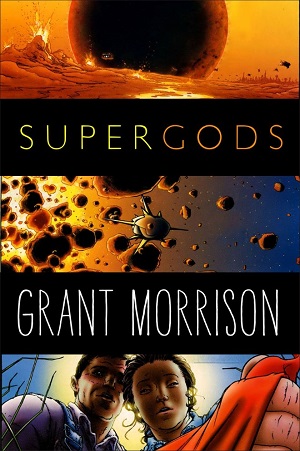
Grant Morrison's SupergodsPreceded the internet

Superman preceded the internet. And the biggest revolution in distribution of information prior to the internet was the Gutenberg press. Comics were printed entertainment, and the closest the average man could get to the escapism now afforded to us by Facebook, 9Gag and YouTube.

“Batman was born of the deliberate reversal of everything in the Superman Dynamic.” — Grant Morrison, “Supergods”.

From this quote, comic book writer Morrison goes on to explain how Batman truly is the inverse of Superman.

Superman is an alien with superhuman strength, a bright costume and who grew up as a farmer’s son. Batman is a human with no super powers, a dull costume and who grew up as a billionaire’s son. Superman loved Lois Lane from a distance; Batman was a womaniser. Superman had a boss, Batman had a butler. Morrison’s list goes on.

Change vs adjustment

In interviews, Morrison talks about how Superman has changed over the decades to suit his times, an example I’ve often used to demonstrate how a brand can adjust to reflect relevant values. Batman goes through little change; instead, it’s his villains who adjust (follow the Joker through his movies). Whom Superman is adapts; what Batman fights against changes.

It’s remarkable to see how the sun god and the dark knight oppose each other, almost as if the first two superheroes marked the territory in which the others can develop.

Morrison’s title “Supergods” is also appropriate. The Greek Pantheon provides us with a framework that, if not prescribes DC comics, at least provides a loose framework. Superman is something like Hercules or Zeus. Batman is a bit like Hades.

The DC and Marvel worlds sort of reflect each other, and then the Greek and Roman pantheons overlap. There’s also not a lot of work to do if you want to match Carl Jung, founder of analytic psychology, to the pantheons and the hero lists.

We create the gods

It would, then, seem that we create the gods and not the other way around. In the case of Marvel and DC, we know this — but the Greeks and Romans might have disagreed.

It’s for this reason that I’m a huge fan of archetype work. There’s reason to believe that there is a rather rigid chassis underneath our thinking, almost like that ladder-like shape that forms the basis of a car. We can shape it into something really beautiful and unique but, underneath it all, is a simple and immovably rigid structure.

But how would this manifest in a portfolio? What would actually happen if we applied this to a brand? The answer arrived in an almost textbook way when I was going through international advertising a few days ago.

The first commercial that launched the new Audi TT in the UK in 2014 shows the TT, our superhero, screaming in from beyond the stratosphere, landing on a massive ramp, arriving the change the world.

It’s cherry-picked from Superman language. Something magnificent, sent from the sky to save us from ourselves. The ramp is that sort of past-futuristic construction (like the pyramids), so colossal that it would only make economic sense in a time where slavery was really ok in the most-advanced regions of the world.

And then, of course, the car is red — bright Superman red.

The other commercial from the same brand is for the A7 Sportback.

Superman fought for truth, for what is right and for survival of what is good — all lofty ideals. Batman battled psychopaths and schizophrenics in gritty warehouses. Metropolis is a modern bustling city; Gotham is a dark underworld. Superman flies high in the sky; Batman struts around basements.

So, too, the A7 Sportback is introduced in a basement to the sound of the sinister voice of a lonely gramophone.

It’s a bit eerie. Something is out of place. Then, the A7, not entirely unlike the Batmobile, glides in. It meets the antagonist — the-old fashioned way of making a presence — and cheekily knocks it of the table. The gramophone’s voice winds up into a surreal and defunct tone before it crashes to the ground. The A7 retracts its wing and glides off — confidently and quietly.

Speak to truths in our lives

It’s unlikely that these two commercials were willfully created off the back of DC comics. Much like the ancient pantheons were not the base for Marvel and DC. It’s more likely that these characters, these archetypes, speak to truths in our lives — it reflects who we are and how we are.

Archetypes give us a fantastic point from which to start, whether it’s Jung’s archetypes, Grimms’ Fairy Tales or just general story characters. They are a prepackaged set of values, rules and expectations that’s been checked against reality, time and time again.

Instead of recreating complicated and plausible characters, we can simply learn from archetypes, adjust to suit our brand and use them as the foundation to create, not a something, but a someone that our target audience will recognise.


DK Badenhorst


DK Badenhorst is a cultural insight and semiotics consultant who brings cultural context and long-term trend insights to brand communication. He contributes the monthly “Brand Culture” column, exploring the value and meaning interaction between brands and society, to MarkLives.com.


— MarkLives’ round-up of top ad and media industry news and opinion in your mailbox every Monday and Thursday. Sign up here!

Creation: Differentiating — three powerful steps to succeed as a creative

by Artwell Nwaila (@artwelln) Many years ago, on my first day of work, the first person I met was an old man whom I thought was the boss. He showed me to my desk and made small talk to put me at ease.

One of his tales was of the 20 wonderful years he had enjoyed at the company. The gentleman finalised his story by telling me that he was the scanner guy and had a few months left before he retired and got a big pay cheque.

Arrow Upstairs by renjith krishnan courtesy of FreeDigitalPhotos.net
Image by renjith krishnan courtesy of FreeDigitalPhotos.net

The first think I could think of was “WTF? I am more senior than this guy who looks strangely like Steve Martin!” Could this be my future? Was I destined to be a 200-year-old scanner guy? Damn it, I should have listened to my folks and studied a suicide-inducing career such as accounting…

It was at this point that I decided that I would differentiate myself; I would not follow the same path that most creatives walk upon, where they are just creative in the corner waiting for retirement. As with any successful brand, I too would have a unique selling proposition to make me rise above the clutter.

In this post, I share three points I’ve learned from industry leaders that will help creatives differentiate themselves from their counterparts, therefore making success more reachable.

  1. Make a ruckus — Seth Godin
    Bestselling author and blogger extraordinaire, Seth Godin advocates creatives to be bold in their endeavours. I think this point is powerful, especially when you find yourself in a space where there are many creatives. It’s the ruckus you make that makes you stand out.

When I refer to ruckus, I’m talking about always being bold enough to be always heard, and by that I don’t mean being an annoying clown.

It can be done in many ways; mine was to always be heard through my blog. This platform would literally fast-forward my career growth.

  1. Learn a new skill always — Joe Girard
    Canadian-born speaker and trainer, Joe Girard has tasked himself to learning a new skill each and every month. These may be new skills that can and will be a weapon in your palette of skills — a graphic designer is just a graphic designer; one who has a knowledge of digital marketing and understands the value of networking is a gem to any potential employer.

I’ve embraced this point quite heavily by trying to learn something new when I can, such as web development, photography and a little bit of calligraphy. I am currently making it my goal to learn a new, small skill monthly (related or non-related to my industry).

With the advent of the Internet you have no excuse for not learning. Who knows? Your passion for tap dancing could get you that creative director job.

  1. Freelance — Galen Mooney
    Creative entrepreneur Galen Mooney believes that freelancing develops your entrepreneurial side, ignites your personal brand, and teaches you how to interact with consumers directly. This is true and so much more.

Most creative leaders don’t allow their staff members to freelance as they feel it disrupts and affects their day to day work. But I know for a fact that creatives get bored doing the same mundane work over and over, and sometimes the only opportunity to learn new skills which they can bring into the organisation is through freelancing.

So, if your boss tells you that it is not good to freelance, you tell him or her that he or she is stunting your knowledge growth and that makes him or her evil.

From a technical-skills point of view, freelancing can help you find new skills, polish them and make you stand out; most importantly, you get paid for this.

In conclusion

Just as with any career, those who put in the extra effort to polish and differentiate their personal brand will see success quicker. Do not end up a 65-year-old scanner, waiting patiently in the corner of the studio for retirement.


Artwell Nwaila

Artwell Nwaila (@artwelln) is a creative director at Offlimit Communications and publisher of the award-winning creative publication SA Creatives (@thesacreatives). His monthly column on MarkLives, “Creation”, is a humorous take on life in the creative world, seasoned with practical advice based on experience.


— MarkLives’ round-up of top ad and media industry news and opinion in your mailbox every Monday and Thursday. Sign up here!

Ad of the Week: As a fan, how far would you go?

by Oresti Patricios (@orestaki) It goes without saying that Castle Lager is an iconic South African brand, and it has taken a lot of time, effort and money to achieve this status. The beer brand has knitted itself into the very lives and loves of its target market*, which is predominantly male, loves braaing and is addicted to sport.


Today, Castle Lager is the premier sponsor of Bafana Bafana, team sponsor of the SA Cricket Team, and the associate sponsor of the Springboks. It is also the official beer supplier to the HSBC Sevens World Series Leg, Vodacom Super Rugby Tournament and the Premier Soccer League (PSL).

Naturally, the “Superfans” campaign, which has been running for several years, capitalises on the feel-good factor associated with sport. And this latest commercial is a goodie — it’s an epic journey, a hell of a tale, a real mini-movie with a spectacular ending.

In this latest spot, directed by Sunu Gonera of Egg Films for Ogilvy Johannesburg, four ‘Superfans’ are on their way to a soccer match in Cape Town when their car breaks down, frustratingly right in the middle of the arid Karoo. But the ad shows how teamwork and the Superfan spirit can change the fate and fortunes of a ‘Superfan’.

Ogilvy Johannesburg TVC for Castle Lager: “Castle Superfans”


The ‘mini-movie’ begins with the four friends abandoning their overheated, broken-down car at the side of the road and walking into town — a town called ‘Droogfontein’ (Dry Spring) no less. It’s hot: there is a haze rising up from the road and a tumbleweed drifts by. The pals arrive at an open-air pub, where whom should be enjoying a Castle Lager but three Proteas (cricket) players: AB de Villiers, David Miller and Aaron Phangiso.

“Hey guys, what’s going on?” asks De Villiers, and one chap explains their predicament. “Oh no — let’s see if I can make a plan,” says the Proteas captain. He gets on the phone and calls someone named Jannie. Moments later, a red 4×4 arrives, driven by none other than rugby heroes Jannie and Bismarck du Plessis.

The four pile into the back, and the SUV roars off through the Karoo. They get some assistance from a traffic cop, and eventually arrive at an airplane hangar. Naturally, one of them is afraid of flying and has to be virtually carried onto the plane by his mates.

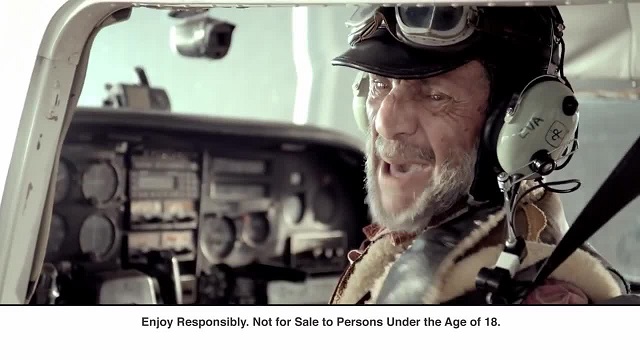
Castle Superfans TVC screengrab - crazy-eyed pilotThe pilot has crazy eyes… I know I would never step into a light aircraft with someone who looks like that at the helm, but these are Superfans. They will do anything, go anywhere and take just about any risk to get to the game. Nothing’s going to stop them!

As the plane takes off, the music changes to “Best Day of My Life” by American Authors; it’s an upbeat song that matches the excitement and adventure of the scene.

The crazy-eyed pilot flies them right over Greenpoint Stadium in Cape Town, and tells them to jump (by this time, they are kitted out in parachute gear). For the chap with a fear of flying, this is too much, and he clutches onto the edges of the door. “Come on, we’re Castle Superfans!” yells his companion. “We never miss a game!”

It’s not clear if he’s pushed or if he jumped, but they all follow him down.

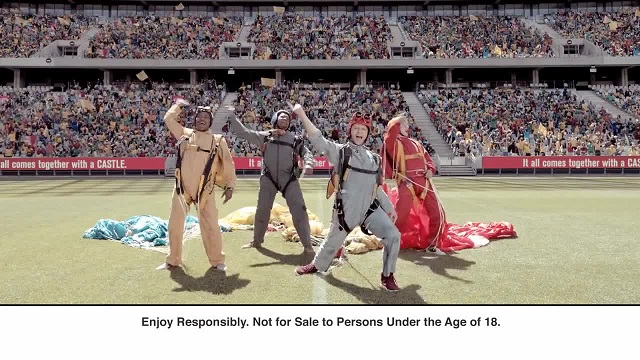
The four parachute into Greenpoint Stadium, just in time to interrupt the coin-toss. The entire Bafana Bafana team is there, with managers and officials: all their jaws hang slack at the sight of these unruly invaders.

The four stand up and look around: “Now what?” they seem to be thinking. A deathly hush hangs over the stadium. [The scene cuts momentarily back to the bar in Droogfontein, where the Du Plessis brothers have joined the aforementioned Proteas to watch the game on TV.] Will they be arrested?

One of the four guys spots a Castle banner that reads “It all comes together with a Castle”, and he takes inspiration from this.

Castle Superfans TVC screengrab - landed on the field“Castle Superfans TVC screengrab - landed on the field 2Inqaba!” he yells, making a circular gesture with his finger. “Inqaba” is isiZulu for “castle”, and one can safely assume that the hand signal has to do with “another round”. The entire crowd erupts with applause, echoing the “Inqaba!” as a warcry. This ‘punchline’ continues the format of previous ads in the campaign, and it is a clever way of creating a sort of internal mythology.

The final shot is of a couple of Castle bottles being clinked, with the voiceover: “Here’s to a nation of Superfans. It all comes together with a Castle.”

The production is well-directed and is superbly cast. The creative is spot-on, from the ironic tumbleweed in Droogfontein to the guy in the crowd with a crown made from Castle Lager cans. The editing is well-paced and the cinematography — including some spectacular aerial shots — is flawless.

Each new iteration of the Superfan campaign builds upon the previous one, and fortifies the brand as likeable, fun and friendly — a double-blast of the vuvuzela to Sunu Gonera, Egg Films and Ogilvy Johannesburg!

So, cheers, folks. I’m off to go and drink a Castle Lager in celebration of this awesome branded flick.

Credits
Agency producer: Juliet Curtis
Executive creative director: Neo Mashigo
Creative director: Molefi Thulo
Copywriter: Tracy-Lynn King
Art director: Georja Bunger
Director: Sunu Gonera
Director of photography: Rory O’Grady
Production co art director: William Boyes
Production co producer: Martina Schieder
Executive producer: Kerry Hosford
Editing co & city: Riot, Cape Town
Editor: Gordon Midgley
Post production co & city: Blade, Johannesburg

*According to MBASkool, Castle Lager is targeted at “urban middle and upper middle individuals”.


Oresti PatriciosAd of the Week, published on MarkLives every Wednesday, is penned by Oresti Patricios (@orestaki), the CEO of Ornico, a Brand Intelligence® firm that focuses on media, reputation and brand research.


If you are involved in making advertising
that is smart, funny and/or engaging,
please let Oresti know about it at info@ornicogroup.co.za.


— MarkLives’ round-up of top ad and media industry news and opinion in your mailbox every Monday and Thursday. Sign up here!

Dissident Spin Doctor: The death of traditional PR

by Emma King (@EmmainSA) I’ve been banging on about it for ages, but it is becoming ever more prevalent and I do feel I need to take a stand and shout it out. Traditional PR — the PR of old, where press releases are schlepped out far and wide — is dead. And any agency that continues to do so is wasting the time and money of its long-suffering clients.

Public Relations Key Means News Media Communication Online by Stuart Miles courtest of FreeDigitalPhotos.net
Image courtesy of Stuart Miles at FreeDigitalPhotos.net

There are a few reasons for this:

  1. Traditional print media outlets have changed

Back in the days of old, PR consisted of getting loads of media outlets to cover an event or piece of news. Much of this was generated from the good old press conference or media briefing. But this concept is outdated and clients who have expectations that their news warrants this are likely to be disappointed.

This is mainly because the media landscape that we are working in has changed so much. Just look at all the melodrama with newsrooms at various media organisations — teams being made redundant; senior reporters, columnists and editors throwing up their hands in disgust and leaving in droves; and what appears from an external viewpoint to be general chaos all around.

Teams appear massively reduced, with one or two journalists frantically trying to cover enough stories each day to fill a paper. This means a greater reliance on getting news from syndicated feeds, being provided with content that they can literally cut and paste, and generally, no time to waste in sending bodies to sit around for hours hearing brands drone on about how great they are.

Added to this is the reduction of media outlets and brands themselves. Every year, we see more and more titles disappearing off our shelves, as budgets are cut and print media appears to become more and more obsolete.

It all adds up to less media space and less time for the few journalists left to create the news.

  1. The spread of information has changed

As traditional media shrinks, so we see the growth of all the other ways in which consumers obtain information and are influenced. Just think back 10 years or so — how we made so many of our decisions based upon what we saw on TV or what a magazine or newspaper told us was cool?

But, fast forward to today, and I’d take a bet that traditional media — competing with digital, social and word of mouth — plays a massively reduced role in driving perception.

So the ongoing desire to get coverage in traditional media, over and above anything else, seems to be misplaced. Perhaps instead we should be looking at all the other ways that we can share information and guide perceptions, and place as much importance on these as getting a column in a broadsheet.

  1. The immediacy has changed

One only needs to look at the way news outlets have changed to realise how differently we now consume news. Back in the day, we were content to get our information once a day when we picked up our newspaper or tuned in the 6 o’clock news. But, what with 24-hour news stations and stories being broken online, we have come to expect our news on demand and as it happens.

An interesting example is the recent communications put out by Eskom, which appears on some days to be relying upon Twitter to update the public on loadshedding. It is then up to digital-savvy journalists and news teams to monitor and run the news via more traditional outlets to reach the wider South African population — not the worst of strategies..

When considering the last-minute and ever-changing nature of our electricity crisis, perhaps having a channel where updates are given in real-time is the most effective and realistic way to communicate?

  1. Marketing has changed

My last gripe with ‘traditional PR’ is that it is, well, so traditional. But very few brands (if any?) benefit from having all of their PR, advertising, digital and other services separated into little silos.

It seems mad to me to have a PR team which only deals with sending press releases to traditional media, without any synchronicity with what is happening digitally or out in the real world.

Why not, instead, have a team that understands how content can be shared across channels, and works to have a holistic view across all?

The answer to all of this is, obviously, to look at PR campaigns as more than just “free advertising” or a chance to see a CEO on the evening news. It’s an understanding that no communications can work in isolation; that a brand’s reputation is made from more than a couple of holding statements in times of crises; and that people are influenced just as much by the friends and family that surround them as by the media they consume.

I do believe that many of us PR practitioners “get” this. We just need to get our clients to do as well…. :)

Emma King


Emma King (@EmmainSA) is the owner and MD of The Friday Street Club (@TheFridayStClub). Previously, she was head of PR at The Jupiter Drawing Room (Cape Town). She contributes the monthly “The Dissident Spin Doctor” column on PR and communication issues to MarkLives.com.

— MarkLives’ round-up of top ad and media industry news and opinion in your mailbox every Monday and Thursday. Sign up here!

Media Report: Meet the maverick

a The Media Report 2014 interview. More than marginally self-assured, Daily Maverick pitches itself as news content and analysis for people with brains. A digital-only media brand that emerged in the latter half of 2009, Daily Maverick’s intelligent writing and obsession with independence is what sets it apart from the pack. The Media Report hits its publisher, Styli Charalambous, with 10 questions.

Styli Charalambous the media report: independence graphicWho are you and what do you do?
Styli Charalambous: Styli Charalambous — officially, publisher and CEO of Daily Maverick. But in a lean, mean media start-up, those are just titles for business cards and press releases. In the space we work in, we have to do much more, with way less than anybody else, so everyone is expected to produce more than is required.

I’m also a very hands-on kinda guy and I don’t hesitate to get involved in sales, business development, marketing and even the odd bit of writing. I think it’s the way the future of media is going; we’re going to have to remove all these thick layers of management and unnecessary overhead, if newsrooms are to survive.

the media report: independence graphicWhy do you do what you do with the Daily Maverick?
SC: Certainly not for the money! Daily Maverick is a passion for most people who work here, driven by being part of an organisation that can influence the national discourse and help shape people’s thinking and outlook. The influence the organisation has on the media landscape, given its small but tenacious presence, is testament to the collective effort and admiration the team has for the organisation and what it’s trying to achieve.

Given the flock to click bait-type articles, ‘juniorisation’ of newsrooms and general dumbing-down of news content, the role Daily Maverick plays in the South African context is becoming more important, and everyone who participates in this journey recognises it’s more than just a job.

the media report: independence graphicWhat value does Daily Maverick offer?
SC: I touched it on it earlier, but the chase for clicks (and thereby short-term revenue) as well as the economic pressures on traditional media means there is a general and rapid decline in the quality of news out there. Digital is still dictated by numbers, so editors are more likely to run a story about Justin Bieber or Miley Cyrus than explain what’s happening in Syria. Not even the world’s biggest and respected news outlets are immune, and we’re seeing that happen in South Africa too.

So it makes Daily Maverick a bit of an outlier by focusing on fiercely independent analysis and opinion pieces, which makes our role even more important. And as our audience and influence grows, our role as part of the fourth estate takes on even more significance as outside influences, agendas and economic pressures divert investment away from the real, hard issues affecting SA’s democracy.

the media report: independence graphicWhy are independent media important to SA?
SC: South Africa without a strong, independent media would be a very scary place. And it’s infuriating to see how big business fails to recognise the importance of the role we play. Can you imagine what the levels of maladministration and corruption would be like without the likes of Daily Maverick, amaBhungane and Mail & Guardian doing their thing? How many more Marikanas or Nkandlas would there have been without the kind of coverage those institutions are churning out?

the media report: independence graphicWhat is the proposition for media buyers and brand owners?
SC: Meaningful advertising alongside meaningful content. We’ve taken a print-like approach to advertising, and offer a format that provides one of the few true brand advertising spaces online. And because our content is of the highest quality, we attract the type of reader that premium brands and companies want to get in front of.

the media report: independence graphicWhat results have advertisers achieved with Daily Maverick?
SC: Some of the best results for any online platform in the world. Apart from being one of the few places that guarantees two minutes of exposure each time an advert is displayed, our click-through rates on adverts yield 200-300% better results than industry averages. Only now are we starting to see our format being copied on international websites, some five years later.

So I guess our thinking was spot on, but maybe a little too advanced for the South African market when we started. We’re working on some new ad formats that will see a major shift in thinking, and provide a place for those brand advertisers still stuck in print to find a consummate place for their brand adverts, online.

the media report: independence graphicWhat differentiates Daily Maverick?
SC: I’d probably say our fiercely independent editorial philosophy. We’ve never been swayed by government or corporate pressures to influence what we write. That makes my job as publisher somewhat difficult as we don’t accept ‘advertorials’ — where we see most PR companies looking to push their clients’ releases through newsrooms. It’s probably the biggest indictment on the news landscape, being a press release-driven news environment, which can severely affect how news is represented.

The best (worst) example of this was Marikana, where the established media swallowed up press releases from SAPS, Lonmin, the Unions and the government, but overlooked the miners. If it wasn’t for the great work done by the Daily Maverick team, the South African history books could have looked very different.

the media report: independence graphicWhere is Daily Maverick going to?
SC: We have to keep on growing, and improving on our offering. That means investing in an improved website and mobile experience for readers and advertisers, a bigger newsroom, as well as looking at other channels to get our content out there.

Our showpiece event “The Gathering” will also play a bigger role as we look to extend our brand, but we’ll remain true to our ethos, so you won’t be seeing Miley Cyrus or Justin Bieber on our pages any time soon.

But until such time as the long-awaited digital tide comes in, we’ll need to find smarter ways of working with partners, doing events and trying to generate revenue beyond just digital advertising.

the media report: independence graphicAny other thoughts on media independence?
SC: It’s an incredibly tough space to be in. People think government exerts influence and pressure over media through legislation and things like the Protection of Information Bill, but really the pressure comes through diverting advertising budgets to more government-friendly publications. Through its departments and parastatals, government controls a huge part of the economy and ad-spend. When that is siphoned off to other organisations with closer ties, it means there is less in the pot available to us playing by the rules.

the media report: independence graphicAny other thoughts?
SC:
It’s certainly been an emotional roller-coaster, but one that has been immensely rewarding on both a professional and personal level. Working with people who have a passion for what they do is something quite rare, so I make sure to appreciate that on daily basis.

Find the Daily Maverick online: www.dailymaverick.co.za

the media report: independence graphicThis interview first ran in The Media Report 2014, which is published by Ornico with MarkLives.com as its official media partner. Read or download the full magazine via Issuu.

Visuals used are licensed through Creative Commons. Attribution and gratitude go to: Reporters Without Borders and the Give Dictators The Finger campaign; r2hox, who documents urban and street art; Rebel Mouse Digital artist, Surian Soosay; Khalid Albaih, founder of Freestock.ca; Nicolas Raymond, print buyer, and photographer, Karen Roe; photographer SandisterTei; and author, scientist and occasional photographer, Duncan Hull.

— MarkLives’ round-up of top ad and media industry news and opinion in your mailbox every Monday and Thursday . Sign up here!

#SouthAfricanTVratings: 2–8 February 2015 (week 6)

by MarkLives (@marklives) See which were the most popular shows on South African TV for the week of 2–8 February 2015! Using data supplied by the new Broadcast Research Council of South Africa (BRC), this #SouthAfricanTVratings column is a weekly roundup of SA’s TV audience viewership.

Red alert satellite dish transmission data on red background by 2nix courtesy of FreeDigitalPhotos.net
Image by 2nix courtesy of FreeDigitalPhotos.net

We reveal the best-watched shows of the week before (in this case, 2-8 February 2015), where they ran and how many South Africans tuned in to watch:

  • Top 20 all adults
  • Top 20 all kids
  • Top 10 SABC1 — adults and kids
  • Top 10 SABC2 — adults and kids
  • Top 10 SABC3 — adults and kids
  • Top 10 e.tv — adults and kids
  • Top 10 Mzansi Magic — adults and kids

Top 20 shows across channels (national — adults age 15+)

Variable TVR %
Ranking Description (grouped) Channel Level 1 Level 2\Activity (r) Live + VOSDAL
1 MUVHANGO SABC 2 Drama Drama 15.7
2 SKEEM SAAM SABC 2 Drama Drama 14.9
3 GENERATIONS THE LEGACY SABC 2 Soap opera Local 14.1
4 POWERBALL SABC 2 Variety Variety 11.8
5 MOFEREFERE LENYALONG SABC 2 Sitcom Sitcom 9.5
6 SPEAK OUT -R SABC 2 Actuality Actuality 7.2
7 OH SHUCKS I’M GATVOL e.tv Movies Comedy 7.1
8 SCANDAL e.tv Drama Drama 6.9
9 AFCON 2015:COTE ‘D IVOIRE VS GHANA SABC 1 Sport Football (soccer) 6.2
10 IT’S GOSPEL TIME -R SABC 2 Music Music 6.1
11 LOTTO DRAW LIVE e.tv Competition Competition 6.0
12 SKEEM SAAM -R SABC 1 Drama Drama 5.8
13 90 PLEIN STREET SABC 2 Drama Drama 5.7
14 QUANTUM OF SOLACE e.tv Movies Action/ adventure 5.5
15 EMZINI WEZINSIZWA -R SABC 1 Sitcom Sitcom 5.5
16 7DE LAAN SABC 2 Soap opera Local 5.3
17 MUVHANGO -R SABC 1 Drama Drama 5.2
18 WWE WRESTLING RAW e.tv Sport Wrestling 5.1
19 GA RE DUMELE SABC 2 Sitcom Sitcom 4.6
20 GENERATIONS THE LEGACY -R SABC 1 Soap opera Local 4.6


Top 20 shows across channels (national — kids age 4–14)

Variable TVR %
Ranking Description (grouped) Channel Level 1 Level 2\Activity (r) Live + VOSDAL
1 SKEEM SAAM SABC 2 Drama Drama 15.3
2 MUVHANGO SABC 2 Drama Drama 15.0
3 GENERATIONS THE LEGACY SABC 2 Soap opera Local 14.1
4 MOFEREFERE LENYALONG SABC 2 Sitcom Sitcom 9.7
5 POWERBALL SABC 2 Variety Variety 9.7
6 OH SHUCKS I’M GATVOL e.tv Movies Comedy 7.1
7 SPEAK OUT -R SABC 2 Actuality Actuality 6.0
8 SCANDAL e.tv Drama Drama 5.8
9 LOTTO DRAW LIVE e.tv Competition Competition 5.7
10 90 PLEIN STREET SABC 2 Drama Drama 5.2
11 DR DIMENSION PANTS e.tv Children’s programs Children’s programs 5.1
12 IT’S GOSPEL TIME -R SABC 2 Music Music 5.1
13 QUANTUM OF SOLACE e.tv Movies Action/ adventure 5.0
14 DORA THE EXPLORER e.tv Children’s programs Children’s programs 4.6
15 GA RE DUMELE SABC 2 Sitcom Sitcom 4.5
16 XHOSA NEWS SABC 2 News News 4.1
17 WIPEOUT USA SABC 2 Competition Competition 3.9
18 MONSTERS VS ALIENS(CHILDRENS PROGRAMME) e.tv Children’s programs Children’s programs 3.9
19 AFCON 2015:COTE ‘D IVOIRE VS GHANA SABC 1 Sport Football (soccer) 3.8
20 MUVHANGO -O SABC 2 Drama Drama 3.8


Top 10 shows across SABC1 (adults)

Variable TVR %
Ranking Description Day of week Level 1\Activity (r) Live + VOSDAL
1 SKEEM SAAM -R Wednesday Drama 6.4
2 AFCON 2015:COTE ‘D IVOIRE VS GHANA Sunday Sport 6.2
3 MUVHANGO -R Wednesday Drama 6.1
4 EMZINI WEZINSIZWA -R Tuesday Sitcom 6.1
5 GENERATIONS THE LEGACY -R Wednesday Soap opera 5.0
6 LOGO FLASH Thursday Promotion 4.8
7 AFCON 2015:GHANA VS EQUATORIAL GUINEA Thursday Sport 4.5
8 AFCON 2015:DR CONGO VS COTE D’IVOIRE Wednesday Sport 4.4
9 ISIDINGO -R Wednesday Soap opera 4.4
10 NYAN NYAN -R Wednesday Reality 4.4


Top 10 shows across SABC1 (kids)

Variable TVR %
Ranking Description Day of week Level 1\Activity (r) Live + VOSDAL
1 GENERATIONS THE LEGACY -O Saturday Soap opera 4.0
2 AFCON 2015:COTE ‘D IVOIRE VS GHANA Sunday Sport 3.8
3 ZAZIWA Friday Variety 3.7
4 NGEMPELA Friday Drama 3.5
5 EMZINI WEZINSIZWA -R Tuesday Sitcom 3.2
6 SOCCER BUILD- UP Sunday Sport 3.0
7 SKEEM SAAM -R Tuesday Drama 3.0
8 DREAM WORLD Monday Drama 2.9
9 AFCON 2015:GHANA VS EQUATORIAL GUINEA Thursday Sport 2.8
10 AFCON 2015:DR CONGO VS EQUATORIAL GUINEA Saturday Sport 2.8


Top 10 shows across SABC2 (adults)

Variable TVR %
Ranking Description Day of week Level 1\Activity (r) Live + VOSDAL
1 MUVHANGO Tuesday Drama 17.4
2 SKEEM SAAM Monday Drama 16.1
3 GENERATIONS THE LEGACY Monday Soap opera 15.5
4 LOGO FLASH Thursday Promotion 12.6
5 POWERBALL Tuesday Variety 12.3
6 MOFEREFERE LENYALONG Monday Sitcom 9.5
7 SPEAK OUT -R Thursday Actuality 7.2
8 7DE LAAN Monday Soap opera 6.1
9 IT’S GOSPEL TIME -R Tuesday Music 6.1
10 90 PLEIN STREET Wednesday Drama 5.7


Top 10 shows across SABC2 (kids)

Variable TVR %
Ranking Description Day of week Level 1\Activity (r) Live + VOSDAL
1 MUVHANGO Tuesday Drama 17.4
2 SKEEM SAAM Monday Drama 16.9
3 GENERATIONS THE LEGACY Tuesday Soap opera 15.8
4 LOGO FLASH Thursday Promotion 12.8
5 POWERBALL Tuesday Variety 11.4
6 MOFEREFERE LENYALONG Monday Sitcom 9.7
7 SPEAK OUT -R Thursday Actuality 6.0
8 XHOSA NEWS Tuesday News 5.3
9 90 PLEIN STREET Wednesday Drama 5.2
10 IT’S GOSPEL TIME -R Tuesday Music 5.1


Top 10 shows across SABC3 (adults)

Variable TVR %
Ranking Description Day of week Level 1\Activity (r) Live + VOSDAL
1 ISIDINGO:THE NEED Wednesday Soap opera 4.7
2 THE BOLD AND THE BEAUTIFUL Monday Soap opera 3.6
3 LOGO FLASH Thursday Promotion 3.1
4 MUSIC Monday Music 2.9
5 THE MENTALIST Tuesday Drama 2.7
6 TOP BILLING -R Sunday Magazine 2.6
7 TOP BILLING Thursday Magazine 2.5
8 DAYS OF OUR LIVES Monday Soap opera 2.5
9 WILD AUSTRALIA Sunday Documentary 2.3
10 MINUTE TO WIN IT Friday Reality 2.3


Top 10 shows across SABC3 (kids)

Variable TVR %
Ranking Description Day of week Level 1\Activity (r) Live + VOSDAL
1 ISIDINGO:THE NEED Wednesday Soap opera 3.5
2 TOY STORY 3 Saturday Movies 3.1
3 WILD TRIPS Saturday Children’s programs 2.2
4 ARTHUR Saturday Children’s programs 2.2
5 TOP BILLING -R Sunday Magazine 2.2
6 THE BOLD AND THE BEAUTIFUL Wednesday Soap opera 2.0
7 MUSIC Saturday Music 2.0
8 WHICH WAY Saturday Children’s programs 1.9
9 DESPERATE HOUSEWIVES -R Saturday Drama 1.9
10 ISIDINGO -O Sunday Soap opera 1.9


Top 10 shows across e.tv channel (adults)

Variable TVR %
Ranking Description Day of week Level 1\Activity (r) Live + VOSDAL
1 LOTTO DRAW LIVE Saturday Competition 9.4
2 SCANDAL Tuesday Drama 7.4
3 OH SHUCKS I’M GATVOL Saturday Movies 7.1
4 LOGO FLASH Thursday Promotion 6.4
5 QUANTUM OF SOLACE Sunday Movies 5.5
6 RHYTHM CITY Monday Drama 5.4
7 GORGEOUS Friday Movies 5.3
8 WWE WRESTLING RAW Sunday Sport 5.1
9 NEWS Monday News 5.1
10 E NEWS EARLY EDITION Sunday News 4.8


Top 10 shows across e.tv channel (kids)

Variable TVR %
Ranking Description Day of week Level 1\Activity (r) Live + VOSDAL
1 LOTTO DRAW LIVE Saturday Competition 9.8
2 OH SHUCKS I’M GATVOL Saturday Movies 7.1
3 SCANDAL Tuesday Drama 6.5
4 LOGO FLASH Thursday Promotion 6.4
5 DORA THE EXPLORER Saturday Children’s programs 5.8
6 GLUMPERS Saturday Educational Program 5.6
7 DR DIMENSION PANTS Saturday Children’s programs 5.1
8 QUANTUM OF SOLACE Sunday Movies 5.0
9 RHYTHM CITY Monday Drama 4.8
10 GORGEOUS Friday Movies 4.3


Top 10 shows across Mzansi Magic (adults)

  Variable TVR %
Ranking Description Day of week Level 1\Activity (r) Live + VOSDAL
1 ISIBAYA Monday Variety 2.3
2 LOGO FLASH Thursday Promotion 1.5
3 OUR PERFECT WEDDING (MAG) Sunday Magazine 1.5
4 ROCKVILLE (DRAMA) Sunday Drama 1.2
5 ZABALAZA Monday Drama 0.8
6 THE FIGHTING TEMPTATIONS Sunday Movies 0.6
7 ISIBAYA – O Sunday Drama 0.5
8 LOVE BACK Sunday Drama 0.5
9 BOOTCAMP MZANSI Sunday Variety 0.5
10 ISIBAYA – R Tuesday Drama 0.5


Top 10 shows across Mzansi Magic (kids)

Variable TVR %
Ranking Description Day of week Level 1\Activity (r) Live + VOSDAL
1 ISIBAYA Wednesday Variety 1.9
2 LOGO FLASH Thursday Promotion 1.7
3 OUR PERFECT WEDDING (MAG) Sunday Magazine 1.6
4 ROCKVILLE (DRAMA) Sunday Drama 1.4
5 ZABALAZA Monday Drama 0.6
6 ISIBAYA – O Sunday Drama 0.4
7 LOKSHIN BIOSKOP: THE WEDDING DRESS Thursday Movies 0.4
8 THE FIGHTING TEMPTATIONS Sunday Movies 0.4
9 MUSIC Tuesday Music 0.3
10 KILLER WOMEN Monday Drama 0.3

Source: 2015 Week 6 TV Audience Report


Broadcast Research Council of South AfricaThe Broadcast Research Council of South Africa (the BRC) is a non-profit, industry body that has recently been incorporated to cater to the audience research needs of the radio and television industry in South Africa.


— MarkLives’ round-up of top ad and media industry news and opinion in your mailbox every Monday and Thursday. Sign up here!

Agency Leaders: 2014’s most-admired ad agency in Joburg

by Herman Manson (@marklives) Every year, MarkLives polls South Africa’s top agency leaders to find out what they think of their competitors, whom they see as effective managers and great creatives, and where they believe their future competition is likely to come from. Today, we publish the results of our regional Johannesburg poll.

The recap

Last year, for the second year running, Joe Public was voted the most-admired ad agency by its regional peers. Runner-up was Ireland/Davenport, a boutique advertising agency part of the WPP group. The 2012 runners-up were Black River FC and M&C Saatchi Abel.

Pepe Marais, chief creative officer at Joe Public, was voted as the most-admired creative director by his peers in Johannesburg in 2013. In 2012, Pete Case (founder of Gloo) took the honours.

The most-admired agency boss in 2013, for the second year running, was Gareth Leck, CEO, Joe Public Group. The runner-up was Graham Warsop, founder and chairman, The Jupiter Drawing Room. In 2012, Nunu Ntshingila (Ogilvy South Africa) was the runner-up. Quirk was tapped as the agency to watch last year.

Cape Town

Last week, we revealed the most-admired ad execs in Cape Town, as voted for by their regional peers. Ogilvy Cape Town and King James Group tied for most-admired agency, with FoxP2 the runner-up. Justin Gomes, ECD at FoxP2 and Alistair King, founding creative partner at King James Group, tied for most-admired creative, with Chris Gotz, CCO of Ogilvy & Mather South Africa, the runner-up. Adrian Hewlett, CEO, Publicis Machine, was the most-admired agency boss.

Ogilvy Cape Town was voted the most-integrated, with Publicis Machine the runner-up. The latter was also voted the one the watch, followed by Saatchi & Saatchi Brandsrock.

The Cape Town poll revealed a revitalised King James Group, and unanimity in the vote for Hewlett as the most-admired agency boss in town.

How it works

Jozi’s agency leaders were also invited to nominate their most-admired agency based in the city, the most-admired creative director working in the city and the most-admired boss of a Joburg agency. We also asked them which Johannesburg agency did the best at digital integration, and which local agency they saw as the one to watch in the future.

Nobody could nominate his or her own agency or staff. All the nominations were then tallied up to see whom adland’s highest decision-makers most admire.

You may find our 2013 results here and our 2012 results here.

Agencies

Joe Public

and, as runner-up,

FCB South Africa

Most-admired: Joe Public

Joe Public recently moved into its new bespoke three-storied, 3000m2 building in Bryanston. The agency had a cracker of a year in 2013, when revenue grew by 89% and staff by 42% in 2013.

In 2014, the group took home the AdReview Agency Group of the Year, as well as the title of AdFocus Agency of the Year. It established a number of key African partnerships and now has a presence in 10 African countries. In total, the group claimed 21 birds over the Loeries weekend.

Account wins included SAICA, Glenmark Pharmaceuticals, Times Media, Mandela International Film Festival and Hippo.co.za, among others. Ignite Joe Public, its below-the-line agency, also picked up Knorr Soup as an account.

On the downside, the group exited Cape Town, and now needs to rebuild a digital capacity in Johannesburg.

Staff grew from 161 to 183 (12%) and the agency achieved 23% annualised revenue growth between June 2013 and June 2014.

Runner-up: FCB South Africa

FCB South Africa definitely had a fantastic year.

It managed to win a significant amount of new business across the group, including Cell C, Moneygram, Bonitas, Cape Union Mart, Adcock Ingram, Parmalat, Capfin and IDC. The group was also named the Sunday Times Top Brands Agency of the Year.

According to group CEO & CCO Brett Morris, the agency enjoyed a creative shot in the arm, including being the top-ranked group at the South African Creative Circle Ad of the Year for 2013 (announced in 2014); no. 2-ranked (South African) agency at Cannes; no. 1-ranked agency at Loeries; Loeries Grand Prix winner two-years running; HelloComputer being named AdFocus Digital Agency of the Year; and Sunday Times Top Brands Agency of the Year.

Creative directors

Pepe Marais
Pepe Marais

and, as joint runner-up,

Mariana O’Kelly
Mariana O’Kelly

tied with

Brett Morris
Brett Morris

Most-admired: Pepe Marais, founding partner & CCO, Joe Public

Once again, for the second year running, it’s Joe Public co-founder and chief creative officer, Pepe Marais!

Joint runners-up: Mariana O’Kelly, co-ECD at Ogilvy & Mather Jhb, and Brett Morris, group CEO & CCO, FCB SA — tied

2014 produced a tie between Mariana O’Kelly, co-executive creative director at Ogilvy & Mather Johannesburg and Brett Morris, group CEO and CCO, FCB South Africa.

Agency bosses

Brett Morris
Brett Morris

and, as first runner-up,

Gareth Leck
Gareth Leck

and, as second runner-up,

Alistair Mokoena
Alistair Mokoena

Most-admired: Brett Morris, group CEO & CCO, FCB SA

Morris took over as CEO from John Dixon in early 2014 on an agency high; it had just won the Cell C business. He then managed to build upon the momentum FCB SA enjoyed afterwards, winning both clients and creative accolades — in 2014, the agency picked up Cell C, Moneygram, Bonitas, Cape Union Mart, Adcock Ingram, Parmalat, Capfin and IDC.

First runner-up: Gareth Leck, CEO, Joe Public

After two years as most-admired agency boss for Jozi, Leck falls to first runner-up position. As co-founder as well as the CEO of Joe Public United, he has been successfully steering the agency through tremendous growth over the past three years, and has helped lead it to become one of the foremost ad agencies in the country.

Second runner-up: Alistair Mokoena, MD, Ogilvy & Mather Jhb (ex MD, FCB Joburg)

Second runner-up Alistair Mokoena is the managing director of Ogilvy & Mather Johannesburg (he started 1 January 2015). Formerly the  MD of FCB Joburg, he played a key role alongside Morris in keeping that agency on a winning path, having been with FCB since November 2012.

Before that, he was head of marketing: retail & business bank at Absa Bank. He has also spent time in marketing positions at Cadbury Schweppes, SABMiller, Tiger Brands and Unilever.

Most-integrated

Ogilvy & Mather Johannesburg

and, as runner-up,

Publicis Machine
Most-integrated: Ogilvy & Mather Johannesburg

Ogilvy & Mather Johannesburg possibly receives this accolade partly because of the stellar reputation of Ogilvy & Mather Cape Town in this regard, but also because of its intended merger with Gloo Digital Design, announced shortly before our poll commenced.

Runner-up: Publicis Machine

Last year, no agency garnered sufficient support for us to name a winner in this category. To have two, the other being runner-up Publicis Machine (now with a significant office in Johannesburg, thanks to its merger with Publicis), is certainly positive progress.

One to watch

Not awarded

No agency garnered sufficient support to stand out as the one to watch. Agencies with multiple nominations included the merged Ogilvy & Mather Johannesburg/Gloo, FCB Joburg, FoxP2 Johannesburg and Joe Public.

 — MarkLives’ round-up of top ad and media industry news and opinion in your mailbox every Monday and Thursday. Sign up here!

Online CPD Courses Psychology Online CPD Courses Marketing analytics software Marketing analytics software for small business Business management software Business accounting software Gearbox repair company Makeup artist