Media Future: HR joins the tech revolution

by Arthur Goldstuck (@art2gee) The technology revolution has swept away most vestiges of the old ways of business. But not all. Now the HR department is about to be disrupted.

There is hardly a mainstream business that has not been transformed by technology, yet the management of human resources (HR) remains stuck in early 20th century mode. This is ironic, considering the massive emphasis placed on young workers and the new generation of job-entrant. The problem is that buzzwords are being used to paper over the cracks in the system. The term “millennial” has become a convenient byword for describing this new kind of employee, despite that the 17-to-37-year-old age group it defines is utterly meaningless.

Little is being done

The result is that, while tremendous effort is made to attract young talent, little is done — outside youth-oriented brands such as Google and Facebook — to retain them. Performance measures and reward systems may well be in place, but little is done with the huge amount of data collected in the process, and little effort goes into understanding what makes employees tick, and what contribution HR can make to the business. Yet, in the age of big data and artificial intelligence, HR should be given as much emphasis as sales, marketing and the customer experience — currently the obsession of most big businesses.

This gap explains the massive growth of a business such as SuccessFactors, which provides human capital management software solutions via the cloud. Listed on the NASDAQ exchange in 2007, it was acquired by SAP in 2011 and now serves more than 6 000 companies and 45m subscribers across more than 60 industries.

“A lot of people believe on-boarding ends when someone is sitting in their office,” said Stefan Ries, chief human resources officer of SAP, opening the recent SuccessFactors SuccessConnect 2017 conference in London. “It doesn’t stop there. You need to check it after 30 days, after 60 days, after 90 days.”

Ries was brutal in his assessment of the failings of HR. But he was equally frank in what needed to be done, providing a roadmap for businesses that are ready to evolve in the way they manage employees. Even those who’ve moved from thinking of staff as customers haven’t caught up to the way other areas of their business are being disrupted.

Five key elements

He outlined the five key elements that matter most in the new HR roadmap:

  1. “HR needs to deliver much more experience. Stop calling employers and managers customers; they are consumers. It’s not only about employees but also managers, contingent labour, the retired workforce, as well as new candidates. They all want to have a consumer experience. It’s all about usability, simplification and performance. We need to think and act as if we’re in a consumer business, and we must be ready for the next big thing: mobile and conversational HR.
  2. “We in HR need to measure much more strongly our impact vs the activities we are performing. Within the cloud environment, you need to deliver HR services anytime, anywhere, on any device. If you can’t do that, you won’t attract talent from the younger generations. We have to understand how cloud services can help us to have high employee engagement and to be a more-attractive employer of choice.
  3. “We need to continue to get much more fluent in data analytics. We have the tools available. We are hiring data analysts in HR, and that job description didn’t exist four or five years ago. Integration of machine learning is very important but it’s not in isolation or separate; it must be fully embedded.
  4. “How jealous are we of the finance department? Business loves them because they have the numbers that define the business. We need to work hand in hand with them, and our numbers must be seen as an important business metric. Sales, marketing, finance and HR must all come together to enable us to make the right business decisions.
  5. “Social media and social commitment really matter. In the solutions we offer, we must capture the needs of the younger generation. They are much more embedded in the social media environment. These generations have a clear determination in their minds that they need purpose in their jobs. What can they do to help the company make an impact and improve the way we live on this earth? We must continue to invest in corporate social responsibility.”

The flip side

Later, at a media briefing, Ries offered the flip side of the coin: how to look after the older generation that may feel left behind by digital transformation.

“On the one side, you’ve got to listen to the younger generation but, on the other side, have to pay attention to other generations. You have customers out there with managers and leaders in their 50s or 60s who may say, ‘Why bother?’ They will bother if they see the benefits, that they have to work for another 10-to-15 years and can experience the advantages of the new approach. And at home they are confronted with the same challenges with kids or in the broader family. The magic word is integration.”

A company that seems to have got it right is the venerable automotive brand, Jaguar Land Rover. “We thought we would have a lot of rejection of the whole concept, so we geared up for putting out fires, and over-supported people through the change,” said Jon West, the company’s director of manufacturing HR and employee relations.

“Actually, we found that there was a high level of acceptance,” he told media at the SuccessConnect conference. “A significant amount of people in the organisation — 40% of employees — are older people who’ve been with us for a long time. But, over time, we brought in a lot of new people, and they were expecting this new approach. We’re lucky we have such well-established, premium brands, and we have to make sure our HR practices do the brands justice.”


Arthur GoldstuckArthur Goldstuck (@art2gee) heads up World Wide Worx and is editor-in-chief of Gadget, the magazine of personal technology. He is a consulting editor to MarkLives.com and our media tech columnist. This article has been republished from Gadget.

Sign up now for the MarkLives email newsletter every Monday and Thursday, now including headlines from the Ramify.biz company newsroom service!

Ad of the Week: Safely Home does it again

by Oresti Patricios (@orestaki) Here’s an ad that will have you rolling on the floor with laughter — before it punches you in the gut. Director Jason Fialkov of Egg Films and FCB Cape Town’s public service announcement (PSA) for the Western Cape Government’s Safely Home initiative hits hard, and is unrelenting. But that’s just what’s makes it work.

The Western Cape Government PSA reminds me of the Darwin Awards. This organisation is “named in honor of Charles Darwin, the father of evolution” and commemorates “those who improve our gene pool by removing themselves from it”. The site features stories of people who have been successful in offing themselves in unusual ways, as well as “honorable mentions”: stories of those who’ve narrowly escaped untimely deaths by foolhardy actions. A lot of these stories involve people doing stupid things while using their cellphones.

Which is pretty much the opening to the latest Safely Home PSA to create awareness of the dangers of texting while driving. The Western Cape Government, working in conjunction with FCB Cape Town (which won the account towards the end of 2016), has decided to take a different approach. This campaign uses humour to draw attention, and then uses a quick shock to deliver a stunning message. (Last year, our 2016 Ad of the Year was Fialkov’s First Kiss, also for Safely Home and also making use of shock tactics.)


Pinterest icon View all the Ads of the Week at a glance on our #AdoftheWeek Pinterest board!
YouTube icon Watch our 2017 #AdoftheWeek playlist on YouTube


The Safely Home PSA taps into the spontaneous comedy of “FAIL” videos with a hard-hitting message. The ad starts off with a CCTV-like montage of people trying to text while walking, and learning the hard way. They walk into poles, trip into a pond or generally make a fool of themselves because they’re not paying attention to where they’re going.

The music supports the comedy, with a tune that would be suited to a slapstick movie. A message is flashed up on the screen: “You can’t even text and walk.”

The scene then cuts to a young woman (possibly a teenager) texting while driving. The camera is mounted on the dashboard, with a wide-angle lens and the colour reduced to match the previous montage. The woman glances up at the road but, for the most part, is focused on her phone. Suddenly she is thrown sideways. The car is jolted. Tumbles. Turns. The music stops and the sounds of the crash continue. The car rolls over and over. It comes to rest upside down — the woman hanging, suspended by her seatbelt.

It’s a shocking moment, made doubly so by the comedy that precedes it. The message flashed on the screen is almost redundant: “So why do you text and drive?”’ This is followed by the hashtag #itcanwait and the Western Cape Government’s Safely Home website and logo.

It can wait! In an age of instant gratification and always-on connectedness, there’s a massive drive to always be in contact. Yet there’s nothing more important than arriving where you are going, healthy, safe and alive. When you’re driving, your mobile phone must wait. Put it away until you get where you’re going.

Getting this message to today’s youth is a hard task but I would say that FCB Cape Town and the Western Cape Government get it right.

Keep it up, folks— and let’s all try and keep our roads safer for ourselves. But, more importantly, for our children.

Credits

Advertising agency: FCB Cape Town
Creative director: Mike Barnwell
Art director: Dylan Davies
Copywriter: Alistair Morgan
Director: Jason Fialkov
Production company: Egg Films


Oresti PatriciosAd of the Week, published on MarkLives every Wednesday, is penned by Oresti Patricios (@orestaki), the CEO of Ornico, a Brand Intelligence® firm that focuses on media, reputation and brand research. If you are involved in making advertising that is smart, funny and/or engaging, please let Oresti know about it at clientservice@ornicogroup.co.za.

Sign up now for the MarkLives email newsletter every Monday and Thursday, now including headlines from the Ramify.biz company newsroom service!

By Invitation Only: Popping my APEX-judging cherry

by Katlego Moutlana. To say my first experience as an APEX Awards judge was intimidating is to put it mildly but it has made me adopt a more-critical approach as to what it is that we, as marketers, are truly meant to be doing and the type of work we exist to deliver for our clients.

The APEX Awards, hosted by the Association for Communication and Advertising (ACA) of South Africa, evaluates communications campaigns based on their effectiveness in improving the client’s bottom line. As a judge, I was exposed to some compelling cases of effective campaigns, some less-compelling cases with tenuous results and, in some instances, cases with completely absent measures of success. Those entries that did make it to the top of the pile were well-written, insightful and exciting pieces of work that would make any marketer and planner proud.

Never-ending debate

The challenge of delivering a strategy that will bear results, as against producing disruptive creative that will make brands stand out, is one that has always occupied my mind. As a planner who daydreams of being a copywriter, I must admit I’ve often found myself falling in love with work that I know won’t nudge any metrics. And, so, I reflected on the never-ending debate: when does an effective strategy start to hamper groundbreaking creative and when does disruptive work start to undermine our responsibility to our clients?

A lot of the work today is simply a cataloguing of a product’s benefits and attributes and, dare I say, we’ve been stalling at the very purpose of our service — to inspire people to buy said products and services. And it’s in the inspiring that strategy and creativity make the best of bedfellows.

We know that nothing is more efficient than creative advertising at getting people to buy, Verimark ads aside. The more creative your advertising, the more attention and impact they will have. The more consumers will think about you, the more likely they are to convert to customers. But where we often get stumped in boardrooms is whether creativity has had an influence on real-life purchase behavior, or any affect at all.

Address the basics

Of course, certain dimensions of creativity work harder than others to influence and so we still need to address the basics of rigorously identifying compelling human truths that lend themselves to a different perspective or challenge conventional wisdom; and producing fantastically executed work that gets the message out clearly and engages, thereby managing, somewhere deep in the recesses of our minds, to pitch a tent in which that brand or product will reside.

And that is what I found myself learning these past few weeks.

How to systematically measure the effectiveness of a campaign. How to judge a piece of creative work on more than just the brand love or the heartstrings it tugs, but to reward and acknowledge inspiring ideas that actually worked.

You can’t always accurately predict the effectiveness of a creative campaign before you get the results but you can come pretty close.


Katlego MoutlanaKatlego Moutlana is head of strategy at Mortimer Harvey, where she leverages her experience in the FMCG and banking industries and guides communication strategies of blue-chip clients. Career high-points include working as brand experience manager when Virgin Mobile was launched and gaining five years’ experience TBWA; she also worked on the Vodacom account at Ireland/Davenport. She lectures part-time at AAA School of Advertising and believes great creative may truly make a difference to a company’s bottom line.

“Motive” is a by-invitation-only column on MarkLives.com. Contributors are picked by the editors but generally don’t form part of our regular columnist lineup, unless the topic is off-column.

Sign up now for the MarkLives email newsletter every Monday and Thursday, now including headlines from the Ramify.biz company newsroom service!

Shelf Life: Massmart’s Urban Bookshelf opens in Soweto

Cheryl Hunter (shelflife at marklives.com)’s weekly pick of all things new — product, packaging, design, insight, food, décor and more!

  • Massmart’s first free lending library with GASS, Mr Ekse, Jacana and Jonathan Ball
  • Twinsaver supports Women’s Month and CANSA
  • Dinner even easier with UCook’s new categories

Betting on books

Massmart has launched its first Urban Bookshelf, a literacy project developed to increase access to books in under-served communities in the form of a free lending library, at Phefeni Recreation Centre in Orland, Soweto.

Through a curated process, Massmart commissioned GASS Architecture Studio to design the unique book-sharing station, and renowned graffiti artist Rasik Green, aka Mr Ekse, was tasked with enriching the design.

Says Alexander Haw, Massmart sustainability executive, “This is the first of many artist-designed free miniature libraries. We have earmarked other locations around Johannesburg and will be collaborating with various artists and architects to create different interpretations of the bookshelf, hoping to promote reading and improve literacy.”

Made of powder-coated steel, the book-sharing station is 2.8m high and consists of durable steel boxes that ensure the books are protected from all the elements. The structure is tailored to both children and adults, with children’s literature at the bottom for easy access. The structure includes built-in benches so people may sit while browsing. Storing up to 500 books, the genres cover African fiction; general fiction; non-fiction; current affairs and politics; law and business; self-help and motivation; young adults and children’s books. There are no library cards or fees and the community may borrow and return books at their leisure.

To provide and replenish the structure with a diverse range of reading material, Massmart has partnered with publishers Jacana and Jonathan Ball.

massmart.co.zaInstagram
gass.co.zaFacebook
jacana.co.zaFacebookInstagramTwitter
jonathanball.co.zaFacebookTwitter


#CelebrateWomen

Household brand, Twinsaver, has launched a special edition twin-ply pack in honour of South African women, ahead of Women’s month this August, with a portion of funds going to the Cancer Association of South Africa (CANSA).

Twinsaver CANSA Women's Month 2017Says Chevonne Wilkins, Twinsaver marketing director, “New Twinsaver Twin Ply special edition, Floral Fresh, has a lightly scented pink core, designed to gently release a fresh fragrance. The brand represents the confidence shown by 18 inspiring women.”

The Twinsaver special edition pack, conceptualised in-house by the marketing team, is intended to inspire change and be a symbol of awareness; the women featured on the pack are cancer survivors and were specifically selected for their diverse backgrounds, experiences and distinctive stories, proving that cancer may affect anyone.

For every special edition pack sold, Twinsaver will donate R2 to CANSA and these funds will go towards supporting women with breast cancer.

Available in all major retailers from today.

twinsaver.co.zaFacebook


Easy-peasy dinner

South Africa’s growing dinner kit delivery service, UCook from Sarah Graham, has analysed the demographics of its customer base over the last three years to identify how and what people want to eat, resulting in two new categories introduced this month — Health Nut and Easy Peasy — a first as they are based on direct feedback from users.

UCOOK with Sarah GrahamUnlike traditional categories which commonly form part of the international dinner-kit circuit, UCook’s new categories are not centred on specific diets. The business has, instead, opted to create categories oriented around a specific set of benefits, aligning the offering more closely with its  customer’s lifestyles.

Health Nut dishes consist of a weekly menu that includes recipes with a focus on ethical sourcing, clean carbohydrates, high-protein sources, and superfood trends. UCook has also ensured that gluten, dairy, and sugar-free offerings are available where possible. Easy Peasy is all about simple, yet satisfying, home-style classics containing organic, unrefined, seasonal ingredients with most of the prep-work removed — think cubed veg, diced onion and a selection of pre-made sauces.

September 2017 will see a further highly requested category for families added.

ucook.co.zaFacebookTwitter


Cheryl HunterShelf Life is MarkLives.com’s weekly column covering all things new. Notify us of yours at shelflife at marklives dot com. Want to sponsor Shelf Life? Contact us here.

Cheryl Hunter (@cherylhunter) has written for the South African media, marketing and advertising industries for more than 15 years. A former editor of M&M in Independent Newspapers and contributor to Bizcommunity, AdFocus, AdReview and the Ad Annual, she has also produced for various television networks and currently consults on communication strategy and media liaison.

Sign up now for the MarkLives email newsletter every Monday and Thursday, now including headlines from the Ramify.biz company newsroom service!

#CannesLions — candy store of where creative industry is headed

by Thomas Mueller (@tmuellernyc) Until recently, the Cannes Lions International Festival of Creativity appeared to be fully controlled by big marketing, communications and advertising networks such as WPP, Omicom or Publicis, but it’s undergoing monumental change.

Cannes LionsWalking the Cannes Croisette or the exhibitor spaces in the Grand Palais, one couldn’t help but observe an all-out war for survival — and domination. The more-traditional agencies are still influential in their industry, at the same time trying vigorously to transform themselves for continued relevance, while two new types of player are challenging them. The first is advertising technology companies showcasing their newest offerings and advances in the world of programmatic advertising, promising infinite precision coupled with incredible efficiency. On the other side, you find the big consulting companies, which are increasingly investing in a much more-prominent presence at the festival.

Big ideas

Big ideas are no longer exclusive to advertising campaigns but at the core of the most-impactful work focused on delivering the best customer experiences.

The amount, range and variety of work being submitted, adjudicated, shown and awarded can be overwhelming and confusing. This is exaggerated by festival categories that are discipline- or touchpoint-centric, instead of being industry- or category-centric. Despite this increasingly outdated approach, this year was marked by some truly iconic work, distinguished by its obsessive focus on story, impact and execution. To me, the common thread in the most-memorable work was its focus on people and innovation.

Here are my personal highlights from Cannes Lions 2017:

1. Fearless Girl, State Street Global Advisor

Across nearly all categories: Grand Prix, Gold, Silver and Bronze Lions

I applaud this powerful contribution to International Women’s Day 2017. A bronze statue of a young fearless girl challenges the Charging Bull on Wall Street, while standing for the power of women today and tomorrow. It’s a beautiful execution of a bold statement, and sparked widespread use of #FearlessGirl across social media platforms.

2. Humanium, IM Swedish Development Partner

Innovation category: Grand Prix

Small firearms are one of the world’s most-deadly epidemics. Someone is shot and killed every single minute on this planet, in addition to the armed conflicts reported in the news. To take guns of the streets and successfully destroy them, Humanium created the world’s first supply chain made out of confiscated firearms. I love this this initiative for brilliantly aligning a humanitarian cause with an economic one: elements of death and destruction are transformed into resources for creation and construction. Sharp and powerful.

3. Tilt Brush, Google

Innovation category: Gold Lion

When I saw the first demo of the Tilt Brush, I immediately realised this far outstrips the VR apps we’ve come to know. This is potentially the birth of a new tool and medium, allowing creatives to paint, sculpt and story-tell in VR spaces, and walk in and around their creations in real time. The toolset is easy to grasp, fun, and might be the beginning of an entirely new genre of expression.

4. Refugee Nation, Amnesty International

Across many categories: Grand Prix, Gold, Silver and Bronze Lions

The images of refugees reaching Greek islands and huge piles of discarded life vests became iconic representations of a crisis unfolding before our eyes. Amnesty International wanted to raise global awareness, ignite positive conversation and engage the world to offer support. The 2016 Olympic Games provided just the right opportunity: a team of refugee athletes, competing on a global stage, with their own flag, anthem and identity. To me, this project works on so many levels, from offering dignity and a sense of belonging to the individual, to assigning responsibility to a global audience by defining the problem through a strong identity. Compelling, iconic and brave work.

5. Google Sheep View, Visit Faroe Islands & Atlantic Airways

PR category: Gold and Silver Lions
Cyber category: Bronze Lion

This project made me smile for its approach, creativity, and DIY attitude — “if Google doesn’t think we exist, we’ll take care of it ourselves.” A tiny set of islands wedged between Iceland and the UK wanted to boost tourism, so it strapped 360-degree cameras on the backs of sheep and let them loose. Shortly after the first video was posted, it started to turn into a global story.

6. Your Voice is Your Stamp, US Postal Service

Innovation category: Silver Lion

How refreshing to see something this simple and smart from the US Postal Service, showing that innovation is possible even in a category such as mail delivery, which is under pressure all over the world. Using the unique signature of someone’s voice as a transactional identifier, it turned ubiquitous mail boxes into a point of transaction, handling payment in The Cloud. To me, this is the Uber-ization of our good old mail but in the most pleasant of ways.

7. Out Of Office, Qantas

Direct category: Bronze Lion

My final pick is something really simple and smart: turning boring out-of-office emails into personalised travelogues. All it requires is for travellers to connect their automated messages with their Instagram feeds, which then populates them with images tagged #qantasoutofoffice. This transforms a boring email into a new medium of storytelling, combined with driving sales for destinations through offer links. Smart, fun and simple.

It was a long week of hard work, extensive networking and good fun, but I do look forward to the months of creativity ahead of us that will make this year look conservative compared to what we’ll hopefully see when we walk down the Croisette in Cannes next year.

Republished and adapted with permission.


Thomas MuellerThomas Mueller (@tmuellernyc) is managing director of Fjord Design & Innovation from Accenture Interactive (Europe, Africa, Latin America). He is a strategic design executive and brand experience visionary who passionately believes in the essence of simplicity to enable remarkable experiences through any service, interaction or communication.

“Motive” is a by-invitation-only column on MarkLives.com. Contributors are picked by the editors but generally don’t form part of our regular columnist lineup, unless the topic is off-column.

Sign up now for the MarkLives email newsletter every Monday and Thursday, now including headlines from the Ramify.biz company newsroom service!

Dear Radio: Radio stations forgetting their core product

by Paulo Dias (@therealptp) You’ve decided to buy some radio airtime. Great. You were sold on the responsive audience and the intimate, one-on-one relationship it has with its station. You were sold on radio’s ability to ‘converge’ digital and social media, and an ability to amplify. You were sold low production costs, quick turnaround times and that you get a big brand feel without having to pay TV prices.

That’s what you were sold but what did you buy? And do the radio stations really know what they sold you? Because does anyone really still know what a radio station’s core product is?

Let’s explore.

Positioning

Radio stations position themselves on music — this or that no. 1 hit doowab, some or other playing the hits of your whatever, nothing but new blah blah blah. Except, radio doesn’t own music anymore. People get their music preference whenever they want them from multiple other sources, so radio can’t say its core product is music as no-one can own your music tastes anymore.

Ok, maybe radio’s product is interesting programming that encourages debate or provides information. Except that happens on social in a much more-organic, -dynamic and -conversational, or (in Twitter’s case) confrontational, way.

Radio has always excelled in talking to you rather than at you but, even in the liveliest debate, you never have more than two people on air at a time taking part. (And just as a quick aside while on this: I notice pretty much every station using voice notes to encourage listener interaction. I get it; we’re moving with the times, more people can interact and that’s fine but it massively reduces the opportunity for great on-air moments. Social media means we’re constantly fed polished, best-foot-forward content, edited to an inch of its life and losing some of the live to air, rawness that radio provides and has been famous for.)

Ad space

All right, back to regular programming and trying to find what radio’s product is. It must be ad space — sponsorship opportunities, features, competitions, 30” spots. But everyone has those in some or other form, and some even have them cheaper.

So we sit here half way through this article and we’re nowhere nearer to finding radio’s real product. Yet radio stations are spending millions on music research, digital assets, digital staff, loyalty programs, online platforms, events etc, and chasing every new trend that comes along. Radio stations have gradually been turning themselves into tech companies, event companies, production houses, sales forces and commercial programming hubs — bringing in more and more staff with vastly different objectives and interests to what a radio station should have.

Does a social media manager in a radio station have a passion for great radio? Does a sales rep live the next amazing on-air moment as much as they do for the sale?

Different agendas

What happens is that, as different people with different agendas come into radio, radio stations and senior people in programming start concerning themselves with things such as the logistics of a concert or feeding the whims of an advertiser.

Senior programming people shouldn’t be worried about social media, video production teams or sales targets. Savvy radio groups should be outsourcing those responsibilities to agencies and teams specialising in those as a business so that radio people may do what radio people should be doing and focusing on their core product, the people who sit behind the mic.

Because your drive show hosts, traffic readers, the people who do the morning prank calls, the team behind the special news reports– that is a true radio product and, while any number of stations may be playlisting the same songs, the people on their breakfast shows is unique to them and their one unique selling point.

Who would notice?

So, dear radio, you won’t be the next tech success. You’re not suddenly going to be the go-to concert organisers and, while people enjoy your fun walks, colour runs and parties in the park — everyone else is doing them. And if you stopped… who would notice?

While you’re wrapping yourself up in doing all those things, your differentiator is being left to run itself with an open mic and not as much guidance and attention as they need.

But, if your talent disappeared, where would that leave you?


Paulo DiasPaulo Dias (@therealptp) is the head of creative integration at Ultimate Media. He works closely with the programming teams at leading radio stations to help implement commercial messaging into their existing formats. He contributes the regular column, “Dear Radio”, looking at the changing radio landscape in South Africa, to MarkLives.com

Sign up now for the MarkLives email newsletter every Monday and Thursday, now including headlines from the Ramify.biz company newsroom service!

Big Q Consultancies: What you need to know & change

by Herman Manson (@marklives) We wrap up our Big Q Consultancies series by pulling out the highlights and key insights from the individual contributions.

Eating agencies’ lunch

So the consulting and technology firms have been eating agencies’ digital lunch. Now they’re gearing up to grab a bigger chunk of the marketing budget. They already have reach, and scale, and access to the executive suit. They have a billing model that doesn’t rely on them having to desperately sell R15m TVCs to clients. “But we have creativity,” I hear the ad industry say. Yet it’s not locked up, it’s got a price, and consultancy and tech giants such as Deloitte, IBM and Accenture are buying.

At a guess, the giant Snapchat ferris wheel set up on the Croisette in Cannes during the 2017 Cannes Lions was just the last straw for some execs

Panel of agency and consultancy executives

Over the last couple of months, we asked a panel of agency and consultancy executives for their sense of what the broader agency and marketing community may learn from the rise of non-traditional firms now operating in the advertising agency space. What processes and practices are giving these firms an edge, and to what would the rise of these players be attributed, in spite of the best integration efforts by the traditional agency networks?

Consultants dominate tech, but agencies still own storytelling (for now)

Jerry Mpufane
Jerry Mpufane

Jerry Mpufane, chairman of the M&C Saatchi JHB Group of Companies, says that, “in spite of the increased competition from the management consultants, it’s not all doom and gloom for the ad agencies.” He argues that it is access to the chief information officer (CIO)’s budget, an area of spend traditionally dominated by the management consultants, that is behind the large revenues claimed by the management consultants.

At the same time, budgets traditionally held by the chief marketing officer (CMO), the ad agency’s historical client, continue to grow, he continues. “My belief is that agencies must focus on their core strength — being that of fostering meaningful consumer engagement through storytelling. The strength of the ad agencies as a supplier partner to brands has never been their size but their ability to connect with consumers through brilliant ideas based on great consumer insight.

“The complimentary skills of the management consultant and the ad agency are essential to create an integrated and interdependent touchpoint matrix for the client organisation,” he concludes.

Yet the agency model still lags

Prakash Patel
Prakash Patel

The problem, as Prakash Patel points out, is that agencies haven’t successfully adapted structurally to the modern consumer environment. “The world around us has been changing at a phenomenal rate,” he says. “Yet agencies have barely changed their business models to meet the needs of today’s hyper-connected consumer. Acquisition is short-term. Changing the mindset, strategy and proposition of the future agency is at the heart of the solution to these needs.”

In general, the needs of marketing and brands have fundamentally changed and are no longer aligned to any specific model, let alone agency model, he contends. Agencies need to “reimagine their business models, proposition and services to meet the needs of today’s brands and consumers with, in my opinion, data, analytics, technology and digital at its heart — to see digital transformation as more than a medium but a critical business enabler.”

Consultancies have had a head-start, he argues, in that they’ve have not been hindered by media and understand that consumers don’t see brands or fragmented businesses but experiences. Digital is also not — as agencies seem to believe — about websites and social media but about digital business transformation. “It is time to view consumers through their lens and not the lens created by agency business models,” he concludes.

Consultants have budget to become what clients require

Heidi Custers
Heidi Custers

Heidi Custers, the digital transformation strategy manager at Deloitte Consulting, says that brands have been moving more and more of their marketing execution in-house over the past five years as they face greater disruption and competition from digitally enabled rivals.

“In my opinion, the bigger technology and management consulting firms are taking advantage of this shift in a pincer attack on the agencies,” she writes. “Tech consultancies are typically working with CIOs and CDOs to redefine how digital is used to enable business growth, while traditional management-consulting firms are capitalising on their influential C-suite relationships to deliver customer-led strategy to CEOs and CMOs. In both these cases, the consulting firms are tying our work back to the bottom line of the clients’ companies, instead of using awareness or interest success metrics that are still used by some agencies to measure success.”

Wayne Hull
Wayne Hull

Says Wayne Hull, the managing director of Accenture Digital for South and sub-Saharan Africa, “In today’s digital world, all these things are integrated and, to solve problems or take advantage of opportunities, the people around the table require a range of capabilities. You need technologists, consultants, storytellers, copywriters, creative people, entrepreneurs, data scientists to make sense of it all, and to have all these capabilities in-house is very rare.”

The existing consulting competence from firms such as Deloitte or Accenture has been enhanced by strategic employment and acquisitions enabling them to offer a truly integrated offering. Marketing agencies, with their relatively lower margins and rate pressure, face an uphill battle to make the necessary investments required to edge the large, influential consulting firms out of the clients’ boardrooms, notes Custer, who feels they may need to take on an ultra-specialist role, a space consultancies cannot compete in.

Agencies haven’t moved from offering creative to offering business solutions (while consultancies now offer both)

Joshin Raghubar
Joshin Raghubar

Joshin Raghubar, the founder of iKineo, argues that “traditional ad agencies certainly have had a head-start on the management consulting industry to dominate the digital customer engagement and experience services portfolio for clients. However, by not being able to step out and above the ‘creative communication and advertising’ mindset, and firmly into the problem-solving business and leadership territory, agencies have once again ceded the high ground to consultancies.”

Marketing was already evolving then from a campaign-dominant activity to a service-design-led activity, he says. “In this new world, where the power has shifted from companies to customers, marketers and their agencies needed to become service and product designers, strategy consultants, data scientists, user-experience (UX) specialists, intangible product owners, and customer community managers.

“Even though they’ve had at least 13 years since the writing has been on the wall, for many traditional agencies, it has been difficult to shake this campaign-dominant logic,” he says.

But all is not lost — if agencies are willing and able to disrupt themselves. Again, this goes to staking a space in the digital transformation space currently owned by the consultancies and tech companies, as well as the high-value pricing model they enjoy (and which agencies don’t). Traditional agencies should turn the tables and consider buying firms for their C-suite brand share, is his advice.

To remain relevant, marry data and creativity

Andy Sutcliffe
Andy Sutcliffe

“CMOs understand that a data-led strategy, not just a creative one, is driving top-line growth,” writes Andy Sutcliffe, CEO and co-founder of 34°. “This explains why business models of consulting and creative agencies are converging. The key, of course, is the need to own high-level business strategy and this is an area in which ad agencies have been found wanting.”

Big consultancies underestimate the value of creativity and the culture, while the agencies under-exploit the value of business analytics. Agencies need to bring in a data-driven approach and marry it to world-class creative if they are to beat the consultancies, he argues. “But we’ve got to grow up and understand that creativity is essential yet only part of the solution business needs today, not the overall solution.”


Herman MansonHerman Manson (@marklives) is the founder and editor of MarkLives.com.

Sign up now for the MarkLives email newsletter every Monday and Thursday, now including headlines from the Ramify.biz company newsroom service!

MagLove: The best magazine covers this week (28 July 2017)

by MarkLives (@marklives) Our choice of the best South African and international magazine covers this week:

  • Autoweek (30 & Under Issue)
  • Getaway
  • Marie Claire (South Africa)
  • The Economist
  • The Edit
  • The South African Artist

Find a cover we should know about? Tweet us at @Marklives.
Pinterest icon Want to view all the covers at a glance? See our MagLove Pinterest board!


Autoweek (30 & Under Issue), 24 July 2017

Autoweek, 24 July 2017

Everyone who worked on this edition is 30-years-old or younger.


Getaway Magazine, August 2017

Getaway Magazine, August 2017

Let’s go paddle the Orange River :-)


Marie Claire (South Africa), August 2017

Marie Claire South Africa, August 2017 - Thando Hopa

The August 2017 edition of Marie Claire features lawyer, model and activist, Thando Hopa, on the cover. Stunning.


The Economist, 22 July 2017

The Economist, 22 July 2017

So very clever.


The Edit, 20 July 2017

The Edit, 20 July 2017 - Ruth Negga

Ruth Negga, as photographed by Norman Jean Roy for The Edit Magazine.


The South African Artist, Issue No. 27

The South African Artist, Issue No. 27

The cover features an acrylic on canvas painting by Andrew Cooper of the Kirstenbosch Gardens.


MarkLives logoMagLove is a regular slot featuring the best local and international magazine covers every week. It recognises well thought-out, powerful and interesting (and hopefully all three) covers and celebrates the mix of pragmatism, creativity and personal taste that has created each of them.

Sign up now for the MarkLives email newsletter every Monday and Thursday, now including headlines from the Ramify.biz company newsroom service!

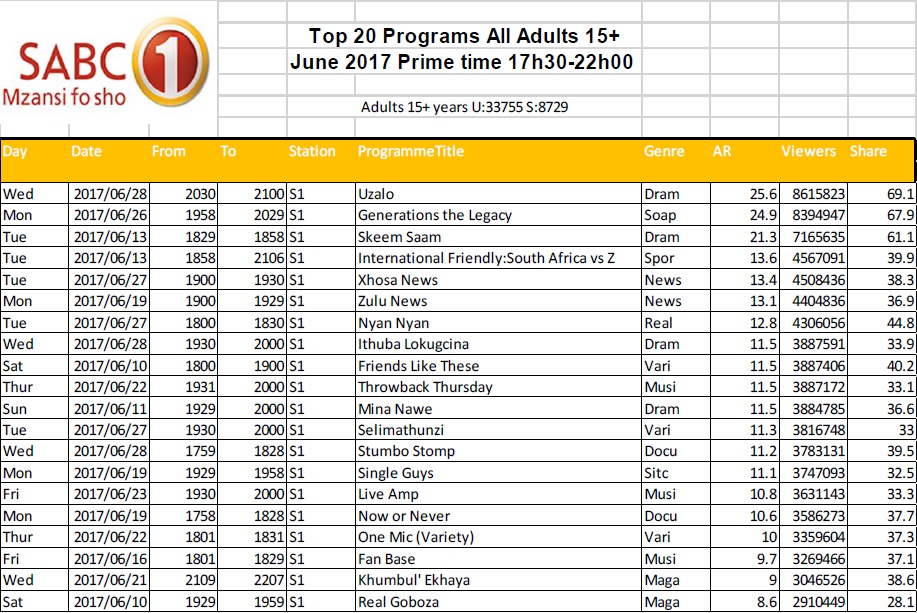
SA TV Ratings: SABC 1 — primetime top 20 for Jun 2017

by MarkLives (@marklives) The hottest primetime television shows on SABC 1 in South Africa revealed: TV ratings for June 2017.

In 2016, the Broadcast Research Council of South Africa (BRCSA) changed its policy about giving away TAMS and now only monthly reports, highlighting the top 20 or 30 primetime shows on several popular channels, are available.

SABC 1 June 2017

BRCSA TV Ratings June 2017 primetime SABC 1

Source: BRCSA June 2017

Broadcast Research Council of South Africa


The Broadcast Research Council of South Africa (the BRC) is a non-profit, industry body that was incorporated in 2015 to cater to the audience research needs of the radio and television industry in South Africa.

Sign up now for the MarkLives email newsletter every Monday and Thursday, now including headlines from the Ramify.biz company newsroom service!

Headspace: Where heart meets tech

by Tenielle Maris. ‘Playsumerism’ is one of the megatrends defined by Trendwatching in 2016 and it encompasses those brands and campaigns that make life more enjoyable, simply by bringing a sense of unexpected entertainment to the consumer arena. This very definition, however, has evolved into something that is no longer a ‘nice to have’ for consumers but is demanded from brands vying for the scarcest resource — their attention.

This endless quest for fun and excitement has been proliferated by the explosion of accessible digital interfaces and platforms, where interactions and connections are more liquid and seamless than ever before. The result? Consumers no longer see the walls between the physical and digital worlds, and neither should we.

Blurred worlds

It’s certainly not new news that consumer touchpoints are no longer linear: they are multifaceted and layered, where physical platforms are fast becoming content-rich destinations, and with consumers engaging multiple platforms simultaneously. Beyond relaying brand storytelling, digital integration within physical spaces means that audiences have access to make more-informed decisions than we’d ever anticipated. These decisions go beyond relying on brand and product information, and now extend to consulting social networks for exclusive content and instantaneous peer-to-peer recommendations.

Uber, Apple and Spotify are among big-name brands that are shaping the future for contextual content: “In order for brand content to succeed it must exist where the consumers are already spending their time — and not necessarily on digital destinations, such as brand websites.” —CampaignLive 2017

The experience economy

We are seeing a seismic shift in the collection of experiences over products, where experiences are the new forms of status symbols. Whilst this was previously more true for affluent consumer groups, tech is now transcending conventions by making digital experiences a form of tailor-made self-expression which is accessible to wider audiences. What these experiences offer consumers is the ultimate form of escapism.

Good Housekeeping’s latest launch of The Kitchen of the Future is a shining example of a brand that is evolving with its audience by placing content-rich experiences at the epicentre of its offering. By inviting readers into its traditional test kitchen space for personalised and sensory-filled dining experiences, the publication has, in essence, developed its very own content-creation hub to generate a plethora of magnificent brand content to be seeded across social media.

Not ‘tech for tech’s sake’

In an award-winning campaign last year, The Automobile Club of Romania and Publicis Romania launched an interactive game through the App store, Mr Bear Driver, to overcome the high incidence of accidents resulting from speeding on Romanian roads. The app was born from the human truth that adults are biologically programmed to respond to children’s voices. By adding a new speed-tracking feature to a popular game, children were prompted to get their parents to slow down in order to continue playing the game. Pretty darn compelling, no?

A human touch

AI, VR and a host of other digital buzz words all contribute to more-enhanced consumer experiences, no doubt about it. What brands and marketers need to get right, however, is not forgetting that they are talking to human beings, who will ultimately connect with human brands.

To get tech really right, they need to look beyond the tech if they want to make a deep and long-lasting impact: they need to leverage a powerful human truth in a (fun) way that may be seamlessly integrated into a brand’s story.


Tenielle MarisTenielle Maris is strategic director at TTL agency, 34°, in Johannesburg. Beginning her career in branding and communications, she has spent the last decade in the marketing industry where she has worked upon big brands spanning the African continent. Having found her passion in understanding what drives human beings to connect with particular brands, her time is spent getting up close and personal with the people whom brands are trying to connect with. Tenielle contributes the monthly “Headspace” column, which unpacks anything and everything that helps marketers and advertisers understand why people connect with brands, to MarkLives.com.

Sign up now for the MarkLives email newsletter every Monday and Thursday, now including headlines from the Ramify.biz company newsroom service!

Online CPD Courses Psychology Online CPD Courses Marketing analytics software Marketing analytics software for small business Business management software Business accounting software Gearbox repair company Makeup artist