Cover Stories: Top 5 international mag covers for 2017 — commercial

by Shane de Lange (@shanenilfunctBecause of his dominance within the global public eye, my Top Five International Commercial Covers have been chosen in defiance of Donald Trump and his perspective on the world, and in honor of diversity, expression and freedom. Seeking to erode political tyranny, voracity and dictatorship — specifically, the brand that is displayed by the president of the United States — this list celebrates creative output from 2017 that revolts against any form of ignorance, oppression and totalitarianism, specifically with regard to Trump’s America.

2017 was quite a year for the North American president. There were, and still are, many pressing concerns about America’s new president and his actions, including a nuclear crisis between America and North Korea, the US government’s inability to recover properly in the aftermath of the most-devastating hurricane to hit the state of Florida and the Caribbean in recent history, ongoing attempts by the Russian government to destabilise the country, various public acts of violence arguably following the trend of ignorance, indifference, apathy and bigotry set by the president himself; and the list goes on and on.


Find a cover we should know about? Tweet us at @Marklives and @shanenilfunct.
Pinterest icon Want to view all the covers at a glance? See our Pinterest board!


#5. The Economist (US), 11–17 November 2017

The Economist, 11-17 November 2017 - Donald TrumpOne may argue that Trump’s hair styling is historically and ironically odd. An equally odd-looking bald eagle decorated the cover of the November 11–17 issue of The Economist. At one stage severely endangered and on the verge of extinction, the Bald Eagle is a bird of prey, and an apex predator — an icon of Americana, and an analogy for America itself. Taking advantage of this, the cover depicts this majestic avian critter with a charming hairstyle, an unambiguous metaphor for Trump’s America. Sporting the headline: “Endangered — America’s future as a global power”, one would not be wrong to bet that America is likely see itself on display in the museum of past world superpowers if Trump has his way.


#4. The New York Times Magazine (US), 17 September 2017

The New York Times Magazine, 17 September 2017Crafted by American Illustrator, Mike McQuade, this abstract yet typographically provocative cover communicates how the Kremlin uses confusion as a weapon, and how the Russians are pioneering a new form of information war using its vast media network. McQuade is known for his idiosyncratic use of collage, typography, imagery and illustration. Here he uses his skills masterfully, depicting the relationship between notions of confusion and disruption, superimposing an image of a news anchor over a partially revealed flat red background, exposed by portions of the top image being ripped away in much the same way posters are in urban spaces. Erasure at its best, the message is resultantly amplified: “confusion is a weapon”. Using confusion tactics himself here, McQuade tells a story of how nations, notably the US, may be targeted and manipulated by spreading confused and fabricated propaganda.


#3. Der Spiegel (Germany), 4 November 2017

Der Spiegel, No 45, 4 November 2017 - Donald TrumpFor the November 4th issue of Der Spiegel, Cuban illustrator, Edel Rodriguez, used Hokusai’s famous woodblock print, “The Great Wave off Kanagawa”, to communicate popular sentiments surrounding Trump’s five-leg tour of Asia in 2017, which included visits to Japan, South Korea, China, Vietnam and the Philippines. A German headline accompanies this layered image, stating “Washington one year later”. Instead of Mount Fuji in the background, with Kanagawa prefecture under threat from natural disaster, Rodriguez depicts Washington already in the recession of water just before the onslaught of the arriving tsunami, painting a dismal picture of America already in the riptide of a dangerous political sea current and awaiting the big crash.


#2. The New Yorker (US), 28 August 2017

The New Yorker, 28 August 2017 - Donald Trump

Trump blows his own horn all the time — so, too, his own sail on the cover of the August 28th issue of The New Yorker Magazine. Titled “Blowhard”, the cover is illustrated by David Plunkert, who represents Trump as an inept lone sailor blowing his own punctured and tattered white sails (resembling a Ku Klux Klan mask) of a flimsy black raft while navigating his morally barren, ethically devoid social, political and economic seas. This illustration is a critical commentary in support of the public outcry related to Trump’s inaction towards the Charlottesville attacks in August 2017. After a lengthy bout of silence, Trump’s dismal pushback placed equal blame on counter-protestors for the violent events that were clearly caused by white supremacists, suggesting the president’s support for the far right in the US. Trump has an uncanny inability to hold back, unscripted, which places further scrutiny upon his delay and lackluster response towards the Charlottesville rally. America and white supremacy, on the precipice of quasi-imperialism.


#1. The Washington Post Magazine (US), 29 October 2017

The Washington Post Magazine, 29 October 2017

Cleverly composed and illustrated, a fragmented American flag fills all the available space on the cover of the October 29th issue of The Washington Post Magazine. Designed by iconic American designer, Michael Beirut (a partner at Pentagram and co-founder of Design Observer, among a variety of other significant responsibilities), this cover recalls the work of historic Russian artists, notably suprematist, Kazimir Malevich, and constructivist, El Lizzitsky (particularly his ‘Proun’ works). As a subtle hint at Russian interference in American politics, the Washington Post Magazine appropriates from Russian art and design history to expose Trump’s compromised America, further emphasised by the headline that states “some assembly required”— both visually and poetically describing a fragmented and fractured nation.


Shane de LangeShane de Lange (@shanenilfunct) is a designer, writer, and educator currently based in Cape Town, South Africa, working in the fields of communication design and digital media. He works from Gilgamesh, a small design studio, and is a senior lecturer in graphic design at Vega School in Cape Town. Connect on Pinterest and Instagram.

Cover Stories, formerly MagLove, is a regular slot deconstructing media cover design, both past and present.

Sign up now for the MarkLives email newsletter every Monday and Thursday, now including headlines from the Ramify.biz company newsroom service!

SA TV Ratings: e.tv — primetime top 20 for Dec, Nov 2017

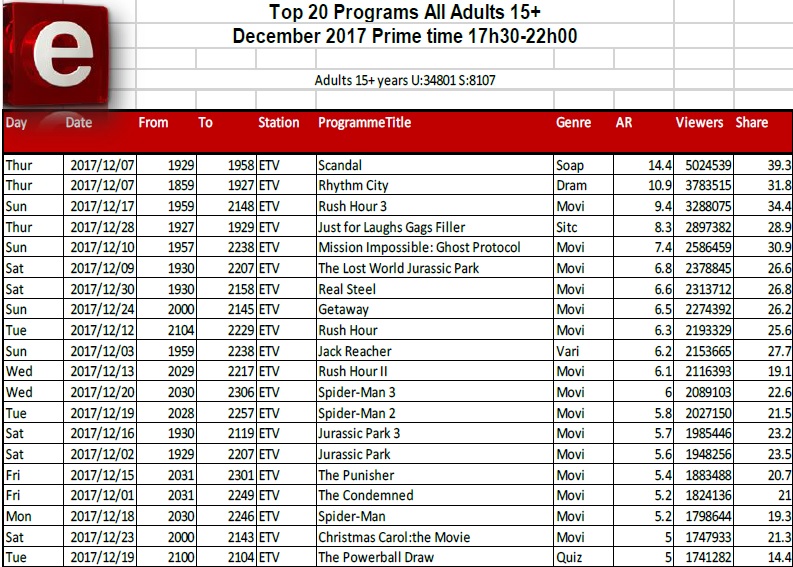
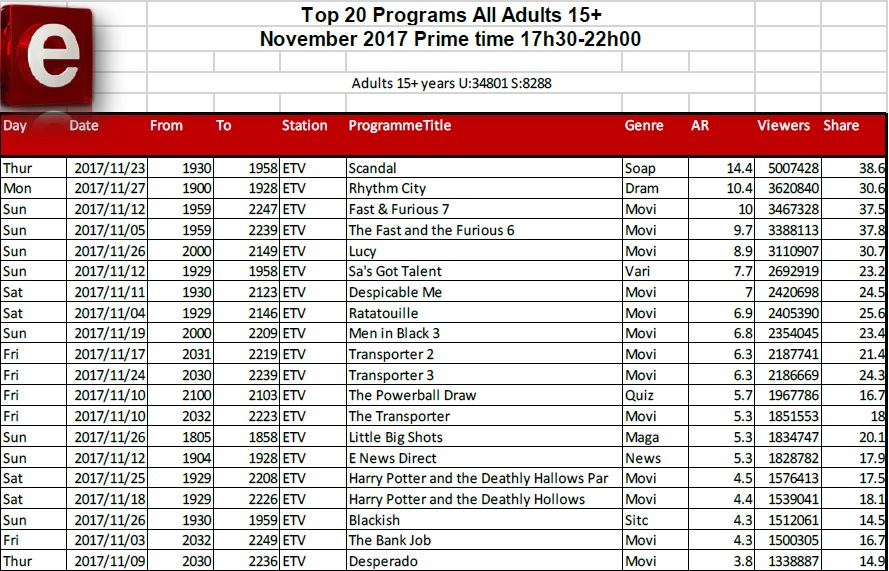
by MarkLives (@marklives) The hottest primetime television shows on e.tv in South Africa revealed: TV ratings for December and November 2017.

In 2016, the Broadcast Research Council of South Africa (BRCSA) changed its policy about giving away TAMS and now only monthly reports, highlighting the top 20 or 30 primetime shows on several popular channels, are available.

e.tv December 2017

BRCSA TV Ratings December 2017 primetime etvSource: BRCSA December 2017


e.tv November 2017

BRCSA TV Ratings November 2017 primetime etvSource: BRCSA November 2017

Broadcast Research Council of South Africa


The Broadcast Research Council of South Africa (the BRC) is a non-profit, industry body that was incorporated in 2015 to cater to the audience research needs of the radio and television industry in South Africa.

Sign up now for the MarkLives email newsletter every Monday and Thursday, now including headlines from the Ramify.biz company newsroom service!

#BigQ2018: Marketers to take digital in-house at unprecedented rate

by MarkLives (@marklives) What are the expectations for the marketing and advertising industry in 2018? We emailed a panel of key industry executives for their take on the macro environment, budgets, changes in messaging, movement in the industry and any consumer and communication trends they’ll be looking out for. Next up is Johanna McDowell of Independent Agency Search and Selection Company (IAS).

Johanna McDowell

Johanna McDowellJohanna McDowell (@jomcdowell) is managing director of the Independent Agency Search and Selection Company (IAS), which is partnered with the AAR Group in the UK. Johanna is one of the few experts driving this mediation and advisory service in South Africa and globally. Currently she is running the IAS Marketers Masterclass, a programme consisting of masterclasses held in Cape Town and in Johannesburg. Twice a year she attends AdForum Worldwide Summits.

For marketers, who’ve been very focused on budgets during the past 12 months, their expectations of their agency partners will continue to be high. Agencies are expected to be able to manage the marketers’ smaller or tighter budgets. It is a real worry to marketers that agencies will struggle with this, as evidenced in the Scopen agencyScope South Africa 2017 report. With our economy only growing a little, this focus will continue to persist in 2018.

[Full disclosure: Scopen Global and Mazole Holdings (the company that owns IAS 100%) have formed a company in South Africa called Scopen Africa. Scopen Global holds the majority of the shares; Mazole is a minority shareholder. Johanna McDowell is a director of Scopen Africa, as is Cesar Vacchiano, global CEO of Scopen.]

While margins may well be growing tighter, agencies are being forced to look further afield for more business. I’ve noticed that many agencies, especially in Cape Town, have a number of international clients and can compete aggressively for business based on price and talent

Digital

More and more marketers will handle more and more digital marketing in-house, I believe, not just because it’s more cost-efficient in some ways but also because they want to understand the role of digital more closely and believe that one of the barriers which they have is lack of knowledge. As the digital demands within and across the business grow, the percentage of dedicated digital marketers within the marketing department should increase from about 25% to 35% in the next 12 months.

ROI

The above trend directly links back to return on investment (ROI). This will also become a more and more important focus for both marketers and agencies. Marketers love digital marketing as they can see an immediate result, which links to consumer engagement and sales. This helps to prove the value of marketing and advertising. ROI will become more and more sophisticated over the next 12 months as the growth in digital channels continues to flourish.

Talent in agencies

All over the world, agencies talk about the shortage of skills and talent in the industry. Does this mean that advertising as an industry is becoming less attractive to potential recruits? Or are there too many other options? This will be debated at length here and globally for some time to come.

A shake up in media

Transparency is a big issue. It’s not necessarily being viewed as such here but I believe that SA will follow the rest of the global ad world and that marketers will be demanding far greater levels of transparency in media — especially with digital expenditure. Media-spend reporting and media audits will mushroom.

BEE and transformation

There is lots of talk about this issue and a number of transactions and transformation initiatives etc are in place across the industry. Partnerships will form in this area during the early part of 2018 — and some of these might be borne out of desperation or need. I hope that most of these will be borne rather from desire to partner and a willingness to share growth and economic transformation.

Durban

The coastal city of Durban in KwaZulu-Natal is seeing something of a resurgence in creativity and innovation among the local agencies. I think this will start to become more and more significant over the next 12 months.

#BigQ2018 series


MarkLives logoLaunched in 2016, “The Big Q” is a regular column on MarkLives in which we ask key advertising and marketing industry execs for their thoughts on relevant issues facing the industry. If you’d like to be part of our pool of panellists, please contact editor Herman Manson via email (2mark at marklives dot com) or Twitter (@marklives). Suggestions for questions are also welcomed.

Sign up now for the MarkLives email newsletter every Monday and Thursday, now including headlines from the Ramify.biz company newsroom service!
#BigQ2018: Brands adapting comms to be part of consumer journey

by MarkLives (@marklives) What are the expectations for the marketing and advertising industry in 2018 from a media perspective? We emailed a panel of key industry executives for their take on the macro environment, budgets, changes in messaging, movement in the industry and any consumer and communication trends they’ll be looking out for. Next up is Ashish Williams of MediaCom South Africa.

Ashish Williams

Ashish WilliamsAshish Williams is chief executive officer of MediaCom South Africa. He has in-depth and vast expertise in emerging economies, having spent over 14 years, in three of the five BRICS countries, working for companies such as P&G, Unilever and HSBC. This unique experience has enabled him to drive innovation through digital communication platforms and build digital capabilities that resonate with a South African market.

I really believe that, in the future, only companies that are able to bridge the gap between brand and performance marketing will be successful; those that can’t, won’t survive.

Another trend I’ve noticed is that many companies and brands are heavily investing in technology, as they should, but my belief is that everything must be people-driven. This is why our strategy remains “People first”, because I believe that, without a people-centric approach, the best technology will fall flat as it can’t connect with its audience. With a people-first, better-results philosophy, you can deliver world-class solutions that are rooted in human insights.

Uber and Airbnb are perfect examples of brands that had unique insights into customer needs and then built technology platforms around those needs. Due to this approach, their proprietary technologies changed decades-old business models and moulded new ones, literally putting service offerings into the hands of consumers.

While we always talk about digital data and researchers, my fundamental belief is that you need to get consumer data right first. All data — whether it’s digital, second-party or third-party — needs to fall in line with how the consumer can be understood. This allows you to effectively follow the consumer journey and become part of it.

Therefore, brands aiming to become part of the consumer journey and adapting their communication accordingly is the overarching trend I predict for 2018 and brand engagement moving forward.

The macro environment

From a media perspective, there needs to be a closer alignment between performance marketing (leads- and sales-generation) and brand marketing (creating awareness and building consideration). Essentially, the communication challenge is shifting from ‘one-to-many’ to ‘one-to-one’. Agencies and brands have to develop more one-to-one communication while striking the perfect balance between brand marketing and performance marketing.

Budgets

Due to low GDP growth, high inflation, and ratings downgrade, the chances are limited for budgets to increase. However, the rest of the African continent is looking promising, with a 5.8% GDP growth compared to a global GDP growth of 3.7–3,8%. This is why I predict Africa will be the driver of advertising budgets.

Changes in messaging

One-to-one communication is going to be vital moving forward for clients and consumers. Interest-based targeting will become more and more prevalent as consumers expect brands to understand them without being too intrusive. The key to effective interest-based targeting is fitting the right brand with the right consumer need and then following it up with the right content to make a connection.

Movement in the industry

One factor that has become clear is that, when things move globally, it will eventually change locally as well.

Typically, there is a two-year delay from more-developed economies to reach South Africa but information travels fast, and we can adopt and leverage these trends within a matter of weeks.

Communication trends

First, a big trend is the attempt to effectively digitise analogue mediums. Secondly, the communication industry is faced with the challenge of efficiently adapting digital to that level of planning and buying.

It all ties back to one-to-one communication. Traditional above-the-line media are adapting, eg radio can now be traded programmatically. This means that messaging also has to adapt. Macro messaging won’t be a viable option for much longer because, in the future, an evolution from ‘one to many’ to ‘one to one’ is not just pertinent — it’s essential.

#BigQ2018 series


MarkLives logoLaunched in 2016, “The Big Q” is a regular column on MarkLives in which we ask key advertising and marketing industry execs for their thoughts on relevant issues facing the industry. If you’d like to be part of our pool of panellists, please contact editor Herman Manson via email (2mark at marklives dot com) or Twitter (@marklives). Suggestions for questions are also welcomed.

Sign up now for the MarkLives email newsletter every Monday and Thursday, now including headlines from the Ramify.biz company newsroom service!

Why Things Matter: Commodified — appropriation vs appreciation

by Marguerite Coetzee. What happens when material culture items are removed from their original context — as we see more and more brands drawing inspiration from various cultural sources — and transplanted into another? If such an item is the source of interaction in one setting, what does it become in another? That all depends on the distinction between appropriation and appreciation.

Culture is defined as ‘learned behaviour’ — it is how we dress, what we eat, the things we believe in, how we interact with others, the practices we participate in. Everything we do is cultural; it is learned. Material culture is our learned behaviour around and interactions with objects, products and brands. Material culture is the tangible translation and evidence of a community’s heritage, identity, behaviours, beliefs, and more.

Appropriation

The problem with appropriation (the misguided adoption of elements of one culture by another) is that it disregards the origin, complexities and cultural value of the items or elements that they then claim as their own.

Fashion brands tend to be the key perpetrators in cultural appropriation, where they either draw inspiration from patterns, symbols, hairstyles or accessories, or simply copy and paste entire elements. Examples include Gucci’s Geisha-themed 2017 autumn runway, Chanel’s Bantu knot featured in its 2017 campaign and Victoria Secret’s Native American-inspired runway piece, all sported by predominantly white models.

What makes this offensive — apart from it being seen as a modern form of colonial behaviour, where one dominant cultural grouping takes advantage of another — is that the dominant group picks and chooses aspects of a minority group that it finds appealing, removes the cultural value attached to it, and makes it purely about image, status and aesthetics. It transforms something complex and dynamic into something static and flat.

Appreciation

In understanding material culture, we are more likely to gain insight into the ways in which people express themselves and who they imagine themselves to be. If appropriation is on one end of the spectrum, appreciation is on the other. It’s not to say that we should avoid all contact with or inspiration from some form of cultural expression that’s not our own. We can appreciate something without appropriating it.

Designers, artists, marketers, advertisers can collaborate, exchange and celebrate through their interactions with people. It is about sharing the value and expressing the significance to an audience while doing justice to the source of inspiration and the people from which it originates.

For example, Quartz published a video telling the story of how designer Osklen participated in a mutual exchange between himself and a community in the Amazon when creating his spring collection. He was in awe of the details of their designs and forms of expression and, in return, the community received royalties and recognition for the role it played in the design process.


Marguerite de VilliersMarguerite Coetzee is an anthropologist at strategic marketing consultancy, Kantar Consulting. “Why Things Matter”, her latest regular column on MarkLives, applies an anthropological lens to the world of commercials and commodities.

Sign up now for the MarkLives email newsletter every Monday and Thursday, now including headlines from the Ramify.biz company newsroom service!

Refilwe Maluleke appointed MD at Yellowwood

by MarkLives (@marklives) Marketing strategy consultancy, Yellowwood, has announced the appointment of Refilwe Maluleke as managing director. Described as a skilled marketer with significant experience working across multiple brands and geographies, Maluleke joined the Yellowwood team as strategy director in January 2016.

Yellowwood logo“It’s a privilege to lead this talented and eclectic group of people. At Yellowwood, we are committed to helping our clients build sustainable businesses by becoming better for their customers, not just better than their competitors,” she says.

Maluleke has a business science degree with an honours in marketing from the University of Cape Town. She recently completed her MBA with distinction at Cass Business School in London.

She began her career at Unilever, where she joined the Asia, Africa, Middle East and Turkey (AAMET) brand team on the Flora, Rama, Stork and Mrs Ball’s portfolio. In 2010, she moved to SABMiller, now AB InBev, where she worked on Hansa Pilsener for five years.

Sign up now for the MarkLives email newsletter every Monday and Thursday, now including headlines from the Ramify.biz company newsroom service!

#BigQ2018: Production sees smaller teams, integrated offering

by MarkLives (@marklives) What are the expectations for the commercial production industry in 2018? We emailed a panel of key industry executives for their take on the macro environment, budgets, changes in messaging, movement in the industry and any consumer and communication trends they’ll be looking out for. Melina McDonald and Lorraine Smit of Darling give their take.

Melina McDonald & Lorraine Smit

Lorraine Smit and Melina McDonald of DarlingIn 2014, Melina McDonald and Lorraine Smit launched Darling, one of the few female-owned production houses in South Africa. It would be good to say that, after having always been responsible for some big productions, Darling has produced some amazing work, including recently the latest Nando’s spot that has had over 1m views and Bite-Size Ballet, to name but a few.

In 2018, trends within the advertising industry will continue to be altogether affected by the growing multichannel nature of campaigns, the social and economic climates of production hubs, real-time engagement with audiences, and the need for creativity that’s jarring to the consumer yet still hits the mark.

2017 saw many clients hesitant to commit to bigger projects, favouring projects that have been through vigorous research and are cost-effective. Gone are the days of the big production houses — budgets are tight and we all have to run very lean in order to survive in an ever-dwindling market.

Adapting to the multichannel demands of clients

Traditionally, TV has dominated the industry and made up the bulk of our work but digital media is transforming the industry, and has been for some time. Campaigns now almost always feature a digital component of some kind. This will affect business models, pushing the flexibility that comes with managing all the requests and suggestions for new angles and ideas that might come our way. Teams will need to be smaller but more adaptable, hopefully bringing more to the table.

As production houses, we’ll soon be providing our clients with stills, online directors, mainstream TV directors, post facilities, virtual reality and animation—all under one roof using diversely skilled teams. In terms of the economy of scale, that has to be the future. We could be partnering the television ad with its corresponding print execution while producing a dynamic Facebook campaign to drive the message home. This is also beneficial from a marketing point of view because it contributes towards continuity and a single common vision throughout. We are seeing some of this already and, as budgets get tighter, we expect that this trend will increase.

South Africa is growing as a hub for global production

The local commercial production industry is in crisis while South Africa is flirting with junk status, and both agencies and clients alike are starting in-house production houses; it seems as if the industry is diminishing.

On the flipside, during the northern hemisphere’s winter months, there’s an influx of American and European agencies to SA for the production of ads for their markets. From ice cream to insurance company commercials and the myriad of products and services that lie between, our locations have again become the go-to for global advertisers. These international commercial productions import entire teams of directors, producers, DPs and, at times, art departments and — due to the weak rand — there is a false sense of increase in spend.

Multinational clients also tend to find cost-effective production hubs to create advertising for multiple markets, including South Africa, and this certainly seems to be an area of the business our talented director pool could tap into. It makes good economic sense for clients and would help the growth of our industry, too

While Cape Town has always been the location of choice for the European market, Johannesburg has captured the interest of an increasing number of companies and definitely has the potential for growth as an alternate production hub.

Regional African advertising is also looking to SA for both creative and production value, so this is definitely a trend we hope to see more of.

Creativity that’s not stifled by fear of the audience

Unlike traditional media, digital platforms allow consumers to engage with brands and tell them exactly how they feel about them and whether they miss the mark or make an impact. We’ve seen many campaigns fall short and deal with the backlash online. “Black Twitter” is celebrated for speaking out against marketing that doesn’t speak to our diversity — especially if it’s tone-deaf or just plain offensive. Advertisers seem to have retreated into their shells, favouring the more-conservative approach for fear that anything different would be burnt on Twitter’s proverbial stake; however, this should be seen as an opportunity for marketers to understand the needs of their consumers as they now have a direct line to them. Entertainment is king and online media moves quickly. This year, audiences will continue to be vocal and that will hopefully make creativity trend again.

Even in 2018, production houses will have to navigate quick turnarounds, limited budgets, and translating briefs into the best possible work. That’s where the opportunities lie: to help and support how our creative partners adapt and push the bounds of the creative content that clients offer to their consumers… Because now, more than ever, audiences want better… and they’re not afraid to tell you.

#BigQ2018 series

Authors’ bio updated at 11.15am on 17 January 2017.


MarkLives logoLaunched in 2016, “The Big Q” is a regular column on MarkLives in which we ask key advertising and marketing industry execs for their thoughts on relevant issues facing the industry. If you’d like to be part of our pool of panellists, please contact editor Herman Manson via email (2mark at marklives dot com) or Twitter (@marklives). Suggestions for questions are also welcomed.

Sign up now for the MarkLives email newsletter every Monday and Thursday, now including headlines from the Ramify.biz company newsroom service!

Shelf Life: Expectations for 2018

by Cheryl Hunter (shelflife at marklives.com) This year, everything is about personalisation, integration and technology… not necessarily in that order. The 2018 consumer expects it all.

1. Artificial intelligence

While many local retailers and marketers are still talking “digital” vs “traditional”, others are ahead of the pack and have already embraced AI to enhance customer relationships and experiences.

The phenomenal potential of AI and its primary tool — image recognition — has experts positing that by 2020 (a mere 24 months away), 80% of consumer interactions will take place without human involvement. As the uptake of this technology increases, it offers creative teams extraordinary opportunities to break new boundaries; fortunately, we still need human ideas.

2. Augmented reality

Although there was much talk of virtual reality in 2017, this seems to have been overtaken by augmented reality (AR). This is rapidly becoming more and more mainstream, with some software now built into smartphones and more marketers understanding the vast potential for immediately integrating this into existing campaigns.

3. Content marketing

Content remains a vital component of all new technology, as well as more traditional marketing mechanisms, forming part of all communications from social to website.

It, too, is being influenced by technology, however, as AI makes it possible to decide what content to deliver, in which conversations, and to whom, at what time, forcing content creators to be ever-more imaginative in their delivery.

As an aside, influencer marketing — the buzzword of many years — has grown rapidly, but has brought with it credibility issues and an overcrowded, uncertain space. The challenge now is for brands to demand higher standards and consumers more transparency.

4. Social media

2018 will likely see the fall of Twitter, the continued rise of LinkedIn, and the rise and rise of Instagram. This is a trend already established during 2017, with 800m users now on Instagram and Instagram Stories overtaking Snapchat in less than 12 months from launch.

Brands are currently seeing better engagement on Instagram than any other social media platform.

5. Integration and collaboration

All of this means integration is an imperative. Industry players will increasingly need to partner with one another as the distinctions between marketing, creative agencies, designers and content creators rapidly become less distinct.

A content strategy, focused on user experience across the full range of marketing communications channels, requires all players to commit to truly integrated teamwork and collaboration.


Cheryl HunterShelf Life is MarkLives.com’s weekly column covering all things new. Notify us of yours at shelflife at marklives dot com. Want to sponsor Shelf Life? Contact us here.

Cheryl Hunter (@cherylhunter) has written for the South African media, marketing and advertising industries for more than 15 years. A former editor of M&M in Independent Newspapers and contributor to Bizcommunity, AdFocus, AdReview and the Ad Annual, she has also produced for various television networks and currently consults on communication strategy and media liaison.

Sign up now for the MarkLives email newsletter every Monday and Thursday, now including headlines from the Ramify.biz company newsroom service!

Online CPD Courses Psychology Online CPD Courses Marketing analytics software Marketing analytics software for small business Business management software Business accounting software Gearbox repair company Makeup artist