SA TV Ratings: DStv — primetime top 30 for Aug 2018

by MarkLives (@marklives) The hottest primetime shows on DStv in South Africa revealed: TV ratings for August 2018.

DStv August 2018

BRCSA TV Ratings August 2018 primetime DStv
Click to enlarge to view clearly.

Source: BRCSA August 2018

In 2016, the Broadcast Research Council of South Africa (BRCSA) changed its policy about giving away TAMS and now only monthly reports, highlighting the top 20 or 30 primetime shows on several popular channels, are available.


Broadcast Research Council of South AfricaThe Broadcast Research Council of South Africa (the BRC) is a non-profit, industry body that was incorporated in 2015 to cater to the audience research needs of the radio and television industry in South Africa.

— One subscription form, three newsletters: sign up now for the MarkLives newsletter, including Ramify headlines; The Interlocker, our new monthly comms-focused mailer; and Brands & Branding, launching soon!

#AgencyFocus: Banyana Banyana & a boatload of awards

by Carey Finn (@carey_finn) Though still relatively young, Joburg-based communications agency Levergy hasn’t wasted any time in securing major clients, achieving transformation goals and rolling out work that has garnered recognition (and lots of it). The six-year-old business has positioned itself as a significant player in the local sports and entertainment industry, expanding its offerings, client list and ambitions since its inception in 2012.

Success

According to Clint Paterson, co-founder and CEO, Levergy has had “an incredible couple of years”, with 2017 bringing strong growth and a slew of accolades, as well as a major structural shakeup when M&C Saatchi PLC acquired a majority stake in the agency last November. He reports organic growth of over 50% and points to this, its multiple award nominations and wins, and that the agency has “never lost a retainer client”, as proof of its success in the field. Levergy had nine victories at the 2017 Discovery Sports Industry Awards, including the title of Agency of the Year (losing that one to T+W last month), and also hauled home seven trophies at the 2017 New Generation Awards (the agency has been nominated for six this year), plus two Bookmarks (and one this year, too).

While 2018, so far, hasn’t filled up the agency’s trophy cabinet to the same extent, it has seen other successes, most notably the addition earlier this year of major new clients, Sasol and Energade, to a stable that includes Audi, SuperSport, DStv and New Balance, and the announcement of its achievement of Level 1 BBBEE certification in July.

Transformation

Transformation has always been a focus, says Paterson, and obtaining Level 1 BBBEE status is something the agency is very proud of. “It’s been a long process,” he says. “The key thing for us was getting the right equity partner in. We worked closely with the M&C Saatchi Group on that.” This turned out to be a trust, as part of the group, which currently holds 26% ownership. Struan Campbell, Levergy co-founder and director, confirms that M&C Saatchi PLC remains the majority shareholder at 51%, with the M&C Saatchi Africa Group and a senior group of shareholders in the Levergy business holding the rest. The agency reports directly to London-based M&C Saatchi Sport & Entertainment as one of its six global offices.

Going forward, Levergy will be looking at ways to incorporate its staff into the ownership structure, says Paterson. Other aspects in the agency’s transformation strategy have been procurement, upskilling and training of newcomers to the industry (he reports a lack of training centres that cover the kind of work Levergy does), and pro bono work with the likes of the JAG Foundation, as well as through existing clients Audi and New Balance. He says that none of the agency’s efforts have been about “checking boxes”, but are geared towards, “without sounding cheesy”, making the BBBEE strategy “work for the business and economy as a whole”.

Empowerment

Empowerment — of women specifically — is not just something that the agency has focused on in terms of BBBEE; Paterson and Campbell say they are passionate about driving greater support for women’s sport. As part of Levergy’s sponsorship work for Sasol, notably the #Limitless campaign spearheaded by Banyana Banyana, the agency, says Campbell, is trying to elevate the status of women’s sport on home soil. “Our goals are quite simple in this space: we want higher participation figures,” he says. “We’re trying to get girls wanting to participate, and trying to get the country as a whole behind the women’s team.”

Paterson says that the agency’s broader aim is to get women’s sport in general “commercially up to speed”, in line with what he sees as global trends in terms of increasing sponsorship, fans and money in the game in order to grow it. He says that the Levergy crew is excited to have the opportunity to “start doing some great work” with the South African national netball team as part of their sponsorship mandate for Energade. “We’ve got a long way to go, but it’s a good start,” he says.

Diversity

When it comes to other goals, the agency is ultimately gunning for the title of leading sports and entertainment agency in Africa, says Campbell. Securing that, he says, will require picking up a few more major clients, and further upskilling the agency’s divisions. While Levergy has become known primarily as a sponsorship agency, it offers various other services. “We do very different things for different clients,” he says.

“We’ve grown our business offering over the years to be diverse in what we can offer. From consulting and strategy to PR, digital and social, to on-the-ground experiential, we do all that stuff. And now we’re not a sponsorship agency; we’re a communications agency that specialises in sports and entertainment. Sponsorship agencies generally take orders from ATL agencies, and have not traditionally been driving creative and campaigns; I think we’ve turned that on its head.”

2016 showreel

Levergy logo
levergy.co.za • Ramify

  • Office locations: Joburg
  • Revenue band: R50–R60m
  • Staff count: 35
  • Key clients: Audi, SuperSport, New Balance, Energade, Sasol, DStv
  • Services: Sponsorship, experiential, PR, digital, production & insights

Updated on 17 and 18 September 2018.


Carey FinnCarey Finn (@carey_finn) is a writer and editor with a decade and a half of industry experience, having covered everything from ethical sushi in Japan to the technicalities of roofing, agriculture, medical stuff and more. She’s also taught English and journalism, and dabbled in various other communications ventures along the way, including risk reporting. As a contributing writer to MarkLives.com, her new column “#AgencyFocus” is an ongoing weekly series updating the market on agency performance, including business performance, innovation, initiatives, the work, awards and people.

— One subscription form, three newsletters: sign up now for the MarkLives newsletter, including Ramify headlines; The Interlocker, our new monthly comms-focused mailer; and Brands & Branding, launching soon!

Clicks ’n Tricks: Google gets personal with ad-blocking

by Charlie Stewart (@CStewart_ZA) Life is becoming complicated for advertisers who want to target customers as precisely as possible.

Previous columns have touched on the growth of ad-blocking and its impact on the marketing industry. While consumers — particularly in South Africa — remain relatively unaware of how to enable technology to prevent ads being shown, GDPR and the imminent arrival of POPI are making people more cognisant of their rights to privacy. Couple this to the latest browser updates from Mozilla (the people behind Firefox) and Google, which make it far easier to avoid ads, and we’re likely to see a significant growth in the number of people who switch on ad-blocking.

Hit the mute button

Google’s recent decision to let its customers ‘mute’ remarketing, or ‘reminder ads’ as it refers to them, is particularly frustrating for marketers because these ads work exceptionally well. We’ve all experienced remarketing; it’s when those pesky adverts follow you around the internet, reminding you of products that you were looking at a few days earlier.

For consumers, it’s a good, albeit ever so slightly creepy, reminder that you might still want those feather-trimmed gold Converse sneakers you were checking out last week. For businesses, particularly those in the ecommerce space, it’s an extremely cost-effective way of boosting conversion rates and increasing their sales of dodgy trainers.

It’s easy to understand why Google has made this shift. Its core purpose is to give people great browsing experiences and it clearly feels brands have been overusing remarketing and annoying their customers. After all, if you only looked at the tekkies to see how atrocious some people’s fashion sense is, it will become pretty grating if they’re shoved in your face every time you go online.

One person who certainly won’t be complaining about the demise of remarketing is Gavin Barwell, the UK politician who, a few years ago, embarrassed himself by accusing his Labour party opponents of placing an inappropriate ad for an ‘Arab girl’ dating service in an email. After investigation, it transpired he’d only been shown the ad because he’d previously visited a website offering introductions to Middle Eastern beauties.

5bn mut(ant) ads

For brands, the upside of this latest policy change is that Google won’t automatically block your adverts. And it remains to be seen just how many people will exercise their rights by making the effort to go into their user settings and switch on the remarketing ‘mute’ feature. Indeed, stats from Google show that people used the previous mute option (which allowed them to block ads they found distasteful but didn’t apply to remarketing) just 5bn times in 2017, which, while a large number, represents a tiny fraction of the total ads the search giant served last year.

But it’s clear that change is on the cards and, given the probability that the halcyon days of remarketing-based advertising are behind us, savvy marketers should be looking for other ways to engage their customers.

While brands continue to invest in digital advertising, money’s pouring into martech — Gartner indicates that larger companies allocated 22% of their budget to it in 2017 — and it’s a trend that shows no signs of abating. Hopefully, many will double down on personalisation. Good marketers should know their customers. If they’ve made the effort to build value during the relationship, people will be more than happy to provide email addresses or phone numbers. And that opens up a whole new range of tech-driven marketing opportunities.

Standing tall among the contending tactics are dynamic content serving and marketing automation. The former tracks a person’s behaviour when they visit a website, recording the pages they view and the actions they take. It uses this data to cluster them into groups and then serves them content that elicited desired actions (like purchases or downloads) from others in the group who displayed similar browsing behaviour.

Silverback gorilla

The silverback gorilla in the marketing automation space is IBM’s Watson, which uses artificial intelligence to hone outbound email and SMS-based messaging campaigns to ensure they resonate with our needs right here, right now.

While news of remarketing’s demise will doubtless come as a relief to Barwell (who in true political style will probably claim it as a direct result of his intervention), I’m sure he’ll be checking his emails somewhat nervously next time he visits his favourite website.


Charlie StewartCharlie Stewart (@CStewart_ZA) is CEO of Rogerwilco, a multi-award-winning independent digital agency best known for its expertise with Drupal, SEO and content marketing. A Scot by birth, he moved to South Africa in the early 2000s in his quest to support a winning rugby team — a search he’s reluctantly forsaken. Together with Mark Eardley, he co-authored Business to Business Marketing: A Step by Step Guide, (Penguin Random House, 2016) and may be found on LinkedIn. Charlie contributes the monthly “Clicks ‘n Tricks” column, which looks at how brands are using digital channels to engage their customers, to MarkLives.

— One subscription form, three newsletters: sign up now for the MarkLives newsletter, including Ramify headlines; The Interlocker, our new monthly comms-focused mailer; and Brands & Branding, launching soon!

Book Extract: Growing Greatness — Pepe Marais on the worst is the best

MarkLives is running five extracts from Joe Public United founding partner Pepe Marais‘s first book, “Growing Greatness — A Journey Towards Personal and Business Mastery”, over the next few weeks. Here’s the fourth, “The worst thing that can happen is the best thing that can happen.”

Growing Greatness book coverby Pepe Marais (@pepemarais) Steve Jobs, in his famous Stanford speech, made mention of being able to connect the dots only when looking back on your life. No truer words could ever have been spoken by the man who set out to make a dent in the Universe. On the day of his death, I remember myself tweeting: iCame. iSaw. iConquered. He truly did.

However, long before having to look back on my journey, I became aware of the truest insight available to anyone willing to see it. A way in which this organism we live within, our Universe, works in its very own mysterious and, at times, miraculous ways. It is an understanding so true, that it gives me hope every day and enables me to look forward to whatever life may throw at me. Because the worst thing that can happen, is the best thing that can happen.

At the end of Standard Nine I lost my heart to the very same girl I had followed around our schoolyard for two years before the day that she finally took notice of me. The clincher to our affair would be a piece of art created by me — a drawing on the shell of a chicken egg. And although I was far too chicken to come out and vocalise my undying love for her, my artistic act of affection would be the tipping point — because, within a month, she would finally hand me her heart in return.

Less than 12 months later, she broke mine. And anyone who has ever experienced true heartbreak will attest to the heartache it can cause. It was a pain so excruciating that the brunt was borne by my room when every gift from her, every single picture, every piece of evidence of our one-year affair, was reduced to tiny pieces in a final fit of rage.

She left me for an Englishman named Roel. Her reasoning was that he could play guitar, and thus my obsession during my two-year period of conscription would be to learn how to play the guitar. To the frustration of my fellow troops, I would practise for endless hours at the end of painful days of basic training in order to string together a few basic chords. First came D. Then A. A minor, E, E minor and C would follow soon thereafter. F took a while. And once my left hand managed to stumble from one chord to the next, like a child learning to walk for the very first time, I started to focus on my right hand in order to strum to the beat of a very rudimentary version of one of Rodriguez’s songs. I was part of an old South African system, following instructions like a sheep, but deep within me a little flame of anarchy, of rebellion against the accepted norm, was starting to burn, ignited by a newly inspired passion for music.

By the end of my two years in the army, I could play guitar and sing. Not only would this lead to the start of a two-decade-long love affair with music, but it would also enable me once again to win back the heart of my love.

For the next 20 years, I was part of various bands and eventually formed my own, playing gigs to audiences from as small as two people to crowds as large as 2 000. The memories and experiences were not only countless, but priceless. The creativity in writing my own lyrics, constructing and originating a piece of music to it, rehearsing it to perfection through hours and hours of practice with a band of brothers, would never, ever be matched by any number of zeros on a spreadsheet.

The physical experience, going from zero to hero while performing our own creation in front of a 500-strong, full house at the Roxy Rhythm Bar in the mid-nineties, remained one of the top snippets from the B-side of the record of my life. The gorgeous groupie in the front row of the thumping crowd, swinging her long hair rhythmically to our music, screaming in absolute adoration at the top of her lungs while the last note was still hanging in the air, “That was fucking beautiful!” would leave my heart at the opposite end of the emotional scale to what it had been less than 10 years before when it was shattered to pieces.

And so, very early in my life I learned to see the miracle behind each grievance, that without my heart being crushed by the love of my life, I would never, ever, ever have discovered the magnificence of music. The depth of experience and richness that it has brought me throughout my journey remains an infinite source of inspiration to this day.

Looking back, I see more and more such examples unfold. Like losing half our business in 2006.

See also


Pepe Marais August 2018Pepe Marais (@pepemarais), founding partner of Joe Public United, officially launched his first book, “Growing Greatness — A Journey Towards Personal and Business Mastery”, on 27 August 2018 in Cape Town and on 29 August in Johannesburg. Filled with scribbles from the mind of an adman, the book inspires innovation, creativity and showcases the entrepreneurial spirit. Through his growing awareness of what purpose means in both business and personal terms, Pepe points the way to growing your own greatness. Published by Tracey McDonald Publishers, “Growing Greatness” is available in print and electronic format from leading bookstores.

“Motive” is a by-invitation-only column on MarkLives.com. Contributors are picked by the editors but generally don’t form part of our regular columnist lineup, unless the topic is off-column.

— One subscription form, three newsletters: sign up now for the MarkLives newsletter, including Ramify headlines; The Interlocker, our new monthly comms-focused mailer; and Brands & Branding, launching soon!

Media Design: MyKitchen, Shelf, The Guardian, The Observer, 291

Shane de Lange (@shanenilfunct)’s weekly analysis of media design — both past and present, print and online — from South Africa and around the world:

  • Commercial print: MyKitchen performs well with international trends, in a sea of stylistic clones
  • Online: Shelf is a didactic online archive detailing historic pieces of Russian literature, a canon of work that helped to define the human condition
  • Independent print: The Guardian and The Observer magazines recall iconic modernist art tendencies, reminding us of the importance of culture in a world increasingly devoid of it
  • Iconic: 291 was a New York-based prototype for dadaism, pre-dating the historic inauguration of the movement in Zurich by at least a year

Find a cover we should know about? Tweet us at @Marklives and @shanenilfunct.
Pinterest icon Want to view all the covers at a glance? See our Pinterest board!


Print

¯\_(ツ)_/¯   MyKitchen (South Africa), issue 49, October 2018

MyKitchen Sep 2018, Lucky Peach gender issue summer 2013 and Gastronomic Sep 2012It doesn’t take much to observe that many mainstream food publications tend to clone each other’s style; one only needs to do a simple comparison of magazines such Bon Appétite, Good Housekeeping, Food & Wine, and EatingWell, to name a few. The cover to the upcoming October issue of MyKitchen is no stranger to these incredibly popular trends, and as such comes across as a middle-of-the-road effort.

Food magazines on the extremes of what MyKitchen is attempting here include the edginess of Lucky Peach (now defunct) and Put An Egg On It, and the high-brow approach of Gastronomica, Kinfolk and Diner Journal. The one extreme is experimental, youthful, and maverick, and the other extreme is more sophisticated, tasteful and vanguard.

Although situated in the neutral middle-ground of these prolific and creative extremes, on a positive note, My Kitchen’s art direction and photography are clearly on par with its international counterparts, sans the engaging conceptual edge that magazines such as Put An Egg On It would contribute, or the sense of taste that Kinfolk would have.


Heart-Love-Polygon-Geometric-Flat-Design-Icon-Illustration by lekkyjustdoit courtesy of FreeDigitalPhotos   The Guardian Magazine and The Observer Magazine, (UK), September 2018

The Guardian Magazine, The Observer Magazine, Alexander Calder, Dan Flavin, Joan MiroThis week, two sister publications, The Guardian Magazine and The Observer Magazine, both reference the work of important artists within the rubric of modernism.

Themed “balance”, the cover to the last issue of The Guardian Magazine is a clear reference to the work of the iconic modernist sculptor, Alexander Calder, who transformed traditional perspectives of sculpture with his invention of the mobile. A term first coined by Marcel Duchamp in 1931, mobiles are light, suspended shapes that move through, and alter, surrounding space, as opposed to a stagnant, solid object with mass and volume. Calder’s mobiles are the epitome of balance and form, and the colours he used suggest the influence of Joan Miró with his original brand of organic surrealism. All these influences are evident in the work of contemporary artist, Robbie Simon.

Themed “calm”, The Observer Magazine commissioned London-based artist, Kyle Bean, to craft an artwork that could illustrate the act of coping with the stresses that come with the pressures of modern life. Aside from referencing the work of minimalist sculptor, Dan Flavin — particularly his early series titled “Icons”, 1961–1963, the first of his works to incorporate electric lights — Bean appropriated his concept from a popular buzzer game, which can be quite stressful to play, with the charged metal rod of the game fashioned into the word “calm”. Minimalism meets Zen.


Online

Heart-Love-Polygon-Geometric-Flat-Design-Icon-Illustration by lekkyjustdoit courtesy of FreeDigitalPhotos   Shelf (“Полка”, Russia), September 2018

Shelf, online, Polka Academy, September 2018The history of literature is organic and erratic, with many important pieces of writing going unrecognised or lost to obscurity, and others considered as classical or canonical, all depending on the ideological ebb and flow of time. In this context, Shelf (“Полка”) is a didactic online archive detailing historic pieces of Russian literature, a canon of work that helped to define the human condition. This selection of books is curated by a panel of specialists in the field of Russian literature, including writers, critics, publishers, and teachers, all mentioned in the Experts’ section of the site. In total, 108 historically significant publications have been included in this collection. Interestingly, the most-popular book selected by the panel of experts is Mikhail Lermontov’s Hero of Our Time.

The site is easy to navigate, making information accessible and easy to understand. The main page offers an abstract visual display of a shelf presenting all the books in the selection. The Book section grants access to the curated collection of books selected by the panel using different filing systems, including by rating, chronology, title and author. The Lists section leads to interactive elements, including topical texts, audio and video, all related to the Book section.

The site subtly hints at Russian traditions in visual language as well, specifically the constructivist movement and the dominant use of a black, white and red, colour swatch, and a strong preference for abstraction and formalism, exemplified by its dynamic grid, geometric forms, and formalist approach to layout.


Iconic

Heart-Love-Polygon-Geometric-Flat-Design-Icon-Illustration by lekkyjustdoit courtesy of FreeDigitalPhotos   291 (US), 1915–1916

291, issue 1, March 1915, and issue 5 & 6, 1915 Francis Picabia291 was the first manifestation of dadaism in the US, more so a ‘proto-dada’ publication of sorts as it appeared before dada had taken root in Zürich in 1916. Based in New York, 291 magazine was an offshoot of Alfred Stieglitz’s infamous Fifth Avenue gallery of the same name. Focused on avant-garde tendencies, 12 issues of the publication were printed from March 1915 to February 1916. Limiting the print-run to 12 had always been the plan, and three issues were double issues, making a total of nine print-runs in actuality. The magazine became more than just a printed document, styled into a bona fide work of art in itself. Moved by the work of French poet, Guillaume Apollinaire, and his concrete poetry and calligrammes, 291 took a more experimental form that other magazines of the time. The large folio format was an interesting choice, simultaneously existing as a single gatefold sheet of paper and a regular magazine. Every issue had 4–6 pages, bound together to create a foldout spread, with no advertising.

Focused on experimental happenings within the arts and literature, 291 was a critical juncture between Stieglitz’s other publication project, Camera Work magazine, which was a quarterly photographic journal published by him between 1903 and 1917, and Francis Picabia’s 391 (mentioned in last week’s Media Design column), published in 1916 and styled as 291’s European avant-garde heir.

Stieglitz was predominantly on the sidelines of 291’s editorial efforts, with three other members largely responsible to produce the magazine, including Mexican artist Marius de Zayas, American writer Agnes E Meyer, and French photographer Paul Haviland. Together they would publish original art and writing or invite the expertise of key artists, such as Picabia himself, and other noteworthy avant-garde artists.

Picabia happened to be a close friend of Apollinaire, whose work informed the visual language of 291, especially its design and format. The layout was inspired by Apollinaire’s second volume of his own journal, Les Soirées de Paris, published in France between 1913 and 1914. The cover for the first issue of 291 was created by De Zayas, who injected the conceptual and stylistic traits of Les Soirées de Paris into the magazine, which would later inform Picabia’s 391. Thanks in part to 291 and other like-minded publications across the globe, dada became a truly internationalist movement, and in America there was certainly no other magazine like it at the time.

References


Shane de LangeShane de Lange (@shanenilfunct) is a designer, writer, and educator currently based in Cape Town, South Africa, working in the fields of communication design and digital media. He works from Gilgamesh, a small design studio, and is a senior lecturer in graphic design at Vega School in Cape Town. Connect on Pinterest and Instagram.

Media Design, formerly Cover Stories and MagLove, is a regular slot deconstructing media cover design, both past and present.

— One subscription form, three newsletters: sign up now for the MarkLives newsletter, including Ramify headlines; The Interlocker, our new monthly comms-focused mailer; and Brands & Branding, launching soon!

Market Research Wrap: “Convenience is the ultimate currency”

Cheryl Hunter (research at marklives.com)’s weekly wrap of the latest market and consumer research:

  • Smaller, better, faster
  • Global migration
  • Dairy juice blends decline

SA consumers demand convenience

Nielsen avatar logoThe latest report from global measurement company, Nielsen, which focuses on the Quest for Convenience, explores changing global consumer needs and highlights the rapidly growing demand for convenience in markets around the world — including South Africa. The South African version of the report was released this week.

Ailsa Wingfield, Nielsen executive director thought leadership global markets, spoke to Market Research Wrap about the report and its local relevance: “In today’s hyperconnected world, convenience is the ultimate currency. Manufacturer, retail, technology, media and service brands have a vital role to play in providing an overall convenience experience with easy-to-use, automated, intelligent and digitised options for every conceivable lifestyle item, incident and interaction.”

According to Wingfield, says rising internet penetration, denser urban locations, faster-paced lifestyles and challenging working hours are adding more and more layers of complexity to consumers’ lives. Consumers are feeling more stretched than ever before, and are increasingly striving for convenient solutions that help to simplify their busy lives. “Today, convenience transcends products, services and store channels. Packaging, preparation, storage, portability, disposal, ordering, replenishment and fulfilment, as well as device, payment and application technologies, are all key considerations in providing an overall convenience experience.”

Wingfield has identified six ‘factors of change’ driving SA consumers’ increasing need for convenience:

  1. Rapid urbanisation: People are flocking to urban areas in search of better employment prospects, infrastructure, services and a wider array of lifestyle options. By 2025, 69% of South Africans will live in cities or towns — 39m people in total, 4.7m more than today.
  2. Shrinking households: Average household sizes are declining as fertility rates continue to fall (3.0 people per household by 2025 in SA). With increasing population density, limited space for new housing and high property prices, many consumers are downsizing their physical living areas.
  3. Crowded transport: Limited land and high investment costs are major barriers for many urban areas to develop the transport infrastructure needed for their growing populations. In many cities, congestion is increasing, car ownership is declining and people are spending, on average, two hours commuting every day.
  4. Evolving gender roles: Nearly 52% of SA working-age females participate in the labour force. With more working women, the traditional role of women (taking care of shopping, cooking and other domestic duties) is shifting to a shared role between men and women.
  5. Generational needs: People are living longer than before. In SAa, 18% of the population will be aged over 50 by 2025. Shifting age demographics means technology adoption, spending ability and priorities will vary considerably between generations.
  6. Uptake of technology: The scope and scale of technology has exploded, driving a fundamental transformation in the way consumers include and use digitisation in their lives. SA mobile subscription is well over 100% and internet access will reach 68% by 2020 (an increase of 16 points in five years). Growing smartphone penetration and the rise of smart homes and spaces will escalate consumer capability and connectivity to services to streamline their lives.

Wingfield says that, by understanding what drives convenience across various marketplaces, FMCG companies can question assumptions, create better strategies and develop agile, forward-focused plans to satisfy consumer demand.

For more, go to Nielsen.


Migration increases prosperity for all

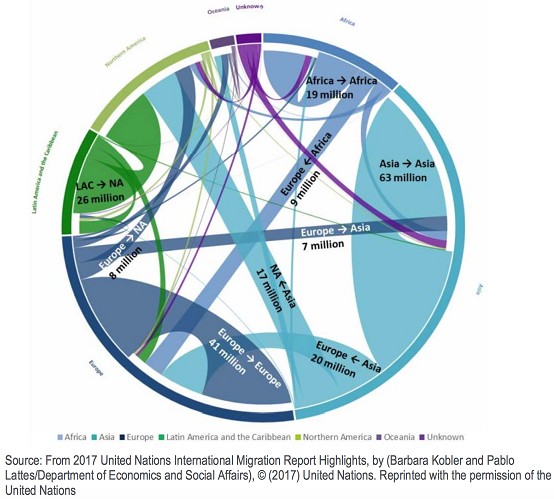
Number of international migrants classified by region of origin and destination, 2017

Migration has always existed but the global stock of migrants has grown materially since 1990 — although it still only accounts for around 3% of the global population — and in recent years has become a toxic issue in political debates. However, new research by Citi GPS and the Oxford Martin School shows migration increases prosperity for all.

The report, focused on economic migrants who’ve not been compelled to migrate either as refugees or through force, takes a detailed and balanced perspective on the impact of immigration on advanced economies. The overriding conclusion is that migration is conducive to native and aggregate prosperity, especially over longer time frames, when it’s likely to generate greater prosperity on an aggregate, per capita and per worker basis.

In most cases, migrants consume fewer benefits and receive less from the public purse in comparison to natives in similar circumstances, although the level of migrant inactivity often varies dramatically from one expatriate group to the next. In many cases, migrants return home in older age, which further improves the fiscal equation but which is often missed in economic modeling.

The ageing trend is global and will lead to a doubling in the number of people over 60 from 962m today to over 2bn in 2050. Migration will play an increasingly vital role in coping with this transition and easing the burden on care and social security systems.

Download the full report here or here.


Volume decline in dairy juice blends category for 2017

BMI logoA recent BMi Research report shows that the dairy juice blends category declined in volume for 2017, although the category value grew as the average industry price increased during the same period.

The above-inflation price increase may be attributed to a rise in packaging and production costs, as well as increases in fuel prices that influenced the distribution costs. It’s believed that players passed most of the growing production costs on to consumers.

Some of the manufacturers in this category changed their product formulations ahead of the implementation of sugar tax. This was with the aim of avoiding the tax load, and maintaining or gaining market share as consumers become more ingredient-conscious.

The category is expected to remain under pressure in the short term, with a limited decline in 2018; however, there’s a positive outlook for the long term and the category is forecast to grow year-on-year through to 2022.

For more, go to BMI Research.


Cheryl Hunter

Cheryl Hunter (@cherylhunter) has written for the South African media, marketing and advertising industries for more than 15 years. A former editor of M&M in Independent Newspapers and contributor to Bizcommunity, AdFocus, AdReview and the Ad Annual, she has also produced for various television networks and currently consults on communication strategy and media liaison. She now does the new weekly “Market Research Wrap” column for MarkLives.com.

— One subscription form, three newsletters: sign up now for the MarkLives newsletter, including Ramify headlines; The Interlocker, our new monthly comms-focused mailer; and Brands & Branding, launching

The Power Report: Hello… is there anybody out there?

by Megan Power (@Power_Report) In a world increasingly seduced by artificial intelligence, big data, in-app services and chat bots, the much-maligned call centre can be oddly reassuring, even with the tedious menus, inevitable waiting on hold and the frequently disengaged person at the other end. But reaching that person — a living, breathing and accountable human being — is often still first prize.

Getting to talk to someone who, with some luck, listens, empathises, trouble-shoots and resolves a distressing issue or technical problem. In real time. That’s not to be taken for granted.

First choice

When things go horribly wrong, then, picking up a phone is without doubt my first choice. And seems I’m not alone. Despite 2011 predictions from US research and advisory company, Gartner, that by 2020, 85% of customer relationships will be managed without human intervention, a new PwC global survey reveals most consumers want more human interaction in the future. It’s hardly surprising. Voice is the most personal of all forms of communication. It taps into our emotional side; the part that drives our decisions and colours our perceptions. It allows us to share and express how we feel. And how we feel informs our choices and determines our loyalty.

So it’s hard to believe that any business, especially one like Uber, which recently described itself as “customer-obsessed”, doesn’t offer the option of that most basic of human interaction — connecting on the phone. The multibillion-dollar ride-hailing service, with operations in more than 100 countries around the world, has no call centre, no phone support, no call-back feature, nada. No matter how hard you try, you simply don’t get to talk to anyone there. Instead, customers have three faceless alternate routes: log a query in-app, go online to a designated portal or use its social media channels.

It’s not a big deal if you’re querying basics, like how fares are calculated or how to split a fare with a friend. It’s a different story, though, when your account has been hacked or, worse, you’ve left your cellphone, laptop, wallet or house keys in the car and the driver isn’t responding — which seems to happen at an alarming rate, if local online posts are anything to go by. Instead of being able to talk to an agent immediately to explain your plight, and (hopefully) get some reassurance and assistance, the company requires you to search the app for the required FAQ (on somebody else’s phone if yours is gone), and then send an in-app message to access the driver’s number. Only if you can’t reach the driver after 24 hours, will Uber “step in to help”. Hardly comforting.

Not the way

As for reporting serious safety incidents, accidents and hijackings — and let’s face it, using this service carries risk — similar rules apply. You’re invited to report in-app, describe the event in writing, and someone will get back to you. Not the way the average traumatised victim chooses to be handled, I assure you.

How quickly it responds is another question: I noted on Twitter recently how the company took several days to resolve a nasty case of a mislaid cellphone and alleged driver extortion. Those following the saga on social media were, understandably, appalled. At the same time, more than 1000 bitter customers have logged complaints on Hellopeter.com, where Uber has a dismal rating of 1.2 out of 10, not realising that it doesn’t respond on that platform, either.

And it’s not just emergency situations. Last year, my receipts stopped coming through on email. Ironically, the marketing emails continued. A year later, despite months of exhausting back and forth — including those dreaded cut-and-paste replies — the frustrating glitch on my account remains. Even a manual resend via the app doesn’t work. With nobody to escalate to in person, I’ve now given up. And, so it seems, has Uber.

An obvious win

If a high-tech business like this is not going to bother with a traditional call centre or email support, or at least offer live chat, its alternate customer care channels need to be super-efficient, intuitive and fast. Digital technology is part and parcel of good customer experience, with seamless automation that improves the customer journey an obvious win. In the ride-hailing world specifically, full automation is king; self-driving cars are just around the corner.

But is self-driving customer care what most of us really want, all of the time? I’m not convinced. I still want to be able to reach a human when I need to. It’s a choice customers expect and deserve. It’s all very well being a global tech disruptor with a smart, shiny app, but focusing too much on the online product at the expense of the offline experience is a long-term gamble you’ve got to be brave to take. The company’s nearest competitor, another app-based contender, offers email support at least but also no phone support. Must be a thing.

The other day, I opted for — dare I say it? — a conventional taxi service, a reputable company operating for decades in my city. The excellent service made up for the slight extra cost, and the old-fashioned paper receipt. When I lost the receipt (yes, I have a problem with receipts), I called the operators, and was emailed a copy within hours. It felt good.

Traditional customer service? You bet. And it won hands down.


Megan PowerMegan Power (@Power_Report) has nearly 30 years’ experience working in South African media, including investigative journalism and news editing; she now runs Power LAB, a strategic communications and customer experience agency focusing on customer journey audits, crisis readiness and brand reputation. Megan’s consumer column, The Power Report, ran weekly in the Sunday Times for six years and has now found a new home on MarkLives.

— One subscription form, three newsletters: sign up now for the MarkLives newsletter, including Ramify headlines; The Interlocker, our new monthly comms-focused mailer; and Brands & Branding, launching soon!

Book Extract: A mind full of choices

In this extract from his new book, The Choice Factory: 25 Behavioural Biases That Influence What We Buy, Richard Shotton delves into the world of bias, an aspect of human nature that shapes our choices without us even consciously knowing about it.

The Choice Factory book coverby Richard Shotton (@rshotton) Your main task this afternoon is to interview the last two candidates for the position of manager on your team. At the close of the second interview you realise both candidates have the same relevant experience, strong academic results and practical ideas to implement once they start. You’re wondering how you’ll ever choose between them. As the final candidate gets up to leave, he catches his foot awkwardly on the table leg, upending the dregs of his coffee over the new floor. He leaves ashen-faced, but highly apologetic.

Who do you think you’ll end up picking? If the Pratfall Effect is correct, it’ll be the clumsy candidate.

The bias was discovered in 1966 by Harvard University psychologist Elliot Aronson. He recorded an actor answering a series of quiz questions. In one strand of the experiment, the actor — armed with the right responses—answers 92% of the questions correctly. After the quiz, the actor then pretends to spill a cup of coffee over himself (a small blunder, or pratfall).

The recording was played to a large sample of students, who were then asked how likeable the contestant was. However, Aronson split the students into cells and played them different versions: one with the spillage included and one without. The students found the clumsy contestant significantly more likeable.

Here’s how advertisers have applied this effect, and what we can learn from them.

  1. Flaunt your flaws

The best application is to admit that your brand has a flaw.

Admitting weakness is a tangible demonstration of honesty and, therefore, makes other claims more believable.

Further to that, the best taglines harness the trade-off effect. We know from bitter experience that we don’t get anything for free in life. By admitting a weakness, a brand can credibly establish a related positive attribute. For example, when Guiness admits it’s slow to pour it gives credibility to its claim of high quality.

Everyone assumes that brands are fallible, so if a brand is open about its failings, it can persuade consumers that its weaknesses lie in inconsequential areas. This theory partly explains the success of budget airlines. At launch they openly admitted that the trade-off for cheap prices was compromised service: no seat reservations and a pitiful luggage allowance. If they hadn’t admitted as much, consumers may have assumed the cost-cutting had come at the expense of safety.

  1. Make sure this tactic suits your brand

A twist in Aronson’s experiment suggests caution. He repeated the setup but this time the actor feigned incompetence and answered only 30% of the questions correctly. Once again students rated his appeal. In this scenario the clumsy spillage made him less appealing. The Pratfall Effect has a multiplicative effect rather than a purely positive one. It makes strong brands stronger, but weak brands weaker.

  1. It’s not only ads

Finally, it’s not just a matter of tweaking the copy in your ads. It should affect how you deal with unflattering customer reviews. Many brands hide the negative reviews. However, a 2015 study, by Northwestern University’s Spiegel Research Centre, analysed 111 460 product reviews across 22 categories and linked ratings to probability of purchasing. It found that likelihood of purchase didn’t peak with perfect scores but at 4.2–4.5 out of 5. There was only minor variation between categories — hair care reviews, for example, peaked in effectiveness at 4.2, while 4.5 was ideal for light bulbs.

Perfect ratings had less impact because they were seen as too good to be true. According to the authors:

Counter-intuitive as it may seem, negative reviews may have a positive impact because they help establish trust and authenticity. Consumers understand that a product can’t be all things to all people.

If it’s a successful approach, why is it rare?

There are a few examples of brands applying the Pratfall Effect such as VW, Avis, Listerine and Stella Artois. But they stretch over a period of nearly 60 years, making them a minuscule proportion of the tens of thousands of ads that have run over that time.

Why?

The rarity is explained by the principal-agent problem, a theory first suggested by Stephen Ross, Professor of Finance at the MIT Sloan School of Management. He suggested that there is a divergence between the interest of the principal in a company, the shareholders, and the agent, the staff.

What is in the interest of the brand, the principal, is not in the interest of the marketing manager, the agent. If the campaign flops it might be the end of the brand manager’s career. Imagine explaining to your CEO as sales dive that the key message of your campaign was that the brand was expensive. Even referencing Aronson’s research won’t save you.

For those prepared to embrace a modicum of career risk then the best chance of growing your brand is to flaunt your flaws. The principal-agent problem ensures it will always be a distinctive approach. For those interested in safe career progression then you may want to consider another route.

Further reading


Richard ShottonEveryday marketers make decisions aimed at trying to influence human buying behaviour, but few really understand why humans do what they do. Richard Shotton, author of The Choice Factory: 25 Behavioural Biases That Influence What We Buy, makes a compelling case for why this must change. The deputy head of evidence at Manning Gottlieb OMD, Shotton advocates that, before trying to influence human decision-making, marketers need to understand how and why people behave the way they do.

“Motive” is a by-invitation-only column on MarkLives.com. Contributors are picked by the editors but generally don’t form part of our regular columnist lineup, unless the topic is off-column.

— One subscription form, three newsletters: sign up now for the MarkLives newsletter, including Ramify headlines; The Interlocker, our new monthly comms-focused mailer; and Brands & Branding, launching soon!

#Campaigns: Africa will #GetItBack

by MarkLives (@marklivesThis week we feature insight into the brief, creative idea, production challenges and results of the #GetItBack campaign for Castle Milk Stout from Joe Public United.


Pinterest icon View all the #Campaigns at a glance on our #Campaigns Pinterest board!
YouTube icon Watch our #Campaigns playlist on YouTube


Client: Castle Milk Stout
Ad agency: Joe Public United
Title: #GetItBack

Information supplied by Joe Public United.

Brief

Castle Milk Stout is a brand steeped in heritage. To rebuild rapport with its key target audience, the brand set out to remind all Africans that now is the time to recognise who we are.

Creative summary

The westernisation of Africa is pervasive and prevalent, often taking precedent over African values and culture. This has resulted in us losing sight of who we are as Africans and losing touch of our proud and rich heritage. The latest film by Castle Milk Stout, titled #GetItBack, is held together by three main narratives:  the “baptism”, the “dream” and the “journey”. The supporting scenes are peppered with authentic and rich street-cast portraits, which helps to bring our African culture to life. This concept aimed to create tension in order to remind the audience of what is beautiful. Visual textures, authentic characters, coupled with a powerful and emotive voice-over, help to enhance the need for us as a nation and continent to get back to our roots.

Through an integrated campaign so unapologetic in its spirit and pride, Castle Milk Stout seeks to inspire all Africans to remember the richness of their heritage and to #GetItBack.

Production

Everyone involved in the process of this film was so brave and wanted to push the boundaries, to make a real statement which made it an incredible experience.

“The trust and understanding for a collective vision of wanting to actually say something was a huge driving force on this piece of work,” says Daniel Kaplen, Bioscope Films executive producer. “Being given so much creative freedom really allowed the work to be singular in its vision and, in turn, powerful and emotive, which we knew sitting in the edit room would have an impact on the audience. Following the audience’s reaction to the spot was wonderful because we clearly got people talking and. taking it all into account, it was mostly positive engagement. It’s great to be part of brave, powerful work that actually says something.”

Resources

  • Launched during Africa Month — July 2018
  • Digital (Facebook, Twitter, YouTube)
  • OkayAfrika website
  • Target market: South African’s 18+

Measurement

  1. Reach: 5.5,
  2. Impressions: 10.3m
  3. Twitter Trend: Peaking at #2

The campaign is still in progress.

Credits (TVC)

Brand

SAB AB InBev: Castle Milk Stout
Client: Leanne Martin (director category expansion and premiumisation)
Brand manager: Keneilwe Pholo
Campaign lead: Sifiso Pule

Agency

Joe Public United
Group chief creative officer: Pepe Marais
Chief creative officer: Xolisa Dyeshana
Executive creative director: Roanna Williams
Art director: Gareth O’Callaghan, Tshepo Mogorosi
Copywriter: Cameron Fraser, Tshepo Tumahole
Account management: Mpume Ngobese, Nana Lloyd, Gloria Malatji, Paul Wenzel, Sihle Luthuli, Koketso Kganyago
Strategists: Laurent Marty, Sisinyane Sihlali
Agency TV producer: Di Cole

Production company

Bioscope Films
Director: Fausto Becatti
Director of photography: Thomas Revington
Executive producer: Daniel Kaplan
Stylist: Bee Diamondhead

Post-production

Left Post Productions
Editor: Daniel Mitchy
Colourist: Keno Naidoo
Online operator: Keno Naidoo

Music

Pressure Cooker Studio

Audio

Sergio Da Cruz, StudiJoe

SFX

Left Post Productions


MarkLives logo#Campaigns is the new weekly MarkLives column featuring insight into the brief, creative idea, production challenges and results of South African communication campaigns, both ongoing and recent. Have a campaign worthy of being featured in #Campaigns? Submit a short motivation to 2mark and we may well be in touch. Please include links to campaign material, when it ran/is running and why you believe it should be featured.

— One subscription form, three newsletters: sign up now for the MarkLives newsletter, including Ramify headlines; The Interlocker, our new monthly comms-focused mailer; and Brands & Branding, launching soon!

Thinking B2B: Marketing myopia in B2B

by Warren Moss (@warrenmoss) One of the most-profound marketing insights from Theodore Levitt, the late Harvard Business School professor, was that customers buy ¼ inch holes, not ¼ inch drill bits — that the purchase decision is made based on the solution to the problem, not the tool that solves it.

Cardinal sin

Ask the majority of companies what business they’re in and they’ll tell you what product they sell or what service they provide, rather than focusing on the solutions that those wares offer their customers. Levitt believed that was a cardinal marketing sin: that too many companies were focused so narrowly on their products and services that they missed the bigger picture — what their clients really need. He coined the phrase “marketing myopia” to describe this state and the corporate landscape is littered with the skeletal remains of some big-hitting companies which failed to heed his advice.

The railroad industry in the US is a prime example: it was so focused on delivering the best railroad facilities that it missed that it was actually in the transport business, — so its revenues decreased dramatically when its market’s transportation needs grew and others innovated with cars, planes and boats, when it had been in a prime position to pioneer that market itself. Old-school Hollywood made a similar mistake: it thought it was in the film business, while it was actually selling entertainment. Citing movies as its focus, it dismissed the role of TV and paid the price when, suddenly, there was a TV in every lounge and scores of companies emerged to produce content for an entirely new audience.

B2B marketing clients must be advised to think broadly about their business — inside-out as opposed to outside-in. Being customer-oriented doesn’t mean finding ways to sell your customer new things, but rather understanding how to solve your customers’ needs. Creating a customer-oriented marketing strategy means that your company is in a better position to innovate and develop new markets, not grow within your existing one.

Think broadly

Companies which believe theirs is purely a growth industry are in trouble; obsolescence is a short hop away, if they put too much faith in the current superiority of their offerings. Those which think broadly — outside their industries — are the ones who will spot new opportunities. Every industry was a major growth industry, until it wasn’t. Similarly, those which believe that over-expanding and targeting a more-affluent market will guarantee their growth are looking at the problem from the wrong angle. Believing that more people will need your product if you make more of it, or try to sell it to people with more money, will land you in trouble. The trick is to understand what it is your customers are really using your products for, and how, and work to make it better, faster, simpler or more cost-effective, to use.

There’s also a common belief that, if there’s no competitive substitute for an existing product, there’s no need to innovate. Innovating around changing customer needs instead of current ones will set the company up for longer-term success. Others believe that making their production methods more efficient may deliver a better product and improved margins, but this often means taking their eye off the marketing ball. When output is high, efforts are concentrated on moving product and the company’s focus falls on selling, rather than marketing — often leading to a disconnect from customer needs. Instead of moving more products, try to satisfy customer needs by creating goods and services that customers want to buy…

Positioning a company for the unthinkable is impossible; repositioning a company with foresight to innovate is much more achievable.


Warren MossWarren Moss (@warrenmoss) is the CEO and founder of Demographica, a multi-award winning full service agency that specialises in the B2B category. He is the chair of both the Direct Marketing Association of South Africa (DMASA) and the Assegai Integrated Marketing Awards (Assegais), as well as the only African to judge the B2 Awards, which recognise the top performing B2B marketers in the world. Warren contributes the monthly “Thinking B2B” column, which looks at the latest trends in B2B communications and explains why it is fundamentally different from B2C comms.

— One subscription form, three newsletters: sign up now for the MarkLives newsletter, including Ramify headlines; The Interlocker, our new monthly comms-focused mailer; and Brands & Branding, launching soon!

Online CPD Courses Psychology Online CPD Courses Marketing analytics software Marketing analytics software for small business Business management software Business accounting software Gearbox repair company Makeup artist