FIFA gives press freedom, workers the finger

These headlines speak for themselves. Shame on FIFA.

Sacrificing press freedom on the altar of commercialism
Local journalists have accused world football governing body FIFA of acting as a bunch of ‘bullies‘ and ‘dictators’ with a neo-colonialist mentality, following what analysts see as ‘unreasonable’ media restrictions on the 2010 FIFA World Cup coverage.
BizCommunity.com

More Web sites ‘illegally’ using Fifa’s trademarks are expected to be launched, says a lawyer
Fifa expects more Web sites that illegally use its trademarks, such as 2010 and World Cup, to appear as the games draw closer. The federation’s trademarks revolve around the words “2010 Fifa World Cup South Africa” and combinations of those words.
ITWeb

With world domination, no one does it like Fifa
If I was a mascot I know who I’d want to be: Zakumi, the green-haired leopard for the Soccer World Cup in South Africa. I’d get to proclaim being “proudly South African” from the rooftops while coining it in China.
Mail & Guardian

Zakumi: Chinese workers earn R23 a day
Trade union federation Cosatu is up in arms about the fact that light-up models of Zakumi, the Fifa World Cup mascot, are being manufactured in China by workers who are being grossly exploited.
Times LIVE

Money for kicks
I am always amused when I see the game of football referred to as “The Beautiful Game” when, in my view, it would be more pertinent to call it “The Greedy Game.”
Business Standard

South Africa’s cup is failing to set the world on fire
The English FA have returned some of their tickets to Fifa and sales in Germany and Holland have also been slow, amid the disconnected though still unhelpful publicity surrounding the attack on the Togo team bus in Angola and doubts raised by influential football figures such as Franz Beckenbauer and Uli Hoeness over cost and security.
The Guardian

Kissing is not a crime

e.TV is “clearly a crime-kisser“, according to our gung-ho police commissioner Bheki Cele, for broadcasting a segment in which two criminals held forth on their plans to do what criminals do best, rob people and shoot anybody interfering.

Fearless journalism? Only if you believed that criminals and politicians would suspend their grubby ways and join hands with the rest of the nation in celebrating being overrun by drunken mobs of disenchanted football hooligans (with apologies to The Huffington Post). And yes, the cops should have and did make it a priority to catch these guys, which sent a clear message that South Africans, and the government, are fed up with crime and those who perpetrate it.

At the same time the police commissioner should think twice about his attack on journalists at SA’s only free-to-air TV station (read non state run). Issuing warrants to try and force journalists to identify their sources is counter-productive and contrary to the democratic voice of our country. It also sets a president which, if upheld, could severely influence future corruption cases as potential whistle blowers figure out that ‘journalistic privilege’ means jack and that their identities are at risk of being revealed.

Police Minister Nathi Mthethwa has gone as far as to suggest that freedom of the press and editorial independence were not without limitations.

Pierre De Vos of http://constitutionallyspeaking.co.za/ points out that “the last time I checked section 16(1)(a) of the Constitution states that ‘everyone has the right to freedom of expression, which includes freedom of the press and other media’. A journalist’s freedom to gather information and report it would be dramatically infringed if he or she could not keep the identity of their sources secret.”

MarkLives joins other media organisations in calling on the police commissioner to withdraw toss out the goodwill generated towards the police with this short sighted action.

Oh and kissing is not a crime. Except maybe in Uganda (small minds, tiny…?) or at Warrington Station.

Finally – a retraction

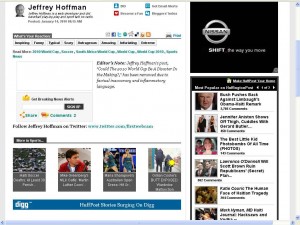
The Huffington Post finally publicly distanced itself from a blog post by Jeffrey Hoffman on South Africa’s 2010 World Cup. The story has been huff_retractionsmallremoved from its website and the following note appears:

Editor’s Note: Jeffrey Hoffman’s post, “Could The 2010 World Cup Be A Disaster In the Making?,” has been removed due to factual inaccuracy and inflammatory language.

The Huffington Post conned with previously published racist nonsense – before removing it without explanation

Following our story on how The Huffington Post published a blog post by Jeffrey Hoffman on the 2010 World Cup, before pulling it without explanation, we can now reveal that Hoffman was passing them second hand goods and racist nonsense to boot. The Huffington Post story, titled ‘Could The 2010 World Cup Be A Disaster In the Making?’ was published January 14, 2010. It was also published January 30, 2008 on several sites owned by Hoffman, including delraybeachwebcam.com and firstwebcam.com, under the headline ‘The 2010 World Cup in South Africa – A Disaster In the Making’.

In the original version Hoffman writes “Most would agree that three of the major venues, Johannesburg, Durban, and Capetown are cities where lawless mobs of disenchanted blacks run rampant and threaten both classes on a regular daily basis.”

The Huffington Post would eventually edit out the reference to mobs of disenchanted blacks in the version published on its website but not before one reader, WorldofTomorrow420 commented: “My god, what a load of racist claptrap! No doubt South Africa has a *major* crime problem. But read this loaded statement, and the author’s blatant racism comes shining through: ‘…Johannesburg, Durban, and Capetown are cities where lawless mobs of disenchanted blacks run rampant  …'”

Hoffman made some cosmetic changes to the story he submitted to The Huffington Post but for the most part they read exactly the same. Judge for yourself: Huffington Post vs. Firstwebcam.com.

Will The Huffington Post do the right thing and publish a proper retraction? We wait and see.

Huffington Post publish 2010 nightmare story, then pulls it without explanation

Just as the New York Times prepares to start charging for their carefully fact-checked content The Huffington Post goes and make their case for them. The Huffington Post published a piece by Jeffrey Hoffman headlined huffpost20102small“Could The 2010 World Cup Be A Disaster In the Making?” (Posted: January 14, 2010 09:15 AM), thought better of it, and then pulled it from its website to the apparent surprise of the author. It can still be accessed at this URL but does not appear on a public list of stories attributed to Hoffman.

Hoffman subsequently tweets “Hold on…now I see that The Huffington Post has pulled my last blog. What is their problem? All I reported on is history…NOT my opinion!  3:43 PM Jan 15th” and “I need to find out what their issues are, if I am going to continue to try and offer them my best ideas regarding reality as we know it. 3:44 PM Jan 15th.”

huffposttwitter2smallIn his post Hoffman wrote that “Most would agree that three of the major venues, Johannesburg, Durban, and Capetown are cities where lawless mobs run rampant and threaten both classes on a regular daily basis.” Hoffman suggests Googling the Johannesburg Times for the endless tale of horror that in his opinion is South Africa. Of course no such paper exists. “If you Google the Johannesburg Times, you will be shocked to find numerous stories every day about all different kinds of good and decent individuals, whose lives have been tragically cut short by crazed lunatics who never ever know their victims…and sadly, never will,” he writes.

Why would The Huffington Post, which seems to employ and significant number of editorial staff, run a story so obviously based on, well, Google? Which references a non-existent newspaper? And then pull it from public access without an explanation to readers or the author? It speaks of poor editorial decision making and dubious journalistic ethics. Shame on one of my favorite reads.

i spy media: The ANC “really deserves to be in power”

The Daily Maverick is turning into a mighty good read. The website, launched by Branko Brkic from Maverick and Empire magazines fame, is fast becoming one of the must read sites in South Africa through its insightful, mostly intelligent and opinionated content.

One story that recently caught my attention was a short overview on the year ahead for COPE (Congress of the People), you know that political one night stand so many liberal commentators had a fling with, in which the author suggested that the ANC “really deserves to be in power.”

The story read as a conversation between reporter Stephen Grootes and a Daily Maverick editor. The comment flew past unchallenged.

Of course many in South Africa believe that the ANC deserves to be in power, and looking at the alternatives, maybe it does. My issue, I suppose, is that when comments like these appear in local media it simply underlines what the ANC leadership itself believes, namely that it deserves to rule this country ’till Jesus comes back (some folks would read this as forever).

In the context of a discussion around the future of one of the few potentially viable opposition parties in the country I thought the point should have been explored in more detail if it had to go unchallenged.

In power since 1994, and with opposition parties struggling to gain traction, it seems less an issue of being deserving than of default.

Internet reaching 10% of South Africans

The number of South African Internet users has passed the 5-million mark for the first time, finally breaking through the 10% mark in Internet penetration for the country. This is the key finding of the Internet Access in South Africa 2010 study conducted by World Wide Worx.

Other highlights:
* The Internet user base grew by 15% last year, from 4,6-million to 5,3-million
* Growth is expected at a similar rate in 2010 bringing the user base to the 6-million mark by the end of the year.
* The landing of a new undersea cable on the South African coast was only one of a range of factors behind the growth. Of greater significance was the granting of Electronic Communications Network Service licenses to more than 400 organisations.
* Small and medium enterprises migrating from dial-up connectivity driving broadband uptake.
Each company moving from dial-up to ADSL, for example, extended Internet access to general office staff.

‘Ice Ice Baby’ round two

Following the success of the Castle Lite TV commercial starring Vanilla Ice the has held onto the 90’s hit ‘Ice Ice Baby’ in the follow up TVC created by Ogilvy Cape Town.

The original Vanilla Ice commercial emphasised the beer’s new extra cold attribute by aligning it with the ’90’s rap star, otherwise known as Robert Matthew Van Winkle, and his number one hit single from the ’90s, ‘Ice Ice Baby’.

The new ad will start flighting at the end of January 2010.

Online CPD Courses Psychology Online CPD Courses Marketing analytics software Marketing analytics software for small business Business management software Business accounting software Gearbox repair company Makeup artist