Shit is trending at Design Indaba

by Nadine Botha “Do shit that matters,” declared Bielenberg in the second presentation of Design Indaba 2012. His sentiments echoing the closing refrain of last year’s penultimate speaker, Robert Wong from Google, who beseeched: “Do epic shit.”

John Bielenberg, Rene Redzepi, Rahim Bhimani, Alfredo Brillembourg, Sissel Tolaas and Clive van Heerden all said it: shit. And the hipsters were all the happier.

With a working methodology based on “thinking wrong”, Bielenberg further provoked by emphasizing that all the shit around us is invented and it need not be that way. Primarily a socially motivated design instigator in Alabama, Bielenberg called for more do-good shit. At best it’s also good shit, but Bielenberg warned against shitting yourself before even starting.

Surely though, no one could make better shit than the world’s top-rated chef, Rene Redzepi of Noma in Copenhagen? Redzepi quoted his friend, Dutch food designer Marije Vogelzang, in pointing out that all of his work ends up as shit within 24 hours. “Food is just the shit eventually,” he said in his imperfect English. One can quite accurately say that he makes ‘future shit’. Get on it before it becomes a trend, son.

Although not on the formal Design Indaba programme, the official tweeter for the conference, Alexandra Daisy Ginsberg, was quick to point out her own shit, eChromi. A British interaction designer specialising in synthetic biology, Ginsberg has reengineered the eColi bacteria to emit different colours, making rainbow-coloured shit.


That the repositories of shit – toilets – should come up on the first day of the Design Indaba was prosaic after Patricia de Lille had yet again been harangued about shit service delivery at the World Design Capital 2014 public forum the day before. What to do when the shit hits the fan? Tell the designers that they’re responsible for resolving shit.

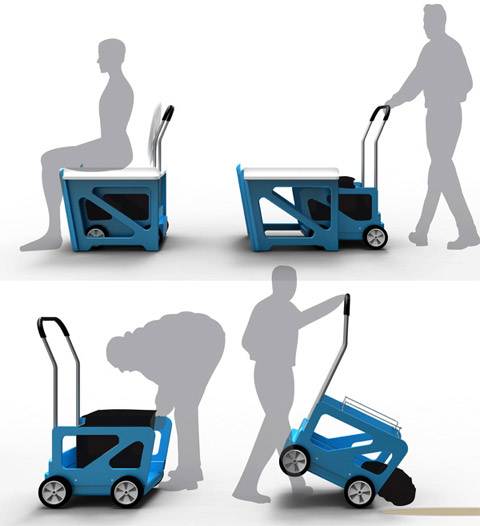
Canadian industrial design graduate Rahim Bhimani showed off the flat-pack toilet he created for use after natural disasters. Shit happens, after all. So when deep in the post-apocalyptic shit, the loo is simply assembled using a coin to turn the screws. The handy wheels make it easy to cart the shit to a hygienic distance.

In turn, Chilean architect Alfredo Brillembourg, of Urban Think Tank, described a more permanent shit solution. The Dry Toilet. The idea is put Dry Toilets at the top of the hillsides where there was a shortage of water. It came from the residents of the favela they were working in. Brillembourg was illustrating the power of the collective community insight into getting their shit together. Further dynamics of the Dry Toilet remained, well, a little murky.

Putting shit to good use was, then, a natural evolution of the shit trend. The director of Design-Led Innovation at Philips Design, South African-born Clive van Heerden, sent everyone a shitter (and a twitter) with the Philips methane gas digester for the kitchen. Converting excrement and leftover food into methane. Philips proposes this as a sustainable source of cooking gas. Cooking with shit!

That shit be treated with such disgust is perhaps an indictment on our smell-sanitised world. It clearly has weight in the design world. As Norwegian smell designer Sissel Tolaas said: “Nothing stinks, only thinking makes it so.”

Reprinted from Mahala. Cool shit.

Magazine covers we love (with cyclists on them)!

MarkLives.com runs a regular slot featuring the best local and international magazine covers every week. We recognise well thought out, powerful and interesting (and hopefully all three in one) magazine covers and celebrate the mix of pragmatism, creativity and personal taste that created each of them. By media bloggerMediaSlutZA.

I’m one of those people who dreads the Cape Argus Pick n Pay Cycle Tour more and more as it gets closer and closer. Not because I’m participating, but because every morning on my way to work, more cyclist end up on the roads, and forces me to swirve out for them into on coming traffic. I much prefer them in print.

For that reason, and because it’s the massive Cape Argus Pick n Pay Cycle Tour on Sunday in Cape Town, I thought it worthy to celebrate the magazines that dedicate themselves to everything Cycling. Here’s a round up of some covers currently in the market worth pointing out. If you’re a cycling-fanatic, make sure you click on the links and look at their subscription options.

Bicycle Times, No 015

Bicycling South Africa, March 2012

Cycling Plus, March 2012

Mountain Flyer, No 23

The Ride, Issue 6

– The (for now anonymous) blogger behind MediaSlutZA knows way too much for his own good about media in South Africa. Magazines in particular. His mission is to show when South African magazines might fail, but most importantly, succeed. If you’re looking for a library about South African magazines and news, your one-stop pitstop is MediaSlutZA. #MagazinesForTheWin

– Find a cover we should know about? Tweet us @marklives and @mediaslutza

SENSEable cities

by Herman Manson Carlo Ratti and Assaf Biderman head up the SENSEable City Laboratory, a research initiative at the Massachusetts Institute of Technology (MIT), where they study the built environment through deployment of sensors and hand-held electronics.

Apart from being director of the SENSEable City Lab, Ratti also regularly contributes to architecture magazine Domus and the Italian newspaper Il Sole 24 Ore. He is a member of the World Economic Forum Global Agenda Council on Urban Management, curator of the 2012 BMW Guggenheim Pavilion in Berlin, made the Forbes Magazine Names You Need to Know in 2011 and was named as one of Fast Company’s 50 Most Influential Designers in America in 2011.

Biderman teaches at (MIT), where he is the associate director of the SENSEable City Lab.

Speaking at the 2012 Design Indaba conference, which took place at the Cape Town International Convention Centre, 29 February 29 – 2 March 2012, Ratti and Biderman highlighted the role technology and information can play in optimising city planning.

Herman Manson: Tell us more about the philosophy behind your approach to studying built city environments?
Assaf Biderman: We are looking at how the recent proliferation of digital and mobile technologies is transforming the built environment, opening new doors for understanding and designing the city better, as well as for servicing and experiencing it in new ways.

For example, most of the world’s population has access to mobile phones already today and the numbers are growing rapidly. More so, the telecom industry claims that in less than 10 years there will be nearly 50 billion devices online. At such quantity, this means that the things around us – buildings and cars, our personal belongings, and the networks that service our cities and much else -are becoming embedded with microprocessors and sensors, and are going online. They’ll be able to tweet to you, and you’ll be to talk back to them.

Under this condition, we can begin to think of cities as if [they] were computers in the open air. We can sense occurrences and flows in real-time and feed that information back into the city so that people [can] make smarter decision about consumption, resource allocation, disaster response, mobility, interpersonal interaction, and many others.

At the lab, we explore this new condition by partnering with the industry and with cities worldwide, and together we develop technological interventions that are then deployed in those cities, with the aim of touching upon key urban issues.

Manson: What are the tools you use in your research?
Biderman: When it comes to design, we use common drawing, modelling, or prototyping tools. In our scientific work, we use GIS and programs for numerical analysis. For the most part, our projects involve software and hardware development, which we do in-house.

Manson: Based on your research so far – in what aspects of modern city design would you say are city planners still failing comprehensively?
Carlo Ratti: I think that today we are all failing for not involving people enough. In a paper written with Nashid Nabian we note that, “In architectures without architects, the inhabited environments are inspired and directly shaped by their inhabitants.” So it’s important to give people a say in designing their own environments.

To quote from the paper: “From democratising access to real-time urban information, to providing cyber platforms that allow people to participate in addressing and solving urban challenges, to crowdsourcing the collection of information about how the city operates and is used, we believe that the coming years might be full of promise for the ‘bottom’ up paradigm of how our cities are planned, conceived, built, inhabited, managed, and restored or repaired (as in the case of natural disasters or civic conflicts).”

Manson: How would you judge the design success of public spaces?
Ratti: Based on how people use them! People are the ultimate metric of success for an architect and planner…

Manson: While physical city spaces might not change in the short term, you do believe we can positively change the feel and function of cities by understanding its communities and flow of people better. Do you have any interesting case studies where this has been achieved?
Ratti: I believe that it is about digital and physical space together. For instance, in the case of Zaragoza (where we designed the digital water pavilion, a half-physical half-digital building), there is now an open source community taking control of public space and programming it!

Manson: In South Africa, large parts of our cities consist of an informal urban environments physically separated from the planned urban environments. How would you recommend we approach the closer integration of these environments?
Biderman: While the physical separation between these two types of environments can be the result of an abrupt transition in how they are planned or built, we know that the informal and the formal settlements share resources and people, sometimes extensively.

As the adoption of digital technologies, such as mobile phones, is often substantial in both formal and informal environments, we can use the digital infrastructure as a means to study flows and usage of space in both types of places, as well as across the boundaries between them. Such information can enable to reinforce the vital connections between formal and informal environments, such as transportation links and economic opportunities.

Bizcommunity Originally published on Bizcommunity.com Marketing & Media | South Africa – click to see more comments.

Andrew Shoben on how a ‘design capital’ should view public art

by Herman Manson Andrew Shoben makes art in public spaces. His artists’collective, greyworld, has become known for creating artwork in mostly urban spaces that resonates with many rather than an ‘arty’ few.

So they famously tuned sets of street railings in cities around Europe so that when you ran a stick along them they played “The Girl from Ipanema.” More recently they created a public art installation for the launch of the Nokia N8 at Nokia World that allowed you “splash” digital content onto a wall of LED lights using an app on the phone. Earlier this year a large ‘ball of light’ become a ‘sun’ over London’s Trafalgar Square to give ‘Londoners a brighter start’ to an otherwise cold, dark and dreary Monday morning. The sun was commissioned by Tropicana fruit juice.

Shoben, a Professor of Public Art at Goldsmiths University, was a guest speaker at the Design Indaba 2012.

Herman Manson: What does public art contribute to city environments?
Andrew Shoben: Good public art creates several positive outcomes – a sense of place, and identity for an area and a local audience. It also creates thoughts – discussion, both positive and negative in areas of cities where often things can seem impersonal and distant. And in greyworld’s work, it creates an opportunity to play and to create.

Manson: Have most city administrations come around to its benefits or do you still experience resistance from time to time?
Shoben: City administrations appreciate the effect that good art can have. The problem is usually who chooses good art? There’s a lot of easy, anonymous, lowest common denominator bland work being commissioned. Shame.

Manson: How would you measure the effectiveness of a public art installation?
Shoben: Well, there are the usual methods of polling and interviewing, media interest and suchlike. I like to sit and watch the audience as they interact with our installations. You quickly get an idea of how engaged or otherwise people are with your work.

Manson: Why is so little public art installations taking place in more informal urban environments where most city dwellers now live?
Shoben: Those areas have always been greyworld’s zones of preference. But you’re right, the town square, and the office forecourt are the kinds of “prestige” areas that have become the defacto place of art.

Manson: In Cape Town, Coca-Cola has had a hugely successful public art initiative in the form of Cratefan – a ‘statue’, built with red Coke crates. To what extent is corporations becoming involved in public art and what do they need to keep in mind when they do?
Shoben: Corporations and wealthy individuals have always been involved in commissioning art. More and more, they have realised that they don’t need to paint a giant logo on it, or make it out of their product, for people to appreciate it, and find affection for the brand. “Sympathetic marketing,” a light touch, is much more suitable as consumers become even more savvy at recognising adverts.

Manson: Cape Town is preparing for 2014 when it will take up the World Design Capital title. How much is public art a signal of a city’s design ‘health’ and what would you like a to see a ‘Design Capital’ do to stimulate public art?
Shoben: Public art certainly can reflect a city’s health – but it need not be confused with wealth. Public art doesn’t need to cost the earth, it needs to be well thought through, and relevant. The best way to do this is to involve the artists as early as possible in the process.

A Design Capital should think of art not just as a something placed in somewhere, but as a system – allow as many people as possible to interact, comment, create and even creatively destroy the city’s art elements.

Bizcommunity Originally published on Bizcommunity.com Marketing & Media | South Africa – click to see more comments.

Clive van Heerden sees the ‘far-future’ of design

by Herman Manson Clive van Heerden is the senior director of Design-Led Innovation at Philips Design. In its simplest terms, Van Heerden and his team researches how socio-cultural and technology shifts only just emerging today might shape society and the way we live ten or twenty years from now.

In 2007, the team’s work on emotive clothing – clothing that lets others know how the wearer feels – was awarded at the Time Magazine Best Inventions of 2007.

Van Heerden studied political science and industrial sociology at the University in South Africa (Unisa). He soon moved to London where he completed a research fellowship at Westminster University and finally graduated with a masters degree in interaction design from the Royal College of Art in London.

Van Heerden was a guest speaker at Design Indaba 2012 conference, which recently took place at the Cape Town International Convention Centre.

Herman Manson: You have a very interesting job – conducting ‘far future’ research to identify long term systemic shifts and anticipating changes in future lifestyles. Could you tell us more about the process behind the research you conduct. How does it work and what do you look at?
Clive van Heerden: We develop future lifestyle scenarios as a way of testing the future, rather than trying to predict it. Apart from conventional technology research we try to understand changing social trends in different timeframes. These timeframes or ‘horizons’ are incremental next steps, near term futures and far future explorations like design probes. Most of my work has focused on developing design probes which are provocations designed to stimulate feedback and debate around probable lifestyle scenarios 10 to 20 years out.

We develop these future scenarios around clusters of ‘weak signals’ – tendential socio-cultural or technological shifts that may or may not manifest themselves as mainstream trends in the future but which warrant attention now. By materialising a scenario or publishing a disruptive narrative we get feedback from a very large number of people. These reactions enable us to gather ‘contextual insights’ which informs our nearer term research.

Manson: What is the value in this kind of research for a multinational like Philips?
Van Heerden: Our research attempts to understand emerging socio-cultural trends that will expose opportunity in the peripheral vision of our existing business. Design probes generate intellectual property, new product genres and new technology, but primarily they identify “contextual insights” that help us to understand medium to long term futures – they shine light on terrain off the beaten track which exposes both opportunity and changing attitudes, behaviours and needs.

Manson: What are some of the key conclusions you have come to in terms of where society is moving?
Van Heerden: A lot of our work over the last few years has been in the area of sustainability and alternative solutions to many of the technology processes we take for granted. We have been pre-occupied with rapid urbanisation and its implications for primary resource availability and usage. Subjects like high rise sustainability, home farming, up-cycling waste, liveable cities and the like.

We have produced a lot of provocations in the area of natural, recyclable, non-polluting, ethically produced, non-resource depleting alternative solutions which have resonated very strongly. The test will be to see how much these sentiments remain at the level of social lip-service and to what extent consumers change their behaviours in coming years.

Manson: What is the role of technology in the social and lifestyle shifts you see and do you expect it to increase the pace for and increments of societal change?
Van Heerden: Technology has always been very important but shouldn’t be seen in isolation. We are interested in the political, economic, environmental and cultural contexts in which technology emerges. Throughout history we have seen the effect that major upheavals and crisis – whether social or environmental – has had on technological innovation. The wakeup call we are being given by our planet at the moment is making us aware of the drastic need for alternatives.

Manson: How is sustainability going to influence design work going forward?
Van Heerden: Substantially. A decade ago talking about designing for life off-the-grid seemed an extreme idea – now it doesn’t. The next few decades present an interesting challenge for design as we move from an electro-mechanical existence to an increasingly biological one.

Design has an important role to play in challenging the way we make stuff – materials, processes and values and I hope that it finds its voice. Designers also need to understand the changing technological universe and recognise the need to develop new skills – for example learning to develop and apply materials that are living, self-powering, self-repairing, adaptive and responsive changes the way we think about objects.

Manson: If you apply your research and your knowledge of South Africa, at a guess, what sort of society do you see emerging here?
Van Heerden: In some ways South Africa is a glimpse into the future. We have been working on Liveable Cities and the shift from formal to increasingly informal urbanisation over the next 25 years. What we learn in Cape Town and Johannesburg today with literally hundreds of informal settlements will be very relevant to parts of Western Europe and the US over coming decades. 70% of the world’s population will be urbanised by 2050 and the very large part of that will live in unplanned, un-recognised, badly housed settlements.

Many parts of the world that have had no experience of mass squatter settlements on the doorsteps of major cities will have to come to terms with a new urban reality and will learn a lot from the strategies and solutions that South Africa develops in the coming decades.

Bizcommunity Originally published on Bizcommunity.com Marketing & Media | South Africa – click to see more comments.

An architect’s manifesto

by Herman Manson People are expecting real change real fast. This is true for the Middle East and North Africa. It’s also true here at the Southernmost point of Africa. Urban environments that imprison and entrench poverty rather than provide economic mobility has immense socio-economic and cultural ramifications for an increasingly urbanised nation.

The failures in our urban design was recognised by the two South African architects speaking on the Day 2 of Design Indaba 2012, the annual design conference that took place in Cape Town last week.

Heinrich Wolff, a partner in Noero Wolff Architects, told conference delegates that architecture can contribute to outcomes of change and called on them to develop a agenda for urban change.

Wolff suggested this agenda applies constitutionally enshrined rights to the field of architecture and urban design.

Architecture should develop freedom through recognising the need for access to economic opportunities, healthcare, education and security. It should recognise the importance of environmental sustainability. It should perpetuate constitutional values of equality and not give differential treatment to formal and informal cities. It should value and recognise architecture as a form of free expression and personal freedom. It should make use of labour intensive building methods to contribute to job creation and skill training and it should value and recognise those construction skills. Cities should be made great for every one of its citizens – not just a select few.

Wolff argues that society often images itself through its buildings – and that as such South Africa requires an architecture of equality.

Wolff and his team also recognises the importance of education, and chose to apply his agenda/manifesto for change to the architecture of the Inkwenkwezi Secondary School they were commissioned to design in Du Noon outside Cape Town. In acknowledgement of the decorative paint work that is part of the local culture, especially when locals run businesses from their homes, the architects adapted this as an element of the schools design, allowing a sense of participation in the community.

The school hall was built to mimic both a school and a church hall, lending itself to be rented out over weekends to local churches, allowing the school to raise funds for educational needs. Ten community churches make use of the hall every weekend. A large square around which the school is built and where kids congregate during breaks also allows the principal to keep an eye out on the playground. With a pass rate of only 40% prior to the construction of the new school building Du Noon remained a dead end for learners.

However, within the first year of moving into the new building, the pass rate rocketed to 70%, and today it sits at 82%, rivalling some established city schools. Now if you will – go back to that quite on architecture of equality…

Architect Y Tsai of Tsai Design Studio is known for his ability to provide the maximum amount in the minimum amount of space. He famously designed the Nested bunk beads that sleeps eight people in stacked beds but takes up the space of a single unit. It was created as a solution to sleeping arrangements in confined spaces like low cost housing and has been rolled out in multiple orphanages already.

Tsai has also been successfully converting retired shipping containers into functional, not to mention beautiful, community sport centres and classrooms. Designed to fit into local environments and maximising design advantages to ensure proper ventilation, shade etc, they offer exciting spaces for the kids that also contribute to the environment that surrounds them. The Vissershok Container Classroom, a 12m recycled container, today serves as classroom for 25 Grade R (age 5-6) pupils as well as a library for kids having to wait at school before they go home.

Design can make a social impact as the projects by both Wolff and Tsai have proven. Architecture has a role to play in the change people demand. It can do more than design and build buildings. It can physically manifest in communities the values of our democratic constitution and offer tangible proof that the words enshrined within it truly and physically translates into all our lives – the proof set in bricks and mortar.

Bizcommunity Originally published on Bizcommunity.com Marketing & Media | South Africa – click to see more comments.

Interaction design with Hellicar & Lewis

by Herman Manson Hellicar & Lewis is the interaction design partnership between Pete Hellicar and Joel Gethin Lewis.

Hellicar co-founded Unabomber Skateboards in 1997, producing boards and apparel featuring the work of artists and illustrators including Jody Barton, Will Sweeney, Pete Fowler, Nik Taylor and Adam Neate. He would later become art director at Etnies – a retailer of action sports footwear and apparel. Lewis was an interaction designer at United Visual Artists, had worked at Dazed&Confused magazine and AnotherMag.com.

In March 2011 Hellicar & Lewis teamed up with Nexus Productions, Wieden+Kennedy, Frukt, Lexus PR, Coca-Cola and Maroon 5 to put on a live streamed 24 hour music event in which the band had to come up with a new song in just 24 hours, all while interacting with fans on progress via social networks. Taking the experience beyond webcams the duo helped create an event that offered fans an interactive experience and a front row seat into the creation of the band’s music.

They use open source and believe truth and the real world are the killer apps to business success – even when dealing with giants like Coca Cola.

Hellicar and Lewis were guest speakers at the Design Indaba which took place at the Cape Town International Convention Centre 29 February – 2 March 2012.

Manson: I’m hearing a lot about the integration of physical and digital environments and I believe it’s also an important feature in your work?
Hellicar & Lewis: We are really interested in taking people into the moment. We think this is an interesting thing artistically and commercially. We like to make bridges between different groups of people or places, technologies and experiences. We don’t understand why so many installations seem to have instruction manuals – if that’s happened we feel we’ve failed. There should be no “wrong”. Violins always make noise, even if they don’t make pretty noise.

Manson: There seems to be a global move towards a more collaborative approach to design and business. How is it impacting on your own business and work style?
Hellicar & Lewis: We’ve deliberately kept Hellicar & Lewis extremely streamlined. We like to collaborate with as many different groups as possible – from youth groups in South London, to the Coca Cola company, to hardware hackers in Tokyo. Open Source is collaborative by definition.

Manson: Do you think it might relate to the uptake in social media that is influencing broader society to emerge from a more isolated, individualist culture to something that is more open and collaborative?
Hellicar & Lewis: It’s difficult. Sometimes it feels to us like people are creating illusions. I tweet therefore I am. We get excited when digital crosses over to the analogue world, or vice versa.

Manson: Open source also plays an important role in how you approach design. Why is this?
Hellicar & Lewis: Open source allows us to work with the best people in the world in an open and more human fashion. Standing on each other’s shoulders rather than toes.

Manson: What are the open source tools you use most often and how do you use them?
Hellicar & Lewis: We use openFrameworks in all our projects. It enables us to create new experiences in the way that we want to.

Manson: Do you think it’s appropriate for marketers to try and engage with people in spaces they consider personal – like is often the case with social media?
Hellicar & Lewis: We think that installations or experiences should respond to people once the person makes that initial connection. We hate spam, and we see a lot of it about on social networks at the moment.

Manson: What will your core message be to the delegates of Design Indaba 2012?
Hellicar & Lewis: The real world is still the killer app of all time. Just tell the truth.

Coke 24hr Music from Hellicar&Lewis on Vimeo.

Bizcommunity Originally published on Bizcommunity.com Marketing & Media | South Africa – click to see more comments.

Design Indaba 2012: Find courage and leave the Wookie pant-less

by Herman Manson Find courage. To leave the Wookie pant-less. To think wrong, and be right about it, to capture a sense of place in otherwise mundane spaces, to give when its not something your trade is known for, to order cities from the informal rather than the formal city. And to enjoy doing it.

Design Indaba 2012, the annual design conference held in Cape Town, 29 February – 2 March, got underway on Wednesday with a call from speakers to approach design from unconventional viewpoints as a route to true creative solutions.

Designers become victims of their own heuristic neural pathways (learned, pre-determined behaviour) said graphic designer and social entrepreneur John Bielenberg. To break such behaviour they need to avoid the conventional – i.e. ‘think wrong.’ Get out of the office and speak to people, take risks and make stuff that reveal your talents, and have fun doing it. As Bielenberg notes – if changing the world isn’t fun then nobody is going to do it. Some might call that flippant but who says seeking, designing and implementing change is only for the morose and the humourless?

Bielenberg, through his Project M initiative, has inspired his students to come up with real innovative solutions that changed lives, whether it was the Mbulance supplying graphic designers affected by Hurricane Katrina with supplies or handing out free pie to foster a sense of community – something that developed into a sustainable eatery that supports families and created an inviting communal space in an otherwise segmented community.

A point many speakers would make is that change cannot be planned on a global scale – you start where you can and it will replicate itself around you.

This was very much the core message from Alfredo Brillembourg, founder of architecture firm Urban Think Tank. As predicted – it’s the architects and their contributions to creating livable urban environments that often carry Design Indaba. Brillembourg did so again with his (sucker punch to conventional thinking) take on informal city-scapes.

Brillembourg points out that informal settlements is a fast growing part of all urban landscapes. In South Africa this has been a reality for a long time but few have been brave enough to offer solutions to integrating formal and informal (Brillembourg describes them as ‘another city’ within the formal city) urban environments. We either entrench the segregation or ignore these settlements – paying attention would mean political accountability after all.

Brillembourg calls on architects to expand their horizons – informal settlements is in crisis and desperately requires well designed solutions. By ignoring these parts of our cities architecture as a profession has depleted its legitimacy, argues Brillembourg. Designing for the 1% and ignoring the rest is no longer sustainable (and have arguably never been).

Informal settlements are not simply problems – they offer solutions in themselves. In San Agustin, a poor barrio in Caracas, Venezuela, Brillembourg and his team took a collaborative approach to urban planning by involving local community leaders in finding solutions to the areas infrastructure problems.

Local government had proposed a system of roads that would have flattened 30% of the houses in the district. Instead Urban Think Tank proposed a cable car system (San Agustin is built against a steep mountain ridge) running over 2.1 km and allowing movement of 1200 people per hour.

The cable car system was fully integrated with the metro system in Caracas. The five stations have cultural, social and system administrative functions, and serves as public spaces, and houses in the area are being upgraded by their owners. Make a start at change and the surrounding area will follow on its own volition.

Charl Thom and Justin Gomes, the South African duo from local agency FoxP2, called on delegates “not put pants on the Wookie”, a reference to the pant-less character in the movie Star Wars, which studio execs had tried to force George Lucas to dress, completely changing its character (at least from nude to semi-nude, but you get the point). Lucas resisted, and did some other very smart things like cutting his directors fee for the faithless studio suits in favour of the merchandising rights to characters in the film, which of course made him enough money to go out on his own.

The FoxP2 guys warned against ‘best practice’ – like putting pants on Wookies, or in another anecdote from the making of Star Wars, the disco soundtrack that thankfully never was, but which studio execs felt would work with its target audience.

Rene Redzepi, owner of Noma, which tops the S.Pellegrino World’s Best Restaurant list, also looks at design (in this case food design) differently. He dismisses all the attention placed on chefs in the ‘restaurant food chain’ and gives credit to farmers for returning to polyculture food production. They are often dealt with by buyers who talk price but never praises.

Redzepi not only deals with and encourages farmers directly, he also transformed his guests’ notion of a fine dining experience by stripping his restaurant to quality, hand made but otherwise bare furnishings. His chefs serve the food they created, taking them out of the kitchen to interact with their customers, and he looks after his people, through the kitchen studio (described as a Google like space for foodies), something the restaurant trade is not known to do often.

The young designers participating in the Pecha Kucha also impressed with their sometimes sincere, sometimes bizarre but always questioning takes on design. Rahim Bhimani from Canada created a flat pack toilet that makes use of biodegradable waste bags (to be buried) which can be rolled out to serve in areas struck by natural disasters.

Carly Berger from the USA, alongside her college team, helped create a solar powered house that aims to be affordable, replicable and movable, in a bid to bring such buildings from expos to neighbourhoods. One such residence can save its owners an equivalent of R996 000 in bills over a 25 year period.

Andy Chen, another Pecha Kucha participant from the US pointed out that often we are “at ease with grievance but not with grief” in how we treat those in our prison system (our legal system has failed to protect those we imprison once they have been locked away) or the sexual health of the elderly.

Local designer Renée Rossouw explored her professional identity through design, while Sputniko! from Japan, designs to trigger discussion and debate, like with her “Menstruation Machine” which attempts to replicate the effects of menstruation, and which MOMA describes as exploring the “relationship between identity, biology, and choice, while also inquiring into the meaning of gender-specific rituals.”

Finally, Massoud Hassani, a Pecha Kucha participant from the Netherlands, took his childhood toys from his native Afghanistan as inspiration to create a wind-powered land mine clearance device, which costs only $40 and is wind powered to roll across the land of his childhood country and detonate unexploded mines.

None of the designers speaking on the first day of the Design Indaba claimed they can change the world. They did claim they could make a small part of it better. By looking at things differently. And then finding the courage to follow their vision.

Bizcommunity Originally published on Bizcommunity.com Marketing & Media | South Africa – click to see more comments.

Magazine covers we love (this week)!

MarkLives.com runs a regular slot featuring the best local and international magazine covers every week. We recognise well thought out, powerful and interesting (and hopefully all three in one) magazine covers and celebrate the mix of pragmatism, creativity and personal taste that created each of them. By media bloggerMediaSlutZA.

INTERNATIONAL
Cincinnati, March 2012

Remember the selection of ‘handwritten’ coverlines we featured two weeks ago? Here is a well executed chalkboard look-and-feel, with a very simple dish at the centre of it all. Loving it!

The Guardian, G2-section, 23 February 2012

The G2 supplement to The Guardian asks on its cover “Does this image still shock?”. The cover concept reminds me a bit about the DA Youth leaders’ DASO poster with the line “In our future, you wouldn’t look twice”. So does flipping the bird still shock? Let us know!

LOCAL
Where It’s At, Edition 1

The 2012 Design Indaba conference is currently running in Cape Town. The Indaba recently announced the closure of their well respected quarterly magazine. But I should have known that they would bring out something even more creative, and they have. I haven’t seen the issue yet, but from what I read, and have seen on their website, it looks like an awesome project, and hopefully there will be many more. The website states that it’s “Guest edited by Richard Hart and designed by Disturbance, Where It’s At is the first in a series of limited editions inspired by Design Indaba magazine”. Fun times and I can’t wait to get my hands on the first issue!

– The (for now anonymous) blogger behind MediaSlutZA knows way too much for his own good about media in South Africa. Magazines in particular. His mission is to show when South African magazines might fail, but most importantly, succeed. If you’re looking for a library about South African magazines and news, your one-stop pitstop is MediaSlutZA. #MagazinesForTheWin

– Find a cover we should know about? Tweet us @marklives and @mediaslutza

Online CPD Courses Psychology Online CPD Courses Marketing analytics software Marketing analytics software for small business Business management software Business accounting software Gearbox repair company Makeup artist