The Dissident Spin Doctor: Collaborative economy not ‘marketing bollocks’

by Emma King (@EmmainSA) ‘Collaborative economy’ is one of those marketing buzz words that I’ve seen bandied about quite a bit recently. I’m not a big fan of those marketing catchphrases that everyone loves – ‘marketing bollocks’, as a colleague and I used to call it.

Anyway, ‘collaborative economy’, as bollocksy as it sounds, is interesting and also very relevant to the modern marketplace.

A shift from owning to sharing

A collaborative economy, or collaborative consumption, was named by TIME in 20111 as one of the “10 Ideas That Will Change the World”, and is Emma Kingdefined as “the shift in values from ownership to sharing and access”. What that means in real terms is a shift from owning to sharing – something social networks encourage (beyond over-share, I might add). Think house swaps, couch surfing and similar experiences facilitated by these networks!

We’ve all borrowed or shared things with friends, but the exponential developments in technology in recent times meant we can extend these circles, and start doing this with people we don’t know.

Infrastructure

Social networks have put in the infrastructure that not only puts people in contact, but also supports trust and endorsement. And, with the growing distrust of brands, media and institutions coupled with prolonged tough economic times, the ways in which this can create an alternative economy to one based just on access to products and price will only grow.

So where does that leave us, who are in the business of communications?

In the past, big brands were the only ones that could buy media space. And so they would tell us what to buy, what to consume and how to do it. But in a collaborative economy – where we can all share and communicate with each other – we need to start working out how we, as brand custodians, can participate.

Something more conceptual

Of course, we could look at the basic concept of sharing, and barter or swap our services for goods. But my FD would have a conniption fit if I waltzed into his office and announced that we would take on a big new client, in return for, say, a truckload of mielies.

So, it’s not just about swapping but something more conceptual.

As communicators, we’re well-placed to be part of this brave economy. Our expertise is based around building awareness – vital for collaborative consumption.  We are used to making sure that people engage with us or our brands. We know how to make something enticing, and we know how to get people to get involved – again, vital for anything that wants to thrive in a collaborative economy.

But, most importantly, we understand the value of trust. That it’s not just about saying how great you are but actually acting in that way, resulting in other people trusting and endorsing you.

The vital part

And this is the vital part of a collaborative society – without trust, we will not send money to someone we have only seen on a website, or go and crash on their sofa. Without the endorsement of others – via reviews or feedback or ratings – the economy won’t survive. And isn’t this something that we’ve already been doing for ages?

Emma King is Head of PR at The Jupiter Drawing Room (Cape Town). She is a columnist for MarkLives on PR and communication issues. You can find her on Twitter at @EmmainSA.

– Industry news you’ll make time for. Sign up for our free newsletter!

TREND. report: The PR evolution


TREND.

Public relations agencies and communication strategists need to reengineer themselves as social businesses to meet client communication needs.

This is a key finding to emerge from a report on the evolution of the public relations industry by trendwatching site, TREND. at www.TRENDlives.info, called ‘Social Communications’. The report was made possible through a sponsorship by FleishmanHillard and Lion’s Wing Brand Communications.

The public relations industry has reengineered itself in recent years to focus on acquiring digital skills to compete with digital agencies in the social media realm, as well as repositioned as reputation management specialists – a core skill needed by communication firms today.

In South Africa, steps to “professionalise” the industry are seen as hugely positive in setting professional standards for PR in the country. A green paper is ready to go before parliament.

“This is the most significant time to be a communication practitioner in South Africa,” says Louise Marsland, Publishing Editor of TREND. and the author of the PR report.

“The step to professionalise the industry is hugely positive and should be applauded and supported. It can only help the industry grow further and evolve into being regarded as a more important stakeholder in the marketing communication sector.”

Current key PR trends identified, include:

  1. Professionalising the industry: The green paper lays out the education minimum to be called a public relations practitioner and requires registration with a legislative body that will replace PRISA eventually with a ‘society of public relations practitioners’.
  2. Reputation management: Reputation, positive reviews and strong search and social visibility is key for business today.
  3. Expanded measurement: Understanding and using the data being generated by all these new technologies that consumers are now interacting with, is essential.
  4. Lead generation & conversion: PR needs to deliver measurable business results, not just column centimetres.
  5. Content PR: Content marketing, once the preserve of the PR industry, now forms part of all integrated marketing strategies and the lines of communication are blurring. PR practitioners need to be on top of their game to remain in control of earned media.
  6. Micro stories: Stories don’t have to be epic, but can be about one element seeded to influencers that impacts on specific target audiences.
  7. Multimedia content: Video is the future of the web.
  8. Seek out engagement opportunities: Generating buzz beyond the hard news is key – it is all about the brand experience now for consumers.
  9. Skills development: there is an emerging technologies skills gap at the top of organisations and an experience gap at the entry to an organisation.
  10. Authentic communication, not spin: brands have to demonstrate honesty and transparency, not just talk about it. This goes for all business processes and communication – from ethically sourced raw materials, to the factories you produce your goods in, to your social media conversations.

Read the first part of the Social Communications TREND report here.

[Digital Grandad] Demystifying your huge data Syndrome

MarkLives’ digital agony uncle @DigitalGrandad1 is now taking questions on all issues digital. Tweet them to him or email DigitalGrandad@marklives.com.

DigitalGranddad

Dear Grandpa – does size matter?

I was hoping you could help me demystify the topic around ‘Data and Big Data’. We are a high street retail brand and run a loyalty program and have over 520,000 records in our database that run monthly campaigns with little conversion – but my CEO attended a few conference recently and feels we are not doing enough, don’t have enormous amounts of data and we should be thinking big data. In truth I am not sure what it all means and quite frankly feeling quite insecure. I need to report back next week and advise on what is Big Data. Help.

Regards
Mr Insecure

Dear Insecure

“Big data is huge, its enormous, it’s gigantic, in-fact it so bloody big, its scaring the living daylights out of marketers, sending shivers down CTO’s & CMO’s backs,  making some break out in a cold sweat and leaving them feeling very inadequate umm”

dd1

But, please don’t be insecure – your not alone! You must have heard the saying “size matters”, but let me tell you son, size doesn’t matter! It’s what you do with it that counts! So lets equip you with the intelligence to verify what you have is good and that you are taking the right steps in what you are doing with your data – let alone if it is big or small data and in doing so, demystifying your huge data Syndrome.

Did you know, everyday, we create 2.5 quintillion bytes of data–so much that 90% of the data  in the world today has been created in the last two years alone”.

dd2

Lets first take a look at the definition of Big Data by my dear old friend Wikipedia:

Big data[1][2] is the term for a collection of data sets so large and complex that it becomes difficult to process using on-hand database management tools or traditional data processing applications. The challenges include capture, curation, storage,[3] search, sharing, transfer, analysis,[4] and visualization. The trend to larger data sets is due to the additional information derivable from analysis of a single large set of related data, as compared to separate smaller sets with the same total amount of data, allowing correlations to be found to “spot business trends, determine quality of research, prevent diseases, link legal citations, combat crime, and determine real-time roadway traffic conditions.”[5][6][7]

Light-my pipe backwards Wiki! Even I got confused when I digested the above… what are they on about? So lets be serious for a few mins and summarize what they are saying in English and look at what big data is made up of?

“data sets whose size is beyond the ability of commonly used software tools to capture manage, and process the data within a tolerable elapsed time.”

Image: Autonomy/HP Company

So big data maybe defined in many ways, by many different people and therefore it’s not surprising it is confusing people. In Grandad’s laymen terms, to me Big Data is like any other data, small, tiny, big, enormous, giganticor whatever size it is. Data is data. We have been gathering data for hundred of years (yes it is now growing at a phenomenal rate and the opportunities are unthinkable). But it’s not a new phenomenon or something that hasn’t been done before at a basic level. In-fact data has been used statistically by veteran marketers and data planners for decades (correctly and incorrectly), from the early days of stamp coupon data, through to direct mail, driving business CRM models, loyalty programs and tactical eMarketing through to visualization of trends, and predictions of change in behaviour.

Image: Autonomy/HP Company

Grandad’s Data falls into three parts:

  1. Gathering data – where and what data is being gathered by your organization across all touch-points from traditional techniques, digitals sources, through to transactional data and even third party appended data.
  2. Storing data – How is the data once gathered being processed to give you a true holistic view of your customer base, including data hygiene processes to ensure the quality and view is correct
  3. Data Mining – Once gathered and stored, what intelligence can be mined to drive insightful intelligence to data driven marketing.

In the old days when data was tiny compared to big data being gathered today and at the rate it is being gathered, one thing is becoming even more prevalent and clear is that every business needs to think about data and its power to drive data-driven marketing. Not doing so will be at your businesses detriment. This is NOT new. But you need to have a data strategy not a data size strategy:

  • why you want to gather data
  • how the data will be gathered across your business internally and externally
  • How the data is going to be mined and analyzed
  • How these insights will be used to drive more data-driven marketing
  • How ongoing learning’s will be feedback to refine the journey ongoing

So son, it’s not about the size of data you are gathering but how you are using it. To me it sounds like you have started to gather data and use it to run campaigns. That to me is so 2000 (as my kids would say), the power of data has always been there. It the intelligence you add to it that gives you the power.

“DigitalGrandads #TopTweetTips to improve your security”

  • understanding what data you really have,
  • the quality of the data
  • how old is the data
  • identifying if your base are dormant vs active
  • what is the value of your base
  • appending segmentation models e.g. high value records vs. low
  • Analysing your base through data mining – what insights can you learn for example who is responding, what are the attributes and triggers, can these learning’s be applied to improve your next campaigns

So before you start thinking about big data, tell your CEO your first step is better understanding your current data and setting an over-all data strategy. Then open the floodgates and think about big data with a sound solid foundation.

Happy data-mining Mr Secure.

@digitalgrandad1

– DigitalGrandad is a Marketing Professional with over 140 dog years of practical digital experience working with both global and local brands. From SME’s through to Multinational’s and across industry sectors he has seen and embraced the changes technology has given to us to better our lives. Yes he remembers the old days, but is now a firm traDigitalist born through traditional marketing.

If you have a digital dilemma and are too afraid to ask your boss or your agency, but feel you need to ask for some straight no-nonsense advice, please email me at DigitalGrandad@marklives.com with your question, or better still tweet to @digitalgrandad1. I’ll answer one every week on MarkLives.com.

– Industry news you’ll make time for. Sign up for our free newsletter!

Letter from NY: Agency giants vs Davids — shareholders vs principles?

by Matthew Bull (@StixBull) “Stumbling around like drunks”.  These were the words Lord Dan Weiden used last week at the AdAge small agency conference whilst describing today’s advertising holding companies.

Little did we know that less than 48 hours later, two of the biggest drunks – to continue the metaphor – would stumble smack bang into each other and end up in bed.

Lord Dan had spent a significant portion of his speech emphasizing what a great time it was to be an independent agency  – “small, bright, energetic and provocative”.

We are, of course, at the long beginning of a technological revolution not seen since the advent of television.  A revolution that spurs creativity and changes society.  And to take advantage of that revolution, one needs to be hungry for change, open-minded enough to recognize its needs, and nimble enough to take advantage of it.  Much like DDB (US) and CDP (UK) did back in the 60’s.

No holding company owned agency is capable of doing this – hence the need for them to continue to either 1. Merge.  2.  Cut costs drastically. 3.  Buy the small, bright, energetic and provocative young things. 4.  All of the above.

The PubOmni merger has nothing to do with creating better advertising – no matter what Wren and Levy might say.  It has everything to do matthew_bullwith trying to create better “shareholder value”.  This they will do by trying their best to retain as much revenue as they can, whilst cutting as many costs as they can.

In time, they will hope that the street likes what they see financially, which will drive the share price up, which will give them more money to buy bright young things….and the world of advertising, unfortunately, stays the same.

At no stage during the negotiations on this merger did the two principle architects say:  “If we put our two businesses together we will create much better advertising for our clients”.  The truth is, holding companies never think or talk about this.  In all my years on sitting on the global board of Lowe, not once were we asked to present our work to the networks’ board when we made our quarterly board presentations.  Networks care about three things – revenue growth, margin growth and, by extension, profit growth.

Of course, this is what they exist for, it’s what they do.  They don’t do advertising, their agencies do.  However, they set the ultimate agenda, and therefore culture, of every single agency that belongs to them.  Meaning that the agencies owned by holding companies are beholden to shareholders, whereas independent agencies are beholden to principles.

Anyone in the world of advertising will tell you that the latter is more beneficial to our clients than the former.

So what does the future hold then?  More and more our agency, and many like us, are being sounded out by large multi-national clients to work on significant brand positioning and idea-creation projects for some of their most prestigious brands – brands that have large holding company owned roster agencies.  We have just completed two huge projects for two different global brands – ideas that are now being handed over to the clients’ main roster agencies to implement globally.

I had the pleasure of sitting on a panel at the conference with three of America’s finest creative talents who themselves had started agencies within the last two years, Gerry Graf, Jamie Barrett and Roger Camp.  Each concurred that we actually liked working this way.  At our agency, we certainly do not have the capability to manage a mega global brand at present, but we do have the capability to think and create ideas for one.

Of course, people and their brains are everything in this business, and the deluge of start-ups both here and in the UK shows that more and more people are seeking companies they can believe in, as opposed to companies they can merely get paid in.  This is so important for the health of our industry – any industry for that matter.

Evidence will show that the more entrepreneurial start-ups there are in an industry, the healthier, more dynamic, it is.  This is because, by their very nature, independent agencies are disruptive, inventive, whereas large monolithic organisations are the exact opposite.  I watch Australia with great interest nowadays as the industry there is going through a mega-renaissance.  20 years back, it was a wonderfully inventive industry.  But suddenly every bright young thing on the block – Campaign Palace etal – sold out to holding companies.  The resulting malaise has taken 15 years to shake off.

Now, once again, a start-up culture is rearing its beautiful head, fuelled by the digital age.  It will sweep everything along with it, to the degree that, in order to compete, even holding company owned agencies will have to up their game.  In other words, create a great product..

South Africa, of course, became a world powerhouse in this business because of a multi-generational start-up culture:  From Grey Phillips, Kuper-Hands and Sonnenburg Murphy (DMB&B), to Rightford Searle-Tripp & Makin, Hunt Lascaris and Jupiter Drawing Room, to Network, Lowe Bull and King James, to FoxP2, Joe Public and Gloo.  This is why it remains so competitive globally, and why, hopefully, it always will.

I will never forget what Steve Jobs said about IBM – that had IMB won, had they put Apple out of business, then the computer industry would have been held back 20 to 30 years, simply because that’s what suited IBM.  After all, innovation costs, doesn’t it?  The same has applied in our industry and the only thing that has saved its creative bacon has been a revolution – a digital one.

Now I’d like to see an independent revolution on top of the digital one.

*      Full disclosure:

  1. Lowe was only ever a minority shareholder throughout the time Bull was at Lowe Bull.
  2. Bull bought out MDC’s shares of The Bull-White House in July 2012.

Matthew Bull (@StixBull) is a partner at The Bull-White House in New York. Before that, he served as chief creative officer/chairman of Lowe & Partners/Lowe Bull and chief creative officer at Lowe Worldwide. Matthew contributes the regular “Letter from New York” column to MarkLives.

— MarkLives’ no-bull round-up of top ad and media industry news and opinion in your mailbox every three work days. Sign up here!


ABC Analysis Q2 2013: MarkLives’ Big Newspaper List

The ABC has released circulation statistics for the period April 2013 to June 2013 (ABC Q2 2013). Here are a couple of numbers that stood out in terms of newspaper circulations.

Note: We compare the current figures with the same figures for this time last year and not with the previous quarter.

For magazine circulation figures click here
For more coverage on newspaper circulation figures see here and here

ABC member circulation totals:
Daily Newspapers: down to 1,494,023 from 1,599,299 for the previous corresponding period
Weekly papers: down to 619,400 from 668,954
Weekend papers: down to 2,205,462 from 2,396,355
Local papers: down to 437,815 from 465,158
‘Hydrid’ papers: down to 165,641 from 166,951

Daily papers:

Beeld fell to 64,073 from 73,595, Die Burger to 59,704 from 60,354 and Volksblad to 20,059 from 22,181. Business Day declined to 32,486 from 35,070. Cape Argus is down to 33,297 from 35,332 and the Cape Times fell to 35,396 from 37,948. The Citizen fell to 61,623 from 67,794 and Pretoria News fell to 17,750 from 20,316. The Star fell to 102,498 from 117,874

Daily News fell to 31,383 from 33,093, The Witness to 17,908 from 19,275 and The Mercury to 30,121 from 31,740. Isolezwe declined to 110,764 from 113,786 Daily Sun fell dramatically to 287,222 from 348,265 (and 296,489 in Q1 2013). Son fell to 91,735 from 100,331

The Herald saw a small gain to 22,255 from 22,113 and the Sowetan grew to 99,517 from 98,156. The Times grew to 143,597 from 142,383 (and 142,117 in Q1 2013)

MarkLives Big Daily Newspaper List*

1. Daily Sun 287,222
2. The Times** 143,597
3. Isolezwe 110,764
4. The Star 102,498
5. Sowetan 99,517
6. Son 91,735
7. Beeld 64,073
8. The Citizen 61,623
9. Die Burger 59,704
10 Cape Times 35,396

Weekly & Weekend papers

Ilanga fell to 107,102 from 128,877, Soccer Laduma fell to 292,328 from 306,939 and the Mail & Guardian fell to 42,496 from 46,518. The Post rose to 44,072 from 43,994.

Saturday Beeld declined rather dramatically to 59,944 from 72,124 and Saturday Burger fell to 74,256 from 77,668. Saturday Star fell to 75,128 from 82,839.

Ilanga Langesonto fell to 59,152 from 77,345. Isolezwe ngeSonto grew slightly to 91,368 from 90,092 while Isolezwe ngoMgqibelo grew to 79,874 from 76,127.

Independent on Saturday fell to 42,635 from 45,543.

Rapport fell to 192,328 from 220,485 and City Press is down to 120,666 from 146,054 (but up from 118,547 in Q1 2013). The Sunday Times fell to 422,869 from 452,785 and Sunday Sun fell to 170,843 from 207,294. Sunday Tribune is down to 73,521 from 78,944. Sunday World declined to 127,659 from 151,291.

MarkLives Biggest Circulation per issue Newspaper List*

1. Sunday Times 422,869 –
2. Soccer Laduma 292,328 +1
3. Daily Sun 287,222 -1
4. Rapport 192,328 –
5. Sunday Sun 170,843 –
6. The Times 143,597 –
7. Sunday World 127,659 –
8. City Press 120,666 –
9. Isolezwe 110,764 +1
10. Ilanga 107,102 -1

The Star 102,498

** ABC considers The Times a hydrid (paid-for and free to subscribers of The Sunday Times) newspaper.
* South African titles only. Must have cover price. Excludes Free papers.

Die-Burger_20130814

Sign up for our free newsletter!

MagLove: Did you even know kykNet has a magazine?

MarkLives.com runs a regular slot featuring the best local and international magazine covers every week. We recognise well thought out, powerful and interesting (and hopefully all three in one) magazine covers and celebrate the mix of pragmatism, creativity and personal taste that created each of them. By media blogger MediaSlut.

See our archive of previous MagLove cover selections

INTERNATIONAL

The New York Times Magazine, 11 August 2013

New York Times Magazine

The coverline reads “The Midcareer Time Out (Is Over)”, with reference to people (working mothers) who ‘opted out of their careers’, and how they now want to get back into a career (You can read the article here).  I like the visual (and playful) element to the cover, with the “crayon scribbles” over “time out”. Because it’s over. Get it?

L’Equipe magazine, 3 August 2013

L'ÉQUIPE

This French Sports magazine (meaning The Team) has some amazing covers, but I especially like their cover of 3 August 2013. There’s a calmness and special beauty to it, and the use colour, coverlines and text all comes together. You can page through this issue, right here.

Open Skies, August 2013

Open Skies

Emirates’ Open Skies in-flight magazine is one of the strongest in-flight magazines, with consistently strong covers! This issue, they focus “How Technology is destroying the guide book”. The way they illustrated it, with such a simple design element, is what makes this once of my favourite covers… of the year! You can read the complete August 2013 issue right here, or look at their archive.

Tentações (Portugal), 3 August 2013

Tentações (Portugal)

When translated to English, “Temptations” supplement (Saturdays with a publication called Sábado) produced this creative (and in it’s own dirty and messy way, beautiful) cover with the coverline “10 Ideas to spend the day on the river or the sea (One should not take this magazine into the water)”… Seems like it’s already been :-)

LOCAL

kykNET, August 2013

kykNET 3 August 2013

Not many people will be familiar with kykNET’s magazine, or know that they even had one. Well, it’s a well-kept secret, and kept as a present for Kaboedel-subscribers (you know, that Media24 MySubs platform where one gets 15 Afrikaans magazines for only R99 per month…) who get this monthly title as an added freebie. I thought it’s a pretty cover, with clever use of coverlines. Even though some of them are quite small, and you have to put in some ‘effort’ to read everything I like the execution.

JSE, July – September 2013

JSE3_Jul_2013_web_317_415 JSS03_July_2013_web_317_415

Once again a title that not many people will be familiar with, but a title that needs recognition as they definitely have some bragging-rights with their stunning covers (you can view an archive of previous covers here). I’ve included the main JSE cover, as well as that of the supplement, in my list of weekly favourite covers because both are just stunningly beautiful. JSE is produced quarterly and is the official business and lifestyle quarterly of the JSE Limited.

– The (for now anonymous) blogger behind MediaSlut knows way too much for his own good about media in South Africa. Magazines in particular. His mission is to show when South African magazines might fail, but most importantly, succeed. If you’re looking for a library about South African magazines and news, your one-stop pitstop is MediaSlut. #MagazinesForTheWin

– Find a cover we should know about? Tweet us @marklives and @mediaslut
Sign up for our free newsletter!

Shelf Life: Appletiser taps into superfood trend

Louise Marsland’s (@Louise_Marsland) pick of new product, packaging and design launches.

A limited edition superdrink from Appletiser; Rebranding of the Nerds on a street corner near you; a new skintone range to dream of; and Provantage launches a specialist activation division.

Appletiser’s Limited Edition

Appletizer

Superfoods are a trend and Appletiser has introduced a limited edition variant combination of apple and the so-called superfood, pomegranate.The Appletiser Pomegranate Limited Edition will be available at select upscale retail outlets only for the summer.

Appletiser South Africa also commissioned local fashion designer Suzanne Heyns to design a unique outfit to capture the “allure and exclusivity” of the new drink. Fans of Appletiser Pomegranate Limited Edition stand the chance of winning a designer outfit via an SMS competition, details of which can be found on swing tags on each bottle.

Said Appletiser global brand marketing manager, Andrea Shuttleworth: “Life is made up of small luxuries and how we capitalise on those brief moments of indulgence goes some way in defining our lives. With the introduction of Appletiser Pomegranate Limited Edition we are inviting audiences in South Africa to indulge in the finer things in life – and to make them last.”

The new drink will be available in a glass 750ml bottle and will retail at R25.99.

The pomegranate is apparently also a symbol for seduction, temptation and beauty. Who knew?! Here’s to a seductive summer!

Dial a new Nerd

Dial a Nerd new logo

The nerds have left ‘old school’ behind. Gone is the cheesy cartoon nerd in the logo, replaced by an updated font and the tagline ‘Simplifying technology’. Dial a Nerd’s new, streamlined logo aims to reflect the company’s changing role in the local IT landscape.

“Dial a Nerd was founded in 1998 to cater for the needs of home users who didn’t have the time to figure out technology issues, and at the time it was essential to portray a non-threatening image of a young company trying to have fun while providing an important service,” explained MD Roberto Caprio.

The nerd character was created with this objective in mind and has been a prominent feature of the brand, but it was time for a change as the company has evolved into a “mature, professional company” which provides proactive and skilled IT support services to SMEs. It now has a presence in retail outlets around South Africa, as well as strategic locations from which it deploys consultants and technicians.

“While we won’t forget our loyal following of home based customers, we also want to illustrate this evolution through a more professional and less cartoonish image. The majority of our customers have progressively shifted from home users to professionals, educational institutions and medium sized businesses. Today, as when we started, our objective is to simplify technology for those that need to use it.”

The stuff dreams are made of

Lancome

Lancome has introduced a new skincare product to correct skin tone problems in women, giving them ‘the skin tone of their dreams’. The new DreamTone range targeted at three different skin types, from fair to dark, contains “pigmentation correctors” designed to treat blemishes, redness and correct colour irregularities.

It claims to combine cutting-edge research and brand studies of women around the world and their skin care requirements. The new skincare range contains proprietary triple action technology tailored to the different pigmentation profiles of women to meet their specific needs, such as: dark spots, unevenness and irregularities in specific skin tones.

According to Lancôme publicity material, “a shared core, common to all three formulas, is the unique combination of three complementary ingredients, designed to carry both melanocyte and melanotope”.

“This original approach aims not only to target the excess of melanin synthesis but also to restore the epidermal homeostasis, the dermal epidermal junction, reshape the architecture of the dermis and fight against inflammation and oxidative stress.”

There you have it!

Provantage goes ProActive

ProActive brandProvantage has rebranded its core activation unit as a specialist brand activation company called ProActive under the leadership of Vaughan Berry.

The company has been in the news lately for its transit television offerings at airports and transit hubs, but activations have been at the core of the company’s offering since 2003.By creating a specialist unit, they aim to give the activations unit its own identity and clear market positioning within the company.

Berry says ProActive offers a total turnkey brand activation solution for complete campaign management and control.

“Our campaigns speak directly to the consumer in a familiar environment where they can touch, hear, see and even smell the brand. It brings the brand to life and makes the experience memorable. This ultimately ensures that awareness is generated around a brand, which in turn keeps it top of mind and builds loyalty. At the point of purchase, it is brand perception and unique selling points that will drive a consumer to choose one brand over another. ProActive stimulates this brand loyalty and ultimately connects people to brands, converting shoppers to customers.”

The new brand portfolio includes the following activation platforms: road shows, instore brand ambassadors, airports, route to market (shelf merchandising, mystery shopping, point of sale), street teams, campus activations, ‘after dark’ (clubs and pubs), commuter transport nodes, malls and expos, and large scale activations.
Louise Marsland– Shelf Life by Louise Marsland is a weekly column on MarkLives. Tweet new product, packaging and design launches to @louise_marsland or email her at louise.marsland at gmail.com.

– Want to sponsor Shelf Life? Contact us here.

Louise Marsland has written about the FMCG, media, marketing and advertising industry for 18 years of her 25 year media career as a former Editor of magazines AdVantage, Marketing Mix and Progressive Retailing; as well as websites Bizcommunity.com and FMCGFiles. She currently edits the weekly Wednesday Media & Marketing Page for The New Age newspaper; and is the co-founder and Publishing Editor of SA’s newly launched industry trendwatching portal, TREND. at www.trendlives.info, in partnership with MarkLives.com.

– Industry profiles you’ll make time for. Sign up for our free newsletter!

Latest newspaper circulation figures. Yowzer!

by Gill Moodie (@GrubstreetSA)  There’s blood on the floor in the most recent set of print sales figures – for the second quarter (Q2) of this year that were released this week by the  Audit Bureau of Circulations of SA (ABC)  – but there are also titles fighting for their lives, street by street, and even winning back a tiny  bit of territory.

There are a few newspapers out there that are actually managing to arrest circulation decline – and not just in the vernacular market.

This tells us that it is possible in newspapers today to be interesting and have meaning to people but you have to think very deeply about how to be relevant and you have to work very hard and be very patient about getting there, street by street, block by block.

This is not a traditional battle on open terrain but difficult, complicated urban warfare. sowetan

So you really have to put your hands together for the editors, newsrooms and publishing teams of:

Times Media Group’s The Herald in Port Elizabeth (edited by Heather Robertson) that started showing signs of stability throughout 2012 and in Q1 of 2013. In this latest reporting period, The Herald is showing a small uptick to  22 255 (from 22 113 in the same period a year ago).

“We put the pressure on ourselves,” Robertson told Grubstreet in this interview recently. “We do not want to see a newspaper that was started in 1845 dying. We want to survive and be relevant today and into the future.”

The Sowetan (edited by Mpumelelo Mkhabela and owned by Times Media) is also showing circulation growth – and for the second quarter in  a row! In Q2 2013, the paper came in at 99 517 total circulation from 98 156 a year ago.

Independent Newspapers’ Post  in KwaZulu-Natal (edited by Aakash Bramdeo) is also doing well. In Q2 this year, the paper was at 44 072 compared with 43 994 in the same period last year.

Then there are these newspaper where the fall in sales figures is relatively small:

  • Media24’s Die Burger (the Western and Eastern Cape editions combined): 59 704 in the second quarter of this year compared with 60 354 a year earlier (click here for a recent interview with editor Bun Booyens);
  • Times Media’s Daily Dispatch in East London: 25 956  in the second quarter of this year compared with 26 751 (notable as the paper is now being printed in Port Elizabeth, necessitating earlier print deadlines and making distribution more difficult);
  • Caxton’s Saturday edition of The Citizen (which goes big on sport): at 37 947 (38 068)
  • Times Media’s Saturday Dispatch: 20 186 (20 594)
  • Independent Newspapers’  The Sunday Independent: 35 002 (35 874)
  • Independent Newspapers’  Weekend Argus (Saturday and Sunday editions combined): 60 076 (61 705)
  • Independent Newspapers’ Isolezwe Saturday and Sunday editions: 79 874 (76 127) for the Saturday and 91 368 (90 092) for the Sunday. Interestingly, these latest ABCs show a decline in the daily Isolezwe – a first for this paper:   110 764 (113 786), possible a sign of the tough economic times translating into readers cutting back on buying the paper daily when they can pick it up at the weekend.

All these papers are doing something right, that’s for sure, especially when you compare them with these tables of the biggest daily and weekend losers in the recent round of ABC figures (Courtesy of ABC Q2 2013 presentation):

Courtesy of ABC Q2 2013 presentation. Click to enlarge.


Courtesy of ABC Q2 2013 presentation. Click to enlarge.

I really feel for Media24’s City Press and Daily Sun as both these paper have loads of moxy but, my word, those drops are concerning!

Look at, for example, this decline in City Press’ copy sales (the papers sold on the street and in shops, and a good dipstick of reader sentiment) year-on-year: 115 733 in Q2 this year compared with 142 413.

Yowzer!

Copy sales at City Press’ rival, Times Media’s Sunday Times, are also down: at 248 859 compared with 253 121 a year earlier.

Total circulation of the Sunday Times is also down: at 422 869 compared with 452 785, with subscriptions dropping along with copy sales and a stripping out of the PMIE category (that goes to schools for free to aid literacy).

PMIE has probably been stopped by new Times Media CEO Andrew Bonamour to save on  distribution costs. A year ago, the Sunday Times was doing 25 000 PMIE papers; this quarter there were none – and third-party bulking was also reduced (from 26 000 a year ago to 23 636).

That will be a significant cost saving but it also means that Sunday Times editor Phylicia Oppelt will really have to prove her mettle  as the paper must increasingly stand and fall by it copy sales and subscriptions.

The Sunday Times’ sister paper, The Times, however, is showing a rise in copy sales under new editor Stephen Haw: at 50 236 compared with 47 833 a year ago. Total circulation (many of which go to Sunday Times subscribers for free) is at: 143 597 in Q2 this year compared with 142 383.

While “digital editions” are counted by the ABC, these do not yet include Kindle or app sales but only pdf-repilca “e-editions” of the printed product. It is interesting to note that Business Day and the Mail & Guardian are leading the field here: at 600 and 1 350 sales respectively, probably a signal that their readers are receptive to digital delivery of the titles.

The M&G – which fell year-on-year in total circulation from 46 518 to 42 496 – is selling more than 1500 iPad editions and about 3 000  Kindle these days so it’s possible that some their print buyers are migrating to digital.

It’s too early to tell if Business Day’s BDlive metered paywall, launched in May, is stemming circulation decline. The paper’s total circulation was at  32 486 in this latest quarter compared with 35 070 in 2012.

– SA’s leading media commentator, Gill Moodie, offers intelligence on media – old and new. Reprinted from her site Grubstreet.

Sign up for our free newsletter!

ABC Analysis Q2 2013: The biggest circulating consumer magazines in SA

The ABC has released circulation statistics for the period April 2013 to June 2013 (ABC Q2 2013). Here are a couple of consumer magazine ABC numbers that popped out for us. We also updated our list of the biggest circulating consumer magazines in SA! For the first time in years we have movement in the top 3 positions!

Total ABC member circulation fell to 6,135,842 from 7,047,759 in the previous corresponding period (and from 6,207,891 in the previous quarter).

Note: We compare the current figures with the same figures for this time last year and not with the previous quarter!

Bad quarter for entertainment, celeb titles

Tempo fell to 39,991 from 62,928. Uhm – the 39,991 is the exact same one as for Q4 2012 and in Q1 2013. What’s not to trust? heat fell to 27,929 from 30,925, People fell to 82,644 from 87,058.

Bona continued its decline to 87,683 from 105,816 (and 98,267 in Q1 2013). Drum fell to 121,025 from 130,513, Huisgenoot to 280,593 from 281,045 and YOU to 165,130 from 167,485. Readers Digest made no ABC submission. Often this is a precursor to worse news. Rolling Stone fell to 7,405 from 12,377. This just doesn’t seem like a sustainable figure. The Red Bulletin made no ABC submission after it slashed its circulation to 38,425 from 69,700 (total paid: 19) in the previous quarter. Seventeen fell to 24,327 from 29,125.

The Big Issue bucked the trend to climb to 12,037 from 10,323. Youth title Live SA grew to 50,731 from 48,167 (free distribution)

Bad news for business news

The Financial Mail fell to 22,249 from 23,046 and Finweek fell to 15,191 from 23,716 (and 17,571 in the previous quarter). Finweek has been struggling to reinvent itself. It sits with a total paid circulation of 12,405 compared to that of FM at 20,164. Media24 has overseen the steady decline of the title which was the result of an experiment to combine Finance Week and Finansies & Tegniek. Entrepreneur declined to 17,984 from 18,518. Succeed magazine saw a slight decline to 19,559 from 19,947.

Forbes Africa climbed to 18,531 from 16,127 (total paid: 8,391) and Noseweek climbed to 18,836 from 16,064 (total paid: 18,836).

Good news in Home

Conde Nast House & Garden fell slightly to 44,483 from 44,744.

Elle Decoration climbed slightly to 24,044 from 23,593. Food & Home Entertaining climbed to 36,014 from 34,530. House & Leisure climbed to 45,356 from 40,767, SA Garden & Home from 59,898 to 55,984, Tuis/Home to 85,561 from 79,723 and Visi to 11,026 from 10,604.

Kuier Combo (an annual title) reported a circulation figure of 105,511 (all paid for). Another annual, Landbouweekblad Boerekos, reported an ABC of 38,387.

FHM collapse

FHM collapsed to 25,614 from 37,277 (and 32,270 in the previous quarter).  Popular Mechanics, usually a a fairly steady horse, fell to 44,280 from 49,916. Stuff (now monthly) fell significantly to 19,379 from 25,811. Destiny Man declined slightly to 18,730 from 19,250, Men’s Health to 61,722 from 61,963 and GQ to 29,672 from 30,054. Playboy resigned. Kick Off fell to 48,129 from 56,539. Braintainment saw a slight gain to 13,133 from 13,080. SA Hunter climbed to 42,449 form 38,838.

It’s a flat

Auto Trader fell to 11,104 from 16,138, Bike SA to 22,286 from 26,684, CAR to 79,848 from 87,782 (and out of our Top 10), Drive Out/Wegry to 31,557 from 33,433, Leisure Wheels to 22,945 from 24,114 and Speed & Sound to 38,763 from 42,670. TopCar fell to 19,124 from 20,177 and TopGear to 33,111 from 39,136.

Getaway fell to 44,470 from 56,624. Ouch! SA Country Life climbed  to 38,921 from 36,417. Weg/Go saw a slight rise to 80,270 from 79,364.

Not so sexy

Cosmopolitan fell to 78,619 90,444 (and 83,049 in Q1) and Elle to 30,816 from 39,467. Fair Lady fell to 50,738 from 54,375 and Finesse to 70,145 from 79,581. Glamour fell to 70,805 from 76,078. Ideas/Idees fell to 88,930 from 90,622, Leef to 36,476 from 41,455 and Marie Claire to 36,599 41,544. Move fell to 124,187 from 138,444. O fell to 33,870 from 38,898 and Real to 42,764 from 59,299. True Love – down to 69,809 from and Woman and Home collapsed to 83,863 from 101,690 (also out of our Top 10). 73,144. Vroue Keur fell to 69,809 from 73,144. Grazia came in at 22,790, slightly down from the previous quarter.

Kuier climbed to 97,135 from 72,493 (Q1 2013: 95,846). Destiny climbed to 31,091 from 27,545 and Fitness Magazine to 22,162 from 19,056. Good Housekeeping rose to 67,311 from 66,486. Rooi Rose climbed back up to 95,891 from 81,555 but still lags Sarie at 102,223 (down from 108,449). Intiem grew to 33,070 from 27,975.

The MarkLives Big Magazine list*

1. Huisgenoot 280,593 –
2. YOU 165,130 –
3. Move 124,187 +1
4. Drum 121,025 -1
5. Sarie 102,223 –
6. Kuier 97,135 +1
7. Rooi Rose 95,891 +1
8. Ideas/Idees 88,930 New
9. Bona 87,683 -3
10. Tuis/Home 85,561 New

Woman and Home 83,863 Out (from No 9)
People 82,644
Weg/Go 80,270
CAR 79,848 Out (from no 10)
Cosmopolitan 78,619

* By total circulation. Must have a cover price. Annuals Excluded.
Movement on the Big Magazine list compared to 2013 Q1 data.

Past ABC reports

huisgenoot-4-1-15-august-2013

Media news you’ll make time for. Sign up for our free newsletter!

ABC Round-up Q2 2013: Newspapers cont circ decline, consumer mags fall by 13%

Extracts from the latest 2nd Quarter ABC presentation (ABC Q2 2013) given by Gordon Patterson.

Sector size ranked by average circulation– Quarter 2 2013

abc sector ranked by size
Only 100 custom magazines has more than double the circulation of 219 customer magazines.

4 Year Total Newspaper Circulation Trend by Quarter
abc news gen

Total Newspapers decreased by 33,000 copies compared to the previous quarter.

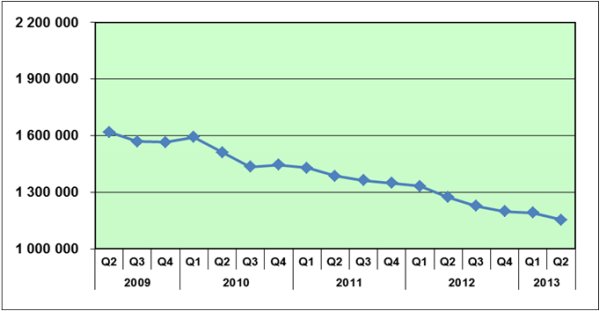
4 Year Category Trend by Quarter: Daily Newspapers

abc daily
Circulation has declined annually by 6.76% since 2009, equivalent to 466, 000 copies. However, Q2 declined by 3.1% (47,000 copies), compared to Q1 2013. English titles have declined by 7.6% annually (389, 000 copies), Afrikaans titles have declined by 6.4% annually (89,000 copies) and vernacular titles have increased by 2.9% annually (12,000 copies) over the period.

Titles Showing Largest Decline: Daily Newspapers

abc daily biggest decline4 Year Category Trend by Quarter: Weekly Newspapers

abc weeklyWeekly newspapers reflect an erratic performance but remained static over the period.

4 Year Category Trend by Quarter: Weekend Newspapers

abc weekend

Circulation has declined annually by 4.3% (429,000 copies) over the period. English titles have declined annually by 5.7% (402,000 copies) over the period, Afrikaans titles have declinedannually by 5.1% (120,000 copies) but vernacular titles have grown annually by 16.1% (94,000 copies) over the period.

Ilanga Langesonto have declined by 23,52% compared to the corresponding previous reporting period.  Sunday Sun fell by 17,58%, City Press by 17,38% (but is up 1,79% on the previous quarter) and Sondag by 16,93%.

4 Year Category Trend by Quarter: Consumer Magazines

abc cons mags

Circulation declined annually (over four years) by 0.8% (277,000 copies) over the period, although performance over the past year has been  particularly disappointing, declining by 13% (930,000 copies).

4 Year Category Trend by Quarter: Consumer Magazines – Woman’s General

abc women

Circulation declined by 1.7% annually (116,000 copies) over the period, although Q2 decreased by 4.2% (65,000 copies)  compared to Q1.

4 Year Category Trend by Quarter: Custom Magazines

abc customer

Circulation increased annually by 2.7% (1.303,000 copies) over the period. Q2 increased by 57, 000 copies compared to Q1.

– Industry news you’ll make time for. Sign up for our free newsletter!

Online CPD Courses Psychology Online CPD Courses Marketing analytics software Marketing analytics software for small business Business management software Business accounting software Gearbox repair company Makeup artist