Design Annotator: Creative Co-Working, Digital MTB Courses and Attention Seeking Illustration

uno de waalDesign Annotator with Uno de Waal is a  new column featuring the top design work from South Africa’s biggest online creative showcase, Between 10 and 5, curated by Publisher Uno de Waal @Unodewaal. 

Co-working seems to be booming all over South Africa. Our co-working space in Johannesburg is nearly full-up, and there have been some other interesting spaces popping up. We’ve brought you some of the best, most interesting spaces in Cape Town to work from to meet other inspiring creatives. The second series in the 21 Icons project has also been released with FW De Klerk and we show some interesting work from local illustration studios. Lastly, have a look at the wacky Stimorol campaign, while Toyota have seriously taken the interpretation of physical/digital to a new level with the outdoor website built by Hello Computer and DraftFCB.

5 Creative Co-Working Spaces in Cape Town

Creative-co-working-Cape-town

With co-working fast becoming a more and more sought after option for creative freelancers and part-timers, we’ve rounded up 5 creative co-working spaces in Cape Town.

Find out more about the 5 Creative Co-Working spaces in Cape Town.

21 ICONS: FW de Klerk

FW-de-klerk

21 ICONS South Africa is a multimedia project by renowned photographer and filmmaker Adrian Steirn that spans print, tv and online and highlights 21 South African icons who have contributed significantly to our country and mankind.

See the video documentary behind the 21 Icons Project with FW de Klerk

Toyota RAV4 Outdoor Website

https://www.youtube.com/watch?feature=player_embedded&v=0h5RIDciv1U

Digital agency Hellocomputer, with the help of Thingking, designed, built and installed a physical, outdoor website for the launch of the all-new Toyota RAV4.As the new model is built for outdoor adventurers, they decided to take the new RAV4 website directly to target market. Set up on a mountain biking track at the Bryanston Cycle Park, the outdoor website is a scaled-up, interactive version of the actual website. Cyclists used their mountain bikes as cursors to navigate.

See the rest of the Rav4 digital outdoor campaign.

Si Maclennan | Attention Seekers

si-mclennan

In a witty move, Si Maclennan decided on Attention Seekers as the title and concept for this collection of “unashamedly self-promotional typography”. For the series he has chosen phrases applicable to the concept, such as “Am I trending yet?”, and visualised them as beautiful, elaborate custom type pieces.

See more of Si’s illustration and typography work

Featured: Joey Hi-Fi

joey_hifi_08-620x876

Joey Hi-Fi is the alter-ego of award-winning illustrator and designer, Dale Halvorsen. Although he enjoys working on (and impresses with) a variety of projects ranging from editorial illustration to comics to packaging, his speciality is book cover design.

Having made the decision to follow in the hallowed footsteps of his creative role models (Chip Kidd, gray 318) by trying his hand at book cover design, Joey Hi-Fi gets to indulge his two passions – design and illustration – at once. He says, “Despite what some may think, you literally CAN judge a book by its cover. Which is just as well – or I’d be out of job.”

See more of the great illustration work from Joey Hi-Fi.

Cool Your Jets

What happens when Ben Rausch and Matt McFarlane decide to pair up and form an illustration/animation company?  Cool Your Jets, of course.Although Ben and Matt have been working together unofficially for about two years, they went ahead and made it official in June this year with the launch of their company Cool Your Jets – the unique vision of two highly experienced creatives.

Read more about Cool Your Jets.

Stimorol Sensations – The Most Indulgent Gum In The Universe

https://www.youtube.com/watch?feature=player_embedded&v=uMdWphCxd6U

Now well-known for embracing the crazy, Stimorol’s new campaign for a brand new offering is no different. Ogilvy & Mather Cape Town were bestowed the task of launching Stimorol Sensations: the most indulgent gum in the universe, ever. This they did with an integrated marketing campaign headlined by this new TV commercial shot on the ‘most indulgent set ever’. The ad features a clarinet-playing parrot, synchronised swimmers and 30 tons of pink goo, pretty standard stuff for Stimorol.

See more behind the scenes stills and video from the Stimorol Sensations campaign.

– Uno de Waal is the publisher of creative showcase 10and5.com.

– Industry profiles you’ll make time for. Sign up for our free newsletter!

Ad of the Week with Oresti Patricios – you keep your eyes on the road

Ad of the Week with Oresti Patricios – you keep your eyes on the road

Mercedes Benz has developed yet another pioneering, high-tech innovation, aimed at improving road safety. Studies show that around one quarter of all serious motorway accidents are attributable to sleepy drivers in need of a rest, meaning that drowsiness causes more road accidents than drinking and driving.

This latest piece of computing wizardry works on several levels to analyse a driver’s behaviour in order to detect if they are getting sleepy at the wheel, and then sound an alarm that brings their attention back to reality.

Of course, just showing this technology would probably induce sleep in today’s low attention-span TV audience, so ad agency Net#work BBDO mercedescame up with an amusing take on two ‘Walter Mitty’ type characters. The first features a good looking executive type, who catches his own reflection in the mirror while driving. He’s clearly in love with himself, as each time he looks in the mirror, his gaze lingers a little longer.

The music, a Sinatra/Perry Como-style song (created for the ad by Pulse Music New York) that harks back to the sultry lounge-lizard era, is a ballad about “You’ve either got it or not,” – something that this driver seems to think is the case.

As his hand reaches up to run his fingers through his hair, and you’re about to snarl “Keep your eye on the road,” a loud beeping snaps him back to reality. It’s a reality that is a bit of a shock, because now we see that he is, in fact, balding, and maybe slightly older than the ‘mind’s eye’ picture that we previously had of him. The beeping sound was, of course, the Mercedes Benz Attention Assist technology, that picked up the fact that the driver wasn’t paying enough attention to the road, and quickly brought him back to reality.

The byline is: “‘When your mind wanders, ATTENTION ASSIST brings it back.”

The technology is quite amazing: the on-board computer creates a profile of the driver at the beginning of the trip, which is compared continuously with the current data. There are several factors that could indicate driver fatigue or inattention, including steering characteristics and behaviour, the way a driver changes lanes, his use of indicators, and how he responds to traffic and road conditions. As soon as driver fatigue is recognised, a loud audio warning is emitted, and the car’s instrument display panel displays the words ‘Attention Assist. Break!’

Daimler-Benz has long been involved in developing safety systems for its vehicles, including pioneering use of crash-tests in the 1950s, innovations made to the Anti-lock braking system (ABS) in the 1970s, and the development of the Electronic Stability Programme, or ESP in the 1990s. Daimler was the first automotive manufacturer to present the driver airbag in a series production car at the Geneva Motor Show in 1981.

Mercedes will roll out the Attention Assist system next year on the S-Class models and, like most of these safety innovations, it will eventually become a standard safety fixture on all Mercedes models.

The second in the ‘Walter Mitty’ series features a Woody Allen look-alike, who is having a wonderful reverie about driving with a sultry Hispanic girl by his side – all set to the tune of “The Girl From Ipanema”. The Attention Assist beeping that brings him back to reality reveals that it is a colleague sitting next to him, and there is a lovely moment where the colleague is half-woman, half man, and then in the next shot it’s clearly a man, who is giving the nerdy driver a bit of a strange look.

All in all it’s a very creative interpretation of this pioneering technology, and the humour doesn’t detract from the serious message – this is potentially life-saving technology, and no doubt something that will be a major consideration for many people, when buying a car – so top-of-mind recognition is important.

The cinematography is perfect, the editing is slick, and the casting is impeccable. Kudos to director Bruno Bossi of Egg Films, and to agency Net#work BBDO for coming up with a suitable follow-up to their award-winning print and radio campaigns for the same product. The co-Creative Directors was Brent Singer and  Jenny Glover and Net#work BBDO’s Creative Chief was Mike Schalit.

Ad of the Week is published on MarkLives every Wednesday. See past selections here.
Oresti Patricios is the CEO of brand and reputation analysis company Ornico.

– Industry profiles you’ll make time for. Sign up for our free newsletter!

The Switch: Pitching is like begging at an intersection

by Alistair Mokoena (@AlistairMokoena) Ten years ago, when car hijackings were still rife in Johannesburg, I attended an anti-hijacking class. One of the insights I picked up from the class was that most hijackings occur at traffic lights when most motorists are not paying attention to the world around them. Since then I’m more observant at intersections and this has opened my eyes, not only to the plight of beggars, but also to the methods employed in begging.

[pullquote]We are all after the “client’s” wallet. We all face huge levels of competition. Clients don’t enjoy pitches any more than motorists enjoy stopping at a traffic light. We are all trying to leave a stranger with a lasting impression and we are all under huge time pressure.[/pullquote]

There was a time not so long ago when all you saw at traffic lights were stories of poverty and strife and all you heard were heart-felt pleas for money and food. You still get a lot of that but in the main, begging has evolved, possibly in direct response to the impact of the global recession. The recession has increased the number of people begging and it has also left many would-be donors with little or no money to donate, resulting in a scramble for a smaller benevolent pie.

In their desperation to make ends meet, people begging have turned to … the power of branding. You can no longer paint them with the same brush. Their tools now range from a neutral plea for help to a bartering system where the donor receives a blessing, a clean windscreen, a garbage free car, gardening services, a joke, a trick, even a dance routine, in return for a small donation.

The competitive landscape ranges from other people begging at the same intersection to other cars, newspaper vendors, pedestrians crossing the road, make up, the car radio, cellphones and the traffic light itself. They have less than a minute to pitch their proposition to a motorist.

It makes me think of advertising pitches. We are all after the “client’s” wallet. We all face huge levels of competition. Clients don’t enjoy pitches alistair makoenaany more than motorists enjoy stopping at a traffic light. We are all trying to leave a stranger with a lasting impression and we are all under huge time pressure.

We’ve all experienced defeatist agency teams. They approach pitches with the proverbial begging bowl. They could just as well stand there with a sign saying “money please.” They trade on pity either because they are a start-up or because they’ve just lost a major account and therefore need to bounce back financially. I doubt their success rate is very high.

Agencies that win pitches are more resourceful. They have a sound appreciation for their target audience and what drives them. They are aware that there’s competition out there and that they need to use their ingenuity to cut through the clutter and make a “sale” in a very short space of time. They understand that endorphins attract, and pity repels.

They are charming instead of pompous, cocky, flamboyant or over-familiar. They are sincere and don’t over-promise. They are entertaining and pleasant to deal with. All of these things are a necessary canvas for you to lay your creative work on. Without them, the work is like a poisoned chalice that might cost you the pitch or cost you the account down the line.

Clients want to feel good about engaging with you. Remember every piece of communication, even those that are researched to death, is a gamble. It’s quite scary, as a client, to make a 3 million rand commercial without any guarantee that it will work. They want to know that they can walk this tight rope with you and that their faith in you will be rewarded.

And if you feel pitches are unfair, spare a thought for the the men and women begging you encounter on your way home.

Alistair Mokoena (@AlistairMokoena) is a Unilever-trained Chartered Marketer with lots of blue-chip marketing experience. He’s currently MD of Draftfcb Joburg. Mokoena contributes the monthly “The Switch” column to MarkLives.com.

Industry news you will make time for. Subscribe here. It’s free!

Africa Style: The art of ukushela — ‘courtship’

by Masingita Mazibuko It is a sunny Sunday afternoon, clear blue skies with modest cloud cover.  The open roads are calling. In the distance, there’s an unseen sound – deep, throaty, distinctive. Before long, the source rumbles into sight. It’s a throng of Harley Davidson riders, all kitted out in leather, all sitting self-assuredly on malleable leather seats. For them, biking is more than simply a means of getting from A to B; it’s a time of bonding.

It’s the evening before the launch of a new product in major cosmopolitan cities around the world – New York, Tokyo, London. Enthusiasts camp on the streets in lengthy undulating queues to secure their opportunity to be among the first to buy it. The stores are Apple outlets and the campers endure rain, snow, sun and wind in addition to uncomfortable camping gear and trashy fast food.

Clearly, both Harley Davidson and Apple offer quality products which act as the foundation on which the brands have been built.

However, are the product intrinsics the sole determinants of the Love – yes, Love – accorded them by consumers?

A fantastically intelligent friend of mine is ever at the mercy of eager men yearning for her attention. Some are suave, having mastered the art of ukushela, or courtship. Others, well, the art of courtship seems to elude them.

In my opinion, courtship is no different to what we do when we seek to recruit consumers and build their relationships with our brands. Masingita Mazibuko

Now, the foundation of a relationship is based on a connection, meaning that consumer intimacy is a critical starting point in brands building a relationship. The marketer needs to ascertain the gap in consumers’ lives that needs filling, must then inform or create the experience, and the bond will be formed.

Think about the ‘Got Milk?’ campaign from the Californian Milk Board. To encourage brand/milk consumption, it highlighted the role it plays in the lives of its target audience by showing people attempting to consume dry or sticky foods without lubrication.

Going back to my friend, from the countless stories that she has shared, different emotions bring rise to different relationships. So marketers need to have clarity on what kind of emotion they want to evoke.

My friend is the independent sort with certain specificity about what she wants, so any act of courtship that involves macho tendencies irks her immensely. Conversely, an act of courtship that suggests an equal partnership is met with her favour.

Going back to brands, think of the sense of innocent freedom evoked through the purity in Disney’s movies. Or the nurturing nature of Hallmark, evidenced in every message they convey or reminder they give us of key moments in our lives. These two examples speak to a clarity of brand character, and of consistency in the emotions their marketing campaigns – acts of courtship – evoke.

Then, securing a future relationship implies relevance. To be relevant and evolve seamlessly along with consumers requires not only being in tune with the events and happenings informing their world, but a sense of simplicity in what the brand stands for.

By this I mean is the brand easy to get, especially for a non- marketer. Think ‘Oprah’ and ‘empowerment’ – she helps us find an ‘aha’ moment every time we come into contact with her be it on her TV show or magazine.

At the end of the day, however, love – personal or for a brand – can’t be faked. It has to be simple, genuine and consistent. Remember, acts of courtship often end in marriage, but that can end in divorce.

Masingita Mazibuko, marketing director at Unilever, contributes the monthly “Africa Style” column to MarkLives.com. The views expressed within this column are entirely her own.

Sign up for our free newsletter!

Waldimar Pelser: “Our rivals on Sunday aren’t other papers; it’s going on a picnic or lying in”


Waldimar Pelser

by Gill Moodie (@GrubstreetSA)  They started on the same day – June 1 this year – and that’s not the only similarity between Waldimar Pelser, the new editor of Rapport, and Bongani Siqoko,  editor of the Daily Dispatch.

Both are young editors and are former news editors; both have studied in the UK (Pelser at the elite Oxford University). Both men are very much of their communities and have all sorts of interesting things up their sleeves.

Crucially, both must try grow circulation in this toughest of times in the newspaper industry.

For Pelser, who has been both a foreign correspondent covering Africa and the news editor of Beeld,  that means achieving a balance between having stories that are of interest to readers and those that are in the public interest – and not forgetting about reputation and premium-quality journalism packages.

“Circulation is never the only thing one chases,” he told Grubstreet. “Of course, it pays our salaries and we constantly have to find and organically develop new markets. But if it were the only thing that mattered, you would put on the front page that which aims squarely at the lowest common denominator – and probably push up nudity and sex and alarmist politics. But none of these things, we believe, is really in the interest of our readers or journalism as a trade on even the future of democracy.

“And it won’t sell in the long run. Once you’ve had enough of the eat-as-much-as-you-can buffet with a lot of calories, you become satisfied. You can’t take it anymore. ”

Media24’s Rapport – which was started in 1970 – is one of the biggest-selling papers in the country. However, like many others, it is struggling with circulation decline.

In the most recent ABC circulation figures – for the first quarter of this year – the paper was at 210 675 sales compared with 223 593 in the same quarter of 2012.

There does appear to have been a change in Rapport’s front pages since Pelser took over as editor – there is certainly less reliance on rugby – and he says this is part of a rethink about gauging the value of the paper’s content.

So sports news stories make the front page and the news section but pure sports stories are happier in the sports section.

RapportSportsgraphicJuly2013

Sport is still very important in the content mix for Sunday, says Pelser. However,  the paper is now really striving to be bold and infused with personality in its presentation of sport.

Hence, the increase of opinion-driven sports writing and a new element in the sports section meant to spark engagement with readers and become a talking point: a 3D-style infographic of a key moment in a big game and how the play unfolded.

“So the bar is very high and it is creeping up,” Pelser says. “But because the bar is creeping up across the board and because people’s perception of value is changing, the same thing is happening to other sections of the paper.”

Under Pelser, the various sections are being revamped – but in isolation from each other – for this key reason: “For a long time we’ve believed that the value of the paper needs to be equal to the cover price, which is a very dangerous fiction,” Pelser says, “because this can only be so if every reader reads 100% of that package.”

Because some readers read only one or two sections of a paper amid  their busy Sundays, each section  must be worth the read on its own.

“We can’t risk someone reading something that is not worth R15. So that’s why we’re having a rethink of bundling and the value proposition because people’s time is very valuable. Our rivals on a Sunday are not other papers. It is going on a picnic or lying in or watching a box-office movie.”

RapportDPSJuly2013

A recent double-page spread feature in Rapport.

Changes to the “Weekliks” (the opinion, features and analysis section inside the paper), for instance, include profile writer Hanlie Retief moving from news to the front of this section, the start of a guest-column slot for what Pelser calls  “refreshing new voices” and a double-page spread feature with great display and high-impact pictures.

In the news section, the drive is to be really choosy about the stories – some of which come from the Media24  investigations team – so that Rapport has exclusive stories that one doesn’t find elsewhere.

News pages are also now typically dominated by one longer lead story surrounded by lot of much shorter stories – some only 45 words long  that have gained the nickname  of the “superkort minibrokke”.

“There must be variety and there must be depth (on news pages),” Pelser says. “A crucial guiding principal is “willingness to pay” in everything we put in, something that people would actually be willing to pay for. Or are we selling ice to Eskimos?

“It sounds like an MBA question but it’s actually a value question: If I am flooded with social media, will I still put my hand in my pocket and pay R15 for what you are giving me on a Sunday?”

For a Sunday paper, Rapport has quite a small newsroom of about 10 journalists in Johannesburg, Pretoria and Cape Town so everyone needs to work smart and most senior editors also write.

Doubtless, it helps that Pelser is a former news editor.

“You know how stories are born.” He says, “and crucially, how easy it is not to see a story where a story exists. We all know those very good journalists who come back from a seemingly non-descript event or a press conference and see a very special story. A news editor has to know when someone comes back and says, ‘There’s no story,’ and it’s not the case. And he also has to recognise overselling and overpromising of stories.”

– SA’s leading media commentator, Gill Moodie, offers intelligence on media – old and new. Reprinted from her site Grubstreet.

Sign up for our free newsletter!

Getting grads into adland


ogp

by Herman Manson (@marklives) Ogilvy last year trialled a programme to get graduates in the fields of marketing and design interested in advertising in general and the agency in particular. It met with considerable success, landed Ogilvy with four new staffers, upskilled a bunch of students and helped steer many more into a career in advertising.

Ogilvy & Mather already targets students in ad schools and has a good intern programme in place, according to Lauren Woolf, Marketing Director at Ogilvy and Mather South Africa, but the agency also wanted to look beyond those already set on a career in advertising. Last year it teamed up with several tertiary institutions in the Western Cape and Gauteng and encouraged varsity students to enter the newly launched Ogilvy & Mather Graduate Programme (OGP). They would not be competing for an internship but for a salaried, permanent position at the agency (after an initial six-month training programme).

Students were invited to conceptualise and publish a blog, which Woolf says already gave the agency insight into potential candidates a CV would not have (think topic selection, persistence, creativity etc.). They also received two challenges they had to complete, and members of the faculties where they studied helped with the final judging process, adding another layer of insight for the agency.

Last year 64 graduate students participated and four winners was announced, although more participants ended up behind hired by the agency based on their performance in the programme. The winning candidates had their final year’s study costs funded by Ogilvy.

Students learned more about the digital media and marketing environment, the social media ecosystem and some of the interview processes involved in landing a job (finalists were all interviewed by agency staff).

The four students who ‘won’ the blog challenge were put through a six month training programme that exposed them to various facets of the Ogilvy offering, and with the help of agency mentors, helped them decide where in the agency their skills would be best suited.

Woolf says the feedback on the programme has been positive, both inside the agency and form the participating institutions, and of course form the students themselves.

This year close to a hundred applications to join the programme was received. It also expanded to include the University of Johannesburg (Strategic Marketing & Communications – Honours course), University of Pretoria (Visual Communication – 4th Year Information Design course), University of Cape Town (Business Science / Marketing courses), Red & Yellow (Art Direction / Copywriting / Marketing courses) and the University of the Western Cape (Advanced Marketing / Global Marketing courses).

Once again at least four graduates will walk into a position at Ogilvy, and Woolf says the effect of the programme inside the agency will continue multiplying – 5 years from now at least 20 staffers will have entered the business through OGP.

The broader industry also benefits with more students in marketing and design now considering advertising as a viable career prospect. This year’s winners will be announced in October, says Woolf, who adds that although it takes up considerable time resources inside the agency, the calibre of candidate that walks into the office come January makes it absolutely worth their while.

Ogilvy & Mather Graduate Programme – Get to know the 2013 graduates

– Industry news you’ll make time for. Sign up for our free newsletter!

Dear Digital Grandad: LIKE-it or not – Facebook Page success can not just be attributed to LIKES

MarkLives’ digital agony uncle @DigitalGrandad1 is now taking questions on all issues digital. Tweet them to him or email DigitalGrandad@marklives.com.

DigitalGranddad

Dear DigitalGrandad…

How do I get 10 000 likes on our brand’s Facebook page? My MD told me it’s embarrassing when his kids ask him why only 98 people like our product. I manage an FMCG brand and we fired the PR agency that set it all up for us a while ago.

Brand Manager FMCG

Dear Un-popular

My grand-daughter got more likes on her 6th birthday party Facebook page in 1 day. So yes the MD’s kiddo has asked a valid question and just put the nail in your social media coffin! So you should be “embarrassed” or wake up and take this thing seriously like any other marketing activity.

“98 fans depending on who you are may not be that bad as a starting point”

So to be serious for a second, 98 fans depending on who you are as a business may not be that bad as a starting point. If you’re a small business selling cuddly toys from home – great start I would say!

But as you mentioned you are a FMCG brand, then it sounds like you have a problem and not thought this through!

“take responsibility and don’t just blame other”

To be blunt, just because your ex-PR agency set-up your Facebook Page, it doesn’t mean you will automatically make 1000’s of friends who like your product – there’s a little more to it than that. To stay friends and become great friends you need to engage with them and have a relationship, have some fun, share stories, give advise, invite them to a party and do things together like you do in the real world and stop just blaming your PR agency – if that’s all they did and recommended – but also take responsibility yourself for not having a social media strategy.

So Mr Un-popular, you too can become Mr Popular! But here’s a few questions I would like you to ask yourself first and the a few of my #TopTweetTips to get you started before the Mr MD kids really puts the nail in your marketing trials!

  1. Why did you start a branded Facebook Page and what did you do to make it work honestly? Please don’t just say because your competitor are doing it or your website says follow us on Facebook.
  2. What is the marketing objective behind your Facebook Page for example is it about sharing your latest products, customer reviews, promotions, competitions, asking your consumers for their feedback or creating a new product through social innovation? Remembering a brand FB Page is just another Marketing channel that requires effort to make it work and in truth more one-to-one regular ongoing effort.
  3. LIKE-it or not – Facebook Page success can not just be attributed to LIKES. Once you have 10,000 likes, then what? You also need to think beyond that as a measurement of success and think what are you trying to door gain  at the end/long-term? Is it about creating a loyal base, creating a community? Is it to drive CTA or purchase intent online or in-store with a voucher redemption or simple to create an engagement platform that offers exclusive deals, competitions and content to drive sales, recommendations, review?
  4. Now you have fired your PR Agency, who’s responsibility is it to manage and maintain the Facebook Page on an ongoing basis. Agency or Internally. Remembering it needs commitment, knowledge of your brand, governance policies, content plan and skill. The MD’s kid could probably set it up, but I am sure the MD’s kid couldn’t maintain it. So who do you want to trust with your brand online! Who will be held accountable?
  5. And finally how does your Facebook Page integrate with your overall Marketing and Social Media Strategy? For example do you do ATL, BTL. Are these efforts also driving to your social media platforms if NOT why NOT?

Now you have answered the above or at least thought about it, here’s a few of DigitalGrandads #TopTweetTips that will not guarantee, but most definitely give you some directions and ideas in improving your LIKES or better still SHARING and engagement online.

“DigitalGrandads #TopTweetTips to improve your likes”

“CONTENT is KING” – like it or not, content matters and the way it is displayed is just as important. Make it rich, engaging & relevant.’

“CONTENT PLANNING” – People are inclined to keep visiting if you maintain regular, consistent, engaging content. Plan ahead, post at least 5 times a week & keep it alive / TOM

“IMAGERY” – as the say a picture can paint a thousand words. Choosing eye-catching imagery convey a message is very useful. Try to alternate photos & video with text only

“CREATING A COMMUNITY” – Interact with your fans. Ask them questions, give them incentives to invite & share with friends – the old ones are always the best.

“PROMOTE” – your Facebook Page on other material – make sure you promote your Facebook Page in other marketing material. INTEGRATE & INTEGRATE

“OFFER ADDED VALUE” – think before you share something on Facebook – is this content worth sharing and will my fans find value in the content

“BE RELEVANT& AUTHENTIC” – keep your content relevant& authentic. It should let your audience know that you know who they are in a voice that is true to your brand

“CALL TO ACTION” – don’t be afraid to ask your fans to share, like or comment on your content. Give them an incentive to do so? Spread the love.

“SIZE MATTERS” – keep your message short & simple. Post with between 100 & 150 chrts (less 3 lines of text) see 60% more likes, comments and shares than longer ones

“TIMING” – Like any other medium, timing is important. The best time to post will depend on your business type. i.e retailers get best engagement between 8am to 2pm

Remember the golden rule – There is no such thing as easy marketing. Put in the effort, and you’ll reap the rewards. Don’t put in the effort, and things will stagnate! Like your current Facebook Page

Now start becoming POPULAR

Regards

@digitalgrandad1

– DigitalGrandad is a Marketing Professional with over 140 dog years of practical digital experience working with both global and local brands. From SME’s through to Multinational’s and across industry sectors he has seen and embraced the changes technology has given to us to better our lives. Yes he remembers the old days, but is now a firm traDigitalist born through traditional marketing.

If you have a digital dilemma and are too afraid to ask your boss or your agency, but feel you need to ask for some straight no-nonsense advice, please email me at DigitalGrandad@marklives.com with your question, or better still tweet to @digitalgrandad1. I’ll answer one every week on MarkLives.com.

– Industry news you’ll make time for. Sign up for our free newsletter!

grandad

MagLove: Men’s Health Italy skips the cookie cutter cover

MarkLives.com runs a regular slot featuring the best local and international magazine covers every week. We recognise well thought out, powerful and interesting (and hopefully all three in one) magazine covers and celebrate the mix of pragmatism, creativity and personal taste that created each of them. By media blogger MediaSlut.

See our archive of previous MagLove cover selections

INTERNATIONAL

Variety

Variety

This range of covers isn’t brand new (25 June 2013 issue), but I spotted it now on CoverJunkie, and absolutely love the concept. Variety magazine releases an annual list of “Power of Youth”, and for 2013, they created this smart cover execution over 5 covers. Maybe this will inspire a South African title to do something similar…

ICON, August 2013

ICON

Loving the intricate (yet simple) design of the new ICON cover, which immediately drew my attention.

COMPLEX, August / September 2013

Complex

COMPLEX is one of those magazines that always seems to get it right with a very simple, but extremely striking cover, month after month. For their August 2013 cover, they have The Weeknd tearing up this cover… (and yes, that’s how you spell their name…)

Men’s Health (Italy), July / August 2013

Men's Health Italy

Wait, I’ve got my reasons for including a Men’s Health cover on my list… Usually, they are all the same cookie cutter covers. Same style of photography, same colours (mainly Red) and same use of fonts (and coverlines). So when I spotted this Men’s Health cover from Italy, it was a fresh surprise. The photograph is something different (not shot in a studio), and the bright colours are nice, and they’ve also played around a bit with the text and directions of the text. And for that reason, because it’s a Men’s Health cover with a difference, I’ve included it.

LOCAL

Playboy South Africa, August 2013

Playboy 8 August 2013

The model is absolutely stunning (not the normal long haired model you might be used to), the colours all work together (from the logo and the background, all the way to the little see-through pink bikini-top…), and it’s a nice taste of Summer that’s around the corner (in South Africa). It’s clean (pretty much in every sense of the word), and very striking.

– The (for now anonymous) blogger behind MediaSlut knows way too much for his own good about media in South Africa. Magazines in particular. His mission is to show when South African magazines might fail, but most importantly, succeed. If you’re looking for a library about South African magazines and news, your one-stop pitstop is MediaSlut. #MagazinesForTheWin

– Find a cover we should know about? Tweet us @marklives and @mediaslut
Sign up for our free newsletter!

Social media puts HR ethics under the spotlight

by Karen Sutherland, Monash University Social media has definitely changed the game for job-seekers and recruiters. Traditionally, HR recruiters placed an advertisement, sifted through the responses, and interviewed the shortlisted candidates before appointing the best interviewee with the best references. Those days are over.

[pullquote]While the potential savings to time and costs may be enticing for recruiters using social media instead of traditional methods, this practice limits the field exclusively to social media users. If social media skills are not a key selection criterion, limiting the candidate pool to only those with a social media presence could be deemed as unethical and discriminatory. It is unfair for candidates to be excluded purely because they have not jumped on the social media bandwagon. Additionally, recruiters could be overlooking quality candidates by limiting the field.[/pullquote]

The increase in social media adoption has provided recruiters with access to volumes of information about candidates that they were never before privy to. With this vast amount of candidate data at their fingertips, recruiters may struggle with the ethical implications regarding how much they let this information influence their decisions when appointing staff.

Limited research has been undertaken in Australia (or South Africa – ed) in relation to this issue. However, research from the Unites States suggests that HR recruiters are using social media in two ways: to find candidates and to screen them after receiving their applications.

The jury is still out on the effectiveness of social networking sites such as LinkedIn as recruitment tools, although, they have been described as a “shop window” for recruiters searching for suitable employees. A US study of 1000 recruiters found that 92% used or planned to use social media as part of their recruitment strategy and 93% chose LinkedIn as their most favoured tool for this process.

While the potential savings to time and costs may be enticing for recruiters using social media instead of traditional methods, this practice limits the field exclusively to social media users. If social media skills are not a key selection criterion, limiting the candidate pool to only those with a social media presence could be deemed as unethical and discriminatory. It is unfair for candidates to be excluded purely because they have not jumped on the social media bandwagon. Additionally, recruiters could be overlooking quality candidates by limiting the field.

HR recruiters also need to be extremely mindful when using social media to screen potential candidates, reportedly a common practice. A 2012 linkedinstudy by Reppler of 300 US recruiters found that 91% used social networking sites to screen prospective candidates, favouring Facebook, Twitter and LinkedIn. Furthermore, 47% used this information to decide whether or not to interview the candidate and 69% admitted to rejecting a candidate based on what they discovered from their social media profiles.

Mark Manton, managing director of UK company Soap Recruitment, wrote on The Drum that “social media is living proof of natural selection and survival of the fittest”. Recruiters should be extremely wary of this attitude: they need to ask themselves on what grounds are they making decisions based on the information they glean from a candidate’s social media profile. If this information relates to some aspect of a candidate’s background that could not be requested in an interview, such as age, cultural background, sexual orientation, etc, they could be contravening discrimination law.

Social media screening could also be considered as an invasion of privacy for job seekers. To some, uploading information to social networking sites implies consent for it to be seen by others, including potential employers. However, is it ethical to judge a candidate based on what they do in their own time away from work? Before social media, did a recruiter observe the candidate at the local pub on a Friday night or watch them play sport on the weekend and base their decision on that? This possible invasion of privacy was taken up a notch recently when a New York City statistician was asked in an interview for the password to his personal Facebook profile.

While this example is over the top, recruiters need to be more ethically transparent with candidates if they plan to screen them using social media. Applying for some positions requires a police check, a working with children check or a drug test and this is usually included in the key criteria. This should be the same for social media screening so that recruiters can avoid unethical and discriminatory behaviour. Organisations neglecting to do this run the risk of damaging their reputations with prospective candidates who may choose to apply elsewhere.

Social media screening may eventually become a redundant practice as users become savvier. I teach my undergraduates about the importance of privacy settings and maintaining a professional profile and a personal profile that is difficult to find. While recruiters may be under the impression that social media can show them what a candidate is really like, it may actually make job seekers more adept at concealing the truth, leaving recruiters exactly back where they began before the technology existed.

Karen Sutherland does not work for, consult to, own shares in or receive funding from any company or organisation that would benefit from this article, and has no relevant affiliations.

The Conversation

This article was originally published at The Conversation.
Read the original article.

– Industry news you’ll make time for. Sign up for our free newsletter!

Shelf Life: Kraft SA becomes Mondelez (just don’t say it in Russia)

Louise Marsland’s (@Louise_Marsland) pick of new product, packaging and design launches.

A new purple logo for Kraft Foods SA and a name change; collaboration is the game for Lego and Cartoon Network; adidas runs an experiment and Tile Africa renovates its logo.

Kraft SA becomes Mondelez

Mondelez logo

July 31 heralded a name change for Kraft Foods South Africa to Mondelez  South Africa after parent company Kraft Foods split in 2012 to create Mondelēz (pronounced ‘mohn-dah-LEEZ’) International, the world’s largest snacks group.

The name change last year was despite a 100-year brand legacy for Kraft. The US  business keeps the Kraft name. ‘Mondelēz’ is a mashup of the Spanish words for ‘world’ and ‘deliciousness’. The name change was implemented in SA despite controversy over the “ugly” logo and the name, which when pronounced, can sound like it means the colloquial vulgarity for oral sex in Russia, according to Business Insider and AdAge.

The company, whose Cadbury brand is its best known in SA, used the occasion yesterday to reiterate how vital South Africa is as a market for Mondelēz International and a gateway for Mondelez SA operations in Southern and Central East Africa, going as far north as Ethiopia.

Gawad Abaza, who took over in April as managing director in Johannesburg, has made it his mission to expand the company’s business, develop its people, brands, and sales and manufacturing infrastructure.

Mondelēz International’s business in Southern and Central East Africa was worth $585 million last year, contributing some 15% of total revenue for the greater Eastern Europe, Middle East and Africa (EEMEA) Region. EEMEA, one of five business regions in the Mondelēz International world, generated $3.7 billion in revenue in 2012.

The company has a presence in 18 countries in Southern and Central East Africa where it continues to invest in growing these markets. In South Africa, its brand portfolio includes: Cadbury Dairy Milk, Jacobs coffee, Halls, Oreo and Trident/Stimorolgum, Chappies bubble gum, Lunch Bar, Dentyne chewing gum and Royal Baking Powder.

 Lego, Cartoon Network build innovative partnership

Lego Mixels 41508 Volectro Electroids

More and more brands are beginning to team up to provide unique customer experiences, with fashion designers for example, and in the case of Cartoon Network, with Lego.

Cartoon Network and The Lego Group have announced that they will jointly produce an unprecedented new global entertainment franchise: Mixels, launching in 2014. The new venture will feature animated content (primarily shorts), a rich digital gaming experience, a collectible building toy concept and more.

Animated content will air on Cartoon Network featuring the colourful Mixels creatures that can mix and combine with one another in creative and unpredictable storylines; an app-powered gaming experience will engage fans in a deep mobile game that will cover the sprawling world of Mixels; and this will be followed with a collectible portfolio of low-priced mini building sets from Lego.

The two companies joined forces when Cartoon Network Studios had an interest in creating original content based on the inherent open-ended values of Lego play, while at the same time that The Lego Group was exploring a new concept involving small creatures – and hence Mixels was born. The property was developed by a multinational team of content innovators, designers and animators – from Los Angeles to Atlanta to San Diego to Connecticut to Denmark.

“This is the next step in the evolution of Cartoon Network Studios and the way we develop original IP,” explained Rob Sorcher, chief content officer, Cartoon Network. “Bringing together worldclass animators and game developers with Lego content and product design teams at the earliest stages of creation proved to be an energising collaboration, showcasing the creative strengths of both brands.”

Cartoon Network Studios will drive all narrative, animation and digital content and Cartoon Network Enterprises will handle Mixels non-toy licensed merchandise. The Lego Group will focus on Mixels toy design, manufacture and distribution as well as licensed LEGOMixels publishing to support the property.

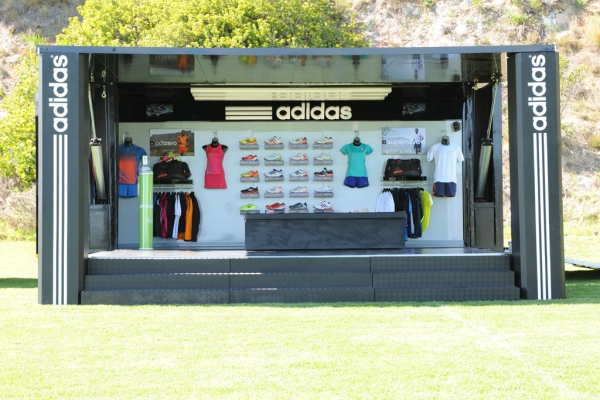
Mobile running statement          

adivan4                        

adidas South Africa is taking its adiVan mobile pop-up store to races and sporting events around the country to showcase its technical running product to the running community in South Africa. The aim is to target runners with the message that adidas is a serious running brand.

The adiVan was developed by adidas in conjunction with experiential marketing agency, Stretch, says Bradley Stern, senior trade marketing manager, adidas SA. “The brief was to create a mobile showcase of the adidas technical product range. We will give consumers a chance to physically experience the product and provide incentives to try and ultimately purchase the adidas product to improve their game or sport of choice.”

The mobile, interactive showcase offers consumers a real opportunity to experience the adidas technical product range, by combining the marketing tools of the adidas footscan, micoach trial on site, and digital integration with the adidas club newsletter, 3Stripes.

The mobile experience will also visit football, rugby and cricket matches and through partnerships with various clubs, Discovery Health and Virgin Active gyms, will try reach an even bigger segment of its target audience over time.

Tile Africa’s new corporate ID

Tile Africa - refreshed logo

With its celebration of 25 years in the home improvement market this year, Tile Africa has refreshed its corporate image, including its logo, which will be used on all applications, including store signage, internally and externally through stores, advertising, digital media and stationery from mid-2013 onwards.

The new corporate image is a move towards a slimmer and more sophisticated font and colours, to make the new logo more stylish and approachable.

The retailer says it is going through a change cycle in line with the shifting needs of its customers and it’s implementing various initiatives to offer customers the best possible experience. “We’re looking at a number of exciting projects that encompass marketing, store development, our value chain, people development and operational systems to keep us at the forefront of providing a great customer experience,” says Richard Nuss, Tile Africa marketing manager. “This new cycle of change is about being on-trend, stylish and fast. We want to make it both easy and enjoyable for our customers to do business with us.”

Tile Africa’s signature tangram design remains part of the logo as well as the key message ‘our home is your home’.

The logo design was a collaborative effort between Andrea Jacobs, creative designer at Tile Africa and niche design agency Daniel and McKay based in Bedfordview. The updated design features two tones of grey as well as the classic black, white and orange.
Louise Marsland– Shelf Life by Louise Marsland is a weekly column on MarkLives. Tweet new product, packaging and design launches to @louise_marsland or email her at louise.marsland at gmail.com.

– Want to sponsor Shelf Life? Contact us here.

Louise Marsland has written about the FMCG, media, marketing and advertising industry for 18 years of her 25 year media career as a former Editor of magazines AdVantage, Marketing Mix and Progressive Retailing; as well as websites Bizcommunity.com and FMCGFiles. She currently edits the weekly Wednesday Media & Marketing Page for The New Age newspaper; and is the co-founder and Publishing Editor of SA’s newly launched industry trendwatching portal, TREND. at www.trendlives.info, in partnership with MarkLives.com.

– Industry profiles you’ll make time for. Sign up for our free newsletter!

Online CPD Courses Psychology Online CPD Courses Marketing analytics software Marketing analytics software for small business Business management software Business accounting software Gearbox repair company Makeup artist