10th birthday wishes from readers

by MarkLives (@marklives) Ten years ago today, MarkLives debuted on the South African web. Our readers wish us a happy birthday.

  • Add your message to our birthday page by emailing your message to simone at marklives.com.

Messages via email

Alistair KingAlistair King

Congratulations, MarkLives, on reaching your 10th birthday. I vividly remember the day you told me you were thinking of launching it, Herman. I remember thinking, “Odd name. It’ll work.”

Thank you for keeping us informed. Thank you for having such strong principles. And thank you for celebrating South African creativity at a time when media journalists always seemed so cynical. You’ve done our industry a great service.

To many more years and decades.


Zibusiso MkhwanaziZibusiso Mkhwanazi

When your businesses age has made it to double-digit numbers, it is evidence that we, the consumers of advertising and marketing content, would struggle to live in a world without Marklives.com.

Happy birthday from Zibusiso Mkhwanazi and all the AvaStars!


Brett Morris October 2016 by by Jeremy Glyn.Brett Morris

To Herman and the MarkLives team

Huge congrats on this fantastic milestone! Thanks for your tireless efforts and focus over the last 10 years in giving the marketing industry a credible platform in the news.

Wishing you a happy birthday and another 10 years of continued success.

All the best
Brett Morris, FCB Africa group CEO


Jarred Cinman. Credit: Chris Saunders (www.chrissaunders.co)Jarred Cinman

Dear Herman and team

Congrats on this big milestone. The publishing business is tricky and publishing for the advertising industry exponentially more so. I commend you staying at it, always sticking to your principles and providing a valuable platform for our industry in this country.

Jarred and the VML team


Lani CarstensLani Carstens

Congratulations on achieving this milestone and celebrating your 10th birthday! Your journalistic and in-depth approach to reporting on the media industry is refreshing and sets you apart. Here’s to many more birthdays, MarkLives!

Lani Carstens
John Brown Media group MD


John DixonJohn Dixon

Hey MarkLives, congratulations on a decade of breaking “the news that matters” to our industry! Looking forward to seeing you continue to blossom as you head towards your teens!

John Dixon
Publicis Groupe Africa CEO


Cathy van Zyl at Morgenster Launch 2018Cathy van Zyl

Hiya Herman and Marklives

Congratulations on a decade of publishing good stuff on the SA marketing and advertising scene. And for helping us remember not to take ourselves too seriously, all of the time.

Looking forward to another 10 years.

Cheers, Cathy van Zyl


Mxolisi Goodman Buthelezi by Jeremy Glyn.Mxolisi G Buthelezi

Live Long and Prosper, MarkLives

Mxolisi G Buthelezi
June15 Advertising


M&C Saatchi Abel logoBill Stephens & Sharika Jaga

Hi Herman, huge congratulations!

You have given the communications industry a media platform that has become integral to our daily lives! Most importantly, a platform built on integrity and true independence. You have successfully evolved with and even lead the ever-changing landscape of the advertising and marketing industry in South Africa.

Long live MarkLives! With thanks and best wishes from all your friends in the M&C Saatchi Group.

https://twitter.com/abelmike/status/1028947461421899776


Charlie StewartCharlie Stewart

From one ten-year-old to another, congratulations! You’ve been a source of inspiration from the get go and have shown a level of integrity and balance that puts the rest of the media industry to shame. Pop those corks, Herman, Simone and team, and, when the hangovers subside, let’s figure how to become teenagers!

Best wishes from the Rogerwilco team.

Charlie Stewart, Rogerwilco CEO


Katherine Leach-LewisKatherine Leach-Lewis

Happy 10th birthday — here’s to the next ten years.

Katherine and the Casta Diva Pictures team


Alex LeontsinisAlex Leontsinis

Dear Herman and team

Happy birthday!

Love your brand!

Alex Leontsinis
Best Talent


Mark Eardley

Mark EardleyHello Simone and Herman

Just read the birthday editorial — hats off and congrats for all the effort it has taken to hit a decade. Respect.

ATB
Mark Eardley
B2B Consultant


Jonty FisherJonty Fisher

Hi Herman & team

A short note to say a heartfelt congrats on your decade of service to the industry! You started at a time when print publications for our industry were disappearing, and there was a chance that there wouldn’t have been an industry voice / water-cooler. MarkLives has been that and much more. We thank you for that, and wish you the best for the next decade!

Jonty Fisher, OFYT CEO

Duke

DUKE's birthday message to MarkLives


Conversation Lab

Happy birthday! Thanks for giving us a reason to open the bar.


Twitter

https://twitter.com/EveryAdAgency/status/1028888968753029120

https://twitter.com/jozib_sa/status/1028952700854132736

https://twitter.com/kilmerandcruise/status/1029050190832037888

https://twitter.com/thepaulkerton/status/1029244042498981888

https://twitter.com/thepaulkerton/status/1029244042498981888

https://twitter.com/34agency/status/1029275746894659584


See also


MarkLives logo— One subscription form, three newsletters: sign up now for the MarkLives newsletter, including Ramify headlines; The Interlocker, our new monthly comms-focused mailer; and Brands & Branding, launching soon!

#AgencyFocus: Surviving disaster, a blank slate & the next step

by Carey Finn (@carey_finn) Once one of South Africa’s most-heralded agencies, Ireland/Davenport saw a dramatic decline in its fortunes starting in 2015, culminating in its suspension from the Association for Communication and Advertising (ACA) in July last year. The future of the agency looked unclear. However, founder and executive director, John Davenport, and his team took the opportunity to refocus and regain their footing in the industry, starting with rebranding as Collective ID in October 2017. Its comeback makes for a story of remarkable tenacity and grit in the face of once-assumed overwhelming odds.

2015 had marked the start of a sharp decline for Ireland/Davenport, which suffered the loss of several key accounts in rapid succession, including BMW, South African Tourism and Vodacom, with the cellular company pulling the plug on an estimated 40% of the agency’s total revenue. 2016 was not kinder, heralding first the departure of managing director Susan Napier in June and then that of founding partner Philip Ireland in October. And then there was the matter of the Telkom account pitch that led to the suspension in mid-2017.

“The agency did go through hard times,” says Sharon Bergmann, chief financial officer. “But we had to carry on, and it gave us the opportunity to get our shareholding correct. We were given a blank canvas to restart and recreate.”

Opportunity to rethink

Managing director Brenda Khumalo, who was promoted from the position of executive client services director in February this year, agrees that the difficulties offered an opportunity to rethink the agency’s way of operating, and restructure. “We saw both a need and a chance,” she says.

Executive creative director Qingqile “WingWing” Mdlulwa, who joined the team in July last year, explains that they were looking to create a less-hierarchical, more-inclusive type of agency structure. “We wanted to make sure every employee felt that they had a say in how the organisation is run and how things happen, and we saw it as an opportunity to go from having two names on the door to having everyone’s name on the door, as a collective with one vision,” he says.

Having increased its black ownership from 21.5% to 52.6% in April 2017, the agency’s appointment of Khumalo and Mdlulwa as managing partners in October that year saw it become both majority-black-owned and -managed, and achieve a Level 1 BBBEE rating in line with its ongoing transformation strategy. This helped it take home the new MarkLives Agency Leaders’ Agency Diversity & Transformation Award for what peers saw as the most-significant contribution in this area for a Joburg-based agency.

“Clients responded positively”

The general reaction to the restructuring and rebranding has been good, say Khumalo and Mdlulwa, with curiosity and eagerness surrounding the ID comeback. “We were fortunate that our clients responded positively; they didn’t go running out of the door,” says Khumalo. “But it was a process for us to take them through the new vision of the company, with the new executives of the company.”

The agency’s clients have been key to the process, emphasises Davenport, highlighting Standard Bank in particular, whose personal and business banking account sits with Collective ID as lead agency. “Standard Bank [was] crucial to the rebuilding,” he says. Signing it on late last year with the new management team, the agency has driven its popular “What’s your next?” campaign. Other major clients include the Development Bank of Southern Africa, another win late in 2017; the Avis Budget Group; Isuzu; and the MAQ brand. Revenue growth for the 2017–2018 period is predicted to be around the 42% mark, up nearly 10% from the previous year.

A large part of the motivation behind the agency’s reemergence into the market, say Khumalo and Mdlulwa, was meeting the need for diversity and the relevance it engenders. Khumalo says that the narrative of being at the forefront of transformation has “sunk in”, and it’s something that Collective ID is working to achieve with a multipronged approach focused on improving lives. Part of this involves a CSI and training programme called Collectivity, which sees the agency sponsoring accelerated learning and other education efforts for a number of young black females, as well as a tertiary qualification for an aspirant black male graphic designer, the son of a security guard at the office premises.

Mentoring and incubating

Under the Collectivity banner, the agency also mentors students and runs an incubator programme, ID Labs, which provides young black-owned agencies with access to support including office space, infrastructure, training and clients, for a period of three years. Book of Swag, the agency currently in the programme, is about to graduate and go out on its own, and the search is on for the next group of creatives, says Khumalo.

L-R: Qingqile Wingwing Mdlulwa, Sharon Bergmann, Brenda Khumalo and John Davenport, the executives of Collective ID.

Another focus area in Collective ID’s transformation efforts is improving gender diversity, with Khumalo describing it as the agency’s biggest passion. “For me, the transition is not fast enough,” she says. “If you don’t have that representation in agencies, how are you going to do work that resonates with the majority of the population?” She’s volunteered to sit on a gender quality council being set up by WPP, whose fold the agency falls into.

Mdlulwa agrees and emphasises the urgent need for female role models within the advertising and other industries. “It’s important for young women outside and inside the industry to see that there are women who leading, and leading very effectively,” he says.

Davenport believes that rectifying current imbalances in gender diversity requires giving women more opportunities.

“And equal pay,” adds Mdlulwa.

Goals

Other than paving the way for broader social transformation, the agency counts attracting new business among its goals for the coming year. “We’re putting it out there that we are open for business,” says Khumalo. “Our mandate is to continue moving forward, attracting great talent [along the way].” To this end, the agency appointed Tshepang Louw as new business director in June, and has set up a task team focused on new opportunities.

While Collective ID is looking to increase its base of clients who buy into diversity, transformation and representation, say Mdlulwa and Davenport, the agency is happy to remain medium in size and is not looking to become an industry giant. To expand its offerings, however, says Khumalo, the agency is in discussions with partners which will supply the digital backend component that’s thus far prevented it from calling its digital stable of offerings fully integrated.

The future, they all agree, is looking set to be exciting.

Collective ID logo
collectiveid.co.za

  • Office locations: Joburg
  • Revenue band: R30–R50m
  • Staff count: 33
  • Key clients: Standard Bank PBBSA, Avis Budget Group, Development Bank of Southern Africa, Envisionit, Isuzu, Bliss Brands
  • Services: Integrated project management, strategy, social media, content, digital


Carey FinnCarey Finn (@carey_finn) is a writer and editor with a decade and a half of industry experience, having covered everything from ethical sushi in Japan to the technicalities of roofing, agriculture, medical stuff and more. She’s also taught English and journalism, and dabbled in various other communications ventures along the way, including risk reporting. As a contributing writer to MarkLives.com, her new column “#AgencyFocus” is an ongoing weekly series updating the market on agency performance, including business performance, innovation, initiatives, the work, awards and people.

— One subscription form, three newsletters: sign up now for the MarkLives newsletter, including Ramify headlines; The Interlocker, our new monthly comms-focused mailer; and Brands & Branding, launching soon!

Media Design: Womankind, Evergreen Review, Emergence, Prufrock, NYTM

Shane de Lange (@shanenilfunct)’s weekly analysis of media design — both past and present, print and online — from South Africa and around the world:

  • Online: Emergence advocates reform and renewal in relation to environmental issues, compelling us to stop violating the planet
  • Iconic: Evergreen Review surged to the forefront of American counterculture during the ’60s, introducing the world to some of the most-prolific creative minds and cultural innovators of the 20th century
  • Local/print: Prufrock appropriates ‘found’ photographs to tell compelling stories about past narratives and current issues, teetering on the edge of ‘pulp’ or ‘cult’ sensibility
  • International/print: The New York Times Magazine and The New York Times Book Review expose that we could’ve have stopped climate change and the current environmental crisis 30-years ago, but we chose profit over nature
  • Multiplatform: Womankind ushers in a new age for women, emphasising the notion of change in the context of the feminine zeitgeist and focusing on fantasy books and films

Find a cover we should know about? Tweet us at @Marklives and @shanenilfunct.
Pinterest icon Want to view all the covers at a glance? See our Pinterest board!


Print

¯\_(ツ)_/¯   Prufrock (South Africa), issue 14

Prufrock, issue 14, 2018Issue #14 of Prufrock, themed “Flowers”, features prose by Liam Kruger (Hieronymus Rondebosch), Richard Rive (Rain), Girinandini Singh (Starstuff), and Zandile Khumalo (uNtsika eZweni leseThembiso), to name a few. The publication is illustrated by emerging South African artist and illustrator, Caitlin Mkhasibe, and the cover image is an appropriated ‘found’ image by SA-British writer, poet, editor and publisher, Nick Mulgrew.

The appropriation of historic footage can be an incredibly powerful communication tool, specifying a clear message, tone of voice, and considered creative direction. Photographs taken out of their original context can tell compelling stories by themselves, and compliment or influence understandings of past narratives and current issues, as exhibited in Mulgrew’s visual language in this issue of Prufrock, which teeters on the edge of ‘pulp’ or ‘cult’ sensibility. The ‘readymade’ picture was constructed using photographs shot by an unknown SA botanist in 1968, and more of these photographs appear sporadically throughout the publication. Importantly, adhering to the theme of the issue, these images feature flora unique to SA, much like the writers and other contributors featured inside.


Heart-Love-Polygon-Geometric-Flat-Design-Icon-Illustration by lekkyjustdoit courtesy of FreeDigitalPhotos   The New York Times Magazine and The New York Times Book Review (US), 5 August 2018

The New York Times Magazine and The New York Times Book Review, 5 August 2018Veering slightly from its normal publishing format, The New York Times Magazine delivers a simple, silent statement — one gloomy but powerful message — to accompany one story by author and novelist, Nathaniel Rich. A tragedy in two acts, this story is an account that we had the data which forecasted the dire circumstances that we currently must deal with in relation to the environment. We had time to act; nothing stopped us, except ourselves. This was the decade we lost all common sense, and chose profit over nature. Moreover, profit is in our nature; human beings are innately self-destructive.

Two kinds of imagery are used to compliment the two acts of this story, either archival footage, or commissioned images from American photographer, George Steinmetz. Both kinds document the effects of climate change globally. The cover needs no imagery to describe the effects of climate change as a result, implying rather than revealing. Besides, we are already numb to literal ‘shock factor’ or ‘guilt trip’ approaches to this critical situation: 30 years ago, we could’ve saved the planet but we didn’t. Beautifully presented, associated content is available on the The New York Times Magazine website here.

A special mention must be given to The New York Times Book Review, which covers a few environmental issues alongside a pressing socio-economic epidemic, showcasing books on water contamination (“What The Eyes Don’t See” by Mona Hanna-Attisha), fracking (“The Poisoned City” by Anna Clark) and opioids (“Amity and Prosperity” by Eliza Griswold and “Dopesick” by Beth Macy). The cover, illustrated by Golden Cosmos, titled “Tableau of Hell We Allowed”, is a striking reminder of these issues, and the massive impact that they have on the environment and the lived lives of human beings across the globe.


Multiplatform

Heart-Love-Polygon-Geometric-Flat-Design-Icon-Illustration by lekkyjustdoit courtesy of FreeDigitalPhotos   Womankind (Australia), issue 17, July 2018

Womankind, 17 August 2018Womankind is a quarterly magazine about ways to live a more-fulfilling life, focusing on issues of identity and meaning in contemporary society. As its name suggests, Womankind is marshalling a new age for women, following the oft-quoted belief that “change is the only constant in life” (quoted from Heraclitus, the pre-Socratic Greek philosopher). True to the nature of independent publishing, Womankind has no advertising, and is filled with work from various authors and artists who comment on the often-challenging relationship between culture and nature within the feminine zeitgeist.

The magazine’s strapline, “why you are destined to change”, implies that it nurtures ideas that challenge the status quo, and defy as opposed to obey. Themed “unicorn”, issue 17 encompasses the realms of fantasy fiction and films. Arguably, fantasy exists as a measure to escape or consume a vacuum in our lives, to relive lost feelings of enchantment and wonderment that once gave our lives meaning. To quote Carl Jung, “the lack of meaning in life is a soul-sickness”, and perhaps this is what fantasy ultimately teaches us about contemporary society. The cover showcases an illustration by Greek illustrator, Stavros Damos, depicting Queen Elizabeth I of England holding-up a unicorn — maybe some sort of gesture to symbolise the dualism between the rational and the irrational, fantasy and reality, all within the context of womenkind, presenting the future is female.


Online

Heart-Love-Polygon-Geometric-Flat-Design-Icon-Illustration by lekkyjustdoit courtesy of FreeDigitalPhotos   Emergence (UK), August 2018

Emergence Magazine, online, issue 2, August 2018An initiative of Kalliopeia Foundation, Emergence is an online quarterly publication with an annual print edition that advocates reform and renewal, particularly with regards to the environment, compelling us to stop violating the planet. As the planet is conquered, and human beings increasingly separate themselves from the environment, the question needs to be asked: instead of being indifferent towards the planet and its present fate, what if we were humbled by it and did something about it?

As its strapline implies, Emergence embraces the pivotal, often-overlooked, connections between ecology, culture, and spirituality, exploring human nature and our fear of the ‘unknown’ (in this case, the wild, nature, etc), and our related need to control the planet, submitting that we must become more sympathetic towards ‘the wild’ within the ourselves and our environment. Themed “Wildness”, issue #2 investigates why the wild perplexes us, implying that we should cherish and respect it — more so, revere it, and be in awe of it. The design of the site ticks many boxes: typography, art direction, layout, functionality, interactivity, usability et al, neatly introduced with cover art by Studio Airport.


Iconic

Heart-Love-Polygon-Geometric-Flat-Design-Icon-Illustration by lekkyjustdoit courtesy of FreeDigitalPhotos   Evergreen Review (UK), 1957–1973, relaunched in print in 2017

Evergreen Review volume 1 issue 1 and Evergreen Winter 2017Evergreen Review was an American literary journal originally published from 1957 to 1973, and has been legitimately relaunched in print again since 2017. Despite its deceptively conservative name, Evergreen Review was far from conventional, essential in exposing and promoting the work of literary icons such as Samuel Beckett, Jorge Luis Borges, Charles Bukowski, Vladimir Nabokov, and Susan Sontag, to name a few. The prolific beat writers, William S Burroughs, Allen Ginsberg, and Jack Kerouac, also found a stage for their work at Evergreen Review, with Kerouac and Ginsberg contributing to the magazine throughout its existence.

One key feature of Evergreen Review was that it had illustrated work in every issue and sometimes included erotic cartoons, notably The Adventures of Phoebe Zeit-Geist. The brainchild of writer Michael O’Donoghue and artist Frank Springer, this serial comic encapsulated a zeitgeist during the ’60s and the various liberation movements that it generated, including sexual liberation and politics.

The first issue featured an essay by the important 20th century philosopher, Jean-Paul Sartre, and two stories by the notorious Irish avant-garde novelist, Samuel Beckett (Dante and the Lobster, and Echo’s Bones). The cover is an image by American photographer, Harold Feinstein, who has been described by The New York Times as “[o]ne of the most accomplished recorders of the American experience”. Thanks to its radical contributors, and the sheer number of important creatives and cultural innovators that the magazine showcased, Evergreen Review surged to the forefront of American counterculture.

From the original Evergreen Review, the final print issue, #96, was published in 1973. An online-based revival of Evergreen Review came in 1998, edited by the magazine’s original founder, Barney Rosset, and his wife, Astrid Myers, lasting until 2013. The magazine has recently been revived again in 2017, with both online and print iterations. The most recent issue, Winter 2017, features a work by New York-based Aziz + Cucher, showcasing a story inside titled Manifesto by American writer, Yasmin Nair.

References


Shane de LangeShane de Lange (@shanenilfunct) is a designer, writer, and educator currently based in Cape Town, South Africa, working in the fields of communication design and digital media. He works from Gilgamesh, a small design studio, and is a senior lecturer in graphic design at Vega School in Cape Town. Connect on Pinterest and Instagram.

Media Design, formerly Cover Stories and MagLove, is a regular slot deconstructing media cover design, both past and present.

— One subscription form, three newsletters: sign up now for the MarkLives newsletter, including Ramify headlines; The Interlocker, our new monthly comms-focused mailer; and Brands & Branding, launching soon!

Market Research Wrap: Latest SA-csi results • Middle-class retreat

Cheryl Hunter (research at marklives.com)’s weekly wrap of the latest market and consumer research:

  • Customer satisfaction yields business growth
  • No more middle

Fast food wins in National SA Customer Satisfaction Index

The South African fast-food industry has emerged as a top performer in the latest National South African Customer Satisfaction Index, SA-csi, compiled by managing consultancy, Consulta, and released this week.

Consulta 2018 SA-csi slide 01
Supplied.

Established in 2012, the SA-csi forms part of a broad global network of customer satisfaction measurement tools. It delivers impartial insights into a variety of SA sectors by measuring customers’ overall satisfaction out of 100, based on a brand exceeding or falling short of customer expectations, providing customer satisfaction benchmarks for a multitude of sectors and representing a broad overview of the local economy.

The five-year results (2012–2018) show consumer industries such as Fast Food, Mobile Handsets and Life Insurance were the best performing sectors, with scores ranging from 79 to 82. On the other end of the spectrum, municipalities and wireless internet providers delivered much-lower scores (59.3 for main metropolitan municipalities and 67.8 for wireless internet industry).

Industries on the rise that have improved their year-to-year averages include mobile handsets, banking, fast food, life insurance and full-service restaurants. Short-term insurance, cellular networks and medical insurance have been stable over the period, while municipalities and supermarkets are on the decline.

During the recent CEM Africa 2018 conference, Prof Adré Schreuder, SA-csi founder and chair, said SA companies need to focus on achieving a more-consistent and -positive level of customer experience to reap the benefits of the positive financial outcomes associated with higher levels of customer satisfaction: “Over the years, the SA-csi has consistently reflected a strong relationship between customer satisfaction and sustained business performance. It is interesting to see that the average perceived value metric — a perception of value-for-money — across all surveys also closely correlated with movements in key economic indicators such as GDP, inflation and the rand value relative to major world currencies.”

Consulta 2018 SA-csi slide 02
Supplied.

The index reports that Nando’s (fast food), Capitec (banking), Woolworths (supermarkets and clothing), and Apple (mobile handsets) are the consumer brands that consistently outperformed their competitors in terms of customer satisfaction from 2013 to 2017. In short-term and long-term insurance sectors, Santam and Metropolitan showed consistent high scores respectively.

“The success of fast-food restaurants demonstrates how consumer-driven the SA economy is. It’s a good recession-proof industry that often experiences a slight uptick during economic downturns, as consumers spend more time at work and eat out more often.”


Euromonitor’s middle-class retreat

The “middle-class retreat” is one of the most-influential megatrends identified by Euromonitor researchers, a long-term fundamental shift in behaviour, crossing industries and shaping the future of global markets.

Euromonitor middle-class retreat
Supplied.

Euromonitor International’s webinar this week, “Megatrends: Middle-Class Retreat’s Effect on Consumer Behaviour”, focuses on how middle class households’ behaviour has changed in the context of stagnant incomes, greater access to technology and changing middle-class values.

Middle classes in Asia are booming, while the middle classes in developed markets are struggling to maintain the economic position they’ve enjoyed for the last 50 years. It is the middle-classes, nevertheless, that remain the drivers of consumption and an important target group for businesses, brands and entire industries.

Explains An Hodgson, Euromonitor International head of income and expenditure research, “Middle-class households in developed economies have not enjoyed any meaningful real gains in their purchasing power, nor experienced any significant improvement in their standards of living since the global financial crisis. The median incomes in many major developed countries have not even returned to their pre-crisis levels.”

As the middle classes in developed countries struggle to maintain their economic status, they’re reassessing their values, ownership and priorities. Chris McNiff, Euromonitor International consultant, says: “One of the most-interesting dynamics is the shift from ‘having’ to ‘being’. Driven by stagnating incomes and the desire to simplify their lives, middle-class consumers are becoming more selective in their consumption. With this being the case, they choose to own less and instead put their money towards ‘experiences’. Many businesses are reinventing themselves to meet the changing consumers’ need to become synonymous with socialising, relaxing, and enjoyment.”

Researchers address the concept of fickle consumers, an increasingly frugal middle class, consumer-to-consumer trade popularised by online selling platforms and a rising number of disruptor businesses, with case studies showcasing challenges and solutions.


Cheryl Hunter

Cheryl Hunter (@cherylhunter) has written for the South African media, marketing and advertising industries for more than 15 years. A former editor of M&M in Independent Newspapers and contributor to Bizcommunity, AdFocus, AdReview and the Ad Annual, she has also produced for various television networks and currently consults on communication strategy and media liaison. She now does the new weekly “Market Research Wrap” column for MarkLives.com.

— One subscription form, three newsletters: sign up now for the MarkLives newsletter, including Ramify headlines; The Interlocker, our new monthly comms-focused mailer; and Brands & Branding, launching

#Campaigns: A father & son take the long view

by MarkLives (@marklivesThis week we feature insight into the brief, creative idea, production challenges and results of the “Father’s Share” campaign for Allan Gray from King James the Second.


Pinterest icon View all the #Campaigns at a glance on our #Campaigns Pinterest board!
YouTube icon Watch our #Campaigns playlist on YouTube

Client: Allan Gray
Ad agency: King James the Second (KJ II)
Title: Father’s Share

Information supplied by King James the Second.

Brief

Allan Gray refreshes its long-term investment campaign every two years and this was the first campaign produced with us, its new agency. Its considerable heritage of great advertising has largely defined the communication language for the finance category in South Africa. As a result, Allan Gray’s marketing team and we, creative team from KJ II, had to rise to the challenge of not only sustaining this position but also taking the work to the next level.

According to Zwelethu Nkosi, Allan Gray head of brand and advertising, “stories influence behaviour and can encourage our clients and potential clients to embrace the values that are important for the brand and that the extent to which these values are embraced reflects the success of our advertising efforts.”

King James II for Allan Gray: outdoor (top) and press (bottom)
Outdoor (top) and press (bottom).

Creative summary

The challenge was to up the ante yet stay true to Allan Gray’s values, and ground-breaking creative work was both a challenge and a licence to explore interesting new avenues and reboot our thinking. The phrase coined “true rewards take time” is not a new one but rings especially true for Allan Gray, as it’s not a popular or fashionable viewpoint but one that’s the very cornerstone of wealth creation.

The campaign kicked off with a heart-warming universal fable, told in a truly South African way, of a boy learning the value of long-term investing from his father. A radio and outdoor campaign followed that, highlighting the value of waiting, plus a print campaign that spoke to the amount of patience and grit required to achieve extremely long-term goals.

King James II for Allan Gray: MarathonProduction

Painstaking detail and research went into the production of the ad, with particular focus on the accurate representation of South African history over five decades. While there’s a plethora of information on the politics of the times, there was very little documented historical information about life in the rural areas between 1940 and 1960. Enter renowned actors, John Kani and Mabutho “Kid” Sithole, who provided accurate historical and cultural detail through their extensive anecdotal and childhood experiences.

Staying away from the big three South African languages, it was decided to use Sesotho as the campaigns language, and a dialogue coach was there to ensure that the language used was both idiomatically and historically spot on; even the correct slang of the time and the area was used. The next challenge was how to recruit actors who would appear similar over the five decades for the story. The solution was to rely heavily on specialised prosthetics, in which the lead actors had to go into makeup at 1am in the morning to be aged for their scenes, five hours before actual shooting began.

The ad is shot in Allan Gray’s trademark black-and-white, and a specialist cinematographer was brought in, along with a custom Arriflex Alexa B+W digital camera. Extensive VFX was used to create seamless backgrounds and historical detail, none of which anyone will, or should, notice in the final film.

Unusually for a commercial, the music was scored to the finished film using traditional African instruments and live musicians to reflect the mood and timeless quality of the story.

Channels: TV, Radio, print, press, OOH, PR, digital

Measurement

Launch TV burst

Campaign period: 13 May–3 June 2018
Target market: Upper income individuals, age 30+
Total viewership in ‘000: 796 817 (with each person seeing the ad on TV on average five times)

YouTube

Campaign period: 11 May–1 June 2018
Target based on interests/behaviours: Investments, luxury goods, travel, higher education, business professionals
Total video views: 458 000

Radio

Campaign period: 23 May–28 June 2018
Target market: Upper income individuals, age 30+
Reach in ‘000: 160 000

Credits (TVC)

Client: Allan Gray
Head of marketing: Henk Pieterse
Head of brand and advertising: Zwelethu Nkosi
Brand manager: Tshepo Mogotsi
Marketing specialists: Dilchaard Haroun, Charmaine Mhlongo
Agency: King James the Second (KJ II)
Creative founding partner: Rob McLennan
Founding partner: Graeme Jenner
Integration creative director: Michael Wilson
Strategy partner: Lesego Kotane
Managing director: Charles Matterson
Agency producer: Wendy Botha
Business unit director: Sheri Goldberg
Account director: Muriel Gouws
Production house: Plank Productions
Director: Peter Pohorsky
Producer: Ben Kaufman
Production manager: Seamus Bax
DOP: John Christian Rosenlund
Offline: Deliverance Post Production
Editor: Ricky Boyd
Online: Chocolate Tribe
Music: Adam Howard, Howard Audio
Music: Sterling Sound

See also


MarkLives logo#Campaigns is the new weekly MarkLives column featuring insight into the brief, creative idea, production challenges and results of South African communication campaigns, both ongoing and recent. Have a campaign worthy of being featured in #Campaigns? Submit a short motivation to 2mark and we may well be in touch. Please include links to campaign material, when it ran/is running and why you believe it should be featured.

— One subscription form, three newsletters: sign up now for the MarkLives newsletter, including Ramify headlines; The Interlocker, our new monthly comms-focused mailer; and Brands & Branding, launching soon!

Masterclass Notes: Black-owned agencies & marketers

by Johanna McDowell (@jomcdowell) Agencies need practice in order to optimise their sales pitch to potential clients and this opportunity was offered to eight black-owned agencies last month. Agencies were deliberately selected for their BEE structures (preferably 100 % black-owned), along with their variety of services.

Attendees

On the day, the following agencies were in attendance:

  • BWD Advertising: full-service advertising
  • Purple Room: PR
  • The Plum Factory: social and digital
  • eNitiate: social and digital
  • Glasshouse Communication Management: PR and corporate governance [note: Glasshouse is a subsidiary of Mazole Holdings]
  • Avatar PR: PR and publicity
  • Harambee: activations South Africa and Africa
  • DAVID: full-service advertising

From marketers and procurement, we had representatives from: JSE, Coca-Cola, Diageo, Sorbet Shark, Nedbank and Ocean Basket.

Evaluation

Clients were taken in turn to each agency ‘station’ for a 10-minute introduction/mini chemistry session with the agency. Immediately after each session, they were required to complete an evaluation form which consisted of the following questions:

  • What was the main thing you learned about this agency?
  • What is this agency’s greatest strength?
  • What is this agency’s greatest weakness?
  • What suggestions do you have for this agency to improve?
  • Do you see a role for this agency in your business?

Positive feedback

In general, the feedback from the marketers and procurement heads was very positive and they reminded the agencies to ensure that they:

  • Come across with a single-minded approach — and not try to be ‘jack-of-all-trades, master of none’
  • Allow each team member of the agency to speak and have a role to play
  • Compile and present solid case studies that demonstrate return on investment
  • Structure their message to “land” within 10 minutes — this is the realistic time frame that most agencies have to present in
  • Be prepared to tell the story about why the agency was formed and how the founders arrived at the name of the agency — a very important factor and so often forgotten

We learned from agencyScope in both the 2016 and 2017 studies that agencies in South Africa are not proactive in making contact with marketers and procurement, especially in comparison to agencies in the other 11 countries where SCOPEN is active. Procurement in particular needs contact from agencies in order to build up its list of potential suppliers for marketers. This is more and more important as the need for black-owned agencies increases.

[Full disclosure: Scopen Global and Mazole Holdings (the company that owns IAS 100%) have formed a company in South Africa called Scopen Africa. Scopen Global holds the majority of the shares; Mazole is a minority shareholder. Johanna McDowell is a director of Scopen Africa, as is Cesar Vacchiano, global CEO of Scopen.]

Very keen

Overall, the results for the agencies in terms of feedback were very good and there were definitely a few interested parties who might want to take things further. From the marketers’ perspective, they were very keen to give their time to this initiative as they recognise the importance of helping agencies to grow and develop their skills and offerings.


Johanna McDowellJohanna McDowell (@jomcdowell) is managing director of the Independent Agency Search and Selection Company (IAS), which is partnered with the AAR Group in the UK. Johanna is one of the few experts driving this mediation and advisory service in SA and globally. Currently she is running the IAS Marketers Masterclass, a programme consisting of masterclasses held in Cape Town and in Johannesburg. Twice a year she attends AdForum Worldwide Summits.

— One subscription form, three newsletters: sign up now for the MarkLives newsletter, including Ramify headlines; The Interlocker, our new monthly comms-focused mailer; and Brands & Branding, launching soon!

Clicks ’n Tricks: The internet’s greatest lies

by Charlie Stewart (@CStewart_ZA) The internet is full of lies. A perfect cesspit of false promises and deceit waiting to snare the unwary in all manner of traps. And, no, I’m not referring to dodgy Tinder profiles; I’m talking about our willingness to make false claims when dealing with brands and the way they, in turn, hoodwink us by pretending they care about our opinions.

Greatest porky pie

Some argue that that cyberspace’s greatest porky pie is that single sentence we’re all guilty of acknowledging without so much as a cursory glance: I have read and agreed to the terms and conditions.

In a 2016 study, two researchers at Michigan State University asked a bunch of students to open a fictitious social media account. The end-user license agreement (EULA) included gems such as a clause requiring subscribers to hand over their firstborn children to the company, and a waiver allowing all personal information gathered to be handed to the NSA.

In spite of this, 98% of the students accepted the t&cs; of the 550 or so who participated in the study, 399 clicked the checkbox without even opening the terms of service. The ones who did open the document scanned it for just over a minute before accepting it, although the lawyers who drafted it reckoned it would take around 45 minutes to read and understand. And that’s just the point. Most EULAs run to thousands of words of unintelligible legalese (for an entertaining distraction, check out this story of a British guy who decided to examine all the small print on the internet), so it’s hardly surprising most of us fib about reading them.

Deafening silence of the feedback loop

To my mind, the bigger online deceit is the almost always false ‘we value your feedback’ claim made by companies which implore us to tell them what we think of them.

A couple of months ago, a car arrived to take me to the airport for an early morning flight. I nearly gagged when I opened the door and was engulfed in a putrid stench of BO and general mustiness. If I hadn’t already been late, I’d have cancelled it and ordered another, but I braved the ride. A bad decision, as my sleepy driver proceeded to fart loudly before shooting through the first red light we encountered. No sooner had I been dropped off (alive but dazed and somewhat out of breath) than the app pinged, prompting me to rate my ride. After scoring Lucky a 1 (zero, sadly, isn’t an option), I was asked to explain where it all went wrong. That led to an email from the taxi service telling me that it values my feedback and that someone would get back to me.

But no-one did.

It’s not the first time my comments — which were remarkably constructive, given my ordeal — have been deemed to be of such value that a service provider has chosen to file them in the same receptacle into which I entrust most of its correspondence. While I’m not sufficiently self-important to think that my feedback really does matter, if someone goes to the bother of telling me they will look into it, I kind of expect them to. Any of you marketers encoding CRM autoresponders, please take note to map out the next step in the process.

Driving me nuts

One of the things that irks me more than a company that promises to get back to me, and doesn’t, is a company which hounds me for feedback in the first place.

The last time I bought a car was an absolute masterclass in how to use insincere customer survey requests to piss a customer off. Apparently, it’s become standard practice for the dealership agent to ask you to fill in a form rating its service before it’ll give you the keys. Given what happens next, I can only imagine it quickly packages the responses up and ships them off to the abovementioned taxi service’s feedback filing depot. No sooner are you out the door than the dealership’s head office team is on the phone, asking the same questions you’ve already answered. And, to rub salt into the wound, the auto-manufacturer then feels the need to check in and get a rating on your experience. By phone and email. Would be nice if it spent a little more time talking to each other and a little less time talking to me.

So, the internet’s full of lies. Around 50% of its content is false (there’s a one-in-two chance of that being a lie, too). Perhaps it’s time for those of us who care to stop moaning and start acting. To the software companies out there, please simplify your EULAs to avoid making liars of us all. And to the brands which so crave our feedback, please follow up on it. For our part, we’ll stop pretending we’re all perfect 10s, 6’4” with chiselled looks and 36-24-36 physiques.


Charlie StewartCharlie Stewart (@CStewart_ZA) is CEO of Rogerwilco, a multi-award-winning independent digital agency best known for its expertise with Drupal, SEO and content marketing. A Scot by birth, he moved to South Africa in the early 2000s in his quest to support a winning rugby team — a search he’s reluctantly forsaken. Together with Mark Eardley, he co-authored Business to Business Marketing: A Step by Step Guide, (Penguin Random House, 2016) and may be found on LinkedIn. Charlie contributes the monthly “Clicks ‘n Tricks” column, which looks at how brands are using digital channels to engage their customers, to MarkLives.

— One subscription form, three newsletters: sign up now for the MarkLives newsletter, including Ramify headlines; The Interlocker, our new monthly comms-focused mailer; and Brands & Branding, launching soon!

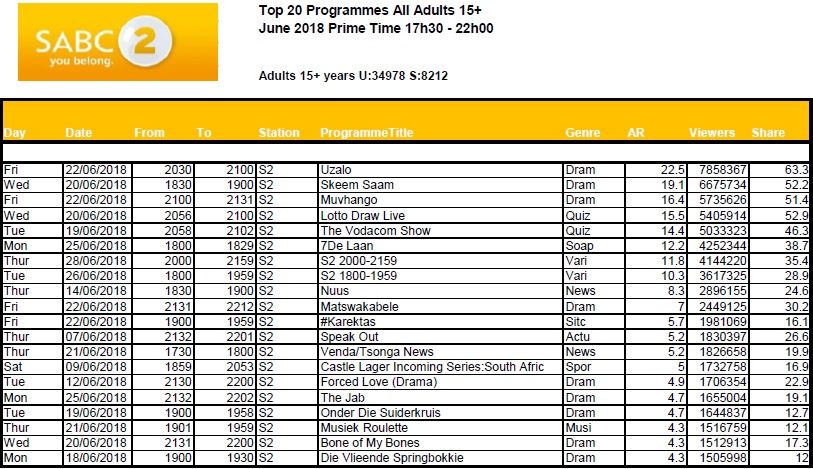
SA TV Ratings: SABC 2 — primetime top 20 for Jun 2018

by MarkLives (@marklives) The hottest primetime shows on SABC 2 in South Africa revealed: TV ratings for June 2018.

SABC 2 June 2018

BRCSA TV Ratings June 2018 primetime SABC 2
Click to enlarge to view clearly

Source: BRCSA June 2018

In 2016, the Broadcast Research Council of South Africa (BRCSA) changed its policy about giving away TAMS and now only monthly reports, highlighting the top 20 or 30 primetime shows on several popular channels, are available.


Broadcast Research Council of South AfricaThe Broadcast Research Council of South Africa (the BRC) is a non-profit, industry body that was incorporated in 2015 to cater to the audience research needs of the radio and television industry in South Africa.

— One subscription form, three newsletters: sign up now for the MarkLives newsletter, including Ramify headlines; The Interlocker, our new monthly comms-focused mailer; and Brands & Branding, launching soon!

#AgencyFocus: Big changes ahead for Clockwork Media

by Carey Finn (@carey_finn) The awards list for Johannesburg-based agency, Clockwork Media, is long, and rapidly growing. The same could be said of its to-do list, with the content and communications business gearing up for some significant changes in the coming months. “The last year or two have been incredible for us and have fundamentally changed the perception of the agency within the market,” says Tom Manners, managing director.

Manners started the business with co-founder and executive director, Nic Simmonds, in 2011; it was initially a small content and social operation, with the two formally adding a PR division in 2013 and expanding from there. “We wanted to build a strong, sustainable business that focused on doing good work first, and then try to move into the awards,” he says.

The strategy seems to have paid off; Clockwork Media’s recent wins include Large Agency of the Year at the Prism Awards and Africa Consultancy of the Year at the EMEA SABRE Awards (both for two years running), as well as PR Agency of the Year at the 2017 AdFocus Awards. The agency also recently took the Scopen Agency Scope accolade of agency with the highest level of client satisfaction in South Africa, being pegged as one to watch.

While these awards reflect the PR services for which the agency has become well known, the focus of the business is broadening — all the way to a full-service offering. If he were to be asked where he sees the agency in 2021, says Manners, he’d answer that it wants to be doing work that spans the line of available channels, and that makes SA and the world sit up and take notice. As part of this, the agency launched an activations division in February 2018, and will be undergoing a comprehensive rebrand later in the year, though the date for this hasn’t been confirmed.

“One of the big things we’re trying to focus on is to not only continue doing great communications work but also to start moving towards a TLL offering,” he says. “We’ve had that opportunity with a couple of clients and we’ve seen that the model works very well.” He emphasises that the agency is not about to forget its roots, though, and will retain a robust PR and communications portfolio.

“I think agencies are starting to converge into a single space,” he says. “And I think that, in 5–10 years, agencies are going to be less specific about service offerings in terms of niche channels, and start to focus more on strategic and creative work.” It’s this approach, he explains, that’s catalysed change at Clockwork Media over the last 12 months.

Among the drivers of the evolution are fresh senior faces Lisa Cohn, strategy director, and Daniela White, senior strategist. “The two of them are racing ahead with data insights and research work that we’ve taken on,” says Manners, something that he believes has allowed the agency to increasingly speak with clients at an exco level. Creative director Lize du Plessis was also brought onboard just over a year ago to bolster the agency’s creative team, which, he says, has allowed it to start pitching more on work outside the typical PR remit, and to respond to ATL briefs.

Other key new talent includes Lynne Krawchuk, who signed up as commercial director a year ago but has since taken up the reins of digital head; office director Emilia Brooks, who’s freed up Manners and Simmonds to focus more intensively on strategy; and Ciaran Burnand, who started the agency’s interactive team when it scooped the global digital account for Microsoft’s Windows and Devices Group in July last year.

The team members working on Microsoft now number 22, servicing Xbox.com, Surface.com and Windows.com in 46 markets, including the US and Britain. Manners describes the Microsoft win as a serendipitous one and a defining moment for the agency. In response to the economic destabilisation that shook SA in late 2015, Clockwork Media cast its net in the UK, sending Manners to London to drum up interest in the business. When the Microsoft account went out, Clockwork pitched alongside two global agencies — and won. Success in the agency’s initial focus on web development work, including design and UX, has secured it broader global briefs from the client since, including the launch of game Sea of Thieves earlier this year, as well as social and CRM support.

Other major clients include LG, whose digital and social work the agency has been handling for two years, and Exxaro, whose initial communications brief developed into a TTL account. “It’s not just about the big clients though; we’ve also had an opportunity to push the envelope with some of our smaller clients,” says Manners, citing the agency’s 2017 Guinness World Record effort for Dotsure, which saw a gathering of 866 dogs in bandanas, as a fun example.

There have been a couple of losses amid the gains: he explains that the agency’s four-year relationship with NBCUniversal came to an end earlier this year, and that it’s also said goodbye to Tile Africa. However, growth has been strong, and he estimates a year-on-year revenue increase of 40–50%, with a jump in headcount from 50–60 in 2017 to close to 90 now. He’s careful to clarify that there are no wild growth plans in place, though, noting that the agency is “looking to grow responsibly, with the right clients and relationships”.

Clockwork Media logo
clockworkmedia.co.zaRamify

  • Office locations: Joburg
  • Revenue band: R50–60m
  • Staff count: 90
  • Key clients: Microsoft, LG, L’Oreal, SEACOM, Exxaro, Snowflake, Fry’s Family Foods, IQ Business
  • Services: Public relations, social media, digital implementation, influencer marketing, production, brand strategy, creative conceptualisation


Carey FinnCarey Finn (@carey_finn) is a writer and editor with a decade and a half of industry experience, having covered everything from ethical sushi in Japan to the technicalities of roofing, agriculture, medical stuff and more. She’s also taught English and journalism, and dabbled in various other communications ventures along the way, including risk reporting. As a contributing writer to MarkLives.com, her new column “#AgencyFocus” is an ongoing weekly series updating the market on agency performance, including business performance, innovation, initiatives, the work, awards and people.

— One subscription form, three newsletters: sign up now for the MarkLives newsletter, including Ramify headlines; The Interlocker, our new monthly comms-focused mailer; and Brands & Branding, launching soon!

Gestalt: Data-driven ‘micro-moment’ strategy

by Leeya Hendricks (@LeeyaHendricks) As with all corporate functions, marketing increasingly depends on making timely use of all available data. This marks a sea change in the profession, which once, Mad Men-style, valued creativity above all and now uses technology on which to base its opportunities, ranging from data-driven campaigns to performance tracking.

Data treasure

Mobile devices are a major driver of the new data economy. Our devices accompany us at all hours in our unceasing quest to satisfy our most-immediate urges, whether it is to fulfil a need, corroborate or discover a fact, or find, compare, buy and consume an experience, product or service. Collectively, these are ‘micro-moments’ in the customer experience, vital because they’re treasure troves of data about the buyer’s journey. Micro-moments:

  • Signal the customer’s purpose at any point — whether to engage with the brand or buy
  • Reveal their preferences at a highly granular level at various points, and
  • Produce contextual data that let businesses discover new ways to help customers

For this reason, trail-blazing companies use advanced technologies to explore micro-moments strewn across multiple new customer touchpoints and channels, and to gather intelligence and integrate all hardware platforms in a cohesive customer experience. They’ve learnt that, if customers research purchases on one device, their search results ought to deliver personalised content and contextual product information. Using retargeting, companies can serve exclusive personal content directly and consistently across all channels and respond to any customer engagement with mobile-responsive mails. Throughout the journey, data is gathered and stored at each interval to build customer profiles, with ever more granular views of their preferences used to encourage repeat purchases.

This is an area of vast opportunity: Astonishingly, only 0.5% of all the data in the world has been analysed for some purpose.

Advertising recognising the moments

What does this mean for marketers? How may we leverage the on-the-fly, momentary needs of customers?

One thing is certain: If we’re absent or otherwise don’t offer value at the customer’s fleeting moment of need, we’ve missed an important opportunity to meaningfully engage them. We may never get another chance, especially if our competitors have beaten us to it. Quite simply, we need to compete fiercely for our customers’ attention during these moments.

Are we present during our customers’ I-want-to-know, I-want-to-go, I-want-to-do, and I-want-to-buy moments? There may be a hundred of these per customer each day. Even more importantly, are we stitching them all together in one cohesive, beautiful customer-experience fabric?

The value in recognising micro-moments and capitalising on them is enormous. According to Forrester, marketers that can successfully identify micro-moments are 53% more likely to report high marketing ROI. However, just 2% of marketers is taking advantage of them. Only 26% of brands can identify micro-moments, just 27% can deliver on them, and a mere 9% can measure them.1

Anticipate, prepare, and deliver

With the universe of micro-moments constantly evolving and multiplying, it’s imperative for marketers to anticipate, prepare and deliver on them. To understand this, let’s take an example of a brand we are all familiar with: Amazon.

We know that few brands can match Amazon’s ability to create in-the-moment experiences. From purchasing Amazon books online to grabbing lunch at Amazon Go to experiencing Amazon Prime, it leads the way in delivering immersive, memorable, and frictionless experiences.

In fact, Amazon has unlocked many more micro-moments over time. Starting out as a book seller, it has since become an e-commerce, payments, logistics and retail giant and reached deeply into other industries. At the heart of this is its Prime membership, unassailably tying it all together. It is a strategy all brands should adopt: 360-degree customer experiences.

What starts as a micro-moment often leads to a larger brand engagement, if the brand gets it right.

References

1 customerthink.com/how-you-can-deliver-what-the-customer-wants-a-winning-micro-moment-strategy

Further reading

Updated on 7 August 2018.


Leeya HendricksLeeya Hendricks (@LeeyaHendricks) is a designated chartered marketer, global marketing strategist, digital driver and a Women in Tech leader. She holds a BA degree in fine arts, a BA honours degree in brand marketing management and is currently completing her MBA. She is now director of customer first marketing at ORACLE UKI, responsible for driving customer success through customer advocacy, and building strategic partnerships focused on emerging technology and the changed customers’ buying behaviour. Leeya contributes the monthly column “Gestalt”, about putting customer first for sustainable business success, to Marklives.

— One subscription form, three newsletters: sign up now for the MarkLives newsletter, including Ramify headlines; The Interlocker, our new monthly comms-focused mailer; and Brands & Branding, launching soon!

Online CPD Courses Psychology Online CPD Courses Marketing analytics software Marketing analytics software for small business Business management software Business accounting software Gearbox repair company Makeup artist