MarkLives recently stumbled across a website documenting some of the traditional star lore of Africa and thought how wonderful it was to have an essentially oral history collected and made available online to all South Africans. Mark believes it is important for marketers to know local history and mythology and that these can serve as inspiration in the creative process.
The sky and the stars
A wide-spread African concept is that the sky is a solid dome, perhaps made of blue rock, resting on the Earth, upon which the Sun moves. The traditional Tswana idea is that stars are holes in the rocky vault that is the sky.
The Nyae Nyae !Kung Bushmen saw the sky as the dwelling place of all the divine beings and spirits of the dead. The “things of the sky” generally do not influence or reflect the affairs of man, the !Kung taught, nor do they affect the weather, the growth of vegetation, or other conditions of the earth; they are in a realm of their own.
In Xhosa, a star is inkwenkwezi, inkanyezi in Zulu, nyenyedzi in Shona, dinaledi in Sotho, tinyeleti in Tsonga, maledzi in Venda, linaleri in Setswana, and nyota in Swahili.
While the /Xam Bushmen believed the stars were formerly people, some !Kung Bushmen taught that stars are, in fact, small creatures, and look like tiny porcupines – they have little legs, ears, teeth and are covered with tiny spines. Another !Kung account says that stars are actually ant lions, watching from overhead with their bright eyes. When they are hungry and see an ant, they quickly fall to the ground to catch it. Some say that all the stars fall to the ground each morning, and we see them on earth as insects. The Ibibio of Nigeria spoke picturesquely of the stars as “Sand of the Moon”.
The Moon
The Moon – iNyanga to the Xhosa and Zulu, Nwedzi to the Shona and Venda, and Ngwedi to the Sotho and Tswana – is probably the most obvious feature in the night sky, because of its size, brightness, and changing appearance (phases). As the Moon orbits the Earth it goes through a sequence of phases, from New Moon (invisible) to crescent, half-moon, Full Moon, half-moon, and back to New Moon.
To the Kora KhoiKhoi, the Moon was kham, “the Returner”; the Nama KhoiKhoi spoke of khab. The KhoiKhoi also considered the Moon as “the Lord of Light and Life”, and would sing and dance at times of New and Full Moon.
The Nyae Nyae !Kung Bushmen said that the crescent phases with sharp points was male, while the Full round Moon was female.
The Xhosa considered the time of New Moon as a period of inaction. When it reappeared as a crescent in the evening sky, it was cause for celebration. Important events were scheduled to take place around the time of Full Moon. Also at Full Moon the mothers would de-worm their children, believing that at this time the worms collected in one place and could be effectively treated.
The Naro Bushmen taught that when the crescent Moon slopes downward, it is said to be looking into a grave and this is a sign that many people will die in that season. A crescent pointing upward was a favourable sign. The round Full Moon is a sign of satisfaction and that people will find plenty of food.
In /Xam Bushmen mythology, the Moon is a man who has made the Sun angry. The Sun’s sharp light cuts off pieces of the Moon until almost the whole of the Moon is gone, leaving only one small piece. The Moon then pleads for mercy and the Sun lets him go. From this small piece, the Moon gradually grows again until it becomes a Full Moon. The /Xam also have another account of how the Moon came to be. In the old times, it was said, the Moon was one of the leather sandals of the Mantis-god /kaggen. The sandal was placed in water to soften it somewhat, but this angered the water spirit who then froze the water, locking the sandal in ice. When /kaggen saw the frozen sandal he discarded it, throwing it up into the sky, where it became the Moon. Whatever its origin, the /Xam considered the New Moon as being able to influence hunting and the gathering of ants’ eggs, and when the crescent was sighted, they would ask for its assistance.
The surface of the Moon has dark and bright markings; flat lava plains and rocky highlands, respectively. In many African traditions these markings are said to resemble the figure of a man or woman carrying a bundle of sticks.
When the Earth’s shadow falls on the Moon, a lunar eclipse occurs. The Nyae Nyae !Kung Bushmen said that this was caused by the lion, putting his paw over the Moon to darken the night so he could have better hunting
Under certain atmospheric conditions, a “moon bow” can form, appearing as a large ring around the Moon. To the /Gwi Bushman, such a ring was a sign that food will be plentiful.
Bright southern stars

The Southern Cross (Crux) and the two bright Pointers (alpha and beta Centuari) are probably the most recognizable of the southern stars, and they feature prominently in African star lore.
Visit PsychoHistorian.org for more lore on the Sun, The Milky Way, The stars around Orion, Venus, comets and meteors.
In Sotho, Tswana and Venda traditions, these stars are Dithutlwa, “The Giraffes”. The bright stars of Crux are male giraffes, and the two Pointers are female. The Venda called the fainter stars of the Southern Cross Thudana, “The Little Giraffe”. They also say that the month Khubvhumedzi begins when the crescent Moon can be seen for the first time and, at the same time, the lower two giraffe stars are just below the horizon and the upper two are just visible. Sotho lore tells that when the giraffe stars are seen close to the south-western horizon just after sunset, they indicate the beginning of cultivating season.
The /Xam Bushmen saw the two Pointers as male lions; they were once men, but a magical girl turned them into stars. The three brightest stars of the Southern Cross they saw to be female lions. To the Khoikhoi, the Pointers were known as Mura, “The Eyes”, of some great celestial beast.
The Coal Sack, a large dark nebula near the Southern Cross, is known as the “Old Bag of the Night” to the Nyae Nyae !Kung Bushmen.
The long axis of the Southern Cross points towards a bright star called Achernar. This star is called Senakane (Sotho, Tswana) and Tshinanga (Venda), meaning “The Little Horn”.
Brighter still than Achernar is Canopus, one of the brightest stars in the night sky. It is widely known in southern Africa as Naka, “The Horn Star”. In Sotho tradition, a careful watch was kept for Naka about the end of May. Sotho chiefs awarded a cow for Naka’s earliest sighting. The day of the sighting the chief would call his medicine-men together. Throwing their bone dice, the doctors would judge whether the new season would be good or bad. The appearance of Naka also heralds coming of winter and browning of the veld. When Naka appeared before sunrise, the Tswana knew it was time to start breeding their sheep. In Venda tradition, the first person to see Nanga in the morning sky (in May, heralding winter) would climb a hill and blow the phalaphala (black sable antelope horn) and he would receive a cow as a prize. The Zulu knew Canopus as isAndulela, a messenger appearing at the end of Autumn, the harvest time, and also as inKhwenkwezi, “The Brilliant Star”. The /Xam Bushmen believed that Canopus could influence the availability of ants’ eggs, a rich source of nourishment, and they called it “The Ant Egg Star”.
The beautiful constellation Scorpius with its slender curved row of stars is famous for the bright reddish star Antares. This star was called by the !Xu Bushmen “The Fire-Finishing Star” – not only does it have a reddish colour, but (at certain times of the year) it sets very late at night, when the camp fires have died down. (See also Arcturus and Regulus below.)
Along the curved body of the scorpion, just before the tail section, lies a close pair of stars (mu-1 and mu-2 Scorpii), which the Khoikhoi called xami di mura, “The Eyes of the Lion”.
Near Scorpius is a conspicuous circlet of stars known as Corona Australis, the Southern Crown. The /Xam Bushmen had a tale about a group of men who sat eating together when a bewitched girl look upon them, turning them into these stars.
The bright star Fomalhaut lies in a rather star-poor region and is prominent in the summer sky. It is called Ndemara, “The Sweetheart Star”, by the Shona, and Ntshuna, “The Kiss Me Star”, by the Tswana. The visibility of this star was supposed to indicate the time for lovers to part before their parents discovered them. (Compare this with the tale about Venus the Evening Star, below).
Another prominent southern star is Peacock (alpha Pavonis); the /Gwi Bushmen call it “The Female Steenbok”.
The Magellanic Clouds
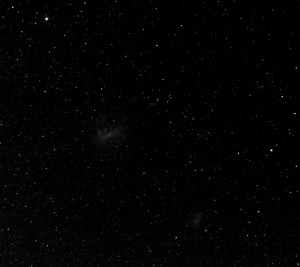
On a moonless night under a dark sky, two interesting “clouds” can be seen to the south, one cloud much larger and brighter than the other. These are the Magellanic Clouds, or the “Cape Clouds”, and are actually entire galaxies, thousands of light years away.
The Ju/Wasi and !Kung Bushmen said that the larger cloud was a part of the sky where soft thornless grass grows, like the kind they used for bedding. One day, they say, God climbed onto the large cloud and went hunting. Several other Bushman groups saw the two clouds as male and female steenbok.
The Sotho saw the clouds as the spoor of two celestial animals. The large cloud was Setlhako sa Naka, “The Spoor of the Horn Star” (Naka, Canopus) and the smaller cloud was Setlhako sa Senakane, “The Spoor of the Little Horn Star” (Senakane, Achernar).
Tswana folklore tells that when the small cloud appeared more clearly than the large cloud, a drought would follow.
Visit PsychoHistorian.org for more lore on the Sun, The Milky Way, The stars around Orion, Venus, comets and meteors.
Source: http://www.psychohistorian.org/


