Cover Stories: Thoughtfulness in design (29 September 2017)

by Shane de Lange (@shanenilfunct) Let’s delve into great media design from South Africa and around the world:

  • ArtReview — local/print
  • BACCALÀ — online
  • FUSE — iconic
  • Lucky Peach — international/print
  • Newsweek — international/print
  • VISI — local/print

Find a cover we should know about? Tweet us at @Marklives and @shanenilfunct.
Pinterest icon Want to view all the covers at a glance? See our Pinterest board!


Print

VISI (South Africa), 8 September 2017

VISI, 8 September 2017 — Zeitz MOCAA

The cover for the October/November 2017 issue of VISI magazine introduces a new feature in the landscape of African art, after the launch of the much-anticipated Zeitz Museum of Contemporary Art Africa (Zeitz MOCAA) at the V&A Waterfront in Cape Town. The cover depicts Githan Coopoo, assistant curator of costume, appreciating a work by renowned South African artist, Penny Siopis, titled “Tranfigure III”, currently on display in the museum.

Originally built in 1921, this appropriated grain silo complex has been repurposed into an important cultural institution. Designed by internationally accomplished architect, Thomas Heatherwick, the structure has undergone a mammoth metamorphosis, transformed as a testament to contemporary African art, and art from the African diaspora, opening Africa to the world.


Newsweek (US), 29 September 2017

Newsweek, 29 September 2017 - Donald Trump

Quoting the famous line from the lyrics to the song “Insane in the Brain” by the infamous hip-hop band, Cyprus Hill, this issue of Newsweek doesn’t need to say much more regarding the president of America. The silhouette of Donald Trump is burgeoning, amplified by dramatic background lighting and a subtle use of typography; his hair is the only detail that the reader can see.

One would be forgiven for taking this cover on surface value, given that tensions have increased between North Korea and the US, resulting in a nuclear crisis with the potential for a declaration of all-out nuclear war. Trump’s ‘sovereignty talk’ at the UN General assembly was provocative, to say the least. His domestic woes are increasingly in the news, with ongoing attempts to replace former president Barack Obama’s healthcare plan (‘Obamacare’), alongside his open criticism of NFL players taking a knee during the national anthem in protest against police brutality, and the Supreme Court cancelling arguments on the president’s travel ban. All this displays how far America, not just the far right, has progressed in seemingly losing its mind, selling its soul and shifting away from a perspective that advocates freedom towards an ideology that propagates authoritarianism.


ArtReview (UK), Summer Issue, September 2017

Collage - ArtReview Summer September 2017 - Zanele Muholi - and Nandipha Mntambo by Pieter Hugo

An imposing self-portrait of South African photographer and artist-activist, Zanele Muholi, titled “Ntozakhe II” (2016), adorns the cover for the Summer 2017 issue of ArtReview. The portrait forms part of a series called Somnyama Ngonyama, meaning “Hail the Dark Lioness”, currently on exhibition in both the Stedelijk Museum in Amsterdam (closing 15 October) and Autograph ABP in London (closing 28 October). This cover celebrates Muholi’s first solo exhibitions in Amsterdam and London that are hosted by major public institutions, exhibiting over 60 self-portraits from the Somnyama Ngonyama series.

Aside from Muholi’s own personal artistic inquiry, the cover portrait reminds one of another iconic South African photographer, and fellow Stevenson Gallery artist, Pieter Hugo — particularly Hugo’s series titled, “There’s a Place in Hell for Me and My Friends”. His portrait of Nandipha Mntambo (2012), another resident of the Stevenson stable, comes close in surface appearance to the ArtReview cover, made by converting colour images to grayscale while maintaining and altering the colour channels to enhance the appearance of his sitter’s skin pigment, drawing attention to the notion of acceptable beauty in popular culture. This is not dissimilar, perhaps even parallel, to Muholi’s narrative.

Muholi’s portraits confront the often-hostile socio-political context within which lesbian and transgender South African women have to exist. Her narrative includes an element of self-invention, deconstructing beauty, exposing the contradictions of race and gender distinctions in society.


Lucky Peach (US), Final Double Issue, #24 and #25 combined, 2017

Lucky Peach, Final Double Issue, issues 24 and 25 combined, 2017

Lucky Peach is a New York Times bestselling quarterly journal, and nine-time James Beard award-winner, including 2016 Publication of the Year. Despite setting some of the highest standards in the publishing industry, the recent demise of the magazine comes as a surprise. Lucky Peach seems to have died in much the same manner that it lived, embracing flux and always disruptive. Every issue had a theme, using tasteful art, typography and photography, to investigate food and writing. Issues 24 and 25 have been condensed into one final double issue release, highlighting the most-memorable moments for each issue in Lucky Peach’s existence.


Online

BACCALÀ (US), Fall/Winter Issue, September 2017

BACCALÀ online, Fall Winter Issue, September 2017

Based in Milan and Los Angeles, BACCALÀ is a large-format independent publication that focuses on fashion, art and photography. The name is inspired by the Italian saying, “Sei proprio un baccalà”, which compares the brash and foolhardy among us as tantamount to Cod fish. Baccalà, or salted cod, is a traditional Italian dish which has flavor sans any offensive smell, and is used here as a humorous analogy for driven young people who still have a lot to learn but have the talent and ambition to achieve anything.

A typeface of choice, recalling Italian futurism, is used for the magazine’s logotype. Combined with great art direction and photography, and textbook layout, this makes the printed version of the publication a pleasure to behold. The publication’s online presence is particularly strong, with a visually interactive spread, aesthetically considered user experience, parallax scrolling, and responsive design that would attract even the most-hardened creative types.

Working hard yet playing harder, humorous yet serious, BACCALÀ promotes a reverence for the past while nurturing the youthfulness of the present.


Iconic

FUSE (UK), Issue 1, 1991

FUSE issue 1 in 1991 and issues 2 and 6

FUSE was a pioneering publication that took a subversive approach to design and typography, showcasing early experimental contributions from a few of the most-influential names in design today, including Stefan Sagmeister, Tobias Frere-Jones, David Carson, Peter Saville, and Bruce Mau, to name a few.

First published by Neville Brody, Erik Spiekermann and Jon Wozencroft in 1991, the original cardboard package for FUSE #1 contained a 3.5” floppy disk, which had digital fonts designed by respective contributors and four posters designed by Brody, Ian Swift, Phil Baines and Malcolm Garrett. Each accompanying issue came with a floppy disk containing bespoke digital fonts, which were also used in the design of the foldout posters. Many of these fonts have been lost, with the posters being the only form of documentation, due to the unreliability and short lifespan of floppy disks.

Eighteen issues were initially released of FUSE before its downfall, published and distributed by FontShop, which was also founded by Spiekermann with Brody’s involvement. The point of the publication was to reclaim typography from the often-tragic standards during the early days of digital type design. The magazine explored various typographic approaches, including unorthodox exercises in architectural form, sculptural dimension, and organic depth, at all times pushing the limits of legibility and readability, acting in defiance of the grid in typical 90s graphic-design fashion and attempting to make typography more poetic and less formal.


Shane de LangeShane de Lange (@shanenilfunct) is a designer, writer, and educator currently based in Cape Town, South Africa, working in the fields of communication design and digital media. He works from Gilgamesh, a small design studio, and is a senior lecturer in graphic design at Vega School in Cape Town. Connect on Pinterest and Instagram.

Cover Stories, formerly MagLove, is a regular slot deconstructing media cover design, both past and present.

Sign up now for the MarkLives email newsletter every Monday and Thursday, now including headlines from the Ramify.biz company newsroom service!

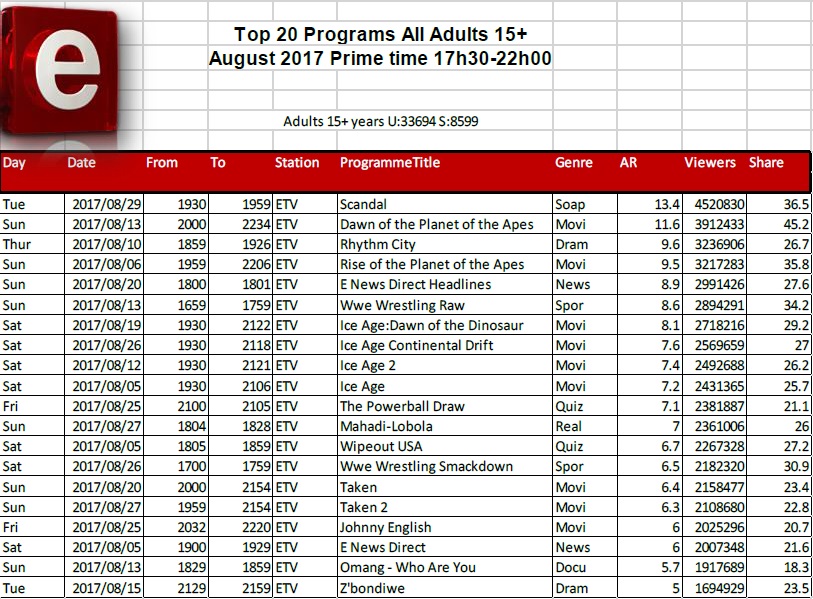
SA TV Ratings: e.tv — primetime top 20 for Aug 2017

by MarkLives (@marklives) The hottest primetime television shows on e.tv in South Africa revealed: TV ratings for August 2017.

In 2016, the Broadcast Research Council of South Africa (BRCSA) changed its policy about giving away TAMS and now only monthly reports, highlighting the top 20 or 30 primetime shows on several popular channels, are available.

e.tv August 2017

BRCSA TV Ratings August 2017 primetime etv

Source: BRCSA August 2017

Broadcast Research Council of South Africa


The Broadcast Research Council of South Africa (the BRC) is a non-profit, industry body that was incorporated in 2015 to cater to the audience research needs of the radio and television industry in South Africa.

Sign up now for the MarkLives email newsletter every Monday and Thursday, now including headlines from the Ramify.biz company newsroom service!

Production transparency is everyone’s business

by Bobby Amm. Transparency has been a contentious topic in commercial production for years, with the US Department of Justice even opening an investigation into bid-rigging in December 2016. But it isn’t just an American issue; transparency in commercial production is a concern worldwide.

Implicated agencies have been accused of submitting proposals for their own projects through their in-house production departments, using information collected from competitor bids. But this conflict of interest has just been considered a problem for independent production houses… Until now.

A report recently released by the Association of National Advertisers (ANA), titled Production Transparency in the U.S. Advertising Industry, affirms that not only are these uncompetitive and non-transparent practices very real but they affect advertisers and related service providers, too.

About the report

The findings of this 30-page report were compiled by a task force of 30 executive subject-matter experts and 12 ANA member organisations, including a law firm, an independent investigative firm, three industry trade associations, five production consultants, and two auditors. Of the 12 organisations, 11 agree that transparency concerns exist at multiple agencies and holding companies. The 12th only had second-hand knowledge of them.

The report also reveals that some agencies ask suppliers (such as independent post-production companies) to submit check bids for their projects — a bid price that’s higher than they’d normally quote. This creates a paper trail that justifies an agency’s decision to award the project to an in-house facility because of its ‘lower bid’.

Interesting findings

Among the findings, some of the ANA’s most interesting discoveries include:

  1. Advertisers don’t know

Marketers don’t always know that in-house units are bidding. This is because in-house production departments often have their own names, and most advertisers don’t require agencies to disclose conflicts of interest.

  1. Production is affected

The report states: “Production business processes marked by agency control of the bidding system… is sometimes dysfunctional and conflicted because the buyer can also be the seller of the services.”

  1. Industry jeopardised

The report also states that competition in the production and editing space is “potentially compromised and unreliable”, jeopardising the success and integrity of the industry.

  1. Clients are deceived

The report states: “Non-transparent agency-controlled bidding can lead to costly, inefficient, and sub-optimal advertiser business decisions.” In other words: the free and open market is distorted and the advertiser pays a higher price because of it.

Recommendations

To address these concerns, the report offers several recommendations for advertisers that mirror many of the Commercial Producers Association’s Universal Principles of Engagement. These include:

  1. Being familiar with the names of agencies’ in-house production affiliates
  2. Requesting full disclosure when agencies’ in-house teams are bidding for a project
  3. Establishing procedures that prevent conflicts of interest
  4. Adjusting client/agency contracts to ensure transparency
  5. Assigning third parties to manage the bidding processes

With advertisers involved in the controversy, it’s more important than ever to be aware of the realities and demand transparency in future business. We hope that resources such as the ANA’s report, and the International Production Communities Principles of Engagement will help to ensure ethical and fair practices for all of us, for many years to come.


Bobby AmmBobby Amm is chief executive of the Commercial Producers Association of South Africa (CPA), the trade association of production companies that produce television, cinema and internet commercials for the local and international market. After a brief stint in journalism, she began her career in the industry at the Consultative Committee for the Entertainment Industry in the early 1990s. She first joined the CPA in 1997 but left three years later to join a production company. After finding that she missed the big-picture perspective of the CPA and the interesting issues which continuously perplex the production industry, Bobby returned to the CPA in 2003.

“Motive” is a by-invitation-only column on MarkLives.com. Contributors are picked by the editors but generally don’t form part of our regular columnist lineup, unless the topic is off-column.

Sign up now for the MarkLives email newsletter every Monday and Thursday, now including headlines from the Ramify.biz company newsroom service!

The Real McCoy: People as strategy

by Sean McCoy (@TheRealMcCoyTRM) It was the late business management guru, Peter Drucker, who is attributed with saying that ‘culture eats strategy for breakfast.’ In spite of this poignant statement, it’s astounding how many organisations still soldier on with rigorous strategic planning and attempted implementation — without due consideration of the people component.

Beyond the cliché, people really do have a crucial role to play in successful strategy implementation, from the leadership role, through to the people actions and behaviours across the organisation.

The need for strategy

If I look around me at our present client base, it’s not surprising how many organisations are engaged in major strategic consideration and intended shifts, and often our role is to help activate this; it’s an exciting part of branding and one in which the internal brand effort has a significant and potentially vital contribution to make. From financial services organisations which are redefining the brand proposition and market positioning to ones which are driving fundamental organisational change in pursuit of an improved customer experience; necessitating quantum shifts in organisational design, governance and regulatory changes, with corresponding system reinventions. Needless to say, the human change requirements of these initiatives are seismic and, while organisational design, people or talent departments and learning and development units all gather around in unison to drive such change, key for a brand in this equation is to play a facilitating role in aligning the internal change with the external brand and reputational promise to market.

To make the point, pick on a few taglines of brands with whom you have engaged or experienced and ponder whether that experience meets the marketing proposition; all too often, the disconnect is sadly large.

It’s not always marketing

In the mining sector at the moment, it’s not necessarily about meeting shiny new slogans and catchy consumer promises. Strategy is premised on the need for real change in a sector that remains highly troubled between commodity pricing cycles and major political interference (if not blatant mining sector incompetence) before you even consider the challenge of a depleting natural resource. This business pressure warrants a major effort around efficiency and effectiveness of current operations, juxtaposed on the need to ‘uberise’ businesses and contemplate what the future looks like.

In some instances, this is driving exciting new initiatives around very diversified offerings and propositions, but this is terrifyingly difficult to ‘sell’ internally, let alone externally.

In an organisation with a deep history in mining as a core competency, the ability to shift into fundamentally different industry sectors requires a sizeable shift in mind-set, culture and human behaviour. Visionary and committed leadership is a superb start, as is commitment to the internalisation journey in order to help people see the future and align towards it. It is a long and arduous road but one that has begun, and the people dimension in enabling the realisation of a different future is a constant work in progress in which there will undoubtedly be many peaks and troughs.

Kubler Ross change curve

Developed by Elisabeth Kubler Ross in the 1960s as a model for terminally ill patients to handle the grieving process of coming to terms with their condition, organisational change experts adopted this change framework by the 1980s and it has become a firm fixture in the realm of organisational change initiatives.

Without a detailed discussion of the theories that underpin this curve, the underlying premise is that people have differing emotional need states during the change cycle; these can and should be effectively managed to enable the emotional and behavioural transition, helping people to understand their reactions to change and upheaval and preparing them for this.

In the virtually permanent state of disruption such as we face today, we are by extension in a state of ongoing change and, as the cliché suggests, ‘change is the only constant’. Helping people to cope, therefore, with the issues of change anxiety, shock, denial and fear of the unknown as they progress towards acceptance, integration and adoption is therefore a continuous requirement of leadership in business, and internal brand alignment has a role to play in aiding this and bridging some of the communication and culture change issues. In most instances, strategic shifts are accompanied by clear statements of a new desired culture in order to enable this, and we therefore need to be mindful of this on an ongoing basis.

Progress rather than perfection

Although hotly contested, it’s often suggested that an imperfect strategy, well-executed, is better that the perfect strategy, poorly executed. Given that we live in an imperfect and increasingly disruptive world, I am inclined to favour the former. The days of embellished strategic planning with long-range horizons are a thing of the past. Speed and agility are now the order of the day and people have a major role to play in achieving this. Even the late, great Pablo Picasso alluded to this when he said “what one does is what counts and not what one had the intention of doing.”

Reference

  • “Picasso Speaks.” in The Arts, vol. 3, ed. Marius de Zayas, New York, May 1923. pp. 315-329.


Sean McCoyDr Sean McCoy, MD and founding member of HKLM, is a prominent figure in the branding arena, with his expertise centered on client service, brand strategy and business development. He contributes the regular “The Real McCoy” column focusing upon internal branding to MarkLives.

Sign up now for the MarkLives email newsletter every Monday and Thursday, now including headlines from the Ramify.biz company newsroom service!

Agency Life: The black elephant in the room — part 1

by TJ Njozela (@tj_njozela) Yes, this is another article about transformation. No, it’s not a rant. Yes, it’s going to be controversial.

Black people might find the awkwardness of ‘white people smiles’ in the office a lot more awkward, and white people might start wondering if young black creatives really are ‘gathering’ to talk about fashion and music, or if they’re plotting the next #ThingThatMustFall. But, ladies and gentlemen of the advertising industry, I put it to you that, while this series of articles is going to be challenging and, at times, as comfortable as a turbulent flight back from the Loeries after starring in your own version of The Hangover — thank goodness for sickness bags — in the end, we’ll have a platform where we can talk about the black elephant in the room in a constructive way.

Before we get into what we need to do with the elephant, we need to understand why it’s there in the first place. Fortunately, there are some valid reasons for the need for transformation, and how as a nation we got to this point. Here are a few that will help contextualise our current economic climate.

1. Because apartheid

For most of us, the only thing we remember about 2010 is that Phillip was here. But the biggest news story of the year (well, one of them; the other one was the Haiti earthquake) was the oil spill in the Gulf of Mexico. Over 700m litres of oil spilled into the ocean, some of which is still washing up on shores to this day.

The pressing question is: what does the Gulf of Mexico have to do with apartheid?

I think it serves as a good analogy. As much as apartheid ended long before anyone ever would have thought Donald Trump would one day become a president, its effects are still being felt in the era of Zumanomics.

And, if the impact of an oil spill a few years ago is still felt today, how much longer would it take to not feel the effects of a complex system designed to disenfranchise, exploit and deprive a people not from a particular racial group from economic freedom?

So, when people say “Apartheid is still alive”, they’re not holding on to the past; they’re actually living it in the present.

2. There is a lot of black people in South Africa

Saying there is a lot of black people in SA is like saying there is a lot of fish in the sea. Duh. But this obvious fact is one of the reasons transformation is necessary. Because it doesn’t make sense to have a country where a minority has a bigger share of the pie than the majority. It’s like your little brother or sister getting a bigger piece at the braai than your dad. It’s just weird.

So, one of the main objectives of transformation is levelling the playing field. That’s why there’s a focus on empowering people who were previously disadvantage by the old system. It’s not about putting black people on boards and so on just to be nice. Black people deserve nice things, too.

3. We all want to live in a nice country

One of the things we have going for us as a country is how nice we are. Whenever people visit SA, they never stop going on about how nice the people are here. And of course we are nice. Though most of these really nice people are part of the growing middle class who, for the most part, are doing ok. But there are also some not-so-nice people, most of whom are living in tough situations.

Imagine how nice the country would be if everyone were doing ok, and didn’t have to resort to being stats about how much our country sucks.

Even white people would be able to walk freely in inner city Joburg, at night, with no fear of anything happening. Even the ‘boujee’ black people will start doing night runs in the city streets.

Yes, it will take a lot of work to get the country to this utopian level. A lot. But because transformation aims to give everyone a chance to lead a happy, economically empowered life, it’s a good first step towards it.

~~~

Transformation is by no means a perfect plan. After all, it was a government idea. But the intention is 100% solid. And, as with most of the government’s plans, it’ll only succeed if businesses and individuals make it work.

As an industry that creates jobs from conceptual teams to community managers, from the people who put up billboards to sound engineers, advertising has the potential to contribute and perhaps even lead the way when it comes to transformation. There are some challenges, however, and we’ll look at those in the next article.

See also


TJ NjozelaTJ Njozela (@tj_njozela) is an award-winning senior copywriter at FCB Africa with several years of experience in the advertising industry. More than a writer, he is also a reader, a thinker, and an avid liker of things; and he once walked from Joburg to Cape Town in 30 days to raise funds to buy wheelchairs for people in need. #30Days30Wheelchairs. TJ contributes the regular “Agency Life” column, in which he gives career advice for working within the advertising industry, to MarkLives.

Sign up now for the MarkLives email newsletter every Monday and Thursday, now including headlines from the Ramify.biz company newsroom service!

Global Headline Makers: Alex Pasini, France

by Mark Tungate (@MarkTungate) The Paris outpost of Canadian agency Sid Lee has always been considered something of an outlier in the French advertising landscape. Here Alex Pasini, SVP global alliances, explains its evolution into a force to be reckoned with and how the European hub of the agency bridges North America and Asia.

I’d always thought of Sid Lee in Paris as a cool agency — almost dauntingly so. It felt like a playground for young creatives who loved working on video games (Ubisoft), vodka (Absolut), energy drinks (Red Bull) or sneakers (Adidas). It turns out that was only half of the story. The man who’s put me right is Pasini. His title is almost a story in itself.

Pasini hails from Montreal, Sid Lee’s home town. (By the way, it began life as an agency called Diesel but changed its name when the fame of the jeans brand began to eclipse its own. Anagram fans will have already spotted how its founders (law student Jean-François Bouchard and graphic design student Philippe Meunier) chose their new moniker.

Pasini recalls: “I was a graduate trainee when I joined the Montreal agency, which at that point was about the same size the Paris office is now — about 50 or 60 people.” Because of Quebec’s failed push for independence in the 1970s, Montreal was frozen out as Canada’s business capital by Toronto. Fortunately, it managed to reinvent itself as a creative hub. As a result, Sid Lee was able to work with iconic creative brands such as Cirque du Soleil.

Says Pasini, “The agency was very human-centric, so they’d look at consumers first and see how they could best interact with the brand, before deciding on the right platform.” Digital expertise was a given: “The first-ever website in Canada came from Diesel, in 1997, for the Montreal Jazz Festival.”

From the very start, the agency broke down borders between disciplines. “By the time I joined, they’d already begun employing architects, which was quite uncommon to advertising.” So the agency could not only revamp your image but redesign your offices or stores, too.

This skill actually led to the adidas account. “When we met them in Portland, their advertising was very decent. But the retail experience was broken. We did a small shop-in-shop project in Portland, then a year later we got the call to pitch on a store concept for adidas Originals. After a while we picked up the entire adidas business — but our way in was through architecture.”

The business of “now”

Flash forward, and today Sid Lee has offices in Montreal, Toronto, New York, Los Angeles and Paris. Two years ago, the agency was acquired by Japan’s Hakuhodo DY to became part of its Kyu Collective (pronounced “Q”), which includes highly respected design firm, Ideo. The idea is to be able to offer top talent in every field. “From day-to-day we’re still very independent in our way of working. But it’s given us more opportunities.”

Pasini is very clear about where Sid Lee stands in terms of the competition: “We define ourselves as ‘creative builders for the modern age’. We build brands, we build authenticity and trust for our clients — but we’re also literally builders, thanks to our architecture practice.”

It’s creativity in a broad sense, he says, and very much attuned to the 21st century way of doing things. “We’re in the business of ‘the now’ — there’s always that notion of being progressive.” At the same time, despite its digital roots, Sid Lee is unmoved by the prospect of programmatic or “automated” advertising. “We’re about creating culture,” stresses Pasini.

He denies that the agency is self-consciously “cool”. “We were aware of that image and deliberately set out to attract more-institutional brands. What’s interesting is that it depends on the maturity of the agency in each market; back in Canada, both in Toronto and Montreal, we’re working with big telcos like Vodafone.” In Paris the agency’s roster now includes Yellow Pages and bank BNP Paribas.

Managing the alliance

Anyone who’s been to Cannes Lions lately knows that the “multidiscipline” approach is now a standard agency pitch. But Pasini believes the connection with Kyu gives Sid Lee an edge. One example is Michelin’s recent Moving On mobility conference in Montreal. It brought together three Kyu companies: alternative seminar organiser, C2 (“the business conference reinvented”); hospitality and experience management firm, Infrared; and, of course, Sid Lee on the branding and communication fronts. “That’s a very tangible example of the kind of collaboration we’re able to do, an offer that’s quite unique in the marketplace.”

A planner by trade, Pasini is now responsible for pulling these disparate strands together: forming a bridge between the North American and European operations; liaising with the other members of the Kyu Collective; and finding ways of offering the agency’s expertise to existing Hakuhodo clients (for example Honda, luxury brand Longchamp and sweet snack Mikado).

“It’s all about ensuring that the synergies between these three pillars are working properly. We call it ‘the alliance’.” Plus, he says, he still dedicates 20% of his time to developing Sid Lee Paris. Sounds as if he’s got his work cut out. “A lot of travelling,” he admits. “And when you’re based in Paris, LA and Tokyo are not easy flights!” Then again, Sid Lee urges its clients to “believe in change” and “stay one step ahead”. So maybe it’s a good idea to keep moving.


Mark TungateMark Tungate (@MarkTungate) is the editorial director of the Epica Awards (@EpicaAwards), the only global creative prize judged by the specialist press. A British journalist based in Paris, Tungate is also the author of seven books about branding and advertising, including Adland: A Global History of Advertising and, most recently, The Escape Industry, a journey through the business of travel. Over his 30-year career, he has has written for leading newspapers and magazines in the UK, France and the US.

This “Global Headline Makers” column, which profiles creative stars making headlines in their home markets, is syndicated monthly from Epica.

Sign up now for the MarkLives email newsletter every Monday and Thursday, now including headlines from the Ramify.biz company newsroom service!

Ad of the Week: Gangs of ballet

by Oresti Patricios (@orestaki) TBWA\Hunt Lascaris and Darling directors Jeana Theron and Ross Garrett teamed up with Joburg Ballet to create a project that entertains — because it takes ballet to the streets and sells the art with a unique mashup of old and new.

Ballet is one of the oldest forms of theatre, dating back to the Renaissance. Although it has gone through many changes, classical ballet has a language in its choreography that transcends time and borders. Traditionally, a night at the ballet means being transported into a spectacle of music, costume, set design and movement. In modern ballet, the opulent costumes and sets are often replaced with something more simple, and it’s this aesthetic that informs the “Bite-Size Ballet” productions, which the Joburg Ballet company has created to promote its latest season.


Pinterest icon View all the Ads of the Week at a glance on our #AdoftheWeek Pinterest board!
YouTube icon Watch our 2017 #AdoftheWeek playlist on YouTube


Three short pieces have been created, based on suggestions from fans of the company. There is a short jump-cut style intro for each one, using Twitter screen shots and scenes from the dancers warming up, which sets the theme.

The first was a ‘recap’ of the wildly popular Game of Thrones, in anticipation of the seventh season of the popular TV saga. Obviously, a literal recap would not fit into such a small timeslot, so the choreographers created a vignette that captures some of the drama and intrigue of the epic mini-series. The music combines big orchestral sounds with a modern electronic beat. The dancers are dressed in neutral colours and the backdrop is the Joburg city skyline; the entire sequence is shot on a rooftop in the city centre. The entire sequence is done in one take, which allows the dance to tell the story, including executions, assassinations and a magical resurrection — all in under 90 seconds.

The second bite-sized ballet production is an interpretation of one of the most-hyped boxing matches in recent history, the ‘Money Fight’ between Floyd Mayweather Jr and Conor McGregor. Released on the eve of the fight, the ‘fighters’ are played by female dancers in a highly stylised encounter. In the opening montage, the two are seen preparing, in a scene that parallels that of a boxer preparing for a fight; instead of taping the hands, the feet are being taped. The performance takes place in an old urban environment, the square of the ring being created by a patch of rough tarmac. One ‘boxer’ is the victor, and the fight/dance ends with a hug and a smile, much as it goes down in the real ring.

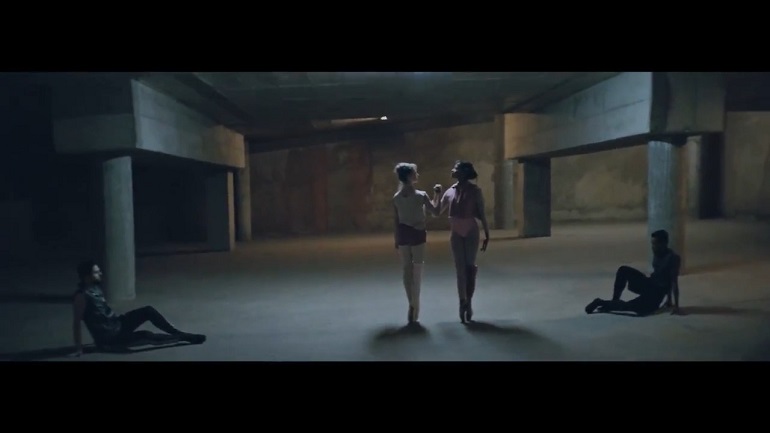
TBWA\Hunt Lascaris and Darling for Joburg Ballet Bite-Size Ballet screengrab 03The third mini-ballet was released on 31 August 2017, and it’s a nuanced look back at the month of August, Women’s Month in SA. The opening montage uses flashes of Twitter that refer to this: “It’s been a bad month for women #WomensMonth” is the one message, as well as hashtags like #MananaAssault and #WomenAbuse. The scene is an underground location: four people walk down dark tunnels that open into an underground parking space. There are two men and two women, and they engage in a parallel dance, depicting the men as aggressors. The two women break free and unite to form a unified defence, which overpowers the men. Even though the context is dark, there is a sense of hope that emerges from the final frame.

Ballet has traditionally been an art form that has benefited from state subsidy, and it’s often associated with a more-affluent audience. By ‘taking it to the streets’, Joburg Ballet has demonstrated that it is both accessible and relevant. And, just in time, too, because Jozi’s ballet dancers have competition. I read that Russia’s acclaimed St Petersburg Ballet has just ended their Jozi tour.

But that’s not the only competition. Like any other live entertainment, ballet jostles for attention alongside theatre, local and global live acts, comedy, music and much more. That’s why Joburg Ballet and its partners, TBWA\Hunt Lascaris, get a standing ovation from me for a campaign that really is getting everyone talking. Want to see what I mean? Just search for #bitesizeballet for a taste. Bravo! ? ? ? ? ?

Credits

Agency: TBWA\Hunt Lascaris
Chief creative officer: Peter Khoury
Executive creative director: Rui Alves
Copywriter: Jeff Tyser
Art director: Nicola Taylor
Agency producer: Boitumelo Rabosiwana, Sandra Gomes
Client service: Debbie Pienaar
Animation/motion graphics designer: Sibusiso Mkhwanazi
Production company: Darling
Executive producer: Melina McDonald, Lorraine Smit
Director: #1 Jeana Theron
Director: #2 & #3 Ross Garrett
Producer: #1 Saskia Finalayson
Producer: #2 & #3: Lindsay-Jane Barnard
DOP: #1 Devin Toselli
DOP: #2 & #3 Adam J Bentel
Editing company: The Upstairs Ludus
Editor: Marc Ash
Post production: The Upstairs Ludus
Music and sound composition: Markus Wormstorm
Recording studio: Opus Studio
Sound engineer: Dave Law
Performance: Cristina Nakos, Shana Dewey
Dancers: Laurence Corbett, Mahlatse Sachane, Ruan Goldino, Claudia Houja


Oresti PatriciosAd of the Week, published on MarkLives every Wednesday, is penned by Oresti Patricios (@orestaki), the CEO of Ornico, a Brand Intelligence® firm that focuses on media, reputation and brand research. If you are involved in making advertising that is smart, funny and/or engaging, please let Oresti know about it at clientservice@ornicogroup.co.za.

Sign up now for the MarkLives email newsletter every Monday and Thursday, now including headlines from the Ramify.biz company newsroom service!

BREAKING: Jupiter Joburg closes, Black Powder take over baton

by Herman Manson (@marklives) Iconic South African ad agency The Jupiter Drawing Room (Johannesburg) has been closed down, The Lionheart Brand Holding Company, owners of The Jupiter Drawing Room brand, has confirmed. The agency is no longer trading and the shutdown happened over the course of 3–4 months earlier this year. It no longer employs any staff.

Two former senior managers at the agency, Gugu Madlala and Sizwe Kumalo, have contracted with Jupiter Joburg’s remaining client roster through their agency, Black Powder (as in gun powder). Madlala explains that he and Kumalo had initially joined Jupiter Joburg to help drive new business opportunities and to explore empowerment options for the agency.

Intended as a separate agency

The two have launched Black Powder as an integration specialist through-the-line agency, developed out of The Jupiter Drawing Room & Partners Group. While it had sat next to and pitched alongside Jupiter Joburg, it had been intended as a separate agency whose future would not depend on the commercial success of Jupiter.

Black Powder has been operational for several months and has been holding off on announcements pending completion of formal shareholder agreements, which will see it transformed from a majority-black-owned agency into a 100% black-owned business. Its clients include the South African Reserve Bank (SARB), Tiger Brands, AMKA Brands, Denel Aeoronautics, ABInBev and ZTE.

The Jupiter Drawing Room logoThe Jupiter Drawing Room was launched in 1989 by Graham Warsop. In 2009, WPP acquired a 49% stake in The Jupiter Drawing Room & Partners, which included agencies in Johannesburg and Cape Town plus subsidiaries, such as Black River FC and MetropolitanRepublic.

Famously won R1bn in new biz

Jupiter Joburg famously won R1bn of new business billings in three pitches over three consecutive days in 2007. Its client roster came to include Absa, Edcon, MTN and Sasol but in 2016 it lost the last of these accounts, when FCB Africa won the consumer component of the Barclays Africa Group ad account from the agency. Since then, it has been an open question as to how long the agency would survive.

Says Warsop on the launch of Black Powder, “Last year The Jupiter Drawing Room (Johannesburg) took a significant hit after a mandatory procurement-led RFP process by client Absa/Barclays, which saw the client leaving the agency. Before this, we had already been looking at how we could operate as a fully transformed agency, so it made sense at that time to make a radical move. We could have divested additional shares in the Jupiter (Jhb) agency to move to 51% black-ownership, but we decided instead to look at how we could create a new 100% black-owned agency.”

Madlala explains that Black Powder is set to become 100% black-owned following an agreement with The Lionheart Brand Holding Company (WPP will own no shares in Black Powder). While the agency will retain a licensing agreement, all shares will be held by Madlala and Kumalo.

Works closely with Timesquare

Black Powder has seven permanent employees but works closely with independent marketing communication agency, Timesquare, with which they share an office and in which Madlala also has a shareholding. Timesquare assists with creative, production and delivery, and gives Black Powder access to another 12 staffers.

According to Madlala, Black Powder’s offering is differentiated by its appreciation of the commercial reality of its clients. It has an appetite for the business of business, and respect for the commercial aspects of a client’s business, especially the need to increase sales. It also loses the ego at the door and works well in a team with multiple agency partners.

Meanwhile, The Jupiter Drawing Room (Cape Town) has had a tough 2017, having lost both Hyundai (to FoxP2) and Windhoek Beer (to M&C Saatchi Abel Johannesburg). A statement released by The Jupiter Drawing Room & Partners states that Jupiter’s operations in Cape Town and outside of South Africa (in Zimbabwe, Malawi, Zambia and Mauritius) “continue with business as usual and are unaffected by these developments”.


Herman Manson 2017Herman Manson (@marklives) is the founder and editor of MarkLives.com.

Sign up now for the MarkLives email newsletter every Monday and Thursday, now including headlines from the Ramify.biz company newsroom service!

Shelf Life: New look for Spree shows off more-inclusive focus

Cheryl Hunter (shelflife at marklives.com)’s weekly pick of all things new — product, packaging, design, insight, food, décor and more!

  • Spree revamps
  • Moving Tactics helps show off Under Armour’s moves
  • Iceland’s Reyka Vodka comes to SA

Spree reinvents

South Africa’s largest online fashion store, Spree, has unveiled a new look to its website and logo, representing the retailer’s move towards a more customer-focused e-commerce company which is meant to appeal to both male and female consumers.

New-look Spree homepageSpree, part of Media24’s ecommerce division, offers women’s and men’s apparel plus children’s and baby clothes from local designers, suppliers and international brands and labels. Says Vincent Hoogduijn, Media24 Ecommerce CEO, “Our business has massively evolved since our inception four years ago; along with our rapid growth over the last few years, it’s very important to be relevant to all our customers. With our attention firmly on the service and value we add to our customers’ lives, we pride ourselves on our innovation in tech, with solutions such as the Image Search and Similar Style features found in our app and as the first of their kind in retail in Africa.”

Reflecting its vision for the future, Spree’s new logo was designed in-house by Ryk Benade and represents its continued focus on its customers with an elegant and simple design.

Alongside the launch of The Index, an online sneaker and streetwear destination for men and women, plus Spree’s mobile-app-first approach, the logo update represents its ongoing transition to a company well beyond its original female-focused heritage.

spree.co.zaFacebookTwitter


Under Armour launches in SA

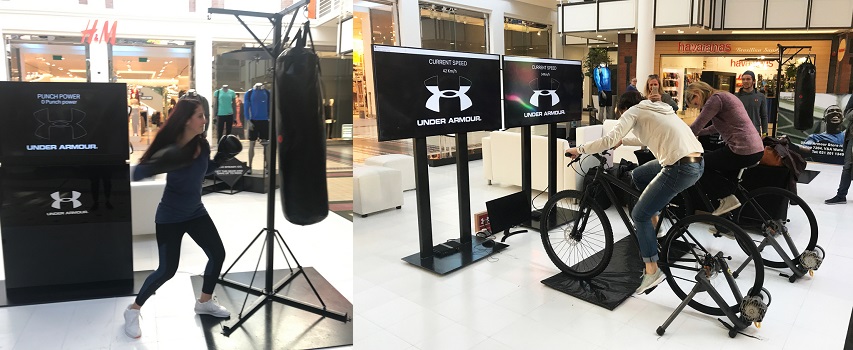
Under Armour, the American performance footwear, sports and casual apparel brand, recently teamed up with Moving Tactics for a fun, interactive, activation event to create awareness for the opening of its new store at the V&A Waterfront in Cape Town.

Moving Tactics activation for Under Armour South Africa in Cape Town Three technical elements worked together to drive interaction with shoppers, who registered to take part in the event via tablets. The first element involved a “bicycle dual” [sic], in which two participants would cycle against each other on stationary bicycles to achieve the best overall speed. Two large 55-inch screens displayed and recorded their times for them to monitor in real time while cycling. Secondly, the “punch power” element recorded how hard shoppers could hit a punching bag. Micro-sensors placed inside the bag recorded the power of the punch and relayed this data so that it could be displayed on a 42-inch touchscreen. Based on individual performances on these two activities, shoppers were rewarded with Under Armour discount vouchers.

According to Lorianne Cloete, marketing lead at Apollo Brands, “we had nothing but positive feedback on the activation, which ticked so many boxes — engagement, fun, hype, driving traffic to store etc. We had loads of really good sales generated from the 20% vouchers and a fantastic amount of traffic to the store. We also managed to create a database of over 1000 people which is incredible.”

Says Andy Higginbotham, creative director at Moving Tactics Digital Impact, “We also created a custom-designed touch table that provided shoppers with information regarding Under Armour’s product range and the various technologies and R&D innovations that differentiate their product offering.”

Under Armour will be running the same centre court activation in Sandton, Johannesburg, in this month.

movingtactics.co.zaFacebookTwitter
underarmour.comFacebookTwitter


Arctic Vodka

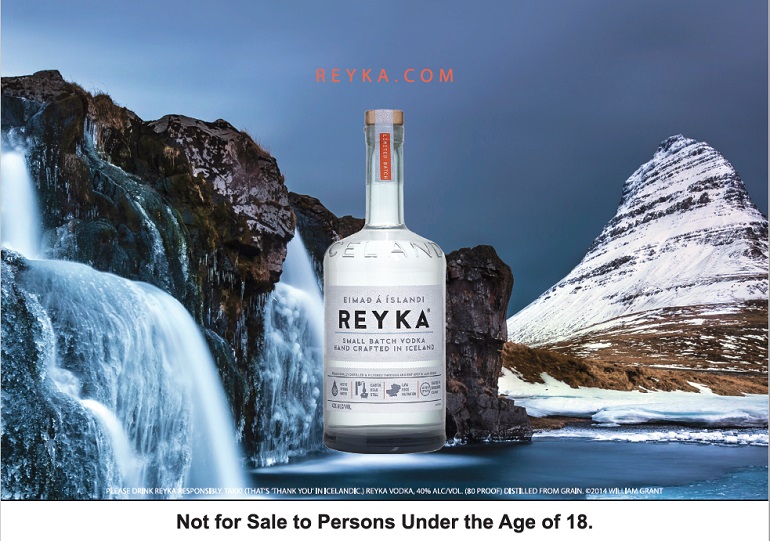
Iceland’s first vodka, Reyka, which debuted in 2005 and swiftly gained a global reputation as a clean, smooth vodka with a natural sweetness, is now available on local shelves.

Reyka Vodka in South Africa

A product of Borganes, a small village steeped in Viking history, Reyka Vodka is handcrafted in tiny batches in Iceland’s first vodka distillery.

Says Shaun Stemmett, brand manager for Reyka, “Fuelled by living on the edge of the Arctic Circle, Icelanders come from a tradition of self-sufficiency and making many things by hand, infusing nature and our own unique perspective in virtually everything we do. From the resourceful use of lava rock and glacier spring water, to being the only vodka in the world that uses a Carter-Head Still in distillation, Reyka Vodka is able to bring you the essence of Iceland by producing a smooth tasting vodka unlike any other.”

Winner of the Vodka Trophy at the International Wine and Spirit Competition (IWSC) and, in 2013, the Gold Medal in the San Francisco World Spirits Competition, Reyka Vodka is retailing at SA liquor stores for R299.95.

reyka.comFacebookTwitter


Cheryl HunterShelf Life is MarkLives.com’s weekly column covering all things new. Notify us of yours at shelflife at marklives dot com. Want to sponsor Shelf Life? Contact us here.

Cheryl Hunter (@cherylhunter) has written for the South African media, marketing and advertising industries for more than 15 years. A former editor of M&M in Independent Newspapers and contributor to Bizcommunity, AdFocus, AdReview and the Ad Annual, she has also produced for various television networks and currently consults on communication strategy and media liaison.

Sign up now for the MarkLives email newsletter every Monday and Thursday, now including headlines from the Ramify.biz company newsroom service!

Tanzanian agency Aggrey & Clifford gets East Africa

by Herman Manson (@marklives) “We live here. We get it” reads a quote mounted on the office walls of Aggrey & Clifford [view agency info via Ramify.biz]. The independent Tanzanian agency offers a range of communications and advertising solutions to clients, ranging from a roving sales force on motorcycles for a leading cigarette brand (with sales data and KPI being tracked by the client via an app) selling and delivering product to the Tanzianain equivalent of South Africa’s spaza shops to creative, activations, digital, media buying and PR.

Aggrey & Clifford logoFounded in 2009 by Rashid Tenga (CEO), a Tanzanian copywriter trained in the US and who has an entrepreneurial streak, the agency landed its first big break when it won Zantel (part of Etisalat) in 2010 and its second big break in February 2013 when it won the Vodacom creative account in Tanzania following a three-way pitch. It since lined up a client roster that includes SABMiller brands (acquired by Anheuser-Busch InBev in 2016) Kilimanjaro Lager, Safari Lager, Castle, Castle Light and Castle Milk Stout (media planning and buying), National Bank of Commerce (NBC), Coca Cola (PR), Nestle (BTL), Barclays Bank (Digital) and Unilever (BTL).

The agency also has an office in Uganda which employs 10 people and has an affiliate agreement in place in Rwanda with ION Advertising. Kenya is its most-recent entry, although still a one-person operation. The agency wants to establish itself as a leading micro-network on the East African market, says COO Cobus van Zyl. The Tanzanian office employs 60 people fulltime and 200 on contractual basis through its BTL and Distribution division.

Drumming up business

Van Zyl, a South African expat, has been involved in the Tanzanian ad industry for many years, first as a business unit director for FCB Tanzania and then as co-founder of Dar es Salaam-based Roots Marketing Communications. He joined Aggrey & Clifford in 2012, having worked with Tenga previously on the Vodacom business (in his FCB days). Today, Van Zyl spends a lot of time in South Africa drumming up business from SA clients active in the East African market.

For Van Zyl, Aggrey & Clifford — in a nutshell — is about creating great brands locally. It manages to mix the reality of a developing consumer market with the skill and standards brands expect in developed economies. The agency is proud to produce effective work developed by Tanzanians that is understood locally. Its culture, says Van Zyl, embraces a collective, inclusive way of doing business, and is founded on strong personal relationships, both between staff and with clients.

The Tanzanian advertising market is relatively young, the consumer economy having only emerged over the course of the last 20-odd years as the economy has been liberalised. It’s a strong WPP market, thanks to Scangroup, the leading East African agency network in which WPP acquired a majority stake in 2013. Scanad Tanzania, Ogilvy Africa Tanzania and J. Walter Thompson Tanzania are the three Scangroup agencies active in the country. Dentsu Aegis Network also has an office in the country. SmartCodes and AIM Group are the leading digital agencies. AIM group  recently expanded its offering to through-the-line.

Total agency market

There is also a number of smaller agency plays, says Van Zyl, who estimates the total Tanzanian agency market as valued at between US$17–22m (agency revenue, not total ad spend). Scangroup controls around US$6m and Aggrey & Clifford controls US$3.5m. Big client pitches (Coca-Cola or similar) come up two or three times a year.

Training and upskilling staff are the greatest challenges facing any Tanzanian agency, says Van Zyl, who in the past has invited South African ad school Vega to visit the agency and present courses. The agency has its own apprenticeship academy. Art directors are nearly impossible to find locally, he says. Even so, the agency generally isn’t keen to import expats from other markets, not even Kenya, given how local nuances get lost in translation.

According to Van Zyl, local brands are upping their game as new entrants enter the market. Thanks to the high uptake of 4G internet, consumers are well-informed, with access to information on similar services and products in other markets. Their expectations have adjusted accordingly. Still, the need for education remains considerable — a survey of 100 bar tenders for a new whiskey brand entering the market revealed that only half of them knew the difference between whiskey and brandy, making the agency question the value of pushing terms such as “triple distilled” in local advertising.

Aggrey & Clifford intends retaining its independence, says Van Zyl, and will continue to add new clients to its portfolio. More and more, clients view the agency as a total solution for setting up in Tanzania. He’s even had requests for help in setting up warehousing. The agency intends to continue pushing regional work by and for East Africans, says Van Zyl, and become involved in new and interesting links in the value chain as brands try to set up shop in this key East African market.

Case studies

Supplied by Aggrey & Clifford

Mpawa

Objective

Aggrey & Clifford managed the 360-degree launch of Mpawa to the Tanzanian market. A real innovation from Vodacom in mobile money space, it is essentially a savings and loans product to complement the already successful M-Pesa.

The objectives of the campaign were twofold. First, we had to create mass awareness that you can now save, earn interest, and apply for a loan through Vodacom. Secondly, Tanzanians don’t have a culture of saving, so we had to design a campaign that changes behavior and encourages saving.

Solution

The agency came up with the name Mpawa, which is Swahili slang for “power”. It also plays on the English “empower”, which is what the product will do for so many local Tanzanians. The name (which can also mean “gifts” in Swahili) also worked well with the launch campaign message of “Fikia Malengo” or “See your plan through.” The campaign focused on sketching, literally with white chalk, what could happen if you saved, or got a loan from Vodacom.

Results

In the first two weeks after the launch, 223 000 accounts were opened and ±TSH 1 600 000 000 (US$1 000 000) was deposited. Through ongoing campaigns, this product has really grown and, three years later, there are 6.3m registered users.


TCC MSM

Objective

To take an existing route-to-market model and expand on it to achieve incremental growth in volumes through deepened market penetration and improved service delivery.

Solution

A KPI-driven last-mile delivery model was set up by deploying 100 motorcycle-salesman nationwide and pairing them with an in-house built application. This tracks every outlet visited and transaction completed in real-time and relays this information to a web-based dashboard for instant review and extraction for reporting.

Results

Within three months, we have seen consistent information coming in to support growth in market penetration (+15 000 outlet increment), daily strike-rate grow from 50% to 85% and call completion rise from 50% to 90%.


Valeur

Valeur Brandy from Aggrey & CliffordObjective

Valeur brandy is the second-biggest seller in the TDL (Tanzania Distilleries Limited) portfolio. Despite this position, it has always been considered the little sister of Konyagi, the biggest-selling spirit in the market. Although Valeur has high top-of-mind awareness, it failed to translate to sales. Several campaigns, over the years, did little to improve the sales figures and, due to multiple messages, created a confused brand positioning.

Solution

In 2015 Aggrey & Clifford was briefed to rethink the brand and so started a strategic process, in collaboration with the client, that would last six months. It included a full brand audit, consumer focus groups and concept testing. All the groundwork finally led to the launch of a campaign entitled “Cheers to good stories”. Considering the social nature of Tanzanians, it was a natural fit as the sharing of stories is common practice. Storytelling also fits into most occasions and transcends barriers in terms of class, religion etc. In short, everyone tells stories, everywhere, all the time!

To create mass awareness, billboards were used across the country, depicting the natural ways people chat over a drink. Radio ads were a variety of stories told in a social environment, some with humour, others with suspense, but they all had positive endings. The strategy was translated to an activations concept called Comedy Nights, where people could take the open microphone and tell their stories to win product, prizes etc.

Results

The activation campaign was so popular that it was evolved the next year to include a Comedy Talent Search, where the winner of the best storytelling, across the country, won a big cash prize. This campaign extension made use of the most popular Tanzanian comedian, Evans Bukuku, as the chief judge and mentor.

The simple and effective campaign contributed to the brand growing sales month-on-month, allowing Valeur to even steal some share of the market from Konyagi. During a time where the entire spirits category had been in decline, Valeur managed to grow by over 55% in volume year on year.


Herman Manson 2017Herman Manson (@marklives) is the founder and editor of MarkLives.com.

Sign up now for the MarkLives email newsletter every Monday and Thursday, now including headlines from the Ramify.biz company newsroom service!

Online CPD Courses Psychology Online CPD Courses Marketing analytics software Marketing analytics software for small business Business management software Business accounting software Gearbox repair company Makeup artist