
Louise Marsland (@Louise_Marsland)’s pick of new product, packaging and design launches this week: Johnnie Walker Red bottle undergoes its first redesign in over a decade; DHL speeds into Africa; and Fashion Media helps Edgars talk to consumers in store.
Category archives: Marketing
Africa Style: To put out to pitch, or not?

by Masingita Mazibuko. Six months ago, when I told a colleague-cum-BTL-agency-owner about my move from an agency to a client organisation, the conversation naturally evolved into a debate concerning how to tackle any new work that needed to be done; that is, to put it out to pitch, or not.
Shelf Life: Window shopping by touch
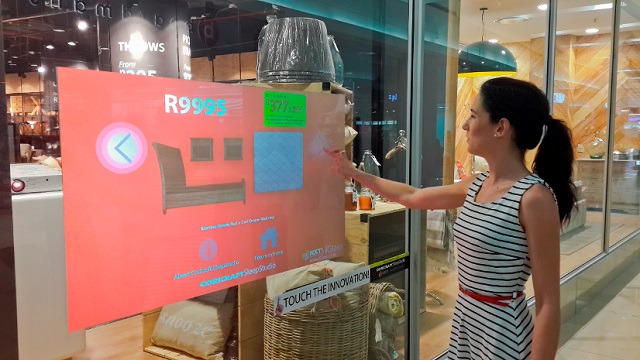
Louise Marsland (@Louise_Marsland)’s pick of new product, packaging and design launches this week: iGlass is a new product that turns shop windows into touchscreens; more luxury festive season gifts for your favourite clients (and media); sweet window branding for Marc Jacobs’ new launch; and a report back on KFC’s Hope campaign.
Green Sky Thinking: What brands can learn from street art

by Colwyn Elder (@colwynelder) In street art, the blurring of context and content, media and message, makes for an exciting and constantly evolving media landscape, with numerous opportunities for sustainability-oriented messaging.
The Sell: How a cupcake can change your shopping habits

by Mimi Nicklin (@MimiNicklin) Every three months or so, I use this column as a review of existing shopper work ‘on the ground’to summarise the current state of the nation. This time, I was reminded how much I love doing this by something as simple as a cupcake painted in blue and white…
It was game day, the Currie Cup final, and the Cape was proud, excited and nervous all mixed into one. From as early as 8am, the men were dressed in Western Province shirts and the traffic lights were alive with hawkers selling, well, anything that allowed for a stripe. I, being the non-rugby-fan shopping addict that I am, chose thatmorning to grocery shop.
It is estimated that, at any one time, there are 600+ live activations (promotions, sampling, activations, offers) in most large grocery stores in South Africa and,that Saturday, Checkers Hyper was buzzing. I could barely walk for a sample, prize or tasting heading my way.
NSA spying could see tech companies could go ‘dark’ to regain trust

by David Glance. There is definitely a motivation for major technology companies to provide a verifiably secure means of allowing users to communicate securely without an ability for them to provide access to security agencies, even if requested to. Two companies, Silent Circle and Lavabit, have come together to form the Dark Mail alliance in an attempt to do exactly this.
Shelf Life: A Toy for Toy Christmas retail story #ExtraSpecial

Louise Marsland (@Louise_Marsland)’s pick of new product, packaging and design launches this week: Royal Dansk butter cookies launch in SA; DStv takes to the malls to demo Explora; Perdeberg Winery launches its wines in a new collection; and here’s how you can contribute to Checkers and Shoprite’s Toy for Toy campaign to provide festive cheer to needy kids.
Fair Exchange: Unilever, P&G and the rise of the corporate brand

by Erna George. Over the past few months, I have noticed that corporate brands are increasingly being featured in campaigns marketing the product or ‘consumed’ brand. Whether a surreptitious inclusion or blaring endorsement, this phenomenon is an interesting addition to the branding landscape.
The Dissident Spin Doctor: Four steps to avoiding a reputational s**tstorm
by Emma King (@EmmainSA) There are some simple things that should be done which have proved, time and time again, to be more effective ways of dealing with a reputational storm.
The big surf brand wipeout

By Andrew Warren. The “big three” Australian surf brands have found themselves in choppy financial waters.
Billabong, one of Australia’s most iconic surf brands confirmed a $386 million refinancing agreement with US consortium Centerbridge-Oaktree Capital Management acquiring a 40% share, guaranteeing the struggling brand’s short-term future after it posted an $859 million loss last financial year.
Like Billabong, public surf company Quiksilver has reported declining revenues, asset write-downs and growing losses, recently announcing third-quarterly earnings had declined 84%. Privately-owned Rip Curl has also been in profit free-fall. In mid-2012 Rip Curl founders Brian Singer and Doug Warbrick engaged Bank of America Merrill Lynch to help source a prospective buyer for the brand. The planned sale was abandoned in March with a lack of interest at the asking price of $400 million.
The current woes are a long way from the heady days of the 1990s and 2000s, which saw each of the big three surf brands aggressively pursue international expansion and high-profile sports sponsorship deals.
So, why have the Big Three surf brands found themselves struggling? And what is the way to calmer waters?